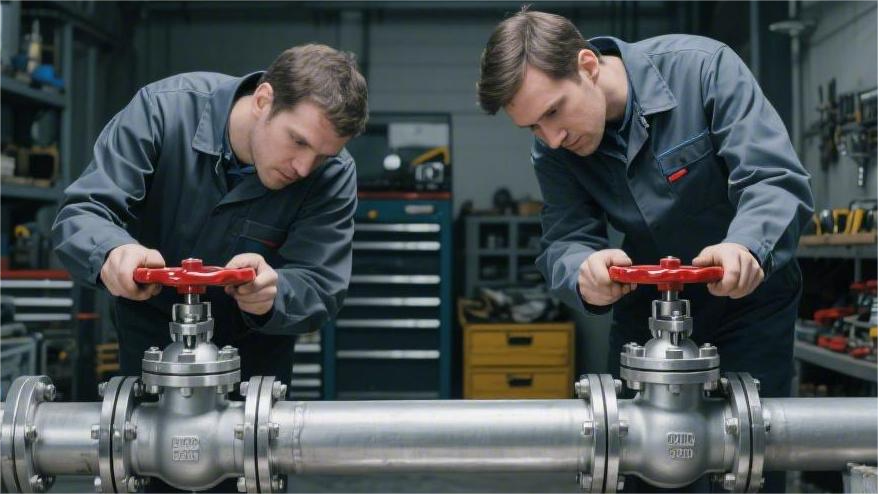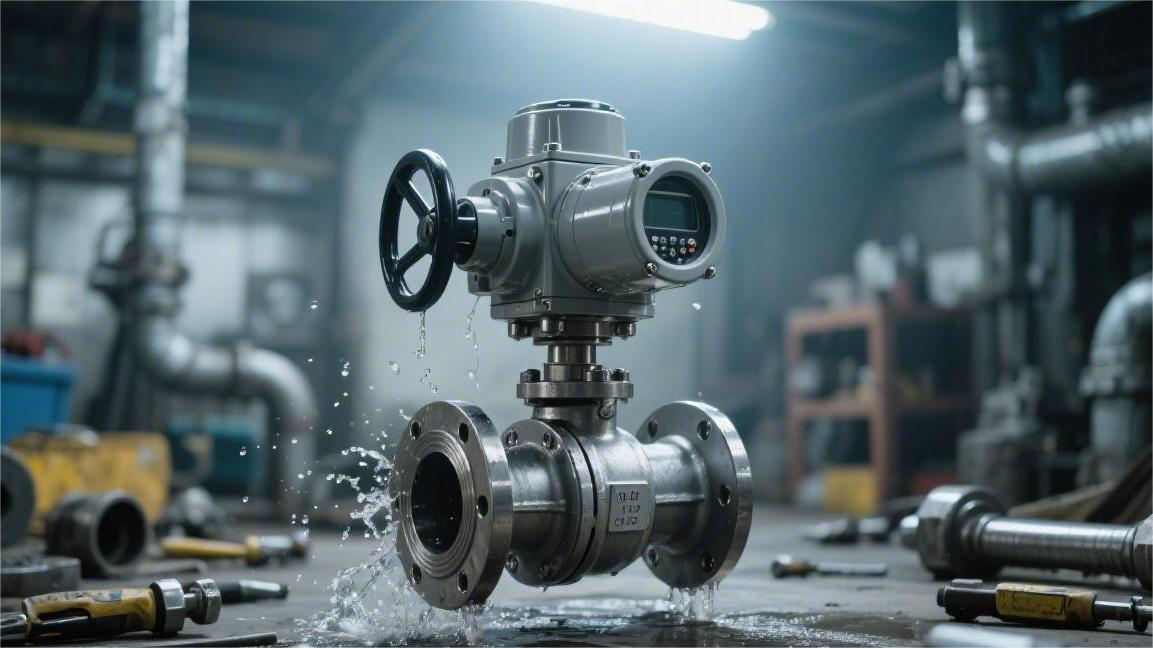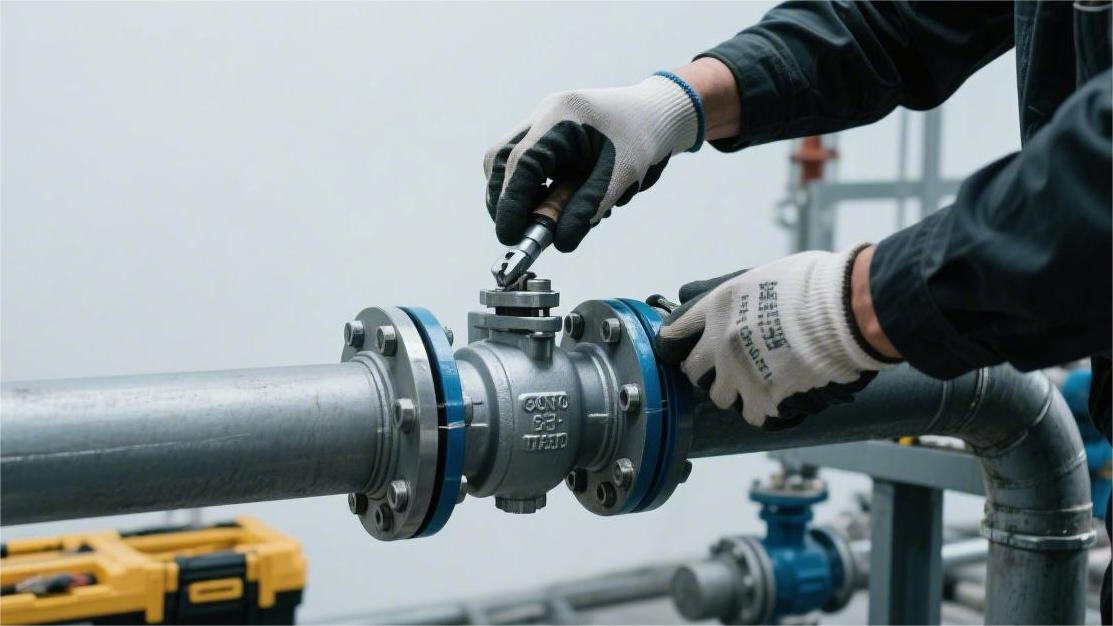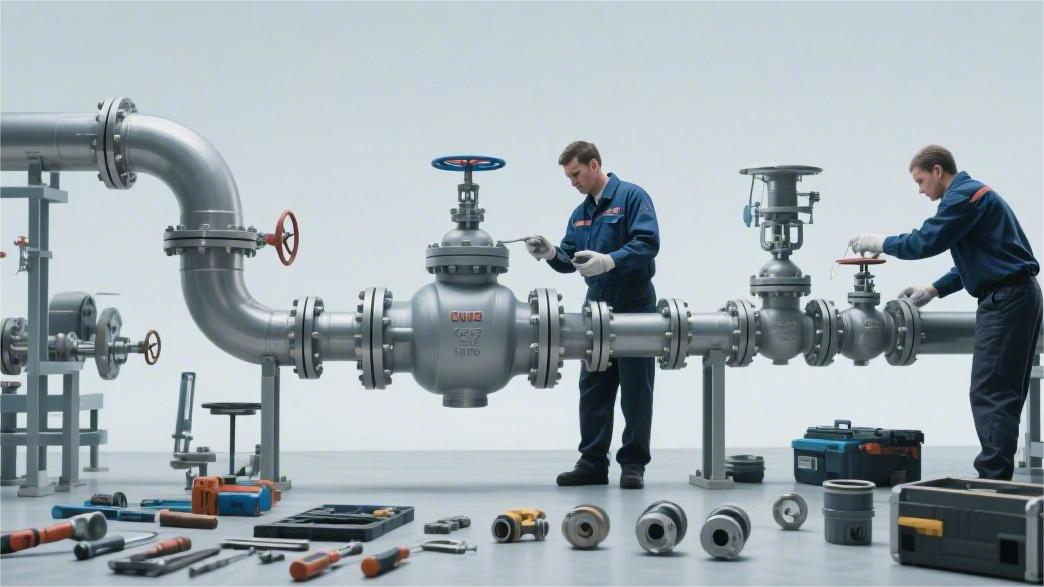
During the API 6D ball valve testing, the shell hydrostatic test requires pressurization to 1.5 times the design pressure, holding the pressure for at least 3 minutes with zero leakage;
The seat test uses 1.1 times the water pressure or 0.6 MPa air pressure to detect internal leakage;
The functional test requires 3 consecutive full open and close operations at the maximum differential pressure to verify that the torque is smooth and free of jamming.
Shell Test
The test requires the ball valve to be placed in a half-open position and injected with clean water containing a corrosion inhibitor (water temperature 5°C-50°C; the chloride ion content of the test fluid for austenitic and duplex stainless steel components must be below 50 ppm).
The applied pressure must reach 1.5 times the Cold Working Pressure (CWP) rating at 38°C (100°F).
The pressure holding time increases according to the Nominal Pipe Size (NPS): 2 minutes for NPS 4 and below, 5 minutes for NPS 6-10, and 30 minutes for NPS 20 and above.
Pressure
The physical dimensions and load-bearing capacity of API 6D ball valves are governed by the ASME B16.34 specification, covering seven classes: Class 150, 300, 400, 600, 900, 1500, and 2500. This numerical system is a dimensionless code reflecting the pressure-resistant capacity of the piping system.
Within the normal temperature range of -29°C to 38°C (-20°F to 100°F), the specification assigns a clear Cold Working Pressure (CWP). The baseline water pressure set by the test equipment is entirely extracted from the CWP data tables of different material groups.
ASTM A105 forgings and ASTM A216 WCB castings belong to ASME B16.34 Material Group 1.1, and the specific CWP parameters of different classes have a fixed correspondence:
| ASME Pressure Class | Material Group 1.1 CWP (psig) | Material Group 1.1 CWP (bar) |
|---|---|---|
| Class 150 | 285 | 19.6 |
| Class 300 | 740 | 51.0 |
| Class 600 | 1480 | 102.1 |
| Class 900 | 2220 | 153.1 |
| Class 1500 | 3705 | 255.5 |
| Class 2500 | 6170 | 425.4 |
The pressure boundary of metallic materials is negatively correlated with the ambient temperature; rising temperatures cause a physical degradation in the material’s yield strength. Taking a Class 600 carbon steel ball valve as an example, when the pipeline operating temperature climbs from 38°C to 200°C (392°F), the maximum allowable working pressure drops from 1480 psig to 1385 psig.
The pressure drop curve of austenitic stainless steel at high temperatures is significantly different from that of carbon steel. The CWP of F316L at 38°C is 1200 psig, and it drops sharply to 860 psig at 200°C.
The geometric dimensions of flanges are constrained by the pressure class assignment; flanges from NPS 1/2 to NPS 24 follow the ASME B16.5 physical dimension specification. As the class increases, the flange outer diameter, thickness, and the bolt circle diameter exhibit stepped growth.
Taking a ball valve with a nominal pipe size of NPS 10 (outer diameter 273mm) as an example, the physical parameter data comparison of different classes of flanges is as follows:
| Pressure Class | Flange Outer Diameter (mm) | Minimum Flange Thickness (mm) | Bolt Quantity & Size |
|---|---|---|---|
| Class 150 | 406.4 | 30.2 | 12 x 7/8 inch |
| Class 300 | 444.5 | 47.6 | 16 x 1 inch |
| Class 600 | 508.0 | 63.5 | 16 x 1-1/4 inch |
| Class 1500 | 584.2 | 108.0 | 12 x 1-7/8 inch |
Even if the steel valve body can withstand the pressure of Class 900 (2220 psig), the physical and chemical limits of the internal soft seals will force a downgrade of the rated value.
The matching relationship between the maximum continuous working temperature of common high-polymer sealing materials and their applicable classes:
- Pure PTFE: Applicable upper limit 120°C (248°F), limited by the material’s resistance to deformation, typically restricted to Class 150 and Class 300 ranges.
- RPTFE (15% Glass Fiber Reinforced): Applicable upper limit 200°C (392°F), the additive improves hardness, compatible up to Class 600.
- NYLON: Applicable upper limit 120°C (248°F), its high-hardness property allows it to withstand the physical extrusion of Class 900 and Class 1500.
- PEEK (Polyetheretherketone): Applicable upper limit 260°C (500°F), possessing a tensile strength of 100 MPa, extensively covering Class 1500 to Class 2500.
Fasteners bearing high pressure must meet the requirements of ASTM A193/A194 specifications. Connections for Class 600 and above specify the use of Grade B7 alloy steel bolts combined with Grade 2H nuts. When the diameter of B7 bolts is less than 2.5 inches, the tensile strength is required to reach 125,000 psi, and the minimum yield strength is 105,000 psi.
The connection parameters for large-diameter pipelines (NPS 26 to NPS 60) must be executed separately according to the ASME B16.47 specification. This specification is divided into two systems: Series A and Series B. Series A flanges have a larger outer diameter and thickness, and the number and diameter of equipped bolts are higher than those of Series B.
Taking an NPS 36 Class 300 ball valve as an example, if a Series A flange is used, the thickness is 104.8 mm, requiring 32 bolts with a diameter of 1-5/8 inches. If a Series B flange is selected, the thickness drops to 85.8 mm, and the bolts are adjusted to 44 pieces with a diameter of 1-1/4 inches.
The calculation of the minimum metal wall thickness of the valve shell incorporates the inner diameter dimension and the stress coefficient corresponding to the class. Table 3 of ASME B16.34 details the specific inner diameter multipliers.
Taking the flow path inner diameter of NPS 8 (about 203 mm) as an example, the standard specifies the absolute minimum thickness parameters for each class:
- Class 150: Minimum wall thickness 9.4 mm
- Class 300: Minimum wall thickness 11.2 mm
- Class 600: Minimum wall thickness 18.0 mm
- Class 1500: Minimum wall thickness 41.1 mm
- Class 2500: Minimum wall thickness 66.5 mm
For products exceeding the scope of the basic ASME B16.34 charts (e.g., exceeding NPS 24 and Class 900), manufacturers independently perform wall thickness calculations based on the material strength data in ASME BPVC Section VIII, Division 1, combined with a safety factor of 1.5.
The physical impact of low-temperature environments on material impact toughness also constrains pressure-bearing performance. ASTM A350 LF2 forged carbon steel material must pass a 20-Joule Charpy V-notch impact test at -46°C (-50°F). If the temperature falls below the set point, it must be replaced with ASTM A350 LF3 or F316 materials.
For buried pipeline ball valves with a Fully Welded Body structure, the tensile strength of the splicing welds in each section of the shell is equivalent to the yield requirements of the base material at that class. All pressure-bearing welds are mandatorily subjected to 100% Radiographic Testing (RT) or Ultrasonic Testing (UT).
When the pressure class is raised to Class 1500 and above, flat gaskets or spiral wound gaskets will be replaced. Ring Type Joint (RTJ) flanges are used for the physical sealing of high-pressure flange ends.
The surface of a Class 1500 RTJ flange is machined with a trapezoidal groove of a specific angle. Paired with an octagonal or oval metal ring gasket whose hardness is 30 to 40 HB lower than the flange base material, plastic deformation occurs under a bolt preload of the 120,000 psi level to achieve fluid isolation.
Media
The specific gravity range of fluids spans widely; light condensate oil has a specific gravity of about 0.4, while heavy crude oil can reach 1.2.
The specific gravity of sour natural gas typically fluctuates around 0.6. The molecular composition and physical state of the fluid inside the pipeline fundamentally determine the material selection direction for all wetted parts inside the valve.
The presence of hydrogen sulfide (H2S) gas alters the chemical corrosion environment of the fluid. According to the NACE MR0175 / ISO 15156 international material standard, the corrosion level of the fluid environment is defined by the partial pressure of the gas.
In aqueous gas-phase systems, when the H2S partial pressure exceeds 0.05 psia (0.3 kPa), the fluid is classified as Sour Service. Internal pressure-bearing metal components must comply with strict metallurgical parameter constraints:
- Carbon Steel: Surface and core hardness upper limits are strictly restricted to 22 HRC (237 HBW).
- Austenitic Stainless Steel: The maximum allowable yield hardness for 316/316L is also 22 HRC.
- Duplex Stainless Steel: The ex-factory hardness test report for UNS S31803 must not exceed 28 HRC.
- Nickel Alloy: The hardness of the Inconel 625 surface anti-corrosion weld overlay is limited to within 35 HRC.
Carbon dioxide (CO2) accompanied by free water generates highly corrosive carbonic acid. When the CO2 partial pressure in the fluid crosses the threshold of 30 psia (207 kPa), rapid pitting occurs on the surface of standard carbon steel.
The annual corrosion rate of conventional ASTM A105 forged carbon steel under these conditions will exceed 0.1 mm. Aside from chemical dissolution, the physical impurities entrained by the fluid destroy the valve’s internal structure even more rapidly.
Solid quartz sand particles mixed in the formation fluid cause severe mechanical erosion and wear. A fluid reaching a velocity of 15 m/s (49 ft/s) and entraining 50-micron silica sand can destroy a standard 316 stainless steel seat within months.
To cope with erosive fluids of high velocity and high particle density, the surfaces of the ball and seat require special hardening treatment processes:
- ENP (Electroless Nickel Plating): Single-side coating thickness 75 microns, surface hardness maintained at 500-800 HV.
- Tungsten Carbide Coating: HVOF supersonic spraying thickness 0.15-0.25 mm, hardness exceeds 1000 HV.
- Chromium-based Tungsten Carbide: Maximum allowable environmental temperature 800°C, coating physical thickness standard is 0.2 mm.
- Stellite 6 Alloy: PTA plasma welding thickness 1.6 mm, Rockwell hardness 38-45 HRC.
Methane or supercritical CO2 reaching a pressure of 1000 psi (68 bar) will continuously permeate into the polymer matrix of non-metallic sealing rings.
During an emergency pipeline depressurization, the expanding gas becomes trapped within the rubber polymer chains. The NORSOK M-710 standard outlines physical testing procedures for Rapid Gas Decompression (RGD) in non-metallic components.
The test requires the O-ring to withstand the impact of dropping from 150 bar (2175 psi) to atmospheric pressure at a depressurization rate of 20 bar/minute. Only elastomers that pass the Anti-Explosive Decompression (AED) certification can resist physical tearing:
- Nitrile Rubber (NBR): Suitable for conventional liquid crude oil, continuous working temperature upper limit is 100°C.
- Hydrogenated Nitrile Butadiene Rubber (HNBR): Withstands 10% H2S concentration gas, physical applicable upper limit increased to 150°C.
- Fluoroelastomer (FKM): Resistant to aromatic hydrocarbon chemical solvents, AED-grade compound materials have a working limit of 200°C.
- Perfluoroelastomer (FFKM): Withstands high concentrations of strong acids and alkalis, continuous working limit temperature reaches 260°C.
Methane transforms from a gaseous to a liquid state at -162°C (-260°F), shrinking to 1/600 of its original volume.
Pure PTFE (Polytetrafluoroethylene) completely loses its elasticity and becomes brittle in environments below -50°C. Valve seats for ultra-low temperature fluids must be replaced with PCTFE (Kel-F) material, which maintains a compressive strength of 32 MPa even at extreme temperatures of -196°C (-320°F).
The kinematic viscosity of the fluid directly alters the mechanical friction torque when the ball rotates. Heavy crude oil reaching a viscosity of 1000 cSt at 15°C will significantly increase the shear resistance between the ball surface and the seat mating surface.
When dealing with high-viscosity fluids, the output torque calculation of the actuator must be multiplied by a safety factor of 1.25 to 1.5 based on the clean water test baseline. Wellhead multiphase fluids usually contain varying proportions of formation water.
Emulsified fluids with a Water Cut fluctuating between 1% and 90% require an anti-corrosion coating on the inner wall of the carbon steel shell. Spraying epoxy phenolic resin with a dry film thickness of 100 to 200 microns can block chloride ion penetration.
The calculation of the volumetric flow rate of a fluid through a valve relies on the flow coefficient (Cv). A full-bore NPS 12 Class 600 ball valve flowing 15°C (60°F) clean water has a rated Cv value of approximately 12,500.
Cavitation phenomena frequently occur at the instant the liquid fluid pressure drops below its physical saturated vapor pressure. The vapor pressure of pure water at 20°C is fixed at 0.34 psia.
Mechanical Operation
The driving device or manual worm gear box needs to rotate the ball to a half-open position of 45 degrees (±5 degrees), allowing the flow passages at both ends to fully connect with the central valve cavity. A fixed ball valve of NPS 12 rotating to this geometric angle typically needs to overcome a static friction torque of 1500 Nm.
Under the mechanical dead zones of fully open or fully closed, the ball and the Polytetrafluoroethylene (PTFE) seat will form a dual-sided physical isolation barrier. The blocked dead zone volume can reach 180 liters in large-diameter products of NPS 24. The half-open state forces the subsequently pressurized water flow to break through the seat lip and directly enter the bottom of the stem stuffing box and the lower support bearing area.
The hydraulic tensioning blind flange of the test bench must apply an axial mechanical clamping force to the flange faces at both ends of the valve. Under a test water pressure of 2225 psig, a single-sided end face of an NPS 16 Class 600 flange bears an outward fluid thrust exceeding 280,000 pounds. The hydraulic station output pressure of the clamping equipment must be preset between 2500 psi and 3000 psi to counteract this thrust.
The clamping thrust of the test carbon steel blind flange (such as SA-516 Gr 70 material) is strictly prohibited from exceeding 1.5 times the yield strength of the valve body material. Excessive axial load application will cause the ASTM A105 forged valve body to undergo a 0.1 mm level of elastic deformation.
A pneumatic diaphragm pump injects clean water containing 30 ppm corrosion inhibitor from the bottom test flange at a constant volumetric flow rate of 50 gallons per minute (GPM). The vent plug at the highest point of the valve body (usually the top of the bonnet) must be maintained in a 100% physically fully open state.
The compressibility factor of gas is much higher than that of liquid. Retained air will be forcibly compressed to 1/68 of its volume at atmospheric pressure when the water pressure climbs to 1000 psi. During the pressurized dissolution phase, residual bubbles will cause the mechanical pointer of the instrument to experience severe mechanical jumping of more than 50 psi. The vent hole must continuously overflow an unbroken, bubble-free water column for up to 30 seconds before applying a 60 ft-lbs torque to close the plug.
Pipeline pressure monitoring highly relies on mechanical analog Bourdon tube gauges or digital transmitters installed at the physical highest point of the system. The ASME B40.100 specification mandates that the diameter of the mechanical dial must not be less than 100 millimeters (4 inches). The calibrated range of the test instrument must be strictly locked within the range of 1.5 to 4 times the target test pressure.
- For a 2225 psig Class 600 shell test target, the lower limit of the selected pressure gauge range is 3337 psig.
- The allowable upper limit of the selected instrument range is physically restricted to the 8900 psig scale.
- The mechanical measurement accuracy class of the pressure gauge must reach or exceed ±0.5% of the full scale.
- The validity period of the third-party ISO 17025 laboratory calibration certificates for all instruments must not exceed 6 months.
During the initial injection phase, the system water pressure is allowed to be rapidly raised to 50% of the target calibration value at a rate of 500 psi/minute. After crossing the halfway node, the reciprocating frequency of the piston must be lowered, and the pressurization rate is forcibly reduced to below 100 psi/minute.
Slow and uniform fluid injection prevents high-pressure water hammer shock waves from causing mechanical cutting damage to the fluoroelastomer (FKM) O-rings. Once the water pressure touches the set threshold, the system piping must cut off the power source and perform static pressure holding for at least 2 minutes. This pausing phase provides a time window for uniform stress distribution in the metal pressure-bearing wall that reaches 60 millimeters in thickness.
During the pressure stabilization period, a water temperature drop of 1°C caused by ambient heat dissipation will genuinely reflect as a physical pressure decay of about 45 psi due to its volumetric cold contraction effect within the enclosed valve cavity volume.
Thermodynamic compensation data is collected in real-time as electrical signals by K-type thermocouples attached to the outer wall of the valve body casting. The scanning sampling frequency of the temperature data logger is set to 1 Hz. When shop temperature fluctuations cause the 38°C test water body to rapidly lose heat, a micro-flow manual pump must physically inject liquid at a displacement of 5 cc/stroke to compensate for the pressure drop.
During the shell pressure test, it is strictly forbidden to apply any mechanical torque loading to any pressurized fastener. If a visible liquid leak of 1 drop/minute appears at the middle flange joint of an NPS 10 valve, the operator must completely reduce the system water pressure to 0 psig via the bleed valve. Forcibly applying wrench torque to tighten a 1-1/8 inch Grade B7 alloy bolt under a 1000 psi pressurized state will instantly trigger shear tearing of the threads.
In the physical inspection phase, quality inspectors perform a 360-degree wrap-around close visual inspection under 1.5 times the rated pressure. Operational specifications require being equipped with an explosion-proof flashlight with an illumination of over 1000 lumens, used to illuminate the 2-millimeter narrow gap at the bottom of the stem stuffing box. The outer edge of the flange sealing gasket, with a surface finish roughness between 125 and 250 Ra, is a high-frequency occurrence area for metallic microporous capillary leaks.
After the acceptance pressure-holding cycle is met, the mechanical opening stroke and bleed speed of the depressurization valve are strictly constrained. The fluid discharge orifice is usually throttled and restricted to within 1/2 inch (12.7 mm). The physical depressurization time from 3350 psig down to atmospheric pressure is forcibly extended to more than 1 minute to prevent instantaneous pressure loss from causing a 0.2 mm physical displacement of the internal PEEK support ring.
Emptying operations require manipulating the handle to mechanically cycle the ball valve back and forth between the fully open and fully closed positions twice. Industrial compressed air is connected to the bottom drain hole to purge the internal dead zones of the valve cavity with a constant back pressure of 80 psi for up to 5 minutes. Residual free water molecules will cause the exposed inner wall of ASTM A216 WCB carbon steel to multiply iron oxide rust spots up to 15 microns thick within 24 hours.
Seat Test
Hydrostatic testing uses clean water containing a rust inhibitor, with the pressure set to 1.1 times the maximum rated working pressure at 38°C (100°F); the low-pressure pneumatic test is filled with 5.5 bar (80 psi) of pure nitrogen or compressed air.
Soft-seated valves mandatorily execute the ISO 5208 Rate A level (0 drops/minute, zero leakage); metal-seated valves typically execute the trace standards of Rate C or Rate D.
The test pressure-holding time is divided according to the nominal pipe size (NPS), starting at a minimum of 2 minutes, and reaching over 10 minutes for large valves, mainly to verify the isolation effectiveness of DBB/DIB structures.
Pressure & Media
The API 6D specification stipulates that the preferred test medium is liquid water, and the temperature must be strictly controlled between 5°C and 50°C. Water, as an incompressible fluid, will not generate a gas-like explosive expansion energy release when a pipe wall rupture occurs.
When testing austenitic stainless steel or duplex stainless steel ball valves, the upper limit of chloride ion content in the water is strictly controlled to within 30 ppm. Testing water for carbon steel valves must be mixed with commercially available rust inhibitors at a ratio of 1:50 to prevent flash rust oxidation on internal machined surfaces after pressure holding and dehydration.
The baseline for the test pressure is anchored to the maximum rated cold working pressure at 38°C (100°F) defined by the ASME B16.34 standard. The multiplication factor for shell pressurization is fixed at 1.5 times. The pressurization process cannot be instantly maxed out; system pressure increases in steps and pauses for 30 seconds when reaching 50% of the target value for a preliminary inspection to prevent high-pressure shocks from damaging the sealing surfaces.
According to the ASME pressure class, the starting water pressure test data for each class are as follows:
- Class 150 valve rated at 285 psi, required to pressurize to 450 psi.
- Class 300 valve rated at 740 psi, required to pressurize to 1125 psi.
- Class 600 valve rated at 1480 psi, required to pressurize to 2250 psi.
- Class 900 valve rated at 2220 psi, required to pressurize to 3350 psi.
- Class 1500 valve rated at 3705 psi, required to pressurize to 5575 psi.
At this point, the pressurization pump source is cut off, and the two analog pressure gauges or high-frequency digital pressure transmitters connected to the blind flanges are observed. The specification requires that the range of the pressure gauges must be set between 1.5 and 4 times the test pressure, and the calibration accuracy error of the equipment must not exceed ±5% of the full scale.
The ball valve is in a half-open state (typically opened at a 45-degree angle), allowing the test medium to completely fill the upstream and downstream passages as well as the middle cavity of the valve. Trapped bubbles create an uncontrollable compression ratio, causing the pressure holding curve to exhibit a false pressure drop fluctuation of more than 5%, interfering with the final reading judgment.
The time baseline for maintaining pressure is deeply tied to the valve’s nominal size (NPS). The shortest pressure-holding time for NPS 4 and below is 2 minutes, 5 minutes for NPS 6 to 10, 15 minutes for NPS 12 to 18, and a mandatory pressure hold of at least 30 minutes for large-diameter pipeline ball valves of NPS 20 and above.
Shell test medium and operational adjustment schemes for specific environments or special working conditions include:
- When the ambient temperature is below 5°C, industrial ethylene glycol antifreeze is proportionally mixed into the water body.
- Special orders allow the use of aviation kerosene, which has a kinematic viscosity similar to water, as the test fluid.
- The use of unfiltered raw water containing abrasive particles or silt is absolutely prohibited.
- After testing austenitic materials, purging with 99% pure dry nitrogen is required.
The inspector performs a 360-degree visual inspection around the valve body during the specified reading time. The pressure-bearing boundary of the shell includes the main cast or forged body, bonnet connection flanges, and all mating surfaces bearing high-strength bolts. The acceptance criterion is an absolute 0 drops/minute, and no wet traces or permanent structural deformations are allowed on external surfaces.
The 1.5 times high-pressure test approaches the yield limit of most carbon steel materials. When designing the wall thickness of pipeline valves, the upper limit of the pipe wall membrane stress at the maximum test pressure is locked at 90% of the material’s Specified Minimum Yield Strength (SMYS). If the pressure gauge pointer shows a sustained drop of more than 2% not caused by a micro-leak, it indicates that the valve body metal has undergone microscopic plastic expansion.
During the shell’s high-pressure holding process, any repair operations attempting to use a torque wrench to tighten pressurized flange bolts are explicitly prohibited in the API specification. The bleed rate during the depressurization phase is controlled to within 300 psi per second to prevent explosive decompression tearing of the O-rings or graphite fire-safe gaskets inside the valve body caused by transient pressure drops.
Dimensions & Pressure Holding Time
For small-diameter pipeline ball valves with nominal sizes of NPS 2, NPS 3, and NPS 4, the specification requires a minimum seat test pressure-holding time of 2 minutes. This 120-second countdown must only begin after the internal fluid pressure has fully risen to 1.1 times the maximum rated cold working pressure and the pressure gauge pointer has stopped mechanically jittering.
When the test subjects expand to medium diameters, covering NPS 6, NPS 8, and NPS 10 ball valves, the specified pressure-holding countdown increases to 5 minutes. The middle cavity of an NPS 8 Class 600 ball valve can hold about 15 gallons of test water; a 300-second observation period provides ample time for the water flow to permeate the 0.05-millimeter microscopic assembly gap on the PTFE soft-seated ring.
Reaching the large size range of NPS 12 to NPS 18, the test also implements a 5-minute observation countdown. The internal volume of an NPS 16 pipeline valve often exceeds 60 gallons; the inspector will actively wait 60 seconds after the high-pressure water pump shuts down to release the 0.5% volumetric expansion of the carbon steel valve body before starting the official 5-minute timer.
The test duration is affected by a weave of various physical data, and specific operations refer to the following parameter details:
- At 38°C, the volumetric compressibility of pure water is about 4.6×10^-5 per bar.
- 10 cubic centimeters of air remaining in the valve cavity will cause a false pressure drop of 2 psi within 3 minutes.
- A mechanical pointer pressure gauge with a range of 10,000 psi requires 30 seconds for the Bourdon tube to fully mechanically reset.
- The 4-20 mA signal transmission of a high-precision digital transmitter has a 0.5-second sampling delay.
For extra-large diameter valves reaching or exceeding a nominal size of NPS 20, API 6D mandates that the seat pressure-holding time shall not be less than 10 minutes. An NPS 36 mainline block valve is typically filled with over 400 gallons of rust-inhibited water; a 600-second monitoring cycle can accurately capture a minute flow rate of 0.1 mm³/sec across a sealing face with a linear perimeter of 2800 millimeters.
Regarding the matching relationship between dimensions and time, the data baselines of various specifications are shown in the table below:
| Nominal Valve Size (NPS) | Hydrostatic Seat Test Time | Pneumatic Seat Test Time | Recommended Stabilization Buffer Time |
|---|---|---|---|
| ≤ 4 | 2 Minutes | 2 Minutes | 15 Seconds |
| 6 to 10 | 5 Minutes | 5 Minutes | 30 Seconds |
| 12 to 18 | 5 Minutes | 5 Minutes | 60 Seconds |
| ≥ 20 | 10 Minutes | 10 Minutes | 120 Seconds |
The fluid dynamic performance when injecting 5.5 bar of nitrogen during the pneumatic seat test is different. Injecting compressed gas into a large NPS 24 valve requires an initial filling time of 45 seconds; during the subsequent 10-minute test period, the Third-Party Inspector (TPI) will keep a close eye on the 6-millimeter outer diameter plastic drainage tube connected to the exhaust port.
The volume of bubbles generated by the pneumatic test in a water cup can magnify the leakage data. A beaker with a capacity of 100 ml containing 80 ml of clean water can clearly present the physical ripples generated when 1 cubic centimeter of nitrogen escapes within a 10-minute countdown.
If the buyer executes custom project specifications for the North Sea oilfields, standard pressure-holding times will be extended. An NPS 10 seat test that originally took only 5 minutes would be required to be extended to 15 minutes; the extra 10 minutes allow a micro-leak of 0.02 ml/minute on the PEEK material to accumulate into a visibly discernible 0.3 ml droplet.
The duration and leakage volume calculation for metal hard-seated valves executing the ISO 5208 Rate D standard highly rely on time accumulation:
- NPS 4 valves are allowed to collect a maximum of 2.4 ml of water within 2 minutes.
- NPS 8 valves allow the total droplet volume to reach 180 ml within 5 minutes.
- For NPS 12 valves, after a 5-minute test, the collected leakage volume must not cross the 270 ml scale line.
- The liquid leakage upper limit for NPS 24 valves during a 10-minute test period is strictly locked at 1080 ml.
The inspector places a 50 ml graduated cylinder directly under the middle cavity drain port of an NPS 8 valve. After the 5-minute countdown ends, the scale reading operation is performed synchronously; at 20°C, the water density of 0.998 g/cm³ can accurately convert the 45 grams of added weight in the cylinder to a leakage volume of 45.09 ml.
Valves with a Double Isolation and Bleed (DIB-1) structure require double the test duration. When testing an NPS 16 DIB-1 valve, the upstream seat first performs an initial 5-minute pressure hold, followed by 45 seconds for middle cavity drainage, and finally, the downstream seat executes a second independent 5-minute pressure hold.
A complete bidirectional measurement process for an NPS 16 valve takes nearly 35 minutes. This includes 60 seconds of initial water injection, two 5-minute official pressure holds, and the 4-minute system stabilization period that must be waited out when switching the 1500 psi application direction back and forth.
The Double Block and Bleed (DBB) structure allows pressure to be applied to both ends of the valve simultaneously. For an NPS 20 ball valve, the left and right ends are simultaneously pressurized to the design limit, and the central 2-inch bleed port is completely opened to the atmosphere. A 10-minute continuous record is kept of the comprehensive water-blocking data for the combined 1570 millimeter linear perimeter of the two sealing faces.
The impact of ambient temperature on the test duration of large valves has a lagging effect. In a 10°C workshop, the 500 gallons of test water inside a 42-inch valve takes 3 minutes to completely cease the physical reaction of thermal expansion and contraction; only after this will the digital jumping of the 1 Hz refresh rate on the pressure gauge tend to stabilize.
Specific manifestations of test data deviations caused by temperature fluctuations include:
- 5°C Water Temperature: NPS 24 valves require an additional 2 minutes of stabilization time.
- 15°C Water Temperature: A 10,000 psi pressure system exhibits a 0.2% baseline drift.
- 30°C Water Temperature: NPS 16 valves maintain the standard 60-second stabilization buffer.
- 45°C Water Temperature: A thermodynamic volumetric contraction pressure drop of 1 psi occurs every minute.
If, at the 8th minute of a 10-minute test run on an NPS 24 valve, the pressure transmitter reading exhibits a sharp drop of 15 psi, the operator must immediately terminate the procedure. The valve will be mechanically cycled open and closed 3 times, applying a 50 N·m torque to reseat the ball, after which the 10-minute timer is reset to zero and restarted.
DBB & DIB
A conventional 16-inch Class 600 pipeline ball valve relies on 24 internal coil springs to provide an initial mechanical thrust of 150 N per side, pressing the 30-millimeter-wide PEEK soft sealing material tightly against the stainless steel ball.
A ball valve with two independent SPE (Single Piston Effect) seats is known as a DBB (Double Block and Bleed) structure. They utilize springs combined with 1480 psi of fluid pressure inside the pipeline to complete the flow interception, while simultaneously possessing the function of automatically draining the 50 gallons of fluid in the valve cavity.
During a DBB test, the inspector simultaneously injects test clean water containing a 2% sodium nitrite rust inhibitor into both the upstream and downstream sides of an NPS 12 ball valve. Once the system water pressure rises to 1.1 times the rated cold working pressure (i.e., 1628 psi), a 1/2-inch NPT drain valve at the bottom of the valve’s middle cavity is completely unscrewed.
During the 5-minute countdown, a graduated 100 ml measuring cup is placed directly below the discharge port to capture any minute water droplets that might penetrate the two O-rings. Because the SPE seat has self-relieving characteristics, when heated and expanding to generate 25 psi to 100 psi of cavity overpressure, the seat is pushed back to create a 0.5-millimeter gap.
The physical pressure-bearing model of a Double Piston Effect (DPE) seat is completely the opposite, capable of withstanding the bidirectional 3350 psi high-pressure thrust from both the main trunk pipeline and the valve’s middle cavity.
- When the pipeline end bears 1000 psi of pressure, the fluid acts on an effective annular area of 150 square centimeters on the outer side of the seat.
- When the middle cavity bears 1000 psi of pressure, the fluid presses against a back area of 165 square centimeters on the inner side of the seat.
- The synthetic mechanical thrust from both the forward and reverse directions can firmly lock the surface of the 800-kilogram metal ball.
A valve combining two DPE seats is known as a DIB-1 (Double Isolation and Bleed) structure. Because the middle cavity of an NPS 24 DIB-1 valve cannot achieve a 0.5-millimeter mechanical backward self-relief like an SPE, inspection agencies mandate the installation of an external safety relief valve on the side of the valve body.
The set pressure of the external safety relief valve is usually preset between 1.1 times and 1.33 times the maximum rated pressure at 38°C, to prevent 150 gallons of liquid propane inside from expanding under heat and rupturing the 50-millimeter-thick carbon steel valve body.
When a DIB-1 seat performs the 1.1 times high-pressure test, the enclosed middle cavity must first be independently pressurized to 2250 psi, and then a 6-millimeter inner diameter transparent polyurethane hose is connected to both the upstream and downstream flange ends for 5 minutes of observation.
After completing the 300-second upstream observation, the pneumatic test pump is cut off, and the inspector releases the accumulated high-pressure water from the middle cavity. Subsequently, the system is turned on again, taking 45 seconds to pump the pressure back up to the 2250 psi test platform, at which point attention turns to the plastic drainage tube at the downstream flange end.
The reverse test procedure verifies that each DPE seat can still achieve a zero-leakage Rate A level under the ISO 5208 specification when bearing a reverse thrust of 45,000 Newtons.
The hybrid DIB-2 structure adopts an asymmetric physical layout pairing an SPE at the upstream end with a DPE at the downstream end. The upstream SPE seat blocks the 1480 psi pipeline fluid while retaining the automatic pressure relief and blowdown function; the downstream DPE seat provides a second line of absolute physical defense at 1480 psi.
Testing an NPS 20 DIB-2 ball valve requires sequentially executing three sets of independently recorded data verification procedures. The first step is identical to the standard DBB operation: pressurizing both ends simultaneously to 1.1 times the working pressure, opening the 2-inch middle cavity drain valve, and observing for 10 minutes.
The subsequent middle cavity reverse test targets only that downstream DPE seat. Empty the accumulated water inside the 100-foot test pipes upstream and downstream, pour 120 gallons of clean water in while the valve is half open, close the ball, and pressurize the internal valve cavity to 3350 psi.
The directions of fluid thrust applied throughout the verification process vary:
- The conventional DBB test squeezes the 24 coil springs from the outside in, with the valve cavity completely open to the external atmosphere.
- The second step of the DIB-1 test applies 1.5 MPa of water pressure from the inside out, the thrust pushing the ball firmly towards the upstream flange.
- When the DIB-2 cavity is pressurized, the single-sided SPE seat upstream will be forcibly pushed open by the 3350 psi internal water pressure, resulting in a 1.2-millimeter leakage gap.
DIB verification during the low-pressure pneumatic phase uniformly utilizes 5.5 bar of dry pure nitrogen for testing. Filling a large-diameter Class 900 ball valve with nitrogen to reach a set value of 80 psi takes a physical duration of 30 seconds.
The inspector inserts the exhaust tubes at the bottom of both flanges into glass measuring cups containing 100 ml of clean water, respectively. During a continuous 5-minute monitoring period, not a single tiny bubble exceeding 1 millimeter in diameter is permitted to emerge from the hose port at the bottom of the water cup.
If a DPE seat utilizing Polytetrafluoroethylene (PTFE) soft sealing material produces 1 cubic millimeter of continuous bubbles within 300 seconds, this pipeline ball valve, priced at $15,000, will be returned to the assembly line to be dismantled and reset.
For hard-sealed DPE seats surface-sprayed with a 0.15-millimeter-thick tungsten carbide coating, leakage data tolerance follows the Rate D standard of ISO 5208. An NPS 16 hard-sealed DIB-1 ball valve is allowed to seep a maximum volume of 48 ml of water droplets downstream within 5 minutes when the middle cavity bears a 1125 psi water pressure thrust.
Functional Test
Operators record the maximum Breakaway Torque and Running Torque using sensors or a torque wrench; the deviation rate of the measured values from the manufacturer’s nominal ex-factory values is usually restricted to within ±10%.
Valves with actuators need to have their Stroke Time verified, and the alignment deviation between the external open/close position indicator and the actual angle of the ball passage must be 0°.
Torque Measurement & Verification
Torque testing under the API 6D specification is typically executed under Maximum Rated Differential Pressure (MRDP) conditions. Technicians will fill a 24-inch Class 600 flanged fixed ball valve with clean water and pressurize it to 1480 psig (approx. 102 barg). The test medium temperature must be maintained between 5°C and 40°C to prevent thermal expansion and contraction from affecting the test readings.
On the mechanical test bench, a rotary torque sensor is connected in series between the top of the valve stem and the operating mechanism. The calibration accuracy of this sensor complies with the 0.5 class standard of ISO 376, and the data acquisition system captures torque signals in real-time at a 100 Hz sampling rate.
At the start of the test, the valve is in a fully closed position and pressurized on one side. At this moment, the static friction between the ball and the PTFE seat peaks, and the recorded transient peak value is the opening Breakaway Torque (BTO). For a 24-inch soft-seated ball valve, its measured BTO value falls within the range of 25,000 Nm to 35,000 Nm.
When the ball rotates 3° to 5°, the medium flows into the interior of the ball passage, balancing the pressure on both sides. Friction transitions from static to dynamic, and the torque reading drops rapidly, entering the Running Torque (RTO) phase. The RTO value is generally 30% to 40% of the BTO.
The valve body continues rotating to the 90° fully open position, the fluid passages align completely, and the system records the End to Open torque (ETO). By comparing the ETO with historical test baselines, engineers evaluate whether the physical displacement offset of the lower trunnion bearing under maximum fluid thrust is controlled within 0.05 millimeters.
| Torque Node (24″ Class 600) | Physical State Description | Measured Reference Data (Nm) | Measurement Point Location |
|---|---|---|---|
| BTO (Break to Open) | 102 barg single-sided pressure, 0° initial action | 28,500 | Top end face of stem |
| RTO (Running to Open) | Pressure gradually balancing, 45° in motion | 9,800 | Top end face of stem |
| ETO (End to Open) | 0 barg differential, reaching 90° limit | 12,500 | Top end face of stem |
| BTC (Break to Close) | 0 barg differential, 90° initial action | 13,200 | Top end face of stem |
| RTC (Running to Close) | Ball intercepting fluid, 45° in motion | 11,500 | Top end face of stem |
| ETC (End to Close) | 102 barg diff. re-established, reaching 0° limit | 26,800 | Top end face of stem |
The valve starts from the 90° fully open position, at which point the system is in dynamic fluid, and the flow velocity inside the pipeline generates hydrodynamic torque. The value overcome by the Break to Close torque (BTC) originates from the static friction of the stem packing and bearings.
The ball rotates to cut off the fluid passage, and upstream pressure is re-established on the ball’s surface, causing the Running to Close torque (RTC) to gradually climb. At the instant of reaching the 0° mechanical stop, the medium pressure pushes the ball tightly against the downstream seat with spring preload, and the sensor subsequently captures the End to Close torque (ETC).
The surface friction coefficient of a Tungsten Carbide coated ball is between 0.15 and 0.20, while that of PTFE material is 0.04 to 0.08. For hard-seated ball valves of the same pipe diameter, their BTO values are 1.5 to 2 times higher than those of soft-seated ball valves.
Measured BTO and ETC data provide engineering parameters for the selection of pneumatic or hydraulic actuators. For a pipeline Blowdown Valve, the actuator’s output torque needs to superimpose a safety factor of 1.3 to 1.5 on top of the measured BTO.
The motor power calculation for Motor Operated Valves (MOV) uses a minimum safety factor of 1.25. The actuator’s maximum Stall Torque is programmed with software limits to prevent overload from destroying the valve’s mechanical transmission chain.
The Maximum Allowable Stem Torque (MAST) is a hard physical boundary. A 4-inch diameter 17-4PH stainless steel stem, calculated according to the shear stress formula in ASME Section VIII, has a MAST of approximately 65,000 Nm. The actuator’s overload protection device will cut off power input before reaching 90% of the MAST.
- The lower limit of the torque sensor range is not less than 25% of the maximum expected load.
- The data acquisition cable uses a 24 AWG shielded twisted pair to isolate electromagnetic interference.
- The accuracy of the supply air pressure gauge for pneumatic testing must reach class 0.25.
- Each torque reading is taken after the medium pressure has stabilized for 3 minutes.
In the overall test section with the actuator, the operator uses a 24-bit Analog-to-Digital Converter (ADC) to record dynamic torque changes. A strain gauge is affixed to the exposed area of the stem, converting axial and radial micro-strains into millivolt electrical signals through a Wheatstone bridge circuit.
Once the millivolt signals are input into the analysis software, a two-dimensional “torque-angle” scatter plot is generated. The appearance of irregular jagged fluctuations in the test chart indicates that there are metal chips inside the seat or that the PEEK sealing ring has undergone uneven extrusion deformation.
Under the API 6DSS subsea valve application specification, torque testing needs to be operated inside a Hyperbaric chamber. A 300 barg external hydrostatic pressure simulating a 3000-meter deep-water environment acts on the stem, which universally causes opening and closing torques to increase by 15% to 25%.
Position Indicator
For a 24-inch fixed ball valve, the parallelism error between the machining datum plane of the keyway at the top of the stem and the centerline of the ball passage must not exceed 0.05 mm. Testers use a Dial Indicator resting against the stem flange face, recording the radial runout amount when rotating from 0° to 90°.
After mechanical assembly is completed, the operator fixes a high-precision Laser Alignment Tool to the valve flange end face. When the external Visual Indicator points to the “OPEN” mark, the laser beam passes unrefracted through the 584-millimeter inner diameter ball passage. The measured Misalignment between the passage inner wall and the flange inner diameter is restricted to within 1.5 millimeters.
An offset exceeding tolerance will trigger a fluid Throttling effect. In a 100 barg natural gas pipeline, a 2° Under-travel angle will generate local high-velocity erosion exceeding 15 meters/second in the seat area.
- The pitch adjustment accuracy of the gear box stroke limit bolt is 0.1 mm.
- The material yield strength of the mechanical stops must be greater than 250 MPa.
- The hole pitch tolerance of the NAMUR standard mounting bracket is ±0.2 mm.
- The shear resistance of the connection pin between the stem and the indicator plate is not less than 15,000 N.
Modern long-distance pipeline scheduling relies on SCADA systems to receive the valve’s electronic position feedback. The test bench is wired to a limit switch box configured with Double Pole Double Throw (DPDT) microswitches. Technicians input a 24V DC test voltage into the circuit and measure the contact resistance when the Dry Contact is closed.
The passing standard for contact resistance is less than 50 milliohms. When the valve stem rotates to 3°, the “fully closed” signal must disconnect, and the reading on the millivoltmeter instantly returns to zero. The valve body continues to rotate, and upon reaching between 87° and 90°, the trigger cam presses against the microswitch lever, connecting the “fully open” signal.
For the high salt spray corrosion environments present on Offshore Platforms, non-contact Inductive Proximity Sensors replace mechanical contacts. During the test, when a 316L stainless steel sensing target passes at a distance of 4 millimeters from the sensor probe, the sensing circuit current jumps from 4 mA to 20 mA.
- Contact closure response time is less than 15 milliseconds.
- The protection class of the Cable Gland reaches IP67 or higher.
- The enclosure explosion-proof certification complies with the ATEX Ex d IIB T4 standard.
- The error rate of the 4-20 mA analog signal output is within ±0.5%.
For Emergency Shutdown (ESD) valve systems with SIL 3 Safety Integrity Level certification, position feedback signals utilize a redundant design. Two independent limit switches are installed at the top of the actuator and the bottom of the stem, respectively. The DCS system synchronously verifies the timestamps and boolean values of these two feedback signals every 100 milliseconds.
Partial Stroke Testing (PST) also relies on the precise feedback of the position indicator. The control system issues a command, and the pneumatic actuator drives the valve to close from the 0° fully open position to 20°. If the limit switch does not detect a 20° arrival signal within the set 5-second time window, the system logs a “Stroke Timeout” fault.
Hysteresis is a mechanical error that must be quantified in position indicator testing. The tester rotates the ball valve clockwise to the 45° intermediate position, marks the pointer position on the dial, and then applies a reverse torque of 500 Nm. The gear engagement backlash causes the pointer to generate a reverse displacement, and the deadband angle is limited to within 0.5°.
On a vibration test bench, the valve assembly undergoes a swept-frequency vibration with a frequency of 10 Hz to 500 Hz and an acceleration of 2g. After 90 minutes of sustained vibration, the 0° and 90° signals of the position indicator are retested; the physical displacement offset of the contact trigger position must not exceed 0.2 millimeters.
- The preload force for the worm gear backlash in the gear box reaches 150 N.
- The fit tolerance class at the Spline connection is H7/g6.
- The sensor signal jitter time during the vibration test is less than 5 milliseconds.
- The Padlock device withstands a 1000 N destructive pulling force.
All position synchronization tests generate digital logs with time series. The voltage and current waveform charts generated during the verification process are transmitted to the industrial PC via an RS-485 interface. The sampling rate of data recording is maintained at 1000 Hz, and the log files are packaged in .csv format, archived together with the EN 10204 3.1 material certificate as acceptance credentials for engineering delivery.