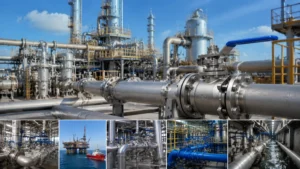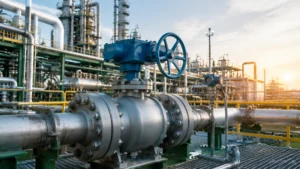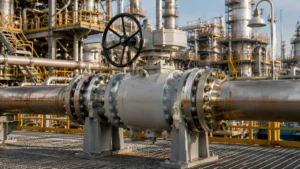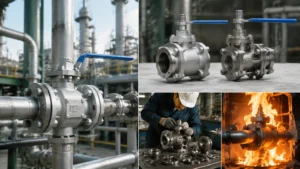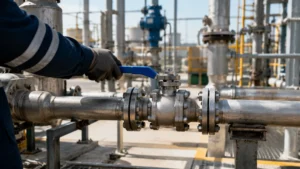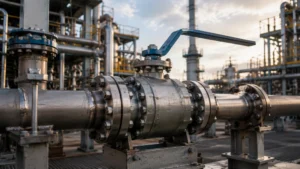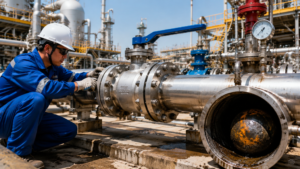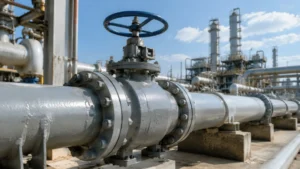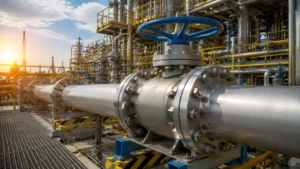
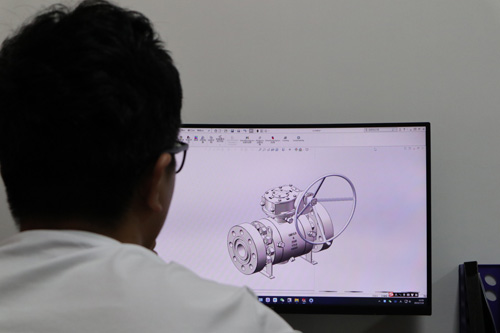
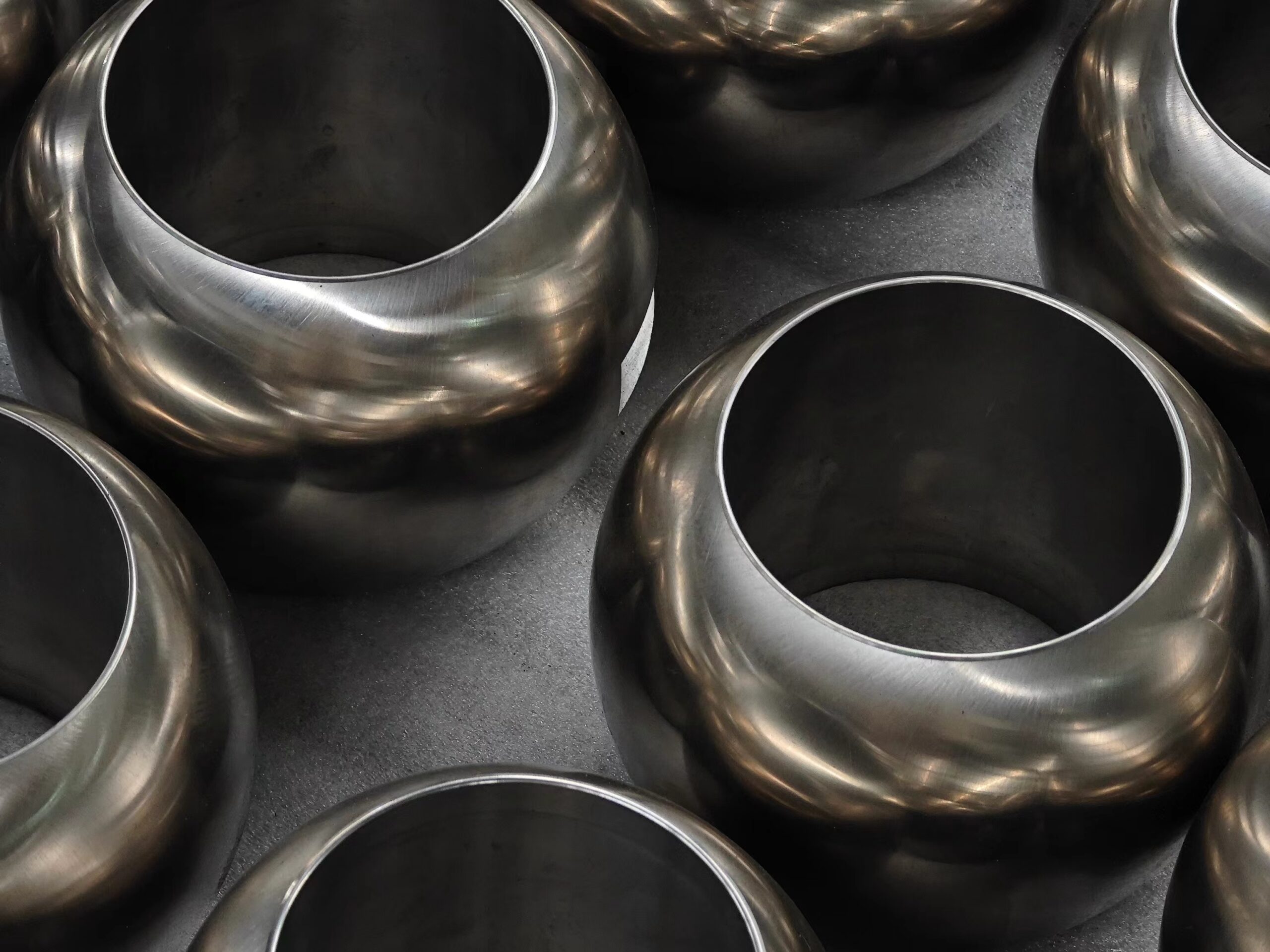
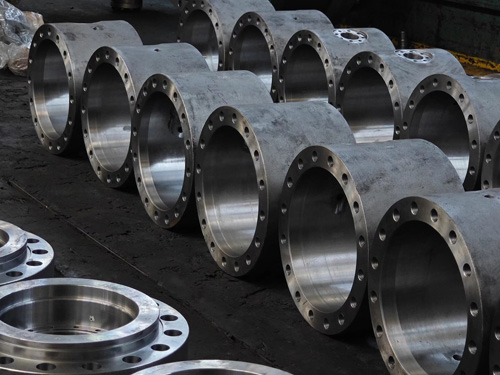
Precision-engineered through high-pressure forging, these ball valves feature a refined grain flow that ensures maximum structural integrity. Optimized for critical environments, they reliably sustain operating pressures up to 10,000 PSI and temperatures exceeding 538°C (1000°F). By strictly adhering to ASME B16.34 standards, the forging process increases tensile strength by approximately 30% compared to cast alternatives, providing superior fatigue resistance and zero-leakage performance under intense mechanical stress.
Praesent ac sem eget est egestas volutpat. Vestibulum dapibus nunc ac augue. Nulla neque dolor, sagittis eget, iaculis quis, molestie non, velit. Phasellus viverra nulla ut metus varius laoreet. Suspendisse nisl elit, rhoncus eget, elementum ac, condimentum eget, diam.
Design Features
• API 6D pipeline valves engineered for ASME pressure ratings from Class 150 to 2500.
• Full-bore and reduced-bore configurations available across NPS sizes from 2” to 60”.
• Optional Double Block and Bleed (DBB) functionality verified by API 6D hydrostatic testing.
• Fire-safe certified according to the latest BS 6755, API 6FA, and API 607 standards.
• Versatile seat designs featuring Single Piston (SPE) or Double Piston (DPE) for bidirectional isolation.
• Sealing materials including RPTFE, PEEK, and Viton GLT to suit specific media and pressures.
• Seamless integration with ISO 5211 compliant pneumatic, hydraulic, or electric actuation.
• Integrated emergency secondary sealing via grease injection ports rated for full system pressure.
• Metal-to-metal sealing meeting ISO 5208 Rate A zero-leakage requirements for all ASME classes.
• Optional fully welded body construction compliant with ISO 15848-1 fugitive emission standards.
• Standardized with blow-out proof stems and antistatic devices ensuring electrical continuity < 10 ohms.
• Specialized executions for extreme Cryogenic (-196°C) or High-Temperature (+538°C)serviceconditions.
Floating Ball / Trunnion Mounted Ball
Forged ball valves are engineered in Floating and Trunnion Mounted configurations to meet specific API 6D operational requirements. The Floating Ball design utilizes upstream pressure to achieve a bubble-tight downstream seal, optimized for NPS 1/2″–6″ and ratings up to ASME Class 600. This seat-supported architecture provides a cost-effective, space-saving solution for bi-directional shut-off in process piping.
For heavy-duty service (NPS 2″–56″, Class 150–2500), the Trunnion Mounted design employs a fixed-ball, bearing-supported structure that reduces operating torque by 30%–45% compared to floating types. This ensures superior sealing integrity and structural stability under high-differential pressures in midstream and subsea environments. CARILO’s forged valves, machined from ASTM A105 or F316 with tolerances within ±0.01mm, undergo 100% API 598 pressure testing. By adhering to ISO 9001 standards, we extend MTBF by approximately 25% in high-cycle, critical-service applications.
The Number of Body Pieces- TWO/ THREE
Body construction is a decisive factor in system uptime and Total Cost of Ownership (TCO).
Two-Piece Forged Ball Valves: Engineered with a split-body design to minimize potential leak paths, these valves support high-pressure service up to ASME Class 2500. This configuration is optimized for petrochemical and energy systems requiring maximum tensile strength (ASTM A105/F316) and a compact footprint for space-constrained installations.
Three-Piece Forged Ball Valves: Designed for rapid in-line maintenance, the “swing-out” central assembly allows for ball and seat replacement without disconnecting the valve from the pipeline. This modularity reduces maintenance downtime by up to 50%, making it the industry standard for high-cycle or abrasive applications requiring frequent seal renewals.
CARILO Standards: All valves are manufactured in strict compliance with API 6D and ISO 15848-1 (Fugitive Emissions). Through 100% API 598 pressure testing and the use of high-grade forged alloys, CARILO ensures maximized MTBF (Mean Time Between Failure) and zero-leakage performance in critical environments.
Soft seated / Metal seated
Seat material selection is the primary determinant of a valve’s operational envelope, governing pressure-temperature (P-T) ratings and media compatibility.
Soft-Seated Valves: Utilizing high-performance polymers like PTFE, RPTFE, or PEEK, these valves achieve ANSI Class VI bubble-tight shut-off with minimal operating torque. They are optimized for clean service, such as natural gas or refined hydrocarbons, operating within temperature ranges up to 200°C (400°F) and pressure ratings typically within ASME Class 600.
Metal-Seated Valves: Engineered for severe service, these valves feature Tungsten Carbide (TCC) or Stellite hard-facing to resist abrasive particles and high-cycle friction. Designed for extreme environments, they maintain structural integrity at temperatures exceeding 550°C (1022°F) and pressures up to ASME Class 2500, making them the industry standard for slurry, catalyst, and high-temperature refinery applications.
CARILO Engineering: Our seating solutions strictly adhere to API 6D, API 607 (Fire Safe), and ISO 15848-1 standards. By integrating precision-lapped components and 100% API 598 pressure testing, CARILO ensures maximized MTBF and zero-leakage reliability in mission-critical installations.
The types of end connection - RF/RTJ/SW/BW/NPT
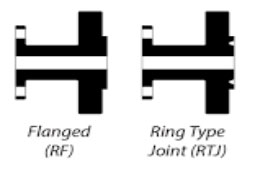
RF (Raised Face):
Engineered per ASME B16.5 with a standard 125-250 AARH serrated finish to optimize gasket compression. This flanged connection ensures secure sealing and precise alignment across ASME Class 150–2500 applications.
RTJ (Ring Type Joint):
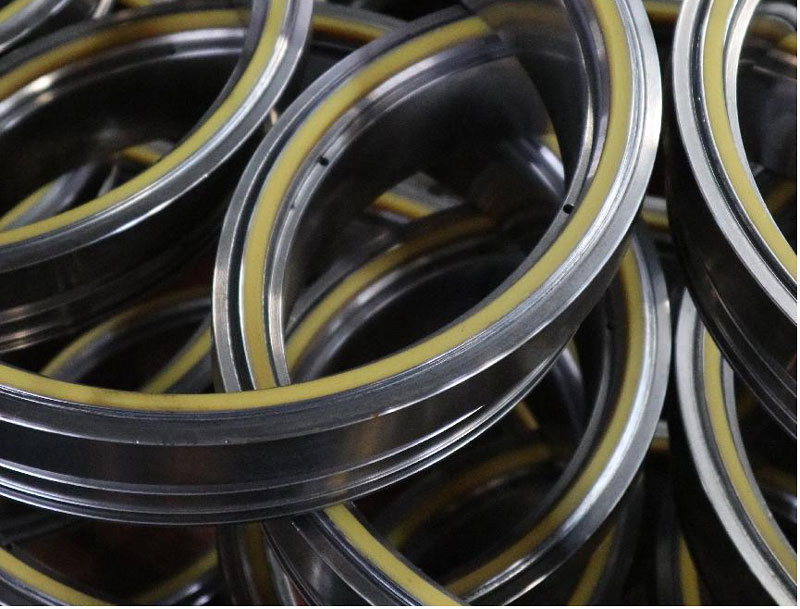
Specialized for high-pressure service (Class 900 and above), utilizing ASME B16.20 metallic ring gaskets. The metal-to-metal interface provides superior sealing integrity under extreme thermal and mechanical stresses.
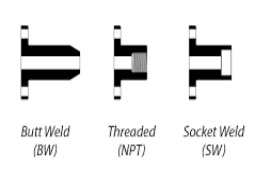
SW (Socket Weld):
Manufactured to ASME B16.11 for small-bore piping (NPS 2 and below). This configuration offers high joint strength and fatigue resistance, ideal for high-pressure process lines requiring leak-proof permanent joints.
BW (Butt Weld):
Designed according to ASME B16.25 for seamless pipeline integration. It ensures zero-leakage performance and is fully compatible with Radiographic Testing (RT) to verify weld quality in critical service.
NPT (National Pipe Thread):
Tapered thread connections per ASME B1.20.1 for rapid, cost-effective assembly. Primarily utilized in auxiliary utility systems and low-pressure applications requiring compact, threaded joints.
Different Design - DBB/ DIB-1/ DIB-2
DBB (Double Block & Bleed):
Compliant with API 6D, this configuration utilizes two independent seating surfaces to provide simultaneous isolation of both valve ends. It features a dedicated bleed point to vent the internal cavity, allowing operators to verify seat integrity and ensure zero-leakage safety in critical process isolation.
DIB-1 (Double Isolation & Bleed – Type 1):
Engineered with two Double Piston Effect (DPE) seats, providing redundant, bidirectional sealing at both upstream and downstream ports. To mitigate risk from thermal expansion or seat bypass, this design requires an external pressure relief valve (PRV) to prevent cavity over-pressurization and ensure structural integrity.
DIB-2 (Double Isolation & Bleed – Type 2):
This configuration integrates one SPE (Single Piston Effect) seat and one DPE seat. It provides high-integrity downstream isolation while allowing for automatic internal cavity relief to the upstream side via the SPE seat. This design eliminates the need for external relief piping while maintaining a secondary seal in the event of primary seat failure.
View More About Forged Ball Valves
Please note that the final cost depends on the customized service you require, the specifications of the raw materials used, the relevant national laws, and the distance of transportation. Take the example of booking a tall container of products:

How to Find a Reliable China Ball Valve Manufacturer for Industrial Projects | factory capability, quality control, project experience
① Products ones consistencies: Requires asks batchs times matchs grids rates ≥ 98%, builds sets comes materials and completes products doubles checks (AQL1.0); ② Communications crosses efficiencies: 48 smalls times insides skills arts replys answers,

China Ball Valve Manufacturer for Long-Term Cooperation: What Really Matters | product consistency, communication efficiency, after-sales support
① Product consistency: requires batch qualified rate ≥98%, establishes incoming material and finished product double inspection (AQL1.0); ② Communication efficiency: within 48 hours technical reply, weekly report follow up, uses ERP/email leaves trace; ③ After-sales

Why More Global Buyers Are Working with a China Ball Valve Manufacturer Directly | lower cost, faster response, better customization
More and more global buyers directly dock with Chinese ball valve manufacturers, mainly because cost can be reduced by 20%–40%, saving middle trade links; Response time shortens from 3–5 days to within 24 hours; support

Ordering Custom Forged Ball Valves? Confirm These Details Before Production Starts ? | drawing approval, marking request, inspection scope
Drawing size tolerance (±0.05mm), material standard (such as ASTM A105), pressure class (Class 150–2500), marking content and position (marking depth 0.3mm), inspection scope (100% water pressure + 10% spot check RT), and sign drawing and

Soft Seated or Metal Seated Forged Ball Valve: Which Option Fits Your Application | sealing method, media condition, temperature range
Soft seated ball valves are suitable for clean media, temperature ≤200°C, leakage class can reach ANSI Class VI; metal seated are suitable for particle-containing or high-temperature conditions (≤550°C), erosion resistant but leakage class is generally

API Forged Ball Valve Buying Guide for Distributors and EPC Contractors | API compliance, project demand, supply stability
API forged ball valve selection needs to satisfy API 6D standard (covering 150–2500 pressure levels), and provide MTC, pressure test reports and other complete documents; Preferably select manufacturers with API licenses (such as 6D certification

What Makes a Reliable Forged Ball Valve Manufacturer for Export Business | export experience, quality control, international approval
Reliable forged steel ball valve export factory look at three points: ① export experience ≥ 5 years, annual shipment ≥ 5000 units; ② Quality control: need API6D/ISO9001, 100% shell pressure test + sampling inspection 10%;

Forged Ball Valve Price Guide: What Affects Cost in Bulk Orders | material cost, order quantity, valve specification
Materials: A105 stainless steel approximately ¥120-200 per unit, 316 stainless steel ¥300-600; Quantity: Price decreases by 5%-10% for 100 units, and by 15%-25% for 1000 units; Specifications: DN50 is approximately 30% more expensive than DN25.

Why Forged Ball Valves Are Preferred for Oil and Gas Pipeline Systems | leak prevention, pressure resistance, safety compliance
Forged ball valve because of overall forging structure dense, strength increases about 20%-30%, pressure resistance can reach Class 1500 above, leakage rate is lower than API 598 standard (≤0.01%). Adopting double seal + anti-blowout valve

How to Choose the Right Forged Ball Valve for High-Pressure Industrial Applications | pressure rating, material grade, end connection
①Pressure rating, such as Class 1500/2500 (corresponding to about 25–42MPa); ②Material, such as A105 applicable to ≤425℃ carbon steel working conditions, F316 corrosion-resistant; ③Connection method, such as welded end (BW) pressure resistance is better than
Order & Payment
Most Popular Questions
Lorem ipsum dolor sit amet, consectetur adipiscing elit. Ut elit tellus, luctus nec ullamcorper mattis, pulvinar dapibus leo.
Forged valves per ASME B16.34 feature a refined, void-free grain structure that maximizes tensile strength and fatigue resistance. They are engineered for high-pressure service up to 6,000 PSI, offering superior structural integrity compared to cast alternatives.
Floating designs (NPS 1/2" to 6") use line pressure for bubble-tight sealing in Class 600 applications. Trunnion valves (up to Class 2500) utilize a fixed-ball architecture to reduce operating torque by 30%, ideal for high-pressure, large-diameter pipelines.
2-piece valves minimize leak paths in high-pressure service. Conversely, 3-piece "swing-out" designs allow for in-line seat and seal replacement without disconnecting end caps, reducing maintenance downtime by 50% and optimizing Total Cost of Ownership (TCO).
Soft seats (PTFE/PEEK) provide ANSI Class VI sealing up to 200°C. For abrasive media or extreme temperatures exceeding 550°C (1022°F), Metal-Seated valves with Tungsten Carbide (TCC) coatings are mandatory to ensure high-cycle reliability and erosion resistance.
Per API 6D, DIB-1 uses dual DPE seats for redundant bidirectional sealing but requires an external relief valve. DIB-2 combines one SPE and one DPE seat to allow automatic internal cavity relief, eliminating the need for external relief piping.
For Class 900+ service, RTJ (ASME B16.20) provides a robust metal-to-metal seal. For permanent, zero-leakage integration, Butt Weld (BW) ends per ASME B16.25 are preferred, as they support Radiographic Testing (RT) to verify joint integrity.
Send us a message
If you have any questions or would like to book a session please contact us.