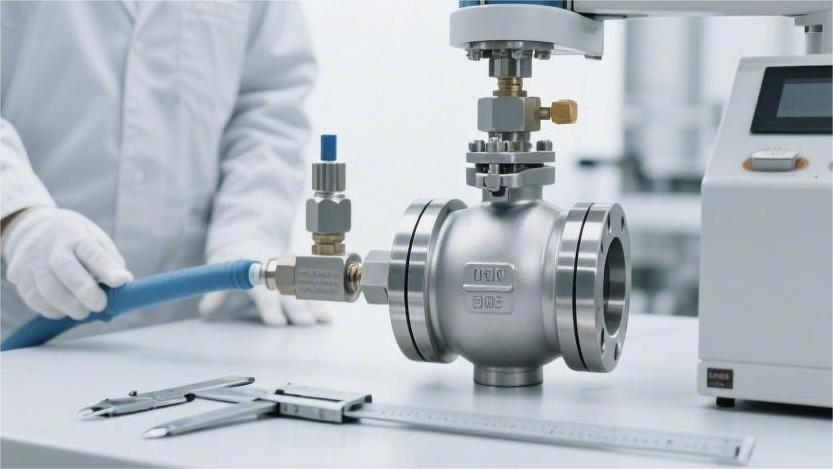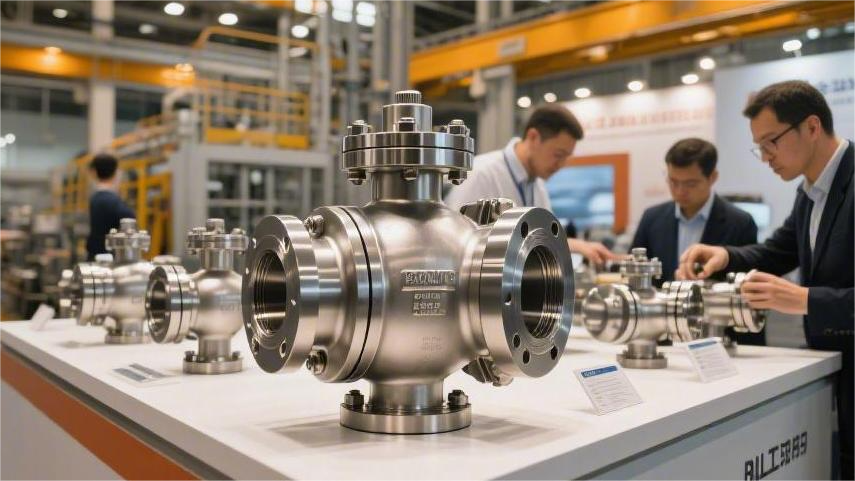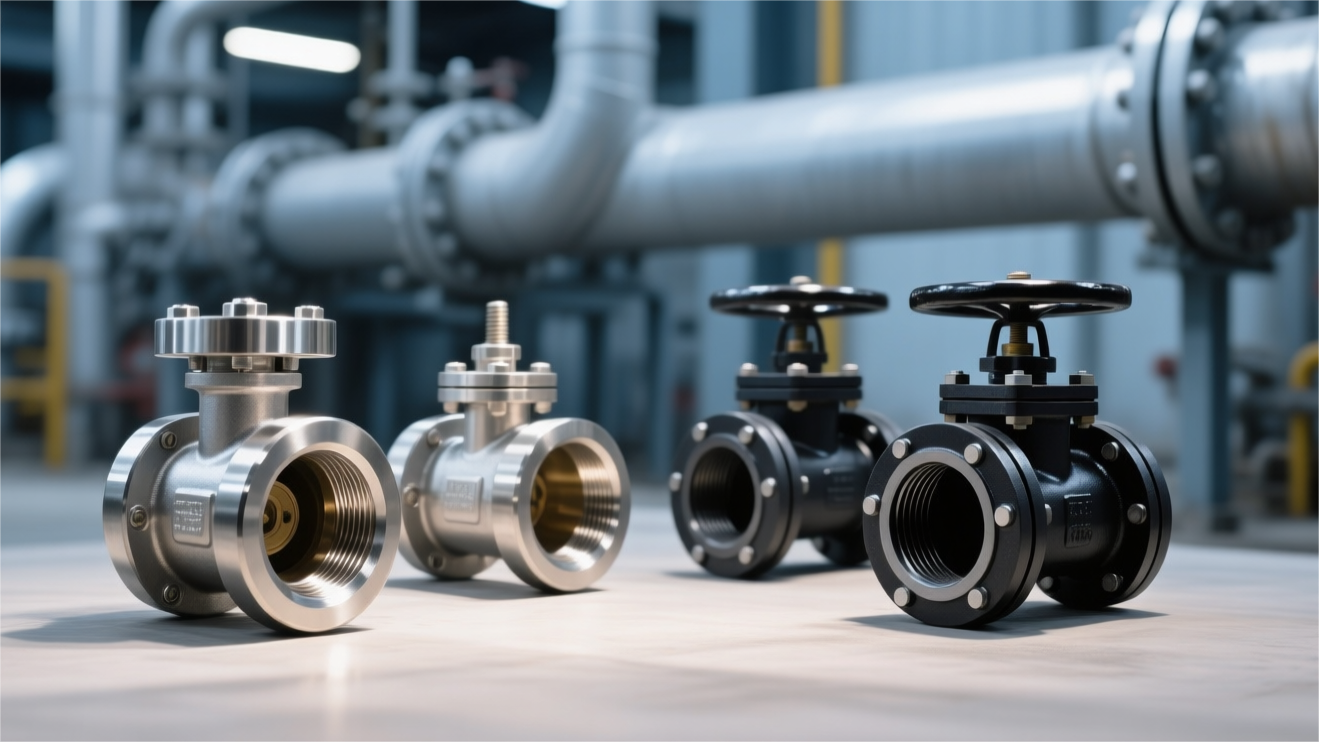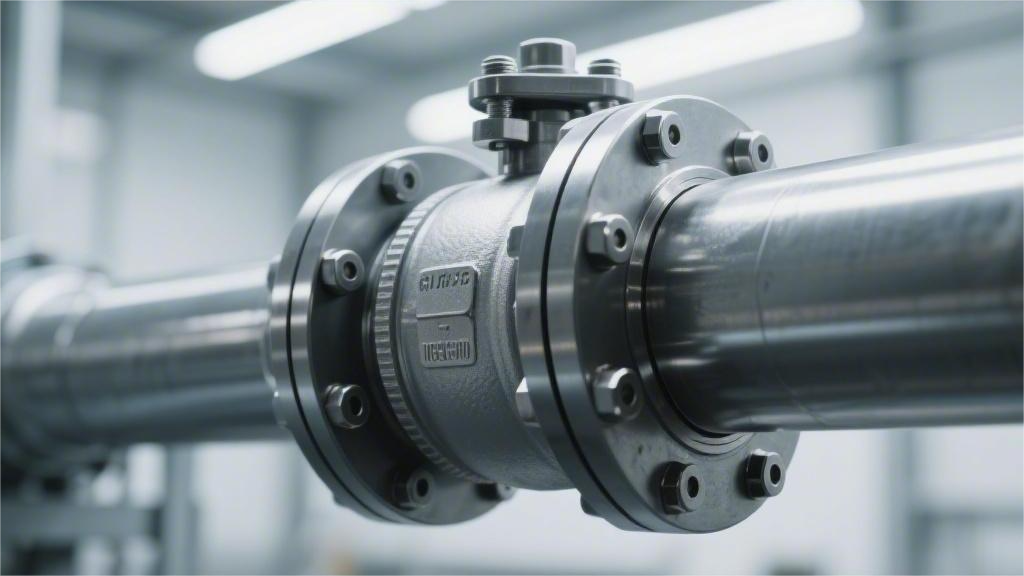
316 stainless steel ball valves outperform carbon steel in harsh environments.
With 2%–3% molybdenum, they can withstand strong acid and alkali corrosion as well as temperatures up to 450°C.
When selecting a valve, if the process fluid has a pH below 6, switch directly from carbon steel to a 316L flanged ball valve to prevent rust and leakage and to help keep the system maintenance-free for 10 years.
Stainless Steel
Chemical Stability
When 65% nitric acid rushes through a pipeline, the inner wall of ordinary carbon steel will start bubbling violently in less than 3 seconds. With 18% chromium, 304 stainless steel keeps the corrosion rate in strong oxidizing acids below 0.02 mm per year at room temperature. Oxygen atoms in nitric acid continuously replenish the metal surface, so even if the 1–5 nm chromium oxide film is scratched by sand or debris, it can reform almost instantly.
At room temperature, 304 can barely tolerate nitric acid below 10% concentration or in the very high range above 85%, limiting metal loss to about 0.1 mm per year. But around 50% concentration, once the liquid temperature rises above the critical 40°C, the surface film can dissolve and peel off completely within hours.
This is where 316 stainless steel, with 2.5% molybdenum, takes over. Molybdenum atoms act like anchors in the crystal lattice, locking iron atoms in place. In 20% sulfuric acid at 60°C, the annual corrosion loss of 316 drops to just one-fifteenth of that of 304.
When liquid alkali reaches 50% concentration and furnace temperatures exceed 80°C, nickel at the grain boundaries becomes essential. With 10%–14% nickel, 316 stainless steel keeps annual metal loss below 0.05 mm even in hot, concentrated caustic solutions.
In plants handling hazardous chemicals, veteran supervisors usually keep a strict fluid compatibility chart close at hand:
- 98% sulfuric acid: flow velocity must not exceed 1.5 m/s
- 20% hydrochloric acid: 300-series stainless steels are prohibited
- 65% nitric acid: operating temperature must stay below 85°C
- 50% caustic soda pipelines: stress-relief annealing is mandatory
Once a ball valve and pipe flange are welded together, the weld zone can enter the dangerous 425°C–815°C sensitization range within seconds. If the torch lingers for just two extra minutes, carbon atoms inside the grains migrate to the boundaries and combine with chromium, forming large amounts of chromium carbide precipitates.
As chromium is depleted, the free chromium content at the grain boundaries can drop below the critical 10.5% threshold. Even mildly corrosive fluids can then creep into microscopic gaps. In less than three weeks, a once-solid valve weld can turn into a sponge-like structure full of corrosion pits, with high-pressure fluid ready to burst through at any time.
Modern steelmaking uses AOD argon oxygen decarburization to strip carbon from molten steel. Standard 304 stainless steel allows up to 0.08% carbon, while 316L stainless steel cuts that to below 0.03%. With less carbon available, welding can no longer cause enough carbide precipitation to rob chromium from the weld area, so the gaps in corrosion resistance remain protected.
On fabrication sheets handed to welders, a few rules are never negotiable:
- Standard 316: carbon content ≤ 0.08%
- 316L: carbon content ≤ 0.03%
- Avoid the 425°C–815°C sensitization range
- L-grade stainless steel should not be used continuously above 426°C
Semiconductor etching lines often run 99.5% glacial acetic acid every day. At room temperature, it is fairly stable. But once a little water mixes in, or the liquid nears its 118°C boiling point, free acetic acid molecules begin attacking the underlying iron atoms in groups.
Machining centers mechanically polish the valve bore to a surface roughness below Ra 0.4 μm, leaving it so smooth that even organic residues struggle to cling to it. Then the surface is pickled and passivated to remove microscopic free iron, raising the chromium-to-iron ratio from 1.2 to above 2.5, effectively sealing off the pathways that acetic acid molecules would otherwise exploit.
Natural gas from oil and gas wells often contains toxic hydrogen sulfide. Once the partial pressure exceeds 0.05 psi, hydrogen atoms released during hydrolysis—only 0.053 nm in size—can squeeze into metal gaps. These atoms combine into hydrogen molecules, expanding several times in volume and forcing cracks open along the grain boundaries.
Valves built to NACE MR0175 sour-service standards must keep hardness below 22 HRC. A slightly softer metal lattice provides more flexibility, allowing hydrogen atoms to diffuse through microscopic voids and escape instead of accumulating and rupturing the steel from within.
Paper mills use wet chlorine gas to bleach pulp. Once mixed with water, it turns into hypochlorous acid. Its molecules are small and extremely oxidizing, and the normal 1–5 nm chromium oxide film offers little protection. 317L stainless steel, with 3%–4% molybdenum, can double service life in wet chlorine environments.
Negatively charged chloride ions target the weak points in passive films. At just 0.181 nm, they can penetrate the nanoscale oxide layer and combine with iron atoms beneath it to form soluble ferrous chloride. In high-flow pipelines, the dissolved material is constantly washed away, and before long the bright steel surface becomes riddled with fine pinhole pits.
304 vs. 316
When purchasing ball valves for water treatment plants, suppliers usually offer 304 stainless steel first. With 18% chromium and 8% nickel, it is more than adequate for purified water. In dyeing and finishing plants in Jiangsu and Zhejiang, where valves are installed on weakly acidic waste liquid lines, this cost-effective alloy combination can last for years in environments around pH 5.5.
Move that same pipeline to a coastal saltworks, and 304 quickly reaches its limit. Seawater contains about 35,000 ppm chloride ions. After two months of sea breeze exposure, the bright silver valve body will start showing reddish rust spots. On chemical plant drawings, buyers often revise the material callout directly to 316 stainless steel, precisely because it can resist the aggressive chloride attack of saltwater.
When steelmakers add 2%–3% molybdenum, 304 effectively becomes 316 in terms of chemical resistance. On the spot market, pure molybdenum powder can cost nearly RMB 450,000 per ton. Once that expensive alloying addition goes into the furnace, the finished price of a 316 valve rises 30%–40% above 304.
In paper mills, workers routinely clean bleach-containing pipelines with high-pressure water guns. If sodium hypochlorite lands on an ordinary metal housing, it can eat a 0.5 mm-deep pit in just three days. A 316 housing, thanks to its molybdenum content, can withstand bleach attack, and its ultra-thin passive film can remain intact for five consecutive years under strong oxidizers.
In dairy plants, milk pipelines stay around 4°C year-round. Raw milk has a pH of about 6.5–6.7, which is very mild on metal. Even with two full 80°C hot-water CIP cycles every day, 304 ball valves will not shed detectable heavy metal ions into infant formula production, and the money saved can buy the plant two more homogenizers.
| Material Grade | Chromium Content | Nickel Content | Molybdenum Content | Price Difference per Ton | Typical Fluids |
|---|---|---|---|---|---|
| 304 | 18.0%–20.0% | 8.0%–10.5% | Almost zero | Baseline price | Purified water, weak acids, milk |
| 316 | 16.0%–18.0% | 10.0%–14.0% | 2.0%–3.0% | About 30% premium | Raw seawater, strong alkali, bleach |
Quality inspectors may use a handheld XRF analyzer worth over RMB 300,000. Once the gun is pressed against the valve body, the screen displays the exact elemental composition within three seconds. If that 2% molybdenum is missing, the whole batch is treated as ordinary 304 and unloaded straight into the scrap pile.
For maintenance teams that cannot afford such an instrument, there is a simpler field method. Supervisors often carry a bottle of ammonium molybdate reagent in their blue workwear pocket. A drop is placed on the polished valve surface and energized with a weak current from a 9V battery. After two minutes, if the liquid turns rose red, the material is genuine 316; if it stays dark and does not redden, the supplier likely substituted 304.
Beside a liquid nitrogen tank at -196°C, ordinary carbon steel can shatter like glass when struck. Both 304 and 316 have passed Charpy impact tests at -196°C, absorbing more than 100 J of impact energy. Their austenitic crystal structure does not shrink or become brittle at cryogenic temperatures, so workers can still operate the handle smoothly while wearing gloves.
In chemical plants, even trace chlorine occasionally enters demineralized water lines. With just 2–5 ppm free chlorine in a 25°C indoor environment, ordinary 304 ball valves can be covered in yellow-brown rust within six months. Replacing all wetted parts with 316 means the molybdenum-stabilized passive film keeps corrosive chlorine species out.
Veteran foremen keep a blacklist of chemical services where 304 must never be used:
- Warm brine with concentrations above 0.5%
- Raw, unfiltered seawater freshly pumped from offshore
- High-strength hypochlorite residue from bottle-washing machines
- Industrial developer solutions above 60°C
- Strongly acidic wet chlorine gas from paper mill exhaust lines
Some dishonest foundries cut corners by reducing the nickel content in “316” to 8% and molybdenum to 1.5%, saving about RMB 500 per ton in raw materials. The surface is polished bright, stamped, and sold cheaply to salt-chemical plants. But once this fake 316 meets 150 psi high-pressure brine, the pipe wall can tear open at both flange ends in less than three months.
At reputable manufacturers, every anti-corrosion valve destined for high-risk service must pass PMI spectrographic testing before entering the warehouse. The acceptance criteria are clear: nickel above 10%, chromium no less than 16%, and molybdenum at least 2%. If any one of these three readings fails, the entire pallet is rejected and sent back to the foundry for remelting.
Advantages and Disadvantages
A standard 2-inch carbon steel ball valve may cost around RMB 300. Change the material line to 316 stainless steel, and the supplier’s quote can jump immediately to RMB 850. The upfront cost is almost 2.5 times higher, which makes budget-sensitive contractors hesitate.
The real cost is not the purchase price in year one. If the pipeline carries weakly acidic chemical wastewater, a carbon steel valve may fail in less than 14 months. One shutdown for replacement—counting half a day of labor for two workers plus RMB 2,000 in production losses—already exceeds the cost of buying three better valves in the first place.
On scaffolding, installers dread one particular failure mode: galling. When 304 bolts are paired with 304 nuts, the 1–5 nm chromium oxide film on the threads can be stripped instantly under wrench pressure. Once two freshly exposed metal surfaces rub together, the friction coefficient can climb above 0.5, causing microscopic cold welding.
Apply too much force with an 80 N·m torque wrench, and the threads seize completely—neither tightening nor loosening is possible, leaving only an angle grinder to cut them apart. Experienced fitters prevent this by applying a dark gray molybdenum disulfide anti-seize compound. These micron-scale lubricant particles separate the metal surfaces and bring the friction coefficient back below 0.1.
In food plants simmering high-salt brine or broth, jacketed kettles often run at around 95°C with chloride levels above 8,000 ppm. In this hot, humid environment, even strong alloy housings begin to reveal their hidden weakness.
Residual tensile stress trapped in the metal lattice during fabrication can trigger chloride stress corrosion cracking in warm brine above 60°C. A stainless steel ball valve may still look shiny and flawless on the outside, while inside the grain boundaries are already filled with thousands of micron-scale cracks. Under repeated pressure pulses, it can fail without warning.
Plant supervisors often circle a few red-flag conditions in their notebooks:
- Free chlorine exceeds the limit and water temperature is above 60°C
- Unlubricated threads with identical mating materials
- Projects with very tight budgets handling only room-temperature clean water
- Suspended plastic piping systems where total equipment weight must be extremely low
In cryogenic zones at -196°C, such as liquid nitrogen tank farms, ordinary cast iron will shatter like an icicle under impact. Austenitic face-centered cubic structures, however, still maintain impact toughness above 100 J at that temperature, and their yield strength can even double instead of dropping.
In thermal power plants, superheated steam may push line temperatures up to 450°C. The metal body can survive this, still well below the 815°C oxidation scaling limit. But anyone experienced in maintenance knows the body is not the weak point—the white PTFE seat inside the ball valve will turn into mush at around 260°C.
Inside stainless steel piping polished to Ra 0.8 μm, not even a single bacterium is allowed to settle. Every night at 11:00 PM, the automated cleaning system pumps 2% sodium hydroxide at 85°C through the network for full-coverage CIP.
The hot caustic solution flows at 2 m/s for 45 minutes. Ordinary metals would release thousands of free iron ions under such chemical attack, contaminating tons of purified water. But the dense passive film on stainless steel remains intact, and next-morning spot checks still show heavy metals below the 0.01 ppb detection limit.
When designing supports for metering skids, engineers must account for the actual weight of the material. One cubic meter of solid stainless steel weighs 7.93 tons. A standard 4-inch flanged ball valve typically weighs close to 25 kg. Two young workers tied off with safety belts may struggle to carry such a valve up a 10-meter-high pipe rack.
Carbon Steel
Three Advantages
Cast WCB carbon steel has a tensile strength of 485–655 MPa. On crude oil trunk lines up to 24 inches in diameter, with oil moving at 3 m/s, a carbon steel body can withstand fluid impact pressures up to 15 MPa.
As fluid squeezes through the narrow gap around the ball, it creates severe turbulence. Forged A105 carbon steel offers a yield strength of 250 MPa. Its rigidity allows the valve to be installed on Class 1500 high-pressure lines without even microscopic deformation.
Pneumatic actuators can generate enormous force. Carbon steel stems can withstand operating torques of 5,000 N·m. If the line occasionally suffers water hammer, tripling pressure in a single second, the valve body may still not change dimension by even 1 mm.
Natural gas pipelines often cross hundreds of kilometers of desert. Fully welded carbon steel valves weighing up to 3 tons are buried 2 meters underground. Internally they hold back 10 MPa of gas pressure, while externally they resist soil settlement and shifting loads of several tons.
Typical loads on these pipelines include:
- Soil settlement pulling the pipe in opposite directions
- Pump starts and stops causing vibration
- A 500 kg+ suspended mass hanging from the line
- Uneven tightening across large flange bolts
- Sand particles up to 2 mm eroding the wall at high speed
Superheated steam systems often operate steadily at 350°C. Plastic or brass components would soften or fail within minutes, but carbon steel maintains structural stability from -29°C to 425°C.
At refineries, heat transfer oil lines commonly run at 280°C. WCB carbon steel has a very low thermal expansion coefficient—only about 1.2 × 10⁻⁵ per °C. That slight expansion does not significantly compress the PTFE seat, so seizure is avoided.
But once the temperature crosses the 425°C red line, the carbon in carbon steel begins to graphitize. The once-tough ferritic structure turns brittle. At the other extreme, if temperature falls below -29°C, impact energy can drop below 15 J, and the material becomes vulnerable to cracking from even a light hammer strike.
In Arctic oilfields, ordinary carbon steel becomes too stiff and brittle. Engineers therefore switch to LCB low-temperature carbon steel. After heat treatment, it can still absorb more than 20 J in impact tests at -46°C.
Typical field rules for temperature control include:
- Below 0°C, wrap the line with 50 mm of insulation
- Coat the exterior with aluminum paint rated for 400°C
- Before introducing steam, preheat the line with low-pressure hot gas for 10 minutes
- Install thermocouples at flange joints and monitor temperature continuously for 24 hours
Large projects may require over 5,000 valves. A genuine 316 stainless steel ball valve may cost RMB 8,000 each, while a carbon steel valve of the same size and pressure rating can be purchased for about RMB 2,500.
From a budgeting standpoint, the choice is obvious. In many plants, 60% of all lines carry nothing more corrosive than cooling water. Replacing those safe-service valves with low-cost carbon steel can save the owner RMB 30 million immediately—enough to purchase more than a dozen high-capacity fire pumps.
Some crude oil contains small amounts of deadly hydrogen sulfide. Replacing the entire system with Hastelloy C-276 would destroy the project budget. Instead, engineers specify NACE MR0175-compliant sour-service carbon steel, carefully heat-treated to keep hardness below 22 HRC.
A slightly softer structure makes it harder for free hydrogen atoms to penetrate and disrupt the metal lattice. With a 50 μm electroless nickel-phosphorus coating, the valve gains a first line of defense against mildly acidic water, and the processing cost is only about RMB 300 per valve.
Seawater desalination plants are notoriously expensive. 2507 duplex stainless steel often shocks purchasing managers with its price. Engineers therefore develop more affordable hybrid solutions: a low-cost carbon steel shell lined internally with 3 mm of PTFE.
A lined carbon steel ball valve can cost only one-quarter as much as a solid duplex steel valve. The carbon steel shell withstands 16 bar pressure, while the PTFE liner handles seawater at 35,000 ppm chloride. This kind of hybrid design can cut procurement cost by 45%.
Limitations
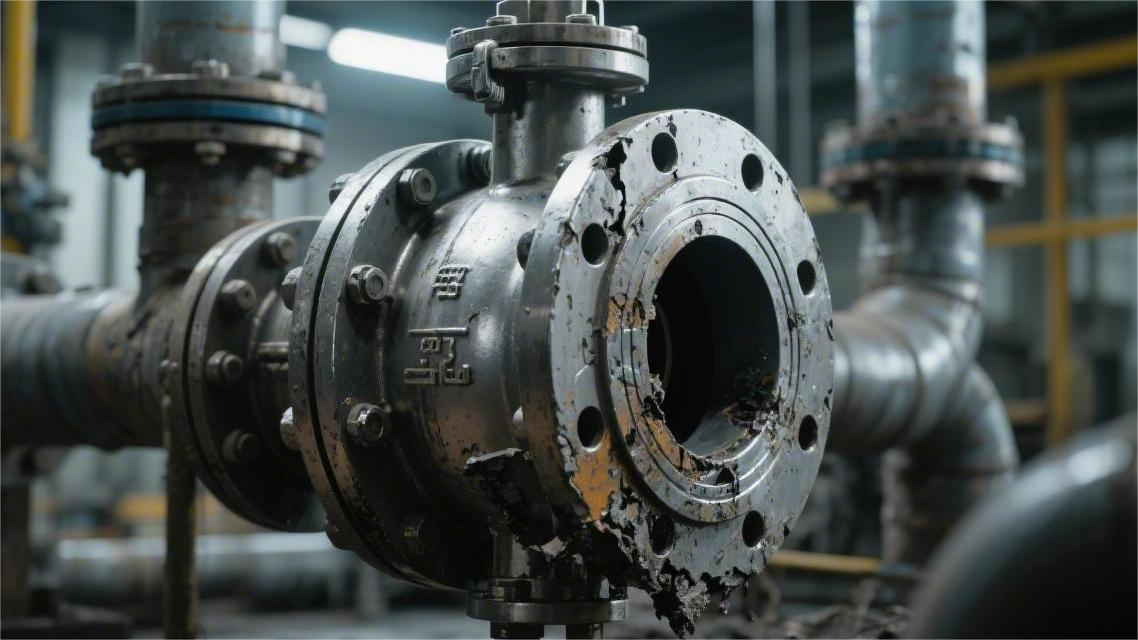
In coastal air, chloride concentrations can often exceed 500 ppm. Carbon steel lacks the 10%+ chromium needed to form a protective passive film. Iron reacts with moisture and oxygen, forming loose rust through electrochemical corrosion.
In acidic service, failure can be painfully fast. If carbon steel is mistakenly installed in a line carrying 5% sulfuric acid, a 15 mm-thick wall can be completely penetrated within 48 hours. Hydrogen ions strip electrons from iron atoms, while flammable hydrogen gas bubbles continuously form in the pipe.
On construction sites, one rule is absolute: once the fluid pH drops below 5.5, ordinary carbon steel parts are off limits. Alkaline service is slightly more forgiving, but if concentrated sodium hydroxide exceeds 80°C, the surface can suffer caustic embrittlement. Grain boundaries begin to look termite-eaten, and a shell once rated for 10 MPa can fracture under vibration.
Inexperienced installers sometimes bolt carbon steel flanges directly to 316 stainless steel pipes. With a galvanic potential difference greater than 0.2 V, the carbon steel becomes the sacrificial anode. In less than three months, the stainless remains bright while the carbon steel flange face turns into black-brown corrosion debris. Once the gasket loses just 3 mm of support, water can spray out through the gap.
| Common Industrial Medium | Estimated Corrosion Rate of Carbon Steel | Visible Condition | Industrial Countermeasure |
|---|---|---|---|
| 5% dilute HCl (25°C) | > 5.0 mm/year | Violent bubbling, rapid thinning and perforation | Strictly prohibited; use Hastelloy or fluoropolymer lining |
| 3.5% brine (marine conditions) | 0.1–0.5 mm/year | Large reddish-brown rust scale on surface | Apply 300 μm heavy-duty anti-corrosion coating |
| Industrial pure water (8 ppm O₂) | 0.05–0.1 mm/year | Dark red hemispherical tubercles on inner wall | Add oxygen scavenger; control O₂ below 0.1 ppm |
| Dry chlorine gas (room temperature) | < 0.01 mm/year | Dense ferric chloride film forms on surface | Keep moisture below 50 ppm |
| 10% sodium hydroxide (20°C) | < 0.05 mm/year | Surface darkens, almost no dimensional change | Safe at room temperature; beware caustic embrittlement at high temperature |
Corrosion shops often spray 250 μm of epoxy coating on carbon steel valves to extend service life. The coating does block acid rain and moisture—until an installer chips off a flake the size of a grain of rice with a 15 kg pipe wrench.
Once bare iron is exposed, rust begins and expands outward. Within six months, a palm-sized sheet of intact coating can be forced off entirely by the corrosion building underneath. Repairing the damage is labor-intensive: workers must grind the area to an St3 finish, spending around two hours just to reapply primer.
Some factories use 50 μm nickel-phosphorus plating for protection. But if water carries 1 mm quartz sand at 5 m/s, the thin metallic layer can be scoured away in less than 30 days, exposing the substrate to renewed corrosion.
After large-scale coating failure, maintenance crews measure the remaining wall thickness with an ultrasonic thickness gauge. If a valve body originally 12 mm thick is reduced to 8 mm, ASME standards may require immediate shutdown and replacement. For a major refinery, one day of downtime can cost millions.
Hydrogen sulfide from oil wells is disastrous for ordinary carbon steel. In the presence of water, it penetrates the microstructure and causes hydrogen-induced cracking (HIC). A solid, heavy metal body can develop more than a dozen invisible internal cracks, each up to 3 cm long.
Nothing may look wrong from the outside. But once the line is pressurized to 5 MPa, the valve body can shatter like dropped glass. Chlorides make matters worse exponentially. Inland power plants often use river water containing 300 ppm chloride for cooling.
In stagnant dead zones, chloride ions concentrate and trigger pitting. A tiny black dot on the surface may seem harmless, but cut it open and the hidden cavity may already be 5 mm in diameter and 8 mm deep. A pressure boundary eaten away that severely is always at risk of rupture.
Closed heating boiler systems use treated soft water. If the deaerator fails and dissolved oxygen rises above 0.1 mg/L, reddish-brown corrosion nodules will start growing rapidly on the pipe wall.
When water flows through a partially open ball valve, pressure drops sharply and creates thousands of bubbles. As these bubbles implode on the metal surface, they produce micro-jets and cavitation damage. Each microscopic explosion can form a pit 5 μm deep. The newly exposed metal immediately oxidizes and becomes even more vulnerable.
That is why you will never see unprotected plain carbon steel on a subsea tree at 1,500 meters depth. Under long-term immersion in highly saline water and 150 atmospheres of hydrostatic pressure, conventional coatings simply peel away layer by layer.
Typical Applications
Long-distance natural gas pipelines in northwestern deserts often exceed 1,500 km. The main line, up to 40 inches in diameter, carries gas at 10 MPa. Contractors use API 6D fully welded carbon steel ball valves, each weighing around 5 tons, then wrap the assembly in a three-layer polyethylene coating.
The valve is lowered into a 3-meter-deep trench and buried, with only a 2-meter operating stem left above ground. It may remain untouched for 15 years, effectively growing into the pipeline as one buried structure.
Urban district heating networks in northern cities spread beneath asphalt roads like webs. In winter, heating plants force 130°C water into the mains at 2.5 MPa. On DN800 supply headers, rows of carbon steel valves handle the continuous impact of massive volumes of hot water.
In thermal power plant boiler houses, 300°C superheated steam flows through scalding pipelines into turbines. WCB cast carbon steel expands only by fractions of a millimeter, while installers tighten the flange bolts to 1,500 N·m to compress the flexible graphite gasket.
Hydraulic stations in large rolling mills are packed with narrow oil lines carrying ISO VG 46 anti-wear hydraulic oil at 60°C. Pressure gauges frequently spike to 31.5 MPa. In these conditions, forged A105 carbon steel is invaluable, using its high strength to contain the pressure.
Experienced piping engineers routinely approve carbon steel for services such as:
- Heavy oil under atmospheric distillation columns at 250°C
- Cooling water circuits in chemical parks with 5 ppm scale inhibitor
- Compressed air systems at 0.8 MPa
- Dry gas lines in ethylene plants with moisture limited to 10 ppm
But LNG operates at -162°C. Ordinary carbon steel becomes glass-brittle under such cryogenic conditions. A light blow from a 1 kg hammer can split the valve body open.
Ordinary carbon steel must never be used in LNG receiving terminal cryogenic lines. Even a single palm-sized carbon steel forged fitting mixed into the system can fail catastrophically during commissioning.
Fine chemical plants handle far more aggressive media. 98% sulfuric acid may seem relatively benign to carbon steel at room temperature because a passive film forms on the surface. But once flow exceeds 1.5 m/s, that film is stripped away in minutes, and exposed iron can be deeply attacked within hours.
Reviewers reject carbon steel immediately whenever the design includes conditions such as:
- Raw seawater at 19,000 ppm chloride
- High-purity deionized water from pharmaceutical reactors with resistivity of 18 MΩ
- Highly corrosive sodium hypochlorite bleaching solution
- Toxic sour gas streams containing 30% wet H₂S
Before finalizing material selection, lab technicians may take a 500 mL sample of the process liquid for analysis. Once the report shows pH 7.2 and 15 ppm chloride, the purchasing manager can finally relax and order 200 carbon steel ball valves, saving the project a full RMB 4 million.
Chemical Resistance
Resistance to Chemicals
At 25°C, carbon steel valves can survive in 98% sulfuric acid for about three months. Raise the liquid temperature to 80°C, and the same metal can be completely penetrated within 48 hours. An 8 mm wall may be reduced to just 0.1 mm—as thin as a sheet of office paper.
At a flow rate of 3 m/s, the protective film on the metal surface is stripped away. In hydrochloric acid with pH 2.5, steel has virtually no defense. A manufacturer’s claimed corrosion rate of 0.05 mm/year can jump to 1.2 mm/year under flow-induced erosion.
In real plants, a material is challenged every second by hidden variables:
- Concentration changes: 98% acid may be safe, but 70% acid may be lethal
- Temperature swings: every 10°C increase can double damage
- Flow acceleration: rapid scouring removes the protective film
- Trace impurities: just 5 ppm of contamination can cause perforation
If cooling water contains 50 ppm chloride, the inner wall of 304 stainless steel can begin failing silently. The surface still looks bright, but ultrasonic testing reveals tree-like cracks 2.3 mm deep.
To evaluate this kind of localized damage, engineers use a scoring method.
The Pitting Resistance Equivalent Number (PREN) is calculated as chromium plus 3.3 × molybdenum plus 16 × nitrogen. Ordinary 304 stainless steel scores only around 18. In the high-salinity waters of the Persian Gulf, it may rust all over in just two weeks. 316L, with an additional 2.1% molybdenum, pushes the score above 24.
Sour oilfields containing hydrogen sulfide pose another risk: internal rupture by hydrogen. Once gas pressure exceeds 0.05 atm, hydrogen atoms can saturate the iron lattice. When they recombine into hydrogen molecules inside microscopic voids, they generate internal pressures of hundreds of megapascals. A perfectly intact carbon steel pipe can then shatter like glass within hours.
Seals can also become the weakest link. FKM may survive 10,000 hours in 200°C mineral oil without damage. But place it in 15% ammonia solution, and in just three days it can swell by 320%, with hardness dropping from Shore A 75 to about 20, allowing fluid to spray through the gaps.
Countless costly industrial accidents have come from mismatched seal materials:
- EPDM in mineral oil: swelling and rupture
- FKM in strong ammonia: turns to mush
- Natural rubber in ozone: cracks into a tortoise-shell pattern
PTFE, thanks to its exceptionally strong carbon-fluorine bonds, is almost indifferent to most chemicals. But once temperature exceeds 260°C, it begins releasing hydrogen fluoride gas and softens into failure. In 300°C steam lines carrying acidic condensate, it must be replaced by PEEK composites rated up to 343°C.
When dissimilar metals are immersed together in conductive chemical liquids, galvanic corrosion occurs. If a 316 stainless steel pipe is rigidly connected to a cast iron valve, the brine flowing through acts like electrolyte in a natural battery. The more active cast iron, at around -0.44 V, becomes the sacrificial material. The flange corrodes seven times faster than it would alone.
Welding also drastically alters local corrosion resistance. If 304 stainless steel is heated at 450°C–850°C for more than three minutes, carbon and chromium combine intensely. In that area, chromium content can fall below the critical 10.5% threshold, creating a major weakness. Expose that weld to 65% hot nitric acid for two days, and 1.5 mm-deep ditch-like attack can develop beside the weld.
That is why controlling carbon content is such a powerful way to lock in corrosion resistance:
- Standard 304: 0.08% carbon, welds are more vulnerable
- Low-carbon 304L: carbon reduced to 0.03%, protects the weld area
- 321 stainless steel: titanium is added to tie up carbon and prevent migration
Misalignment stress introduced during installation can also multiply chemical damage. If 316 stainless steel carries 20% magnesium chloride solution above 70°C while under a constant load of 60 N/mm², microscopic cracks can form along the direction of stress and advance inward at 0.2 mm per hour. In just one week, a thick stainless component can fracture without warning.
Material Differences
When 316 stainless steel is no longer enough in chloride service, duplex stainless steel (Duplex 2205) is the next step. Its structure is roughly half ferrite and half austenite. Yield strength rises to 450 MPa, about twice that of 316, and its resistance to high-temperature magnesium chloride solutions is much stronger.
Cost, however, rises fast. Ordinary WCB carbon steel castings may cost about RMB 8,000 per ton. 304 stainless steel exceeds RMB 17,000 per ton. Specify 2205 duplex steel, and procurement costs can approach RMB 35,000 per ton.
Accountants may focus on unit price, but maintenance teams think in total cost. In a pulp digester system carrying black liquor containing 15% sodium hydroxide and sodium sulfide, a carbon steel ball valve may start leaking after only 15 days.
Each hour of downtime can cost RMB 300,000 in lost production. A 316 stainless steel valve may last 8 months, but then its body may develop 2 mm-deep grooves from alkali erosion. Replace it with a ball valve machined from TA2 titanium, and it may run for 36 months without a single visible scratch.
Behind the numbers in a materials table lie very real costs of trial and error:
| Material | Test Fluid | Operating Temperature | Annual Corrosion Loss | Estimated Safe Service Life |
|---|---|---|---|---|
| WCB carbon steel | 10% dilute sulfuric acid | 25°C | 1.8 mm/year | Less than 3 months |
| 304 stainless steel | 30% nitric acid | 60°C | 0.08 mm/year | About 5 years |
| 316L stainless steel | 20% glacial acetic acid | 120°C | 0.02 mm/year | More than 10 years |
| TA2 titanium | Saturated wet chlorine gas | 80°C | 0.005 mm/year | More than 15 years |
Dry chlorine gas at room temperature is relatively mild to ordinary steel, but add just 0.1% water and highly destructive hypochlorous acid forms immediately. Titanium solves this by forming a protective titanium dioxide film the moment it contacts moisture, keeping corrosion rate at around 0.005 mm.
However, in absolutely dry pure chlorine, titanium can ignite violently. In that case, engineers turn to Hastelloy C-276, a nickel-based alloy containing about 16% molybdenum, 16% chromium, and 4% tungsten.
Under boiling 98% sulfuric acid or strongly oxidizing ferric chloride solution, conventional stainless steels dissolve rapidly. Hastelloy C-276 in boiling 10% sulfuric acid loses no more than 0.02 mm per year.
Hastelloy is extremely expensive—raw material alone can exceed RMB 300 per kilogram, and a 100 mm Hastelloy ball valve can cost as much as RMB 40,000.
To control cost, many plants keep the outer shell in low-cost carbon steel at around RMB 8,000 per ton to handle 5 MPa line pressure, while lining all wetted surfaces with 3 mm of PFA.
A PFA-lined ball valve can reduce anti-corrosion cost by 70%. As long as process temperature stays below 150°C, it can handle either strong acid or strong alkali. PFA’s molecular chains are so stable that even aqua regia cannot attack it at room temperature.
The weakness of plastic is abrasion. In phosphoric acid service containing quartz particles with Mohs hardness 7, slurry moving at 5 m/s can wear away a 3 mm PFA liner in just three days, exposing the cast iron underneath.
That is why ceramic materials enter the picture for corrosive media with solids. Industrial ceramic with 99% alumina, sintered at 1600°C, reaches HRA 88—harder than ordinary steel blades—and easily resists quartz abrasion.
Ceramics are also highly resistant to strong acids other than hydrofluoric acid. Ceramic balls and seats can be installed in power plant desulfurization systems, where they handle gypsum slurry and sulfuric acid mixtures through tens of thousands of cycles without leaking.
Their weakness is brittleness. If a line carrying 10°C cold water suddenly receives 150°C steam, the resulting thermal shock can crack the ceramic ball into multiple pieces.
To balance toughness and wear resistance, engineers often return to metal and apply HVOF tungsten carbide coating to a 316 stainless steel ball.
The powder impacts the metal at around 800 m/s, achieving a bond strength of 70 MPa. After diamond grinding, the surface reaches a mirror finish of Ra 0.2. This preserves the metal’s resistance to thermal shock while adding tungsten carbide’s exceptional anti-scratch performance.
Recommendations for Harsh Service
Even if you buy specialty alloys worth hundreds of thousands, incorrect assembly can still ruin them in two weeks. At the outlet of a hydrochloric acid storage tank, fluid pressure may reach 1.2 MPa. If a maintenance worker tightens flange bolts unevenly, the internal PTFE gasket can be crushed immediately.
Fluid then begins leaking through a 0.5 mm gap, and within two days it can corrode a hole into the concrete floor beneath. That is why experienced engineers always use a torque wrench for 20% hydrochloric acid service.
Typical best practices include:
- Cross-pattern tightening: 8 bolts tightened in 3 passes to 85 N·m
- Extra wall allowance: add 3 mm in severely corrosive sections
- Conductive design: install spring-loaded steel balls to keep resistance below 10 Ω
Static electricity is another hidden danger in chemical plants. When insulating solvents such as toluene flow faster than 2.5 m/s, friction can generate tens of thousands of volts on plastic liners.
If that charge is not safely dissipated, a tiny spark can destroy the entire workshop.
“A solvent fire at a chemical plant was traced back to a ball valve pipeline that was missing a RMB 5 antistatic copper wire, triggering a xylene explosion.”
Even once static electricity is controlled, thermal cycling continues to attack sealing materials. At 150°C, PTFE experiences cold flow. A seal ring originally 4 mm thick can be compressed down to 2.8 mm after one month under load from a stainless steel ball.
As the seal thins, shutoff performance deteriorates. Under 1.5 MPa steam with acidic condensate, internal leakage begins, and a temperature gun may show the downstream pipe wall reaching 90°C.
Common upgrades include:
- Belleville spring washers: provide a continuous thrust of 60 kg
- Switch to PEEK: raise the temperature limit to 260°C
- Graphite packing: use 99% pure flexible graphite around the stem
Material resistance is gradually consumed by daily exposure to flowing fluids. A 316L stainless steel valve in an ammonia synthesis unit may contact 40°C urea solution every day. For the first three years, there may not be a single rust spot. In the fourth year, pinhole leakage can suddenly appear next to the weld seam.
Even a Hastelloy valve rated for 10 years should still be checked annually with an ultrasonic thickness gauge if it operates in boiling water containing 50 ppm chloride.
The probe is coupled to the valve body, and if the screen shows that wall thickness has dropped from 12 mm to 9.5 mm, the line must be shut down and the valve replaced immediately.
Many plants try to save RMB 10,000–20,000 by delaying replacement until wall thickness falls below 3 mm. But if pressure fluctuates and water hammer occurs, the system can see an instantaneous physical shock of 3 MPa.
At that point, the shell—thin as an eggshell—can burst like a balloon, spraying 80°C concentrated alkali and causing third-degree burns to anyone within a 5-meter radius.
Routine monitoring should include:
- Coupon testing: place metal coupons of the same material in the line and weigh them every 3 months
- Torque monitoring: if the handle torque rises from 50 N·m to 80 N·m, internal scaling is likely
- Infrared scanning: inspect flanges every two weeks for leak points
Once thick scale or polymer buildup forms inside a pipe, even the best metal cannot survive indefinitely. After transporting concentrated acrylic acid, any residual liquid left in the line can harden into solid deposits within two hours at room temperature.
Those deposits can lock the stainless steel ball in place. If an operator forces the valve with a 1-meter extension bar, the internal torsional load can exceed three times the design value, and a 25 mm 304 stainless steel stem can snap on the spot.