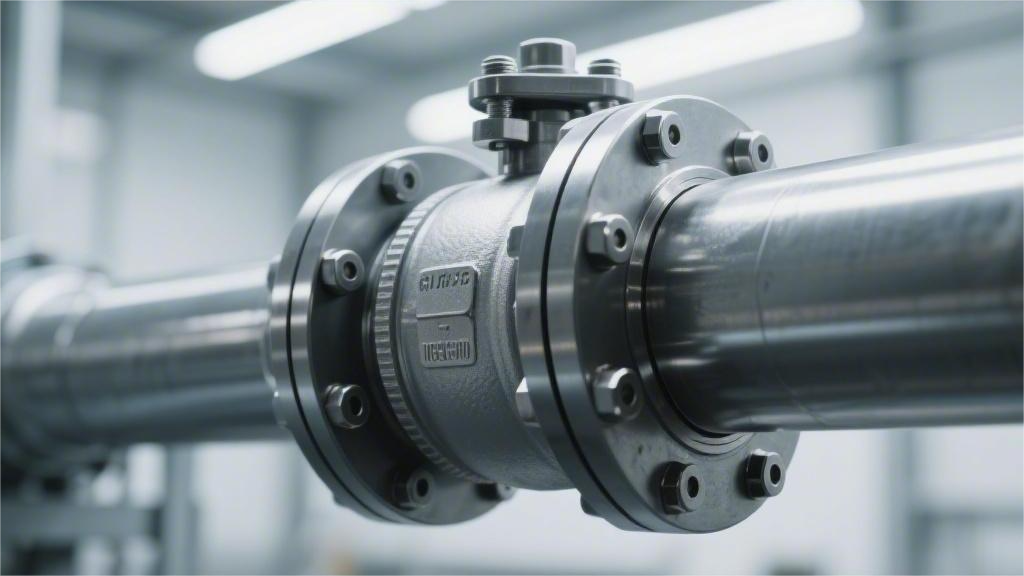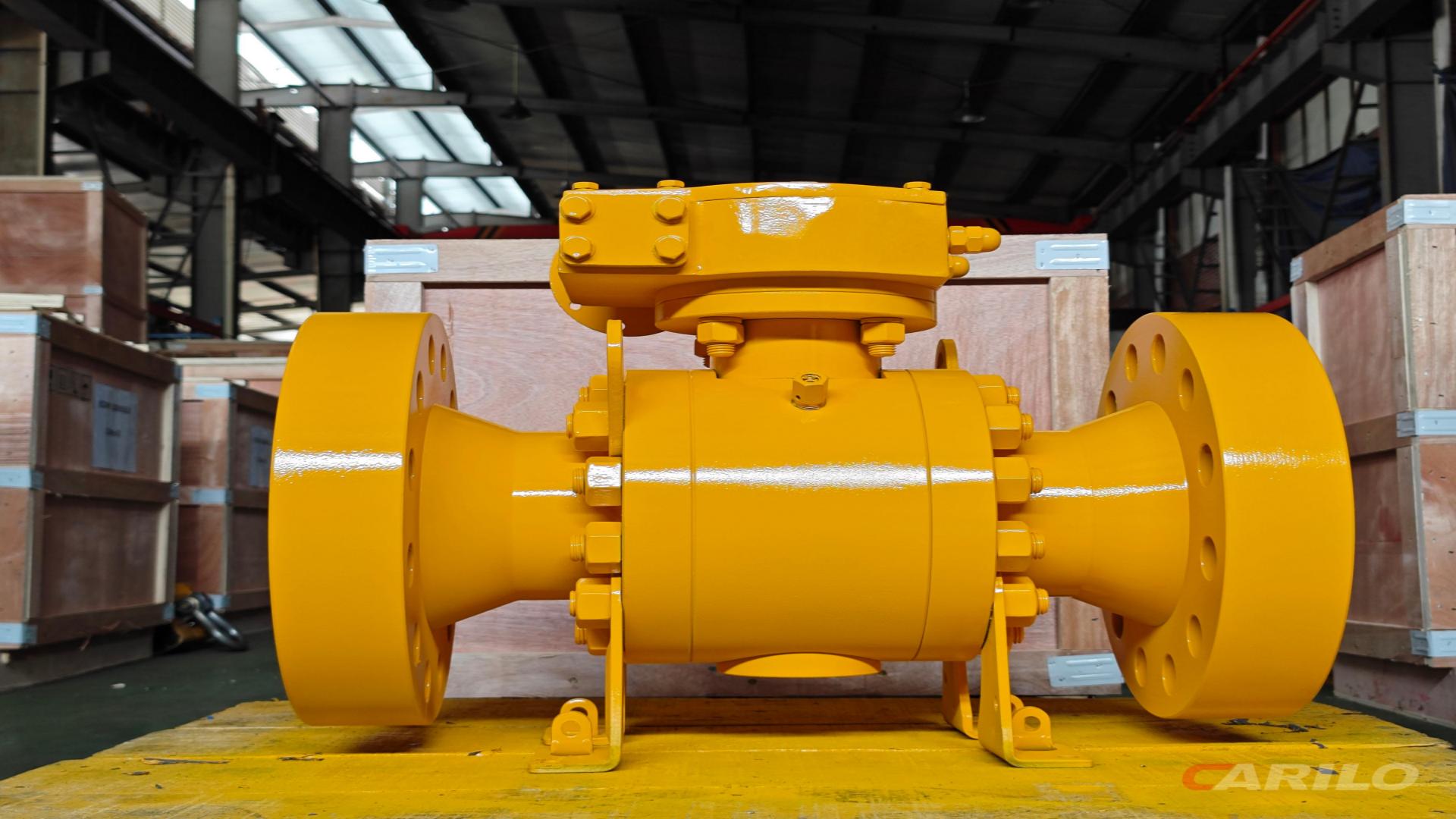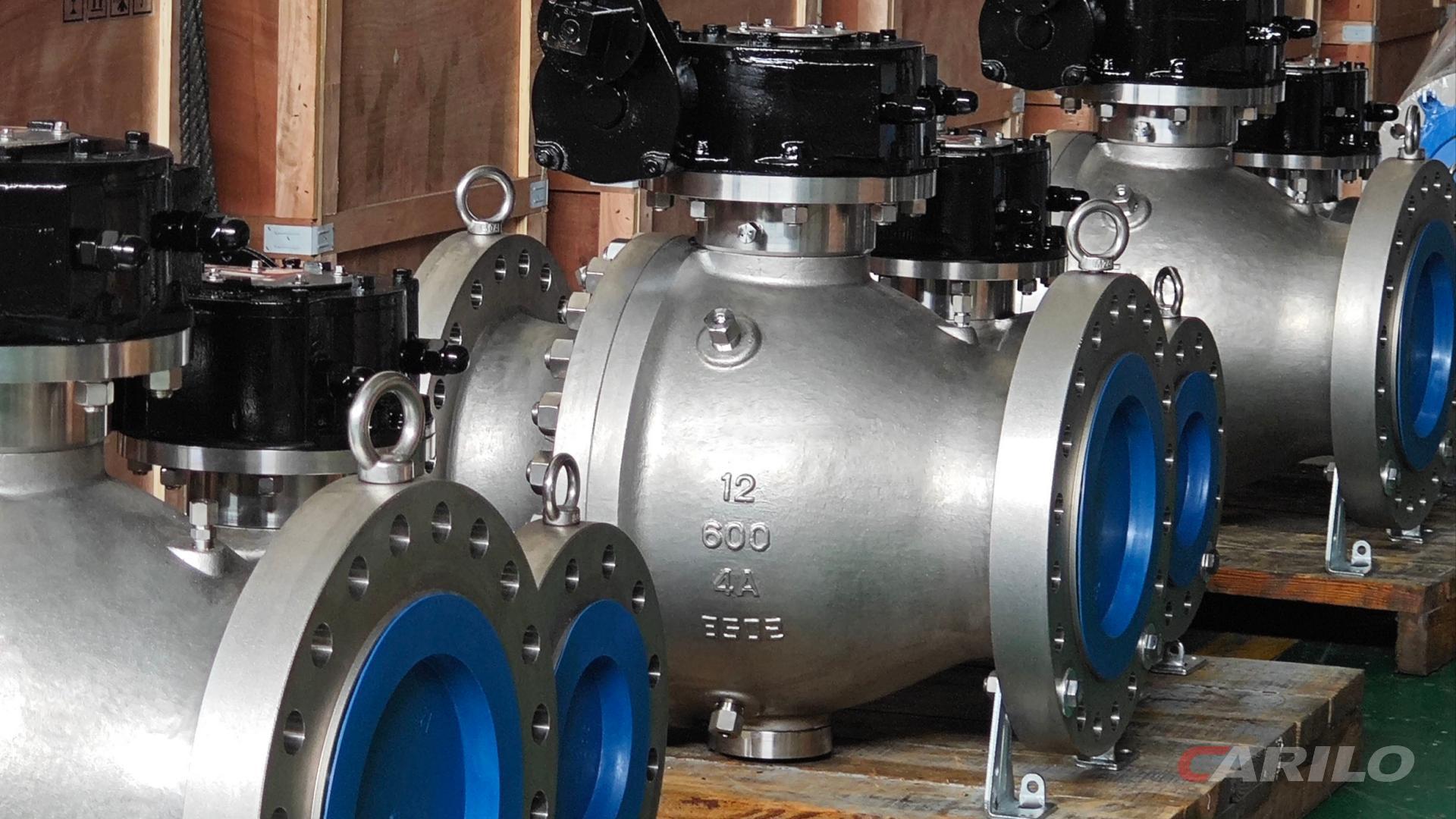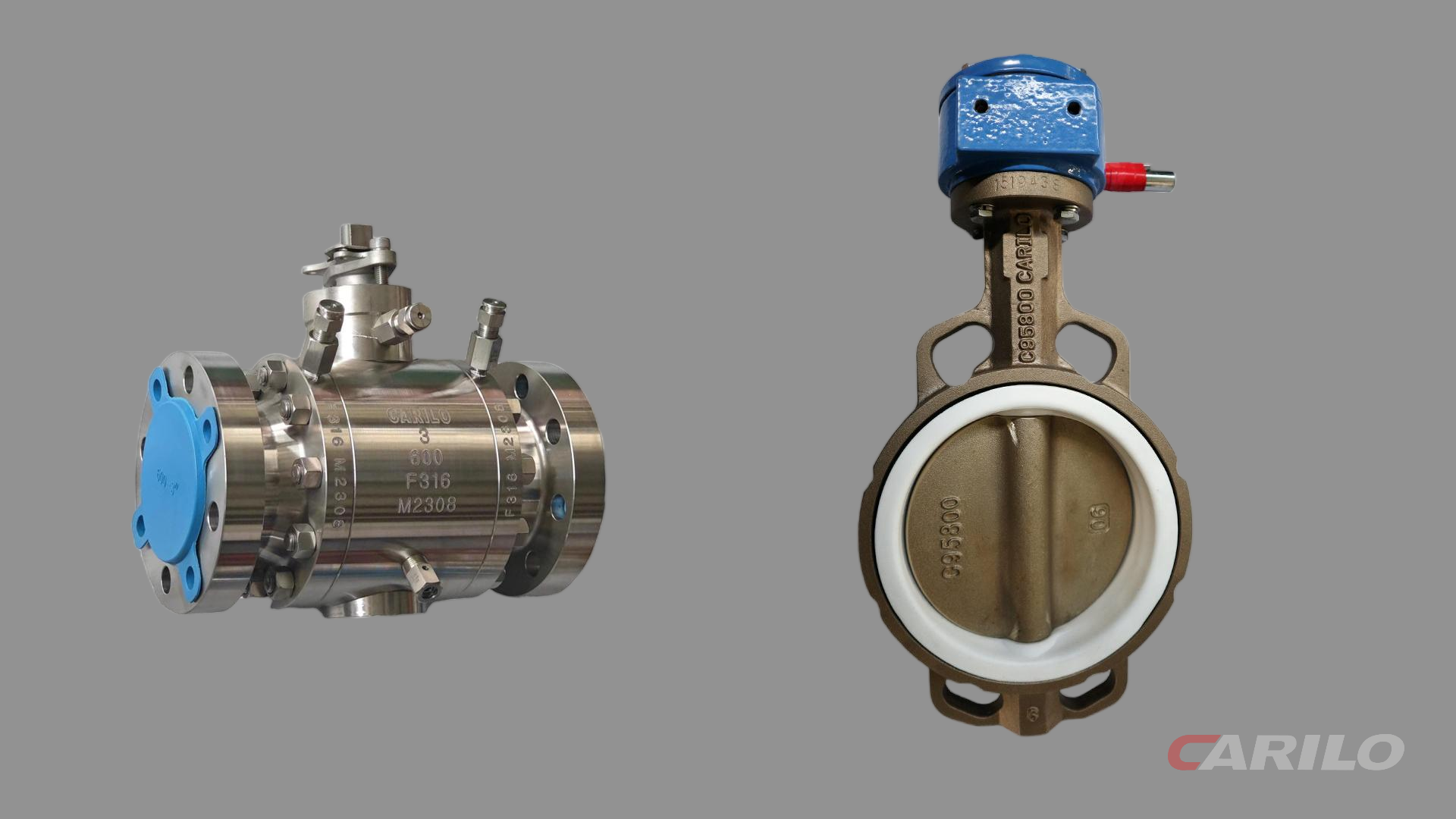
In chemical service, flanged ball valves can handle pressures up to 16 MPa, use PFA lining for strong corrosion resistance, and create virtually zero flow resistance.
Butterfly valves are only about one-third the face-to-face length of ball valves, making them far more space-efficient.
Both operate with a 90-degree turn, but ball valves excel at tight shutoff, while butterfly valves are better suited to large-diameter, low- to medium-pressure flow regulation.
corrosion resistance
When handling highly aggressive media such as 98% concentrated sulfuric acid or 30% hydrochloric acid, flanged ball valves are typically fitted with a full PFA lining of at least 3.5 mm, combined with zero-leakage sealing to API 598 standards.
By contrast, the disc of a butterfly valve remains immersed in the flow path at all times. Even when made from Hastelloy C-276, the stem seal area still faces a risk of seepage at pressures above PN16.
Data shows that fluorine-lined ball valves offer 25% better resistance to permeation than fluorine-lined butterfly valves. Their straight-through flow path also helps prevent localized pitting caused by media buildup.
Lining & Permeation Resistance
The inner cavity of a ball valve is typically cast with a 3 mm to 5 mm layer of PFA (perfluoroalkoxy). This material is introduced through high-temperature melt processing and reaches a density of about 2.15 g/cm³. Compared with cold-pressed PTFE (polytetrafluoroethylene), PFA has a tighter molecular structure, making it much harder for hydrogen ions as small as 0.1 nanometers to penetrate and reach the metal body underneath.
In vacuum pipelines, for example at pressures down to -0.8 bar, many lined valves can suffer from liner collapse. To prevent the lining from separating from the metal, the inner wall of a ball valve casting is machined with multiple dovetail-style recesses. During injection molding, the PFA locks directly into these grooves, much like an anchor bolt fixed into concrete. Butterfly valve seats are usually fitted into the body without this kind of mechanical locking structure, so under negative pressure or frequent cycling, the probability of liner displacement is roughly 30% higher.
The table below compares the physical anti-corrosion parameters of the two valve types:
| Performance Metric | Fluorine-Lined Ball Valve (Standard) | Fluorine-Lined Butterfly Valve (Standard) |
|---|---|---|
| Standard lining thickness | 3.5 mm – 5.0 mm | 2.5 mm – 3.5 mm |
| Processing method | Melt injection | Molding / encapsulation |
| Maximum working pressure | PN16 / PN25 | PN10 / PN16 |
| Vacuum resistance (150°C) | Full vacuum (-0.1 MPa) | Partial vacuum (-0.05 MPa) |
| Sealing surface width | 15 mm – 25 mm (large contact area) | 3 mm – 8 mm (line contact) |
Butterfly valves have one unavoidable drawback: the disc always sits in the middle of the pipeline. Even when fully open, the medium continues to scour the disc edge. If the fluid contains 1% fine particles, those particles act like sandpaper against the lining on the disc. Tests show that at a flow velocity of 4 m/s, the lining on a butterfly valve wears 2.5 times faster than that of a ball valve. In a fully open ball valve, the bore matches the pipe I.D., so the medium flows straight through without contacting the sealing surface.
The stem area is another common leak point. In a butterfly valve, the stem passes through the seat and depends on sealing at just two points. Every time the valve moves, the lining at the shaft head is compressed and deformed. When handling highly permeating media such as chlorine gas, the medium can work its way out along the stem gap. In a ball valve, the stem seal is located at the top and is continuously loaded by Belleville springs, providing a sealing contact stress above 20 MPa. Even if the lining experiences slight wear over time, the spring automatically compensates by pushing downward and keeping the gap closed.
- 10 kV spark testing: Fluorine-lined ball valves undergo high-voltage inspection before leaving the factory. Even a pinhole as small as 0.1 mm will be detected by electrical breakdown.
- Thermal expansion and contraction: The expansion coefficient of PFA is 8 to 10 times that of carbon steel. The ball inside the valve body has about 0.5 mm of movement clearance to absorb this deformation.
- Sealing class: Ball valves can easily achieve the gas-tight zero-leakage standard of API 598, while butterfly valves often develop seepage of 1-2 drops per minute at the sealing surface after long-term use.
Highly permeating organic solvents such as dichloromethane can cause fluoroplastics to swell. Ball valve seats are usually designed with compensation features, so even if the lining swells by 5% after absorbing solvent, the valve can still operate. In butterfly valves, the disc and seat are tightly compressed against each other. Once swelling occurs, the disc can seize, and forcing it open often twists off the stem.
If you compare total cost of ownership (TCO), the numbers are revealing. A DN100 fluorine-lined ball valve may cost about 50% more than a butterfly valve up front, but in severely corrosive process lines, the average maintenance interval (MTBM) for a ball valve is typically more than 36 months, whereas a butterfly valve may need seat replacement after just 12 to 18 months.
In actual assembly, the flange face of a flanged ball valve is also covered directly by the lining through a turned-over flange lip. That means the medium touches nothing but fluoroplastic from inlet to outlet. This structure is especially effective when handling 98% sulfuric acid, because it eliminates the possibility of medium leaking through the flange gasket area and corroding the external bolts. Butterfly valves can use a similar structure, but because the body is thinner, the lining at the flange lip is often only about 2 mm thick, making it easier to crack under heavy bolt loading.
The surface roughness of the ball in a ball valve is typically required to reach about Ra 0.2 μm. This mirror-like finish helps sweep acid off the lining surface completely during shutoff. This physical self-cleaning effect reduces how long acid remains on the sealing surface, lowering the risk of environmental stress cracking (ESC).
Fluid Erosion
Flanged ball valves use a full-bore design. Once open, the internal passage becomes a smooth cylinder with the same diameter throughout, giving the valve a very high Cv. For a DN100 ball valve, the flow coefficient is typically above 1000, so the fluid passes almost straight through without creating severe turbulence or lateral impact inside the cavity.
By contrast, the disc of a butterfly valve acts like a plate across the center of the flow path. Even at 90° full-open position, the fluid must flow around a disc that is roughly 15 mm to 30 mm thick. This geometry creates a strong Venturi effect around the disc edge, where local velocity can instantly rise to 2 to 3 times the average pipe velocity. If the average pipeline velocity is 3 m/s, the actual scouring velocity at the butterfly valve lining edge may reach 9 m/s.
Test data shows that when the medium contains 1.5% silica particles, wear on PTFE lining increases with the cube of flow velocity. After 500 hours at 5 m/s, the lining thickness at the disc edge of a butterfly valve drops from an initial 3.5 mm to about 2.8 mm, while under the same conditions, almost no measurable thickness loss is seen on the inner wall of a ball valve.
As fluid passes around the disc in a butterfly valve, it creates a large back-pressure recirculation zone. These vortices not only consume energy but also repeatedly strike the lining at the rear of the valve body. Under long-term high-frequency vibration and impact, fluoroplastic lining is prone to fatigue-related delamination. Because the flow path of a full-bore ball valve matches the pipe I.D. exactly, the internal flow field remains far more uniform, with the Reynolds number staying within a stable range, which greatly protects the physical integrity of the PFA lining.
| Erosion Factor | Flanged Full-Lined Ball Valve | High-Performance Fluorine-Lined Butterfly Valve |
|---|---|---|
| Typical flow coefficient (DN150) | Approx. 2400 | Approx. 600 – 800 |
| Maximum local velocity | Equal to pipeline velocity | More than 250% of pipeline velocity |
| Particle deposition risk | Very low (self-cleaning flow path) | Relatively high (dead zone behind disc) |
| Predicted lining erosion life | 60 – 80 months | 18 – 24 months |
When a valve is partially open for throttling, erosion becomes even more severe. At a 30° opening, a butterfly valve forces the medium through two narrow gaps above and below the disc. These jet streams create intense shear on the seat lining and often cause thermal deformation or tearing at the sealing line. Ball valves also generate local high velocity during throttling, but a V-port ball spreads the stress across a wider curved surface, reducing impact energy per unit area by about 40%.
During closure, the ball scrapes deposits off the lining surface, preventing crystalline particles from embedding into the seat under erosive flow. In a butterfly valve, the disc presses vertically into the seat. If hard particles remain on the surface, they are forced directly into the 3 mm PTFE layer, leaving permanent scratches and internal leakage paths.
On a phosphoric acid extraction line in a chemical plant, the average replacement interval for a DN200 fluorine-lined butterfly valve was only 7 months, because fluid erosion cut grooves as deep as 0.5 mm into the disc sealing edge. After switching to a flanged ball valve, the initial purchase cost rose by 65%, but the valve ran for 22 months without leakage, and maintenance labor costs dropped by more than 4 times.
At PN16 pressure, microbubbles generated by high-speed flow can collapse behind the disc and cause cavitation. The resulting instantaneous shock waves are strong enough to punch through standard lining that is only 2.5 mm thick. Because the flow path in a ball valve is smoother, the chance of bubble formation is about 70% lower than in a butterfly valve, and its lining shows much greater resistance to this kind of physical damage.
The table below records the force distribution on the lining surfaces of the two valve types at different openings (unit: N/mm²):
| Valve Opening | Stress on Ball Valve Sealing Surface | Stress on Butterfly Valve Disc Edge | Erosion Energy Difference |
|---|---|---|---|
| 10% open | 12.5 | 45.8 | 3.66 times |
| 50% open | 8.2 | 28.4 | 3.46 times |
| 90% open | 1.1 | 15.6 | 14.18 times |
In high-velocity chemical pipelines, a flanged ball valve behaves more like a protected section of pipe, while a butterfly valve behaves more like a target under constant attack. For applications requiring frequent cycling and media velocities above 4 m/s, the ball valve avoids more than 85% of lateral erosion simply through its geometry. That built-in structural advantage cannot be fully offset by material upgrades alone.
Structural Differences
A standard DN100 fluorine-lined ball valve typically has a face-to-face length of 229 mm under ASME B16.10. Inside the metal body is a PFA lining at least 3.5 mm thick, and total weight usually reaches about 35 kg to 40 kg.
By comparison, a butterfly valve of the same size is only about 52 mm thick and generally weighs just 7 kg to 9 kg. This major difference in size comes from the different closing member designs. A ball valve uses a hollow perforated sphere at the center, while a butterfly valve relies on a single disc about 15 mm to 25 mm thick.
Field installation data shows that in large pipe racks, such as DN300 and above, the self-weight of a ball valve places a substantial static load on the pipe support system. If a ball valve is used, support spacing often has to be reduced from 6 meters to 4 meters, while a butterfly valve usually does not require that kind of extra structural reinforcement.
The ball in a ball valve is tightly clamped by two PTFE seats, which function like two solid retaining walls. When the valve closes, pressure pushes the ball slightly toward the outlet side. This floating-ball structure can generate sealing contact stress of 15 MPa to 20 MPa. Even though the cavity is lined, there is still a dead space of about 500 ml to 1500 ml between the ball and the body.
That dead space can be troublesome when handling chemicals that crystallize easily, such as 32% caustic soda or sulfur. Residual media can accumulate in the cavity and jam the ball once crystallization occurs. Butterfly valves, by contrast, have no cavity dead space at all. The medium flows directly over the disc and seat. Although the disc blocks about 15% of the flow area, butterfly valves are less likely to trap residue.
As for how the internal “plastic skin” is anchored:
- The inner wall of a ball valve is machined with dense dovetail grooves about 3 mm deep, allowing the PFA to lock in during injection molding.
- The ball surface is also typically drilled with many small holes about 4 mm in diameter to prevent the plastic layer from separating under high-temperature differential expansion.
- This mechanical locking structure can withstand full vacuum suction of -0.09 MPa without liner collapse.
- In butterfly valves, the seat is usually installed as an independent liner or insert directly into the body, without this level of mechanical interlock.
The stem design is another major dividing line. In a ball valve, the stem is separate from the ball and sealed by a top-mounted V-ring packing set. This packing group usually consists of 5 to 7 layers of PTFE rings, continuously loaded by top-mounted Belleville springs. Even after 5000 cycles and 0.1 mm of wear, the spring automatically compensates by pushing the packing down and preventing acid from escaping along the stem.
In a butterfly valve, the stem passes directly through both the disc and the seat, creating two dynamic sealing points, top and bottom. This design requires the clearance between the stem and the seat to be controlled within 0.05 mm. But when operating pressure exceeds 1.0 MPa, the disc can deflect slightly under load, causing periodic lateral squeezing at the shaft seal area.
From the standpoint of operating torque:
- A ball valve opens and closes by sliding the ball against the seats, which creates high friction torque and requires a larger actuator.
- A butterfly valve works by pressing the disc edge into the seat, so starting torque is highest at the beginning and then drops quickly.
- For a DN200 valve, the required driving torque of a ball valve is often 3 to 4 times that of a butterfly valve.
- As a direct result, the pneumatic or electric actuator used in automated service also has to be substantially larger on a ball valve.
The flange connection on a ball valve is usually fully lined, meaning the PFA is turned over directly onto the flange sealing face. With a lip thickness of around 3 mm, the valve effectively carries its own built-in gasket. When connecting to pipe flanges, you only need to tighten 8 to 12 bolts evenly to a torque of 80 Nm to 120 Nm to achieve the gas-tight standard of API 598.
Because butterfly valves have a narrow body, their flange bolts often pass through the entire assembly in a wafer-style configuration. These long bolts experience much more thermal expansion in outdoor service with large temperature swings than the short bolts used on ball valves. Once a bolt elongates by just 0.05 mm, the contact pressure on the butterfly valve sealing surface can drop sharply, increasing the risk of external leakage.
The machining precision of the ball surface is a key durability factor. In high-end ball valves, the roundness tolerance is controlled within 0.02 mm, and the surface finish reaches Ra 0.2 μm. This mirror finish, together with the PTFE seats, reduces the coefficient of friction to below 0.05. Butterfly valve discs may also be polished, but because they are disc-shaped, it is much harder to achieve the same lining thickness uniformity at the edges as on a spherical surface.
In high-pressure pipelines rated PN16, ball valves usually incorporate an anti-blowout stem at the bottom. Even if the packing gland fails unexpectedly, the internal shoulder of the stem remains trapped by the valve body lining. Butterfly valve stems operate under more complex stresses. In 150°C service, the pin or square key connection between the stem and disc can develop torsional play of about 0.5°.
flow control
For a full-port ball valve in DN100 size, the Cv value is typically above 1000, with an equivalent length L/D of less than 3, making it almost equivalent to a straight run of pipe.
A triple-offset butterfly valve of the same size has its disc occupying about 20% of the flow area, reducing its Cv value to around 450-600.
The typical rangeability of a ball valve is about 50:1, while a V-port ball valve with a high-performance positioner can reach 300:1. Butterfly valves show better equal-percentage characteristics mainly between 20° and 70° open.
Pressure Loss
In a DN150 full-port flanged ball valve, the internal flow passage matches the pipe I.D. completely, allowing the resistance coefficient (K value) to remain around 0.05. By contrast, in single-offset or double-offset butterfly valves of the same size, the disc center thickness occupies 18% to 25% of the flow cross-section.
The conversion of fluid kinetic energy into heat is much more pronounced in butterfly valves. When flow velocity exceeds 5 m/s, the separation zone created at the disc edge produces large-scale vortices. This turbulence makes the pressure distribution extremely uneven over a downstream length of 8 to 12 pipe diameters. The smooth internal surface of a ball valve reduces boundary-layer friction, and its energy loss is only about 1/10 that of a butterfly valve at the same flow rate.
| Performance Metric | Full-Port Ball Valve (DN200) | High-Performance Butterfly Valve (DN200) | Reduced-Port Ball Valve (DN200/150) |
|---|---|---|---|
| Resistance coefficient (K) | 0.04 – 0.07 | 0.65 – 1.30 | 0.25 – 0.45 |
| Equivalent pipe length (L/D) | 3 | 25 – 45 | 12 |
| Maximum allowable velocity | 12 m/s | 7 m/s | 9 m/s |
High-viscosity media such as polymers above 500 cP are especially sensitive to flow path geometry. The full-flow design of a ball valve prevents shear stress from developing in seat recesses. In a butterfly valve, a dead zone forms behind the disc, causing actual pressure drop to run about 15% higher than theoretical values. When handling slurry containing 3% by mass solid particles, the upstream face of the butterfly disc is continuously eroded, and changes in dynamic pressure can trigger flow-induced vibration near a 60-degree opening.
From a fluid dynamics standpoint, the pressure drop (delta P) across a butterfly valve increases with the square of the flow rate. In a Class 300 pressure line with an inlet pressure of 4.0 MPa, the pressure loss through a butterfly valve can reach 0.05 MPa. A ball valve keeps the pressure at about 3.98 MPa. In multistage continuous reaction processes, this small pressure advantage helps maintain stable laminar flow into downstream restriction orifice plates.
delta P = K * (rho * v^2) / 2
When a liquid with a density of 1000 kg/m3 flows at 3 m/s, the local resistance loss through a ball valve is only about 225 Pa. Under the same conditions, the loss through a butterfly valve jumps to around 4500 Pa. In a plant producing 200,000 tons per year, that difference translates into tens of thousands of dollars on the electricity bill. Ball valves use Ra 0.4 μm mechanical polishing on the inner wall to reduce boundary-layer drag, while the complex geometry of a butterfly disc makes comparable flow compatibility much harder to achieve.
Under high differential pressure, flashing is more likely to occur in the narrowed flow section of a butterfly valve. When local pressure drops below the medium’s saturation vapor pressure at operating temperature, bubble formation and collapse can damage the disc edge. A ball valve distributes pressure drop over a longer internal flow path through its segmented seat design. In a 150°C heat-transfer oil system, the flow stability of a ball valve is about 40% better than that of a butterfly valve because it has no internal element like a disc forcing the flow to change direction abruptly.
For large utility pipelines above DN500, butterfly valves do have higher flow resistance, but their overall cost-effectiveness improves as size increases. In precision chemical synthesis sections, users usually accept the higher initial cost of ball valves in exchange for pressure-loss behavior approaching 0. Even at a small opening of 15%, a V-port ball valve still concentrates flow into a relatively defined jet, unlike a butterfly valve, which produces scattered turbulence around the entire disc perimeter.
Measured Cv data confirms the step change between the two. In ANSI testing, a DN250 ball valve can reach a Cv of 11000. Even high-end butterfly valves with thin-disc designs struggle to exceed 4500. For the same process flow requirement, a ball valve allows a smaller pump motor. When handling flammable and explosive liquefied gases, lower flow resistance also reduces friction frequency between the fluid and the internal valve wall.
The Reynolds number (Re) fluctuates sharply as flow passes a butterfly disc, jumping suddenly into the 10^5 range and increasing the likelihood of acoustic induced vibration (AIV). The pressure recovery coefficient Fl in a ball valve is generally above 0.85, while in butterfly valves it varies between 0.55 and 0.70. This shows that ball valves have an inherent structural advantage in recovering kinetic energy and suppressing cavitation.
In long-term operating tests, the full-port structure of a ball valve changes the fluid shear rate by less than 5%. In a butterfly valve, the shear force at the edge of the flow passage is more than 4 times that at the center due to the presence of the disc. For shear-sensitive chemical fluids, this non-uniform force field can alter molecular chain structure and reduce finished-product yield.
Control Accuracy
At an opening of only 5%, a V-notch flanged ball valve still maintains a precise geometric flow path, allowing it to hold flow error within 1.5% during low-flow control. By contrast, when a standard butterfly valve is opened less than 15 degrees, fluid velocity at the disc edge can spike above 35 m/s, damaging the sealing surface and causing major flow instability.
The ball in a ball valve is typically machined with a 30-degree, 60-degree, or 90-degree V-notch. This design meets the equal-percentage characteristic requirements of ISA-75.11. Across the full stroke, the turn-down ratio of a V-port ball valve can easily reach 300:1, far above the 50:1 typical of high-performance butterfly valves.
In a typical Class 300 chemical pipeline, if inlet pressure fluctuates within 0.5 MPa, a V-port ball valve equipped with a digital positioner can keep downstream flow variation within 0.2% of rated value. Because the ball maintains continuous shearing contact with the seat, it can handle media containing 2% polymer particles without losing control the way a butterfly valve can when particles jam along the disc edge.
- A ball valve covers the full flow curve within a 90-degree rotation, and the flow change per 1 degree of movement remains highly consistent.
- In high-performance butterfly valves, once the opening exceeds 70 degrees, the increase in Cv becomes very slow, effectively compressing the useful control stroke into the range from 20 degrees to 70 degrees.
- At small openings, the unbalanced torque on a butterfly disc can cause pronounced jumping behavior. Even if the positioner output changes by only 0.1 mA, the valve may suddenly lurch open or closed.
- The torque acting on a ball valve stem remains relatively constant throughout the control range, reducing the negative impact of actuator deadband on control accuracy.
As flow passes through a V-port ball valve, the stream remains concentrated in the center of the passage, reducing erosion on the valve wall. Under high differential pressure control, the internal pressure recovery coefficient Fl stays around 0.9, which helps suppress cavitation. In a butterfly valve, the disc splits the flow into two streams, and the localized low-pressure zone on the downstream side is highly prone to flashing, which degrades control precision.
Measured data under ASME B16.34 shows that a DN100 V-port ball valve has a Cv of about 180 at 50% open. For every additional 10% of opening, the Cv increases by roughly a logarithmic factor of 1.6. This high level of consistency makes PID tuning much easier and helps the system avoid frequent oscillation under changing process conditions.
Butterfly valves rely entirely on contact between the disc edge and the seat. In control duties involving differential pressure above 1.0 MPa, the disc can shift slightly along the axial direction. This causes non-linear deviation in the flow characteristic, pushing actual flow more than 5% away from the design curve.
- A ball valve fitted with a 0.5% accuracy positioner typically keeps hysteresis below 0.3%.
- Due to the special geometry of the sealing pair, a triple-offset butterfly valve must overcome very high static torque at the start of movement, which makes its initial control point less distinct.
- For precision additive dosing lines, a 1/2-inch ball valve can achieve titration-level control that is beyond the physical limits of butterfly valve geometry.
- In high-temperature service at 260°C, thermal expansion of a metal-seated ball valve has less impact on control accuracy than thermal distortion of a butterfly disc.
When medium velocity fluctuates around 3 m/s, the dynamic torque acting on a butterfly disc can reverse direction as the opening increases, a phenomenon known as negative torque. This sudden torque reversal interferes with actuator logic and causes the positioner to keep correcting itself around a 65-degree opening.
According to durability testing under ANSI/ISA-75.19, after 100,000 control cycles, the control deviation of a V-port ball valve increases by only 0.15%. By comparison, wear on the shaft pin of a butterfly valve caused by frequent vibration in turbulent flow can more than double the control deadband, directly reducing downstream process stability.
The symmetrical flow path in a ball valve reduces downstream turbulence intensity, allowing a flowmeter installed just 5 pipe diameters downstream to obtain accurate feedback. The asymmetric flow field produced by a butterfly valve usually requires at least 15 pipe diameters of straight pipe to dissipate turbulence. Where installation space is limited, the ball valve contributes less system error to the overall control loop and helps preserve closed-loop accuracy between the flowmeter and the actuator.
- When handling gas at Class 150 pressure, the linear control error of a V-port ball valve is less than 1%.
- In large-diameter water regulation above DN600, butterfly valves may offer better economics, but their control accuracy typically stays around 5%.
- In fine chemical applications that require 1% control increments, ball valves provide a much stronger physical relationship between rotational travel and actual flow output.
- Because the mass distribution of the ball is uniform, control performance deviation in vertical pipe installation is about 30% lower than with butterfly valves.
Fine fibers in the medium can wrap around the support shaft of a butterfly disc, distorting the flow path and reducing control accuracy. The shearing action of a ball valve can cut through these fibers during regulation, keeping the passage clean and geometrically stable. In production lines for crystallization-prone chemicals such as pesticides and dyes, this self-cleaning ability is an important factor in keeping process parameters consistent.
Dynamic Stability
When flow velocity exceeds 6 m/s, the separation zone behind a butterfly disc causes pressure pulsation to rise sharply, especially between 20 degrees and 60 degrees open. This unsteady flow field can induce high-frequency oscillation of the disc itself, which is transmitted through the shaft to the actuator and causes continuous low-amplitude hunting in the positioner during 4-20 mA signal control.
Ball valves have a natural structural advantage in dynamic stability, especially in full-port designs that minimize flow separation. As the medium passes through the ball, the boundary layer stays near the pipe wall instead of being forced into two streams around a disc. Under Class 300 pressure conditions, turbulence intensity through a full-port ball valve is typically below 5%, which keeps the radial load on the stem highly stable during control.
- A butterfly valve can experience torque reversal near a 75-degree opening, where hydrodynamic torque suddenly changes from the opening direction to the closing direction.
- In a triple-offset butterfly valve under 1.5 MPa differential pressure, a deformation of only 0.05 mm in the shaft pin can trigger high-frequency hammering noise at the sealing surface.
- At certain flow velocities, the Strouhal number of a butterfly valve can trigger acoustic induced vibration (AIV), with sound levels potentially exceeding 110 dB.
- The pressure recovery coefficient Fl of a ball valve stays above 0.85, allowing it to recover most of the kinetic energy at the outlet and reduce downstream pressure pulsation.
- Trunnion-mounted ball valves use upper and lower bearing support, so even under a high differential pressure of 4.0 MPa, offset of the ball centerline remains limited to the micron level.
This difference in stability becomes even more obvious when handling flashing-prone media such as liquefied petroleum gas (LPG). Because local velocity at the edge of a butterfly disc can be as much as 2.5 times the average flow velocity, pressure there can easily fall below saturation vapor pressure. The collapse of bubbles behind the disc can generate local impact forces as high as 200 MPa. These dynamic loads not only damage metal surfaces but can also trigger mechanical resonance throughout the valve assembly and shorten the service life of associated instruments.
In a flanged ball valve, the seat is pressed tightly against the ball by preload springs or process pressure, creating a built-in damping system. When water hammer or transient pressure waves occur, the ball remains firmly constrained within the annular seat track and does not develop the angular displacement seen in butterfly discs. Under vibration response testing based on ANSI/ISA-75.13, the acceleration response of a ball valve over the range of 2-2000 Hz is more than 40% lower than that of a butterfly valve.
- The torque on a ball valve stem is approximately linear with flow velocity, without the sudden torque spikes seen in butterfly valves.
- At 100% load, the equivalent pipe length L/D of a full-port ball valve is only 3, so it barely affects the natural frequency of the piping system.
- In media with viscosity around 500 cP, the structural stiffness of a butterfly disc is more prone to creep stress, causing a sharp decline in control step accuracy.
- In DN300 pipeline testing, the amplitude of downstream static pressure fluctuation produced by a ball valve is only about 15% of that produced by a butterfly valve.
In continuous chemical production, the dynamic response of a valve must match the process control loop. Butterfly valves have a larger control dead zone, and the disc also carries greater inertia under fluid resistance, so response delay is usually about 200 ms longer than that of a ball valve of the same size. For emergency shutoff or precision blending that requires second-level response, the ball in a ball valve has its center of gravity on the shaft axis and a more even inertia distribution, which narrows the difference between breakaway torque and running torque and ensures smoother action.
The flow pattern through a ball valve is symmetrical, eliminating lateral unbalanced force on the stem. In a butterfly valve, the pressure differential across the disc increases exponentially with velocity during throttling, and this side thrust accelerates one-sided wear on the stem bushing. In continuous monitoring over 4000 hours of operation, the sealing integrity retention of a ball valve packing box is usually about 30% higher than that of a butterfly valve, precisely because the ball valve avoids the damage that side vibration can inflict on the sealing structure.
In nitrogen systems with flow velocity reaching 10 m/s, if the Kármán vortex shedding frequency behind a butterfly disc coincides with the natural frequency of the valve stem, shaft failure can occur almost instantly. By fully enclosing the flow path inside the ball, a ball valve eliminates external vortex excitation on the closure member. In ASME B16.34 type testing, the fatigue life of high-pressure ball valves is often 3 to 5 times that of butterfly valves, directly reducing the frequency of unplanned shutdowns.
The coupling between valve opening and fluid dynamic force determines long-term control quality. A butterfly valve produces its strongest throttling effect around 30% open, but that is also when the disc edge sees the highest shear stress. Ball valves, especially V-port ball valves, spread pressure drop more evenly across the entire flow section as opening changes progressively. Test data shows that under a pressure drop of 2.0 MPa, the fluctuation of actuator air supply pressure in a ball valve loop is 0.02 MPa lower than in a butterfly valve loop, showing that the actuator carries a lighter load when balancing dynamic forces.
installation space
Under ANSI B16.10, a DN300 (12″) Class 150 butterfly valve typically has a face-to-face length of about 114 mm, while a flanged ball valve of the same size reaches about 610 mm, making it nearly 5.4 times longer.
Because the butterfly valve body is much thinner, its weight is only about 20% to 30% of that of a ball valve.
This size difference allows butterfly valves to reduce horizontal layout space by more than 40% in compact pipe racks and also lowers the static load requirement on pipeline supports.
Structure & Piping
Take a DN250 (10-inch) Class 150 valve as an example. A flanged ball valve spans about 457 mm from end to end, while a wafer butterfly valve is only about 68 mm thick. That 389 mm of saved space creates real flexibility in crowded chemical plant pipe racks. In a straight run of pipe only 2 meters long, where one ball valve would fit, using butterfly valves could allow 3 control valve assemblies with bypass lines to be installed side by side.
The wall thickness of the cast body reflects pressure resistance. A ball valve cast from ASTM A216 WCB carbon steel typically has more than 25 mm of wall thickness around the central ball. That heavy metal shell can withstand liquid impact forces at the 5.0 MPa level. A butterfly valve, by contrast, has a thin-body structure, and internal pressure is borne largely by a ring of rubber or metal sealing material. In Class 300 high-pressure lines, the flange faces at both ends of a ball valve are usually 8-12 mm thicker than those of a butterfly valve.
| Specification (DN200 / 8″) | Flanged Ball Valve | Wafer Butterfly Valve |
|---|---|---|
| Face-to-face length (mm) | 457 | 60 |
| Unit weight (kg) | 170 | 35 |
| Connection fasteners (sets) | 16 (short bolts) | 8 (through bolts) |
| Pneumatic mounting pad (ISO) | F12/F14 large flange | F10/F12 small flange |
A DN300 full-port ball valve can weigh about 380 kg on a scale. Before welding it into the line, workers usually have to fabricate and weld an H-beam support frame underneath it. A butterfly valve of the same size weighs less than 90 kg bare. Two pipefitters can simply sling it with rope, lift it into position, and let it hang between the pipe flanges without any issue.
Raw-material transfer lines in chemical plants are often routed on pipe racks 6 meters above ground. Structural engineers calculating support loads find that the eccentric weight added by butterfly valves is about 70% lower than that of ball valves. As a result, the transverse I-beam supporting the line can often be downsized from a heavy W12x65 section to a lighter W8x31. Across kilometers of pipe rack, the steel savings become substantial.
The bore of a DN150 ball valve is exactly about 152 mm, so the liquid flows through without obstruction. In a butterfly valve, a shaft and metal disc always cut across the center of the pipe. Even when fully open to 90 degrees, the disc still occupies about 12% of the flow area.
| Internal Flow Characteristic | Full-Bore Ball Valve | Double-Offset Butterfly Valve |
|---|---|---|
| Cv capacity (DN200) | 8900 | 2300 |
| Flow passage shape | 100% open circular bore | Crosswise metal disc in the center |
| Flow smoothness | Smooth flow with no swirl | Noticeable vortex behind the disc |
To maintain sufficient pressure at the end of a line, the upstream pump must be run at higher power. Replacing a continuously operating line with full-port ball valves can save roughly 2% of the total line power cost over a year.
As the ball rotates inside the spherical cavity, it leaves a closed annular gap. In a DN100 valve, that gap can hold about 1.5 L of residual liquid. If the line is carrying liquid chlorine and the system shuts down, that 1.5 L remains trapped inside. Under daytime solar heating, the metal body temperature rises and the trapped liquid expands, causing local pressure to surge from 2.0 MPa to more than 15 MPa. That is why manufacturers usually drill a 3 mm pressure relief hole above the ball.
The design of a butterfly valve eliminates the internal cavity. Both sides of the disc remain exposed to the main flow all the time. Once closed, it forms a flat wall with no hidden dead spaces. In chemical plants, when the line is switched to a different product and must be flushed with water, this smooth, open internal geometry saves both water and time. Cleaning a butterfly valve section with a high-pressure water gun typically takes about 30% less time than cleaning a ball valve section.
The bolt-and-nut arrangement is also part of the space requirement. A flanged ball valve has a full flange at each end, and workers tighten both sides using 16 to 20 short bolts. A wafer butterfly valve is installed like a sandwich. Workers use 8 long, heavy full-thread studs that pass through the left pipe flange, the butterfly valve in the middle, and the right pipe flange in one shot.
- Short bolts under load (ball valve): Each bolt is very short. In a hot oil line at 200°C, thermal elongation stays below 0.1 mm, so the gasket remains tightly compressed over time.
- Long through-bolts (butterfly valve): Each stud is more than 250 mm long. After the pipeline heats up, the stud elongates and loosens more noticeably, so 4 Belleville washers are often added to absorb the deformation.
- Installation feel: With only half as many long studs, workers can tighten in a diagonal sequence with a large wrench and more easily balance the load on both sides.
A spring-return pneumatic actuator is mounted on top of the valve body. In a ball valve, the spherical element is pressed tightly against the PTFE seats, so rotation takes significant effort. Opening a DN200 ball valve requires a pneumatic actuator delivering around 800 Nm of torque. In a butterfly valve, the shaft is offset slightly to the side, avoiding much of the friction, so opening torque is only about 300 Nm.
Because the torque requirement is lower, the actuator can also be smaller. The actuator on top of a ball valve can weigh about 60 kg and rise 500 mm above the line like a small steel tower. The cylinder matched to a butterfly valve weighs only about 25 kg. Where two insulated process lines are stacked with only 400 mm of vertical clearance between them, the bulky, tall ball valve simply does not fit, so a lower-profile butterfly valve becomes the only practical option.
Once the pipe is wrapped with a 50 mm thick rock wool insulation layer, disassembly becomes much more difficult. To service a ball valve, all bolts at both ends must be removed, and a chain hoist rated at two tons is needed to lift away a block of iron weighing several hundred kilograms. On a butterfly valve, workers only need to loosen the nuts half a turn. By inserting a pry bar into the flange joint and levering downward, they can create a 20 mm gap and slide out the thin metal body to replace the sealing ring.
Weight & Support
A carbon steel flanged ball valve in DN400 (16-inch) Class 300 service weighs around 1250 kg. A high-performance double-offset butterfly valve of the same size, including the handwheel, weighs only about 210 kg. That difference of 1040 kg becomes a very real challenge for site construction teams.
Installing a large ball valve usually requires the contractor to rent a 5-ton mobile crane. In the tight geometry of a chemical plant pipe rack, crane reach is heavily restricted, and a crew may manage to set only 2 units in a full day. With butterfly valves, two pipefitters wearing fall protection can stand on temporary scaffolding and complete the assembly using only a 500 kg chain hoist.
The deflection of outdoor pipe rack beams is calculated under ASME B31.3. If a one-ton ball valve is suspended between two I-beams spanning 6 meters, the local concentrated load becomes very high. Structural engineers running the support model often find that the main load-bearing beam below it must be upgraded to a larger wide-flange section.
- Beam downsizing: Heavy W16x89 sections can be replaced with lighter W10x45 sections.
- Foundation excavation: The embedded base pit below a ball valve installation can be as deep as 1.2 meters.
- Steel tonnage: Steel consumption can be reduced by about 3.5 tons for every 100 meters of outdoor pipe rack.
- Lifting schedule: Daily installation output can increase from 2 units to 6 units.
If a 1250 kg ball valve is welded into the line without proper support, the flanges at both ends may crack under the tensile load. Drawings usually add a stanchion with a base plate directly beneath the valve body. Workers then weld a 20 mm thick carbon steel plate under the heavy cast-steel body and attach an 8-inch wide seamless pipe as a support leg.
In hot oil lines subject to severe thermal expansion and contraction, the foot of this support leg also needs a sliding friction plate coated with PTFE. Shutoff valves installed near the outlet of a centrifugal pump are especially close to the pump casing, and API 610 places very strict limits on allowable pump nozzle loads.
A DN250 full-port ball valve weighs around 450 kg. If that entire downward force is borne directly by the pump casing, long-term operation can cause shaft misalignment and create tiny notches on the mechanical seal faces, leading to leakage of harmful VOC emissions.
- Pump nozzle bending moment: Static gravity load can be reduced by 80%.
- Bearing vibration: It can drop from the alarm threshold of 4.2 mm/s to around 1.5 mm/s.
- Mechanical seal wear: Average seal-face life can be extended by 14 months.
- Alignment time: Laser alignment time can be cut from 4 hours to 45 minutes.
Large ball valves are often fitted with a Scotch Yoke actuator as long as 1.5 meters. The actuator alone can weigh 300 kg. The total valve assembly can approach 1.6 tons, with its center of gravity shifted well away from the pipe centerline. During seismic table testing, this top-heavy structure creates severe eccentric torsional loading.
In CAESAR II piping stress analysis reports, nodes containing ball valves are often flagged in red. Stress engineers can spend days adjusting support positions, adding a spring hanger 1.5 meters upstream of the valve and a restraint frame another 2 meters downstream.
The total weight of a butterfly valve plus actuator is not much different from that of a solid steel pipe section of the same length. As a result, software analysis of butterfly valve piping usually runs much more smoothly, without the need for special support arrangements. When large-diameter valves are throttling in half-open positions, the high-frequency vibration from high-pressure water is transmitted downward through the body.
The metal rigidity of a heavy ball valve is so high that vibration at several hundred hertz is transferred almost directly into the support base. Over time, A325 high-strength bolts connecting the support steelwork can suffer fatigue loosening. The slimmer butterfly valve body behaves more elastically between the pipe flanges and, together with rubber expansion joints on both sides, can absorb part of the water hammer shock wave.
- Anchor locking: Use double nuts plus cotter-pin locking holes.
- Base inspection: Full-penetration weld root passes with 100% magnetic particle testing (MT).
- Flange tightening: Use a calibrated torque wrench and tighten uniformly to 400 Nm.
- Cushion washers: Insert 3 mm thick Garlock reinforced graphite sheet.
In vertical piping, gravity acts directly downward along the pipe. If a 1.2-ton ball valve is installed on a vertical run 15 meters high, the 90-degree elbow below it has to bear a massive compressive load. Civil crews usually have to pour a plain concrete pedestal measuring about 1.5 m × 1.5 m × 1.5 m at the bend.
Two 1-1/4 inch U-bolts are then driven into the pedestal to clamp the pipe firmly in place. If that is replaced with a 210 kg butterfly valve, a few standard pipe clamps fixed to the outer wall are often enough to prevent downward slip.
Operation & Maintenance
When operators turn the handwheel on the pipeline, the difference in resistance at the shaft is immediately obvious. A DN250 Class 300 carbon steel ball valve can require an initial breakaway torque close to 1200 Nm at room temperature. A high-performance double-offset butterfly valve of the same size peaks at only about 450 Nm on a torque wrench.
The gearbox reduction ratios are on completely different levels. A ball valve is often fitted with a heavy-duty worm gearbox at a ratio of 80:1, and the operator may need to turn the 400 mm handwheel about 20 turns to complete the stroke. A butterfly valve typically uses a lighter 40:1 gearbox, and 10 turns clockwise is enough to complete the full 90-degree travel.
Once connected to plant instrument air at 80 psi (about 5.5 bar), the size difference between the actuators becomes obvious. A ball valve may carry a Bettis Scotch Yoke actuator nearly 2 meters long, consuming about 18 liters of compressed air per cycle.
- Actuator weight: A heavy Scotch Yoke pneumatic actuator can approach 150 kg.
- Stroke time: Full close takes 12 seconds to avoid water hammer.
- Backup air supply: A single ball valve often requires a 50 L air receiver.
- Rack & pinion: An aluminum rack-and-pinion actuator weighs less than 45 kg.
The actuator above a butterfly valve can be kept within 0.5 meters in length and uses only about 6 liters of air per stroke. In a chemical plant with 200 automated valves, that reduction can allow the main air supply header in the compressor house to be downsized from 3 inches to 1.5 inches.
API 6D requires pipeline shutoff action to be smooth and free from sticking. Within the torque range below 500 Nm, a standardized double-acting aluminum actuator can cover nearly 85% of butterfly valve drive requirements, reducing the number of actuator models on the procurement list.
During a plant turnaround, the complexity of flange disassembly becomes very clear. A DN300 flanged ball valve may be secured with 32 alloy steel studs, each 1 inch in diameter. Maintenance technicians using a Hytorc hydraulic torque wrench at a set torque of 500 Nm can spend 45 minutes just loosening the nuts.
Removing a 1-ton ball valve from a pipe rack is a major operation. The upper rack structure must leave at least 800 mm of vertical clearance for a chain block, and adjacent scaffolding has to be built extra wide to create a 1.5-meter horizontal work corridor.
A wafer butterfly valve sits between two ANSI flanges. After loosening half the through-studs, workers insert an Enerpac hydraulic spreader into the flange gap and pump in hydraulic oil at 10,000 psi. The pipe flanges on both sides slowly separate by about 25 mm.
- Side extraction: The 210 kg butterfly valve body slides out horizontally.
- Footprint: The maintenance area occupies less than 0.5 m² of steel grating walkway.
- Labor input: Two pipefitters with pry bars can complete removal within 20 minutes.
- Part retention: The downstream pipe section stays fully supported on the rack and does not need to be removed.
Once moved onto the workshop bench, the difference in internal repair time becomes even more pronounced. Ball valves often have two-piece or three-piece cast steel bodies, and the dismantled parts usually need to soak in a cleaning tank for 2 hours. Replacing a full PFA-encapsulated seat set, together with workshop-level hydrostatic testing, can take a total of 6 labor-hours.
In butterfly valves, the seat is often a formed metal ring or an RPTFE polymer ring. By removing the retainer screws around the outside of the disc, a damaged sealing ring can be removed within 5 minutes. A replacement is snapped into the groove, the retaining screws are tightened with a torque screwdriver, and a full refurbishment takes only about 1.5 hours per valve.
In emergency repair or leak-sealing situations under pressure, reducing downtime by 4.5 hours can recover nearly USD 120,000 in production capacity on a single chemical process line. The simplified internal structure also reduces dependence on highly skilled assembly technicians.
Draining the pipeline is a mandatory step before maintenance. In a ball valve, the space between the ball and body can hold about 1.5 liters of residual liquid. After the drain plug is opened, workers must use high-pressure nitrogen to purge the cavity continuously for 15 minutes to force out the toxic liquid little by little.
In a butterfly valve, both sides of the disc are fully exposed to the main flow. Once the upstream side is isolated, the liquid drains along the pipe wall by gravity, leaving only a 0.1 mm liquid film on the metal surface inside. After just 3 minutes of flushing with a high-pressure hose, the combustible gas detector (LEL) reading drops to zero.
After long-term service in media containing dust and solid particles, the surface of the ball can be scored with grooves as deep as 0.5 mm. Repairing a ball with a hardened coating such as tungsten carbide usually means sending it back to the original factory for CNC grinding. Restoring a 10-inch ball can generate an outsourced repair bill of up to USD 3500.
If the edge of an eccentric metal butterfly disc gets scratched, the maintenance team can simply take a same-size stainless steel disc from the spare-parts store and replace it onsite. The material cost of changing the disc in the workshop is only around USD 400. The difference in long-term maintenance cost can exceed a factor of 8.