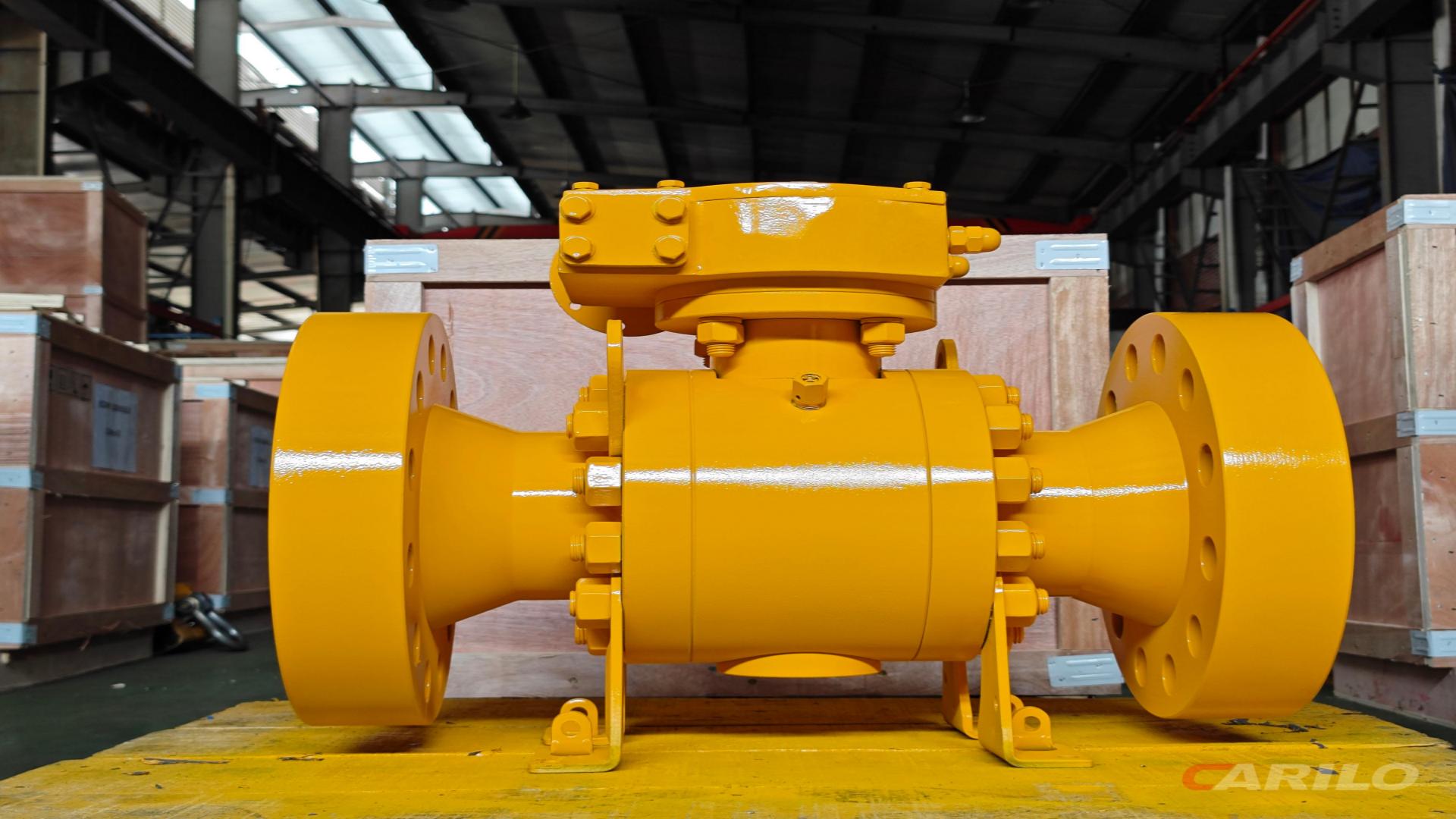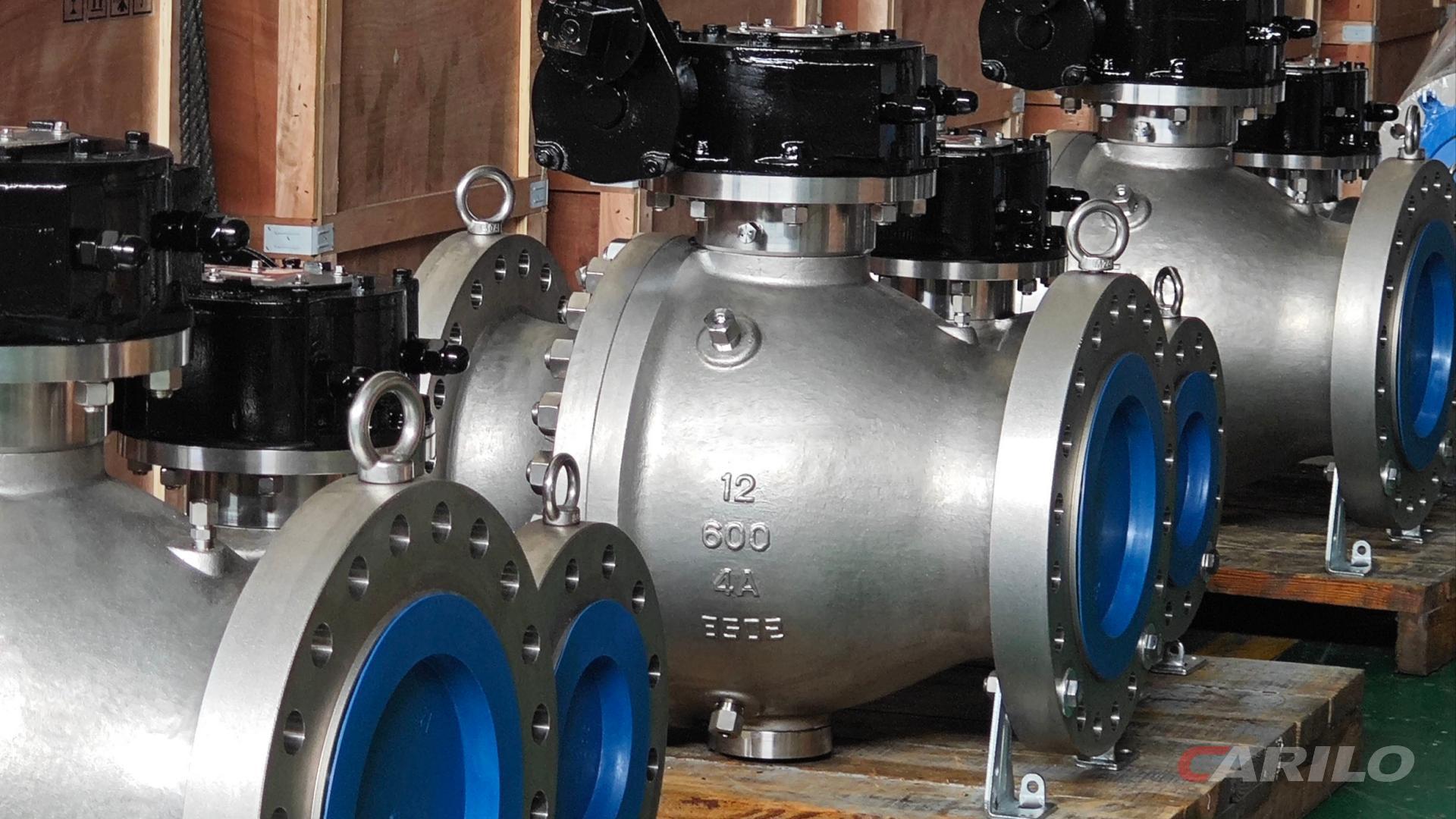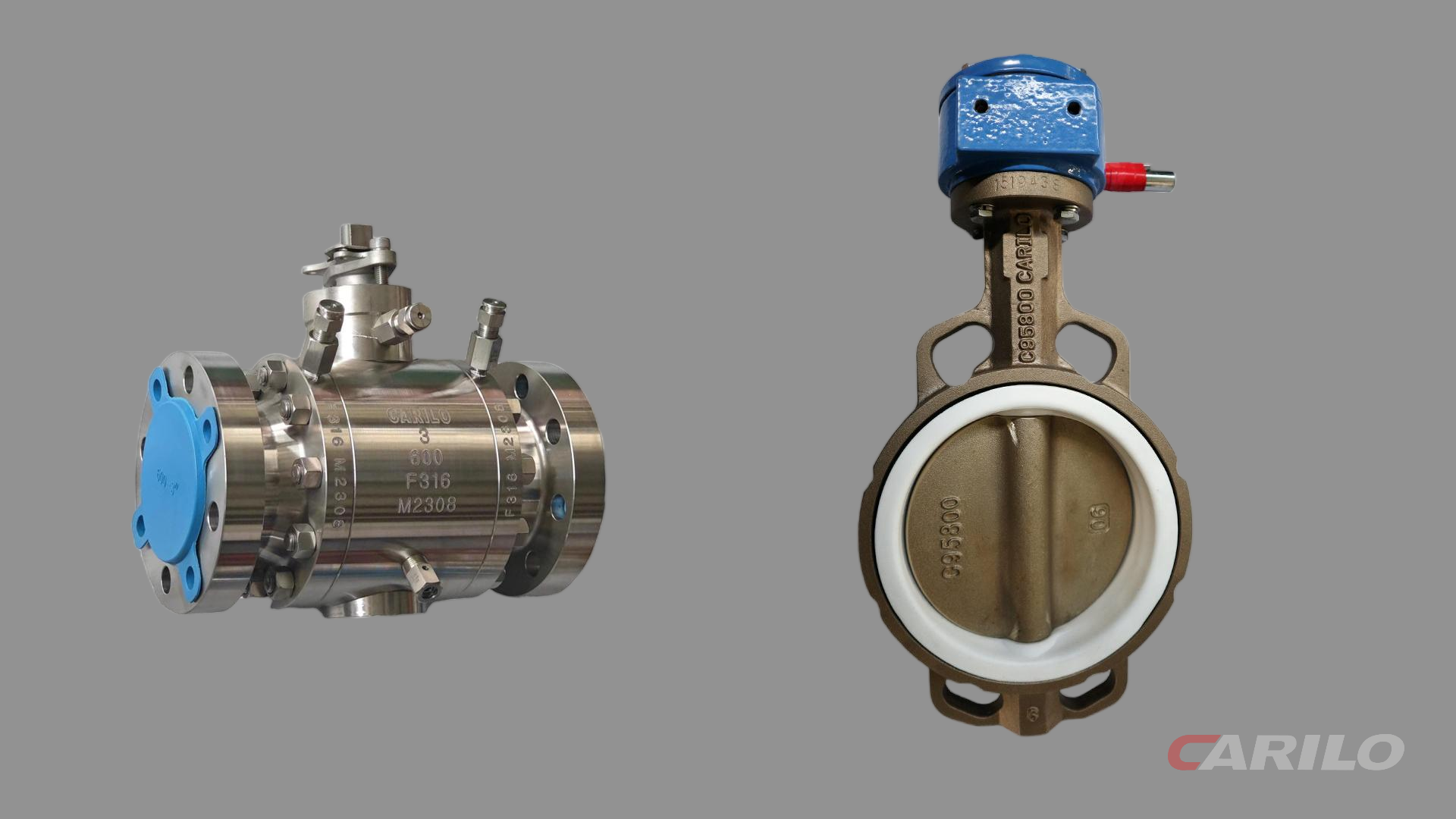
Industrial ball valves can handle pressures of up to 1,000 bar, but they require high operating torque and take up more space.
Butterfly valves save a great deal of installation space, and their operating torque is only about one-third that of ball valves, but their pressure rating is usually limited to within 25 bar.
For large-diameter pipelines in confined spaces, butterfly valves are the practical choice. For high-pressure service requiring tight shutoff, ball valves are preferred. Both can be opened or closed quickly with a 90-degree turn of the handle.
Pressure Resistance
Under the ASME B16.34 design standard, trunnion mounted ball valves use thick-wall forged or cast steel bodies and can operate reliably in ultra-high-pressure pipelines up to Class 2500 service, approximately 414 bar / 6,000 psi.
Concentric butterfly valves are limited by their rubber-seated disc design, with pressure capacity generally capped at Class 150, or about 20 bar / 285 psi.
Triple-offset metal-seated butterfly valves raise that limit to Class 600, around 100 bar / 1,480 psi. For oil and gas transmission pipelines above this pressure range, industrial ball valves are mandatory.
Load Distribution
When pipeline designers lay out the cramped deck areas of a North Sea FPSO, every inch of space carries a clear cost. A look at the face-to-face dimensions defined in ASME B16.10 makes the physical difference obvious. An NPS 12 (DN300) Class 150 flanged ball valve has an overall face-to-face length of 356 mm. In a crowded pipe rack, that extra length often intrudes directly into the maintenance access of adjacent equipment.
A wafer butterfly valve looks remarkably slim by comparison. Under the same dimensional standard, a 12-inch butterfly valve is compressed to a body thickness of just 78 mm. Sandwiched between two pipe flanges, it takes up less than one-fifth of the axial space required by a ball valve. When 50 parallel lines are installed on a chemical plant pipe rack, that difference in thickness can reduce the overall rack width by nearly 2 meters.
- The face-to-face length of an 8-inch flanged ball valve is 292 mm.
- An 8-inch lug butterfly valve is only 60 mm thick.
- A more compact piping layout can reduce carbon steel pipe consumption by as much as 15%.
- A shorter flow path also slightly reduces the valve body’s heat-radiating surface area.
Axial length is only part of the story. Industrial valves are large, heavy steel components that demand three-dimensional space. A 16-inch (DN400) large-diameter ball valve can be extremely heavy. A two-piece cast steel ball valve of this size can weigh as much as 850 kg. To support that mass, an independent heavy-duty structural steel support must be welded beneath it. If the pipeline undergoes just 3 mm of thermal expansion or contraction, the heavy valve body can impose several tons of lateral tearing force on the support structure.
A concentric butterfly valve of the same size weighs less than 120 kg and does not need additional bottom support. Its weight is fully carried by the flange bolts at both ends of the pipeline. Installers with standard hand tools can bolt it directly into a suspended line. During retrofit work in Houston refineries, high-performance butterfly valves are often used to replace bulky gate valves and ball valves, without having to rebuild the original concrete foundations.
Clearance problems are even more severe in the vertical direction. High-pressure, large-diameter ball valves require massive scotch yoke pneumatic actuators to overcome friction. The actuator cylinders project horizontally on both sides and often exceed 1.2 meters in length. When the spacing between upper and lower pipe runs is only 800 mm, those oversized cylinders can end up hard against the upper line.
- A rack-and-pinion actuator housing is typically about 30% smaller than a scotch yoke actuator.
- A 10-inch ball valve actuator often requires a separate air reservoir.
- The very low operating torque of a butterfly valve allows it to use a highly compact electric actuator.
- A handwheel-driven gearbox requires 600 mm of overhead clearance for the operator.
- The cylinder exhaust silencer takes up an additional 50 mm of external space.
When the internal PTFE seat of a three-piece ball valve needs replacement, the center body section must be removed entirely. At least 200 mm of loosening space must be reserved on both sides of the line. With a top-entry ball valve, maintenance personnel must also leave clear operating space directly above the valve so a chain hoist can lift the solid steel ball, which may weigh hundreds of kilograms, straight out of the body.
Routine maintenance on a butterfly valve is much easier. Technicians simply loosen several stud bolts on the wafer flanges, pry the flanges apart by about 10 mm, and slide the entire butterfly valve out in parallel like a drawer. In a cramped underground water treatment pump room, two workers with a small hydraulic jack can remove a 24-inch rubber-lined butterfly valve in half an hour.
The butterfly valve’s extremely compressed profile also comes with an inherent physical drawback. When the disc is fully open, its edge still projects beyond the valve body and into the upstream and downstream pipe bore. In an NPS 10 line, the disc can protrude by nearly 50 mm. If a dual-plate check valve is installed within that same 50 mm zone, the disc can strike the internal components of the check valve violently as it opens.
Buried natural gas networks offer a very different perspective on space. In Alberta’s winter heating network, API 6D fully welded ball valves are buried as deep as 3 meters below the frozen ground. They require no large and expensive above-ground valve chambers. Only a long extension stem reaches the surface. A piece of equipment that would normally occupy dozens of cubic meters above ground is reduced to a surface operating post no larger than a road sign.
- A fully welded valve body eliminates the space otherwise needed for bolted flange joints.
- The outer sleeve of the extension stem is filled with polyurethane foam to prevent freezing.
- Only a 1-meter wrench swing radius is required around the top operating square.
- Because of its structural design, a butterfly valve is not suitable for direct buried, chamberless installation.
- The thickness of the buried anti-corrosion coating does not change the valve’s overall footprint.
For small-bore pipelines below NPS 2 (DN50), the installation space difference between the two is only a few centimeters and can largely be ignored. Once the pipeline size passes NPS 8 (DN200), the butterfly valve’s thin, wafer-like dimensional advantage begins to grow dramatically.
Sealing Materials
In the ethylene cracking units of the Houston petrochemical complex, fluid temperatures remain at minus 46°C year-round. PTFE serves as the physical barrier that blocks gas leakage. Pure PTFE maintains outstanding chemical inertness across a wide temperature range from minus 50°C to 200°C. Its low surface friction coefficient of just 0.04 allows an 8-inch floating ball valve to rotate with a breakaway torque of only 150 N·m.
At ASME Class 300 pipeline pressure, about 50 bar, this soft polymer can be compressed into an irregular flattened shape. Manufacturers therefore blend 15% glass fiber or carbon powder into the resin and mold reinforced PTFE, or RPTFE. This modified formulation raises tensile strength to 25 MPa.
In shale gas gathering systems in the Permian Basin, RPTFE seats allow ball valves to withstand wellhead pressure of 100 bar. That higher hardness comes at a price, however: the surface becomes microscopically rougher. Highly sensitive sensors on an API 598 pneumatic test bench can detect trace methane escaping through microscopic gaps along the carbon fiber structure.
For shutting off high-pressure natural gas at 6,000 psi, about 414 bar, PEEK is a more extreme option. It has a melting point of 343°C and compressive strength above 118 MPa. The internal cavities of high-pressure water injection ball valves on North Sea offshore drilling platforms are fully fitted with this specialty polymer.
Inside a Class 2500 trunnion-mounted ball valve, the preload contact gap between the PEEK seat ring and the super duplex steel ball is controlled to within 0.01 mm. It can absorb instantaneous water hammer shocks of 500 bar without cracking. Because of the material’s high hardness, CNC machining tolerance for PEEK must be held to an extremely tight 0.005 mm.
Concentric butterfly valves dominate the large-diameter market with a completely different sealing system. EPDM handles all sealing duties in municipal water treatment and HVAC pipelines. In a DN600 cast iron butterfly valve, the inner wall of the body is tightly fitted with a one-piece EPDM liner up to 15 mm thick.
As the stainless steel disc rotates into this rubber liner, the rubber is compressed by about 3 mm. That elastic deformation fills every gap around the metal edge. EPDM performs extremely well in hot water below 120°C and in weak acids and alkalis. It has almost no resistance to petroleum-based hydrocarbon solvents. Even a small drop of oil can cause it to swell and break down within a few hours.
- NBR takes over in low-pressure oil pipelines in refinery atmospheric and vacuum units.
- In oil-containing fluids, NBR volume swell can generally be kept below 5%.
- Viton / FKM is much more expensive and is reserved for highly corrosive acidic fluids above 200°C.
- The thick rubber liner significantly reduces the effective flow area.
- In a DN100 concentric butterfly valve, the rubber liner can reduce the flow coefficient, or Cv value, by 20% compared with a bare valve body.
Quartz sand suspended in heavy crude is the natural enemy of soft polymer seats. In Alberta oil sands upgrading plants, pipelines carry abrasive slurry with up to 20% solids. Under this kind of “liquid sandpaper” erosion, no polymer can survive for more than three months.
Metal-to-metal hard sealing fills this gap in severe wear service. The stainless steel ball of a ball valve is coated by HVOF spraying with a 0.2 mm tungsten carbide layer. With a Rockwell hardness up to HRC 70, the surface is almost diamond-hard.
The seat is also made of hardened stainless steel, and the two surfaces are hand-lapped mechanically for as long as 8 hours. Workers use diamond paste to lap the ball and seat into a perfectly matched mirror finish. In Class 1500 pipelines, this extremely hard sealing pair can physically scrape away coke deposits left inside the valve body by the flowing medium.
| Sealing Material Type | Main Valve Applications | Maximum Temperature Limit | Highest Pressure Rating (ASME) | Wear Rate (vs. Pure PTFE) |
|---|---|---|---|---|
| Pure PTFE | Ball valves / high-performance butterfly valves | 200°C | Class 150 (20 bar) | 1.0 |
| PEEK | Industrial ball valves | 260°C | Class 2500 (414 bar) | 0.15 |
| EPDM rubber | Concentric butterfly valves | 120°C | Class 150 (20 bar) | N/A (elastic deformation) |
| Stellite alloy | Triple-offset butterfly valves / ball valves | 600°C+ | Class 1500 (250 bar) | 0.02 |
Triple-offset butterfly valves achieve frictionless metal sealing through a geometric offset design. In the last few millimeters of closing travel, the disc enters the conical metal seat at a precise angle.
This conical seat is usually hard-faced with Stellite cobalt-based alloy. The 10 mm alloy layer can withstand pipeline temperatures up to 600°C. In gas desulfurization units across the Middle East, metal butterfly valves with laminated stainless steel and graphite seals are widely used.
The laminated seal is made by alternating 0.5 mm sheets of 316L stainless steel and 0.5 mm sheets of flexible graphite, then compressing them into a single ring. The graphite fills microscopic imperfections in the metal surface, while the stainless steel provides the rigidity needed to resist 60 bar pressure. On ANSI FCI 70-2 test benches, this multilayer structure can achieve the extremely low leakage levels of Class VI.
Frequent open-close cycles steadily consume the physical life of this laminated seal. Each time the disc closes, the stainless steel layers undergo slight bending fatigue. After 50,000 cycles, graphite particles are stripped away by the high-velocity fluid, and leakage rises sharply. By contrast, a fully welded ball valve with a tungsten carbide-coated sealing surface can complete 100,000 cycles on the same test bench while still holding leakage to 0.1 ml/min.
Free chloride ions in the fluid are highly aggressive toward metal sealing surfaces. In the feed pipelines of seawater desalination plants, chloride concentration can remain at 35,000 ppm year-round. On metal sealing surfaces with fine crevices, even standard duplex steel is highly vulnerable to pitting corrosion.
Manufacturers often electroplate the metal seat surface of high-pressure butterfly valves with a 25-micron layer of ENP, electroless nickel-phosphorus. This ultra-thin coating extends salt spray corrosion resistance beyond 1,000 hours. It acts as a dense protective armor layer, completely isolating the vulnerable base metal from the aggressive fluid environment.
High Differential Pressure
Within 0.1 second of pressing the open command on a Houston gas transmission line, the pressure differential between the upstream and downstream sides can surge past 80 bar. High-pressure natural gas trapped upstream tears through microscopic metal clearances at nearly the speed of sound, about 340 m/s. As this high-energy gas expands violently through narrow passages, instruments record a piercing noise level of up to 110 dB. ASME B31.3 imposes strict numerical limits on fluid turbulence under extreme differential pressure.
At the moment of opening, the heavy metal ball acts as an excellent flow shield. Inside a 12-inch trunnion-mounted ball valve is a smooth cylindrical flow passage 290 mm in diameter. High-velocity fluid transitions smoothly along the curved internal surface, and the flow path stays clear of the vulnerable edge of the PEEK seat.
An independent third-party laboratory in a Texas shale gas field issued an extreme-service test report showing that after 50 pressurized opening cycles of a Class 900 API 6D ball valve, microscopic scanning found seat material erosion held to less than 0.002 mm.
The butterfly disc, by contrast, sits directly in the center of the pipeline and is fully exposed to frontal impact from the flowing medium. When 80 bar gas strikes a partially open metal disc, it is split into two asymmetric high-speed jets flowing above and below the disc. Severe flow separation occurs behind the disc.
In water treatment pipelines carrying industrial water at 20°C, a differential pressure of 30 bar is enough to trigger destructive physical damage behind a butterfly valve. As the fluid passes through the narrow gap at the disc edge, local static pressure drops below the saturation vapor pressure of water at that temperature, 0.023 bar. The liquid flashes instantly into vapor, forming countless microscopic bubbles.
- These bubbles collapse in the downstream pressure recovery zone at speeds of up to 1,000 m/s.
- The tiny fluid jet created when a single bubble implodes can generate local pressure above 4,000 bar.
- Repeated cavitation can turn the edge of a 316L stainless steel disc into a honeycombed surface within 300 hours.
- A 15 mm EPDM seat is highly prone to large-scale tearing under a 15 bar differential pressure.
The asymmetric fluid profile inside a butterfly valve creates intense dynamic instability. Swirl and vortex forces behind the disc generate a strong eccentric torque on the shaft. When a 24-inch metal-seated butterfly valve is opened to 15 degrees, the hydraulic torque on the disc can surge to 9,000 N·m.
To overcome 9,000 N·m of resistance, the pneumatic actuator cylinder must be doubled in volume. That huge increase in thrust demand slows the overall system response. A 1,500 psi natural gas emergency shutoff valve is expected to close fully within 2 seconds, but the exhaust rate of a large cylinder cannot keep pace with the millisecond-level commands of the Safety Instrumented System.
The symmetrical structure of a trunnion-mounted ball valve is largely unaffected by eccentric flow disturbance. Whether the line faces 100 bar or 400 bar fluid impact, the upper and lower trunnions absorb the lateral load completely. With the help of low-friction bearings, the ball rotates smoothly with relatively little breakaway force. A Class 900 8-inch ball valve can cut off high-velocity gas under full differential pressure with less than 800 N·m of torque.
To deal with throttling damage under high differential pressure, engineers machine 30-degree or 60-degree V-notches into the stainless steel ball. In crude control lines on North Sea offshore platforms, Class 1500 V-port ball valves keep the high-velocity flow concentrated in the center of the line.
The V-notch keeps the vulnerable sealing surface at least 20 mm away from the opening gap. Combined with tungsten carbide hard-facing and offset geometry, it allows continuous high-frequency throttling for as long as two years under a 200 bar differential pressure, while casing vibration remains below 0.5 mm/s.
The pressure recovery factor, Fl, defined in ISA-75.01, highlights the performance gap between these two valve types. A full-port ball valve has an Fl value as low as 0.55. Once the fluid passes through the ball, the pressure drop curve remains relatively gentle, and secondary flashing is held to a very low level.
- Large-diameter high-performance butterfly valves typically have Fl values between 0.65 and 0.75.
- High differential pressure forces the fluid into severe three-dimensional turbulence behind the disc, often accompanied by strong low-frequency pipe resonance.
- In a 60 bar natural gas pressure reduction station, pipe wall thickness below a butterfly valve must often be increased by 5 mm to resist flow erosion.
- The very low friction within a ball valve cavity can reduce pumping horsepower losses over long-distance pipelines by 12%.
Deepwater oil and gas manifolds in the Gulf of Mexico must deal with extremely harsh internal differential pressure surges at depths of 3,000 meters. External seawater pressure can reach 300 bar, while internal pipeline pulses may reach 10,000 psi. A heavy forged ball valve with a 75 mm thick super duplex steel body keeps all of that explosive energy locked safely inside the metal pressure boundary.
Installation Space
ASME B16.10 defines the installation dimensions of valves.
A 6-inch (DN150) Class 150 flanged ball valve has a face-to-face length of 394 mm and a total weight of over 85 kg.
A wafer butterfly valve of the same size is only 56 mm thick and weighs about 12 kg.
The length difference exceeds seven times. Installing a flanged ball valve requires a long straight pipe section, and large-diameter models often need H-beam supports to carry the load.
A thin-profile butterfly valve can be installed directly between compact pump outlet flanges, greatly reducing the space required for piping and lowering equipment room construction cost.
Face-to-Face Length
BASF’s chemical complex in Ludwigshafen was expanding an ethylene cracking unit. When engineers designed a prefabricated module measuring only 12 meters by 4 meters, pipe spacing had to be controlled almost down to the millimeter.
Installing an 8-inch (DN200) Class 300 flanged trunnion ball valve required 502 mm of straight installation space under ASME B16.10.
At the same size and pressure class, switching to a wafer triple-offset butterfly valve reduced that physical length immediately to 73 mm.
With a structural length difference of nearly 430 mm, the routing of the piping on the construction drawing had to change dramatically.
A ball valve is long because it encloses a solid stainless steel ball over 200 mm in diameter.
On each side of the ball sit two PTFE or metal hard seats, each about 25 mm thick.
To fully contain these pressure-bearing components, the cast steel body must extend significantly outward on both ends.
The body of a butterfly valve, by contrast, is essentially a flat circular ring.
Its shutoff element is an alloy disc only about 35 mm thick.
The disc rotates 90 degrees within the pipe bore to open or close, without needing extra body length along the pipe axis.
On the Appomattox deepwater semi-submersible production platform in the Gulf of Mexico, deck space is priced by the square inch.
Three parallel 16-inch seawater cooling headers were limited to a center-to-center spacing of no more than 650 mm.
If Class 150 two-piece ball valves were used, each one would have a face-to-face length of 762 mm.
There was simply no way to fit three of them side by side within such a narrow pipe arrangement.
- The flange rims would collide physically.
- There would be no swing space for bolt-tightening tools.
- Maintenance personnel could not squeeze through the gap.
- Offset installation would require a large number of additional elbows.
The construction team had no choice but to use 45-degree elbows to spread the three lines apart and weld the three oversized valves in a staggered arrangement.
The added pipe fittings increased pressure drop through the system.
With lug butterfly valves, the layout changed completely. The structural length of a 16-inch model was cut down to 102 mm.
The wafer-thin body sat neatly between two pipe flanges, allowing all three headers to run forward in a straight, even arrangement.
During the upgrade of an underground pipe gallery at a seawater desalination plant in San Diego, the clear width between concrete walls was only 2.5 meters.
The main line was a 24-inch (DN600) FRP water pipe.
Installing a Class 150 flanged ball valve with a face-to-face length of 914 mm would consume nearly one-third of the gallery’s crosswise space.
Workers would not even be able to push a tool cart through the remaining passage. The design team turned to the ASME B16.10 dimension table for an extreme substitution.
| Valve Type (Class 150) | 8-inch (DN200) Length | 16-inch (DN400) Length | 24-inch (DN600) Length |
|---|---|---|---|
| Floating / trunnion flanged ball valve | 292 mm | 762 mm | 914 mm |
| Wafer / lug butterfly valve | 60 mm | 102 mm | 154 mm |
| Physical length ratio | 4.8× | 7.4× | 5.9× |
The figures show a dramatic difference in size. The larger the valve, the more a ball valve must expand outward to contain the oversized ball.
A 24-inch butterfly valve is only 154 mm thick, not even close to the trailing dimensions of the ball valve.
During pipeline retrofit, old steel pipe must often be cut and re-welded, so dimensional tolerance becomes extremely tight.
If an abandoned 762 mm-long ball valve is removed from an old pipeline and the new replacement differs by even a few millimeters, the entire section of carbon steel pipe may need to be scrapped and re-fabricated.
In a Houston gas processing plant, maintenance crews had to replace shutoff valves on two vertical risers positioned very close together.
A 12-inch trunnion-mounted ball valve measuring 502 mm long had to be forced between two fixed flanges by spreading the upper and lower steel pipes apart with a 5-ton hydraulic jack.
Any excess force could easily create fine cracks in the heat-affected zones beside the carbon steel welds.
By comparison, a butterfly valve of the same size and only 78 mm thick slid smoothly into the flange gap with almost no effort.
Face-to-face length affects not just the horizontal run of the line, but also the actuator interference above it.
When two 20-inch ball valves, each 838 mm long, were installed in series with only a 1-meter straight section between them, the two 800 mm diameter pneumatic diaphragm actuators mounted above them physically collided.
Engineers were forced to rotate one actuator by 45 degrees, making the later installation of 8 mm instrument air tubing extremely awkward.
Skid-mounted water treatment systems shipped through Rotterdam must meet strict external dimension limits.
The usable internal length of a standard 40-foot container is 12.03 meters. Installing four 10-inch Class 150 flanged ball valves in series on the main line consumed a total of 2.12 meters.
That severely compressed the remaining assembly space for the reverse osmosis membranes and the high-pressure pump skid.
Replacing those shutoff points with four wafer butterfly valves only 68 mm thick reduced the total occupied straight-line length to 0.27 meters.
The nearly 2 meters of saved pipe space allowed the assembly team to fit an additional 600 kg standby booster pump at the rear of the container.
Equipment Weight
During replacement of a cooling water main at a refinery in Beaumont, Texas, the construction team ran into a serious problem. A 24-inch (DN600) Class 300 two-piece flanged cast steel ball valve weighed as much as 3,500 kg.
A triple-offset butterfly valve of the same size weighed only 480 kg, more than seven times lighter. That 3.5-ton dead load was hanging entirely on a suspended carbon steel pipe, and ASME B31.3 imposes strict limits on this kind of excessive piping load.
Over time, the steel pipe would inevitably deflect downward. The construction team had no choice but to pour a concrete base below the ball valve and weld a W12x50 H-beam support on top to hold it.
- The concentrated load at a single support point is too high.
- The flange gasket can easily become unevenly compressed and damaged.
- The middle section of a suspended pipe run is highly prone to sagging.
- Pressure-containing welds are more likely to crack under the load.
A ball valve contains a solid metal ball at its center. In a 16-inch Class 600 valve, that ASTM A105 forged steel ball alone can weigh 400 kg.
The body shell must be 38 mm thick to enclose it fully. A butterfly valve, by contrast, contains only a thin disc about 45 mm thick.
Its compact double-flanged body saves hundreds of kilograms of cast metal. For the piping designer, that means there is no longer any need to calculate concentrated load deflection in such detail.
On North Sea FPSOs, weight sensitivity is extreme. Even an extra ton on deck can affect vessel draft.
If all deck piping were fitted with large flanged ball valves, the supported module weight could exceed design allowance by as much as 50 tons. Replacing them with lightweight lug butterfly valves eliminates that excess mass entirely.
The deck support plate thickness beneath the module can then be reduced from 25 mm to 18 mm.
- No bottom H-beam support is required.
- The draft of the floating platform becomes noticeably shallower.
- Deck plate thickness can be reduced significantly.
- Steel consumption and total cost drop sharply.
The heavier the component, the slower site assembly becomes. The plant has to rent a 25-ton mobile crane just to lift a single 3,500 kg ball valve into position.
That kind of crane can cost as much as USD 250 per hour, and its long boom is extremely difficult to maneuver in a crowded plant.
If a swinging heavy component strikes a live main line, the consequences can be dangerous if toxic liquid escapes.
Installing a 480 kg butterfly valve is much easier. Two workers can hang a 2-ton manual chain hoist from a beam and fully bolt the valve into place within 45 minutes.
Major shutdown maintenance creates the same problem. When the PTFE seat inside a large ball valve wears out and starts leaking, the several-ton cast metal body can remain stuck to the pipeline after years of service.
Maintenance crews often have to bring in heavy cutting equipment and burn away the support structure underneath before the valve can be removed. ASTM A351 CF8M stainless steel ball valves exposed for years to salt-laden sea air are especially difficult to handle.
A 12-inch model can weigh 900 kg. Even with three or four workers trying to force it out, the adjoining flange faces can easily end up gouged with deep scratches.
- Large cranes cannot enter low-clearance plant buildings.
- It is extremely difficult to remove oversized valves manually.
- Heavy temporary scaffolding has to be installed.
- Plant shutdown time becomes significantly longer.
International freight is charged by weight. A shipment of twenty 16-inch ball valves loaded in Milan and shipped to the Gulf of Mexico can weigh more than 18 tons.
That load alone can push a 40-foot high-cube container to its weight limit. Switching to thin wafer butterfly valves cuts the total shipment weight to less than 3 tons.
When shipped as LCL cargo, the ocean freight savings on a single shipment can reach about USD 8,500. Even in storage, ball valves need customized heavy timber skids underneath to prevent damage to the warehouse floor slab.
API 6D explicitly requires pipeline valves above 250 kg to be fitted with dedicated lifting lugs before leaving the factory.
On an 8-ton 30-inch pipeline ball valve, the two cast steel lifting lugs alone can weigh 45 kg.
Once the size passes 14 inches (DN350), the weight of a ball valve begins to rise almost exponentially. On Class 900 high-pressure main lines, a 20-inch ball valve can exceed 6,000 kg.
These extremely heavy components force repeated rerouting during construction planning, and pipelines cannot safely be laid in areas with weak soil conditions.
Gravity also affects flange bolt loading. Where a massive valve hangs from the line, high-strength ASTM A193 B7 alloy steel studs are typically required.
The downward eccentric moment created by the valve body places the lower flange bolts under chronically excessive tensile stress.
Top Operating Clearance
During renovation of an underground chilled-water pipe gallery beneath Chicago O’Hare International Airport, the construction team ran into a clearance problem at the ceiling. The centerline of the 18-inch (DN450) Class 300 main was 800 mm above the floor. With the total internal gallery height fixed at 2.1 meters, less than 1.3 meters of space remained above the pipe.
Once a flanged trunnion ball valve was installed, the startup torque created by friction between the solid ball and the high-pressure water reached 9,500 N·m. To overcome that heavy static friction, a double-acting pneumatic scotch yoke actuator had to be mounted on top. The actuator housing alone rose to 1.25 meters, and together with the bonnet, the top of the assembly smashed directly into the overhead light fixtures.
Replacing it with a triple-offset butterfly valve of the same size changed the situation completely. Because the disc rotates in the center of the pipe with much lower resistance, it only needed a rack-and-pinion pneumatic actuator with 3,200 N·m output torque. The total height of the top drive assembly dropped immediately to 410 mm, leaving almost half a meter of comfortable clearance to the gallery ceiling.
In industrial plants, vertical space is often harder to compromise on than floor area.
Large ball valves also demand far more top clearance during maintenance. At a natural gas booster station outside Houston, a 24-inch top-entry ball valve was welded into the line. To replace the worn Teflon seats inside, workers had to remove the top cover and lift the 800 kg ball straight upward.
To extract the full trim assembly, more than 1.8 meters of clear vertical maintenance space had to be reserved above the valve. Unfortunately, a structural roof beam crossed directly over the valve position. The plant had no practical option except to open a large hole in the roof panels and bring in a mobile crane outside to lower the lifting cable down through the opening.
- An opening has to be cut into the roof, affecting the building structure.
- The pneumatic actuator is so large that it can easily strike overhead beams.
- Top-entry maintenance requires roughly double the normal vertical clearance.
- A standard manual chain hoist cannot be used easily in this setup.
In an Alberta oil sands separation workshop, densely packed piping was arranged in three stacked layers. A row of 12-inch Class 600 ball valves was installed on the bottom level, each fitted with a large manual gear operator whose handwheel diameter reached 600 mm. When workers tried to operate them, their fully extended arms kept scraping the insulation on a hot steam line only 400 mm above.
Butterfly valves show their structural flexibility in this kind of layout. A 12-inch butterfly valve usually uses a handwheel only about 250 mm in diameter, and its gearbox is about the size of a small toolbox. The operator’s arm movement stays within a much safer range, greatly reducing the risk of burn injuries in tight spaces.
Hydraulic actuators are widely used offshore and are extremely sensitive to installation orientation. On one Equinor drilling platform in the North Sea, the hydraulic cylinder mounted on top of a 16-inch ball valve weighed 350 kg. To avoid an overhead cable tray, workers rotated the ball valve 90 degrees so the heavy cylinder lay horizontally in mid-air.
Gravity pulls a horizontally mounted actuator downward, and long-term side loading can easily bend the valve stem.
With the heavy actuator hanging off one side, the stuffing box experienced severe one-sided wear and began leaking high-pressure natural gas in less than three months. Because butterfly valves need so little torque, they can use very compact actuators. Even when a butterfly valve fitted with a small electric actuator is mounted at an angle, the eccentric moment is almost negligible.
At a chemical plant in Ohio, eight 10-inch automated ball valves were installed on a second-floor steel platform. Their pneumatic actuators required compressed air connections from above, and the twin-cylinder design needed two 1/2-inch stainless steel tubing connections at the top. The height of the actuator housings reached all the way up to the grating of the third floor, leaving workers no room to swing a wrench while tightening the tube fittings.
With automated butterfly valves of the same size, there was still more than 800 mm of clearance between the top of the actuator and the floor above. The instrument air tubing could be routed neatly, and there was even enough room to add a smart valve positioner with a transparent cover. Standing on the second floor, instrument technicians could easily read the valve opening percentage on the display.
- The tube fittings interfere with the floor grating above.
- The positioner display is blocked by the narrow gap.
- A standard adjustable wrench cannot be used effectively.
- Maintenance requires partial removal of the upper steel grating.
At a semiconductor plant in Seattle, the ultrapure water system was installed beneath a raised cleanroom floor. Clearance under the floor was only 600 mm. A 6-inch (DN150) polypropylene ball valve stood over 280 mm high with its handle installed. If alignment was off slightly, the red operating handle could jam against the aluminum floor support and leave the valve stuck half-open at 45 degrees.
The thin profile of a butterfly valve allows its actuator to be positioned close to the pipe surface. A 6-inch hand-operated butterfly valve made of the same material can be kept under 190 mm in total height. It fits easily beneath the narrow anti-static floor without interfering with the vibration isolation base of the lithography equipment above.
Operating Torque
Data for an 8-inch Class 150 pipeline under ASME B16.34 shows that a full-port floating ball valve requires 1,200 N·m of opening torque, while a triple-offset butterfly valve of the same size needs only 350 N·m.
Inside a ball valve, the stainless steel ball maintains full 360-degree contact with the PTFE soft seat, creating high operating resistance. A butterfly valve uses an offset shaft design, so the disc breaks away from the sealing surface after opening just 2 to 3 degrees, eliminating mechanical friction.
Once industrial pipeline size exceeds 4 inches (DN100), the high breakaway torque of a ball valve forces engineers to buy larger pneumatic cylinders or motors, pushing up hardware cost significantly.
Internal Construction
In a 10-inch Class 600 line filled with fluid, water pressure can reach 1,440 psi. That enormous load acts directly on the 120-pound 316 stainless steel ball inside a floating ball valve. The ball is forced hard against an RPTFE seat ring with an outside diameter of 11.5 inches, generating 112,000 pounds of thrust at the sealing interface.
To turn the handwheel, the operator must overcome the static friction coefficient of 0.04 between the plastic seat and the metal ball. At the moment of opening, the torque indicator often spikes to 3,500 N·m. No one can operate that manually without help, so a gearbox with 1.5 times torque multiplication has to be mounted on top. The worm gear inside the gearbox consumes a great deal of operator effort.
API 6D trunnion-mounted ball valves solve this by adding upper and lower metal trunnions to support the ball. The load of hundreds of thousands of pounds is transferred to Devlon V-API bearings instead. The plastic seat no longer carries the full pressure by itself. On ball valves above 16 inches, a heavy spring is also installed behind the seat.
- Inconel X-750 springs provide 250 pounds of preload force.
- The roughness of the metal ball surface is polished to within Ra 0.15 μm.
- At 200°C, the load capacity of PTFE bearings drops by 40%.
- The V-shaped graphite rings around the stem consume 15% of the turning force.
Pipelines often carry fine solid contaminants. If a 1 mm quartz grain becomes lodged in the PTFE seat, it can cut a groove 0.05 mm deep into the stainless steel ball surface. Even a single trapped particle can increase opening torque by 300 N·m. In emergency situations, workers often have to inject molybdenum disulfide grease aggressively with a pneumatic pump just to restore operability.
In API 609 triple-offset butterfly valves, the motion path of the internal components is completely different. The main shaft is offset 15 mm from the pipe centerline and 22 mm away from the sealing plane. The metal sealing surface itself is set at an inclined angle of about 12 degrees.
As soon as the handwheel opens the valve by 3 degrees, the disc separates completely from the seat. At that point, direct metal-to-metal friction drops to zero. The torque reading on the instrument immediately falls to 220 N·m. Even a small actuator can then continue rotating the disc smoothly through the fluid.
- The laminated seal consists of alternating 0.2 mm 316 stainless steel and 0.5 mm graphite layers.
- Under compression, graphite acts as a dry solid lubricant.
- The Stellite 21 hard-faced seat surface reaches HRC 45.
- At full 90-degree opening, the disc blocks only 8% of the pipe flow area.
With water flowing through the line at 15 ft/s, the stream strikes the disc aggressively. Because the velocity above and below the disc is different, the disc experiences a lift imbalance similar to an aircraft wing. This hydrodynamic torque continuously tries to force the disc back toward the closed position.
At 78 degrees open, that hydraulic force reaches a peak of 310 N·m. Anyone sizing the actuator has to allow for that extra spring return force. The spring inside the cylinder must be strong enough to resist that sudden fluid-driven push.
ISO 5211 governs actuator mounting dimensions. A ball valve requiring 3,500 N·m needs a large F25 mounting flange. Its bolt circle diameter is 254 mm and it uses eight M16 bolts. A butterfly valve requiring only 220 N·m needs just a compact F12 flange.
- An F25 cast steel mounting pad alone can weigh 45 kg.
- An F12 mounting flange plate is only 18 mm thick.
- The square bore in an F10 flange can accept a 22 mm motor output shaft.
- A keyed shaft transmits torque more reliably than a double-flat D-shaped shaft.
17-4PH hardened stainless steel is often used to machine heavily loaded stems. A 45 mm ball valve stem can withstand up to 4,200 N·m of torque without fracturing. If the actuator is oversized and the ball becomes jammed, the stem can twist off immediately. In instrument air systems, the compressed air supply pressure is commonly fixed at 80 psi.
Municipal water butterfly valves built to AWWA C504 use black EPDM rubber liners. The cast iron disc edge is polished smooth and tightly pressed into the rubber seat. The rubber is compressed by 1.5 to 2.5 mm. In 60-inch water mains operating at 150 psi, the bronze bearings in the disc hub are self-lubricating.
The friction coefficient between the bearing housing and the shaft is as low as 0.12. With a gearbox ratio of 60:1, the operator only needs about 45 pounds of hand force to turn the wheel. There is no need for a long cheater bar or any kind of improvised leverage tool.
Actuator Specification
A 12-inch Class 300 natural gas pipeline in Texas carries fluid at 700 psi. The trunnion-mounted ball valve installed on that line requires as much as 5,800 N·m of breakaway torque to overcome static friction.
To move that metal ball, operators use a scotch yoke pneumatic actuator mounted on top of the stem. The actuator cylinder has a piston bore of 350 mm, and the full assembly with housing and internals weighs 420 pounds.
Each piston stroke consumes 45 liters of compressed air at a line pressure of 80 psi. If 50 actuators of this size are installed across the plant, the facility must dedicate a 200-horsepower screw compressor just to support them.
If the same flange location is fitted instead with an API 609 triple-offset butterfly valve, the torque requirement drops to 1,100 N·m. The drive assembly above it shrinks to a rack-and-pinion actuator with a 140 mm piston bore.
Single-cycle instrument air consumption falls sharply to 6.8 liters. The contractor can remove all the surrounding 3/4-inch 316L stainless steel air supply tubing and replace it with cheaper 3/8-inch tubing, saving a substantial amount in material cost per foot.
The difference in electric motor power demand is even greater. A motor connected to a 480V three-phase industrial power supply and used to drive a heavy ball valve can draw 14.5 amps at startup.
A small 110V single-phase motor driving a butterfly valve draws only 2.2 amps at energization. Electricians can wire it with standard 14 AWG copper cable instead of having to pull heavy 8 AWG cable through galvanized conduit.
| Equipment Parameter (12″ Class 300) | Trunnion Ball Valve, Pneumatic | Triple-Offset Butterfly Valve, Pneumatic | Trunnion Ball Valve, Electric | Triple-Offset Butterfly Valve, Electric |
|---|---|---|---|---|
| Breakaway Torque Required (N·m) | 5800 | 1100 | 5800 | 1100 |
| Cylinder Piston Bore (mm) | 350 | 140 | No cylinder | No cylinder |
| Single-Cycle Air Consumption at 80 psi | 45 L | 6.8 L | No air consumption | No air consumption |
| Cold Motor Start Current | Not powered | Not powered | 14.5 A | 2.2 A |
| 90-Degree Full-Stroke Travel Time | 12 s | 5 s | 45 s | 18 s |
| ISO 5211 Mounting Flange | F30 | F14 | F30 | F14 |
ISO 5211 also determines how much steel is required in the actuator mounting base. An F30 ball valve flange uses a 298 mm bolt circle with eight M20 bolts. Pipeline designers must leave about 40 inches of safe clearance around the valve.
The F14 flange on a butterfly valve is much smaller, with a bolt circle only 140 mm in diameter. The entire actuator sits compactly within about 15 inches of the pipe centerline. Personnel walking on a narrow steel grating beside it can pass without their hard hats striking the metal housing.
If spring return is required, the actuator becomes even longer. A single-acting ball valve cylinder contains an Inconel spring capable of returning 3,000 N·m of torque. Its cast housing can stretch to 65 inches in total length.
A butterfly valve rack-and-pinion actuator uses six modular springs in its end caps, generating about 600 N·m of return torque. From end to end, the entire actuator measures only 22 inches.
Valve closing speed depends heavily on exhaust capacity. Engineers often fit a 12-inch ball valve actuator with a 1-inch NPT quick exhaust valve to ensure shutoff within 12 seconds. The high-pressure air discharge can produce 95 dB of noise.
A butterfly valve can shut off water flow in just 5 seconds using only a 1/4-inch sintered bronze muffler on the exhaust port. The escaping air produces only about 65 dB. An OSHA inspector walking past would have no reason to note a hearing-protection violation.
Stem size determines the size of the drive bore at the bottom of the actuator. A 2.5-inch ball valve stem uses either a 2-inch square bore or a fine involute spline. Machining tolerance on both sides must be held within ±0.05 mm to prevent backlash.
The exposed shaft on a butterfly valve is only 1.25 inches in diameter. The actuator base can use a simple double-D bore or a 3/8-inch half-moon key. A worker can tap the actuator into place with a rubber mallet, and it will seat accurately on the shaft.
At minus 40°F on Alaska’s North Slope, standard rubber behaves like brittle plastic. All O-rings in the large actuator of a ball valve must be replaced with fluorosilicone. A full replacement seal kit can cost USD 800.
A butterfly valve uses the same fluorosilicone formulation in its much smaller cylinder. Because the actuator is so compact, the material requirement is minimal, and a spare seal kit costs only USD 95. In many cases, warehouse staff do not even need formal approval to reorder it.
If fail-in-place performance is required under loss of air supply, an external air reservoir must be added. Heavy ball valves are often paired with a 120-gallon carbon steel tank carrying an ASME stamp. The tank is welded to a structural support beam some distance away, and the stainless steel air line connecting it may be as long as 20 feet.
A lightweight butterfly valve can use a compact 15-gallon stainless steel reservoir mounted directly to the back of the actuator bracket with U-bolts. Two short 2-foot hoses are enough to complete the pneumatic circuit.
Manual override under power and air failure also differs greatly between the two. A scotch yoke pneumatic actuator may require a side-mounted hand pump capable of generating 3,000 psi hydraulic pressure. The operator has to pump the lever up and down 150 times just to move the ball valve open.
A rack-and-pinion actuator needs no hydraulic oil at all. Engineers can fit it with a declutchable manual gearbox mounted underneath. The worker turns a 12-inch aluminum handwheel about 25 revolutions, and the disc opens fully.
The limit switch box on top contains the microswitches that report valve position. On a ball valve, the box can sit as high as 4 feet above the pipe centerline. Field inspectors often have to climb an aluminum step ladder just to read the yellow-black indicator dome.
On a butterfly valve, the indicator dome sits almost exactly at eye level, about 2 feet above the pipe. A workshop supervisor walking along the steel catwalk can identify the bright yellow open signal from 50 feet away with a quick glance.