
Heavy Duty Small Port Ball Valve Manufacturer | NPS 1/2"–2" Class 800LB - Carilo Valve
NPS 1/2" – 2" | Class 800LB

Heavy Duty Small Port Ball Valve

Three-piece heavy-duty design engineered for NPS 1/2"–2" (DN15–50) piping systems. API 608 certified, fire-safe to API 607, and built for 25+ years of trouble-free operation.
26+ Years Experience
Class 800 Max Pressure
NPS 2" Max Size
150k+ Valves Delivered
Heavy Duty Small Port Ball Valve - Three Piece Design
Product Overview

What Is a Heavy Duty Small Port Ball Valve?

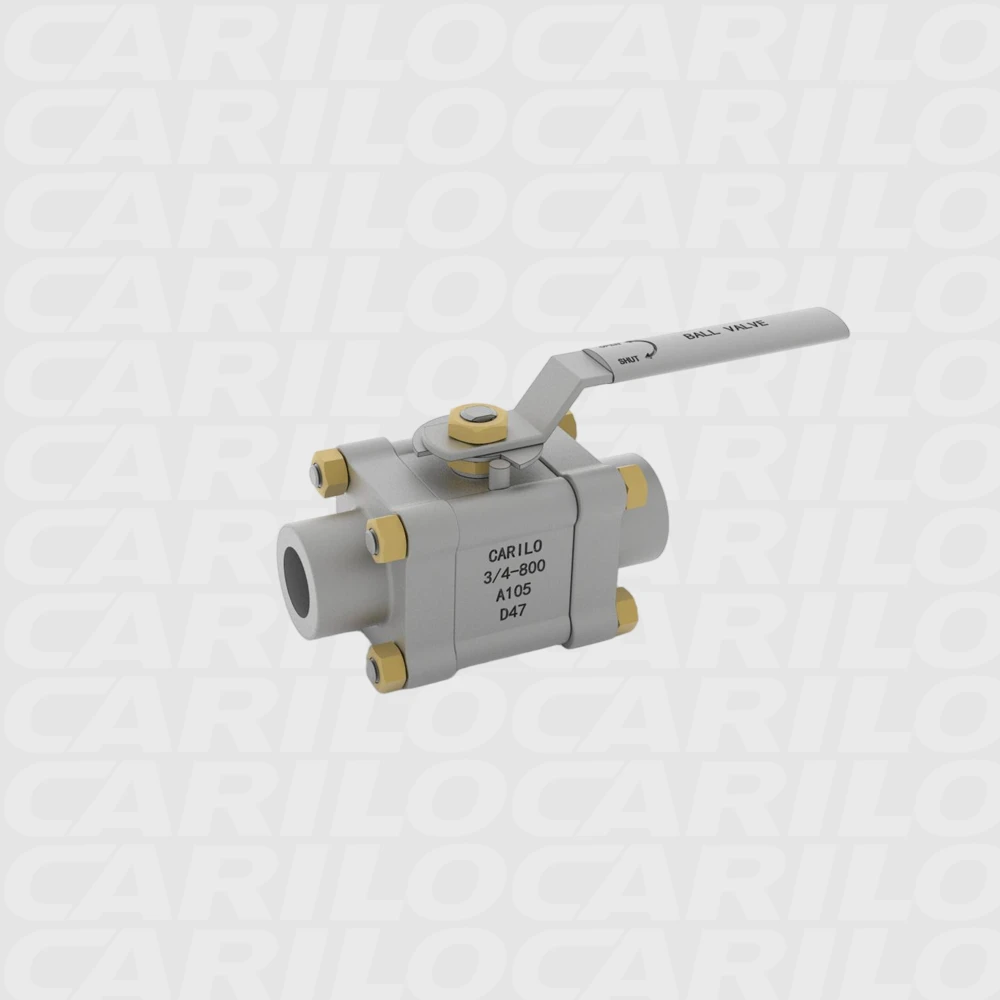
CARILO's three-piece heavy-duty small-bore ball valve delivers premium performance across a wide range of industrial services. Designed for easy inline maintenance and extended, trouble-free operation, this resilient-seated ball valve combines advanced engineering features to ensure superior reliability at a cost-effective price point.

Compliant with API 608 and certified to ISO 15848-2 fugitive emission standards, these valves meet the most demanding industry requirements for safety and environmental performance in Oil & Gas, Refining, Power Generation, and Hydraulic Instrumentation systems.

  • Three-piece body design for inline maintenance without pipe removal
  • Heavy-duty construction rated for Class 800 (PN130) applications
  • Mirror-finished solid stainless ball for bubble-tight sealing
  • Full-bore and reduce-bore options available
  • Soft seat and metal seat configurations for varied temperature ranges
Three-piece ball valve construction
Core Features

7 Engineering Features Built Into Every Valve

Each valve is engineered with precision-machined components to deliver reliable, long-cycle performance in demanding industrial environments.

Fire-Safe to API 607

Tested and certified to API 607 standard for fire-safe design. Ensures reliable seating integrity even under fire exposure conditions, critical for Oil & Gas and petrochemical plant safety systems.

Mirror-Finished Solid Stainless Ball

Precision-ground and mirror-polished solid stainless steel ball provides bubble-tight shutoff with minimal torque requirement. The solid construction eliminates surface defects that cause premature seat wear.

Soft & Metal Seat Available

Choose between reinforced PTFE soft seats for standard service up to 200°C or metal-to-metal seats for high-temperature applications up to 350°C. Both options provide exceptional sealing performance.

Cavity Pressure Relief Mechanism

Integrated cavity pressure relief ports automatically vent trapped body cavity pressure, preventing seat damage during thermal cycling. Essential for steam and thermal oil applications.

Blowout-Proof Stem

Heavy-duty stems with positive blowout prevention meet API 608 requirements. The stem-to-ball connection is designed to withstand maximum torque loads without deformation or leakage.

Antistatic Feature

Built-in static grounding path between ball, stem, and body prevents dangerous static charge buildup in flammable service. Meets API 608 antistatic requirements for safe operation in explosive atmospheres.

ISO 5211 Actuator Mounting

Precision-machined ISO 5211 topworks interface enables direct mounting of pneumatic, electric, or hydraulic actuators. Eliminates bracket-and-coupling hardware for a cleaner, more compact assembly.

Technical Specifications

Complete Specifications

Parameter Specification
Size RangeNPS 1/2" – 2" (DN15 – DN50)
Pressure ClassASME Class 150 / 300 / 600 / 800
Connection EndsSocket Weld (SW), Butt Weld (BW), Threaded (NPT)
Port TypeFull-Bore (FB) / Reduce-Bore (RB)
Body MaterialCarbon Steel (A105/WCB), Stainless Steel (F304/F316), Duplex SS (F51/F55)
Ball MaterialASTM A182 F304/F316/F51, overlaid for hard sealing
Seat MaterialReinforced PTFE, PEEK, DEVLON, NYLON, Metal-to-Metal
Stem MaterialASTM A182 F6a, F51, XM-19, 304/316 SS, Inconel 718
Temperature Range-29°C to +350°C (depending on seat material)
CertificationsAPI 608, API 607 Fire-Safe, ISO 15848-2, ASME B16.34
Face-to-FaceASME B16.10 (short pattern for space-constrained installations)
CoatingsCustom on request
Heavy duty small port ball valve technical drawing

CARILO Three-Piece Small Port Ball Valve — Dimensional Overview

Industry Applications

Where Heavy Duty Small Port Valves Excel

Engineered for reliability across demanding industrial sectors — from upstream production to power generation and hydraulic instrumentation.

Oil & Gas

Production gathering lines, wellhead instrumentation, chemical injection systems, and platform process piping where small-bore shutoff is critical.

Refining & Petrochemical

Refinery process units, catalyst transfer lines, acid and caustic service, steam tracing, and fugitive emission-critical process isolation points.

Power Generation

Thermal and coal-fired power plant condensate systems, feedwater heating, lube oil circuits, and instrument air headers where reliable isolation is mandatory.

Hydraulic & Instrumentation

High-pressure hydraulic control systems, instrument impulse lines, gauge root valves, and pneumatic instrumentation where NPS 1/4"–2" isolation is required.

Procurement Process

From Specification to Shipment in 4 Steps

A streamlined sourcing process designed for industrial buyers who need fast, reliable turnaround on API-certified ball valves.

01

Specification Review & Technical Confirmation

Share your line size, pressure class, temperature, medium, and application. Our engineers confirm the correct material grade, seat configuration, and connection type. Typical technical confirmation within 24 hours. We verify API 608 compliance, NACE MR0175 requirements for H₂S service, and fire-safe certification needs.

02

Custom Manufacturing

Each valve is machined to order in our Wenzhou facility. ASTM A105 carbon steel forgings are upset and pierced to create the three-piece body — a process that produces 17% higher tensile strength than casting. Ball surfaces are precision-ground and mirror-polished. 0.01mm CNC machining tolerance ensures consistent torque and seat compression.

03

Quality Testing & Certification

Every valve passes API 598 shell test at 1.5× rated pressure and seat test at 1.1× rated pressure. Low-temperature Charpy impact testing (CVN ≥27J average) available for cryogenic applications. Material certificates EN 10204 3.1 provided with every valve. Certificates of Conformity issued per batch.

04

Export Packing & Global Delivery

Valves are individually wrapped in VCI anti-corrosion film, boxed in reinforced wooden crates ISPM 15-compliant for international export. Door-to-door logistics coordination available. Typical lead time: 4–8 weeks for standard configurations. Express manufacturing for urgent shutdown requirements.

26+ Years in Industrial Valve Manufacturing
150k+ Ball Valves Delivered Worldwide
Class 800 Maximum Pressure Rating Available
98.5% Client Retention Rate
Why Choose CARILO

6 Reasons Industrial Buyers Specify CARILO

Inline Maintenance Design

Three-piece body enables the valve to be disassembled for seat replacement, ball polishing, and stem packing changes without removing the valve from the pipeline — reducing maintenance downtime by up to 70%.

Class 800 Capability

Rated for ASME Class 800 (PN130 / 13.1 MPa) — significantly higher than typical small-bore valves limited to Class 600. Handles high-pressure hydraulic instrumentation and steam applications with full safety margin.

Three Connection Types

Socket Weld, Butt Weld, and Threaded ends available in a single product family — no need to source from different manufacturers. NPT/BSPT threaded ends available for Class 300 and below, 2-inch and smaller carbon steel pipe.

API & ISO Certified

API 608 product certification, API 607 fire-safe, ISO 15848-2 fugitive emission, ASME B16.34, NACE MR0175 — full compliance documentation package included. Third-party inspection by SGS, Bureau Veritas, or Lloyd's available.

Custom OEM & Private Label

Custom OEM services include material upgrades (super austenitic SS, Inconel 625/825 for sour service), custom port configurations, proprietary stem designs, and private label marking with customer brand, TAG numbers, and project-specific part numbers.

Fast Production & Express Lead Times

Standard lead time: 4–8 weeks. Express manufacturing available for urgent shutdown and turnaround projects. Compare our lead time against the industry average of 12–16 weeks for comparable API 608 forged ball valves.

Certifications

Industry Standards & Compliance

Every CARILO valve ships with complete compliance documentation. Each standard below is verified by test and certification — giving engineering firms and project buyers the documented assurance they need for plant acceptance and regulatory compliance.

API 608 — Steel Ball Valves

The definitive product specification for steel ball valves in petroleum and refinery service. API 608 defines pressure-temperature ratings per ASME B16.34, shell and seat test requirements at 1.5× and 1.1× MAWP respectively, face-to-face dimensions per ASME B16.10, and mandatory nameplate traceability. Every CARILO three-piece small port valve is API 608 certified as standard.

Shell Test 1.5× MWP hydrostatic — zero visible leakage
Seat Test 1.1× MWP each seat, both directions — bubble-tight required

API 607 — Fire-Safe Design

Fire-safe testing confirms the valve will not create a flame path through the body or stem interface if exposed to a 650°C fire for 30 minutes — the primary hazard in hydrocarbon processing environments. After fire exposure, both soft-seat and metal-seat configurations must re-seal. All CARILO three-piece valves are API 607 certified for both seat types.

Fire Exposure 650°C ± 50°C for 30 minutes per API 607 Figure 1
Post-Fire Seal Seat must re-seal at 1.1× MWP after cooling

ISO 15848-2 — Fugitive Emissions

ISO 15848-2 classifies valve fugitive emission performance across three endurance classes. CARILO valves are certified to Class C — the most stringent class available — with a measured stem leak rate of ≤ 10⁻⁶ mbar·l·s⁻¹ over ≥ 150 mechanical cycles plus 15 thermal cycles. Class C certification satisfies US EPA Method 21, EU ATEX, and equivalent international fugitive emission regulations.

Class C Leak Rate ≤ 10⁻⁶ mbar·l·s⁻¹ — lowest class available
Endurance ≥ 150 mechanical + 15 thermal cycles covered

ASME B16.34 — Pressure-Temperature

ASME B16.34 is the parent standard establishing the pressure-temperature relationship for all steel valves. Every CARILO valve's pressure class is rated per the B16.34 tables for the specific body and trim material used — Carbon Steel (WCB/A105) and Stainless Steel (CF8M/F316) have different P-T curves, both documented on material certificates. Class 800 for NPS 1/2"–2" corresponds to PN130 (13.1 MPa) at ambient temperature.

Class 800 Rating PN130 at ambient for NPS 1/2"–2" threaded and SW ends
Temperature Range -29°C to +200°C (soft seat); -29°C to +350°C (metal seat)

NACE MR0175 / ISO 15156 — Sour Service

NACE MR0175 (now ISO 15156) governs material selection for equipment in sour service — environments where H₂S partial pressure exceeds 0.05 kPa or H₂S content exceeds 10 ppm. CARILO offers sour-service configured valves using 316L SS, 304L SS, and Alloy 825 with hardness verified on material certificates. Required for upstream Oil & Gas applications including wellhead Christmas tree valves, gas lift systems, and acid gas injection lines.

H₂S Threshold Partial pressure > 0.05 kPa or H₂S > 10 ppm
Max Hardness ≤ 22 HRC (martensitic steels) — verified on certificates
Download Center

Documentation for Your Engineering Team

Access certifications, quality records, and product specifications to accelerate your procurement review.

PDF Document

CARILO VALVE
CERTIFICATIONS

API 6D, API 607, ISO 15848-2, ASME B16.34, NACE MR0175 — download full certification package with official seals and test reports.

Download PDF
PDF Document

CARILO VALVE
QUALITY MANAGEMENT

ISO 9001 quality system documentation, inspection & test plans, NDT procedures, and traceability records for project compliance.

Download PDF
PDF Document

CARILO VALVE
BALL VALVE CATALOGUE

Complete product range: three-piece ball valves, forged valves, casting valves, gate/globe/check valves — full specs, drawings, and material options.

Download PDF

Ready to Specify the Right Valve?

Whether you need a NPS 1/2" threaded valve for hydraulic instrumentation or NPS 2" butt-weld for steam service — our engineering team will confirm the exact configuration for your application.

Extended Applications

Broader Industrial Use Cases

Beyond core applications, CARILO heavy duty small port valves serve a wide range of critical process and instrumentation roles across multiple industries.

  • Steam & Condensate Systems — Thermal power plant steam tracing lines
  • Chemical Processing — Acid, caustic, and solvent isolation in CPI plants
  • Marine & Offshore — Saltwater service, ballasted water, cooling circuits
  • Gas Distribution — Natural gas city gate stations and district regulator runs
  • Mining & Minerals — Slurry isolation, reagent dosing, process water
Industrial valve applications in process plant
Technical Comparison

Seat, Material & Connection Options

Configure the right valve for your service conditions. Below is a comparison of the most common configurations.

Configuration Soft Seat (PTFE/RTFE) Metal Seat (Stellite/Overlay) Carbon Steel Body Stainless Steel Body
Max Temperature ≤ 200°C ≤ 400°C Varies by seat & trim
Seat Wear Resistance Good — cyclic service Excellent — abrasive media Body material independent
Tight Shutoff Bubble-tight at low ΔP High ΔP/thermal cycling Seat-dependent
Corrosion Resistance Limited to compatible media Good — overlay material Standard atmospheric Excellent — chlorides & acids
Fire-Safe Certified API 607 required Standard Independent of body
Typical Application Steam, instrument air, oil High-temp steam, GTG, reformer General hydrocarbon service H₂S, chloride, acid service
Connection: Socket Weld
Connection: Butt Weld
Connection: Threaded

Your Gateway to Industrial Ball Valves Excellence

Since 2000, CARILO has been the trusted partner for Oil & Gas, Refining, Power, and Process industries worldwide — delivering precision-engineered ball valves that perform when it matters most.

25,000+ Industrial Clients in 50+ countries worldwide
150,000+ Valves Delivered zero field failure rate
98.5% Client Retention proof of consistent quality
26 Years of Excellence since 2000, Wenzhou China
CARILO Valve manufacturing facility
Why CARILO

Your Gateway to Industrial Ball Valves Excellence

Three reasons engineering teams specify CARILO for their most demanding applications.

  • API-Certified Quality

    Every valve is hydrostatically tested and ships with full material traceability (EN 10204 3.1) and API monograms. Zero compromises on pressure boundary integrity.

  • Fast Lead Times

    Prototype in 7 days, mass production in 3 weeks. Keep your project on schedule without sacrificing the QA depth your application demands.

  • 24/7 Engineering Support

    Direct access to valve engineers, not a call center. Average response time under 2 hours for technical inquiries and sizing assistance.

Get Started Today

Get Your Heavy Duty Small Port Valve Today

Whether you need one valve for an instrumentation loop or ten thousand for a refinery turnaround — CARILO delivers API-certified quality with the full documentation package your project requires.

Email: sales@carilovalve.com Web: carilovalves.com
FAQ

Frequently Asked Questions

Technical questions answered by CARILO's engineering team.

01 What is the difference between Full-Bore and Reduce-Bore valves? +
Full-Bore (FB) valves have an internal bore diameter equal to the pipe nominal size — no pressure drop, full flow capacity, and easy pigging capability. Reduce-Bore (RB) valves have a smaller ball bore than the pipe size, creating controlled pressure drop but allowing a smaller, lower-cost valve to be used in higher-pressure applications. For hydraulic instrumentation and impulse lines where minimum pressure drop is desired, Full-Bore is recommended. For high-pressure applications where a smaller valve body is acceptable, Reduce-Bore provides cost savings at Class 600 and above.
02 What pressure classes are available for NPS 1/2"–2" small port valves? +
CARILO's three-piece small port ball valves are available in ASME Class 150, Class 300, Class 600, and Class 800 — covering the full range of common industrial pressure requirements from low-pressure instrument air (Class 150) to high-pressure hydraulic systems (Class 800). Class 800 is the highest pressure class available for this product family. For higher pressures in the same size range, a forged body design or a trunnion-mounted valve would be required.
03 When should I choose Soft Seat versus Metal Seat? +
Soft Seat (reinforced PTFE or RTFE) is suitable for service temperatures up to 200°C and provides bubble-tight sealing at low differential pressures — ideal for steam, instrument air, and general hydrocarbon service. Metal Seat (Stellite 6 overlay orstellitized solid ball) is required for temperatures exceeding 200°C, for abrasive media that would erode PTFE, or for applications with high cycling rates where PTFE fatigue life is a concern. Metal seats provide reliable sealing under thermal cycling but require higher actuator torque. Our engineering team will recommend the optimal seat configuration based on your specific operating temperature, pressure, and media.
04 How does the three-piece design reduce maintenance downtime? +
The three-piece body construction consists of a body, two end caps, and a removable center section containing the ball and stem assembly. The end caps are held in place by body bolts that allow the center section to be removed from the pipeline without disturbing the pipework. This means seat replacement, stem packing change, or ball re-polishing can be completed in 30–60 minutes by a single technician — compared to full pipeline removal and re-welding for a one-piece or two-piece valve. This design reduces maintenance downtime by up to 70% and eliminates hot-work permits for welding repairs.
05 Can these valves be equipped with pneumatic or electric actuators? +
Yes. All CARILO three-piece small port ball valves feature ISO 5211-compliant topworks with standardized flange and stem dimensions for direct actuator mounting. We offer factory-mounted pneumatic quarter-turn actuators (single- or double-acting), electric rotary actuators, and hydraulic actuators. When ordering, specify the required fail-safe position (fail-open or fail-close for pneumatic) and the supply pressure. Our engineering team can size the actuator based on your valve torque requirements, working pressure, and cycling frequency. Third-party actuator brands (Rotork, AUMA, Biffi) are available on request.
06 What documentation and certifications are included with each valve? +
Every valve ships with: (1) Certificate of Conformance to API 608; (2) Material test reports EN 10204 3.1 for body, ball, seat, and stem materials with heat/batch traceability; (3) API 598 test reports (shell and seat hydrostatic test results); (4) Dimensional inspection report; (5) Fire-Safe certificate (API 607) for applicable configurations; (6) Fugitive emission test report (ISO 15848-2) where required. Additional documents such as NACE MR0175 compliance certificates, Charpy impact test reports, and third-party inspection certificates (SGS/BV/Lloyd's) are available on request and typically add 5–10 days to the delivery cycle.
07 Can CARILO provide custom configurations for special service conditions? +
Yes. CARILO's custom OEM capabilities include: extended temperature ratings beyond standard ranges using Inconel 718 stems and graphite-filled PTFE seats; sour service (H₂S) configurations compliant with NACE MR0175/ISO 15156 using sour-rated body and trim materials; ultra-high-purity (UHP) ball valve variants with electropolished internal surfaces for semiconductor and pharmaceutical gas delivery; and fire-safe upgraded designs for oil and gas wellhead applications. Our engineering team will review your process data sheet (PDS) and confirm the technically and commercially optimal configuration. Custom configurations typically require 6–10 weeks and have minimum order quantities of 20–50 pieces depending on the modification scope.
08 Do you offer private label (OEM) branding on valves and packaging? +
Yes. CARILO has extensive experience supplying private label valves to distributors, engineering companies, and EPC contractors globally. Private label branding covers three elements: body marking (required by API 6D Section 7.2 — manufacturer name, pressure rating, temperature, heat number), nameplate (customizable with your brand, model number, TAG number, project name, and purchase order number — effective printable area approximately 100mm x 60mm), and export packaging marking (ISPM 15 wood packaging compliance, country of origin, EU labeling requirements where applicable). Nameplate content confirmation is required 2–3 weeks before production start. MOQ for private label orders is typically 50 pieces. Contact sales@carilovalve.com with your branding requirements and target volume.