
DBB Compact Manifold
Two independent ball isolation assemblies integrated within one single monolithic body — engineered for marine and offshore oil & gas service.
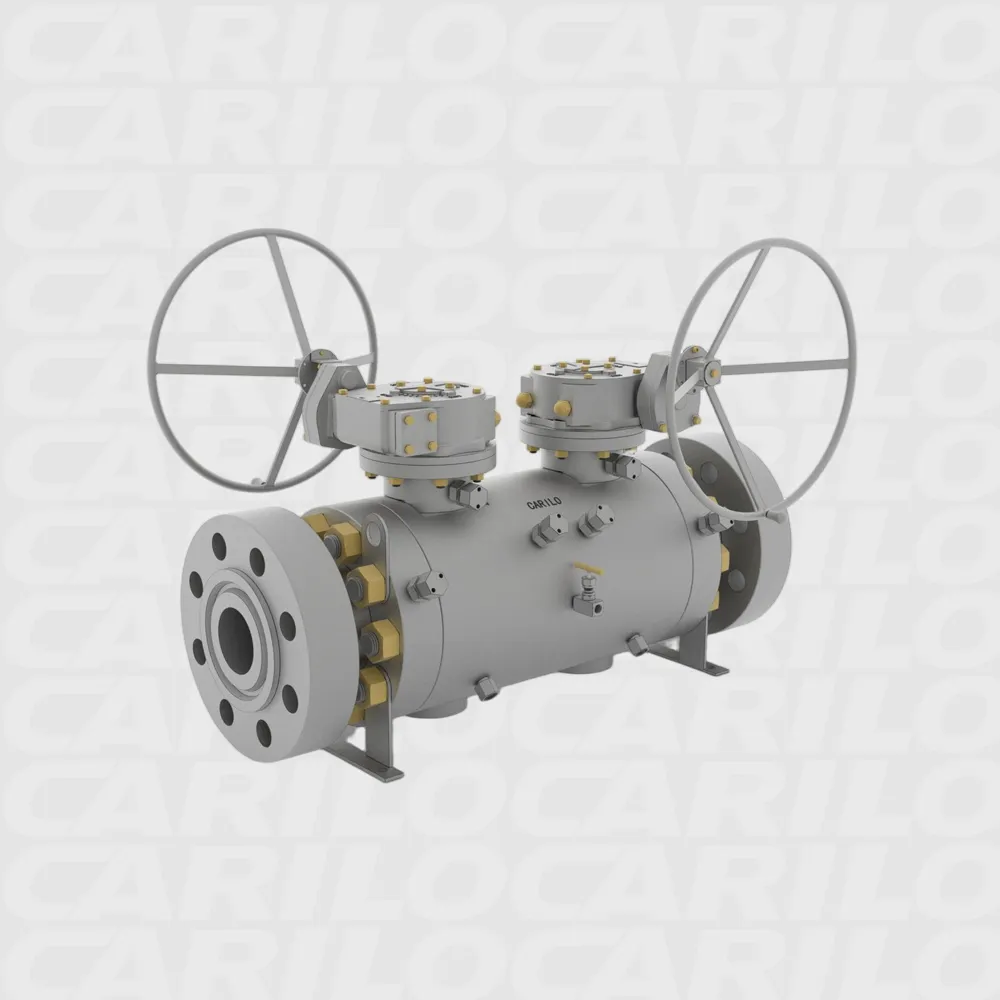
One Body. Two Isolation Points. Zero Compromise.
CARILO DBB Compact Manifold replaces traditional twin separate-valve assemblies with a single integrated body — cutting weight, footprint, and external leakage risk for marine and offshore applications.
Two ball closures in one monolithic body with independent bleed port. Self-relieving cavity pressure design prevents overpressure buildup between the two isolation points.
Two separate valves joined by spool pieces. Higher total weight, larger piping footprint, more potential leak points at each flange connection.
Single-Body Integration vs. Spool Piece Connection
The DBB Compact Manifold consolidates two independent ball isolation assemblies into one cast or forged body. Fewer flange connections mean fewer potential leak paths — a critical advantage in offshore and marine environments where leakage tolerance is near zero.
Floating Ball Valve
CARILO floating ball valves are engineered for safe, reliable operation in demanding industrial services. The design combines stem retention security, anti-static protection, clear position indication, locking capability, standardized actuator mounting, and fire-safe performance.
Blow-out Proof Stem
The valve stem adopts a T-shaped lower end, restrained and protected by the integral boss of the valve body. This reliable structure locks the stem firmly under all rated working pressures and also serves as an effective backseat secondary sealing surface.
Anti-static Device
A spring preloaded plunger is installed on the stem, maintaining continuous contact between the ball, stem and valve body. It forms a conductive channel to dissipate static charges generated by friction during valve opening and closing. This design is especially important for flammable and explosive media such as LNG and petrochemical fluids.
Position Indicator
The stem top features a double-D configuration. After installing the operating lever, the lever always stays parallel to the internal flow path, effectively avoiding lever deflection and misalignment.
Locking Device
A standard reserved structure for lock fitting is available on all CARILO ball valves, allowing users to install locking devices to prevent accidental valve operation.
ISO 5211 Actuator Mounting Pad
Every CARILO ball valve is equipped with an integrated actuator mounting pad fully engineered in compliance with ISO 5211, enabling seamless matching with pneumatic, electric and hydraulic actuators.
Fire-Safe Construction
All CARILO floating ball valves are engineered to meet API 607 fire-safe standards.
Trunnion Mounted Ball Valve
CARILO trunnion mounted ball valves are engineered for critical pipeline isolation where stable sealing, pressure control, double block and bleed capability, emergency sealing backup and fire-safe performance are required.
Cavity Pressure Relief
When trapped cavity pressure rises abnormally, the valve seat structure can automatically release pressure to the upstream or downstream pipeline, helping protect valve integrity and system safety.
Double Block & Bleed
Each seat can independently seal against pressure from both sides of the ball. Vent and drain plugs allow the valve cavity to be safely bled during inspection, maintenance or shutdown operation.
Emergency Sealant Injection
For NPS 6” and above, sealant injection fittings are installed at stem and seat positions. Sealant can be injected to provide temporary leakage control if the soft seat or stem O-ring is damaged.
Standard Anti-static Device
A spring-loaded conductive device maintains electrical continuity among the ball, stem and valve body, dissipating static charges generated during opening and closing.
Metal-to-Metal Seat Option
Optional hard seats are available for abrasive media or high-temperature service, improving durability under severe operating conditions.
Fire-Safe Construction
CARILO trunnion mounted ball valves are engineered to meet API 607 fire-safe standards for critical oil, gas, LNG and petrochemical applications.
The trunnion mounted design supports stable ball positioning, lower operating torque and reliable sealing performance in demanding high-pressure pipeline applications.
Floating vs Trunnion Mounted — Which DBB Design Fits?
Both designs are available within the CARILO DBB Compact Manifold range. Select based on pressure class, temperature, and isolation requirements.
Full DBB Manifold Specifications
| Parameter | Specification |
|---|---|
| Size Range | NPS 2”–24” (DN 50–600) |
| Pressure Class | Floating: ASME Class 150–600 LB / Trunnion: ASME Class 150–2500 LB |
| Temperature Range | -29 degrees C to 200 degrees C (soft seated) / up to 350 degrees C (metal seated, Trunnion) |
| End Connections | Socket Weld (ASME B16.11) / Butt Weld (ASME B16.25) / Threaded (ASME B1.20.1 NPT) / Flanged (ASME B16.5 up to 24" & B16.47 from 26") |
| Port Bore | Full-bore or Reduced-bore |
| Seat / Sealing | Soft seated (default) or Metal-to-metal seated (Trunnion option) |
| Body Materials | A216 WCB (Carbon Steel) / A351 CF8M and CF3M (Stainless Steel) / A890 CE8MN (Duplex Stainless Steel) |
| Operation | Manual (lever or gear) / Pneumatic actuator / Electric actuator / Hydraulic actuator |
Four Connection Types for Diverse Piping Systems
Socket Weld
Socket weld ends per ASME B16.11. Ideal for high-pressure systems requiring leak-tight welded connections.
ASME B16.11Butt Weld
Butt weld ends per ASME B16.25. Suitable for high-temperature and high-pressure piping systems.
ASME B16.25Threaded
Threaded ends per ASME B1.20.1 NPT. Fast installation without welding for low-pressure applications.
ASME B1.20.1 NPTFlanged
Flanged per ASME B16.5 (up to 24") and ASME B16.47 (from 26"). RF and RTJ facings available.
ASME B16.5 / B16.47Full Bore or Reduced Bore — Match Your Flow Requirement
Full Bore
Internal bore matches pipe diameter. Enables pipeline pigging, full bore flow, and inspection gauge passage. Recommended for marine cargo handling and tank isolation.
Max Flow CapacityReduced Bore
Bore diameter one or two sizes smaller than the pipe. Lower cost, lighter weight. Suitable for instrumentation, sampling, and blow-down isolation service.
Cost-EffectiveThree Configurations for Every Installation Requirement
Three-Piece
Body in three bolted sections. Enables inline maintenance without removing the valve from the pipeline.
Extended Neck
Valve neck extended to accommodate pipeline insulation. Prevents heat transfer to the actuator in high-temperature service.
Custom Tailored
Configured to your specific piping layout. Custom body geometry, connection angles, and mounting arrangements available per drawing.
Body Materials for Every Service Environment
A216 WCB
WCB grade cast carbon steel. Suitable for general hydrocarbon service, water, and non-corrosive media. Cost-effective for standard offshore applications.
A351 CF8M / CF3M
Austenitic stainless steel casting. CF8M for standard corrosive service; CF3M (low-carbon) for weld-prone fabrication. Excellent corrosion resistance in seawater and chemical environments.
A890 CE8MN
Duplex stainless steel. Higher yield strength and superior chloride stress corrosion cracking resistance vs. austenitic SS. Ideal for seawater and offshore topside chloride environments.
Engineered for Marine and Offshore Service
FPSO Vessels
Floating Production Storage and Offloading units. Compact design reduces weight budget in floating vessel applications.
Drillship & Semi-submersible
Mobile drilling units with dynamic positioning. Trunnion mounted design handles motion-induced loads.
Oil & Chemical Tanker
Cargo isolation and tank cleaning system isolation. Full-bore option enables pipeline pigging operations.
Fixed Production Platform
Topside process isolation. DBB function enables safe maintenance isolation without system depressurization.
Subsea Manifold
Subsea production control. Trunnion mounted with metal seated option for high-pressure subsea tree applications.
Offshore Wind
Hydraulic system isolation and cooling system shutdown valves. Compact manifold reduces sub-platform space requirements.
Offshore Terminal
LNG and product loading arms. Fire-safe design meets IMO and SOLAS requirements for marine loading systems.
Manufactured and Tested to Global Valve Standards
API 6D
Pipeline ball valve design and manufacturing standard
API 607
Fire-safe testing for quarter-turn valves
API 598
Valve inspection and testing standard
ISO 5208
Industrial valve seat leakage rate classification
ISO 15848-2
Fugitive emission stem packing — Class A
PED 2014/68/EU
European Pressure Equipment Directive compliance
Five Reasons to Specify CARILO DBB Compact Manifolds
API 6D Manufacturing
Designed and manufactured under API 6D quality management system. Traceable material certs and hydrostatic test reports included.
Marine & Offshore Focus
DBB manifolds optimized for FPSO, drillship, and platform service. Fire-safe, anti-static, and cavity relief as standard features.
Customized Solutions
Engineering team available to configure DBB manifold for specific process conditions. Custom drawings and material substitutions supported.
Global Export Ready
Documentation package includes EN 10204 material certificates, API monograms, and third-party inspection support upon request.
Technical Support
Technical sales team responds to specification inquiries. Engineering review of data sheets and process diagrams prior to order confirmation.
Common Questions About DBB Compact Manifolds
What is the difference between DBB Compact Manifold and a standard twin valve assembly?
A DBB Compact Manifold integrates two ball valves within one single valve body, whereas a traditional twin valve assembly uses two separate valves joined by spool pieces. The single-body design reduces overall valve weight, requires less piping space, and cuts the number of potential leak points from eight to four (at the four flange connections). The integrated design also eliminates the spool piece between valves, simplifying the pressure boundary.
When should I specify floating ball valve vs trunnion mounted design?
Specify floating ball valve design for general isolation service up to ASME Class 600 LB where line pressure provides sufficient seating force. Specify trunnion mounted design for higher pressure classes (up to Class 2500 LB), larger sizes (NPS 2 to 24), high-temperature service above 200 degrees C, or when full DBB function with cavity pressure relief is required for critical isolation.
Does the floating ball valve design support full DBB isolation?
The floating ball valve DBB manifold does not provide full DBB isolation in the same way as the trunnion mounted version. The floating design relies on line pressure to push the ball against the downstream seat. For applications requiring confirmed double isolation with independent bleed, specify the trunnion mounted version which includes cavity pressure relief and dedicated bleed port.
What is cavity pressure relief and why does it matter?
Cavity pressure relief is a self-actuating mechanism that vents trapped medium when cavity pressure exceeds the combined force of the seat spring and line pressure. Without cavity relief, thermal expansion of trapped liquid can generate dangerous overpressure between the two isolation points. Trunnion mounted CARILO DBB manifolds include this feature as standard.
What materials are available for seawater service?
For seawater and chloride-rich environments, specify A890 CE8MN duplex stainless steel body material. Duplex SS offers superior chloride stress corrosion cracking resistance compared to standard austenitic stainless steel (CF8M/CF3M), with higher yield strength enabling thinner section designs. Carbon steel (WCB) with appropriate coatings is also used for specific seawater applications.
Are emergency sealant injection fittings available?
Emergency sealant injection fittings are standard on trunnion mounted manifolds NPS 6 and above. Fittings are provided on both the stem and seat positions with internal check valves, allowing field injection of sealant to restore sealing in the event of soft seat or stem O-ring damage without removing the valve from the pipeline. Available for NPS 4 and below on request.
What fire-safe standards does the CARILO DBB manifold meet?
CARILO DBB compact manifolds are designed and tested to API 607 fire-safe standards. API 607 testing confirms that the valve maintains its pressure-retaining capability after exposure to a defined fire scenario. Both floating and trunnion mounted designs incorporate secondary metal-to-metal seating that provides reliable sealing even if the primary soft seat is destroyed by fire.
What inspection and test reports are supplied with the valves?
Standard supply includes hydrostatic shell test and low-pressure air seat test reports per API 598. Material certificates are provided per EN 10204 3.1 (or 2.2 on request), covering body, ball, stem, and seat materials. API monograms are applied to valves manufactured under API 6D. Third-party inspection (SGS, BV, DNV, ABS) available upon request with additional lead time.
Ready to Specify Your DBB Compact Manifold?
Tell us your process conditions — pressure class, size, material, and end connection. Our technical team will respond with a configured quote.