
Cryogenic Ball Valves — Down to -196°C
CARILO is a professional manufacturer specializing in side entry cryogenic ball valves with rich experience in ultra-low temperature applications. Complete quality control system, advanced production & testing equipment, manufactured in accordance with international standards.
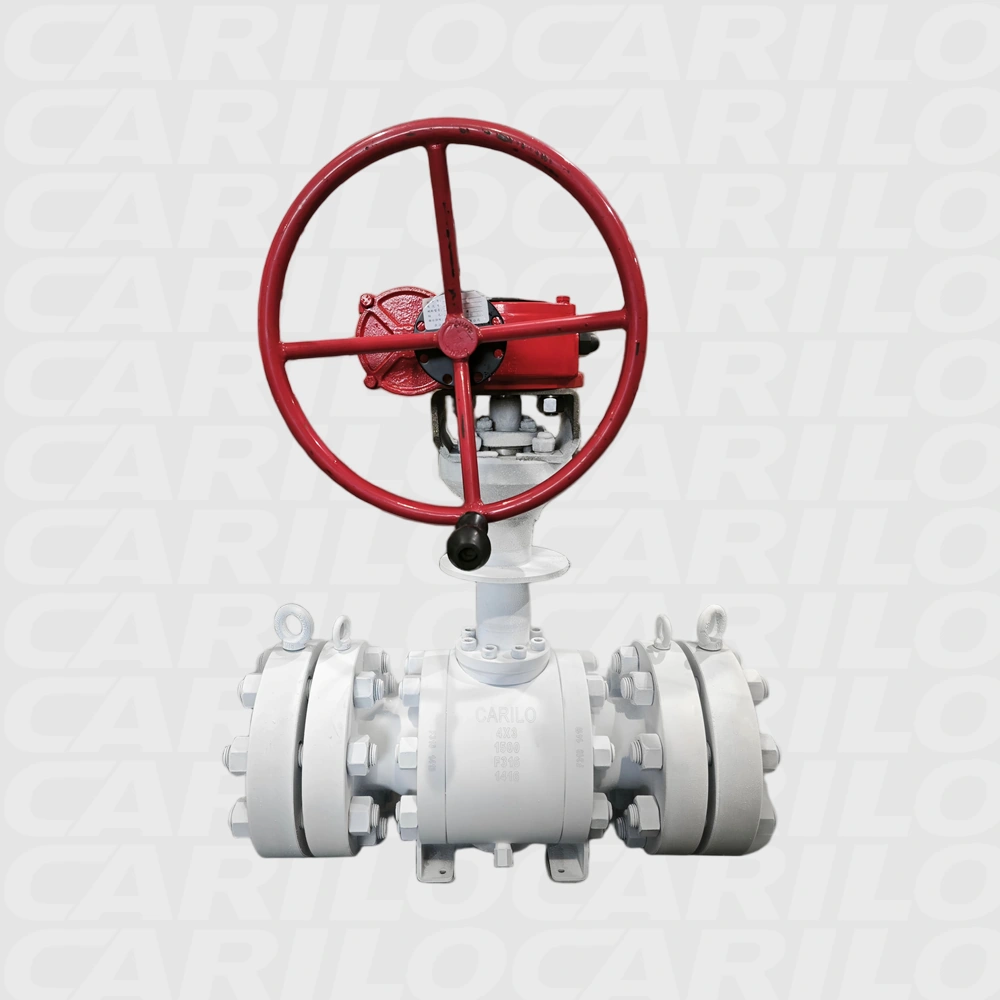
LNG / LOX / LIN service grade per MSS SP-134
ASME Class 150 to 2500LB coverage
NPS 1/2"-36" cast / 1/2"-48" forged
Full cryogenic inspection per BS 6364
Why Choose a Cryogenic Ball Valve?
CARILO is a professional cryogenic valve manufacturer specializing in side entry cryogenic ball valves for ultra-low temperature applications. We operate a complete quality control system with advanced production and testing equipment, manufacturing every valve to international standards and delivering to your exact specifications.
Our valves serve LNG, petrochemical, and industrial gas operators worldwide. Every unit is cryogenically treated, precision polished, and hydrostatically tested before shipment.
Selection Guide for Soft-Seated vs. Metal-Seated Cryogenic Ball Valves
| Attribute | Soft-Seated Cryogenic Valve | Metal-Seated Cryogenic Valve |
|---|---|---|
| Recommended Service | Clean cryogenic media | Particle-containing or severe cryogenic media |
| Typical Applications | LNG, LOX, LIN, LAR storage and loading / unloading | Cryogenic media with solids, high-pressure frequent switching |
| Key Advantage | Excellent sealing performance and low operating torque | Higher resistance to wear, erosion, and harsh working conditions |
| Best Fit | Low-temperature storage, transfer, and general clean-fluid service | Low-temperature + high-temperature cycling and demanding shut-off service |
Six Quality Advantages for Cryogenic Valve Reliability
From double cryogenic treatment to full BS 6364 inspection, CARILO cryogenic valves are engineered for stable sealing, reliable operation, and long-term performance under ultra-low temperature service.
Double Cryogenic Treatment
All spare parts are processed with cryogenic treatment twice before finish machining to enhance dimensional stability in ultra-low temperature service.
High-precision Sealing Surface
All sealing areas are precisely polished to 0.2μm and adopt a lip-seal structure for dependable cryogenic sealing performance.
Special Stem Material
The extended stem, except for check valves, is made of XM-19 or Inconel 718 to ensure strength and reliability under cryogenic conditions.
Full Cryogenic Test
Every cryogenic valve is inspected in accordance with BS 6364 before delivery to verify low-temperature performance and sealing integrity.
Hardened Ball
All balls are hardened and precisely ground to 0.2μm, providing smooth operation and reliable shut-off performance.
Top-grade Sealing Parts
All lip seals adopt well-known international brand components to improve sealing reliability and service consistency.
Two Side Entry Cryogenic Ball Valve Designs
CARILO offers two structural configurations for side entry cryogenic ball valves — each engineered for a distinct size and pressure envelope. Select the floating-ball design for small to medium pipelines; select the trunnion-mounted design for large-bore high-pressure main pipelines.
Side Entry Cryogenic Floating Ball Valve
Side Entry Cryogenic Trunnion Mounted Ball Valve
Three Temperature Grades, Twelve Engineered Materials
Cryogenic valve materials must be matched to minimum operating temperature. The table below shows the standard material selection for each temperature grade — from -46°C LPG service to -196°C LNG storage and transport.
| Min Temp | Cast Steel (per ASTM) | Forged Steel (per ASTM) |
|---|---|---|
| -46°C | LCC, LCB ASTM A352 | LF2 ASTM A350 |
| -101°C | LC3, CF3, CF8 ASTM A352 / A351 | LF3 ASTM A350 |
| -196°C | CF3M, CF8M ASTM A351 | F316, F316L ASTM A182 |
All cryogenic materials are impact-tested at the rated minimum temperature per ASTM A370. LNG-grade (-196°C) carbon content limited to 0.03% max for F316L / CF3M.
Six Reasons Cryogenic Operators Specify CARILO
Double Cryogenic Treatment
All spare parts processed with cryogenic treatment twice before finish machining.
High-precision Sealing Surface
All sealing areas precisely polished to 0.2μm with lip-seal structure.
Special Stem Material
Extended stem made of XM-19 or Inconel 718 for cryogenic service.
Full Cryogenic Test
All valves pass BS 6364 inspection before delivery.
Hardened Ball
All balls hardened and precisely ground to 0.2μm.
Top-grade Sealing Parts
All lip seals adopt well-known international brand components.
Precision-matched Materials for Every Cryogenic Service Condition
Five key component material selections — from body and bonnet to sealing elements — each chosen for cryogenic compatibility, thermal stability, and long-term sealing performance.
| Component | Material Specification |
|---|---|
| Body & Bonnet | Forged or Cast Stainless Steel |
| Stem | XM-19, Inconel 718 |
| Ball | 316L with hard facing |
| Seat | PCTFE, PTFE, STL, NISS, TCC |
| Packing & Gasket | Graphite, Elgiloy + PTFE Lip Seal |
Full-Bore or Reduce-Bore — Matched to Your Flow Requirement
Two port geometries cover virtually every cryogenic service scenario. Choose full-bore for pig-passing and minimum pressure drop; choose reduce-bore for lower cost and weight at the same pressure class.
Full-Bore
Bore diameter equals pipe ID. Pressure drop equals an equivalent length of straight pipe — typically 3D to 5D. Required for pig-passing and scraper service. Recommended for cryogenic pump suction lines where minimum NPSH loss is critical. Cv value matches an equivalent length of 3D pipe at full pipeline-bore flow.
- Bore = pipe ID (1:1 ratio)
- Pressure drop = 3D to 5D straight pipe
- Standard for LNG loading arms & pump suction
Reduce-Bore
Bore diameter is one or two NPS smaller than pipe ID. Lower mass (~30% less), lower cost (~25% less), and ~40% lower torque requirement for the same pressure class. Suitable for throttling service and storage-tank isolation where full-bore flow is not required.
- Bore = pipe ID - 1 or 2 NPS
- ~40% lower torque vs. full-bore
- Standard for storage-tank isolation
Three Connection Types, Each Built to ASME Standards
Socket weld for small-bore instrument and pilot lines; butt weld for high-integrity process piping; flanged for storage-tank and pump headers where periodic disconnection is required.
Socket Weld
ASME B16.11
Forged socket-welding ends for NPS 1/2" to 2" cryogenic lines. Self-aligning geometry simplifies field installation. Standard for instrument air, sample lines, and small-bore cryogenic manifolds.
Butt Weld
ASME B16.25
Butt-welding ends for high-integrity cryogenic process piping. Eliminates crevice corrosion at the joint. Standard for LNG, LOX, and LIN main process lines up to NPS 48" and ASME Class 2500LB.
Flanged (RF / RTJ)
ASME B16.5 & B16.47
Raised-face (RF) or ring-type joint (RTJ) flanged ends. Standard for cryogenic pump headers, storage-tank nozzles, and loading-arm connections where periodic disconnection for maintenance is required.
NPS 1/2" to 48" — ASME Class 150 to 2500LB
Cast steel covers NPS 1/2" to 36"; forged steel extends to NPS 48" (DN1200) for large LNG storage-tank and loading-header applications. Higher pressure ratings require reduced NPS range.
| ASME Pressure Class | NPS Size Range | Typical Service |
|---|---|---|
| Class 150–300 | NPS 1/2" – 8" | LNG storage headers, low-pressure pump discharge |
| Class 600 | NPS 1/2" – 4" | LNG liquefaction process, ASU cold box |
| Class 900–1500 | NPS 1/2" – 2" | LNG loading arms, high-pressure pump suction |
| Class 2500 | NPS 1/2" – 1-1/2" | Instrument & sample lines, HP cryogenic manifolds |
All pressure classes are tested and inspected in accordance with BS 6364. Body and bonnet materials traceable to ASTM A352, A351, A350, and A182 as applicable to the temperature grade.
11-Step Manufacturing Process from Raw Material to Delivery
Every CARILO cryogenic ball valve passes through a controlled 11-step production sequence — including double cryogenic treatment, full NDT inspection, and bubble-tight cryogenic testing — before dispatch.
01
Incoming
Material Inspection
MTC & chemistry
verification
02
Rough
Machining
CNC turning &
milling
03
First Cryogenic
Treatment
−196°C / 4h
stabilization
04
Finish Machining
& Precision Polishing
0.2μm surface
roughness Ra
05
Second Cryogenic
Treatment
−196°C / 4h
final stabilization
06
NDT Inspection
PT · MT · UT · RT
per ASTM
07
Degreasing
& Cleaning
Solvent cleaning
residue-free
08
Valve
Assembly
Seat & stem
installation
09
Pressure &
Cryogenic Test
API 598 / BS 6364
at −196°C
10
Final Inspection
& Painting
Dimensional &
surface check
11
Packaging
& Delivery
Export crate /
FOB Ningbo
Five Industries Where CARILO Cryogenic Valves Are Essential
Five cryogenic service applications — each with distinct temperature, pressure, and safety demands that a general-purpose valve cannot meet.
LNG Systems
LNG is stored and transported at −162°C. Every valve in the LNG chain — from liquefaction plant to terminal to fuel gas supply — must maintain bubble-tight sealing at cryogenic temperatures. CARILO double cryogenic treatment and extended bonnets per MSS SP-134 are purpose-built for this service.
Petrochemical Low-temperature Pipelines
Ethylene and propylene pipelines operate at −104°C. Valves must resist thermal shock during startups and maintain fugitive emission integrity over a 30-year design life. CARILO fire-safe certified valves with dual-stem sealing meet the safety demands of petrochemical operators worldwide.
Liquid Nitrogen & Liquid Oxygen Pipelines
Industrial gas and steel producers move LIN (−196°C) and LOX (−183°C) through miles of pipeline. Cryogenic valves at transfer points and tank outlets must prevent gas loss and eliminate leakage pathways that could cause oxygen enrichment fires or nitrogen asphyxiation risks.
Cryogenic Tanker Trucks & Containers
Tanker and ISO container cryogenic valves face constant vibration, thermal cycling during loading and unloading, and strict weight constraints. CARILO's compact side-entry design reduces envelope dimension while maintaining full port diameter — critical for tanker manifolds where space is at a premium.
Air Separation Plants
Cryogenic air separation units produce oxygen, nitrogen, and argon through multi-column distillation at cryogenic temperatures. Valves must withstand rapid pressure swings and maintain zero-leak performance in oxygen-enriched environments. CARILO offers oxygen-cleaned (LOX) specification for this service.
Seven Standards. One Specification.
Every CARILO cryogenic ball valve is designed, manufactured, and tested in accordance with the international standards that govern cryogenic valve supply.
API 6D
Pipeline Ball Valves
Base specification for pipeline ball valve design, materials, face-to-face dimensions, and testing requirements.
BS 6364
Cryogenic Service Valves
British Standard for valves in cryogenic service. Mandatory reference for LNG terminals and offshore platforms.
MSS SP-134
Cryogenic Body/Bonnet Extension
Defines extended bonnet length and packing-temperature limits. Directly governs CARILO's −100°C treatment protocol.
API 607 / 6FA
Fire Test (TÜV)
TÜV-certified fire-safe. Secondary metal seat engages after soft-seat burn-through in a fire event.
BS 6364
Bubble-Tight Sealing
Zero-leakage class. Cryogenic valve inspection is performed before delivery in accordance with BS 6364.
API 598
Valve Inspection & Test
Hydrostatic and pneumatic testing for every valve. Batch-traceable MTC included with each shipment.
ISO 15848
Fugitive Emission
Fugitive emission performance for environmental compliance. Limits methane/HC leakage from stem seals.
8 Questions Buyers Ask Before Specifying a Cryogenic Ball Valve
1. What is the minimum operating temperature of CARILO cryogenic ball valves?
-196°C (LNG service grade). Material selection and cryogenic treatment are applied to all components operating below -100°C per MSS SP-134. Impact testing at -196°C per ASTM A370 is standard for LNG-grade material certificates.
2. What materials are available for -196°C LNG service?
Cast steel: CF3M / CF8M (ASTM A351). Forged steel: F316 / F316L (ASTM A182). Carbon content limited to 0.03% max for low-temperature sensitization resistance. For -101°C service, LC3 / CF3 / CF8 cast and LF3 forged are standard.
3. Is the valve fire-safe certified?
Yes. CARILO cryogenic ball valves are third-party fire-test certified by TÜV to API 607 / API 6FA. After soft-seat consumption in a fire event, secondary metal-to-metal seating engages to prevent release of LNG or LOX.
4. What end connections are available?
Three end types, each to ASME standards: Socket Weld (ASME B16.11, NPS 1/2"-2"), Butt Weld (ASME B16.25, all sizes), and Flanged RF / RTJ (ASME B16.5 for NPS ≤ 24", ASME B16.47 for NPS 26"-48").
5. How long is the extended bonnet?
200 to 500mm above the body, depending on valve size and minimum service temperature. The bonnet length keeps the packing area operating consistently above 0°C. Specific dimensions per MSS SP-134-2017 based on NPS and temperature class.
6. Do you provide OEM / custom manufacturing?
Yes. CARILO provides OEM and custom-engineered cryogenic ball valves for non-standard pressure classes, special alloys (Monel / Inconel / Hastelloy on request), and customer-specified end-connection dimensions. MOQ 5 pieces for OEM specials.
7. What testing standards are met?
Hydrostatic shell test per API 598, BS 6364 bubble-tight seat test, MSS SP-134 helium leak test at -196°C, and TÜV fire test per API 607. Each valve ships with batch-traceable MTC (Material Test Certificate).
8. What is the typical delivery lead time?
Standard NPS 1/2"-12" Class 150 to 300 in stock: 15 days. Non-standard sizes, pressure classes, or OEM specials: 45-60 days. Shipping via FOB Ningbo or CFR destination port. Sample / trial order quantities accepted.
Talk to a Cryogenic Valve Engineer
Send us your service conditions — fluid, temperature, pressure, size, end connection, and quantity. We return a technical-commercial proposal within 48 hours, with material certificates and cryogenic test reports available on request.
CARILO Cryogenic Valve Contact
[email protected]
+86-577-57766889
carilovalves.com
carilovalves.com/contact-us/
© 2026 CARILO Valve. All cryogenic ball valves manufactured under API 6D, BS 6364, and MSS SP-134-2017.