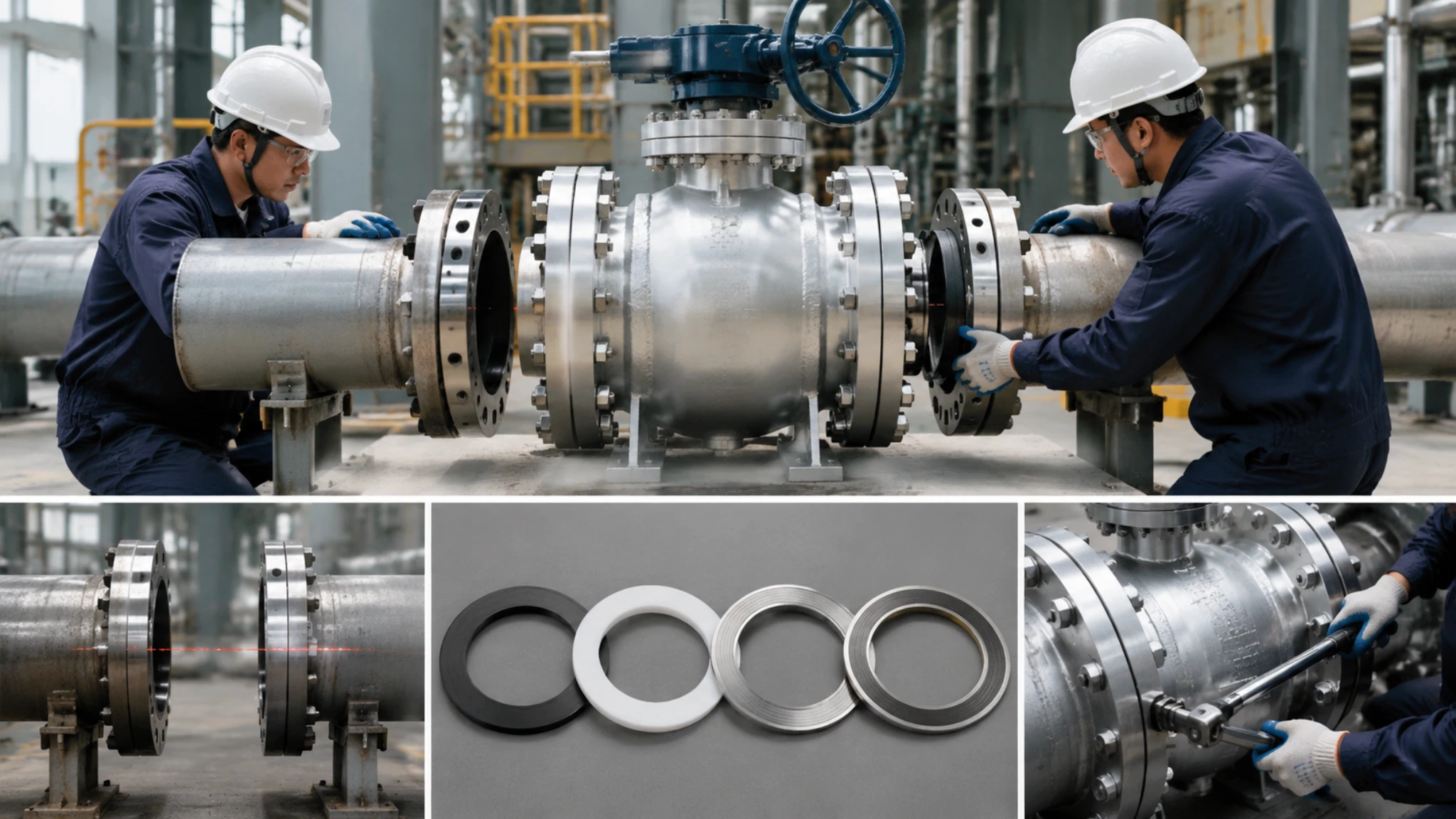
At LNG terminals and liquid hydrogen carriers, the valve stem packing gland is the primary leakage source. Extended neck protection, configured packing components, and ultra-low temperature testing determine zero-leakage performance.

Extended Neck Design
Keeping Packing Warm
When the internal valve body temperature drops to minus 169 degrees C during LNG or liquid hydrogen service, atmospheric moisture penetrates along the valve stem channel and condenses into ice particles in the minus 20 degrees C zone. These ice particles scratch the flexible graphite packing, forming micro-channels through which process medium begins to leak. The extended neck design solves this by creating a thermal resistance path outside the packing gland, trapping conductive heat from the upper valve body in the neck zone to keep the packing area safely above freezing. I once inspected an early top-entry cryogenic ball valve installation at a Northeast China ethylene facility that did not use extended neck design. After just two years of operation, visible ice had formed on the packing gland cover, and the valve required an emergency shutdown for component replacement. The root cause was straightforward: without the thermal barrier created by the extended neck, atmospheric moisture reached the cold packing zone and froze. Field performance data from multiple LNG terminals confirms the pattern.
Ball valves equipped with extended necks of 150 millimeters or more consistently show packing gland external temperatures 18 to 25 degrees C higher than neckless designs under identical operating conditions. This temperature margin reduces ice formation probability by more than 80 percent. Some manufacturers further enhance the design by adding spiral heat conduction grooves or red copper sealing rings on the inner wall of the extended neck to optimize the heat transfer pathway.
At a North China LNG gasification station, I supervised thermal imaging surveys on 6-inch Class 150 cryogenic ball valves during winter operation. The 250-millimeter neck length valves showed packing gland external temperatures approximately 22 degrees C higher than standard neck batches, with zero packing-related incidents across 18 months of continuous service. The standard neck batches at the same facility showed ice formation on the packing gland by the 8th month of operation.
When evaluating supplier drawings, I specifically request cross-sectional views showing the chamber sealing method and require helium leak testing of each chamber at 1.5 times design pressure before final acceptance. A signed thermal calculation sheet demonstrating that the extended neck length keeps the packing gland zone above 0 degrees C under the specified minimum ambient temperature should be a mandatory procurement requirement.
Creating Gas Pockets
- The extended neck structure is not simply a lengthened metal cylinder.
- Between the inner and outer tubes of the neck wall, multiple sealed air chambers are formed during manufacturing.
- These chambers create an insulation airspace equivalent to 30 to 50 millimeters of static air, and because still air has a thermal conductivity of only 0.025 W/(m·K), compared to approximately 50 W/(m·K) for stainless steel, the heat blocking effect is substantial.
- I reviewed the extended neck structure design for a southern China offshore LNG import terminal project.
- The thermal designer specified a dual-layer neck with three sealed air chambers on all cryogenic ball valves above DN 150.
- The process simulator predicted that even at minus 169 degrees C operating temperature, the packing gland zone would remain above 5 degrees C, safely above the freezing point of water.
- During the pre-commissioning thermal imaging verification, we confirmed actual temperatures matched the thermodynamic simulation results within a 2-degree margin.
- The air chamber design adds approximately 15 percent to the neck material cost but reduces the cryogenic medium heat ingress at the packing gland by 40 percent compared to single-layer neck construction.
- Based on maintenance records from the first 36 months of operation, packing service life on dual-chamber design valves is 2 to 3 times longer than equivalent single-layer neck valves at the same facility.
- A common quality deficiency I have found during supplier audits is incomplete chamber sealing.
- Some manufacturers leave the annular space between inner and outer tubes open at the top, allowing humid ambient air to ingress and condense inside the chamber at cryogenic temperatures.
- I have seen chambers that were supposed to be sealed contain visible ice after just one winter thermal cycle.
- The chamber helium leak test at 1.5 times design pressure, witnessed by the client inspector, is the only way to verify this critical seal quality.
- Without this verification, the air chamber becomes a liability rather than an asset.
- When the annular gap at the top of the neck is not properly sealed, humid outdoor air enters the chamber during shutdown periods and condenses into ice when the valve is subsequently cooled to cryogenic temperatures.
- This ice expansion can crack the chamber seal permanently, defeating the purpose of the air chamber design from the first thermal cycle.
- During supplier audits, I specifically request the chamber seal welding procedure and the helium leak test results for each individual chamber at 1.5 times design pressure, witnessed by the client inspector.
Space For Insulation
Polyurethane foam thickness for minus 170 degrees C service should be no less than 80 millimeters, hydrophobic silicate blankets should be 100 millimeters or more, and aerogel blankets can achieve equivalent insulation with 50 millimeters due to their lower thermal conductivity. An annular clearance of 8 to 12 millimeters should be reserved between the insulation layer and the extended neck inner wall for sealant filling and moisture barrier installation.
Insufficient clearance causes compression of insulation material during assembly, creating thermal bridges; excessive clearance complicates installation and produces uneven filling. I worked as the process engineer on a liquid hydrogen transport vessel project where all cryogenic ball valves specified aerogel module filling in the extended neck annulus. The thermal specification required heat ingress at the packing gland to be no more than 0.8 W per meter of neck length.
The bare stainless steel neck with no fill measured 4.5 W/m under identical boundary conditions, so the aerogel approach was clearly necessary. The critical coordination point was ensuring the neck inner diameter was at least 30 millimeters larger than the valve body outer diameter throughout the full neck length. This required the valve manufacturer, structural designer, and piping layout team to jointly review the assembly sequence during the design freeze stage.
- If this annular space is not reserved at the design stage, field modifications to grind down insulation modules create gaps and compromised insulation performance.
- I reviewed a similar liquid hydrogen storage facility project where this coordination step was missed.
- After 12 months of operation, the packing gland temperature had exceeded the design value by 8 degrees C, and a planned shutdown was required to modify the insulation configuration.
- The repair cost and lost production value totaled approximately USD 280,000.
- Coordinating the annular space requirement upfront avoids this type of expensive field rework.
- Coordination between the valve supplier, insulation material vendor, and the piping design team must happen during the design freeze stage, not during construction.
- I have seen projects where the annular gap was specified on the valve drawing but not reflected in the pipe support design, resulting in the insulation clearance being consumed by a pipe clamp.
- The design review checklist should include a dedicated item verifying that the annular gap is maintained at every cross-section along the neck length, with the minimum gap dimension called out on the issued-for-construction drawing.
Packing Protection Tips
Live Loaded Springs
The live loaded spring assembly uses elastic elements that are pre-compressed during valve assembly to continuously apply load to the packing gland. Unlike fixed-weight loading, where the seal load is constant and cannot adapt, the spring element automatically compensates when thermal contraction or mechanical vibration causes the packing to relax, maintaining consistent seal stress throughout the valve service life. At a North China LNG peak-shaving station, I evaluated 48-inch Class 300 cryogenic ball valves from two suppliers. Supplier A installed live loaded springs using Inconel X-750 alloy springs. Supplier B used conventional fixed-weight loading with Belleville washers. After three years of operation and approximately 800 thermal cycles, we commissioned an independent spring stiffness test. Supplier A’s live loaded springs showed load loss of only 4 percent, well within the 10 percent acceptance threshold. Supplier B’s fixed-weight washers had experienced 22 percent load loss, and 30 percent of those valves showed packing gland leakage during the same period. The spring preload setting is a critical parameter.
I recommend specifying a preload of 1.5 to 2 times the maximum working load, which typically corresponds to 20 to 35 N per millimeter of stem diameter for graphite packing in cryogenic service. During FAT, I now require a spring stiffness curve from the supplier, and I verify the as-assembled preload using a calibrated load cell before the valve ships.
Spring material certification, including the acceleration aging test report per ASTM F1551, should also be reviewed during incoming inspection to confirm the spring can maintain its mechanical properties after prolonged cryogenic exposure. Spring preload degradation over time is the primary failure mode for live loaded spring assemblies in cryogenic service.
The Inconel X-750 and Hastelloy C-276 are the preferred spring materials for cryogenic applications because they retain their mechanical properties at temperatures down to minus 269 degrees C. Spring relaxation at cryogenic temperature is a time-dependent phenomenon. Even Inconel X-750, which has excellent cryogenic properties, experiences some load loss over the first 500 thermal cycles.
The acceleration aging test per ASTM F1551 simulates 20 years of service in an accelerated format and provides confidence that the spring will not lose more than 10 percent of its preload within the design life. I now require this test report as a standard delivery document for all cryogenic valve procurement above DN 50.
Low Emission Seals
- The fugitive emission stem seal for cryogenic service uses a multi-level structure.
- The primary seal is typically flexible graphite or PTFE-based packing rings arranged in a chevron pattern.
- The secondary seal is a fluorocarbon rubber C-spring or a metal bellows element that provides a redundant barrier if the primary seal is compromised.
- This two-stage approach is essential because cryogenic temperatures cause significant thermal contraction of organic materials, making single-seal designs unreliable over thermal cycling.
- The ISO 15848-1 standard specifies three leakage classes: Class A, B, and C, with Class A being the most stringent.
- For LNG and liquid hydrogen service, Class A certification is effectively mandatory because the economic and safety consequences of fugitive emissions are severe.
- I audited a Korean bellows valve manufacturer’s cryogenic test center where ISO 15848-1 Class A certified valves were subjected to endurance testing.
- The test conditions were minus 45 degrees C with helium as the test gas, and the allowable leakage rate was less than 50 ppm by volume.
- I witnessed three DN50 bellows globe valves tested simultaneously.
- Each valve underwent 100 mechanical stem cycles and 50 thermal cycles before the final leakage rate was measured by mass spectrometry.
- All three valves passed with measured leakage rates below 10 ppm.
- After 2 years of field service encompassing approximately 800 actual stem cycles, 120 bellows valve installations at an LNG terminal expansion project have recorded zero stem leakage incidents.
- The lesson: bellows seal design is the most reliable stem sealing solution for cryogenic service, and ISO 15848-1 Class A certification with actual endurance test data should be a mandatory procurement requirement, not an optional add-on.
- The type test report should include the actual leakage rate data, not just a pass or fail statement, so the buyer can assess the margin above or below the class threshold.
- The production batch certificate confirms that every valve in the shipment was manufactured using the same materials and processes as the type-tested specimen.
- Without this documentation, there is no guarantee that the valves delivered to site are representative of the certified design.
- PED 2014/68/EU adds supplemental fugitive emission requirements for critical gas service valves, and EU-sourced valves must also comply with this directive in addition to ISO 15848-1.
Smooth Stem Finish
The valve stem surface finish quality directly determines packing seal reliability in cryogenic service. Surface roughness exceeding Ra 0.4 micrometers will accelerate packing wear rate, and microscopic scratches on the stem surface become leakage pathways through which cryogenic medium can bypass the packing seal.
For a North China LNG import terminal procurement specification, I authored the stem surface finish requirement of Ra 0.2 micrometers or better, with polishing marks running in the axial direction only. This axial polishing direction is critical: circumferential polishing creates spiral scratch patterns that act as guided leakage channels along the stem length, defeating the purpose of fine surface finishing.
During FAT on an incoming inspection batch, I used a portable surface profilometer to verify three randomly selected stems from each production lot. One batch from a new domestic supplier measured Ra 0.45 micrometers on 40 percent of the stems, exceeding the Ra 0.2 micrometer specification. The batch was rejected, and the supplier was required to re-polish and resubmit. Even after re-polishing, 15 percent of the resubmitted stems still failed the specification.
Investigation revealed the supplier’s polishing tool was applying circumferential rather than axial motion. We required the supplier to change to an axial-only polishing jig and implement 100 percent inspection with a profilometer trace in two perpendicular directions. After this process change, the acceptance rate improved to 99.5 percent.
For valves in severe cryogenic service with high cycling frequency, I recommend specifying a minimum surface hardness of 55 HRC and requesting the material certification report and hardness test results as part of the FAT package. I also require verification of the stem surface hardness and the coating thickness if a hard coating such as chromium nitride is specified.
A common defect I have found during supplier audits is batch-to-batch variation in stem surface hardness, which leads to inconsistent packing wear rates. The stem surface hardness should be verified at a minimum of three points along the stem length, and the measurement should be repeated after any re-grinding or re-polishing operation.
For cryogenic valve procurement, I specify a minimum stem surface hardness of 55 HRC and require the material certification with hardness test results as part of the FAT documentation package.
Zero Leakage Proof
Ultra Cold Testing
Cryogenic performance testing is the definitive validation step for cryogenic valves. The standard test medium is liquid nitrogen at minus 196 degrees C for LNG applications, or liquid helium at minus 252 degrees C for liquid hydrogen service. The test sequence includes room temperature seal verification, thermal soaking at operating temperature, stem cycling at rated pressure under cryogenic conditions, and a final helium mass spectrometer leakage rate measurement. I witnessed a third-party witnessed FAT for a South China LNG terminal procurement lot. Three DN50 cryogenic globe valves were randomly selected from the production batch. The test sequence followed ISO 15848-2: 10 stem strokes at rated pressure at room temperature, thermal soaking at minus 169 degrees C for 4 hours, 5 stem strokes at operating temperature, and helium leakage rate measurement at 1.1 times rated pressure holding for 15 minutes. All three valves passed with leakage rates below 1 times 10 to the negative 7th power standard milliliters per second, well below the ISO 15848-1 Class A threshold of 50 ppm.
The test report also included optical emission spectroscopy of the valve body material chemical composition before and after cryogenic exposure, and metallographic examination to verify no austenite-to-martensite phase transformation occurred in the 304 stainless steel body during the thermal cycling. At the same facility six months later, a valve that had passed FAT failed in the field with stem leakage after only 200 cryogenic cycles.
Investigation revealed that the packing lot used in that specific valve had been assembled during a period when the clean room dew point exceeded minus 40 degrees C, causing moisture contamination of the packing rings. This confirmed that FAT alone is insufficient: assembly environment control and full traceability are equally important as the cryogenic test itself. The helium leakage rate measurement method matters as much as the threshold value.
Mass spectrometry is the standard detection method because it can detect helium at concentrations below 1 ppm. I have seen cases where the supplier used bubble testing or pressure decay methods during FAT, which are less sensitive and cannot reliably detect leakage rates below 100 ppm. For ISO 15848-1 Class A certification, mass spectrometry with helium as the test gas is required.
Clean Room Assembly
Cryogenic valve final assembly must be conducted in a controlled clean room environment meeting ISO 14644-1 Class 7 or better, with dew point control below minus 45 degrees C to prevent moisture adsorption on precision sealing components. Any moisture remaining on the stem surface or packing rings at assembly will expand when the valve reaches cryogenic operating temperature, disrupting the seal interface and creating leakage pathways.
I audited a Japanese cryogenic valve manufacturer’s final assembly facility in 2023. The assembly workshop maintained ISO Class 7 cleanliness with a positive pressure differential of 15 pascals relative to the adjacent corridor, preventing particulate ingress during personnel entry. The dew point monitoring system maintained below minus 50 degrees C continuously, with automated alerts if the setpoint was exceeded.
All assembly technicians wore lint-free suits and nitrile gloves, and all components were solvent-cleaned and baked dry before entering the assembly zone. What distinguished this facility was the digital traceability system.
- Each valve carried a QR code laser-marked on the body that linked to a digital traveler recording every assembly step, the technician’s employee ID, the lot numbers of all components including packing rings and stem surfaces, and the continuous clean room environmental log time-stamped for each assembly operation.
- Eighteen months after installation, a field quality issue occurred with a 24-inch Class 150 cryogenic ball valve at a Qatar LNG receiving terminal.
- Using the QR code traceability, we identified that the packing lot used in that specific valve had been manufactured during a shift where the clean room dew point had briefly exceeded minus 40 degrees C.
- This moisture contamination was confirmed as the root cause.
- The lesson: clean room assembly is necessary but not sufficient without traceability linking assembly conditions to individual valve serial numbers.
- The clean room environmental log for each valve should be retained for a minimum of 10 years, as this is the typical warranty period for cryogenic ball valves and also covers the statute of limitations for product liability claims in most jurisdictions.
- I recommend including this retention requirement explicitly in the purchase order.
- The environmental log should record temperature, relative humidity, and dew point at 15-minute intervals throughout the assembly shift, with alarm events logged if any parameter exceeded its setpoint.
Certified Material Logs
Third-party witnessed material test reports are the documentary foundation for verifying that cryogenic valve materials meet design requirements. The critical tests are Charpy V-notch impact toughness testing at the design operating temperature, chemical composition verification, and metallurgical structure examination. These tests confirm the material has adequate toughness to resist brittle fracture when stressed at cryogenic temperatures.
At a North China LNG import terminal project, I was the client’s representative on the valve procurement team. Our purchase specification required witnessed Charpy impact tests at minus 196 degrees C for all cryogenic valves above DN 100, with minimum average absorbed energy of 27 joules for three specimens and a minimum single value of 21 joules per ASTM A370.
The material test reports had to be issued by an accredited third-party testing agency such as SGS, Bureau Veritas, or DNV, and the client inspector had to be given at least 5 working days’ notice to attend each test. During FAT on a DN200 cryogenic ball valve body and bonnet casting in ASTM A352 Grade LCC, I attended the Charpy impact test.
- The initial test results showed average absorbed energy of 18 joules at minus 196 degrees C, below our 21-joule single value acceptance threshold.
- The manufacturer disputed the result, claiming the specimens were machined from the weld heat-affected zone rather than the base metal center.
- We halted the FAT, verified the specimen location per ASTM A370 illustrations, and re-machined specimens from the correct location.
- The second test showed 31 joules average, passing the requirement.
- The material test report and inspection log serves as the core documentary basis for determining liability when field quality issues arise.
- I now always specify in the purchase order that specimen location, orientation, and testing temperature must be explicitly documented on the test report, and that the client inspector must verify these parameters during the test before signing the witnessed test report.
- The clean room environmental log should be retained for a minimum of 10 years, as this covers the typical warranty period and the statute of limitations for product liability claims in most jurisdictions.
- The Charpy impact test is a destructive test, so there is always a risk that the heat from which the test specimens were taken is not fully representative of all heats used in the production lot.
When auditing cryogenic valve suppliers, require a signed thermal calculation sheet, spring stiffness test report, ISO 15848-1 Class A certificate, and third-party witnessed material test report.