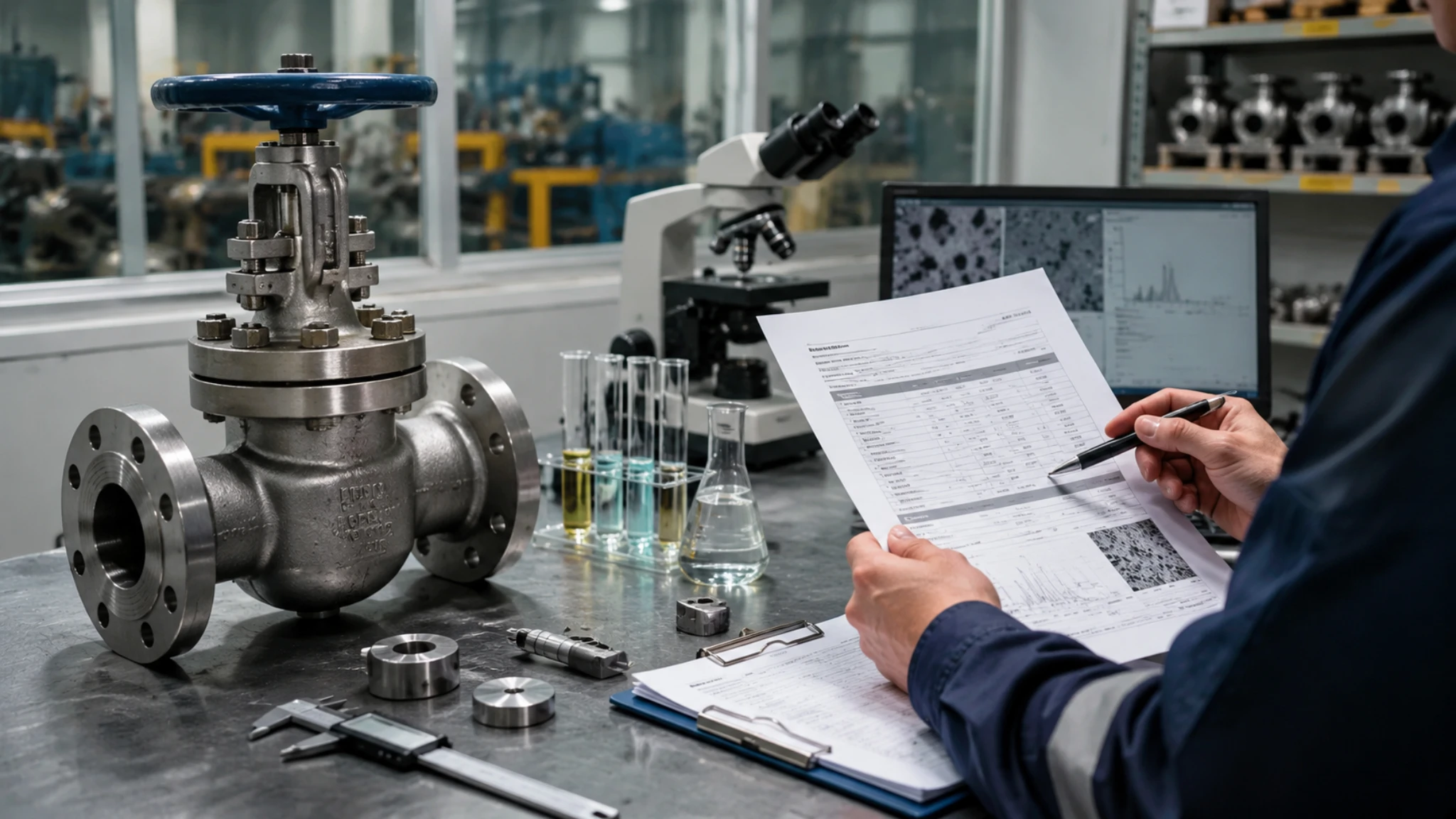
When each valve leaves the factory, a material certificate (EN 10204 3.1) is delivered together with the physical product. It covers key data such as:
| Property | Value / Range |
|---|---|
| Chemical composition | 9 major elements plus trace elements |
| Tensile properties | Re ≥ 250 MPa, Rm = 485–655 MPa |
| Impact toughness | -46°C ≥ 20 J |
| Hardness | ≤ HBW 200 |
Before accepting the goods, the purchaser’s verification of these data is the final quality control barrier. It helps prevent nonconforming materials from entering the installation stage.
In 2021, the first batch of 28 ball valves in a petrochemical project suffered valve body brittle fracture after 18 months of operation. The direct losses were more than RMB 3.4 million.
What Is an MTR?
What Does a 3.1 Certificate Mean?
An EN 10204 3.1 certificate is a material inspection report provided by the steel or forging material supplier to the purchaser. It follows the European standard EN 10204:2004.
The core meaning is: the material manufacturer has carried out the specified inspections for each delivered product or batch according to the contract or applicable standard. The inspection results have been confirmed and signed by the supplier’s quality department. This department must be independent from the production department.
The certificate must include traceability information:
- Material grade (e.g., A352 LCC, CF8M, or WCB)
- Specification and dimensions
- Heat Number
- Order number
- Heat treatment condition
- Applicable material standard number (e.g., ASTM A352/A352M)
During an audit of a valve casting supplier in Jiangsu in 2022, I found that the signature section of its 3.1 certificate contained only the signature of the production workshop director. There was no independent confirmation or seal from the quality inspection department.
This did not comply with the requirements of Clause 5.1 of EN 10204:2004. Even if the factory seal was affixed, it still did not constitute a compliant 3.1 certificate.
The regulatory value of a 3.1 certificate lies in the fact that it serves as a legal document for material conformity declaration.
If a material failure occurs during the warranty period after installation, the purchaser can use the 3.1 certificate as evidence to file a quality claim against the supplier. A certificate issued by a noncompliant signing body may be deemed invalid in legal arbitration.
What Is the Difference Between 3.1 and 3.2?
The essential difference lies in the independence of the inspection body and the confirmation procedure.
| Aspect | 3.1 Certificate | 3.2 Certificate |
|---|---|---|
| Who confirms and issues | Supplier’s own quality department | Manufacturer’s quality department + purchaser’s designated inspecting officer or third-party agency |
| Scope | By production batch (Heat or Batch). Up to 50 pieces from the same batch may share one 3.1 certificate. | One independent certificate per piece |
| Signatures required | One signature from supplier’s quality department | Two independent signatures or seals: one from the manufacturer’s quality department, one from the purchaser or third party |
| Typical cost | Approximately USD 80–120 per certificate | USD 300–500 per person-day (China); USD 1,000–1,500 per person-day (overseas). Unit cost is usually 5–10 times higher than 3.1. |
ASME B16.34 and API 600 usually require 3.2 certification for high-pressure and high-temperature valves.
For the same batch of ASTM A216 WCB castings, such as 50 DN100 gate valves, the quotation for a 3.1 certificate is approximately USD 80–120 per certificate. A 3.2 certificate involves on-site attendance by a third-party inspection agency, which costs about USD 300–500 per person-day in China and may reach USD 1,000–1,500 per person-day for overseas projects. Therefore, the unit cost is usually 5–10 times higher than that of a 3.1 certificate.
In a dispute handled in 2023, the purchaser did not specify the certificate type in the contract. After receiving the goods, the purchaser found that the supplier had provided a 3.1 certificate, while the end client required a 3.2 certificate during acceptance. The supplier refused to supplement third-party confirmation, and the goods eventually had to be replaced, delaying the project by about two months, or approximately 60 days.
How to Identify a Fake Report
Fake MTRs can be identified from two aspects: document form and data content.
Document-form checks (per ISO 10474:2011):
- Verify the unique certificate number. Each MTR should have a unique number that matches the factory’s internal traceability system.
- Check whether the supplier’s name and address match the actual factory information.
- Verify whether the signatory is an authorized quality department signatory.
Data content checks:
- Chemical composition and mechanical property data must fall within the ranges specified by the applicable material standard.
- For ASTM A352 LCC: C ≤ 0.25%, Mn ≤ 0.70%, P ≤ 0.04%, and S ≤ 0.045%. If the report shows C = 0.28%, it has exceeded the standard upper limit.
- For tensile properties: Re ≥ 275 MPa, Rm = 485–655 MPa, and El ≥ 22%. If the reported data are exactly close to the lower limits, such as Re = 276 MPa, the data may have been modified. Re = 276 MPa is 26 MPa higher than the standard lower limit of 250 MPa, and normal production variation would not be so precise.
ISO 10474:2011 requires the time logic of three traceability documents to be consistent: the raw material warehousing date must be earlier than the heat treatment date, and the heat treatment date must be earlier than the finished product inspection date. If the time sequence among the three documents is contradictory, the credibility of the MTR is basically questionable.
- For ASTM A352 LCC, tensile properties require Re ≥ 250 MPa and Rm = 485–655 MPa. The yield-to-tensile ratio Re/Rm is usually between 0.55 and 0.70.
Data modification is an illegal act. In a 2021 offshore platform project, the supplier’s 3.1 certificate showed an impact toughness of 27 J at -46°C, but third-party retesting showed only 18 J, below the ASTM A352 minimum requirement of 20 J. It was finally confirmed that the supplier had misused the MTR from a previous qualified batch.
For ASTM A352 LCC, C ≤ 0.25%, Mn ≤ 0.70%, P ≤ 0.04%, and S ≤ 0.045% are the basis for material conformity judgment.
How to Read Chemical Analysis
What Do C, Mn, P, and S Represent?
| Element | Role | Typical Limits / Notes |
|---|---|---|
| C (Carbon) | Most important strengthening element. Directly determines strength and hardness. | Low-carbon steel (WCB, LCC): C ≤ 0.25%. Medium-carbon steel (WC6, WC9): C = 0.25–0.60%. |
| Mn (Manganese) | Deoxidation and desulfurization. Strengthens ferrite and improves hardenability. Combines with sulfur to form MnS (melting point ~1610°C), which reduces FeS eutectic and improves hot working performance. | Usually between 0.60% and 1.65%. |
| P (Phosphorus) | Harmful element. Increases cold brittleness, segregates at grain boundaries, reduces weldability. | ASTM A352 LCC: P ≤ 0.04%. API 6D: P ≤ 0.045%. Lower phosphorus means better low-temperature toughness. |
| S (Sulfur) | Harmful element. Forms FeS (iron sulfide), which creates a low-melting eutectic with iron at about 985°C, causing hot-short cracks during hot working. | A352: S ≤ 0.045%. Severe service: S ≤ 0.035%. |
In 2023, I reviewed an MTR marked as WCB with C = 0.30%. The manganese content was shown as Mn = 1.05%, exceeding the WCB standard upper limit of 1.00%. The material was not WCB at all and was more likely WC9.
The supplier later admitted that it was a material mix-up accident. WCB tensile properties require Re ≥ 250 MPa and Rm = 485–655 MPa.
Limits for Trace Elements
Valve material reports also list trace elements. Here are the key ones:
| Element | Role | Typical Range / Notes |
|---|---|---|
| Cr (Chromium) | Improves oxidation resistance and corrosion resistance. | Range: 0.50%–13%. ASTM A217 WC6: Cr = 0.50%–0.80%. WC9: 2.00%–2.75%. |
| Ni (Nickel) | Most effective element for improving low-temperature toughness. Reduces the ductile-brittle transition temperature (DBTT). | Low-temperature valve materials (LCC, LCB): Ni between 0.50% and 3.00%. Working temperatures from -46°C to -196°C. |
| Mo (Molybdenum) | Improves high-temperature strength and creep strength. Suppresses microstructural coarsening at high temperature. | ASTM A217: Mo = 0.45%–0.65% for WC6. Cr-Mo steels (WC6, WC9, C12A) used at 400–550°C. |
| V (Vanadium) | Microalloying element. Contributes to grain refinement and precipitation strengthening. | Limit: ≤ 0.03%. |
| Nb (Niobium) | Microalloying element. Contributes to grain refinement and precipitation strengthening. | Limit: ≤ 0.02%. |
Additional requirements for special service conditions:
- EU (PED Directive 2014/68/EU): All intentionally added alloying elements must be listed individually.
- NACE MR0175 / ISO 15156 (sour oil and gas fields): Stricter limits: S ≤ 0.01%, maximum Brinell hardness ≤ HB 200 (or HRC 22), Cr ≤ 13%, Ni ≤ 9%.
Hardness exceeding the limit directly increases the SCC failure rate of valves in H2S-containing service by about 60%.
When purchasing valves for NACE service, the MTR must verify both chemical composition and hardness values. Neither can be omitted.
Heat Number Traceability
The Heat Number is a key traceability identifier in steel production. Each heat of molten steel receives a unique heat/batch number after smelting. This number follows the steel or casting through casting, forging, heat treatment, and machining. The foundry must complete the heat number steel stamping within 15 minutes after pouring.
The Heat Number on the MTR must match the stamped Heat Number on the physical component, usually on the valve body outer wall or nameplate area. The format is usually 6–8 digits, such as 2203012.
The core value of Heat Number traceability is that, once a material failure occurs during operation, the Heat Number can be traced back to steelmaking records (usually retained for 10 years) to identify raw material source, smelting process parameters, and chemical composition control records.
A complete traceability chain includes:
- Steel mill heat records (molten steel tapping time: 18–30 minutes, refining time: 30–45 minutes, total smelting time: 60–90 minutes)
- Foundry melting records (Heat Number, pouring date, mold number)
- Heat treatment process cards (Heat Number, heat treatment batch, heating rate ~50°C per hour, holding time ~1.5–2.0 hours, tempering temperature ~580–650°C)
- Machining records (Heat Number and workpiece number)
- Final assembly records (workpiece number and valve serial number)
Only when the Heat Number 2209121 of the 45th heat of castings matches the Heat Number on the MTR can the traceability chain be considered complete.
During factory audits, I always check two places: the furnace temperature records of the heat treatment furnace, to verify correspondence between the Heat Number and the physical Heat Number; and the foundry pouring logbook, to confirm which casting numbers were poured from that heat of molten steel.
One supplier once stamped the 45th heat number from 2022 onto castings from the 12th heat of 2023. The dates and casting numbers in the pouring logbook did not match. This was a typical Heat Number mis-stamping case. All 38 valves had to be reworked, and the supplier bore about USD 40,000 in costs.
Mechanical Properties
Yield Strength and Tensile Strength
Yield strength Re is the stress value at which a material undergoes obvious plastic deformation (permanent deformation). Re = 250 MPa corresponds to the minimum room-temperature yield strength specified by ASME/ASTM material standards.
In valve design, the working stress of pressure-containing parts (such as valve bodies and bonnets) must be strictly controlled below the material yield strength, usually with a safety factor of 2.5–4.0 under ASME BPVC Section VIII Division 1.
Taking ASTM A216 WCB as an example, the minimum room-temperature yield strength is Re ≥ 250 MPa. For every 1 MPa increase in design pressure, the stress borne by the material increases by about 1–3 MPa.
Typical tensile properties for API 600 gate valves (WCB material):
- Re = 250–295 MPa
- Rm = 485–655 MPa
- El = 22%–30%
Tensile strength Rm is the maximum stress the material can withstand before fracture. It indirectly reflects material toughness. The yield-to-tensile ratio Re/Rm of high-quality valve steel is usually between 0.55 and 0.70. A ratio above 0.85 indicates that the material tends to be brittle.
The probability that all three values (Re, Rm, El) are simultaneously close to the lower limits — such as Re = 252 MPa, Rm = 487 MPa, and El = 22.5% — is extremely low. Normal production variation usually places Re between 275 and 295 MPa. Such data are often modified fake data.
In 2023, WCB tensile data showed Re = 253 MPa, Rm = 488 MPa, and El = 22.5%. The supplier’s normal ex-factory Re was 275–295 MPa, and Re = 253 MPa was nearly 20 MPa below the average. Third-party retesting confirmed Re = 248 MPa, which did not meet the standard, and the supplier was forced to replace the goods.
WCB hardness is usually HBW 170–200, and the yield-to-tensile ratio Re/Rm is usually between 0.55 and 0.70.
Impact Toughness: Charpy V-Notch, -46°C ≥ 20 J, a Core Indicator for LNG Valves
Impact toughness data in an MTR is obtained through Charpy V-Notch impact testing. It measures a steel’s ability to resist brittle fracture under low-temperature or dynamic loading. It is expressed in joules (J). MTR requirements are usually 20–25°C ≥ 27 J or -46°C ≥ 20 J, depending on the material standard and design temperature.
Insufficient impact toughness can cause brittle fracture of the valve body at low temperature.
ASTM A352 LCC impact toughness requirements:
- -46°C ≥ 20 J for a single piece
- -46°C ≥ 14 J for a single specimen
- DBTT is approximately -20°C to -100°C
- Each 1% increase in Ni can reduce DBTT by about 10–15°C
The test temperature of -46°C ≥ 20 J is a required data point that must be listed in the MTR for LNG valves.
The ductile-brittle transition temperature (DBTT) is the core concept of impact toughness. Above a certain temperature, the material shows ductile fracture with a fibrous fracture surface. Below that temperature, it turns into brittle fracture with a crystalline fracture surface.
Nickel is the most effective element for reducing DBTT. Each additional 1% Ni can reduce DBTT by about 10–15°C.
Common problem to watch for: Suppliers sometimes provide room-temperature impact data at 20–25°C instead of the specified low-temperature data. Room-temperature impact values often look excellent (50–80 J), but the material’s low-temperature impact toughness may sharply drop to 5–10 J, failing to meet low-temperature service requirements.
When reviewing an MTR, the test temperature field must be equal to or lower than the minimum design temperature specified by the contract or standard.
Hardness Testing
The standard hardness value for valve steels is HBW 160–200, equivalent to about HRC 17–22. Hardness is the ability of a material to resist local plastic deformation. Valve steels are usually measured by Brinell hardness (HBW) or Rockwell hardness (HRC).
Hardness testing is a nondestructive test (NDT) that can be performed directly on the surface of finished components. Standards require 3–5 points to be measured on each valve and averaged.
Hardness data in an MTR has two uses:
- Verifies heat treatment effect: As-cast hardness of A216 WCB is about HBW 170–200. After heat treatment it should decrease to HBW 160–180. Excessive hardness indicates insufficient heat treatment.
- Correlation with material strength: HBW ≈ Rm / 3.5 can be used to estimate strength.
Valve sealing surfaces (seats and seals) have special hardness requirements. The sealing surfaces of the disc and seat are usually required to be 50 HBW higher than the valve body material to resist media erosion and wear. API 598 specifies that the seat sealing surface hardness of metal-seated ball valves should be at least 50 HBW higher than the valve body material hardness.
In 2022, a batch of WC6 valve bodies (38 units) had MTR-reported hardness values of HBW 180–195. On-site testing found that 7 units exceeded HBW 210, with the highest reaching HBW 229. The cause was uneven temperature distribution inside the heat treatment furnace, which led to excessive bainite or martensite formation in some workpieces due to overly rapid cooling.
If such cases are directly installed after retesting, the crack sensitivity of the weld heat-affected zone will increase significantly, potentially causing losses of RMB 3.38 million.
NACE MR0175 requirements (H2S-containing conditions):
- H2S ≤ 0.01 g/m³
- S ≤ 0.01%
- Hardness HBW ≤ 200 (in some service conditions, HBW 235 may apply)
High-hardness materials are extremely sensitive to stress corrosion cracking (SCC) in H2S-containing environments. When purchasing valves for NACE service, the MTR must verify both S ≤ 0.01% and hardness ≤ HBW 200.
Standard Procedure for Reviewing a Valve Material Test Report
The standard procedure consists of eight steps:
- Verify Heat Number stamping consistency between the physical product and certificate.
- Confirm the issuing body: ensure an independent quality department signature, not a production department signature.
- Confirm that the three tensile values are qualified: Re, Rm, and El. Re ≥ 250 MPa, Rm = 485–655 MPa.
- For low-temperature valves: additionally verify impact energy and whether the test temperature matches the requirement (e.g., -46°C ≥ 20 J).
- For high-temperature valves: verify high-temperature property data, such as Re at design temperature being at least 67% of room-temperature Re.
- For NACE service: additionally verify hardness ≤ HBW 200 and S ≤ 0.01%.
- When necessary, conduct third-party sampling and retesting of chemical composition and mechanical properties according to AQL = 1.0.
- The retention period shall be 10 years in accordance with Clause 10.2 of ISO 10474:2011.