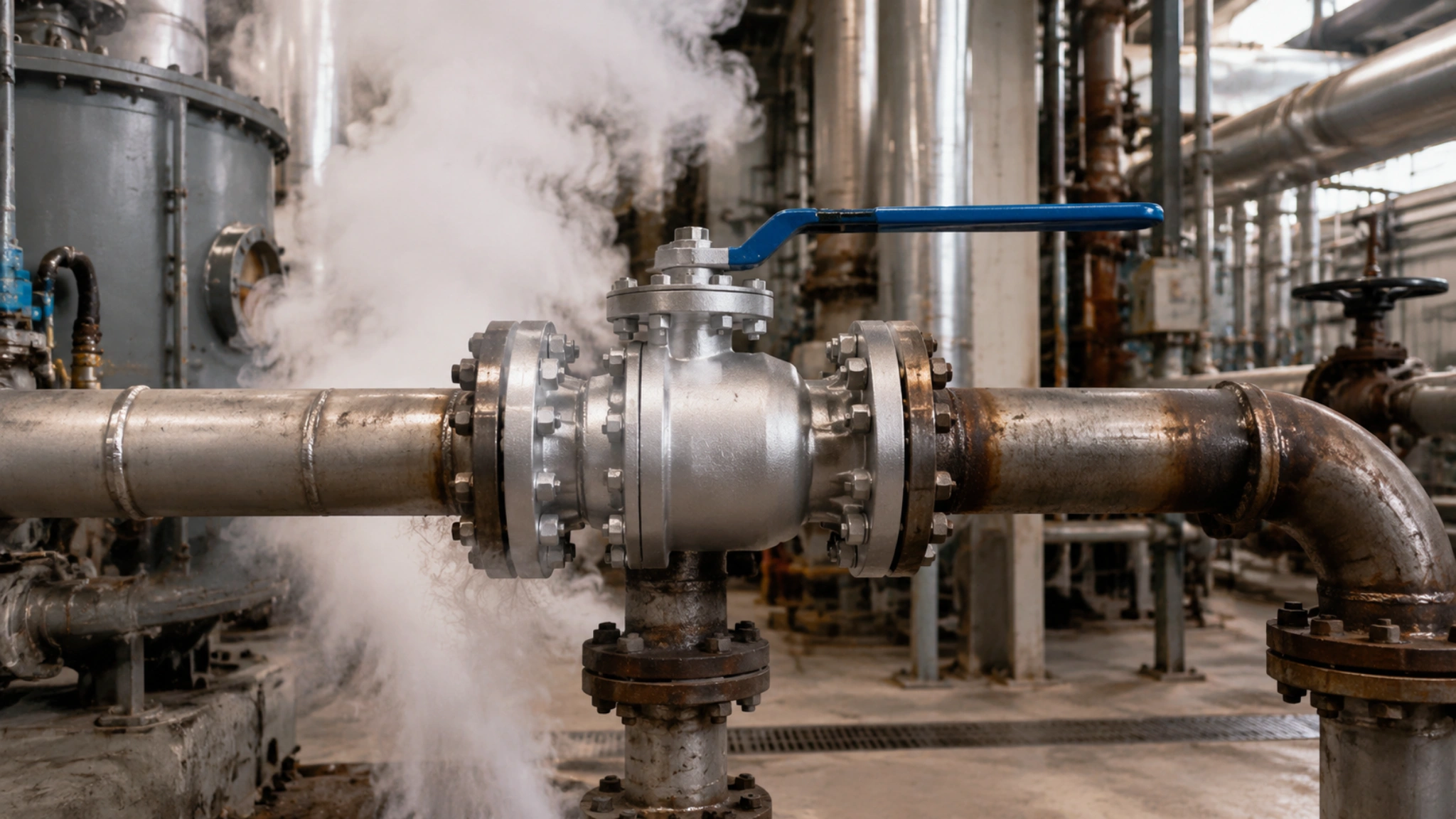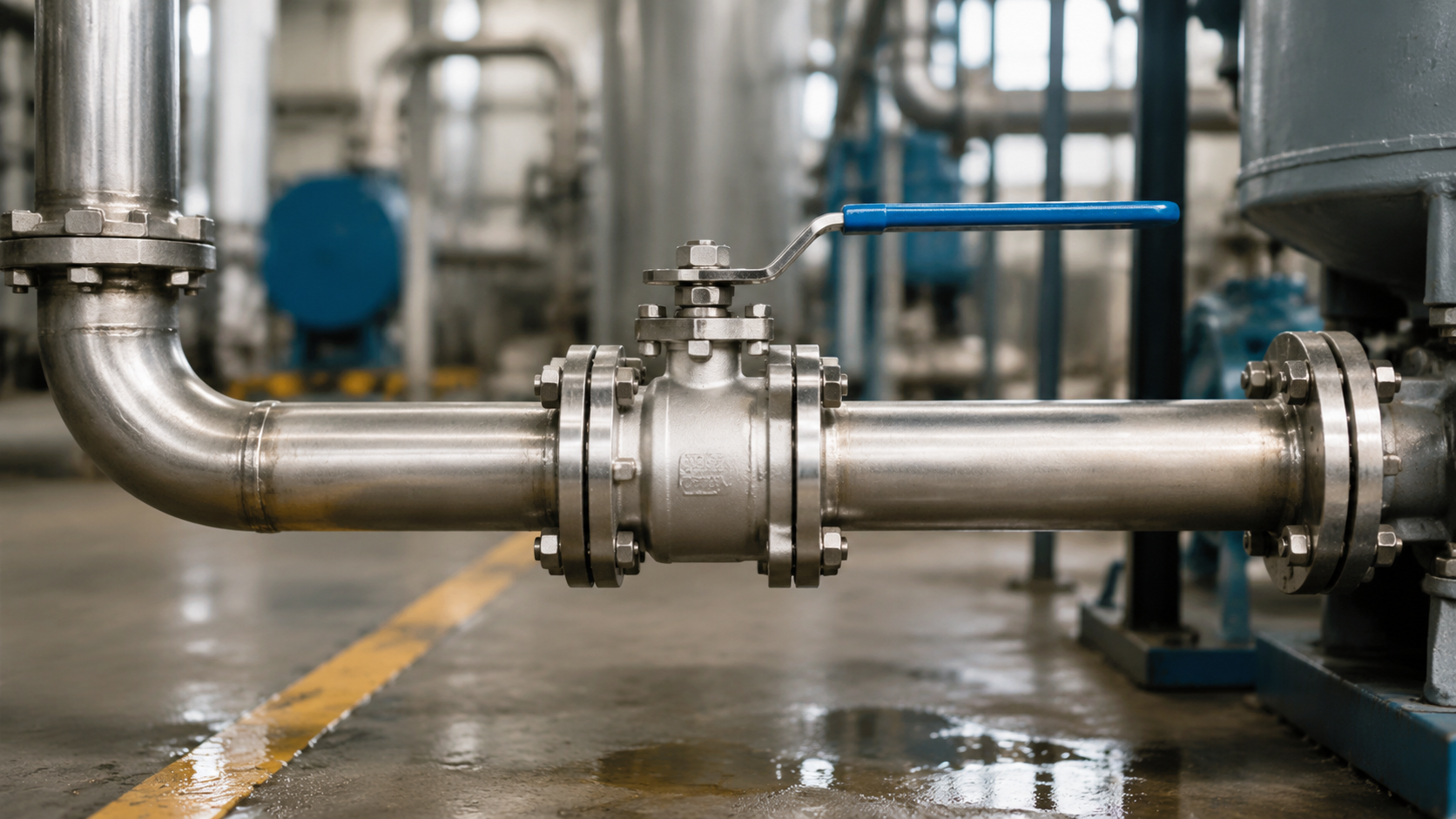
Fugitive emission (FE) testing for industrial valves verifies the external sealing performance of stem or shaft seals and body joints under controlled pressure, temperature, and cycling conditions. It is especially important for valves used with volatile air pollutants, hazardous fluids, methane-containing service, refinery units, LNG facilities, petrochemical plants, and projects where the purchaser requires low-emission valve qualification.
ISO 15848-1:2015 is the international standard for classification and qualification procedures for type testing of industrial valves for fugitive emissions1. It applies to external leakage from valve stem or shaft seals and body joints of isolating valves and control valves. For helium testing, the strictest stem or shaft tightness class is AH. The AH limit is not a fixed total value for every valve; it is expressed per millimetre of stem diameter. ISO 15848-1:2015 states the AH leak-rate limit as ≤1.78×10⁻⁷ mbar·L/s per mm stem diameter2.
For ISO 15848-1, a complete valve performance designation combines tightness class, test fluid, endurance class, temperature class, and stem seal adjustment history. A simple commercial phrase such as “Class A” is not enough for technical specification.
| Item | Correct ISO 15848-1 / ISO 15848-2 Point | Practical Meaning |
|---|---|---|
| Tightness class | Helium classes are AH, BH, and CH. Methane classes are AM, BM, and CM. | AH is the strictest helium stem or shaft seal class. |
| Endurance class | For isolating valves, CO1 = 205 cycles, CO2 = 1,500 cycles, and CO3 = 2,500 cycles. For control valves, CC1 = 20,000 cycles, CC2 = 60,000 cycles, and CC3 = 100,000 cycles. | The cycle count depends on valve type and selected endurance class. |
| Temperature class | Common classes include t-196°C, t-46°C, t-29°C, tRT, t200°C, and t400°C. | The temperature class should match the required service range. |
| Production acceptance | ISO 15848-2:2015 is the production acceptance test for valves whose design has already been type-tested3. | It is not a shortcut for replacing ISO 15848-1 type testing. |

Emission Standards
ISO 15848 Classification
ISO 15848-1 is formally titled “Industrial valves — Measurement, test and qualification procedures for fugitive emissions — Part 1: Classification system and qualification procedures for type testing of valves.” It specifies test procedures for evaluating external leakage from valve stem or shaft seals and body joints of isolating and control valves intended for volatile air pollutants and hazardous fluids. End connection joints, vacuum service, corrosion effects, and radiation effects are outside its scope4.
The ISO 15848-1 performance code should be read as a qualification result, not as a single letter. A typical designation includes the standard, test medium, tightness class, endurance class, temperature class, and the number of permitted or performed stem seal adjustments, where applicable. Two valves can both be described commercially as “Class A” while having different cycle endurance or temperature qualification ranges.
- AH, BH, and CH apply when helium is used as the test fluid.
- AM, BM, and CM apply when methane is used as the test fluid.
- ISO 15848-1 states that no direct correlation is intended between helium classes and methane classes.
- Purchasers should specify the full ISO 15848-1 designation rather than only writing “Class A.”
The EU Industrial Emissions Directive defines fugitive emissions as volatile organic compounds not contained in waste gases and released to air, soil, or water5. In refinery, LNG, petrochemical, and chemical projects, this regulatory pressure often appears in valve procurement specifications as ISO 15848-1 certificates, API fugitive-emission test reports, or project-specific LDAR acceptance criteria.
For packing seal systems, expanded graphite reinforced with metallic wire is widely used in high-temperature and low-emission valve designs. Its suitability still depends on the complete packing set, gland load control, stem finish, surface hardness, packing chamber geometry, pressure, temperature, and cycling envelope. A packing material choice alone does not guarantee Class AH performance.
In one internal batch review of 500 low-emission valves with reinforced expanded graphite packing, the first-pass FE test rate was 96%. That result should be treated as project-specific evidence, not as a universal yield rate for every valve type, size range, pressure class, temperature class, or supplier.
The combination of packing type, packing compression, stem surface finish, gland load retention, body joint design, and assembly control determines whether a valve design can consistently achieve the selected ISO 15848-1 tightness class across production batches.
Class AH vs BH vs CH and AM vs BM vs CM
In ISO 15848-1, helium classes are AH, BH, and CH. Methane classes are AM, BM, and CM. Commercial documents often shorten these to Class A, Class B, and Class C, but the test fluid should always be stated because helium leak-rate classes and methane concentration classes are not interchangeable.
| Class Context | A / AH / AM | B / BH / BM | C / CH / CM |
|---|---|---|---|
| ISO 15848-1 helium stem or shaft seal | AH ≤1.78×10⁻⁷ mbar·L/s per mm stem diameter | BH ≤1.78×10⁻⁶ mbar·L/s per mm stem diameter | CH ≤1.78×10⁻⁴ mbar·L/s per mm stem diameter |
| ISO 15848-1 methane stem or shaft seal | AM ≤50 ppmv | BM ≤100 ppmv | CM ≤500 ppmv |
| Body joint leakage under ISO 15848-1 | Body seal leakage is checked separately and is commonly limited to ≤50 ppmv by the sniffing method for the relevant test fluid. | ||
| ISO 15848-2 production acceptance stem or shaft seal | A ≤50 ppmv | B ≤100 ppmv | C ≤200 ppmv |
| Typical use | Highest emission-control requirement | Balanced low-emission requirement | General low-emission production control |
The standard does not define Class A, B, or C by allowing the final leakage rate to become three or five times higher than the initial value. Each required leakage measurement must remain within the selected tightness class limit. For helium Class AH, the allowable total stem or shaft leakage is calculated from stem diameter. For example, a measured total helium leak rate of 2.3×10⁻⁶ mbar·L/s would require a stem or shaft diameter of at least about 13 mm to remain within the AH limit.
For a large refinery or LNG project, specifying Class A/AH valves can increase procurement cost compared with less stringent classes. The decision should be made from process risk, fluid hazard, LDAR burden, operating temperature, maintenance accessibility, owner environmental targets, and lifecycle risk. A general cost premium should not be presented as a universal industry rule unless valve type, size range, pressure class, material, quantity, and purchasing basis are defined.
API fugitive-emission standards are also widely used in North American and international projects. API 622 addresses type testing of process valve packing for fugitive emissions. API 624 addresses rising-stem valves equipped with graphite packing for fugitive emissions. API 641 addresses quarter-turn valves for fugitive emissions6. These API standards are not interchangeable with ISO 15848-1, but they are often used as companion or alternative qualification requirements.
In six supplier data batches reviewed for Class A programs, products with controlled packing compression ratios in the 22%–25% range achieved a first-pass FE test rate above 90%. This should be presented as internal project evidence. The optimum compression window can shift with packing construction, stem finish, temperature class, gland design, lubricant condition, and manufacturer installation procedure.
Comparison with EPA Method 21
EPA Method 21 is a US EPA method for determining volatile organic compound leaks from process equipment7. It differs from ISO 15848-1 in both detection principle and application scope.
EPA Method 21 uses a portable instrument for field screening of possible leak points at valves, pumps, compressors, flanges, connectors, pressure relief devices, and other process equipment. The detector type is not fixed; it may include flame ionization, photoionization, infrared absorption, or another detector type that meets the method requirements8.
- EPA Method 21 does not set one universal 500 ppmv leak definition for every facility.
- The leak definition concentration is set by the applicable regulation, permit, equipment type, and reference compound.
- The method locates and classifies leaks; it is not a direct mass emission-rate measurement.
- ISO 15848-1 is a controlled type test for valve qualification, while EPA Method 21 is mainly used for in-service field inspection and LDAR programs.
A practical quality program can use both approaches. ISO 15848-1 type test certificates help verify the valve design before purchase or qualification. EPA Method 21 inspections help detect installation, wear, operating, or maintenance-related leaks after the equipment is in service.
ISO 15848-1 validates the valve design under a defined test envelope. EPA Method 21 helps identify field leaks under actual operating conditions.
Test Procedures
Ambient Temperature Cycling Test
The ambient temperature cycling test is a basic validation step in ISO 15848-1 qualification. The valve is installed according to the manufacturer’s instructions, pressurized with the selected test fluid, and cycled according to the selected endurance class. ISO 15848-1 uses helium gas or methane gas with minimum 97% purity, and the same test fluid is used throughout the test9.
Room temperature in ISO 15848-1 is defined as the range from −29°C to +40°C. This is broader than a laboratory-only assumption such as 20±5°C, so test reports should state the actual measured temperature at each leakage measurement point.
- Mount the valve according to the manufacturer’s instructions and record stem or shaft orientation.
- Use a fully assembled valve and document any packing change made before the test.
- Pressurize the valve with the selected test fluid and allow pressure and temperature to stabilize.
- Measure leakage from the stem or shaft seal and from body joints separately where practical.
- Perform the mechanical cycles required by the selected endurance class.
- Record leakage, test fluid, temperature, pressure, operating torque, dwell time, and any stem seal adjustment.
For isolating valves, CO1 means 205 cycles, CO2 means 1,500 cycles, and CO3 means 2,500 cycles. For control valves, CC1 means 20,000 cycles, CC2 means 60,000 cycles, and CC3 means 100,000 cycles10. The required cycle count therefore depends on valve type and selected endurance class.
ISO 15848-1 should not be reduced to a single universal cycle speed. Opening time, closing time, dwell time, operating torque, and stabilization conditions should be defined in the test procedure and recorded in the test report because they affect repeatability and packing wear.
In one LNG cryogenic ball valve FE qualification case, progressive leakage appeared after approximately 1,200 cycles. The failure review indicated insufficient initial packing compression. After changing to a reinforced graphite packing set and resetting the compression ratio to the manufacturer-approved range, the retest met the selected Class AH requirement for the tested stem diameter. Whenever a total helium leak rate is used to claim AH compliance, the report should state the stem or shaft diameter used in the calculation.
Helium mass spectrometer practices such as ASTM E498/E498M and ASTM E499/E499M can support leak detection method selection and equipment practice, but they should not be presented as valve fugitive-emission qualification standards11.
Packing sleeve clearance should be controlled according to the valve drawing and packing design. For the valve designs reviewed in one internal program, a 0.10 mm to 0.15 mm clearance window helped reduce premature packing damage. That range should not be used as a universal design rule without manufacturer validation.
Torque monitoring during the breakaway phase can provide early warning of packing degradation before leakage exceeds the selected limit. Measuring torque rise after major cycle blocks is useful when evaluating packing friction stability, actuator sizing margin, and the effect of gland load changes.
High-Temperature Thermal Cycling
High-temperature thermal cycling evaluates sealing performance when the valve and packing system experience temperature variation. For high-temperature applications, common ISO 15848-1 temperature classes include t200°C and t400°C. The temperature class should be selected from the intended service range, not chosen only for marketing value.
ISO 15848-1 does not use one fixed rule of 250 mechanical cycles at high temperature. The mechanical and thermal cycle sequence is selected according to endurance class and test temperature. Public summaries of the standard list CO1, CO2, and CO3 for isolating valves and CC1, CC2, and CC3 for control valves, with higher endurance classes requiring more mechanical cycles12.
| High-Temperature Test Factor | Correct Handling |
|---|---|
| Temperature class | Select t200°C, t400°C, or another applicable temperature class according to service requirements. |
| Temperature stabilization | Stabilize the valve at the selected temperature before cycling and leakage measurement. |
| Mechanical cycling | Cycle only after the relevant temperature condition has stabilized, unless the approved procedure states otherwise. |
| Leakage measurement | Measure stem or shaft leakage and body joint leakage at the required test points and record the results. |
The main technical challenge is thermal expansion mismatch between the stem, packing, gland, bolting, and valve body. A 316 stainless steel stem heated from about 20°C to 260°C expands by roughly 4.0 mm per metre; over a 30 mm loaded packing length, this corresponds to approximately 0.12 mm of axial growth. If a larger axial displacement such as ±0.8 mm is used in a compensation calculation, the heated effective length and geometry that produce that movement should be stated clearly.
Flexible graphite packing can lose sealing stress as temperature rises and the bolted joint relaxes. In one petrochemical high-temperature FE test, the gland-bolt torque indication dropped from 45 N·m to 28 N·m after heating to 300°C, a reduction of about 38%. This value should be described as a torque indication rather than direct preload unless load cells, bolt elongation measurement, or another preload measurement method is used.
A Belleville disc spring stack can help maintain packing load during thermal cycling when the packing system is designed for spring compensation. In the project case reviewed, the disc spring assembly was used to compensate for measured axial displacement across the heated valve-stem and packing system, and the valve passed the selected high-temperature FE sequence with leakage below the AH limit calculated for its stem diameter.
API Specification 6D defines manufacturing requirements for valves used in pipeline and piping systems in oil and gas service. It should not be described as a high-temperature fugitive-emission standard13. When API 6D valves also require low-emission performance, the FE requirement should be stated separately through ISO 15848-1, API 624, API 641, or the purchaser’s project specification.
Helium Leak Detection Methods
Helium mass spectrometry is one of the most sensitive non-destructive leak detection methods used for valve FE evaluation. In ISO 15848-1 type testing, helium leakage from the stem or shaft seal can be measured by total leak-rate methods such as vacuum or accumulation, depending on the approved setup and selected class. For ISO 15848-2 production acceptance, helium sniffing is used and results are expressed in ppmv14.
The lower detection range of helium leak detection can reach very small leak rates under favorable vacuum conditions. In practical valve testing, the stable detection floor depends on detector sensitivity, calibration, background helium, fixture tightness, bagging volume, airflow, probe control, and test method. Vacuum testing, accumulation testing, and sniffing should therefore not be described with one identical detection limit15.
| Method | Best Use | Important Note |
|---|---|---|
| Vacuum method | High-sensitivity quantitative helium testing | Lowest environmental interference when the fixture is suitable and background is controlled. |
| Bagging / accumulation method | Total leak-rate measurement where the leakage source can be enclosed | Accuracy depends on enclosure integrity, volume, accumulation time, background correction, and mixing. |
| Sniffing method | ISO 15848-2 production acceptance, body seal checks, and field-type screening | Operator technique, probe distance, probe speed, and airflow strongly affect repeatability. |
Before each test round, a traceable standard leak or calibration gas should be used to verify detector response at a relevant order of magnitude. A calibration leak such as 1×10⁻⁵ mbar·L/s may be suitable for some checks, but the selected reference should match the measurement range and method used for the actual test.
For sniffing, internal procedures often specify probe distance, scanning speed, stabilization time, and background checks. Where access allows, keeping the probe tip close to the seal face and scanning slowly improves the probability of detecting small leaks. These values should be treated as procedure-specific settings rather than ISO limits unless they are explicitly required by the applicable standard or purchaser specification.
Operators should be trained in helium mass spectrometer operation, background suppression, calibration checks, response-time behavior, and the difference between true leakage and environmental noise. Blind proficiency checks with known leak rates can help maintain repeatability across operators and shifts.
Certification Acquisition
Third-Party Laboratory Selection
The credibility of ISO 15848-1 certification depends on laboratory competence, test rig capability, calibration control, and accreditation scope. A qualified laboratory should be able to demonstrate competence under ISO/IEC 17025 or an equivalent accreditation scheme covering the relevant test methods, equipment, measurement range, and temperature conditions16.
- Check whether the laboratory’s accreditation scope covers ISO 15848-1 and the required measurement method.
- Confirm whether the test scope covers the valve type, nominal size, pressure class, and temperature class.
- Verify high-temperature, cryogenic, and low-temperature rig capability before placing the order.
- Confirm fixture compatibility for ball, gate, globe, butterfly, plug, and control valves.
- For metal ball valves, verify the product design standard separately, such as ISO 17292 where applicable17.
In one LNG liquefaction plant valve certification project, the initial laboratory selection did not fully verify high-temperature rig coverage. The missing capability caused an additional thermal-cycle test arrangement and extended the certification schedule. The added cost and delay led to a revised laboratory prequalification checklist covering temperature range, actuation system, fixture movement, calibration records, background leak control, and reporting format.
The number and geographic distribution of ISO/IEC 17025 laboratories with FE testing scope changes over time. Buyers should verify the current accreditation scope directly from the accreditation body or laboratory certificate instead of relying on an old worldwide laboratory count.
A laboratory with strong ball valve experience may still produce unreliable results for rising-stem gate or globe valves if the fixture does not properly accommodate stem movement. Fixture compatibility should be reviewed before testing because mechanical constraint can affect packing stress, actuation torque, and leakage behavior.
Certificate Validity and Qualification Scope
ISO 15848-1 type test certificates should not be treated as permanent proof for every future valve variant. A certificate remains meaningful only while the valve design, materials, stem or shaft seal system, body seal system, production process, manufacturing location, and qualified extension range remain within the tested scope.
ISO 15848-2 is a production acceptance test for valves whose design has already been type-tested. It does not create a universal 3-to-5-year renewal rule by itself18. Many project owners, end users, or certification bodies may still require certificate review or renewal every 3 to 5 years as a contractual rule.
- Reduced retesting should be used only when accepted by the purchaser or certification body.
- Any change in packing brand, packing construction, stem coating, stem surface finish, gasket material, bolting, gland design, or manufacturing process should trigger a qualification impact review.
- If the change falls outside the qualified extension range, supplementary testing or a new type test may be required.
- Certificate records should show tested valve size, pressure class, temperature class, endurance class, tightness class, test fluid, stem diameter, body seal result, and seal adjustment history.
For certification schemes operated by third-party bodies, ISO/IEC 17065 is the relevant conformity-assessment standard for bodies certifying products, processes, and services19. It should not be confused with ISO 15848 or with internal manufacturer certificate tracking. Manufacturers can still use a certificate register, expiry alerts, and change-control reviews as part of their quality management system.
A six-size-range cryogenic valve series for an API 6D or ISO 17292 project can lose bid eligibility if its FE certificate is outside the owner’s accepted date range or qualification scope. Planning certificate review several months before tender submission reduces the risk of emergency retesting and missed bid deadlines.
Production Lot Sampling Frequency
Production acceptance testing under ISO 15848-2 helps verify consistency between a type-tested design and series production. ISO 15848-2 does not set one fixed 10% sampling rate. Public summaries of the standard state that the sampling percentage is agreed between manufacturer and purchaser, with at least one valve selected randomly from each production lot by valve type, pressure class, and nominal size20.
| ISO 15848-2 Production Acceptance Item | Requirement |
|---|---|
| Test fluid | Helium gas with minimum 97% purity by volume. |
| Measurement method | Sniffing method, expressed in ppmv. |
| Test pressure | 6 bar unless otherwise agreed by manufacturer and purchaser. |
| Test temperature | Room temperature as defined by ISO 15848-1. |
| Mechanical operation | Fully open and close the pressurized valve five times before final measurement. |
| Stem or shaft seal limits | Class A ≤50 ppmv, Class B ≤100 ppmv, Class C ≤200 ppmv. |
| Body seal limit | ≤50 ppmv. |
For Class A projects, a buyer-approved sampling plan of 10% with a minimum of one unit per batch can be used as a project quality rule. It should not be described as a universal ISO 15848-2 requirement.
Packing gland bolt tightening should be controlled with calibrated tools. A torque wrench with ±3% accuracy can improve repeatability, but torque alone does not guarantee packing stress because friction, lubrication, bolt condition, washer condition, and thread engagement affect the relationship between torque and preload.
- One project sampling plan allowed frequency reduction after three consecutive fully conforming batches.
- Any non-conforming unit triggered increased inspection until a defined number of consecutive batches passed.
- The acceptance plan should be written into the purchaser specification, inspection and test plan, or project quality procedure.
In one plant implementation, FE first-pass yield increased from 85% to 98.3%, and annual field leak repair cost decreased from $370,000 to $65,000 after tighter packing process control, operator training, and trend-based sampling were introduced. These values are project-specific and should not be presented as a guaranteed result for other plants.
Sampling records should be archived according to purchaser, certification body, legal, and quality-system requirements. Owner audit programs may require long retention periods, and project contracts can be stricter than the base standard.
For high-volume production lines running more than 500 valves per month, statistical process control on packing compression ratio, gland torque, stem finish, and leakage trend can add another layer of quality assurance beyond the agreed ISO 15848-2 sampling frequency. Leakage-rate trend lines across consecutive sampled units are more useful than only recording pass/fail results because they can reveal gradual process drift before a batch reaches the rejection threshold.