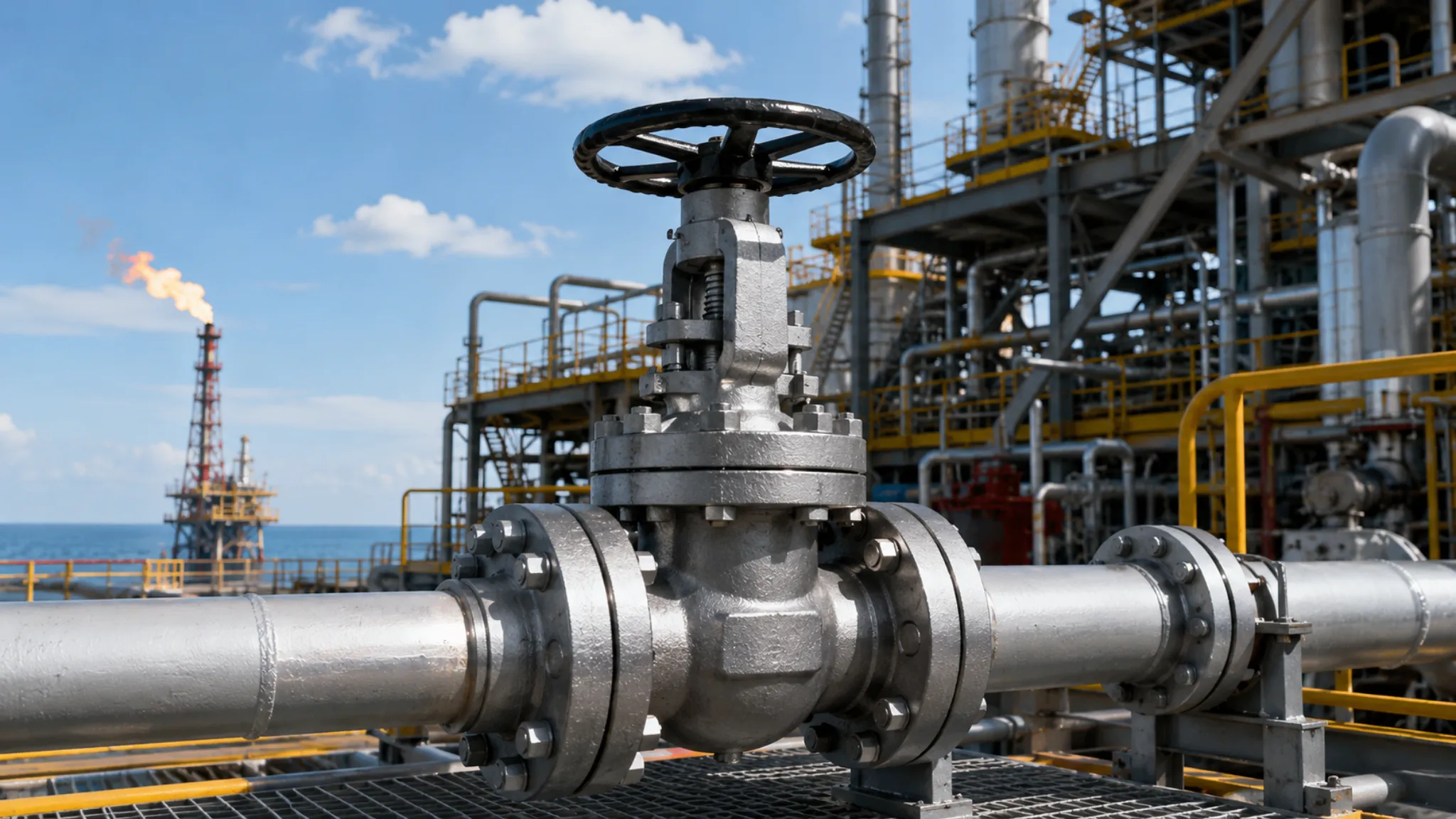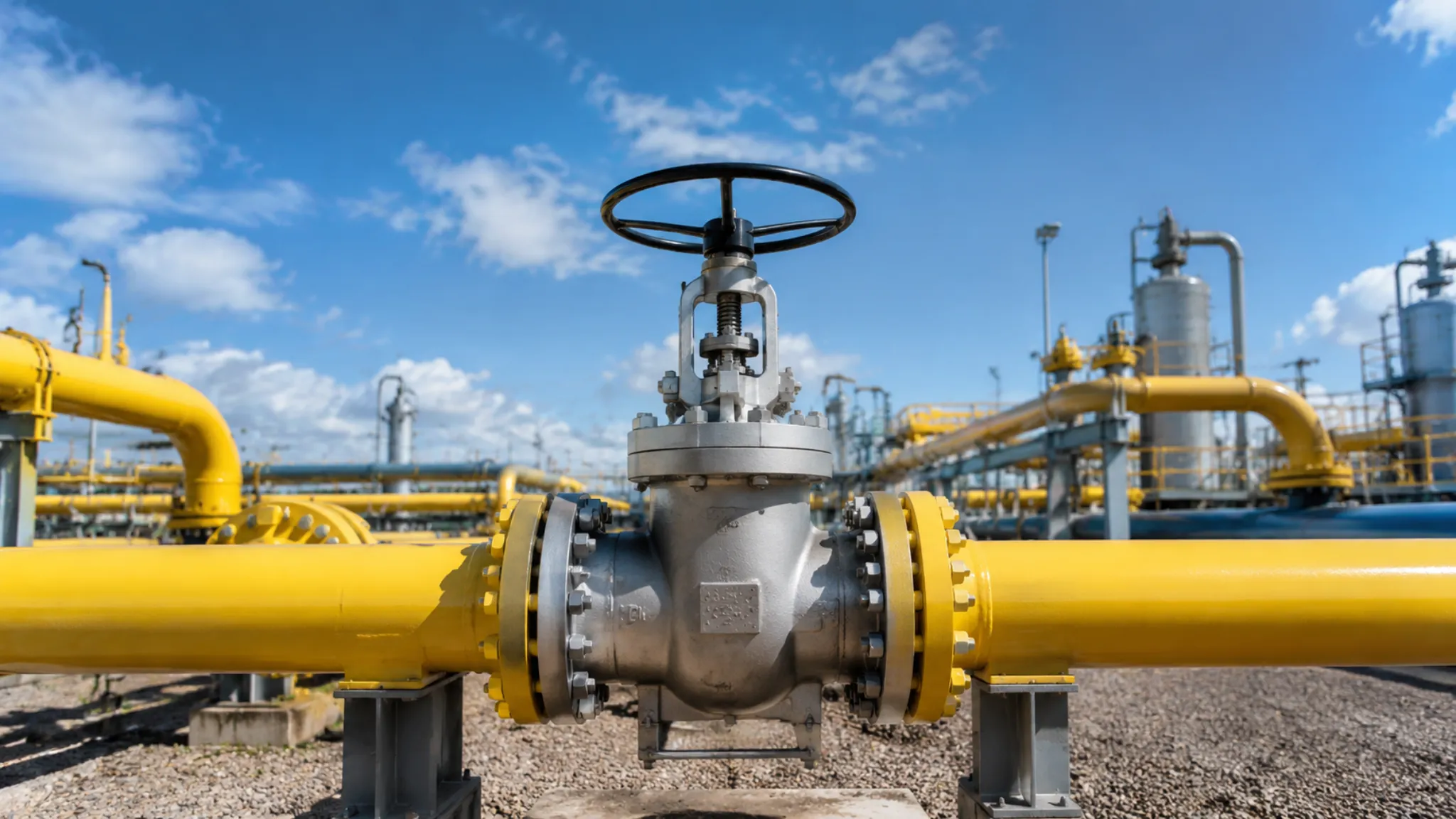
A ball valve manufacturer’s global competitiveness depends on maintaining a pass rate of at least 99%, pricing 5%–10% below comparable competitors, and keeping lead times within 30–45 days.
It also requires API 6D certification, well-managed supply chain inventory with turnover within 60 days, and the use of CNC machining plus 100% air tightness testing to improve stability and customer confidence.
Product Quality
Corrosion Resistance & Pressure Endurance
Oil pipelines operating 2,000 meters below sea level are exposed to 20 MPa of water pressure year-round, in seawater with a salinity above 3.5%. Drop an ordinary carbon steel valve into that environment, and in less than 72 hours it can corrode through under the attack of highly concentrated salt water.
Many manufacturers use 2205 duplex stainless steel for the valve body. This steel contains 22% chromium, 5% nickel, and 3% molybdenum, with ferrite and austenite each accounting for half of its microstructure.
Its pitting resistance equivalent number reaches 35, and its yield strength is roughly double that of standard 304 stainless steel. Even under prolonged exposure to high concentrations of chloride ions, the metal surface can resist pitting and localized attack.
Different industrial pipelines carry highly corrosive fluids, forcing valve manufacturers to keep adjusting material formulas:
- Paper mill bleaching lines: 5% sodium hypochlorite at room temperature typically requires a titanium alloy body.
- Fertilizer plant synthesis zones: high-temperature ammonia solution at 190°C usually calls for 316L ultra-low-carbon stainless steel.
- Semiconductor cleaning workshops: 18 MΩ ultra-pure water systems require electropolished pipe walls.
- Offshore drilling platforms: continuous exposure to salt-laden sea air demands a 250-micron epoxy zinc-rich coating on the exterior.
The metal body must withstand not only chemical attack from acids and alkalis, but also violent physical shock. In narrow pipelines, sudden opening and closing can trigger water hammer, generating impact forces three to four times higher than normal operating conditions.
A ball valve rated for 10 MPa may perform routinely under standard pressure, but when a transient pressure spike hits, the internal pressure often surges to 30 MPa.
Foundries send finished metal bodies into X-ray inspection rooms and use ultrasonic testing to detect tiny shrinkage cavities or gas porosity inside the casting.
Even a microscopic pinhole left in an 8 mm-thick metal wall can, after three months of repeated 15 MPa pulsating pressure, grow into a major crack.
Manufacturers strictly follow the wall-thickness requirements of ASME B16.34. For example, in a 2-inch Class 150 carbon steel ball valve, the thinnest section must never be less than 5.6 mm.
When machining threads and flange faces, coaxial deviation is tightly controlled within 0.05 mm.
Under extreme internal thrust, pressure-bearing components are pushed to their structural limits:
- Blowout-proof stem: designed with a larger base and smaller top so it cannot be forced out by pipeline pressure.
- Reinforced flange root: transition areas are formed with R5 to R10 radii to reduce fracture risk.
- High-strength fasteners: all bolts are upgraded to B7 alloy steel, with tensile strength above 860 MPa.
- Full-penetration welding: weld seams on large-diameter pipelines undergo 100% radiographic inspection.
Conventional PTFE gaskets soften, deform, and get extruded from their grooves once pressure exceeds 4 MPa and the fluid temperature reaches 120°C.
To solve this, workers blend 15%–25% glass fiber into the original Teflon powder and cure it at high temperature, tripling the gasket’s compressive strength.
When service conditions exceed 25 MPa, even reinforced plastic gaskets fail almost instantly. At that point, manufacturers have no choice but to use metal-to-metal hard sealing, spraying tungsten carbide powder onto the ball and metal seat with supersonic flame.
The hard alloy coating is applied to a thickness of 0.3 mm, with hardness measured above HRC 68.
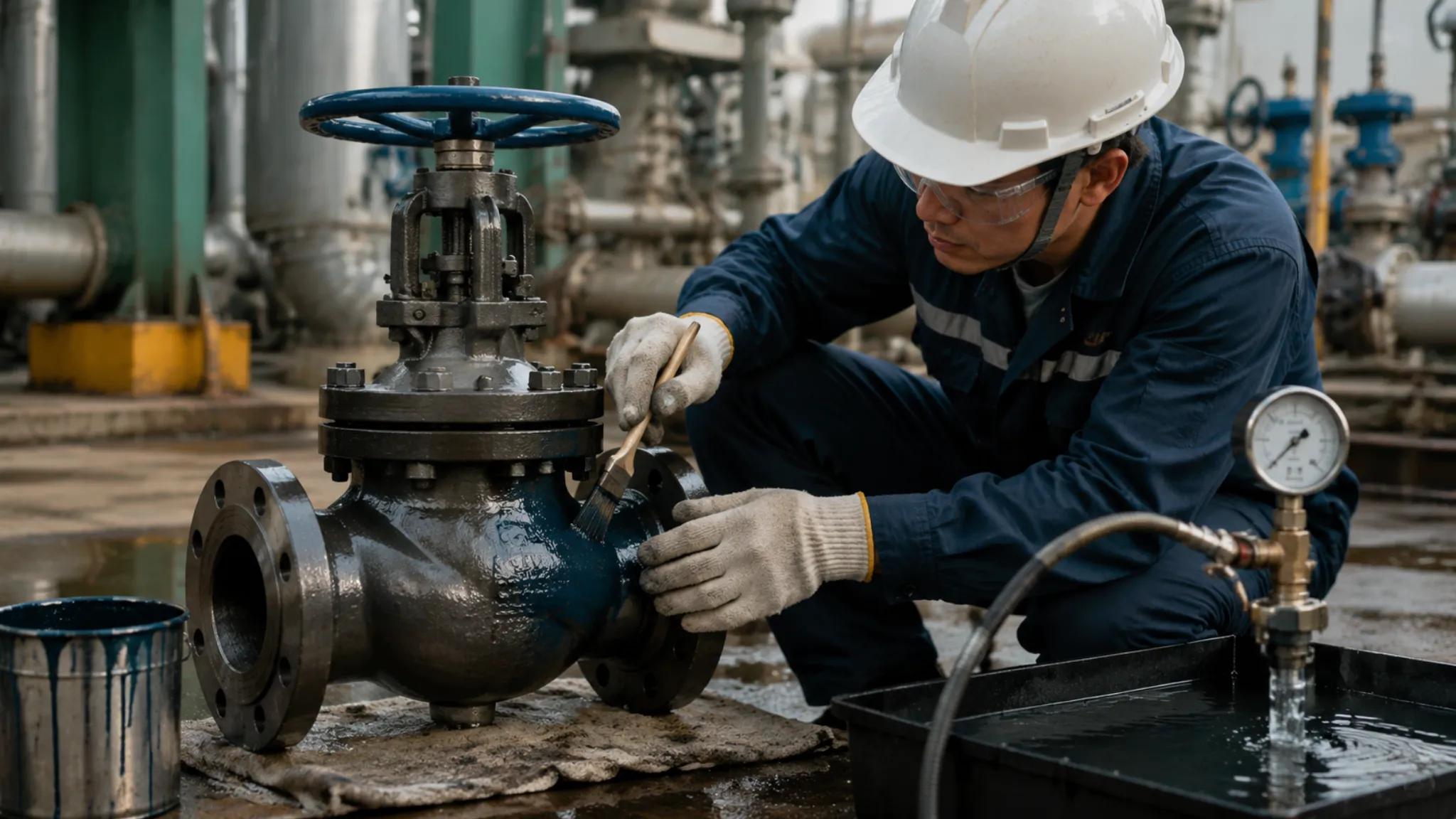
Every assembled valve is then moved to a pressure test bench. Operators seal both ends with heavy steel plates and fill the cavity with water mixed with rust inhibitor. A pneumatic pump gradually raises the pressure to 1.5 times the design pressure.
A 4-inch Class 300 ball valve, for example, is held under 7.7 MPa of high-pressure water for a full 3 minutes, and not a single drop is allowed to leak.
After the hydrostatic test, the water is drained and replaced with 0.6 MPa of dry compressed air. The entire valve is submerged in a clear water tank, and inspectors watch the stem and sealing areas closely for even the tiniest bubbles.
For pipelines carrying toxic gases, leak detection must be done with a high-precision mass spectrometer. Even a helium leak as small as 10^-5 mbar·L/s can still be detected.
Precision Manufacturing
A 15 kg stainless steel forging fresh out of the furnace is covered with up to 2 mm of rough oxide scale. Before it can be installed on a chemical plant pipeline, it still has to go through more than a dozen extremely demanding machining steps. Ordinary lathes cannot handle alloys with hardness up to HB 200, so factories send them to heavy-duty CNC machining centers.
Massive silicon carbide cutting tools strike the metal blank at 800 rpm, with sparks and water-soluble coolant flying everywhere. The first rough turning operation takes about 4 minutes, removing the outer 3 mm of excess material and roughly hollowing out the internal flow passage. Even after that step, the surface still has a height variation of 0.2 mm and feels rough to the touch.
Whether a 15 MPa high-pressure water flow can be fully shut off depends entirely on how perfectly spherical the through-hole metal ball is. Engineers secure the semi-finished ball in a five-axis CNC machine and switch to extremely sharp polycrystalline diamond tools. During fine machining, the ball’s roundness error is strictly controlled within 0.005 mm.
That 0.005 mm tolerance is roughly one-sixteenth the diameter of a human hair. If the operator’s hand slips slightly, or if the cutting tool wears by 0.01 mm, the ball may still appear acceptable—but once installed, highly penetrating natural gas can seep through nearly invisible gaps.
Freshly machined metal balls are covered with fine tool marks about 0.8 microns deep, so they must be sent to a dedicated grinding machine for a full two hours of polishing. Workers first apply W3.5 silicon carbide coarse grinding paste and polish with customized cast-iron lapping plates, then switch to W1.5 fine paste until the surface reflects like a mirror.
Inspectors use a surface roughness tester, letting a ruby stylus travel slowly across 10 mm of the polished ball surface. The displayed Ra value must remain strictly between 0.2 and 0.4 microns. The smoother the surface, the lower the friction coefficient, which significantly extends the service life of the surrounding PTFE sealing seat.
Dimensional accuracy during assembly is equally demanding. The seat groove inside the valve body must be machined with concentricity deviation no greater than 0.02 mm. If the upper and lower holes are misaligned by 0.05 mm, the ball will bind severely after installation, and field workers may be unable to turn the handle even with full force.
On the workshop quality wall, there is always a metal machining tolerance chart posted for reference. Every day, hundreds of finished metal parts are measured one by one against those specified limits.
| Machined Area | Measurement Item | Maximum Allowable Error | Inspection Instrument |
|---|---|---|---|
| Internal metal ball | Geometric roundness tolerance | 0.005 mm | ZEISS coordinate measuring machine |
| Ball and seat sealing surface | Surface roughness (Ra) | 0.2 μm | Taylor Hobson profilometer |
| External stem bore | Bore concentricity | 0.015 mm | Inside micrometer |
| End flange sealing faces | Flatness deviation | 0.05 mm | Granite inspection surface plate |
The stem is the stainless steel shaft connecting the external handle to the internal ball, and it includes a 6 mm-wide flat keyway. After turning, the stem undergoes a nitriding treatment to a depth of 0.1 mm. Surface hardness increases from roughly HRC 20 to above HRC 45.
That increase in hardness prevents slight torsional deformation when operators apply repeated force to the handle or when sudden water hammer occurs. The clearance between the stem and the body bore is tightly held between 0.05 and 0.08 mm. This allows the graphite packing to seal the gap effectively while still permitting smooth rotation.
On the flange faces at both ends, the lathe cuts concentric serrations 0.15 mm deep. When the flange is tightened against an asbestos gasket, these fine grooves bite into the gasket like teeth, enabling the joint to withstand a 20 MPa pipeline load.
Once all metal parts are ready, they move to the final assembly line. Operators use digital torque wrenches to clamp the two halves of the valve body together. Four high-strength M16 bolts must be tightened in a diagonal crisscross sequence, in three stages, until torque reaches exactly 120 N·m. Too little causes leakage; too much strips the threads.
Even overtightening a single bolt by 10 N·m can distort an originally perfect 0.005 mm roundness into micron-level deformation under external force. After assembly, the finished valve is placed on a test bench, and a force gauge is attached to the handle to measure how much torque is needed to fully open and close it under 1.0 MPa water pressure.
For a qualified 2-inch valve under high-pressure flow, the opening torque should remain steadily between 18 and 22 N·m. If the reading jumps to 35 N·m, it indicates eccentric assembly or insufficient ball polishing, and the unit must be disassembled and rebuilt.
Even a tiny 0.5 mm metal chip left inside the cavity can ruin the work of dozens of precision steps. Before assembly, all metal components are placed in a large ultrasonic cleaning tank filled with alkaline solution. At 40 kHz, the vibration continues for 15 minutes, shaking loose even 0.1 mg of debris trapped in threaded corners.
Specialized assembly areas are often required to meet ISO Class 8 cleanliness standards, with no more than 3.52 million particles of 0.5 microns per cubic meter of air. Equipment used to deliver high-purity oxygen to hospitals cannot tolerate even trace lubricant on workers’ gloves during assembly, because in pure oxygen at several MPa, that residue could trigger electrostatic ignition.
Factory Testing
An 8-inch flanged ball valve is clamped tightly in place by hydraulic jaws, with both ends sealed using solid steel blind plates 50 mm thick.
When the worker presses the green start button, a three-cylinder plunger pump begins forcing rust-inhibited water into the metal cavity. The black needle on the gauge rises steadily until it reaches 15 MPa, while the external hydraulic cylinder emits a deep strain-loaded sound.
The destructive force of 15 MPa is roughly equivalent to dropping that mass of metal into water 1,500 meters deep. The operator then inspects the cast steel body inch by inch with a high-intensity flashlight, following the rough texture on the surface.
If any M20 bolt in the assembly shop had been left half a turn loose, or if there were a 2 mm shrinkage cavity hidden in the 8 mm-thick wall, the high-pressure jet would instantly shoot out like a blade for more than ten meters.
According to API 598 factory testing requirements, under 15 MPa hydrostatic pressure, the metal shell must withstand a full 120 seconds. Even a single droplet no larger than a soybean is enough to disqualify the product and send it back for rework or remelting.
Once the shell passes, the next step is to check whether the internal ball and PTFE seat are sealing properly. The worker closes the handle fully and introduces 11 MPa of water pressure from the left side only.
The open outlet on the right is connected to an 8 mm transparent tube, whose other end is inserted into a glass beaker marked in milliliters. During the full 3-minute hold period, the water level in the beaker must not rise by even 0.5 mm.
Hydrostatic testing can only reveal obvious cracks several millimeters wide or major sealing failures. Because water droplets have relatively large physical volume, some micro-scratches only 0.1 mm wide may not show up at all.
So the test medium is switched to 0.6 MPa dry compressed air. The entire heavy valve, weighing over 30 kg, is lifted by crane and slowly submerged into a translucent tank containing 500 liters of clean tap water.
Workers wearing clear plastic safety goggles focus on the joint between the stainless steel stem and the cast iron body. They remain there for a full two minutes, watching for ripples so subtle they are difficult to distinguish with the naked eye.
A gap no thicker than a human hair can still release a 0.1 mm³ bubble under 0.6 MPa air pressure, floating up through the water to the surface.
For chemical plants handling highly toxic liquid chlorine or flammable hydrogen, simply checking for visible bubbling is far from sufficient.
At that point, inspectors bring over a helium mass spectrometer leak detector worth more than 300,000 yuan and move its slender probe around the flange sealing areas. Helium molecules are only 0.26 nanometers across, so they can escape through even the narrowest paths.
The instrument is extremely sensitive, and the acceptable leak rate shown on the screen must remain below 1.0 × 10^-5 mbar·L/s. If the red alarm light flashes even once, the valve fails, no matter how polished the metal surface looks.
The factory also performs stricter sampling checks on a proportion of finished products, subjecting selected batches to even more extreme testing:
- Cryogenic validation: the entire valve is immersed in liquid nitrogen at -196°C for 24 hours, then removed and required to open smoothly within 0.5 seconds, with no hidden cracks visible on the body.
- Fire testing: the valve is exposed to a 980°C blue flame from an industrial diesel burner for 30 minutes. Even after the internal plastic seats are completely burned away, the remaining metal-to-metal seal must keep leakage below 400 mL per minute.
- Fatigue life testing: a pneumatic actuator cycles the valve open and closed 100,000 times under actual pipeline pressure of 1.0 MPa to see how long the internal PTFE components last before wearing out completely.
After all these hard requirements are met, one final value is measured before packing and shipment: operating torque. Pipeline workers often have to turn a stiff, corroded handle while standing five meters high on steel scaffolding in chemical plants, which is extremely dangerous.
Engineers connect the assembled valve to a dedicated torque test bench running with a simulated 5 MPa process fluid. An extended torque wrench with a digital display is fitted onto the handle, and the operator pushes it downward with both hands.
At the instant of opening, the displayed value should remain around 45 N·m. If it exceeds 60 N·m, the most likely causes are a ball eccentricity of 0.01 mm or overtightened gland bolts.
After testing, high-pressure air is blown through the passage to remove every remaining trace of moisture, even as little as 0.1 mg. Both ends are then covered with 3 mm-thick yellow plastic caps to keep dirt and sand from entering during long-distance transport and scratching the ball surface.
Pricing Strategy
Low Unit Price
A pesticide plant bought a carbon steel ball valve for $15. The pipeline was carrying a highly corrosive chlorinated solvent, and in less than 200 hours of service, the PTFE sealing ring around the packing had deformed. Toxic gas began leaking through a 0.2 mm gap, and the alarm on the workshop wall kept flashing red.
Two maintenance workers had to suit up in heavy protective gear, and replacing the part took 4 full hours, costing $120 in labor alone. The production line was shut down for half a day, and the 500 drums of herbicide scheduled for shipment that day could not be loaded on time. At month-end, the finance team had to record an additional $8,000 in contract penalties.
Low-priced stainless steel ball valves are everywhere on the market at $9.90 apiece. Small workshops cut costs mainly by reducing wall thickness. Under ASME B16.34, a 2-inch valve body should retain 5.6 mm of metal wall thickness. Some underground factories secretly modify their molds and reduce it to 4.2 mm, stripping 1.5 pounds of steel from a single valve.
- Durable 2Cr13 stem material is replaced with rust-prone A3 mild steel.
- Recycled plastic from discarded shoe soles is melted down into black nylon seats.
- The handle thickness is cut to 0.8 mm, so it snaps under force.
- The required 10-minute 1.6 MPa hydrostatic test before shipment is skipped entirely.
Large international manufacturers, on the other hand, can quote low prices because of what happens inside their production schedules. In Wenzhou, one brass fitting factory producing 20 million sets annually runs 15 multi-spindle machines in a U-shaped line. A 12 kg brass rod is fed into an automatic bar feeder, and the machines produce one threaded brass semi-finished part every 4.5 seconds.
The CNC machines use imported alloy inserts with coolant-through channels and can machine 5,000 metal balls continuously before a tool change. Every day, chip conveyors collect 3 tons of clean brass scrap, which is sent by forklift to the smelting shop next door and remelted, raising material utilization to 98.5%.
When Dubai Water Authority issued a tender for 300,000 DN15 household water supply ball valves, a Turkish OEM quoted only $1.15 per unit, leaving just a 2.5% profit margin on paper. After winning the huge order, the plant’s 300-ton forging presses ran continuously for 90 straight days.
- They locked in low raw material costs by buying copper ingot futures from mining companies in advance.
- They bought a used palletizing machine and eliminated a warehouse worker earning 3,000 yuan per month.
- They changed hexagonal metal caps to knurled cylindrical ones, saving two machining steps.
- They consolidated shipments into full ocean containers to spread logistics costs across each piece.
On hardware store shelves, PVC plastic water valves sell for only $0.80. Because irrigation systems operate at low pressure, factories simply feed 60% virgin resin and 40% regrind into the injection molding machine. With an eight-cavity mold, one complete heating and demolding cycle takes just 12 seconds.
Extremely low purchase prices usually come with rigid shipping terms. If a buyer wants a flanged ball valve at an ex-factory price of $22, the order quantity written into the contract cannot be lower than 1,000 units. The usual industry practice of paying the balance 60 days after receipt is canceled; the full amount must be wired before the container is loaded and shipped.
Standard components that sit in inventory year-round also dilute average manufacturing cost. A three-way valve may be stocked at 50,000 units per month, reducing mold amortization to less than $0.0001 per piece. But if a buyer insists on replacing a blue plastic handle with a lockable red stainless steel version, the cost rises immediately by $4 per unit and delivery is delayed by 15 days.
Reducing Labor Costs
When manually turning a 50 mm brass ball, an operator has to focus completely on the dial and feed the tool by hand. Even after 10 full hours of work, output tops out at about 200 pieces per day. Once the workshop upgrades to a sliding-head CNC lathe costing 150,000 yuan per unit, a technician with vocational training can manage the process by pressing a few buttons on the control panel.
Twenty-four CNC machines line up in two rows, producing metal chips around the clock. A production capacity that once required 30 skilled lathe operators across three shifts can now be maintained by just three inspectors and one worker responsible for replenishing cutting fluid. With local senior machinists earning 8,500 yuan per month, labor savings slash the allocated labor cost of each brass ball valve from 1.2 yuan to 0.15 yuan.
The four M8 flange bolts in the center of the valve body used to be tightened one by one by female assembly workers using pneumatic tools. Besides wrist fatigue, any slight torque inconsistency could cause hydrostatic test failures. A customized six-axis robot arm equipped with a vision system now locates the bolts precisely and applies the standard 35 N·m torque to all four in just 4.2 seconds.
The workshop manager has calculated the savings from removing scattered manual steps on the assembly line:
- Pneumatic stamping presses replace manual hammer marking, eliminating two marking workers.
- Vibratory bowl feeders automatically orient and deliver PTFE seats, removing the need for three female operators to place them by hand.
- Automatic adhesive dispensers apply exactly 0.2 g of thread sealant, replacing manual brushing.
- Infrared photoelectric counters on the conveyor replace dedicated warehouse staff who used to count pieces manually.
Test bench workers once had to lift heavy valves, screw blind plates onto both ends by hand, fill the cavity with water, raise pressure to 1.6 MPa, and stare at the gauge for 3 full minutes to watch for pressure loss. After a full day of this, their eyes would become strained, and a momentary lapse could let a leaking valve pass inspection.
So the factory director invested 300,000 yuan in a ten-station fully automatic pressure tester. A mechanical arm grabs ten valves at once and places them into fixtures, where pneumatic cylinders clamp them instantly. High-pressure air at 2.5 MPa is introduced, and built-in differential pressure sensors detect extremely slight pressure changes within 15 seconds. Once the green light turns on, qualified products drop into the right-side bin, and the pressure testing team is reduced from 12 workers to just 2.
The finance department once prepared a detailed labor cost table for a DN50 two-piece ball valve, breaking down single-piece labor costs step by step. The gap between the old manual model and the automated model is dramatic.
| Production Step | Manual Labor Cost per Unit | Automated Labor Cost per Unit | Cost Reduction |
|---|---|---|---|
| Valve body blank turning | $0.45 | $0.08 | 82% |
| Metal ball grinding and polishing | $0.30 | $0.05 | 83% |
| Internal PTFE component assembly | $0.25 | $0.06 | 76% |
| High-pressure gas leak testing | $0.15 | $0.02 | 86% |
| Carton packing, sealing, and labeling | $0.10 | $0.03 | 70% |
The packing job once required four temporary workers sweating in piles of cartons, sealing boxes with clear tape and attaching labels by hand. Once the packaging line was equipped with an automatic carton former and labeling machine, photoelectric sensors could detect each box and a pneumatic pusher would instantly apply the barcode label to the upper-right corner.
Iron crates weighing hundreds of kilograms used to be pushed around the aisle by two strong workers with a manual pallet truck. Now, yellow AGVs follow magnetic strips on the floor, carrying up to 500 kg of brass blanks directly to the machine zone on the second floor. When low on battery, they automatically return to charge. Three AGVs can replace five transport workers earning 4,500 yuan per month.
Warehouse stock counting is also handed over to barcode scanners and backend software. Veteran warehouse clerks once recorded inventory with pencils and carbon-copy forms, and finding one batch of offset semi-ball valves buried on the lower shelf could take half a day. Now every part is labeled with its own QR code. A single scan uploads the data instantly, reducing month-end inventory checks from three days to just two and a half hours.
Tiered Pricing
Deepwater drilling platforms in the Gulf of Mexico need pipeline components that can resist both highly saline seawater and hydrogen sulfide corrosion. The drawings specify a 2507 duplex stainless steel body and a tungsten carbide coating on the internal metal ball.
For an 8-inch ball valve weighing less than 40 kg, the ex-factory price can reach an astonishing $28,000.
Only a handful of machining centers worldwide can grind a ball surface to Ra 0.2 and still guarantee performance under the pressure of 10,000 meters of seawater. On these high-end customized models, the manufacturer has absolute pricing power, with net profit per unit exceeding 65%.
A Russian natural gas pipeline project may send an email requesting 3,000 standard WCB carbon steel ball valves. The buyer’s budget is tight, and the specification clearly requires the body to carry the American Petroleum Institute’s API 6D fire-safe mark.
- Two coats of epoxy zinc-rich anti-corrosion primer, each totaling 250 microns in thickness.
- The top-mounted handwheel replaced with a gearbox-assisted worm drive for easier operation.
- A material certificate showing the furnace batch number included with every valve.
The final price for a single 12-inch valve may come to $1,100. The manufacturer keeps profit margin around 18%, giving up excessive unit margin but securing a total contract value of $3.3 million.
At Yiwu International Trade City, hardware booths are filled with blue PVC valves for irrigation hoses. They are sold in bags of 50, and the unit price works out to just $0.35 each.
An Indian buyer taps on a calculator a few times and immediately asks to fill two 40-foot high-cube containers with ready stock.
In the materials workshop, recycled agricultural film waste is mixed into new resin for injection molding, and the molds cycle at least 10,000 times a day. Even if each plastic valve earns only $0.02 in margin, a shipment of 500,000 units still brings in a substantial cash return within three days.
The same model of two-piece stainless steel ball valve that sells for $8 in a roadside hardware store may be ordered by a European fine chemical plant with one extra requirement: absolute oil-free degreasing before shipment, to prevent residual machine oil from reacting violently with pure oxygen inside the system.
- Loose parts are immersed in a dedicated degreasing solution and ultrasonically cleaned for 30 minutes.
- Inspectors wear clean gloves and use UV light to check every inch for oil contamination.
- After vacuum drying, each valve is packed in two layers of anti-static plastic bags and heat-sealed.
Add those three extra processes, and the unit price jumps from $8 to $26. The premium from specialized process requirements is often far more profitable than simply selling by metal weight.
Valves used in Brazilian mining slurry pipelines wear constantly under abrasion from sand and gravel. In large contracts, manufacturers may deliberately lower the valve body price to $800—almost at cost. But the special polyurethane rubber seats inside the slurry valve wear out every six months and begin leaking.
When maintenance workers open the spare parts catalog, they find that a pair of crescent-shaped rubber inserts is clearly priced at $120.
After five years of continuous mining operation, the total money spent on replacement rubber seats and spare stems from the original manufacturer often exceeds the cost of buying two brand-new valves.
Standard water pipeline fittings with no testing may be exported to arid Middle Eastern countries and sold for $4.50. Yet valves from the exact same production line can command a higher price simply by adding Europe’s WRAS drinking water certification mark to the body.
Delivery Reliability
Stable On-Time Delivery
Contracts state it clearly: for every day of late delivery, 0.5% of the total contract amount is deducted. On a $5 million order, a 20-day delay can wipe out $500,000 in profit on the spot.
Money often disappears in overlooked corners of the workshop. In a batch of tens of thousands of parts, if even a single screw worth a few cents is missing, the entire shipment has to remain in the warehouse. Every day, the factory director has to guard against problems such as:
- Casting defects like sand holes discovered under X-ray, forcing rework and adding 15 days.
- Imported plastic seals held at customs for inspection, delaying delivery by 7 days.
- Failed hydrostatic tests requiring workers to disassemble and hand-polish the parts again for another 48 hours.
To control the chaos, each production step has to be broken down into extreme detail. A 16-inch valve weighing 2.5 tons may contain as many as 145 internal parts, including the stem, springs, and other small components.
Purchasing staff work backward from the calendar every day. Ordering corrosion-resistant Inconel 625 special alloy can take a full 180 days from payment to delivery. To deal with that, the owner invests $2 million a year in advance and keeps 50 tons of forgings in stock, purchased six months ahead of use.
Once the material arrives, machine schedules are planned down to the minute. Grinding one mirror-finished metal ball takes 8 machine hours. Three identical spare cutting tool sets are always locked in a cabinet nearby, ready in case a tool fractures midway and ruins a large component.
To compress work that normally takes four months, the factory enforces strict internal rules:
- The best-selling 2-inch valves always have 500 semi-finished units kept in stock.
- Drilling and surface polishing are both completed within the same 8-hour day shift.
- The factory buys its own spectrometer so material verification can be done in 2 hours instead of waiting in line at an outside lab.
Once the metal products are packed into wooden crates and nailed shut, the business is only halfway done. The factory gate is 350 kilometers from Shanghai’s Yangshan Port, and a container truck needs at least 6 hours to get there. Forty-eight hours before port entry, documentation staff enter 12 pages of bilingual paperwork into the system and submit everything to customs for review.
Ocean shipping does not follow anyone’s wishes. Export staff book space with Maersk 21 days in advance. A vessel carrying 20,000 containers may be scheduled to reach Rotterdam in 35 days, but if a typhoon closes the route, the captain’s announcement can add another 3 to 5 days.
Salespeople keep business cards from three separate shipping lines in their desk drawers at all times. If the original vessel is delayed, they can immediately pay an additional $300 to move a 40-foot container onto another vessel departing sooner. Foreign auditors flying in each year may randomly check 50 bills of lading from the previous year and verify departure dates line by line.
Even with strict control, a large-scale machine breakdown can still leave no good options. The owner is left with only two choices: pay a $300,000 penalty and risk being blacklisted by the customer, or spend heavily to charter the full lower hold of a Cathay Pacific cargo aircraft.
Flying 40 tons of products to Houston, Texas, costs $180,000 in freight. But once the shipment lands, 18-wheel trucks are already waiting outside the airport, ready to haul the goods overnight to the refinery.
Shortening Lead Times
When an oil field loses $20,000 for every hour of downtime, manufacturers are forced to compress a 120-day delivery cycle as aggressively as possible. A procurement manager at a Middle Eastern desalination plant may call ten times in one night to chase an order. Holding a reverse-scheduled production chart, the factory director knows that to get an 800 kg pipeline ball valve onto an ocean vessel within 30 days, every process has to save hours wherever possible.
Buying a WCB carbon steel blank normally takes 45 days from furnace scheduling to casting and release. So the factory clears out a 2,000-square-meter warehouse and commits 4 million yuan in working capital to keep 12,000 fully sized valve body blanks permanently in stock.
The old generation of machinists would process one side of a blank and then flip it over to machine the other side, taking 4.5 hours per unit. The factory invests 3 million yuan in a five-axis CNC machining center, where the raw casting is clamped once and finished in a single setup. With tungsten carbide tools spinning at 8,000 rpm, an 8-inch high-pressure valve body can be completed in just 40 minutes.
Surface coating the ball with tungsten carbide wear-resistant material used to require shipment to an old plating plant 30 kilometers away, where parts sat in line for a full week. So the factory director clears out a warehouse on the north side of the site and installs a 400-square-meter supersonic flame spraying line in-house. The spray gun reaches 2,700°C, and a batch of bright polished balls hung on automatic racks can be coated, cooled, and sent to quality control within 4 hours.
By this point, the schedule bars in every workshop have been pushed dramatically forward.
| Manufacturing Process | Traditional Industry Time | Extreme Rush Time | Time-Saving Method |
|---|---|---|---|
| Raw and auxiliary material preparation | 45 days | 0 days | 12,000 blanks and flanges kept in stock |
| Internal machining of valve body | 15 days | 3 days | Five-axis machines running high-speed in two shifts |
| Surface anti-corrosion coating | 7 days | 1 day | In-house 2,700°C coating line |
| Seal assembly and pressure testing | 10 days | 2 days | Weekend cancellation and fully automatic hydraulic-clamp test benches |
| Export customs clearance and packing | 5 days | 1 day | Customs documents submitted online 48 hours in advance |
Assembly Workshop No. 1 cancels weekend breaks, and 30 skilled workers rotate between day and night shifts. Two people once needed half a day to assemble a gear-operated ball valve; now, on a one-way assembly line, a four-person team can tighten 120 high-strength flange bolts in just 45 minutes.
Pressure testing after final assembly remains mandatory. Old-style test benches required workers to connect heavy test pipes manually one by one, and at most 20 finished valves could be tested in a day. With a fully automatic pressure testing machine using hydraulic clamps, heavy iron fixtures lock onto carbon steel flanges with a single click, and electronic hydrostatic data is generated in 2 minutes. Daily capacity rises to 200 units.
While epoxy paint dries slowly during rainy weather, carpenters rapidly nail together fumigation-free wooden crates under the rain shelter in the back yard. The 12 mm plywood used for Europe-bound shipments is pre-cut according to engineering drawings, so workers do not have to measure finished products and then wait for timber delivery. Two pneumatic nail guns connected to an air compressor can assemble a standard dark-colored crate 1.2 meters long in just 15 minutes.
The factory is strict with internal staff, but even stricter with outside component suppliers. Fluororubber O-rings used for sealing may sell for only 0.5 yuan each, but if a supplier’s delivery truck arrives just half a day late, that supplier may lose half its annual purchase allocation next month. More than 120 long-term suppliers are tied into the internal procurement network, and if any of them short-deliver even one part, a red warning immediately appears on the screen.
Products shipped to major Saudi oil fields require certificates issued by SGS. If the factory has to wait for external inspectors to schedule tensile and yield testing, it can lose half a month. So the company invests heavily to certify its own lab to ISO 17025, and technicians perform fracture testing under high-definition live video for overseas customers, eliminating the half-month delay entirely.
Supply Chain Stress Testing
Auditors arrive with an 80-page scoring sheet designed specifically to find weaknesses. As soon as they enter the facility, they may cut off the three-phase industrial power supply on the south side of the site and start a stopwatch to see how long it takes for the backup generator to restore workshop lighting. If the diesel generator is not running within 11 seconds, the factory may be struck off next year’s approved vendor list immediately.
Power and water outages are only the beginning. What foreign auditors really care about is how the factory handles worst-case alternatives.
“What if the Wenzhou foundry that has supplied you for five years catches fire tonight and shuts down—where will tomorrow morning’s 400 pieces of 8-inch ball valve castings come from?”
To answer that, the factory director keeps a standby supplier list on the desk, ready for immediate payment. Two smaller foundries within 50 kilometers have already been built into the backup supply network. Each month, the factory deliberately gives them 30,000 yuan in small orders just to keep their production capability active in case the main supplier fails. The auditor circles a number with a red pen, dials it, and the supplier reports current stock on the spot.
To prepare for Middle Eastern factory audits, the plant runs a series of nerve-racking simulations every year:
- Port shutdown drill: assume Shanghai Yangshan Port is closed for five days due to a level-10 typhoon; documentation staff must reroute 42 tons of cargo to Ningbo-Zhoushan Port within 2 hours and send proof of toll-road receipts back to headquarters.
- Network ransomware drill: cut the site LAN completely; three workshop supervisors must use only paper, pens, and walkie-talkies to push 200 semi-finished parts to the assembly line on schedule.
- Material substitution test: quality inspectors are presented with two deliberately mixed-in inferior carbon steel bars and must identify and reject them using a handheld spectrometer within a 2.5-hour incoming inspection window.
Such extreme contingency plans exist because international trade really does face endless unexpected disruptions. Two years ago, when the Suez Canal was blocked for six full days, more than 400 ships were stranded, burning fuel while waiting. A shipment of 12 large crates that was supposed to reach an Italian refinery in 35 days ended up arriving more than two weeks late.
To guard against paralysis in international transport routes, the company invests abroad in advance. It spends 2 million yuan to rent a temperature-controlled warehouse in Jebel Ali Free Zone, Dubai, where 300 common H₂S-resistant finished valve models are kept in stock year-round. When Saudi Aramco fields urgently need replacements, forklifts can load the goods overnight in Dubai, and the shipment can be delivered by road across the border to the desert within 72 hours.
Freight costs must also survive real financial stress.
“What if ocean freight jumps from $3,000 per container to $18,000—do you default on the contract, or do you bite the bullet and pay for the space?”
That question ultimately tests whether the finance department can release cash fast enough. Owners of large factories often keep 10 million yuan in emergency funds in personal accounts at all times. The export department manager may have the authority to mobilize 2 million yuan within half an hour to cover surging freight costs. As long as the total accounting loss stays within 15%, the company will still book the high-priced shipping space without hesitation.
Even sudden worker departures have already been planned around. At year-end, five veteran welders may leave the workshop, yet production still continues at full pace. The HR office keeps standby agreements for 50 dispatch workers on file. Each month, the factory pays 10,000 yuan in sponsorship to a technical school five kilometers away. When labor shortages occur, the instructor can load 20 young workers who can read drawings onto a minibus and have them on site within half an hour.