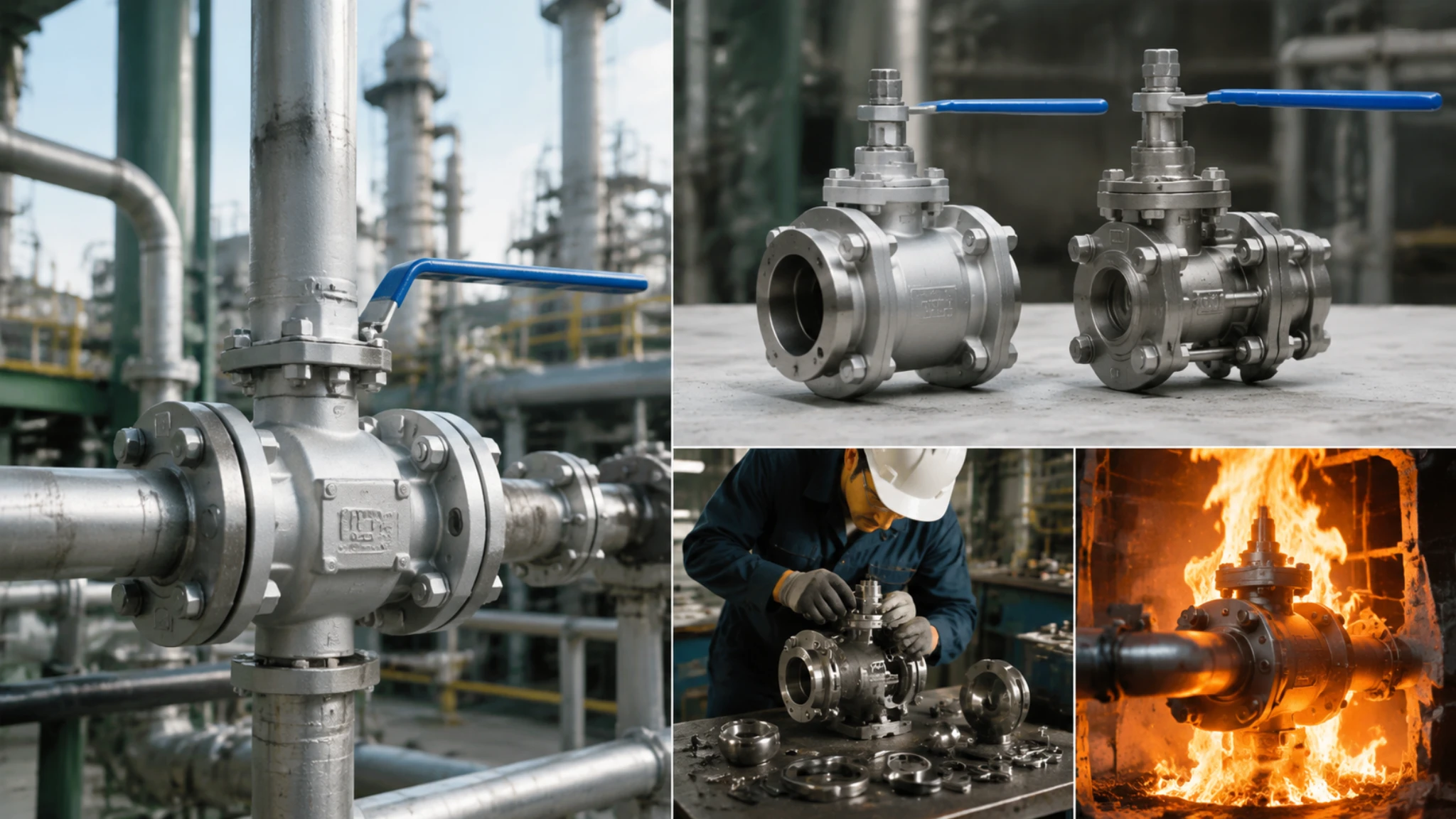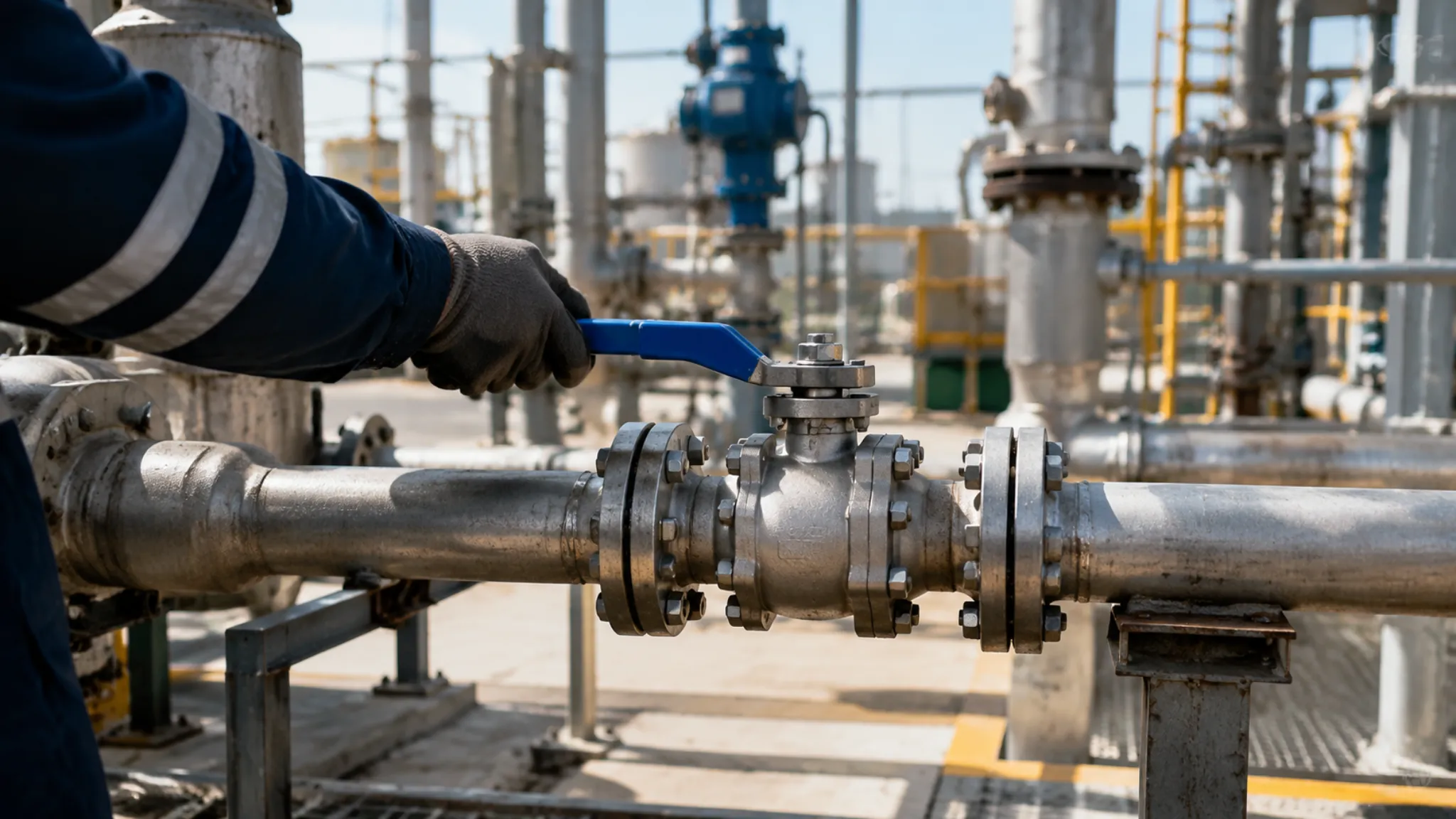
①Pressure rating, such as Class 1500/2500 (corresponding to about 25–42MPa);
②Material, such as A105 applicable to ≤425℃ carbon steel working conditions, F316 corrosion-resistant;
③Connection method, such as welded end (BW) pressure resistance is better than threaded.
Need to check medium, temperature, sealing level (API 598 leakage ≤0.01%), and do pressure resistance test (1.5 times design pressure).
pressure rating
Industrial standards & nominal pressure
ASME B16.34-2020 edition specification divides valve materials into 16 large groups. Under normal temperature environment, common ASTM A105 carbon steel at Class 1500 level can bear 3705 psi of pressure. Changing the material to ultra-low carbon stainless steel ASTM A182 F316L, the pressure bearing upper limit of the same level will drop to 2400 psi.
Testing these high-pressure valves needs to refer to API 6D and ASME B16.34 two sets of standards. API 6D 24th edition wrote clearly the rules for pipeline valve overall gas-tight and double block and bleed tests. When the factory pumps water pressure to test the valve shell, the pressure on the instrument panel must be pumped to 1.5 times of the normal temperature working pressure.
- NPS 2 to NPS 4 size forged steel ball valves, shell water pressure needs to hold pressure for at least 2 minutes
- NPS 6 to NPS 12 size large caliber, holding pressure time is lengthened to 5 minutes
- High pressure sealing test’s pressure value is set at 1.1 times of the pipe network design pressure
- Low pressure gas-tight test only charges in 80 psi of pure nitrogen gas to check leaks
ASME B16.5 specification drew a hard boundary: grades above Class 900 forcibly equip ring type joint (RTJ) flanges. Ordinary raised face (RF) flanges in pipelines with pressure exceeding 10.0 MPa, the gasket is very easy to be rushed away by high pressure fluid.
RTJ flange needs to match octagonal or oval metal ring gaskets. NPS 2 caliber Class 1500 flange will assemble R-44 model soft iron gasket. Workers use a torque wrench to tighten bolts, the metal gasket with hardness 15 to 20 HB lower than the flange is squeezed to produce deformation, deadly filling the trapezoidal groove.
Europe’s engineering projects mostly follow EN 1092-1 flange specification and ISO 14313 manufacturing standard. PN420’s label represents the valve can withstand 42.0 MPa’s pressure at normal temperature. If selecting 1.0460 grade carbon steel, when temperature rises to 200℃, PN420’s allowed working pressure will drop to 33.6 MPa.
- PN100 and lower level valves mostly adopt type B raised face flanges
- PN160 to PN420 high pressure levels forcibly assemble tongue and groove faces
- Bolt hole distance’s machining error is stuck strictly within plus or minus 0.5 millimeters
- EN 10204 3.1 material certificate attaches Charpy V-notch impact data at minus 46℃
Before machining must first calculate the valve body’s minimum wall thickness tm. The calculation formula given by ASME B16.34 Appendix B is tm = t + A. Assume pipeline inner diameter d is 50 millimeters, bearing pressure P is 25.0 MPa, need to substitute material’s allowed stress S under operating temperature to deduce base thickness t.
Selecting ASTM A182 F51 duplex stainless steel, the allowed stress S at 200℃ has 138 MPa. By formula t = (P * d) / (2S – P) calculated out theoretical wall thickness is 4.98 millimeters. Adding 3 millimeters of corrosion and machining allowance A, the minimum wall thickness on the drawing cannot be lower than 7.98 millimeters.
The working condition of injecting gas down the well tests the material’s physical limits. API 10K standard wellhead valves can bear 10000 psi, mostly adopt NPT inner threads or Autoclave cone threads. The grain size of this kind of valve body forgings requires to reach level 5 or finer in ASTM E112 specification.
Acidic fluid will destroy the metal’s structure from the inside. Handling environments containing hydrogen sulfide needs to look at NACE MR0175 specification. When the partial pressure of hydrogen sulfide exceeds 0.05 psi, the highest Rockwell hardness of A105 forgings is forcibly pressed below 22 HRC, to prevent hydrogen-induced cracking phenomenon from happening.
Heat treatment process can improve the metal’s internal mechanical properties. Forged steel gone through 540℃ tempering, yield strength stabilizes around 250 MPa, elongation rate after pulling broken exceeds 22%. Pressure-bearing small parts like anti-static springs inside the valve, have to be changed to Inconel X-750 nickel-based alloy to prevent corrosion.
P-T ratings
ASME B16.34 specification appendix contains hundreds of pages of pressure-temperature data tables. Opening the table of material number Group 1.1, carbon steel valve’s pressure-bearing data presents a parabolic drop as the temperature scale climbs. When the steam temperature inside the pipeline rises from 38℃ to 200℃, the allowed working pressure of Class 900 flange drops from 2220 psi to 2035 psi.
Carbon steel undergoes obvious brittle transition below minus 29℃. After replacing to ASTM A350 LF2 low temperature carbon steel forging, the valve body can withstand minus 46℃ low temperature impact. Inside the minus 46℃ test cabin, the Charpy V-notch impact energy of LF2 material usually maintains above 27 Joules. Low temperature causes metal to shrink, the pre-tightening force between the valve seat and the ball increases about 0.15 MPa per degree Celsius.
Temperature breaking through the 400℃ major mark, austenitic stainless steel occurs physical creep. Group 2.2’s F316 stainless steel baking long-term in a 538℃ high temperature furnace, yield strength is left with about 35% of the normal temperature state. According to specification requirements, Class 1500’s F316 forged steel ball valve’s pressure bearing upper limit in 538℃ environment only has 1065 psi. Pipelines in the factory building with operating temperature exceeding 500℃, the material selection list all uniformly changes to F347H or F321H etc. high temperature alloy steels added with titanium or niobium elements.
Metal shell holds up against high temperature, the internal non-metal sealing ring often gets baked melted first. Polytetrafluoroethylene (PTFE) material valve seat begins to soften and deform at 120℃, the ability to bear pressure presents a cliff-like drop. Pure PTFE sealing ring when environmental temperature touches 150℃, even if pipeline pressure only has 2.0 MPa, high pressure fluid will also squeeze the softened plastic out from the valve seat groove.
Engineering personnel use various modified plastics to deal with the test of high temperature and high pressure.
- RPTFE added with 25% glass fiber pulls the temperature resistance upper limit high to 200℃, maintaining 3000 hours without leaking under 15.0 MPa pressure.
- Nylon 12 material is very common in Class 900 natural gas pipelines, able to bear the double attack of 90℃ high temperature and 15.3 MPa pressure.
- Devlon V-API polyamide material is often used for crude oil long-distance transmission pipelines, maximum operating pressure at 150℃ is calibrated at 25.0 MPa.
- Polyetheretherketone (PEEK) can withstand 260℃ high temperature and keep sealed under Class 1500 level pressure difference.
F316 stainless steel’s linear expansion coefficient is about 16.0×10^-6/℃, ordinary carbon steel’s expansion coefficient fluctuates around 11.2×10^-6/℃. Every time temperature rises 100℃, 10 inch caliber stainless steel ball’s outer diameter will expand nearly 1.2 millimeters more than the carbon steel valve body chamber. The mismatch of expansion amount multiplies the friction resistance of the valve stem, the torque output by the actuator needs to increase 40% to 60% compared to normal temperature to be able to turn the ball valve 90 degrees.
High temperature thermal conductive oil pours into only 15℃ cold state pipe network, within 3 seconds the valve body inner wall temperature surges to 280℃. Severe thermal shock lets A105 forging’s inner wall produce thermal stress as high as 150 MPa. Operating personnel strictly control the heating rate, temperature climbing amplitude per hour is stuck within 50℃, leaving uniform heating and expanding buffer time for the flange face’s spiral wound metal gasket.
Different materials under specific temperatures have strict contrast limits for pressure-bearing data. Consulting ASME B16.34’s original appendix, selecting common metal materials under Class 1500 level, extracting allowed working pressure values in different temperature intervals (unit: psi), listing specific derating data for horizontal comparison.
| Medium temperature (℃) | A105 carbon steel (Group 1.1) | LF2 low temp steel (Group 1.1) | F316 stainless steel (Group 2.2) | F51 duplex steel (Group 2.8) |
|---|---|---|---|---|
| -29 to 38 | 3705 | 3705 | 3600 | 3600 |
| 100 | 3375 | 3375 | 3085 | 3600 |
| 200 | 3025 | 3025 | 2580 | 3380 |
| 300 | 2570 | 2570 | 2275 | 3130 |
| 400 | 2000 | Not applicable | 2120 | Not applicable |
Duplex steel F51 precipitates harmful intermetallic phases after the temperature crosses 315℃, brittleness deteriorates exponentially, the standard forcibly draws all table cells above 300℃ into blanks. LF2 material mainly deals with cryogenic environments, the usage upper limit is rigidly cut off at 425℃ by ASME, exceeding the value the spheroidization effect of carbides causes the steel material to thoroughly lose tensile strength.
PR2 level’s high temperature high pressure cyclic test stuffs an NPS 4 Class 1500 ball valve into a heating jacket. After nitrogen gas is pressurized to 25.5 MPa, the heater continuously outputs heat to bake the valve body surface to 180℃. Under the state of carrying pressure and preserving temperature continuously switching with load 200 times, the valve seat leakage volume index collected by test probes is pressed dead below 30 milliliters per minute, any data exceeding the limit value will let the entire batch of forgings be entirely returned to the furnace.
material grade
Carbon Steel
Steel plant’s tapping molten steel temperature is up to 1600°C, impurities are discharged with slag then enter the forging link. Manufacturing A105 forging’s carbon content must be pressed below 0.35%, manganese content maintained in 0.60% to 1.05% interval. Excessive carbon will make the material turn brittle, extremely easy to occur bursting in API 6D water pressure inspection.
Heavy 3000-ton class steam hammer repeatedly knocks the burned red steel block, severely compressing the volume to one third of the original. Fine bubbles inside the metal are strongly pressed solid, eliminating the cavities left in the casting stage. Experiencing multiple knockings to form the shell, anti-stretching ability steadily stands on the 485 MPa line.
Just beaten well metal blank needs to be put back into the furnace again, heating to 890°C to 910°C. Taking it out after preserving temperature for 2 hours, naturally cooling in flowing air. The crystallization inside the metal becomes very fine, reaching level 7 of ASTM E112 standard, the baseline power bearing deformation is locked at 250 MPa.
Air temperature dropping below zero degrees, ordinary steel materials will shatter upon a knock just like glass. Operating in extreme cold zones, the factory will change to use ASTM A350 LF2 steel material, controlling the impurities inside the material at extremely low levels.
- Carbon (C) proportion does not exceed 0.30%
- Manganese (Mn) maintains at 0.60%-1.35%
- Silicon (Si) controls at 0.15%-0.30%
- Sulfur (S) impurity less than 0.040%
Inspector will cut down a small steel block of 10mm×10mm×55mm, put into -46°C equipment to freeze, and violently strike it with a heavy metal pendulum. The steel block must withstand at least 20 Joules of destructive power without breaking into two halves.
Water flow thrust inside the pipeline is extremely shocking, 3 inch size, Class 1500 pound level equipment, the thinnest place of the shell must exceed 22.2 millimeters. Engineers will purposely thicken 3 millimeters, specially offsetting the slight rust wear caused by water flow in the future decades.
Two pieces of thick and heavy steel shell need extremely strong bolts to bite dead. The factory standard equips A193 B7 alloy steel fasteners with yield strength up to 725 MPa. Facing the furious thrust up to 6000 PSI inside the pipe, bolts deadly press down the sealing gasket, putting an end to all millimeter-level loosening.
- Ultrasonic wave penetrates 100% of the metal interior
- Magnetic particle scans 2 millimeters deep fine lines on surface
- Pure water pressurization test lasts at least 3 minutes
- Gas leakage less than 10 bubbles per minute
The edge preparing to join with the pipeline, is cut out a 37.5 degrees bevel by machine, leaving a 1.6 millimeters flat connecting point. A105 steel’s carbon equivalent is lower than 0.43, welders in field below-zero environments, don’t need to heat the iron pipe to 100°C to smoothly ignite welding. Shooting X-ray films to check weld seams, passing rate perennially maintains above 98%.
Exposed in an environment with air humidity 60%, unpainted metal will grow full of yellow spots in less than 48 hours. Workers start machines to polish the metal surface rough, spray on 50 to 75 micrometers thick anti-rust paint. Seaside natural gas stations perennially blow salty sea wind, paint surface thickness will add weight to coat to 250 micrometers for anti-corrosion.
Underground crude oil occasionally entrains five ten-thousandths of toxic hydrogen sulfide gas, able to let hard metal quietly crack open from the inside. Before leaving factory must use dedicated instrument to press test, ensuring hardness reading is below 22 HRC. Slightly softer metal can effectively prevent tiny hydrogen atoms from gathering and expanding inside the iron.
Temperature of transmitting hot gas once crosses 425°C, inside the originally solid steel material precipitates fragile black-grey graphite flakes. Within just a few months, 485 MPa anti-pulling ability appears a large scale drop. The working condition chart always draws a striking red warning line at the 425°C scale ruler.
A 2 inch Class 2500 pound level full steel equipment weighs up to 45 kilograms, manufacturing cost only has half of stainless steel. Huge price drop makes it become the absolute main force of land long-distance transmission pipelines.
Inside the hard steel shell, wraps a ball with surface sprayed a 0.15 millimeters tungsten carbide coating. Surface hardness instantly surges to the shocking level of 1050 HV. Sharp quartz sand grains mixed into the pipe, amidst tens of thousands of times of opening and closing friction, the ball surface remains intact as before not leaving a trace of scratch.
Stainless Steel
Stainless steel water poured out from the refining furnace, chromium content must be accurately maintained between 16% to 18%, this is the bottom line for building passivation film. ASTM A182 F316 forgings added extra 2% to 3% molybdenum element when smelting, this is not for increasing strength, but specifically dealing with free chloride ions in liquid.
Steel billet weighing up to 5 tons after being heated to 1200°C, is sent into large tonnage forging machine. Metal fibers along the flow channel are strongly squeezed, eliminating internal fine loose holes. Forged formed F316 valve body anti-pulling strength requires exceeding 515 MPa, elongation rate needs to reach 30% and above, ensuring possessing enough ductility elasticity under high pressure.
- Chromium (Cr) proportion 16.0% – 18.0%
- Nickel (Ni) range 10.0% – 14.0%
- Molybdenum (Mo) content 2.00% – 3.00%
- Carbon (C) upper limit 0.08%
If stainless steel needs to conduct high density on-site welding, engineers usually will change to use F316L grade. L represents low carbon, plummeting carbon content from 0.08% to below 0.03%. This change prevents the welding heat-affected zone from precipitating carbides between 450°C to 850°C, avoiding crystal boundaries appearing micro-cracks invisible to the naked eye.
In order to eliminate internal stress produced by forging process, the workpiece is sent into a 1050°C heating furnace to conduct solid solution treatment. Following water quenching process must pull temperature low within a few seconds, letting chromium element evenly lock in the austenite matrix. Hardness tester test results show, this kind of material’s Brinell hardness usually falls in 150 HBW to 180 HBW interval.
| Material performance index | F316 (Standard grade) | F316L (Low carbon grade) | Industrial measured significance |
|---|---|---|---|
| Yield strength (MPa) | ≥ 205 | ≥ 170 | Pressure bearing load foundation |
| Carbon content (C%) | ≤ 0.08 | ≤ 0.03 | Determines welding anti-corrosion |
| PREN (Pitting resistance equivalent number) | 23.1 – 28.5 | 23.1 – 28.5 | Ability to resist salt fog/chloride ions |
| Reduction of area (%) | ≥ 50 | ≥ 50 | Deformation redundancy under extreme overpressure |
In 3.5% sodium chloride solution test simulating seawater, F316’s self-corrosion potential is about 0.5 volts higher than ordinary carbon steel. This layer of chromium oxide film with thickness only 1 to 5 nanometers, can utilize oxygen in water to automatically repair in millisecond level time after damage. This makes it still able to maintain an extremely low corrosion rate of 0.02mm/year under Class 2500 level ultra-high pressure.
Valve stem material selection is usually one level higher than the valve body, often matching 17-4PH precipitation hardening steel. Through 580°C aging treatment, valve stem yield strength can be pulled up to above 725 MPa. This guarantees when facing 3000 PSI pressure difference switching, metal rod of only 30 millimeters diameter will not occur torsion deformation.
- Face to face distance tolerance controlled at ±1.5 millimeters
- Flange sealing face roughness Ra 3.2 – 6.3 micrometers
- Valve seat support ring adopts Stellite No. 6 alloy surfacing welding
- Sealing level reaches Class VI (bubble level leakage)
Stainless steel forging surface does not need paint spraying protection, but must go through pickling passivation treatment. Workers use acid paste containing nitric acid and hydrofluoric acid, to thoroughly remove iron ions adhered during forging process. Following washed with deionized water, until the surface cannot detect free iron. This process guarantees the valve stored outdoors for over 3 months not producing any rust spots.
In minus 196°C liquid nitrogen test tank, F316 performs shocking toughness. Different from carbon steel turning brittle upon receiving cold, austenitic stainless steel’s impact energy still maintains above 100 Joules. This lets it become the first choice for Class 900 pound level LNG (liquefied natural gas) receiving stations, bearing the double squeeze of internal pressure and extreme cold temperature difference.
- 100% Penetrant Testing (PT) captures surface cracks
- Helium mass spectrometry leak detection precision reaches 1×10^-7 mbar.l/s
- Valve body thickness exceeds ASME standard 10% margin
- Cleanliness conforms to oxygen working condition ASTM G93 standard
Even though the purchasing cost of a single F316 forged steel ball valve is 2.5 times higher than carbon steel, but in pharmaceutical production lines or high purity fluid control, it is the only option. Trace rust powder produced by carbon steel will instantly pollute the entire batch of medicament worth millions, while stainless steel’s stable chemical property ensures an over 15 years zero-pollution running cycle.
Facing high concentration sulfuric acid or hydrochloric acid working conditions, F316’s PREN value (pitting resistance equivalent number) if lower than 25 then exists risks. At this time technical personnel will check the nitrogen content in the material test report (MTR). Adding 0.1% nitrogen can significantly enhance the material’s pitting resistance, making it under the washing of complex chemical wastewater, still keep the mirror flatness of the sealing face.
The fitting precision of internal ball and valve seat requires reaching true roundness of 0.005 millimeters. In 10 MPa high pressure gas test, even after closing 5000 times, F316’s sealing face wear amount must also be controlled at micrometer magnitude.
Duplex & Super Alloys
Inside the steelmaking furnace, molten iron is blended out a precise microstructure of 50% austenite and 50% ferrite. ASTM A182 F51 duplex steel‘s chromium element proportion is pulled high to 22%, nickel maintains at around 5.5%. The state of two phases coexisting lets yield strength surge to 450 MPa, the value is fully two times of conventional F316 stainless steel.
When heavy hydraulic press presses flat the 1150°C steel block, operator closely stares at infrared thermometer. When metal surface temperature falls below 950°C, inside precipitates extremely fragile sigma (σ) phase. A few seconds of temperature loss of control will let the whole piece of forging weighing up to 3 tons brittle like glass after cooling, shattering on the spot in knocking test.
In ASTM G48’s ferric chloride solution soaking test, F51 test sample needs to soak fully 24 hours in 50°C strong corrosive liquid. Surface appearing tiny corrosion pits with depth exceeding 0.025 millimeters, the entire batch of metal is all judged scrapped.
Deep sea 3000 meters oil and gas wellhead, seawater pressure is up to 30 MPa, internal crude oil entrains high concentration free chloride ions. F51’s high yield strength allows engineers to reduce valve body wall thickness by 25%, the entire Class 2500 pound level equipment’s weight lightens by 40 kilograms. The weight saved by dozens of valves, drastically reduces the steel material usage amount of submarine pipeline support architecture.
- Chromium (Cr) proportion 21.0% – 23.0%
- Molybdenum (Mo) content 2.5% – 3.5%
- Nitrogen (N) element 0.14% – 0.20%
- Pitting resistance equivalent number (PREN) strictly > 34
When drilling platform digs out extremely strong acidic gas field, ordinary duplex steel faces corrosion failure crisis. Factory will replace material to super duplex steel F53 (UNS S32750). Chromium content continues to push high to 25%, PREN value crosses the red line of 40. It soaks in high concentration chlorides for as long as several months, sealing face as usual does not produce pitting pits visible to the naked eye.
Crossing duplex steel’s limit, iron element gradually exits, nickel becomes the absolute protagonist inside the smelting furnace. In Inconel 625 alloy, nickel content exceeds 58%, chromium occupies 20%, blended into 9% molybdenum and about 3.5% niobium. The expensive mixed metal is tailor-made specifically for extremely harsh hydrogen sulfide natural gas wells.
In deep gas field with gas pressure up to 10000 PSI, metal interior suffers high pressure sour water washing at all times. Inconel 625’s room temperature anti-pulling strength is up to 827 MPa, Rockwell hardness maintains below 35 HRC. Continuously running under 982°C high temperature, metal crystal lattice is completely immune to stress cracking triggered by chlorides.
- Nickel (Ni) lowest content 58.0%
- Chromium (Cr) range 20.0% – 23.0%
- Molybdenum (Mo) control 8.0% – 10.0%
- Niobium+Tantalum (Nb+Ta) 3.15% – 4.15%
In petrochemical factory’s alkylation unit, flowing inside the pipeline is extremely destructive hydrofluoric acid. Any conventional metal containing silicon or large amount of titanium bumping into it, occurs corrosion perforation within a few days. Monel 400 becomes this area’s exclusive defense line, 63% nickel and about 30% copper compose an extremely formidable acid-resistant barrier.
Monel alloy’s hot working interval is deadly limited between 925°C to 1150°C. When lathe cuts, the blade produces severe wear every time processing 50 inner threads, the workshop needs to constantly replace expensive hard alloy cutting tools.
A Monel forging equipment with caliber of only 2 inches, selling price is 10 to 15 times of a carbon steel model of the same size. All metal scraps produced during manufacturing are carefully collected, sent back to smelting factory to re-extract nickel and copper. Material manufacturing cost is extremely high, manufacturers absolutely do not retain spot goods, 100% rely on order customized production.
Inspection standard of flaw detection link is set at an extremely high water level. X-ray penetrates the pressure-bearing area’s metal layer thickest up to 45 millimeters, on the negative film absolutely not allowed to exist any black lines of tiny cracks. Ultrasonic probe scans back and forth on the blank surface, echo signal evaluation standard exceeds the highest limit stipulated by ASME B16.34 by one complete level.
In pulverized coal gasification project’s fluid not only exists strong acid, internally mixed with high speed speeding sharp cinder particles. Factory on the alloy ball and valve seat surface, adopts supersonic flame spraying to strike on a 0.2 millimeters thick chromium carbide coating. Powder bonding force exceeds 70 MPa, guaranteeing the coating absolutely not fall off amidst ten million times of physical friction.
Special alloy equipment completing assembly is pushed into high pressure test cabin. Engineers pass in pure water of 1.5 times rated pressure to hold pressure for 15 minutes, after draining dry the moisture pump in high pressure helium gas. Leak detector precisely sniffs at the joint, leak rate exceeding the extreme value of 1.0×10^-5 mbar.l/s, the equipment immediately dismantles and reloads. Every test data is printed into an independent manual of dozens of pages, accompanying the physical object delivered to the terminal site.
end connection
Welded Connections
Socket welding has an extremely high frequency in the installation of small pipes below 50 millimeters caliber. When construction personnel insert the pipe into the valve’s interface groove, the very bottom will leave empty a 1.5 millimeters gap. According to ASME B31.3 specification requirements, the outer weld seam’s thickness must be 1.25 times the pipe wall thickness, the thinnest place also cannot be lower than the 3.2 millimeters bottom line.
Within a few seconds of metal liquid cooling into solid, internally will produce force shrinking back up to hundreds of megapascals. This 1.5 millimeters gap exactly leaves a retreat path for the pipe, preventing the pipe root from bluntly tearing out fine cracks. Experienced workers before spot welding will stuff in a 1/16 inch thick water-soluble paper ring, pipeline once through water pressure test gets washed thoroughly clean.
Inside this inserted groove has a dead corner the polishing machine cannot touch. High pressure fluid arriving here will form spinning vortexes, if mixed with fine sand etc. solid particles in water, will file this layer of metal everyday. In pipe network reaching 5 megapascals pressure difference, 316L stainless steel valve’s this dead corner in one year can be bluntly worn away 0.25 millimeters.
- 1.59 millimeters thick gap paper pad
- Use pure argon gas protection continuously weld twice
- Smear red liquid medicine on surface to find cracks
- Take vernier caliper catching weld seam to measure width
Pipe size passing 2 inches, pipe wall turns thick, pipe mouth butt joint has to change to butt welding process. Pipe end and valve end both are cut out a 37.5 degrees V-shaped bevel on large lathe. Bevel very bottom must leave 1.6 millimeters smooth blunt edge, both ends aligning leave 2 to 3 millimeters seam, the first pass of molten iron water can thoroughly eat through both sides’ pipe wall.
Bumping into Sch 160 heavy pipe with wall thickness exceeding 22 millimeters, continuing to cut V-shaped bevel will waste a few kilograms of welding rods, surroundings will also be baked over-hot. Workers will change on special milling cutter, cutting into narrower U-shaped or J-shaped cuts. Heat input on the machine is rigidly set at 1.5 to 2.5 kilojoules/millimeter, afraid of baking big the crystal particles inside the forged steel.
- Polishing machine polishes edge 50 millimeters bright
- Tie on ceramic heating belt baking to 150 degrees
- Manually take arc welding filling flat layer by layer
- Temperature between two applications of welding not over 250 degrees
Polytetrafluoroethylene material enduring to 327 degrees will melt into a puddle, more heat-resistant PEEK arriving 343 degrees will also soften collapse deform. Welders before working will carry a water bucket, using soaked thick asbestos cloth wrapping the valve outside tightly, deadly pressing the temperature inside the valve belly below 100 degrees.
Meeting that kind of forged steel valve pieced together by three blocks of iron, before welding can directly dismantle down the middle piece installing the ball and sealing ring. The empty shell flanges left at both ends of the pipe let electric welding bake however and not afraid. Joint totally cooled through, flaw detector sweeping over without problem, maintenance master then takes ASTM A193 B7 labeled high strength bolts to twist the middle part back.
Some fully welded ball valves welded into a whole piece leaving factory, are quite a few pieces of forged steel parts automatically pieced together well in the factory using submerged arc welding machine. Class 2500 level ultra-high pressure product, before leaving factory the belly needs to be pumped in 41.4 megapascals water pressure. Quality inspector moving a stool staring at the pressure dial looking fully 15 minutes, pointer dropping a little bit is not allowed.
Natural gas pumped up from underground brings hydrogen sulfide, engineering requirement for the hardness around weld seam is harshly scary. According to NACE MR0175 standard, this circle of metal baked by fire if Rockwell hardness exceeds 22 HRC, bumping into high pressure acidic gas will immediately shatter crack like glass. Finishing work must locally burn the pipe again to 620 degrees, stifling for two hours then according to speed of 50 degrees per hour slowly cool down.
When pipeline design is inconsistent, valve is A105 carbon steel’s, pipe is however 304 stainless steel’s. Ordinary carbon steel welding wire dripping on fundamentally cannot catch the metals on both sides. Pipe workers have to go to warehouse fetching ERNiCrMo-3 this kind of high nickel alloy welding rod to pave a layer in the middle to pad bottom. Nickel element inside blocks all carbon atoms, after pipe cools the joint place will not crack open.
- Use industrial X-ray machine shoot panoramic negative
- Ultrasonic wave sweep a circle to see internal pores
- Sleeve on 600 degrees electric furnace preserving temperature
- Rockwell hardness tester pokes surface testing hardness
Long-distance transmission natural gas pipe buried underground, steel pipe outside all wraps a layer of 3 millimeters thick 3LPE anti-corrosion yellow skin. Thousands of degrees sparks splashing out from welding gun touching it can burn a big hole on this layer of skin. Drawing requires interfaces at both ends of pipe each leave out 150 millimeters not wrapping this layer of skin. Weld seam finishing checking with ultrasonic wave and nothing wrong, workers taking fire gun baking radiation cross-linked heat shrinkable sleeve re-wrap up.
On petrochemical factory area construction site everywhere is automatic crawling welding machines working. Welding gun head clips on the track outside the steel pipe, according to speed of 80 millimeters per minute circling around crawling by itself. How many centimeters of welding wire sent in one minute, giving how big voltage, walking how fast, these numbers are all written dead into the control board. One circle running down, surface leaves layer upon layer of neat pretty patterns just like fish scales.
Flanged Connections
Workers holding big wrench dismantling dozens of bolts on outer circle, forged steel valve weighing dozens of kilograms can separate from the pipeline. ASME B16.5 specification set extremely many thickness gears for flange plates, covering the most basic Class 150 to Class 2500 level able to withstand 42 megapascals water pressure.
When pipe inner pressure is lower than Class 600, what appears most on construction site is raised face flange. Flange end face middle retains a piece of circular high ground machined out by lathe. In Class 150 and 300 specifications this high ground bulges 1.6 millimeters, after stepping into Class 600 threshold, bulging thickness violently increases to 6.4 millimeters.
In the middle of these two iron lumps is clamped a spiral wound metal gasket carrying locating ring. Outer side carbon steel ring deadly pushes against bolt inner edge, internal 316 stainless steel belt sweeps along black graphite filler. Leaving factory 4.5 millimeters thick gasket, after cross tightened by a few wrenches will be pressed flat to 3.2 millimeters.
- Graphite filler continuously endures 450 degrees Celsius baking
- Internal stainless steel ring blocks residues dropping into pipe cavity
- V-shaped steel belt after squeezing provides microscopic rebound force
- Every time dismantling flange old gasket is all uniformly scrapped
Pipe network pressure crossing the red line of Class 900, the soft gasket clamped inside the raised face is extremely easily flushed flying by high pressure fluid. Engineers on the drawing will entirely calibrate as ring type joint flange. Lathe cutting tool forcefully scoops out a circle of deeply sunken 23 degrees trapezoidal groove on the iron plate.
Installation workers clip into the groove an oval or octagonal gasket polished from pure metal. Soft iron or low carbon steel gasket’s Brinell hardness before leaving factory will be strictly controlled, requiring 15 to 20 HB lower than flanges on both ends. Thick and strong nut twisting, the leaning soft gasket receiving force squeezing, deadly embeds into the 23 degrees inclined wall.
Twisting these peripheral components extremely consumes manual physical strength. One inch thick ASTM A193 B7 stud, testing sheet yield strength pulled to 105,000 psi. Operator is forbidden to tighten one by one along the circle, must follow the diagonal star pattern on the drawing jumping to drive screws.
Site explicitly stipulates 500 N·m torque, must carry over hydraulic wrench attached with third-party calibration label. Screw rod before assembling must take brush to smear a layer of anti-seize paste containing copper. Enduring through 650 degrees high temperature baking inside pipeline, three years later workers taking sledgehammer knocking a few times, rusted nut still can smoothly retreat thread.
- Vernier caliper determines thread crest and thread root wear
- Anti-seize paste containing 20% copper evenly smeared
- Wrench torque dial sent for inspection once every 6 months
- Adjacent flange outer side reserves 3 millimeters thermal expansion contraction seam
When refurbishing old factory building’s pipeline, two pieces of flange experiencing wind blowing and rain beating already stuck dead together. Under the situation of sledgehammer smashing not open, maintenance worker stuffs into the joint a hydraulic separator carrying a wedge. Pressurizing pump pointer stepping to 10,000 psi, a few tons of brute force forcefully props open the iron plates a 5 millimeters wide seam to take old gasket.
North winter air temperature dropping through minus 30 degrees, solid metal gasket inside flange seam receiving cold shrinks back. Pipe network interior running hundreds of degrees of superheated steam, under one cold one hot tossing bolt tightening force begins to slowly decay. Patrol inspector takes portable VOC detector sweeping back and forth around flange plate, instrument reading crossing 100 ppm immediately calls people to re-tighten.
| Pressure level specification | Commonly used flange face form | Matching gasket thickness and material requirement | Bolt tightening equipment |
|---|---|---|---|
| Class 150/300 | Raised face flange (RF, 1.6mm high) | 4.5mm spiral wound metal gasket (attached with outer locating ring) | Manual long handle wrench carrying kilogram scale |
| Class 600 | Raised face flange (RF, 6.4mm high) | 4.5mm spiral wound metal gasket (inner and outer reinforcing rings all carried) | Multi-stage calibrated pneumatic pump driven torque wrench |
| Class 900/1500 | Ring type joint face (RTJ, trapezoidal deep groove) | Soft iron octagonal solid ring with extremely low Brinell hardness | Fully automatic hydraulic tensioner carrying pressure gauge |
| Class 2500 | Ring type joint face (RTJ, trapezoidal deep groove) | 316SS or Inconel 625 oval solid ring | Fully automatic tensioner carrying dial indicator to test elongation amount |
Pipeline transmitting 98% concentration concentrated sulfuric acid, all flange joints outer circle will also cover a Teflon protective shell thick up to 2 millimeters. Internal metal gasket once fatigue breaking, a few megapascals of acid liquid mist gushing out, all being stifled inside by this layer of shell, along a 6 millimeters plastic hose connected out from bottom flowing into waste liquid barrel.
Large size ball valve with caliber as long as 40 inches, flange circumference densely interspersed with nearly a hundred heavy bolts of M48 specification. Manpower holding lengthened sleeve fundamentally cannot drive a single trace. Several heavy hydraulic tensioners sleeved on nuts at four symmetric directions, synchronously pressing down amidst oil pump roaring.
Steel column by this brute force is forcefully pulled long upwards 0.3 millimeters. Workers pinching the exact timing, take a thin iron stick inserting into the hole, lightly dialing the suspended nut to the bottom. Oil pump loosening, the pulling force of stud fiercely shrinking back locks the iron plates weighing several tons tightly seamless.
- Ultrasonic thickness gauge scans confirming stud elongating millimeter number
- Hydraulic loading peak stuck at 50% of yield strength
- Dividing three times boosting cycle slowly approaching drawing value
- Completing work take white marker pen drawing a line on nut thread side
- Use 0.05 millimeters feeler gauge poking a circle along circumference to check seam
When construction team is pulling two sections of pipeline together assembling, large iron plates weighing over ten tons have no way to achieve parallel without a single fraction of difference. ASME specification relaxed for workers a misalignment tolerance of maximum 1.5 millimeters per meter. Taking laser instrument hitting a red line to shine, exceeding standard even by 0.1 millimeters, forcibly locking screws will let the ball inside valve stuck dead.
In machining workshop lathe just withdrawing knife, workers on the bright metal face brush a layer of anti-rust oil. Pipe workers holding cotton yarn fully dipped with absolute ethanol, inch by inch wiping dry and bright these two faces of iron skin before daring to put gasket. Clamping in a tiny iron scrap, when pumping 30 megapascals water pressure testing water drops immediately along this iron scrap seep outwards.
Oil transmission pipeline flanges buried in seabed also have to endure the corrosion test of high salinity seawater. Nut outer side is sleeved on a rubber protective cap filled full of butter to block seawater. Engineers beside flange base tie on two pieces of 20 kilograms heavy zinc alloy blocks, electrochemical reaction lets seawater first go to corrode zinc blocks, keeping flange plate not growing spot rust marks for decades.
Threaded Connections
Workers holding heavy pipe wrench spinning inner the outer threaded steel pipe towards valve body interior, iron teeth on both sides mutually staggering and squeezing. Specification limits pipe diameter upper limit at 2 inches, thick and big steel pipe relying on manpower handheld tools completely has no way to rotate. ASME B1.20.1 drawing stipulated standard taper of 1 degree 47 minutes, pipe pushing inwards, lateral metal seam is stuffed tighter and more solid by thrust.
The number of thread teeth machined out on pipe wall is deadly stuck by technical standards. 1/2 inch thin pipe must machine out 14 sharp teeth on every inch of length, pipe diameter crossing 1 inch red line, teeth number per inch drops abruptly to 11.5. Between tooth and tooth is left with a precise 60 degrees included angle.
Iron bumping iron assembly will leave microscopic voids invisible to naked eye, 10 megapascals high pressure water along the small hole can seep out a big puddle of water stain in a few minutes. People working take polytetrafluoroethylene raw material tape of only 0.1 millimeters thickness circling round and round on the pipe head. Wrapping 5 to 7 circles along the tooth seam, the tape is squeezed into the 60 degrees angled deep groove filling all omissions.
In complex pipelines running light hydrocarbons or high pressure natural gas, raw material tape’s porosity fundamentally cannot block tiny molecule gas leaking out. The bottom layer of maintenance box is equipped with red colored anaerobic type liquid sealant. Glue drops on the most front three circles of thread faces, spinning tight isolating oxygen placing for 24 hours, after curing can withstand 20 megapascals gas flow fiercely scurrying outwards.
- Raw material tape winding retreats behind pipe mouth 2 millimeters preventing blocking pipeline
- Liquid glue curing environment temperature maintained at 15 degrees and above
- Peak strength exerted by 24 inch pipe wrench stuck within 150 N.m
- Completing assembly exposed metal teeth number kept at 2 to 3 buckles
- Before pressurizing statically placing pipeline ensuring glue thoroughly hardens inside pipe seam
Valves of 304 and 316 stainless steel materials mutually biting fastening, surface layer’s chromium oxide anti-rust thin film will be violently scraped broken by metal. High strength friction lets two pieces of steel materials locally heat up breaking through 200 degrees, extremely easily inducing unrecoverable cold welding dead lock. Two rows of teeth sticking just like being point-welded dead by electric welding rod, taking lengthened sleeve hard prying will only bluntly tear broken the peripheral pipe.
“On construction site meeting stainless steel pipe matching stainless steel valve, thread face must be thickly coated with anti-seize paste containing large amount of nickel powder. Metal micro-particles inside lubricant evenly pave on the 60 degrees bevel, forcibly separating two layers of iron skin. Three years later taking old pipe wrench slightly using some underlying energy, identically smoothly retreat thread completing dismantling.”
Lathe machining off a circle of hard iron skin on the outer layer of pipe wall, the metal thickness at the thread root is severely weakened nearly 40%. Liquid carrying high pressure inside the pipe high frequency washes back and forth, metal at the weakest V-shaped gap bears concentrated tearing pulling force. Pump station vicinity perennially stays in severe vibration, this circle of gap only needs half a year will vibrate out fatigue cracks visible to naked eye.
Inside heavy main line pipe networks bearing 30 megapascals and above cannot find the shadow of any thread place. They are forcibly downgraded squeezed to one side’s instrument pressure guiding pipe and bottom blowdown port. Caliber extreme reduced to 1/4 inch, when occurring accidental breaking operator turns off front cut-off valve, spends 10 minutes cutting off old pipe head using manual threading die re-threading changing to new.
Forged steel large size valve carrying Class 800 steel stamp matching NPT interface, design drawing strictly encloses it inside 13.8 megapascals working red line. Tester pushes the water pump’s test pressure up to 20 megapascals, water beads immediately top break the thin raw material tape wrapped inside, along the exposed 3 buckles of thread seam continuously spraying thin water columns outwards.
Meeting assembly of over ten meters long strip-shaped steel pipe unable to spin in place, pipe worker halfway cuts off old pipeline, stuffs in a carbon steel union carrying inner thread. The middle three-piece type hexagonal big nut takes a wrench to spin, relying on the internally well machined spherical surface and 45 degrees chamfer hard bumping hard squeezing out a dead sealing line blocking fluid.