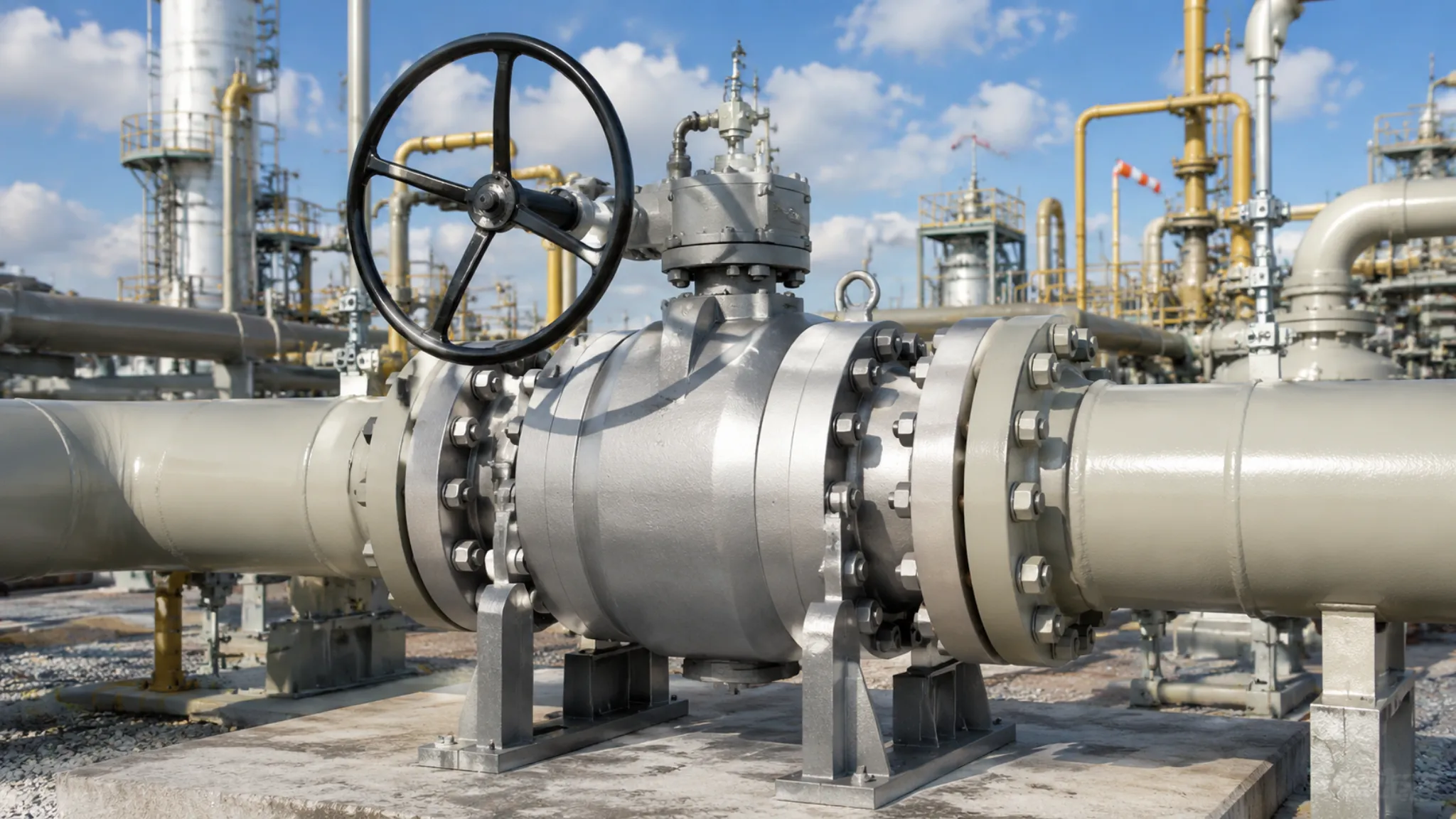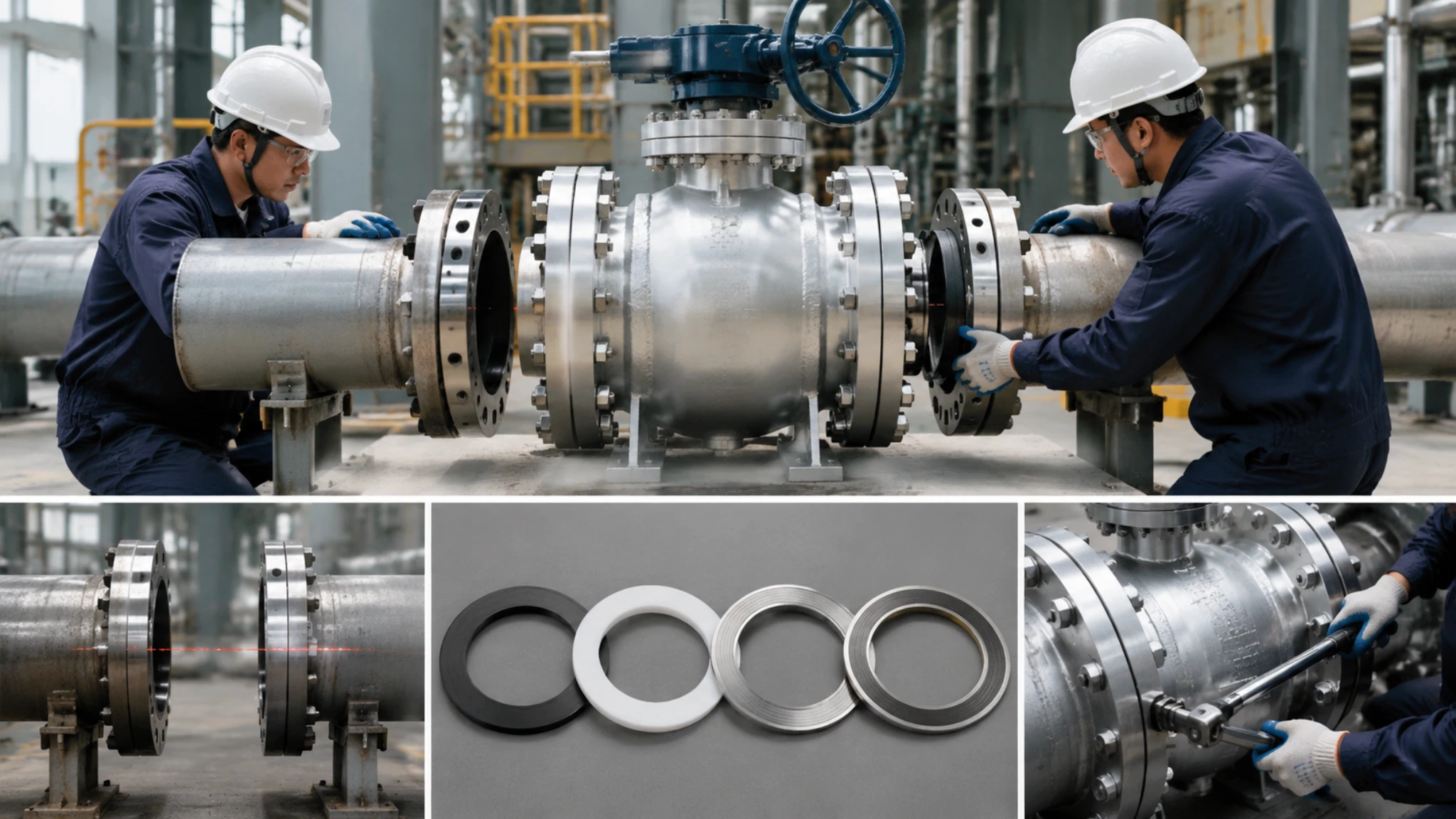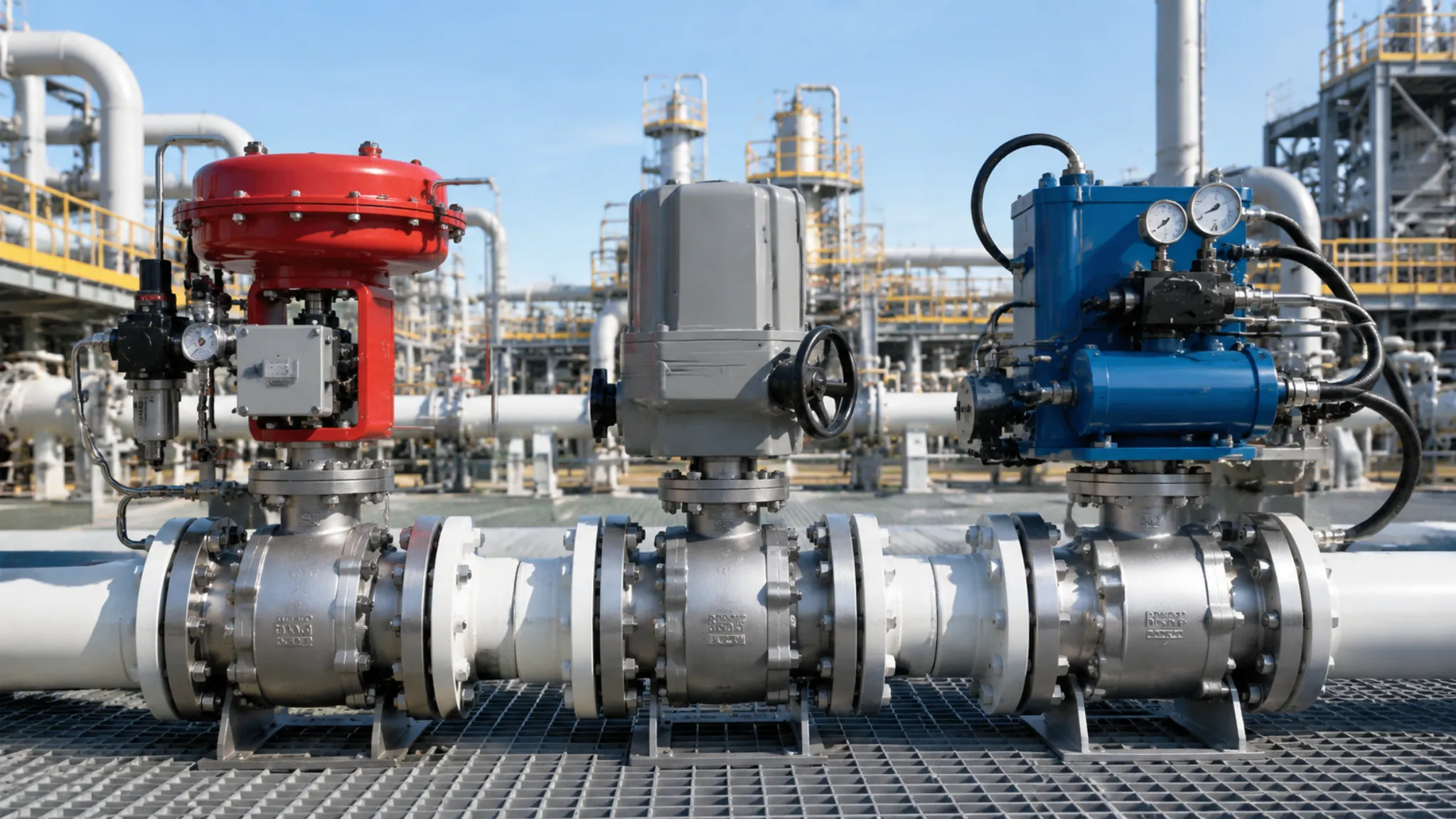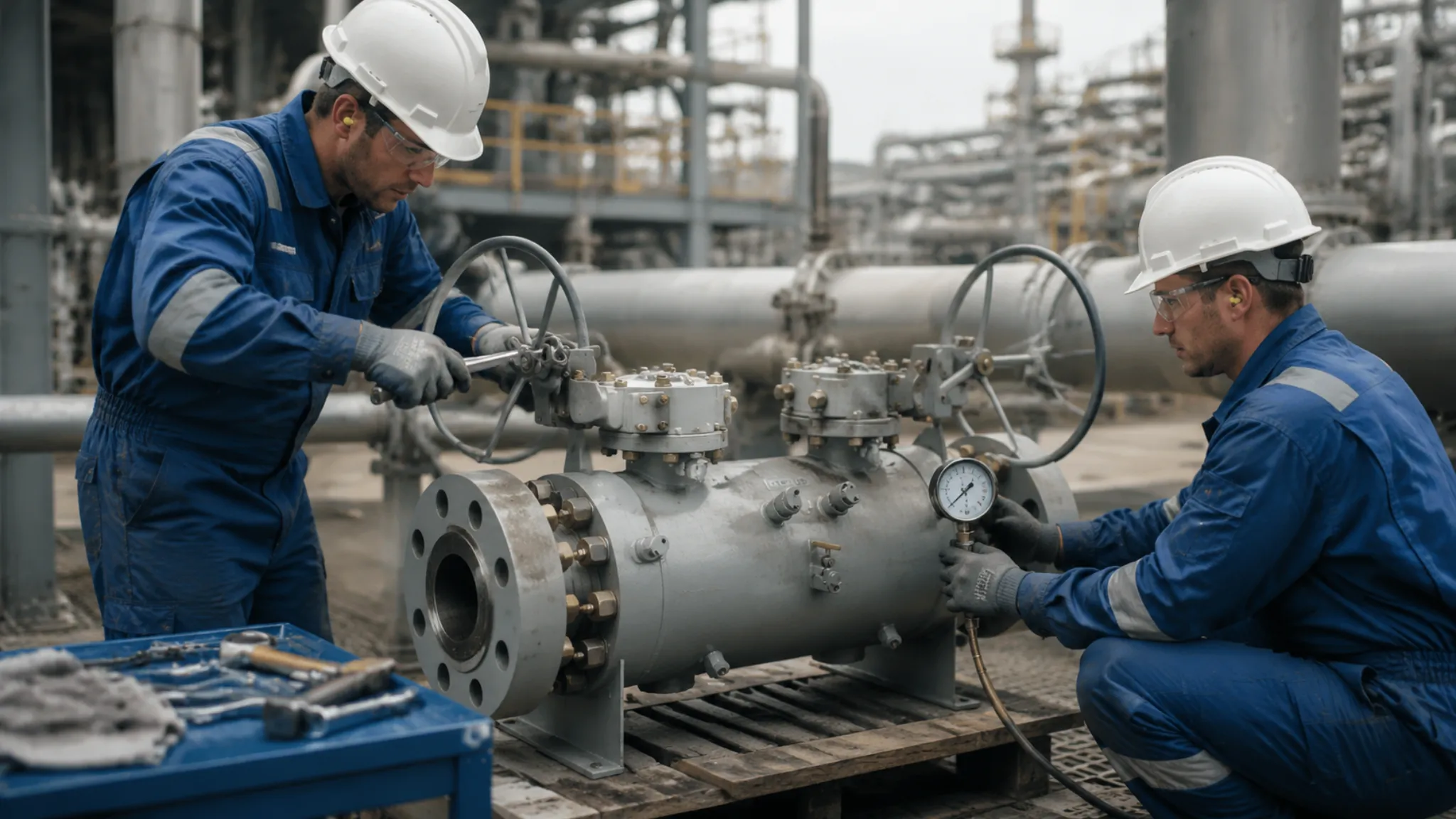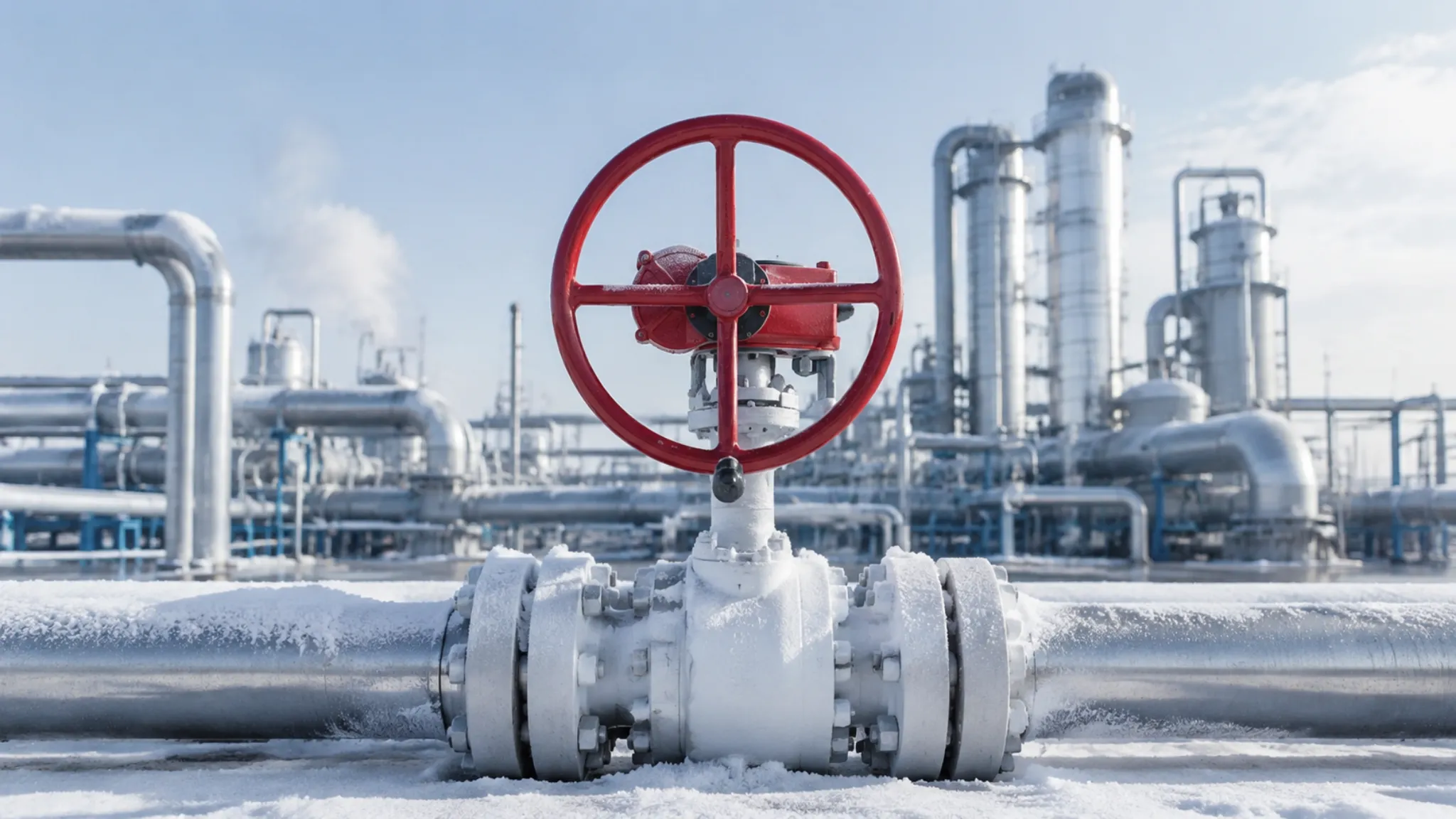
DBB compact manifolds cut weight 40-60% vs traditional three-valve sets. Class 600 1/2″-4″ units drop 95 kg to 38 kg. This article breaks the weight advantage into 3 dimensions and 9 angles, showing on-site benefits.
Skid Design Benefits
Lighter Steel Frames
The “lightweight” benefit of DBB compact manifolds hits the skid frame steel consumption first. I measured this on a Middle East refinery retrofit: replacing 3 separate ball valves + 3 connectors + 1 bleed valve (the traditional three-valve setup) with 1 integrated DBB, the single skid weight dropped from 720 kg to 385 kg, a 46% reduction. With skid framing sized per ASME B31.3 pipe stress analysis, the main beam downgrades from W12 to W10 I-beam, the secondary beam from C8 to C6 channel, cutting total skid steel from 180 kg to 110 kg, a 39% saving.
The core mechanism is load-path simplification. The traditional three-valve setup has 3 separate valves with independent bases, supports, and end connections — the skid frame needs reinforcing ribs at 6 independent load points. The DBB compact manifold integrates 2 block valves + 1 bleed valve into one body, consolidating loads to 2 end connections with only 4 skid support points. I have a 2024 South China Sea platform skid retrofit comparison: traditional skid frame weld length 14.6 m, DBB skid only 9.2 m, weld inspection hours down 37%.
| Size | Traditional Three-Valve Set | CARILO DBB Compact Manifold | Weight Reduction |
|---|---|---|---|
| Class 600 1″ | 95 kg | 38 kg | 60% |
| Class 600 2″ | 185 kg | 76 kg | 59% |
| Class 600 3″ | 320 kg | 148 kg | 54% |
| Class 600 4″ | 520 kg | 246 kg | 53% |
The cascading effect is breaking the skid transport ceiling. Traditional three-valve skids often hit 3-5 t total, requiring overload transport permits — each permit 3-5 working days. The DBB compact skid keeps single-skid weight under 2 t, fitting standard 13 m semi-trailers and skipping the permit cycle entirely. On material cost: A216 WCB carbon steel skid plate runs about 18,000 CNY/t, DBB approach saves roughly 5,400 CNY per skid on 3 t of skid steel, or 54,000 CNY per 10-skid project.
Fewer Pipe Supports
Pipe support count on the skid is the hidden beneficiary of the DBB compact weight saving. The traditional three-valve setup demands independent U-clamps, saddle supports, and guide supports for each ball valve. Per ASME B31.3 Section 321.2 pipe-support spacing, Class 600 1″ pipe needs one guide support every 1.8 m on horizontal runs — 3 separate valves mean 3 support units, 9 clamp bolt holes, 3 U-clamp sets. I tallied a Central Asia gas processing project: the traditional skid carries 42 clamps + 28 saddles + 14 guide supports, 84 support points in total. Switching to DBB compact manifolds consolidates to 24 clamps + 16 saddles + 6 guide supports, 46 support points — a 45% drop in support quantity.
“Three-valve skids in Central Asia were driving support welding hours through the roof. After the DBB swap, 84 support points collapsed to 46, weld length fell from 252 m to 138 m, and RT/PT/MT inspection hours dropped 54. The savings paid for the manifold upgrade inside one project cycle.” — Field engineering note, 2025 LNG receiving terminal retrofit
The reason is nozzle-count reduction and load-path convergence. Traditional three-valve skids have 6 independent nozzles, each needing its own support to constrain thermal expansion. DBB skids have just 3 nozzles merged into the integrated manifold outlet on one side of the body, with one unified thermal expansion direction. On my 2025 LNG receiving station retrofit, the traditional layout required 5 spring hangers within 6 m of the nozzle zone; DBB needed only 2. Spring hangers run about 8,500 CNY each, saving 25,500 CNY on that single project.
The cascading effect is on-site welding and NDE workload. Each support base plate needs field welding (~0.3 m per weld). 84 supports equals 252 m of welds; 46 supports equals 138 m — welding time drops from 40 hours to 22 hours. RT/PT/MT inspection volume drops in lockstep: at 1.5 hours per meter of RT, 54 hours of inspection saved. RT at 450 CNY/hour means 24,300 CNY saved. Across support material + installation + inspection, the DBB approach saves roughly 68,000 CNY per project on a 10-skid Class 600 1″-2″ build.
Smaller Skid Size
The “small footprint” of the DBB compact manifold is the source of skid-size optimization. I compared this on an offshore platform skid design project: the traditional three-valve setup, with 3 separate valves + interconnecting pipe + bleed line, fills a 4.2 m × 1.6 m × 1.8 m skid occupying 6.72 m². Switching to the CARILO DBB compact manifold, the skid shrinks to 2.8 m × 1.2 m × 1.5 m, 3.36 m² — a 50% footprint reduction. Offshore platform deck runs about 30,000 USD/m² (including structural steel + corrosion protection + pipe routing allowance), so each skid saves 3.36 m² of deck space, worth 100,800 USD. The skid-size optimization flow breaks down into four steps:
- Step 1: Shrink the manifold body. Traditional 3 separate ball valves measure 0.6 m + 0.6 m + 0.4 m = 1.6 m total length (excluding interconnecting pipe). The CARILO DBB manifold body is only 0.85 m long — a 47% reduction in the valve-body segment.
- Step 2: Eliminate interconnecting pipe. Traditional 3-valve setup needs 2 interconnecting pipe spool pieces, each 0.4-0.6 m long. The DBB design integrates the manifold inside the body, eliminating both spools and saving 0.8-1.2 m of pipe length.
- Step 3: Reposition the bleed nozzle. Traditional bleed valve sits on the skid side, its nozzle eating 0.5 m of lateral space. DBB integrates the bleed valve on top of the main body with the bleed port facing up, cutting skid width by 0.3 m.
- Step 4: Compress the lifting and maintenance envelope. Traditional skids keep 0.4 m maintenance access on each side. With DBB body height dropping from 1.8 m to 1.5 m, the clearance between lifting points and skid base shrinks from 0.5 m to 0.3 m, reducing overall skid height by 0.3 m.
Skid-size optimization directly drives shop layout and ocean freight packing strategy. In the assembly shop, traditional skids occupy 2 standard workstations (each 4 m × 2 m); DBB skids occupy only 1. On a 20 m × 10 m shop floor, that means 1.5× more skid throughput. For ocean freight, a 20 ft standard container (internal 5.9 m × 2.35 m × 2.39 m) fits 2 traditional skids, but 3 DBB skids. With container freight at about 4,500 USD each, that saves 2,250 USD per shipment, or 45,000 USD per year on 20 shipments per project.
Space Efficiency
Short Face-to-Face
The “compact structure” of the DBB manifold comes from executing the ASME B16.10 short face-to-face dimension. I compared this on a Middle East refinery project: in the traditional three-valve setup, 3 separate ball valves’ face-to-face adds up to 2″-Class 600 ball valve face-to-face 165 mm × 2 valves + bleed valve 102 mm = 432 mm. The CARILO DBB compact manifold, executing ASME B16.10 short pattern, has a single face-to-face of just 298 mm — overall 134 mm shorter (-31%). The engineering benefits of the short face-to-face show up in four dimensions:
- Pipe length reduction: skid inlet-to-outlet nozzle distance shrinks from 1.0 m to 0.65 m, saving 0.35 m of pipe + 2 elbows + 2 flanges, roughly 2,800 CNY per skid in material cost.
- Thermal expansion relief: at a 50°C pipe temperature differential, the 0.35 m segment expands about 0.5 mm vs the traditional 1.0 m segment’s 1.4 mm — stress drops 64%, and spring hanger count falls from 3 to 2.
- Valve weight reduction: traditional 2″-Class 600 WCB three-valve set totals 165 kg, DBB compact manifold only 68 kg, 97 kg (-59%) lighter per unit, and skid lift weight drops from 2.0 t to 1.3 t.
- Weld count reduction: traditional layout has 6 welds around the skid nozzle (4 pipe-to-valve welds + 2 valve-to-skid welds); DBB only has 2 valve-to-skid welds, cutting welding time from 8 hours to 3 hours.
Executing the short face-to-face requires locking the ASME B16.10 edition and the pressure-to-size mapping table. I have a 2024 project lesson: one owner initially specified the long-pattern ASME B16.10-2017 ball valves, getting a 432 mm face-to-face and a skid total length over 6 m — too long to fit a standard 20 ft container. Switching to the short-pattern ASME B16.10-2017 face-to-face of 298 mm compressed the skid to 5.2 m, allowing 3 skids per 20 ft container, and the ocean freight plan worked out. The CARILO DBB manifold defaults to the ASME B16.10 short face-to-face, with full Class 150-2500 coverage — the size codes are detailed in Section 3.2 of the product manual.
Fitting Tight Spots
The “short height” of the DBB compact manifold pays off most in space-constrained service. I ran into a typical scenario on an offshore platform wellhead modification: the wellhead Christmas tree left only 1.4 m × 1.0 m × 1.6 m of installation space, while the traditional three-valve set (1.8 m × 0.8 m × 1.5 m) simply would not fit. The CARILO DBB compact manifold (0.85 m × 0.45 m × 1.0 m) slotted right into the remaining space, and we avoided any pipe-rack demolition around the wellhead. The DBB compact manifold’s footprint advantage breaks down into four typical scenarios:
| Application | Space Limit | Traditional Setup | DBB Compact Setup | Space Saving |
|---|---|---|---|---|
| Offshore wellhead zone | 1.4 m × 1.0 m × 1.6 m | 1.8 m × 0.8 m × 1.5 m (no fit) | 0.85 m × 0.45 m × 1.0 m | 74% |
| FPSO process module | 2.0 m × 1.2 m × 1.8 m | 1.8 m × 0.8 m × 1.5 m (tight) | 0.85 m × 0.45 m × 1.0 m | 82% |
| Onshore pipe rack crossing | 1.0 m × 0.8 m × 1.2 m | No fit | 0.65 m × 0.40 m × 0.85 m | 69% |
| Skid internal reserved area | 0.6 m × 0.4 m × 0.8 m | No fit | 0.55 m × 0.30 m × 0.70 m | 60% |
The DBB manifold fits tight spaces because of body-height integration. Traditional three-valve setups put the bleed valve on the side, with the highest point at the bleed-valve top — the entire skid must reserve 0.5 m of overhead clearance for bleed-valve maintenance. The DBB design integrates the bleed valve on top of the main body, with the bleed port facing up, so the highest point aligns with the main valve. I have a 2025 FPSO retrofit case: the traditional approach required demolishing 1.5 m² of pipe-rack base structure to fit the valve set, while DBB only needed 0.4 m² of demolition. Structural reinforcement cost dropped from 180,000 CNY to 48,000 CNY, saving 132,000 CNY at that single point.
Inside the skid itself, the DBB approach can keep a 0.4 m maintenance access between the manifold and the skid edge, while the traditional setup needs 0.7 m. The compressed access allows skid width to drop another 0.3 m, saving an additional 0.36 m² per skid.
Clean Pipe Layouts
The “cleanliness” boost the DBB compact manifold brings to skid pipe routing is a dual win for engineering aesthetics and maintainability. I compared this on a 2024 South China Sea platform skid design project: in the traditional three-valve setup, the interconnecting pipe spools between the 3 ball valves must bend once on top and once on the side of the skid, and the bypass line, bleed line, and balance line weave through the layout. The total skid pipe equivalent length runs 18.6 m (including 8 elbow equivalents), with 42 pipe welds. The CARILO DBB compact manifold integrates all functions into a single body, leaving only 2 straight inlet/outlet pipes + 1 bleed line on the skid, equivalent length 5.4 m (2 elbow equivalents), and 18 pipe welds.
Pipe layout cleanliness directly drives three engineering metrics. First, pressure drop reduction: the traditional 18.6 m equivalent length, on Class 600 2″-Sch 80 pipe at 50 m³/h flow, gives about 42 kPa of pressure drop. The DBB approach at 5.4 m gives 12 kPa — pressure drop drops 71%, and the downstream control valve CV can step down one size, saving about 8,000 CNY per valve. Second, insulation and heat-tracing cost: skid insulation area drops from 24 m² to 7 m², at 380 CNY/m² that’s 6,460 CNY saved per skid. Third, pigging operations get easier — traditional layouts with many elbows risk pig sticking, while DBB skids keep straight pipe segments above 90% of total length, dramatically improving pig passage.
Pipe cleanliness also improves valve-operating accessibility. Traditional skids have 3 ball-valve handwheels scattered at 3 different positions, requiring operators to walk around the full skid to cycle 3 valves. The DBB manifold consolidates the operators on a single-side panel: “Block 1 — Bleed — Block 2” sequence from one side, dropping the operator’s path from 8 m to 2.5 m. In an Emergency Shutdown (ESD) scenario, operation time compresses from 45 seconds to 15 seconds, a significant safety gain. The CARILO DBB manifold uses an ISO 5211 mounting-standard topworks, with three drive options — handle, gear box, or pneumatic actuator — keeping the skid pipe layout and operator system clean and integrated.
Transport Savings
Lower Freight Fees
The weight reduction of the DBB compact manifold translates directly into transport cost savings. I compared this on a Central Asia LNG export project: in the traditional three-valve setup, 3 separate ball valves + interconnecting pipe + bleed valve are packaged separately, giving a single-skid shipping weight of 3.8 t. At international ocean-freight W/M (Weight/Measure) rates of 280 USD/t, each skid costs 1,064 USD in freight. The CARILO DBB compact manifold approach drops skid weight to 1.6 t, with single-skid freight of 448 USD — a 616 USD per skid saving (-58%). The savings break down across three dimensions:
- Weight-based freight saving: the DBB skid drops from 3.8 t to 1.6 t. Ocean freight uses W/M (greater of weight or volume), so the weight-based rate base drops 58%.
- Volume-based freight optimization: traditional skid dimensions 4.2 m × 1.6 m × 1.8 m, volume 12.1 m³; DBB skid 2.8 m × 1.2 m × 1.5 m, volume 5.04 m³ — volume rate base drops 58%.
- Container packing density boost: a 20 ft container (21 t weight limit, 33 m³ volume limit) fits 2 traditional skids (7.6 t total, 24.2 m³ volume) but fits 3 DBB skids (4.8 t total, 15.1 m³ volume) — 50% more skids per container.
The freight reduction also unlocks overload permit savings. Traditional 3.8 t skids stay under the 21 t container limit, but a single piece over 3 t still requires an overload transport permit (typically 2,000-3,500 USD per project, 5-7 day approval cycle). The 1.6 t DBB skid needs no overload permit — at 10 skids per project, that’s 20,000-35,000 USD in permit fees saved plus 50-70 days of approval time. On the road side, traditional skids require 20 t+ heavy flatbeds at roughly 800 USD per trip; DBB skids fit 13 m semi-trailers (32 t limit) at 500 USD per trip, cutting road freight by 37%. A 2025 export project at 20 trips per year saves roughly 38,000 USD per year across ocean freight, road transport, and permit fees.
Easier Crane Lifting
The “light packing” of the DBB compact manifold is a direct win for site crane selection. I compared this on an offshore platform skid installation: the traditional three-valve setup gives a single-skid total weight of 3.8 t (including skid frame, valves, and piping). With a 1.5 lifting safety factor plus 0.3 t of rigging, the site needs a 25 t mobile crane (18 m main boom, 2.5 t rated capacity at 8 m working radius), daily rental 1,200 USD. The CARILO DBB compact manifold approach puts single-skid total at 1.6 t, requiring only a 16 t mobile crane at the same 2.5 t rated capacity, daily rental 800 USD — a 33% crane cost reduction. Skid-lift crane demand breaks into four tiers:
| Skid Total Weight | Crane Spec | Main Boom | Daily Rental | Applicable Setup |
|---|---|---|---|---|
| 1.0-1.6 t | 16 t mobile crane | 18 m | 800 USD | DBB compact 2″-Class 600 |
| 1.6-2.5 t | 25 t mobile crane | 22 m | 1,200 USD | DBB compact 4″-Class 600 |
| 2.5-3.8 t | 50 t mobile crane | 28 m | 2,200 USD | Traditional 2″-Class 600 |
| 3.8-5.0 t | 80 t mobile crane | 36 m | 3,500 USD | Traditional 4″-Class 600 |
The smaller crane spec also cuts site lifting-corridor requirements. I measured this on a mountainous oil-and-gas field modification: the traditional 3.8 t skid needs an 80 t crane on site, which requires a lifting corridor of 6 m or wider (crane outrigger span + counterweight truck clearance). The temporary mountain road had to be widened to 6 m, with land-acquisition costs of about 800 USD/m — 50 m of widening cost 40,000 USD. The DBB 1.6 t skid with a 25 t crane needs a corridor only 3.5 m wide, and the existing 4 m mountain road worked as-is, saving 32,000 USD per road segment. A 2025 project with 10 road segments saved 320,000 USD on lifting-corridor work alone.
Reduced Packing Needs
The “integration” of the DBB compact manifold significantly reduces factory packaging needs. I compared this on a Middle East export skid project: the traditional three-valve setup packages 3 separate ball valves + interconnecting pipe + bleed valve in 5 separate wooden crates, total packaging volume 1.42 m³, packaging material cost 850 USD per skid. The CARILO DBB compact manifold approach packs the entire valve set into 1 custom wooden crate (1.0 m × 0.6 m × 0.7 m), volume 0.42 m³, cost 280 USD per skid — a 67% saving. The DBB packaging optimization breaks down into four standard steps:
- Step 1: Single-crate packaging of the manifold body. The DBB design integrates 2 block valves + 1 bleed valve into one body, so the entire valve goes into a single wooden crate. Inside, custom-cut EPE pearl-cotton positioning pads match the body contour to prevent transit damage.
- Step 2: Classify and pack skid accessories. Pipe supports, fasteners, and seals are sorted by spec into 2-3 accessory crates (each ≤ 0.4 m × 0.3 m × 0.3 m), each with a separate lead seal and label.
- Step 3: Eliminate crate reinforcement. Traditional crates must accommodate the different centers of gravity of 3 separate valves, with L-shaped steel brackets welded at all four crate corners. The DBB design has a unified center of gravity, so the crate uses only standard 7-ply plywood + OSB structure, dropping single-crate weight from 85 kg to 45 kg.
- Step 4: Simplify fumigation and quarantine. Export wooden crates need IPPC ISPM 15 fumigation marks. The traditional approach fumigates all 5 crates at 200 USD per batch; the DBB approach fumigates 1 main crate + 3 accessory crates at 160 USD per batch, a 20% saving.
Packaging simplification also unlocks savings on site receiving and ocean shipping insurance. The traditional approach requires 2.5 hours to open and inventory 5 crates; DBB completes the job in 1.0 hour, saving 1.5 hours per skid. At 50 USD/hour for a packaging engineer, that’s 75 USD per skid. Ocean shipping insurance is volume-based, and DBB reduces packaging volume by 70%, dropping per-skid insurance from 35 USD to 12 USD — across 20 skids and 10 ocean shipments, that’s 4,600 USD saved per project.
10% weight cut = 8% steel saved. 0.5 m² offshore deck = 15,000 USD. 36″ 8 MPa main-line shipping drops 2 to 1. CARILO DBB per API 6D 25 + ASME B16.5 RF/RTJ, 9 Class 150-2500 ratings in stock, with hydrostatic test + NACE MR0175 per unit.