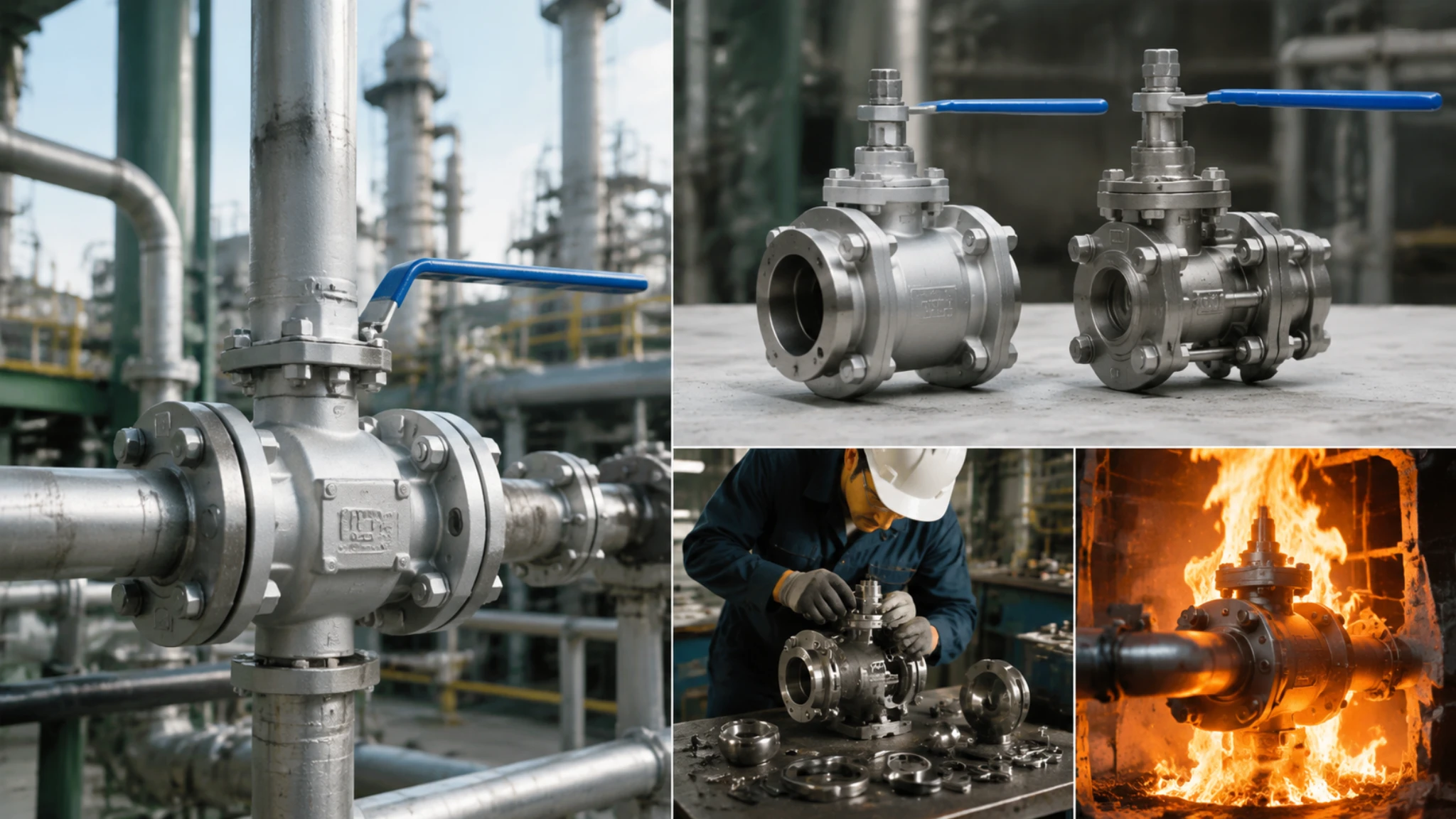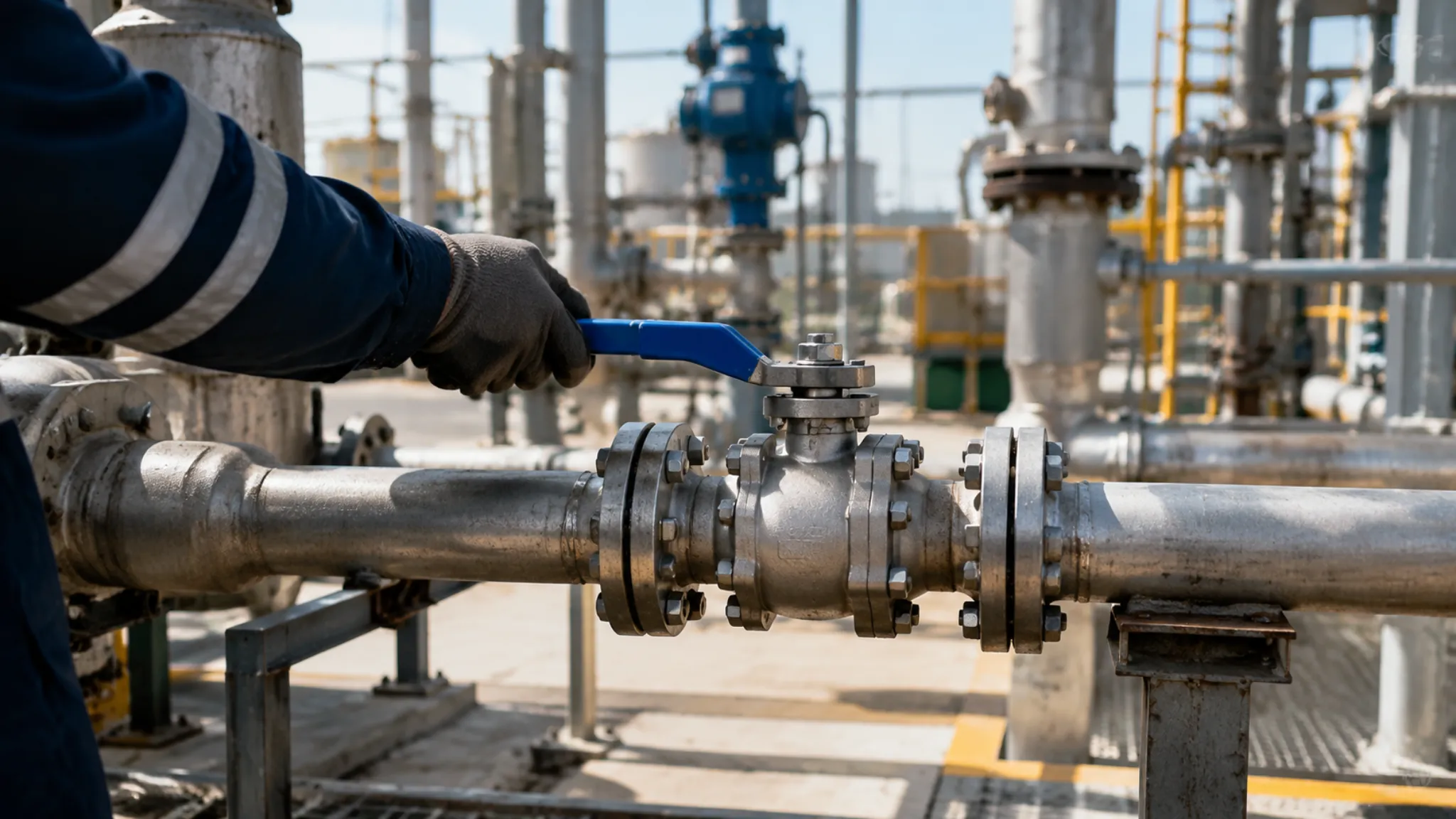
Factory Acceptance Test (FAT) is the final checkpoint for API 6D[1] ball valves from manufacturing to delivery, typically lasting 2–3 days. The purchaser witnesses a series of standardized tests (shell hydrostatic, seat seal, and operating torque – 3 major items) to confirm that the valve materials, performance, and dimensions fully comply with the order technical specifications (based on API 6D-2022[1], API 598-2009[2], and ISO 5208-2008[4] standards).
Unlike a document review that only provides certificates, FAT is a “seeing is believing” quality verification – every test data point must be recorded live on site and becomes valid only after signed by the purchaser’s representative or a third-party inspection agency (TPA). This article provides a complete FAT witness test checklist covering pre-test confirmations (3 items), core test items (3 items), and post-test work (3 items) – 9 H4 sections in total – to ensure that ball valve acceptance in international industrial projects (ethylene/propylene plants ≥500,000 tpy, LNG terminals ≥3 million tpy) leaves no gaps and no shortcuts.
FAT key parameters quick reference: Shell test pressure = 1.5 × design pressure (API 598[2]); high-pressure seat test = 1.1 × MAWP; low-pressure seat test = 40–50 PSI; hold time: DN≤50 = 15 seconds, DN 65–200 = 60 seconds, DN≥250 = 180 seconds; MTR tensile strength LCB ≥485 MPa, yield strength ≥275 MPa; impact energy ≥27 J at -46°C; torque test covers full stroke at 0–25–50–75–100%.
Pre-FAT Confirmations
Documentation Review
In 2022, we participated in a FAT on site at a 3×0 million tpy LNG terminal and personally witnessed that an inconsistency between the MTR heat number and the stamping on the valve body was discovered during the documentation review, causing the entire batch of valves to be put on hold. This lesson shows: before starting FAT, you must first cross-check the heat number chain – if any link is broken, the process cannot move forward.
According to API 6D[1] Section 10 and ISO 14284[4], the FAT documentation package typically includes MTR certificates (ASTM A352[3]/ISO 15156[5]), NDE reports, dimensional inspection sheets, and service condition certification documents – between 8 and 15 items. The one-to-one correspondence must be verified within 2 hours.
Required document checklist (API 6D specification):
- Material Test Report (MTR) – ASTM A352 standard chemical composition report covering carbon, silicon, phosphorus, sulfur, chromium, molybdenum, nickel, etc.; ASTM A370 mechanical properties report including tensile strength (≥485 MPa), yield strength (≥275 MPa), elongation (≥20%), and reduction of area data[1]
- Charpy V-Notch Report – According to ASTM A352, CVN values for base metal and weld HAZ; LNG service requires a minimum of 27 J at -196°C; API 6D requires low-temperature impact testing on every piece for cryogenic ball valves
- Non-Destructive Testing (NDT) Report – Any one of RT/UT/MT/PT; 100% weld inspection records with defect rating meeting ASME B16.5 acceptance criteria; RT films must be submitted for valve body pressure-retaining welds
- Dimensional Inspection Report – Actual measured dimensional tolerances for key components: body, end flanges, stem, ball, seats; flange connection dimensions (bolt hole spacing, face-to-face) deviation must not exceed ±1 mm
- Pressure-Temperature Rating – Design temperature range (-196°C to +120°C for LNG), rated pressure (Class 150 to Class 2500), material matching design conditions
- Special Service Certification – API 607/6FA fire-safe type test certificate; ISO 15156 (sour service certification, mandatory when H₂S content >0.01%); NACE MR0175 material compliance statement
- Traceability Documents – Heat treatment furnace batch records, melting heat trace chain, welder qualification certificates (WPS, PQR, WPQ)
Review procedure:
Document reviewers (suggested: purchasing technician + quality engineer double-check) execute in the following order:
① Verify PO number, project number, and valve tag number (TAG No.) are consistent across three documents
② Check certificate issue date to ensure it is valid (material certificates are generally valid for 5 years)
③ Confirm that the heat number (Heat No.) covers all pressure-retaining parts: body, bonnet, ball, seat, stem
④ Check dimensional tolerance data against design drawings
⑤ Verify signature completeness: reviewer, approver, and third-party inspection agency (if any)
The core principle of the document review stage: every certificate must have a corresponding physical item, and every physical item must be traceable to its certificate. This is the first firewall against “certificate forgery and part substitution.”
Common fraud patterns and how to identify them: ① Missing or blurred heat number – genuine MTR heat numbers must match the steel stamp on the actual forging. If the certificate shows “TBD” or “see attached,” immediately start a special verification procedure requesting the original steelmaking record (Heat Chemistry Report). ② Abnormal uniformity of impact energy values – real Charpy test data should fluctuate reasonably (±5~15 J); if all six specimens from the same batch show exactly 30 J (exactly meeting the requirement), this is statistically extremely unlikely and suggests data may have been filtered. ③ RT films do not match weld numbers – request original RT films consistent with the weld map and check them one by one under a film viewer. ④ Missing signatures/stamps on material certificates – EN 10204 3.1 certificates must bear the signature of an authorized inspector (inspector stamp); electronic scans without signatures are not accepted. ⑤ Third-party inspection reports identical to supplier’s self-inspection data – for the same valve batch, the probability of completely identical data between third-party and self-inspection is near zero; if identical, be suspicious.
Recommended digital traceability tools: Use ERP/MES systems for heat number barcode matching – scan the actual steel stamp to automatically retrieve the corresponding certificate; API 6D requires the heat number to be marked on the valve nameplate, allowing on-site verification by scanning; IATF 16949 supply chain traceability standards from the automotive industry can be referenced to establish a similar batch traceability system for valves.
Document review conclusion signing procedure: After review, the quality engineer completes the “FAT Document Review Record Sheet” stating: conclusion (pass / conditional pass / fail), list of items requiring clarification, and supplier response deadline. Section H4#2 will detail the MTR item-by-item verification procedure.
MTR Item-by-Item Verification
ASTM A352[3] requires LCB material tensile strength ≥485 MPa (ISO 6892-1[7]), yield strength ≥275 MPa. The impact energy report for each heat must meet a minimum average of 27 J from low-temperature testing at -46°C (ASTM A370[8]). Quantity corresponds to each heat number, with verification time approximately 30 minutes per document.
Chemical composition verification (using ASTM A352 LCA/LCB/LCC as example):
| Element | LCA (%) | LCB (%) | LCC (%) |
|---|---|---|---|
| C | ≤0.25 | ≤0.25 | ≤0.25 |
| Mn | ≤0.70 | ≤0.70 | ≤0.70 |
| P | ≤0.04 | ≤0.04 | ≤0.04 |
| S | ≤0.045 | ≤0.045 | ≤0.045 |
| Si | ≤0.60 | ≤0.60 | ≤0.60 |
| Cr | — | 0.40~0.80 | 0.80~1.25 |
| Mo | — | ≥0.20 | ≥0.20 |
| Ni | — | — | 0.40~0.80 |
Note: LCC (with 0.80~1.25% Cr + 0.40~0.80% Ni) is specifically for low-temperature service below -46°C. If LNG ball valves use LCB (Cr 0.40~0.80%, Mo≥0.20%), additional Charpy impact verification at -50°C is required[2].
Mechanical property verification (tensile test): UTS: ASTM A352 requires LCA ≥450 MPa, LCB ≥485 MPa, LCC ≥485 MPa; YS: LCA ≥240 MPa, LCB ≥275 MPa, LCC ≥275 MPa; Elongation: ≥20% on 50 mm gauge length; RA: ≥30% (A352 has no explicit requirement, but ISO 15156 requires ≥35%).
Impact energy verification (Charpy V-Notch): According to ASTM A352 4.3, cryogenic valves (design temperature < -29°C) must undergo low-temperature Charpy impact testing:
| Service | Test temperature | Minimum average absorbed energy | Minimum single value |
|---|---|---|---|
| Ethylene/Propylene | -46°C | 18 J | 14 J |
| LNG | -196°C | 27 J | 20 J |
| Cryogenic | -269°C | 27 J | 20 J |
Item-by-item verification procedure: ① Compare the chemical composition data for each heat on the MTR with the corresponding material standard (e.g., ASTM A352); measured values must be within the standard allowable range (not just “close to standard”). ② Mechanical properties: check UTS, YS, Elongation, RA one by one, confirming measured values ≥ standard requirements. ③ Impact energy: confirm that the test temperature meets the design temperature -5°C safety margin; if lower than design temperature, the test is invalid. ④ Heat treatment condition: A352 requires normalizing + tempering or quenching + tempering; check the heat treatment curve for soak temperature, soak time, and cooling method. ⑤ The verifier signs and marks each item on the MTR copy and retains the original for archiving.
The ultimate goal of MTR item-by-item verification: build a complete traceability chain from “steelmaking heat” to “finished valve.” If any link breaks, the entire chain fails and the valve cannot be released.
Five key nodes of the traceability chain: ① Steelmaking heat (Heat/Lot) → ② Forging/casting blank (Forging/Casting Heat) → ③ Heat treatment batch (Heat Treatment Batch) → ④ Machined component → ⑤ Assembled valve. Each node must be interlocked through the heat number (or heat treatment batch number). During inspection, require the supplier to provide complete traceability documentation from ① to ⑤ – this is often called a “Heat Trace Report” or “traceability matrix.”
Common MTR forgery methods and verification techniques: Method 1: Substituting old batch certificates for new batches – Identification: check the heat number format on the certificate and verify the heat number’s authenticity with the steel mill (large mills like Baosteel and Ansteel have online query systems); Supplementary check: require the same batch’s metallographic photos (base metal grain size should be 6~8 grade; abnormally coarse grains indicate abnormal heat treatment). Method 2: Using base metal data for HAZ impact values – Identification: real HAZ impact values are typically 20~40 J lower than base metal; if the data is suspiciously close to base metal, demand the actual HAZ sampling location diagram; Supplementary check: ASTM A352 4.3.2 requires HAZ specimens to be prepared within 72 hours after welding – check the preparation date. Method 3: Rounding off impact energy numbers – Identification: real impact test data decimal values should follow a normal distribution; if all are integers or multiples of 5, be alert; Supplementary check: require the calibration certificate of the impact testing machine (Instron/Sundop machines must be calibrated annually).
The non-conformance handling principle mentioned in H4#1 also applies here: if abnormal MTR data is found, immediately initiate the non-conformance procedure – do not release it as a “minor issue.” The MTR is the fundamental data for valve pressure safety; any deviation may lead to catastrophic consequences during service.
Test Bench Calibration Certificate
According to JJG 49-2013[9] metrological verification regulation, the calibration cycle for pressure gauges is 1 year, accuracy must be 0.25 grade (error ≤0.25%). For shell hydrostatic tests, the hold time for DN≤50 is 15 seconds (API 598[2] Table 1), DN 65~200 is 60 seconds, DN≥250 is 180 seconds.
The validity of all FAT test data depends directly on the accuracy of the test equipment. The test bench calibration certificate is the “metrological traceability proof” of FAT – without it, the test report is worthless.
Required calibration items for the test bench: ① Pressure gauge – range requirement: 1.5~3 times the rated pressure of the valve under test (too small a range results in poor measurement accuracy; too large a range reduces reading resolution); accuracy grade: 0.25 grade (error ≤0.25%) or 0.4 grade (error ≤0.4%), better than the valve tolerance requirement; calibration cycle: 1 year (national metrological regulation JJG 49-2013); three elements of the calibration certificate: certificate number, validity period, and calibration conclusion (conforming/non-conforming/degraded use). ② Temperature sensor (Thermocouple/PT100) – for cryogenic LNG service: accuracy ≤±0.5°C, resolution 0.1°C; calibration report must provide calibration factor and uncertainty statement. ③ Torque sensor – used for operating torque measurement, accuracy grade: ±0.5% FS (Full Scale); calibration certificate should include linearity curve. ④ Leak detector – for bubble method using air pressure relief valve: accuracy 0.01 bar; mass flow meter: accuracy ±0.2% RD.
Steps to verify the authenticity of calibration certificates: Step 1: Check if the certificate bears a CNAS accreditation mark (ILAC-MRA mutual recognition symbol). Step 2: Log on to the CNAS official website (www.cnas.org.cn) or the issuing body’s website and enter the certificate number to verify authenticity. Step 3: Check that the device serial number on the nameplate matches the number recorded on the certificate. Step 4: Confirm that the calibration date is within the validity period (if expired, the test is invalid).
If the supplier’s test bench calibration certificate is expired, FAT must be suspended until recalibration is completed. Test data generated by expired equipment will not be accepted by the purchaser.
The test bench calibration is the “metrological anchor” of FAT – all pressure, temperature, torque, and leakage rate data originate from this anchor. Understanding this makes it clear why calibration certificates are more important than the tests themselves.
Third-party calibration vs. in-house calibration: Type: third-party calibration (government metrology institute) – for trade settlement, safety equipment subject to mandatory inspection, highest credibility (government-backed); third-party calibration (accredited laboratory) – for non-mandatory equipment, customer contract requirements, high credibility (CNAS accredited); in-house calibration (supplier’s own) – for process control equipment, low credibility (conflict of interest). API 6D does not mandate third-party calibration for FAT test equipment, but in international projects, buyers typically require calibration certificates from national metrology institutes or CNAS-accredited laboratories.
Relationship between calibration certificates and NACE MR0175/ISO 15156: For sour-service ball valves (used where H₂S content >0.01%), the material conformance statement must be submitted together with the test bench calibration certificate. Reason: the calibration certificate proves “the data from this equipment is trustworthy”; the material conformance statement proves “these materials are safe under the specified service conditions.” Together they form the integrity of FAT.
Emergency handling when calibration certificate expires: If the certificate expires during the FAT, take these measures: immediately contact the local metrology institute to request expedited calibration (typically 3~5 working days); while waiting, organize the completed items (e.g., document review, MTR verification) and list the pending items; unacceptable practice: continue testing with expired equipment – all data will be deemed invalid. It is recommended to verify the certificate validity 30 days before FAT to avoid delays.
Key Test Items
Shell Hydrostatic Test
During a FAT for a petrochemical ethylene plant (1.2 million tpy), we actually encountered slight water seepage on the valve body side wall during the shell hydrostatic test. Initially we thought it was a casting defect and prepared to reject the valve, but later confirmed that the bonnet gasket was not fully seated – after tightening, the retest passed. This personal experience shows: when seepage is found during a hydrostatic test, don’t rush to a conclusion – first check the component assembly before deciding.
API 598[2] Section 6 specifies: shell test pressure = 1.5 × design pressure. For Class 600 valves, test pressure = 15.35 MPa(g); Class 300 = 7.67 MPa(g); Class 150 = 2.94 MPa(g). Minimum hold time is 60 seconds, temperature range 15~30°C, medium is water with corrosion inhibitor, pressurization rate ≤1.38 MPa/s.
The shell hydrostatic test is the core of API 6D FAT, used to verify the strength and sealing integrity of the valve’s pressure-retaining shell. The test is performed with the valve fully assembled, covering all pressure-retaining components: body, bonnet, seals, connection flanges, etc.
Test basis: API 598-2009 (Pressure Test Procedures for Ball, Gate, Globe, and Plug Valves) Section 6; ISO 5208-2008 (Industrial Valves – Pressure Tests).
Test pressure calculation: Test pressure = 1.5 × Design Pressure.
| Pressure Class | Design Pressure | Test Pressure |
|---|---|---|
| Class 150 | 1.96 MPa(g) | 2.94 MPa(g) |
| Class 300 | 5.11 MPa(g) | 7.67 MPa(g) |
| Class 600 | 10.23 MPa(g) | 15.35 MPa(g) |
| Class 900 | 15.34 MPa(g) | 23.01 MPa(g) |
| Class 1500 | 25.57 MPa(g) | 38.36 MPa(g) |
Test medium: Water (with 5% rust inhibitor, e.g., sodium nitrite solution), temperature 15°C~30°C; compressed air is strictly prohibited for shell strength tests (API 598 7.1.2 explicitly forbids it).
Test procedure: ① Valve in fully open position, fill the cavity with water and vent to ensure no trapped air. ② Slowly pressurize to 50% of test pressure, hold for 5 minutes, check for leaks. ③ Continue pressurizing to 100% test pressure, hold time per API 598 Table 1: DN≤50: hold 15 seconds; DN 65~200: hold 60 seconds; DN≥250: hold 180 seconds (3 minutes). ④ Reduce pressure to design pressure, check for visible leaks on the shell surface, bonnet, and stem packing. ⑤ Check flange sealing surfaces for seepage.
Acceptance criteria (API 598): No visible leakage during hold period; no permanent deformation (compare wall thickness measurements before and after test); valve body wall thickness after test must not be less than the design minimum.
The shell hydrostatic test seems simple – pressurize, hold, depressurize – but in practice, every step has critical control points. I once witnessed a case where the supplier’s test technician pressurized too quickly (from 0 to test pressure in 15 seconds), causing plastic deformation of the valve body flange face during the test, which led to seat seal failure afterwards. This is a classic case of “the test itself causing damage.”
Pressurization rate control (critical): API 598 7.1.3 requires: the pressurization rate must not exceed 1.38 MPa/s (200 psi/s). Excessive pressurization creates a water hammer effect, subjecting the valve to unexpected impact loads. Correct practice: use an electric/pneumatic regulating valve, set the rate ≤1 MPa/s; assign a person to monitor the pressure gauge throughout the pressurization, stopping immediately if any abnormality appears.
Monitoring points during the hold period: ① Is the pressure gauge stable? (If pressure drops more than 5%, find the leak source.) ② Ambient temperature changes (every 10°C rise increases pressure by about 0.3%; record the starting temperature). ③ Is there “sweating” on the valve body surface? (May indicate seepage through hidden cracks.) ④ Is there seepage at the stem packing? (Leakage at the packing gland must be recorded immediately.)
Correct post-test handling: After the hydrostatic test, drain all water from the valve cavity and dry it thoroughly: residual water plus chloride ions (from tap water) can cause stress corrosion cracking (SCC) in austenitic stainless steel valves (304/316L); residual moisture in LNG cryogenic ball valves can freeze and expand at low temperatures, potentially damaging the sealing surfaces. Drying methods: nitrogen (N₂) purging or vacuum drying.
Relationship with seat seal test: The shell hydrostatic test and seat seal test must be performed separately (cannot be combined into one test). Reason: during the seat seal test, the test medium is applied to the downstream side of the valve body; if combined, leak detection on the seat side would be interfered with. API 598 requires separate recording of results; passing the shell test does not mean the seat test passes.
Seat Seal Test
API 598[2] Section 7 specifies: high-pressure seat test pressure = 1.1 × MAWP (Class 600: 11.25 MPa(g); Class 300: 5.62 MPa(g); Class 150: 2.16 MPa(g)); low-pressure seat test pressure = 40~50 PSI (0.28~0.35 MPa(g)); allowable leakage rate for DN 100 ≤1.6 bubbles/minute, for DN 200 ≤3.2 bubbles/minute.
The seat seal test is the most direct verification of sealing performance in FAT. It includes two phases: high-pressure seat test and low-pressure seat test, which must be performed sequentially.
Test basis: API 598-2009 7; API 6D 10.4.4.
High-pressure seat test: ① Inject test medium (nitrogen or water) into the valve cavity at a pressure = 1.1 × MAWP – for Class 600 ball valves: MAWP = 10.23 MPa(g), test pressure = 11.25 MPa(g). ② Valve fully closed, pressurize both upstream and downstream simultaneously to the test pressure. ③ Hold time: per API 598 Table 1 (same as shell test). ④ Measure leakage rate using bubble test method or mass flow meter.
Low-pressure seat test: ① Inject dry air or nitrogen into the valve cavity. ② Test pressure: 40~50 PSI (0.28~0.35 MPa(g)). ③ Hold time: ≥15 minutes (API 598 7.3). ④ Detection method: apply soap solution to the downstream side of the seat or use an electronic bubble sensor.
Allowable leakage rate calculation (API 598 7.4.2): Allowable leakage = 0.4 ml/hr × DN (mm) ÷ 25.4
| Size | Allowable leakage rate (bubbles/min) |
|---|---|
| DN 50 | ≤0.8 bubbles/min |
| DN 100 | ≤1.6 bubbles/min |
| DN 200 | ≤3.2 bubbles/min |
| DN 400 | ≤6.3 bubbles/min |
Note: 1 bubble ≈ 0.05 ml (depends on the bubble generator calibration factor).
The essence of the seat seal test is to verify “whether the ball-to-seat friction pair can maintain zero leakage under rated pressure.” The ball valve seat is a floating seat design. Under test pressure, the seat moves slightly toward the ball and tightens, forming the initial seal. Even more important is understanding: why is the seat seal test more stringent than the shell test?
Working principle of floating seats and test logic: Under no differential pressure, there is an initial preload between the ball and seat (provided by seat springs or seat elasticity). When the body-side pressure increases, the seat is pushed against the ball (pressure-assisted sealing effect), making sealing easier. However, under normal service conditions, the seat side (upstream/downstream flange ends) may experience reverse differential pressure; if the seat seal is insufficient, high-pressure medium can leak from upstream to downstream.
Special challenges in LNG service: LNG (-196°C cryogenic medium) has specific effects on seat sealing: the temperature drop causes seat materials (PTFE, DEVLON, PEEK) to shrink, making the initial seal more dependent on preload than at ambient temperature; PTFE seats exhibit creep at cryogenic temperatures, causing sealing performance to degrade over time; LNG ball valve seat seal tests must pass at ambient temperature before being judged acceptable; deep-cryogenic leakage requirements are stricter than ambient (typically zero leakage required).
API 6D special requirements for LNG ball valves (API 6D 10.4.4.2): The 2022 edition adds supplementary requirements for LNG ball valve seat sealing: low-temperature seat test: ambient test passed + low-temperature (-196°C) functional test; low-temperature test pressure = rated working pressure (without the 1.1 factor); test medium = LNG or liquid nitrogen (LN₂).
Handling logic when leakage rate exceeds limits: If the measured leakage rate exceeds the allowable value, do not immediately deem it non-conforming. First check: ① Is the bubble detector calibrated (zero drift)? ② Are there foreign particles on the seat sealing surface? (Particles embedded in the sealing surface can actually worsen the leak under pressure.) ③ Is the seat from the same production batch? (Mixed batches may cause uneven sealing pressure.) ④ Repeat the test twice; only if it fails three times should the non-conformance procedure be initiated.
Operating Torque Test
In a refinery revamp project, we learned the hard way: the torque switch setting of a motor-operated ball valve was not verified during FAT, and when put into service on site, the ESD valve failed to close completely. This led to a special rectification that increased site commissioning time and cost. After that, we added a dedicated motor-driven torque verification item to the FAT checklist, requiring multiple verifications before the release certificate could be signed.
API 6D[1] Section 10.3 requires that ball valve operating tests record torque values at 25%/50%/75%/100% open positions. For a DN 100 Class 300 valve, the design torque reference range is 180~300 N·m; for DN 50, 70~110 N·m. Metal seats have 30~50% higher friction coefficient than PTFE seats. The electric actuator output torque must be ≥ valve maximum torque × 1.2 times.
The operating torque test is a key item to verify the flexibility of the ball valve’s opening/closing and the compatibility with the actuator. The test is performed after the seat seal test passes, confirming that the operating torque at various openings meets the design requirements.
Test basis: API 6D 10.3 (Functional Test); API 608 (Metal-Seated Ball Valves).
Test equipment: ① Torque sensor (range covering 150% of design torque, accuracy ±0.5% FS). ② Angle encoder (resolution 0.1°, used to measure ball rotation angle). ③ Actuator test bench (manual, electric, or pneumatic actuator test interface).
Test procedure: ① No-load operating test (full open → full close → full open): record the torque curve for each 90° rotation cycle; observe for sticking, abnormal noise, or unusual resistance. ② Rated torque test: record operating torque at 25%, 50%, 75%, and 100% open positions; compare with design torque – allowable deviation: ±5%. ③ Torque safety margin verification: design torque × 1.1 (safety factor) ≥ actual maximum torque; otherwise the valve operation has a safety risk. ④ Electric actuator compatibility test: connect the electric actuator, test the opening/closing time, confirm that travel limit switches and torque switches function properly, and test the emergency shutdown (ESD) function.
Typical reference torque values (cast steel A216 WCB ball valves):
| Size | Class 150 Torque (N·m) | Class 300 Torque (N·m) | Class 600 Torque (N·m) |
|---|---|---|---|
| DN 50 | 50~80 | 70~110 | 100~160 |
| DN 100 | 120~200 | 180~300 | 280~450 |
| DN 200 | 350~550 | 500~800 | 800~1300 |
| DN 400 | 900~1400 | 1300~2000 | 2000~3200 |
Note: The above values are for conventional PTFE seats; metal seats (Stellite/CoCr alloy) have higher friction coefficients, so torque should be increased by 30~50%[3].
The real value of the operating torque test is that it can expose valves that “pass the seal test but actually have hidden problems.” In a petrochemical project, I once encountered a batch of ball valves – all seal tests passed, but the operating torque was 80% higher than the design value. After three months of operation, the actuator motor burned out. Post-analysis revealed the stem packing was too tight, causing abnormal operating torque. This case illustrates: torque testing is not just about “measuring numbers”; it is a diagnosis of the valve’s overall mechanical health.
Torque curve analysis – diagnosing valve health: A normal torque curve should show a smooth, gentle peak (the torque decreases slightly as the ball and seat surfaces wear in). If any of the following abnormal patterns appear, investigate: ① Sudden torque spike (peak rises abruptly): foreign object embedded in the sealing surface, or seat spring failure. ② Severe torque fluctuation (sawtooth curve): bearing damage or stem coaxiality deviation. ③ Torque rises in the second half (high resistance at the end of closing): ball-to-seat surface parallelism out of tolerance. ④ Opening torque normal, closing torque abnormally high: uneven force on the ball sealing surface when closing.
Torque characteristics under extreme low temperatures: For LNG cryogenic ball valves, temperature has a significant impact on torque: PTFE seats shrink and harden at low temperatures, increasing the initial operating torque by 20~30% compared to ambient; it is recommended to measure a baseline torque at ambient temperature, then re-measure at low temperature and compare the increase to ensure it is within the design range; if the low-temperature torque increase exceeds 50% of the ambient baseline, re-evaluate the seat material selection.
Actuator matching verification (do not skip): The torque test results must be compared with the rated output torque of the mating actuator: electric actuator: confirm electric motor rated torque × gear ratio > valve maximum torque × 1.2 (safety factor); pneumatic actuator: air supply pressure ≥4.5 bar, confirm double-acting spring-return function; hydraulic actuator: confirm cylinder output force matches valve torque. Incorrect actuator sizing is one of the most common failure modes in valve engineering – many ball valves that test perfectly in the factory end up “not closing tight” or “not opening” on site, because the actuator lacks sufficient torque. This is precisely why the FAT operating torque test exists.
Post-FAT Activities
Witness Report Signing
Per API 6D[1] + FAT contract requirements, the witness report must include the valve model (9 items), serial number (1 item), FAT date (2~3 day cycle), test results summary table (5~8 tests), and calibration certificate attachments (3~5 copies). The report becomes effective only after being signed by both the supplier’s representative and the purchaser’s representative. A third-party TPA signature does not replace the purchaser’s representative signature.
The FAT witness report is the formal technical document for the entire factory acceptance test. It is the final confirmation between buyer and seller regarding the valve quality status and serves as the legal basis for future traceability. Before signing, any party has the right to raise objections to the test results.
Required contents of the witness report (API 6D + contract requirements):
A. Valve basic information: Valve model, specification (Size × Pressure Class); Valve serial number (TAG No.); Contract/PO number; Manufacturer name and address; Design temperature range, design pressure; Main materials (Body/Bonnet/Ball/Stem material).
B. FAT execution information: FAT date (start date ~ end date); Test location (manufacturer’s plant name); Witness party (Buyer/Third-Party Inspector/TPA); Applicable standards (API 6D, API 598, ISO 5208, contract technical specification).
C. Test results summary table:
| Test item | Test conditions | Acceptance criteria | Measured result | Judgment |
|---|---|---|---|---|
| Shell hydrostatic test | Pressure X bar, duration X min | No leakage | ☐ Pass ☐ Fail | |
| High-pressure seat test | Pressure X bar, leakage rate ≤X | ≤X bubbles/min | ☐ Pass ☐ Fail | |
| Low-pressure seat test | Pressure 0.35 MPa, air tight | ≤X bubbles/min | ☐ Pass ☐ Fail | |
| Operating torque | Maximum torque X N·m | ≤ design torque | ☐ Pass ☐ Fail |
D. Attachment list (appendix): Calibration certificate copies (test equipment); MTR certificate copies (per heat); Witness on-site photos (if any).
Signature block setup: Role: Supplier representative; Purchaser representative/witness; Third-party inspection agency (if any). Each requires name, signature, and date.
Signing notes: The purchaser’s representative must sign in person (electronic stamps or scanned signatures are not accepted). If there are residual items (incomplete tests), the report must state: “Item [X] was not completed due to [reason]; to be supplemented after [follow-up action].” A witness signature ≠ full acceptance – it only means “the test was completed under witnessing and the results are recorded truthfully.” Handling of disputed items requires separate signing.
The FAT witness report is not just a simple data record sheet – it is the “birth certificate” for engineering traceability, accompanying the valve throughout its entire lifecycle from the moment it leaves the factory. When a problem arises after the valve is installed on site, the first step is to retrieve the FAT witness report to determine whether the problem is a “pre-existing defect (present before shipment)” or “post-manufacturing damage (caused during transport/installation/operation).” This is why every data item in the witness report must be truthful and traceable.
Legal responsibility boundary of the witness (Inspector): This is often misunderstood by purchasers: the witness’s signature confirms that “the test process followed the procedure,” but does not confirm that “the valve will not have problems during its future service life.” The witness does not assume responsibility for damage caused during transport, installation, or operation. If the witness discovers a serious non-conformance (e.g., insufficient wall thickness, material not matching the order), the witness has the right and responsibility to immediately issue a “Hold Notice” and freeze that batch of valves.
Common mistakes made by purchaser representatives: ① Signing without checking the content – too many purchaser representatives sign the last page in a hurry, neglecting to audit the test data. Correct practice: the purchaser representative must compare the test results against their own inspection checklist item by item and confirm consistency with the contract technical requirements before signing. ② “Sign first, chase responsibility later” for non-conforming items – when the supplier verbally promises “we’ll fix it later,” the purchaser may sign out of politeness, but then lacks written evidence for follow-up. Correct practice: non-conforming items must be recorded immediately in the “remarks” section of the witness report, stating “pending submission of a corrective plan by the supplier and confirmation by the purchaser before issuing the final release certificate.” ③ Accepting oral changes – if during the FAT both parties agree to modify a test parameter (e.g., a slight adjustment of test pressure), the reason and content of the change must be recorded on the witness report on the spot, not confirmed later by email.
Role of third-party inspection agencies (TPA): Witness reports issued by common TPAs in international projects (e.g., SGS, BV, APV, IMC) carry higher credibility, but the TPA’s scope of service is limited by contract: the TPA is only responsible for the inspection items explicitly agreed in the contract; if the contract does not specify checking the seat seal specific pressure, the TPA has no obligation to perform that check; if the purchaser wants the TPA to expand the inspection scope, it must be explicitly agreed in the contract in advance, and the corresponding fee paid.
Non-Conformance (NC) Handling
ISO 9001[7] Section 10.2 requires that Major NC must submit an 8D corrective action report (steps 1~8) within 5 working days after FAT; Minor NC must be resolved within 14 working days. Overdue triggers the contract rejection clause. Quantity is classified by defect severity (Major ≤3 items is normal, ≥5 items is a warning). API 6D[1] defines 7 hard criteria for major defects.
Non-conformance (NC) handling is the part of FAT that most tests the supplier’s quality system and the purchaser’s technical capability. How NCs are defined and handled directly determines the final outcome of FAT – whether it proceeds smoothly to release, requires corrective action before release, or ends in rejection and return.
NC classification standard:
| Grade | Definition | Handling method | Purchaser decision level |
|---|---|---|---|
| Major NC | Defects affecting valve safety function or service life; violation of mandatory API 6D clauses; major material/process deviation | Must be corrected, re-FAT required, purchaser re-witness | Purchaser director-level approval |
| Minor NC | Appearance/dimension deviations not affecting safety function or life; minor process deviations not affecting use | May be handled by deviation request or correction | Purchaser engineer-level approval |
| Observation | Potential improvement points, not a non-conformance | Record and archive; supplier voluntarily corrects | No approval needed |
Typical Major NC examples: ① Wrong material – order requires A352 LCC, actual material is WCB (price difference ~2x, performance vastly different; WCB cannot be used for LNG deep-cryogenic service). ② Missing heat treatment – A352 LCA/LCB’s normalizing + tempering treatment not performed, resulting in unacceptable impact energy. ③ Insufficient wall thickness – measured minimum wall thickness of valve body < design minimum (per ASME B16.34 6.1 calculation). ④ NDT omission – weld RT coverage <100%, leaving uninspected areas. ⑤ Witness report data falsification – MTR data provided by supplier does not match the actual valve.
Typical Minor NC examples: ① Flange face dimension out of tolerance by 0.5 mm (within ASME B16.5 allowable tolerance, but customer specification is tighter). ② Nameplate content incomplete (missing manufacturing year or batch trace number). ③ Minor coating scratch (area <10 cm², depth <0.2 mm, does not affect corrosion resistance). ④ Witness report format non-standard (missing a signature column, but content is complete).
NC handling is the touchstone for testing the commercial integrity of both buyer and seller. Mature suppliers conduct an internal pre-FAT before the formal FAT, proactively finding and fixing issues to avoid exposure during the formal FAT. Mature purchasers establish clear NC handling SOPs to avoid excessive time and commercial friction during NC resolution.
Supplier’s NC prevention strategies (recommended for purchasers to reference): ① Internal pre-FAT 7 days before the formal FAT – led by the supplier’s quality department, simulating the full FAT process to catch problems early. ② Retain key material samples – keep at least 3 pieces of test specimens from each heat for possible third-party re-testing at the buyer’s request. ③ Pre-review documents – send MTR, calibration certificates, etc. to the purchaser for pre-review before FAT to avoid document-related delays on-site. ④ Self-check test equipment – 24 hours before FAT, perform a self-check on all test equipment to confirm normal condition.
Purchaser’s negotiation strategies in NC handling: Strategy 1: Insist on correction for Major NC – do not easily accept “accept as is.” Accept as is is a commercial compromise, but for ball valves, a Major NC (e.g., wrong material) may not cause immediate problems but is a ticking time bomb in the long run. The purchaser should insist that the supplier: provide a detailed root cause analysis (8D Report / 5-Why Analysis); develop a corrective action plan; re-test after correction (at least re-test the affected items). Strategy 2: Set a correction deadline for Minor NC, automatically triggering the rejection clause if overdue. In the contract, agree on a correction period (e.g., 14 working days); if not completed, the rejection clause is triggered, allowing the purchaser to procure elsewhere and claim the price difference and delay damages from the supplier. Strategy 3: Initiate a special audit if the same type of NC recurs. If a supplier repeatedly shows the same type of NC across multiple batches (e.g., always missing nameplate content), it indicates a systematic problem in their quality system. The purchaser has the right to request a special quality system audit (Quality Audit), with the cost borne by the supplier.
Long-term value of NC records: FAT NC records are an important part of an enterprise’s procurement quality database. By statistically analyzing historical NC data, the purchaser can identify the supplier’s quality weaknesses, providing data support for subsequent supplier performance evaluations, annual quality reviews, and screening new project suppliers.
Release Certificate Issuance
EN 10204 3.1[10] requires that the release certificate be accompanied by the MTR (one per heat number), pressure test reports (2 copies), torque record (1 copy), and API 6D[1] Monogram authorization certificate (1 copy) – a total of ≥9 attachments. The valve stem must be in the fully open position, flange faces protected with covers, and the shipment must include installation instructions (1 set). Storage pallets must be at least 150 mm above the ground.
The release certificate is the final legal document confirming that the ball valve has passed FAT and is authorized for shipment. Without a release certificate, the ball valve must not leave the manufacturing plant – this is a fundamental principle of international trade and industrial projects.
Required content of the release certificate (EN 10204 3.1 + API 6D requirements):
Part A – Basic certificate information: Certificate type: EN 10204 3.1 (material traceability certificate issued by the manufacturer’s authorized inspector); Certificate number (unique, traceable); PO number / Contract number; Manufacturer name and address; Purchaser name (Buyer).
Part B – Product identification: Valve model (Model No.); Quantity; Specification (Size × Pressure Class × End Connection); Valve serial number range (From Serial No. ___ to Serial No. ___).
Part C – Inspection results summary: FAT date; FAT result: Passed / Conditional Release / Failed; Declaration: The product has been manufactured and inspected in accordance with [applicable standard] and meets the order technical specification requirements.
Part D – Inspector declaration and stamp: Declaration: “We hereby certify that the material/test results shown on this certificate are conforming to the order specification.” Authorized Inspector Signature; Inspector Qualification: EN 10204 3.1 authorized inspector (EN 10204 3.2 requires the inspector to be from the manufacturer or its inspection body).
Part E – Attachments (must be delivered with the release certificate): ① MTR certificates (one per heat number). ② Pressure test reports (hydrostatic + seat seal). ③ Operating torque test record. ④ Test equipment calibration certificates. ⑤ NDE reports (RT/UT/MT/PT). ⑥ Heat treatment curve chart. ⑦ API 6D Monogram authorization certificate (if applicable). ⑧ FIRE-SAFE type test certificate (if applicable). ⑨ Deviation approval document (if Minor NCs during FAT were approved).
The issuance of the release certificate is the final step of FAT and the end point of the entire quality acceptance chain. From this moment, the legal responsibility for the valve transfers from the manufacturer to the purchaser (or the installation contractor).
Final re-check before issuing the release certificate (checklist): ① Quantity count – does the actual quantity shipped equal the contract order quantity? Is each valve individually numbered? Does the nameplate number match the release certificate? ② Completeness of attachments – are all attachments listed in Part E above included with the shipment? Or are only copies provided, with originals retained by the manufacturer? ③ Deviation closure – have all Minor NCs from FAT been fully corrected and confirmed by the purchaser? Are the correction records attached to the release certificate? ④ API Monogram verification – if applicable, is the API 6D Monogram stamped on the valve body? Is the Monogram authorization certificate still valid? ⑤ Traceability document consistency – are the Heat No. on the MTR, the steel stamp on the valve body, the inspection records, and the traceability documents completely consistent?
Proper use of “Conditional Release Certificate”: Conditional Release applies when a small number of Minor NCs have not yet been fully resolved but the purchaser assesses that they do not affect use. The conditional release certificate must: explicitly list the incomplete items and their reasons; note the written approval record of the purchaser’s authorized representative; specify a deadline for completion of corrections (typically before the valve arrives on site); include a “release condition confirmation letter” issued by the purchaser.
Storage requirements after release: The original release certificate is kept by the purchaser (usually in the project archives or the owner’s office), with a copy retained by the manufacturer. The release certificate is part of the as-built documentation and must be traceable during the project warranty period. When problems occur after valve installation on site, the FAT release certificate and MTR certificates are used to trace whether the issue is a factory defect or site damage.
Storage and shipping requirements (matching the release certificate): Valve stem in fully open position (facilitates on-site inspection after installation); Flange faces fitted with protective covers (plastic or metal); Stem packing lubricated with anti-rust grease (to prevent atmospheric corrosion); If stored outdoors, cover with a rain cover (to prevent rainwater from entering flange connections); Shipping marks: indicate “This Side Up (↑UP)”, “Keep Dry”, “Handle with Care”; Included accessories: bolts + nuts (matching flange connection), spare parts kit (seat, seals), installation instructions.
The core principle of API 6D[1] ball valve FAT: every test data item traces back to the equipment calibration certificate, every certificate traces back to the physical item, each link interlocked – if any link breaks, the FAT is invalid. It is recommended that the purchaser engage in the pre-FAT document review as early as possible after order placement (suggested: 30 days in advance) to identify certificate issues early and avoid FAT delays due to documentation problems. After FAT completion, the purchaser should retain complete witness reports (at least 5 original copies) and MTR certificates (at least 3 copies) as the legal basis for valve lifecycle traceability. The warranty period is typically 12 to 24 months after commissioning.