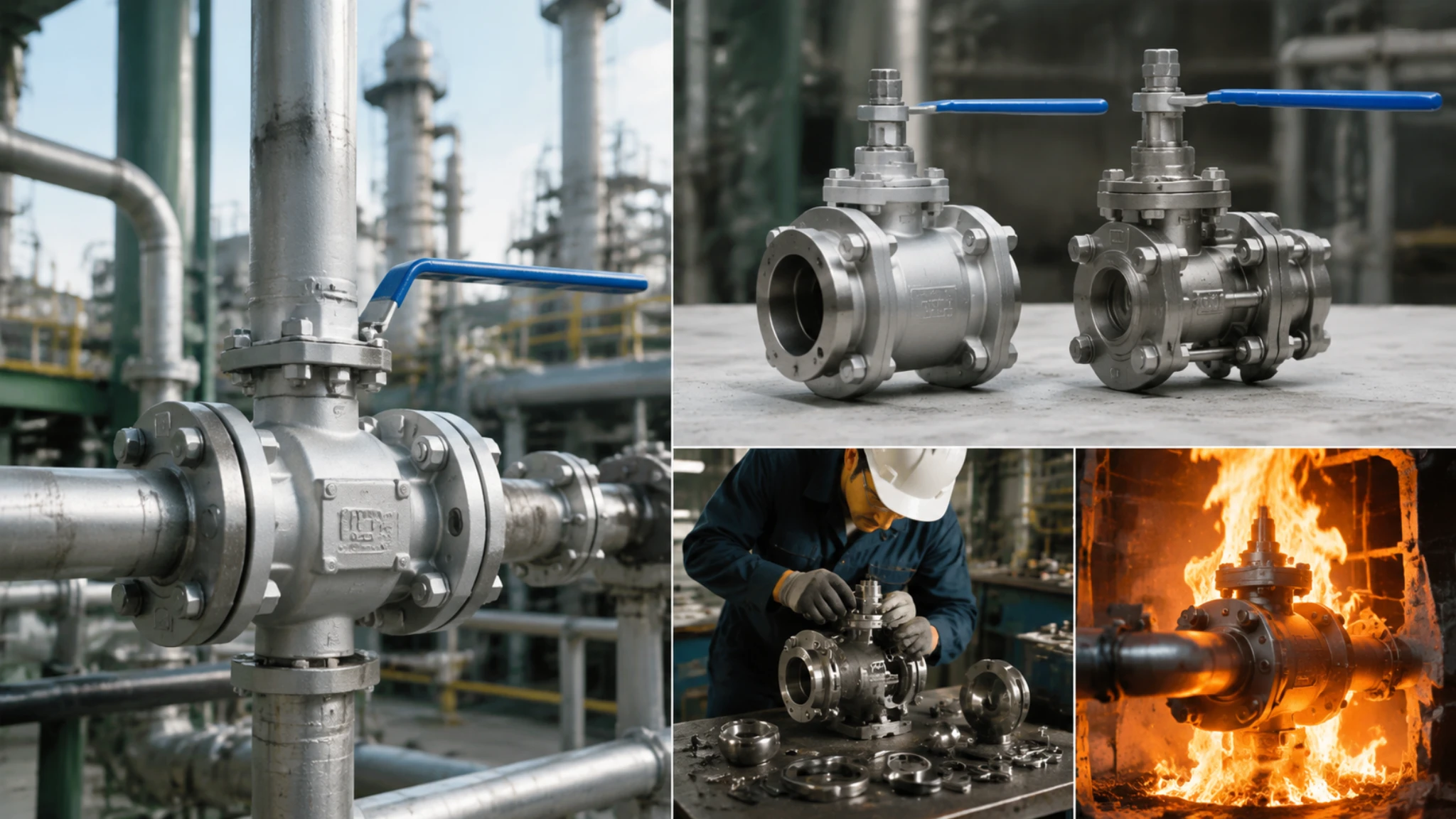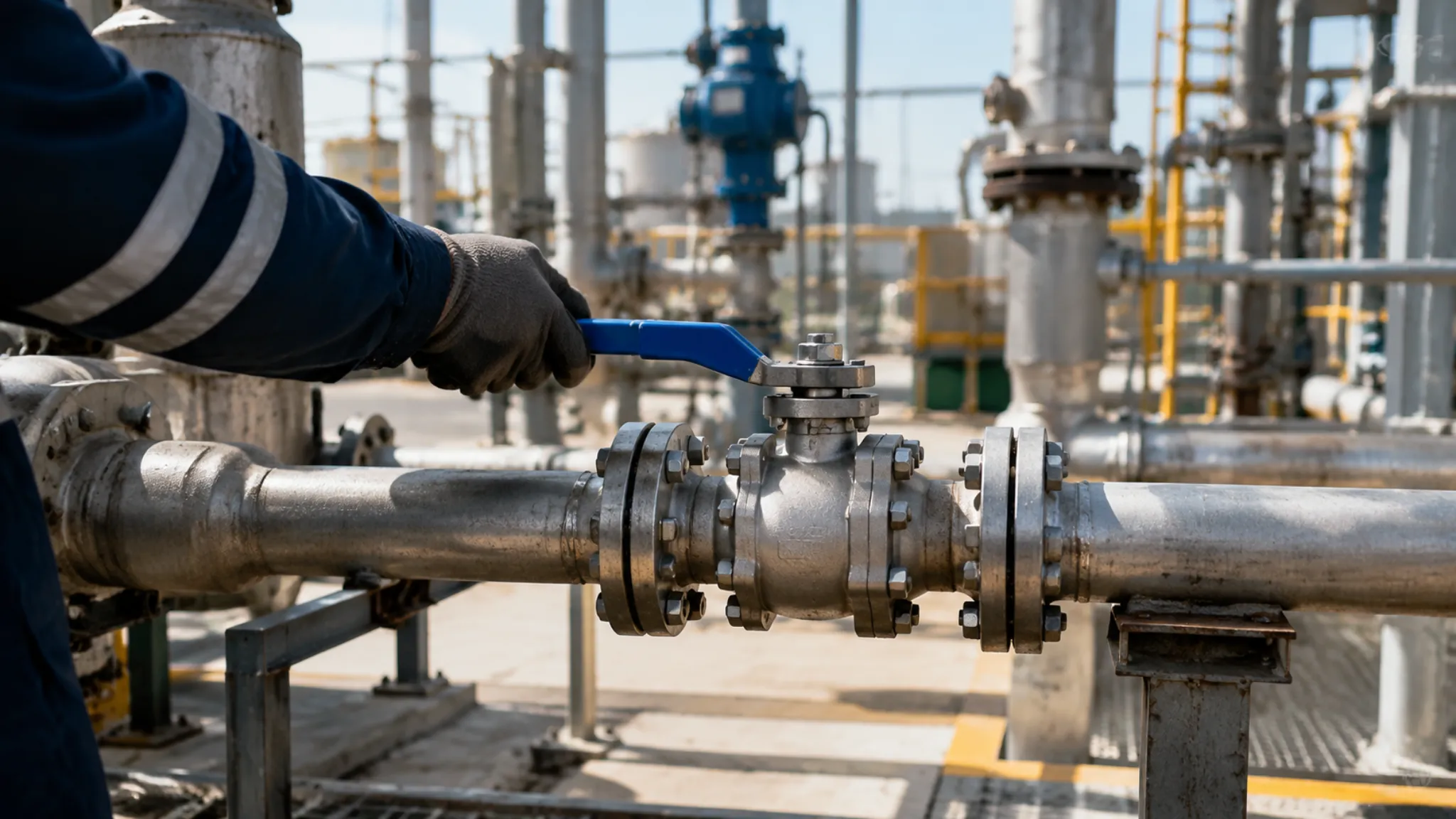
LNG (Liquefied Natural Gas) service imposes stringent low‑temperature requirements on valves: a storage temperature of −162 °C, with instantaneous minimums as low as −196 °C (cargo tank cooling process temperature).
The core selection criteria are threefold:
- The valve body material must maintain sufficient toughness at cryogenic temperatures.
- An extended bonnet design must ensure the stuffing box remains ice‑free.
- The seat seal [1] must retain its preload under cold shrinkage conditions.
Compliance with BS 6364 [2] or ISO 21011 [3] cryogenic testing standards, together with material certificates in accordance with EN 10204 3.1/3.2, represents the basic delivery threshold for LNG ball valves.
LNG Service Characteristics
What Does −196 °C Actually Mean?
LNG is stored at −162 °C, while the cooling process used in LNG cargo tank construction requires an even lower temperature of approximately −196 °C. This temperature is nearly four times lower than the average Antarctic winter temperature (≈ −50 °C) and about eleven times lower than a domestic freezer (≈ −18 °C).
At this temperature, the toughness of conventional carbon steel drops dramatically. Charpy[4] V‑notch impact tests show that the absorbed energy of carbon steel at −162 °C may be only 10–15 % of its room‑temperature value.
This is the fundamental reason why special materials are mandatory for LNG service.
Methane has a boiling point of −161.5 °C (at atmospheric pressure); the actual LNG service temperature is typically maintained below this value to ensure the fuel remains in liquid form. Should a leak occur, liquid methane at −162 °C will rapidly vaporize, expanding approximately 600 × in volume and forming a highly flammable gas cloud. Valve design must prevent any form of cryogenic leakage.
To put −196 °C into everyday context:
- Liquid nitrogen boils at ≈ −196 °C
- Liquid oxygen at −183 °C
- Liquid argon at −186 °C
LNG cargo tanks are cooled to −162 °C using a refrigerant cascade technique — pre‑cooling with liquid nitrogen before gradually reaching the target temperature.
From a thermodynamic perspective, at −196 °C the average kinetic energy of gas molecules drops to about one‑quarter of its room‑temperature value (77 K vs. 293 K on the absolute scale). This reduction in molecular motion increases gas density and simultaneously causes the lattice parameters of all metallic materials to contract.
The linear expansion coefficient of steel is approximately 12 × 10⁻⁶ /°C. From +20 °C to −196 °C, each metre of steel shortens by about 2.6 mm. This shrinkage may appear small, but on the sealing surfaces of a valve it can create a gap of 0.1–0.3 mm between a precisely mated seat and ball — sufficient to cause static seal failure under cryogenic conditions. Design calculations must account for and compensate this thermal contraction.
Risk of Cold Brittle Failure
Cold brittle failure is the phenomenon in which a metal transitions from ductile to brittle behaviour as temperature decreases. The transition temperature is known as the ductile‑brittle transition temperature (DBTT), and each material exhibits its own characteristic curve.
- The DBTT of carbon steel (e.g. WCB) lies in the range of 0 °C to −20 °C; at LNG temperatures it is fully within the brittle zone.
- Brittle fracture is characterised by negligible plastic deformation, a crystalline fracture appearance, and crack propagation speeds that can reach 40 % of the speed of sound — with almost no warning.
ASTM A352[5] specifies material requirements for cast steels for pressure‑containing parts at low temperatures:
- LCB (Low Carbon Steel Cast, Grade B) can be used down to −46 °C
- LC2 down to −73 °C
- LC3 down to −101 °C
Below these temperature limits, austenitic stainless steels (e.g. 304L, 316L) or aluminium alloys must be used.
We personally witnessed a typical cold‑brittle failure at a receiving terminal: a cryogenic ball valve with a WCB body developed a body crack approximately 72 hours after first liquid entry. Investigation revealed that residual moisture from the factory hydrostatic test had not been thoroughly dried; micro‑ice formation through the wall thickness created a stress concentration under −162 °C conditions, ultimately leading to crack propagation in the heat‑affected zone (HAZ) of a weld.
This case illustrates that cold‑brittle risk involves not only material selection but also manufacturing process control.
ASTM A352[5] LCB‑grade material must undergo Charpy[4] impact testing at −46 °C before shipment, with a CVN[4] (Charpy V‑Notch) absorbed energy of not less than 27 J (average) and 20 J (single value). During site acceptance, the material batch heat‑treatment report and impact test certificate should be verified.
Thermal Shrinkage Affects Sealing
The thermal contraction of metallic materials cannot be ignored under LNG service. The linear expansion coefficient of common valve materials is about 12–16 × 10⁻⁶ /°C. Taking 304 stainless steel as an example, from +20 °C to −196 °C, the axial shrinkage of a DN100 valve body is approximately 0.35 mm, and the radial shrinkage about 0.28 mm.
The seat of a ball valve is typically made of PTFE[6] or PTFE V‑ring seals, whose linear expansion coefficient is about 170 × 10⁻⁶ /°C — more than ten times that of stainless steel. As temperature drops, PTFE shrinks far more than the metal body, causing the preload between seat and ball to decrease.
Cryogenic ball valves must employ a “cold preload” technique — the seat preload at room temperature is set higher than required for ambient service, to compensate for the preload loss caused by PTFE shrinkage. Typically, at −196 °C the seat preload should be no less than 60–70 % of the room‑temperature value.
In one project, a cryogenic ball valve developed minor internal leakage after commissioning. Inspection revealed a 0.15–0.20 mm gap on the seat seal[1] face. The conclusion: the body shrinkage was within design calculations, but the material of the seat backup ring was improperly chosen — a glass‑fibre‑reinforced PTFE whose shrinkage characteristics differed significantly from those of pure PTFE, causing a larger‑than‑expected overall seat displacement.
This case demonstrates that thermal‑contraction compensation must consider the expansion‑coefficient matching of all related components — not just the seat material itself. The cryogenic shrinkage of backup rings, stem packing, and connecting bolts must all be included in the overall seal‑interface gap budget.
The extended bonnet design not only isolates the stuffing box from the cryogenic medium, but also — through metallic heat conduction along the bonnet neck — maintains a relatively higher temperature (typically above 0 °C) in the packing area, preventing grease solidification and preserving stem seal integrity.
Valve Design Requirements
How Long Should the Extended Bonnet Be?
Neither API 6D nor ISO 14313 specifies the exact length of an extended bonnet, but BS 6364[2] (cryogenic valve standard) and ASME B16.34 (pressure–temperature ratings for flanged valves) provide design guidance.
Design principle: the temperature in the packing area must never fall below the solidification point of the lubricant (typically around −10 °C to −30 °C) under any operating condition.
Empirical formula: bonnet extension length L (mm) ≈ (DN size) × (1.5 to 2.5).
- For a DN50 valve the extension is about 75–125 mm
- For DN200, about 300–500 mm
Exact values must be determined by heat‑transfer calculations based on design temperature, bonnet material, and insulation conditions.
We performed field temperature measurements (thermocouples placed on the outer wall of the stuffing box) on 14 cryogenic ball valves of different sizes at an LNG receiving terminal. The results showed that the bonnet lengths calculated by the engineering contractor were conservative: the measured packing‑area temperatures were 8–15 °C higher than calculated. Analysis indicated that axial heat conduction along the bonnet neck and the natural‑convection coefficient of the air gap (≈ 2–5 W/m²·K) were lower than assumed, giving a higher actual thermal resistance than predicted.
Based on this experience, we recommend applying a +20 % safety factor to the bonnet length during design.
API 622‑type valves (ball valves for cryogenic service and cryogenic testing) include an extended bonnet as standard, with a typical extension of 2× the DN size — a configuration validated by numerous LNG projects.
Which Valve Body Material to Choose?
Material selection for LNG valve bodies is governed by three factors: low‑temperature toughness, compatibility (no reaction with LNG/methane), and weldability.
Austenitic stainless steel
This is the most widely used body material for LNG valves, with 304L and 316L being the most common grades. 304L has a minimum service temperature of about −196 °C (liquid nitrogen temperature) and provides ample toughness at LNG conditions (−162 °C), with CVN[4] impact values typically exceeding 100 J at −196 °C.
CF‑series (Cast Ferritic) austenitic stainless steels — such as CF8M[5] (equivalent to 316) — have a reduced carbon content (≤ 0.03 %) to prevent intergranular corrosion, and contain 2–3 % molybdenum to improve pitting resistance. Cast austenitic stainless steel bodies can be used down to −269 °C (near liquid‑helium temperature), making them suitable for ultra‑cryogenic service.
ASTM A351[5] defines the commonly used cast austenitic stainless steel grades for LNG valve bodies:
| Grade | Equivalent Wrought | Minimum Temperature |
|---|---|---|
| CF8 | 304 | −196 °C |
| CF8M | 316 (with Mo) | −196 °C |
| CF3 | 304L | −196 °C |
| CF3M | 316L | −196 °C |
Among these, CF3M[5] is the most widely used body material for LNG ball valves.
Selection note: ASTM A351[5] prescribes a relatively wide chemical‑composition range. CF3M from different manufacturers may vary in impurity content (sulphur, phosphorus) and heat‑treatment condition, which directly affects low‑temperature impact toughness. We recommend that the procurement specification explicitly require low‑temperature impact testing to ASTM A352[5] and the provision of CVN[4] test data at −196 °C (average absorbed energy ≥ 40 J, single value ≥ 30 J).
Duplex stainless steel
Duplex stainless steel (e.g. 2205, UNS S31803) is also used in LNG service; its yield strength (≈ 450 MPa) is higher than that of austenitic stainless steel (≈ 190 MPa), allowing reduced body wall thickness. However, its low‑temperature toughness (≈ −46 °C) is lower than that of CF3M[5], making it unsuitable for the main LNG process piping at −162 °C.
Seal Materials for Low‑Temperature Resistance
Seal materials face three main challenges at LNG temperatures: low‑temperature embrittlement, thermal contraction, and solubility in LNG.
PTFE (Polytetrafluoroethylene)
- PTFE is the most widely used sealing material for LNG valves. Its glass‑transition temperature (Tg) is approximately −120 °C.
- At −162 °C, PTFE transitions from a flexible to a glassy state, with a hardness increase of about 30 %, but it does not undergo brittle fracture and retains some elasticity.
- The linear expansion coefficient of PTFE is about 170 × 10⁻⁶ /°C; at −196 °C its volume shrinks by approximately 5–6 %.
- For ball valve seats, a PTFE V‑ring structure (multi‑ring assembly) is typically used, where multiple sealing lips provide compensation capability.
Besides PTFE, flexible graphite (e.g. Grafoil) is also used in LNG valve sealing. Flexible graphite has a minimum service temperature as low as −270 °C (near absolute zero) and does not embrittle at low temperatures, but its self‑lubricating property is inferior to PTFE; it is mainly used for stem packing and bonnet gaskets.
In seat seal[1] applications, PTFE composites — such as glass‑fibre‑filled PTFE or carbon‑fibre‑filled PTFE — offer better cold‑flow resistance and higher compressive strength than pure PTFE. With 5 % glass‑fibre filling, the compressive strength increases by about 40 % while maintaining the low‑friction characteristics of PTFE.
NACE MR0175/ISO 15156 imposes restrictions on elastomeric seals in sour‑oil/gas service. In LNG service, most EPDM and FKM O‑rings are unsuitable because their glass‑transition temperatures are not low enough (typically −40 °C to −55 °C). PTFE is the proven standard choice.
Testing Standards
BS 6364 or ISO?
The two most important international standards for LNG cryogenic valves are BS 6364[2] (Specification for Cryogenic Valves) and ISO 21011[3] (Valves for Cryogenic Service). Their scope and technical requirements differ significantly.
| Standard | Scope | Core Requirements |
|---|---|---|
| BS 6364:2021 | Dedicated cryogenic valve standard for LNG plants, receiving terminals, and carriers | Valve body materials must undergo low‑temperature impact testing at −196 °C (Head Test); seat seal must be subjected to a differential‑pressure test at −196 °C using liquid nitrogen or liquid argon. |
| ISO 21011:2021 | Product standard for cryogenic valves over a broad temperature range from −50 °C to −269 °C | Cryogenic test methods broadly consistent with BS 6364, but slight differences in material qualification requirements. |
How to choose between standards in a project? Based on our experience:
- If the project specification is led by a European engineering company (e.g. Shell, Total, BP), compliance with both BS 6364 and the owner’s supplementary specification (Nitrogen Cold Box Specification) is typically required.
- If led by an American company, MSS SP‑134 (Low Temperature Valves) or API 6DSS (Subsea Valves, with cryogenic supplementary requirements) may be referenced.
Notably, BS 6364:2021 added a helium leak detection requirement for the stem stuffing box (leak rate ≤ 1 × 10⁻⁶ mbar·L/s) and introduced ISO 15848‑1 (industrial valve fugitive‑emission testing) as an optional verification method. For LNG receiving terminal projects, we recommend satisfying both BS 6364 and ISO 15848‑1 Class B fugitive‑emission requirements to meet both safety and environmental regulations.
How Is the Cryogenic Test Performed?
The cryogenic test procedure defined in BS 6364 is the core validation that every LNG valve must undergo before shipment. The test covers the body, bonnet, seat, and stem seal, and the test medium is typically liquid nitrogen (−196 °C) or liquid argon (−186 °C).
- Cool down: the valve is fully immersed in a cooling bath and slowly cooled to the target temperature (−196 °C), then held for no less than 30 minutes to ensure uniform temperature throughout all internal parts.
- Seat test: while at cryogenic temperature, the seat is pressurised with nitrogen or helium at 1.1 × the design pressure and held for 15 minutes. The differential pressure across the seat is measured, and the leak rate must satisfy BS 6364 Table 3 (typically ≤ 10⁻⁵ mbar·L/s).
- Stem seal test: performed after the seat test, using a lower pressure (usually 1.1 × design pressure) to check for fugitive leakage at the stem area.
A common issue during cryogenic testing is thermal‑shock cracking — when a valve is rapidly cooled from room temperature (+20 °C) to −196 °C, if the cooling rate exceeds 50 °C/min, thermal stress cracks can develop in welds and thick‑wall sections. BS 6364 therefore requires a cooling rate of no more than 10 °C/min, and further slowing to 5 °C/min once the temperature falls below −50 °C.
During witnessed testing at a manufacturer’s facility, we observed micro‑cracks on the seat seal[1] surface of a batch of valves after liquid nitrogen immersion. Investigation concluded that the manufacturer had compressed the cooling time from the required 60 minutes to 25 minutes, resulting in an excessive cooling rate. The remedial action was to re‑heat‑treat (stress‑relief annealing) the entire batch and then repeat the cryogenic test.
Test equipment: we recommend requiring the witnessing party to provide temperature calibration certificates (valid within 6 months) and pressure sensor calibration records. The entire test should be video‑recorded, and the manufacturer must issue a Cryogenic Test Certificate in accordance with BS 6364 Appendix C format.
Required Shipping Documentation
For LNG cryogenic ball valves, the documentation that the buyer should receive at shipment — the BIR (Buyer’s Inspection Record) — is a core component of the project completion dossier and directly affects post‑installation compliance acceptance and operational maintenance.
Mandatory documents include:
- Material certificates (to EN 10204 3.1 or 3.2, including chemical composition and mechanical properties)
- Low‑temperature impact test report (ASTM A352[5], CVN[4] data at −196 °C)
- Heat‑treatment records (normalising + tempering, or solution‑treatment temperature curves from the furnace)
- Welding Procedure Specification (WPS) and welder qualification certificates
- Non‑destructive examination reports (MT/PT/UT/RT, as per the design specification)
- Cryogenic test certificate (to BS 6364[2] or ISO 21011[3])
Special attention should be paid to the difference between EN 10204 3.1 and 3.2 certificates: a 3.1 certificate is issued by the manufacturer’s own quality department based on contract requirements and batch sampling; a 3.2 certificate requires the witnessing and signature of the buyer’s representative or a third‑party inspection body (e.g. TÜV, SGS, Bureau Veritas). In LNG projects, the owner’s specification typically mandates 3.2 material certificates.
The 3.2 certificate for the body material should include:
- The correlation between the casting batch number and the melting furnace heat number
- The heat‑treatment furnace number and temperature hold times
- The sampling location for the low‑temperature impact test (CVN[4] — to be taken from the main wall thickness of the body as required by ASTM A352[5])
- A full‑element chemical analysis (measured values for C, Mn, P, S, Si, Cr, Ni, Mo, etc., compared against the standard limits)