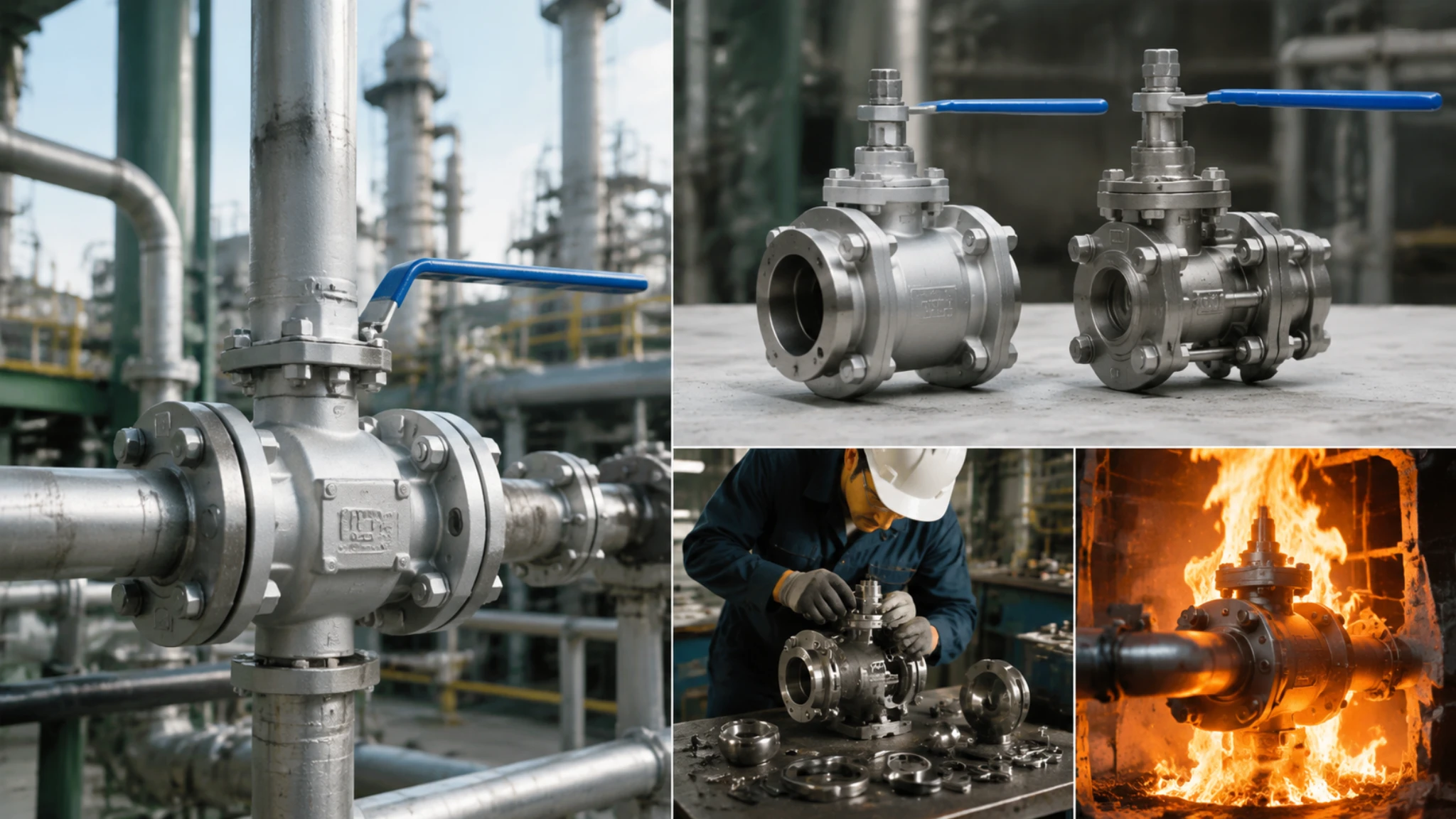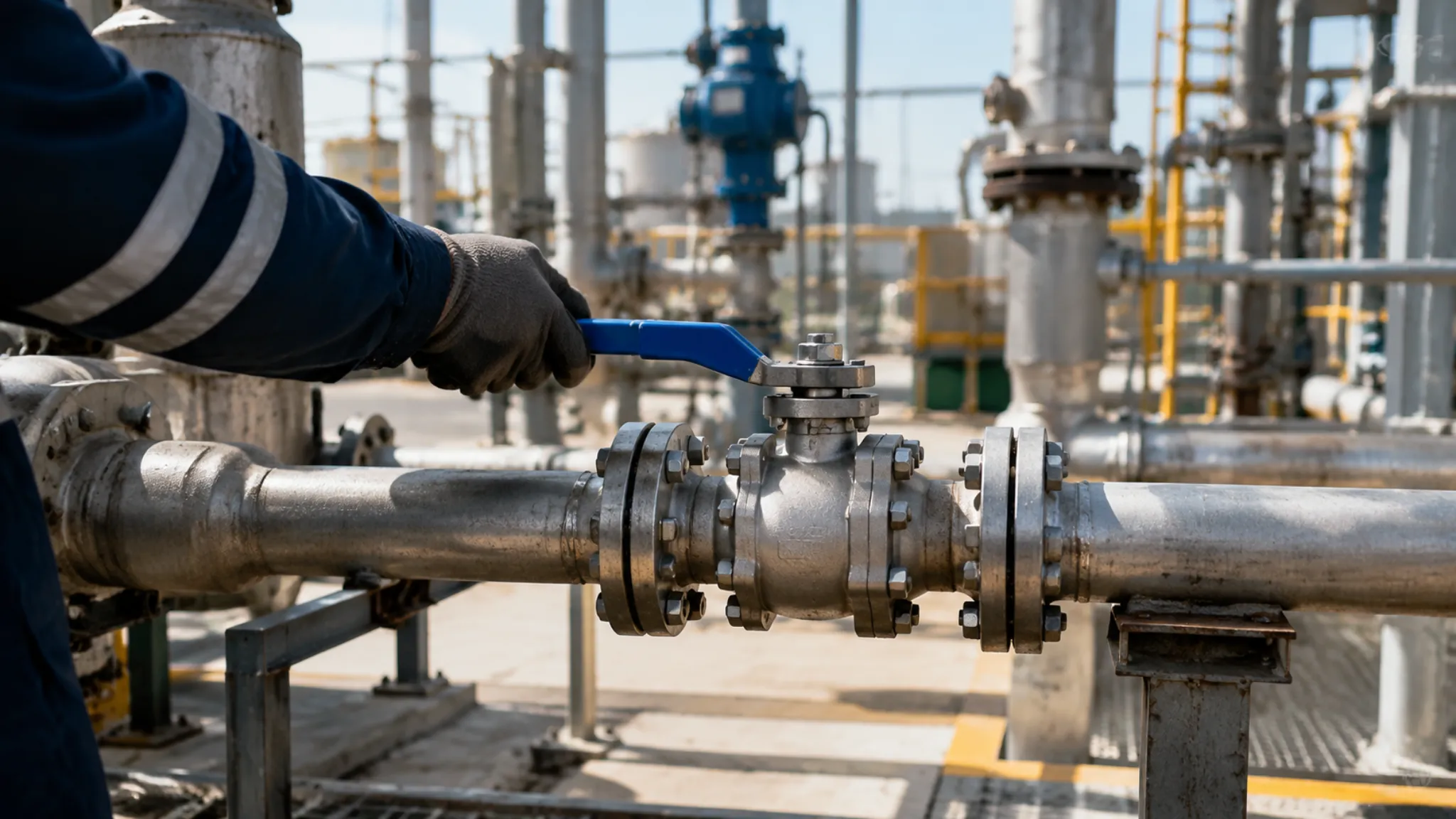
Valve material selection for chemical plant pipelines requires matching corrosion mechanisms with appropriate alloys. The survival of a material depends on acid type, concentration, temperature, and chloride content.
Common Corrosive Media
What Materials Handle Sulfuric Acid
Corrosion engineers frequently encounter the ‘concentration reversal’ phenomenon in sulfuric acid service. What works at low concentration can fail at high concentration, and vice versa.
The H₂SO₄ reducing/oxidizing curve divides the concentration‑temperature map into two zones.
- Below approximately 62% concentration, H₂SO₄ behaves as a reducing acid — stainless steel and carbon steel both corrode at rates dependent on temperature and alloy content.
- Above approximately 62%, H₂SO₄ becomes oxidizing. Carbon steel passivates, dramatically reducing its corrosion rate.
A sulfuric acid transfer line at a refinery operated for over 15 years with carbon steel pipe in 95% H₂SO₄ at 60°C. The same design would fail catastrophically in 20% H₂SO₄ at the same temperature within 2 years.
The relevant standard for H₂SO₄ material selection is ASME B16.34 Appendix F, which provides reference corrosion rate data across the H₂SO₄ concentration spectrum. Always locate your operating concentration on the iso‑corrosion chart before selecting materials.
Sulfuric acid is the most common corrosive medium in chemical plant pipelines. Yet concentration and temperature shifts can completely reverse the material selection verdict.
- For H₂SO₄ below 10% concentration, austenitic stainless steels such as 304 perform acceptably below 40°C — but above that threshold, 304 develops pitting corrosion.
- At concentrations above 50%, sulfuric acid becomes strongly oxidizing. Carbon steel paradoxically forms a protective FeSO₄ film, reducing corrosion rates to below 0.1 mm/year.
In a Xinjiang potassium sulfate plant, the design institute specified 316L for 70% sulfuric acid at 80°C, assuming ‘stainless steel is safer’. Three years later, the valve body wall thickness was below minimum required after 316L corroded at 1.2 mm/year, while WCB carbon steel would have corroded at only 0.05 mm/year under identical conditions.
| Concentration | Temperature | Material | Corrosion Rate (mm/year) |
|---|---|---|---|
| 10%–60% | above 60°C | 316L or above | varies |
| above 50% | above 80°C | carbon steel or ductile iron | < 0.1 |
PTFE soft seals are unsuitable for high‑temperature sulfuric acid — at 50°C with 65% H₂SO₄, PTFE seats become brittle within 6 months.
The four critical variables for sulfuric acid valve selection are concentration, temperature, flow velocity, and oxygen content. Intermittent operation creates low‑point accumulations of dilute acid. This caused a 304 butterfly valve to perforate after 2 years in a nitric acid/phosphate fertilizer plant. Adding an automatic spray cleaning system at dead‑legs solved the problem.
Key field data:
- 20% dilute sulfuric acid at 50°C: 316L corrosion rate approximately 0.3–0.5 mm/year
- 70% sulfuric acid at 80°C: WCB carbon steel rate approximately 0.05 mm/year; 316L reaches 1.2 mm/year
This reversal — carbon steel outperforming stainless steel at high concentration — is counterintuitive but validated by corrosion handbooks and plant operating records.
For H₂SO₄ above 85%, carbon steel is the only economical choice. Even Hastelloy C‑276 offers no advantage over carbon steel at high concentration and temperature.
Special Requirements for Hydrochloric Acid and HF
In hydrochloric acid service, trace levels of oxidizing agents — nitric acid, ferric chloride (FeCl₃), or dissolved oxygen — dramatically change the corrosion electrochemistry.
A chemical plant producing phosphoric acid via the wet process extracted HCl from rock digestion effluent. Trace Fe³⁺ ions from phosphate rock accelerated 316L corrosion by approximately 5x compared to reagent‑grade HCl of equivalent concentration and temperature.
Always request a full media analysis from the process licensor, including trace metal ion content and dissolved gases, before finalizing material selection for HCl service.
HF service adds another layer of complexity: HF is both a poison and a reactant in many analytical methods, making media purity analysis difficult. A common field problem is HF containing trace silica (SiO₂) from the production process. Even 10–20 ppm SiO₂ in HF significantly changes its reactivity with silicon‑containing alloys, invalidating laboratory corrosion test data obtained with high‑purity HF reagents.
Hydrochloric acid (HCl) and hydrofluoric acid (HF) are the two most demanding corrosive media in chemical plant service. HF requires completely different selection logic.
- For HCl, 316L is marginally acceptable below 20% concentration at room temperature, with corrosion rates of 0.1–0.3 mm/year. But above 60°C, even 5% HCl causes general corrosion on 316L.
- A fluorosalt production line using 316L valves for 15% HCl at 50°C perforated within 6 months. Hastelloy C‑276 has operated without issue ever since, though it costs 8–15 times more than 316L.
HF acid dissolves protective fluoride films on metal surfaces, making even noble metals vulnerable. PTFE or PVDF‑lined valves are required for ambient temperature, low‑concentration HF (below 10%). But lining integrity is critical: a semiconductor‑grade chemical factory found PTFE‑lined ball valves delaminating from the valve body after 8 months in 20°C, 40% HF service. Only all‑metal PFA/PVDF diaphragm valves have provided stable service in this application.
Material selection for HCl and HF is not a single‑variable problem. Temperature is the decisive factor in HCl service — for every 20°C increase in temperature, 316L’s corrosion rate in HCl approximately doubles.
In HF service, material purity of the acid becomes critical: trace SiO₂ impurities in hydrochloric acid react violently with magnesium‑bearing alloys. HF also penetrates skin and binds with bone calcium, causing systemic toxicity — valve failure in HF service directly threatens personnel safety, not just plant operation.
- Monel 400 (67% Ni‑Cu alloy) offers the best cost‑performance ratio for low‑concentration HF. It has operated safely for over 6 years in a fluorite flotation plant handling 15% HF at 50°C.
- For HF above 60% concentration or above 80°C, only platinum or tantalum can cope.
- Graphite‑impregnated PTFE or all‑metal packings are mandatory in HF service. A fluoroaluminum plant suffered HF leakage through asbestos gland packing after 6 months, nearly causing a serious personnel injury.
Material Selection Principles for Alkaline Solutions
Beyond SCC, caustic solutions present a crystallized salt accumulation problem. Sodium carbonate (Na₂CO₃), the reaction product of NaOH with atmospheric CO₂, has a retrograde solubility curve — its solubility decreases as temperature increases. In a hot caustic pipeline that cools during shutdown, Na₂CO₃ crystallizes and deposits on internal valve surfaces.
If the valve body contains dead legs or areas of low flow velocity, these become preferential deposition sites. A major pulp and paper mill experienced repeated control valve failures in their black liquor concentrator circuit. Each failure showed Na₂CO₃ scale 3–5 mm thick on the valve internals, originating from a dead leg created by the original piping design.
Process engineers and piping designers should jointly review caustic service valve locations for potential dead leg creation before issuing final piping layouts.
All caustic service valves should be installed with the stem horizontal or pointing downward to facilitate drainage and minimize dead water zones where crystallization can initiate.
Caustic solutions (NaOH, KOH) present fewer corrosion challenges than acids, but critical pitfalls remain.
- Carbon steel performs well in NaOH below 30% concentration and 60°C, with corrosion rates controlled below 0.05 mm/year — making it the most economical choice.
- However, above 50% concentration and 110°C, carbon steel faces sharply increasing stress corrosion cracking (SCC) risk.
- A WCB gate valve in a caustic soda evaporator outlet cracked along the weld heat‑affected zone after 3 years — the classic alkali embrittlement pattern. Switching to 316L solved the problem.
Austenitic stainless steels (304/316) generally outperform carbon steel in caustic service, but have a ‘danger zone’: 10%–45% concentration and 60°C–100°C, where intergranular corrosion and SCC are possible. A 30% NaOH, 80°C service 304 valve cracked after 18 months, with cracks propagating along grain boundaries — chlorine ions from industrial caustic impurities accelerated the SCC.
The three‑parameter confirmation table for caustic material selection:
| Parameter | Condition | Action |
|---|---|---|
| NaOH concentration | below 30% | 316L is safe when all three are met |
| Temperature | below 60°C | |
| Cl⁻ content | below 50 ppm |
Exceeding any one parameter requires re‑evaluation.
High‑temperature concentrated caustic (above 45%, above 120°C) requires nickel‑based alloys or pure nickel. A coal gasification plant’s slag water valve initially specified 316L, cracked from SCC within 8 months — switching to Inconel 600 has provided 4 years of trouble‑free operation since.
NaOH reacts with iron to form Na₂CO₃ scale in the form of sodium carbonate crystals. These crystals accumulate in dead legs and valve internals, causing disc sticking or seat face damage. A major soda ash producer experienced a production shutdown when a control valve in the carbonation tower bottom became completely stuck due to Na₂CO₃ crystal accumulation, requiring emergency replacement before production could resume.
Material Comparison
Is 316 Stainless Steel Enough
316L’s perceived adequacy often stems from familiarity rather than rigorous analysis. SCC in 316L occurs in two distinct environments:
- Chloride‑bearing solutions (above 60°C, Cl⁻ > 50 ppm)
- Alkaline solutions (above approximately 80°C, NaOH > 10%)
Both failure modes are cracks that initiate at weld heat‑affected zones and propagate under tensile stress. They are often invisible during routine inspection because they do not cause visible wall thinning.
API 598 valve leak testing would detect a through‑wall crack in the pressure boundary but not a disc crack that has not yet penetrated. The most reliable detection method for SCC in 316L valves is liquid penetrant inspection (LPI) on all weld areas, performed during planned shutdowns.
A refinery crude unit overhead condenser outlet valve showed normal API 598 seat leakage test results, but LPI revealed three longitudinal cracks in the weld HAZ of the disc — the valve was replaced before it could fail in service.
For 316L valves in SCC‑prone environments, include LPI inspection in the maintenance procedure, not just leak testing.
316L stainless steel is the most common valve body material in chemical plants. Yet ‘is it enough’ depends entirely on specific operating parameters — not on 316L itself.
- The molybdenum content (2%–3%) in 316L provides effective resistance to chloride‑induced pitting and crevice corrosion, but contributes little in reducing‑acid environments such as sulfuric acid and hydrochloric acid.
- In seawater or chloride‑bearing process fluids, 316L’s pitting potential is approximately 200 mV higher than 304 due to molybdenum. But in hydrochloric acid, 316L and 304 show virtually identical corrosion resistance.
A common failure scenario: trace HCl (below 1%) process gas pipeline at 120°C and 1.0 MPa, designed with a 316L ball valve, failed within 1 year due to seat corrosion. At 120°C, 316L exceeds its service temperature limit in chloride‑bearing media (generally accepted as below 100°C). If temperature could be reduced to 90°C, 316L becomes viable; above 120°C, upgrade to 904L or 254 SMO (6% molybdenum, PREN approximately 43).
316L has three critical boundaries:
- Reducing acids where molybdenum provides no special benefit.
- Chloride stress corrosion cracking above 60°C and Cl⁻ above 50 ppm.
- High‑temperature alkaline service requiring confirmed heat treatment condition.
A coastal chemical plant’s 316L butterfly valve in cooling water outlet cracked along the stem after two summer seasons — the classic Cl⁻ SCC failure mode. The solution was upgrading stem material to F51 duplex stainless steel, which has operated normally since. In NaOH service, 316L’s safe temperature limits are approximately 60°C (30% concentration) and 80°C (10% concentration) — above these, Nickel 201 or Inconel 600 must be considered. A paper mill 316L control valve in 100°C, 12% NaOH cracked after 14 months, with transgranular SCC morphology confirmed by failure analysis.
Where Duplex Steel Is Used
The PREN (Pitting Resistance Equivalent Number) calculation deserves closer examination because not all PREN formulas are equivalent. The formula PREN = %Cr + 3.3×%Mo + 16×%N systematically undervalues nitrogen contribution in modern high‑nitrogen duplex grades. The newer PRENw (nitrogen term coefficient 30 instead of 16) was developed for super‑duplex and super‑austenitic grades with nitrogen above 0.2%.
For 254 SMO (approximately 0.2% N), PRENw approximately 43, so the difference is minimal — but for next‑generation super‑duplex grades with 0.3% N, the difference becomes significant. Valve engineers specifying materials for seawater desalination should request PRENw calculations from the material supplier. Phase balance in duplex stainless steel also affects mechanical properties: over‑ferritic duplex (ferrite above 50%) reduces impact toughness at low temperatures, relevant for cryogenic service. The optimal ferrite range for valve body forgings is 35%–45%, confirmed by ASTM E562 point count or ASTM A923 Method B.
Duplex stainless steel (Duplex SS, typically 2205/F51) occupies the middle ground between austenitic and ferritic stainless steels — higher strength and better Cl⁻ SCC resistance than austenitic grades, with better toughness than ferritic grades. The most typical duplex valve applications in chemical plants are chloride‑bearing media pipelines and high‑temperature alkaline service.
Type 2205 (00Cr22Ni5Mo3N) shows significant advantages over 316L above 60°C with Cl⁻ above 200 ppm — yield strength approximately 30% higher and thermal expansion coefficient approximately 30% lower.
A salt MDI production brine pipeline at 75°C with 8,000 ppm Cl⁻ has operated for 4 years with zero pitting or SCC on F51 duplex steel valves — 316L would typically fail within 18 months under identical conditions.
Duplex steel also has a strong advantage in wet H₂S environments per NACE MR0175/ISO 15156‑3. A delayed coker fractionator bottom pump outlet valve initially specified 316L failed from hydrogen‑induced cracking after 2 years in 1,500 ppm H₂S, 200 ppm Cl⁻ service; switching to 2205 resolved the issue. Duplex steel is not suitable above approximately 280°C, where phase changes cause embrittlement — nickel‑based alloys are required above 300°C.
The core value of duplex stainless steel in chemical valve selection is captured in two keywords: chloride corrosion resistance and high‑strength weight reduction. PREN (%Cr + 3.3×%Mo + 16×%N) is the pitting resistance metric:
| Material | PREN |
|---|---|
| 316L | ~24 |
| 2205 | ~34 |
| 254 SMO | ~43 |
High strength enables wall thickness reduction of approximately 25% compared to 316L at equal pressure rating, reducing procurement cost by approximately 15%–20% on large bore valves above DN200. A coal chemical plant circulating water station showed 2205 gate valves cost 18% less than equivalent 316L, primarily from reduced wall thickness.
A critical caution: not all ‘duplex’ materials on the market meet qualified phase ratios. Procurement specifications should require phase ratio test reports (ASTM E562[1] or GB/T 13305) with ferrite content between 25%–50%.
When Hastelloy Is Necessary
The decision to specify Hastelloy is fundamentally an economic one, not a technical maximum. There is almost always an alternative, but the alternative often fails faster and costs more over the full lifecycle.
A Total Cost of Ownership (TCO) model:
TCO = Initial Material Cost + (Replacement Cost × Number of Replacements over Design Life) + (Shutdown Cost per Replacement × Number of Replacements)
For severe HCl service, if 316L lasts 6 months, Hastelloy lasts 15 years, and each replacement requires a 3‑day unplanned shutdown, the TCO gap is often dramatic even before accounting for safety margins. A chlor‑alkali plant producing sodium chlorate found this calculation resolved the internal debate over whether to specify Hastelloy C‑276 for their HCl electrolytic cell outlet valves — the TCO analysis showed Hastelloy paid back its initial premium within the first replacement cycle.
Engineers asked to justify Hastelloy selection should prepare a TCO analysis — ‘it is the only material that will work’ invites challenge, while a well‑structured TCO calculation is unanswerable.
Hastelloy alloys (primarily C‑276, C‑22, 625) represent the ‘final resort’ in chemical valve material selection. Never the first choice because Hastelloy costs 8–15 times more than 316L and requires 3–6 months lead time. The definitive scenarios requiring Hastelloy are oxidizing mixed‑acid media and high‑temperature high‑concentration hydrochloric/sulfuric acid (above 60°C, above 20% concentration).
In an oxidizing acid recovery unit with 30% HNO₃ + 5% HCl at 75°C, 316L corroded at over 2 mm/year with severe pitting perforation risk — Hastelloy C‑276 in the same service corroded at only 0.02 mm/year, a 100‑fold difference. The life‑cycle cost premium is fully justified in severe corrosive service.
Hastelloy is not a universal solution — it fails in boiling concentrated caustic (above 50% NaOH, above 120°C) and shows limited resistance in fluoride‑bearing media (HF acid).
Hastelloy also requires strict welding protection procedures, otherwise the heat‑affected zone develops intergranular corrosion.
The three‑step confirmation before specifying Hastelloy:
- Do operating parameters exceed 316L/904L safe limits?
- Is temperature within Hastelloy’s safe service window (most Hastelloy C‑276 performs best below 65°C)?
- Does the life‑cycle cost comparison support the upgrade?
A titanium dioxide chloride process HCl recovery pipeline at 130°C and 32% HCl uses Hastelloy C‑276 ball valves — designed conditions made alternatives unacceptable within 3 months. Mixed oxidizing acids (20% HNO₃ + 3% HCl + 1% HF at 90°C) caused us to strongly recommend upgrading from 316L to Hastelloy C‑276 — 316L would have perforated within 6 months.
Hastelloy valves must be isolated from direct carbon steel contact with non‑metallic gaskets — a Hastelloy ball valve connected directly to a carbon steel flange developed a galvanic corrosion groove within 6 months and required complete replacement.
Sealing Material Selection
What Conditions Suit PTFE
PTFE’s performance in chemical service follows a well‑documented degradation mechanism. At elevated temperatures, PTFE undergoes radiation‑induced crosslinking when exposed to gamma radiation or high‑energy particles, progressively reducing molecular weight and causing embrittlement.
In steam service, PTFE service life is not infinite even below 200°C. Thermal oxidation and mechanical stress from thermal cycling cause chain scission in PTFE’s crystallite regions. Manufacturers’ steam service ratings for PTFE typically specify a maximum cumulative steam exposure time, not just temperature and pressure — a valve rated for 200°C steam may be limited to approximately 8,000 hours of cumulative steam exposure before replacement is recommended.
In a pharmaceutical company’s pure steam sterilizer valve application, PTFE‑seated valves were replaced on a fixed schedule of every 18 months based on the manufacturer’s cumulative exposure data, regardless of visual inspection results. This proactive replacement prevented in‑service failures and associated production losses.
PTFE (polytetrafluoroethylene) is the most common soft sealing material in chemical valves. Yet ‘PTFE is universally applicable’ is extremely dangerous in engineering practice. PTFE has three inherent limitations:
- Temperature limit: PTFE’s continuous service temperature is approximately 260°C in theory, but in actual chemical service, PTFE seat recommendations typically do not exceed 200°C. Above 200°C, PTFE begins softening and creep, with seal performance dropping sharply.
- Permeability: At pressures above 1 MPa for hydrogen service, PTFE seat hydrogen permeability is approximately 10 times that of stainless steel bellows seals.
- Mechanical strength: Some organic solvents (aromatics, ketones) at high temperature swell PTFE and cause seat face delamination.
In an aromatics complex phenol fractionation unit at 185°C and 0.3 MPa, PTFE‑sealed ball valves failed within 3 months — disassembly revealed seat deformation from sustained high‑temperature cold flow.
PTFE performs best in three application categories:
- Concentrated sulfuric acid and nitric acid above 95% concentration at ambient temperature — PTFE has virtually no chemical attack and represents the first‑choice sealing material.
- Organic solvent and aromatic media below 150°C — PTFE provides excellent resistance to benzene, toluene, xylene, alcohols, and esters (but aromatic service above 150°C requires metal sealing or graphite‑filled PTFE).
- Food and pharmaceutical pure water systems — PTFE is non‑toxic and non‑contaminating. A vitamin API factory’s purified water distribution system exclusively uses PTFE‑sealed diaphragm valves — correct practice for pharmaceutical water service.
PTFE is best used as a lining or sealing ring rather than solid PTFE valves, which deform easily under pipeline stress. PTFE‑lined valves combine chemical resistance with the mechanical strength of a metal body.
PEEK Temperature Ratings
Beyond raw temperature and pressure ratings, PEEK seal performance in valve applications depends critically on the differential pressure across seating faces. PEEK’s compressive strength (approximately 150 MPa) is high compared to PTFE, but the actual stress on a valve seat face is the applied seating load divided by the contact area — in a ball valve, the annular ring of the seat seal.
At high differential pressures (above 2 MPa), seating stress can approach or exceed PEEK’s compressive yield strength, causing permanent deformation and loss of seating preload. A major oil refiner experienced repeated PEEK seat deformation failures in their hydrogen finishing unit make‑up hydrogen control valves at 1.8 MPa differential pressure — the seat geometry had been inherited from a previous PTFE‑seat design without recalculation of seating stress. Redesigning the seat geometry to increase the seating contact area eliminated the failures.
Do not assume that because PEEK’s temperature rating exceeds PTFE, the same seat geometry can be used — compressive stress must be verified independently.
PEEK (polyether ether ketone) has rapidly gained adoption in chemical valve applications as a high‑performance polymer with temperature capability far superior to PTFE. PEEK’s continuous service temperature reaches 260–300°C (short‑term tolerance up to 310°C).
- Mechanical strength approximately 6 times higher than PTFE (tensile strength ~100 MPa vs. PTFE ~15 MPa).
- Creep resistance approximately 100 times higher — PEEK seals deform minimally under high temperature and pressure.
- Chemical resistance: except for concentrated sulfuric and nitric acids, it resists virtually all common acids, alkalis, salts, and organic solvents.
In BTX aromatics service at 150–250°C, PEEK‑sealed metal ball valves have operated reliably for over 5 years. An ethylene cracker quench oil valve at 220°C — where PTFE‑sealed ball valves would typically fail within 18 months — has performed without issue.
PEEK also has excellent steam resistance — it withstands saturated steam at 150°C and 1.0 MPa, critical in pharmaceutical and food industries’ pure steam systems.
PEEK costs 5–8 times more than PTFE and requires injection molding, with longer lead times. Selection should weigh performance benefits against cost premium.
PEEK valve applications fundamentally solve the ‘PTFE boundary conditions exceeded’ problem. The two key parameters for upgrading from PTFE to PEEK:
- Does temperature exceed 200°C?
- Does pressure exceed 1.0 MPa?
When both conditions are met simultaneously, PEEK is typically the only viable soft‑sealing solution.
PEEK’s most validated success is in refinery catalytic cracking unit fractionator bottom pump outlet valves, where the medium is oil slurry containing catalyst powder at approximately 350°C and 1.5 MPa — PTFE seats fail above 250°C while PEEK operates reliably below 300°C.
PEEK also has excellent gamma radiation tolerance — retains over 80% of tensile strength at cumulative doses up to 1,000 kGy, a performance PTFE cannot match.
PEEK‑sealed valves require strict piping cleanliness during installation: metal chips and welding slag embedded in PEEK sealing faces cause stress concentration and sealing failure under high temperature and pressure. Chemical cleaning plus pigging before valve installation, plus Y‑strainers, are mandatory.
When Metal Sealing Is Required
Metal‑sealed valve selection also requires consideration of the thermal expansion differential between the valve body and the sealing faces. When a metal‑sealed valve heats up from ambient to operating temperature, the valve body and the seating components expand at different rates due to different coefficients of thermal expansion (CTE). At the seating interface, this differential expansion changes the seating preload.
For valves with a large temperature differential (say, from 20°C to 320°C), this seating preload change can be significant. In hydrocracker reactor block valves at 300°C, the design engineer calculated that the Stellite‑to‑body CTE differential reduced seating preload by approximately 15% from ambient to operating temperature — acceptable because the initial ambient preload was set high enough that sufficient preload remained to maintain seal.
If the initial preload had been marginal, the temperature‑induced reduction could have caused leakage at operating conditions.
This calculation is part of API 600/API 6D valve design practice but is often overlooked in API 598 seat leakage testing, which is conducted at ambient temperature. Require the valve manufacturer to provide seating preload data at both ambient and operating temperatures as part of the technical bid evaluation.
Metal‑sealed valves represent a smaller share of chemical plant installations than soft‑sealed valves, yet in specific service conditions metal sealing is the only technically viable solution. The core criterion: does the service exceed the temperature or pressure limits of soft sealing materials?
| Soft Material | Temperature Limit | Pressure Limit (creep) |
|---|---|---|
| PTFE | ~260°C | above 1.6 MPa reliability drops |
| PEEK | ~300°C | above 2.5 MPa reliability drops |
| Flexible graphite | ~450°C | moderate |
When temperature and pressure simultaneously exceed these ranges, metal sealing becomes mandatory.
Metal‑sealed valves have three most typical applications:
- High‑temperature oil and steam systems — e.g., a catalytic reformer hydrogenation reactor inlet/outlet block valve at 320°C and 8.5 MPa using Stellite overlay seat gate valves that have operated for over 12 years.
- Pipelines containing solid particles or coking media — Stellite hard‑faced sealing surfaces provide overwhelming durability advantages. A delayed coker fractionator bottom butterfly valve extended from 4 months to over 3 years by switching from flexible graphite to Stellite overlay.
- High‑temperature hydrogen‑bearing service per NACE MR0175/ISO 15156[4], where soft sealing materials age rapidly.
A three‑layer decision framework for metal‑sealed valve selection:
- First layer (temperature below 200°C, pressure below 1.0 MPa): soft sealing priority, PTFE or PEEK sealed ball valves.
- Second layer (temperature 200–350°C, pressure 1.0–10 MPa): semi‑metal sealing with flexible graphite packing and metal valve seat — balancing high‑temperature sealing with regulation capability; the most widely applied metal sealing tier.
- Third layer (temperature above 350°C or pressure above 10 MPa or solid particle erosion): full metal sealing with Stellite or Stellite‑overlay sealing faces plus forged valve bodies.
A coal direct liquefaction plant slurry cut‑off valve at approximately 260°C and 19 MPa with coal powder solids selected full metal‑sealed ball valves with Stellite overlay on both seat and ball — at 20 daily starts and stops, over 6 years of zero internal leakage.
Beyond temperature and pressure, cycling frequency influences the choice: above 50 starts per day, PEEK seat life is limited to approximately 100,000 cycles while hard‑faced metal seals sustain over 500,000 cycles.
I have encountered a typical sulfuric acid material selection error in a phosphate monoammonium plant — we specified 304 ball valves for dilute sulfuric acid at 40°C and found severe pitting corrosion on the seat after only 18 months of operation. After switching to 316L (molybdenum content 2–3% raises pitting resistance by approximately 200 mV), the valves have run without incident ever since.
——40℃30418316L200mV
We have dealt with multiple EPC projects where the project team defaulted to Class 300 “for safety” without realizing the full cost impact — in one titanium dioxide plant using HCl at 130°C and 32% concentration, switching from 316L to Hastelloy C‑276 reduced valve replacement frequency from every 3 months to zero over 5 years of operation.
——316L3C‑2765
I have found specification sheet errors at multiple projects where the fire‑safe valve notation was missing on emergency isolation ball valves — in one delayed coking unit, the absence of API 607 fire‑test certification on an 8.5 MPa, 320°C cut‑off valve led to a near‑miss incident before we caught it in the procurement review.
——320℃8.5MPaAPI 607
Four variables govern valve material selection: concentration, temperature, water content, and chloride level. Cross‑reference ASME B16.34 and NACE MR0175 before specifying any material. 316L is a starting point, not a default.