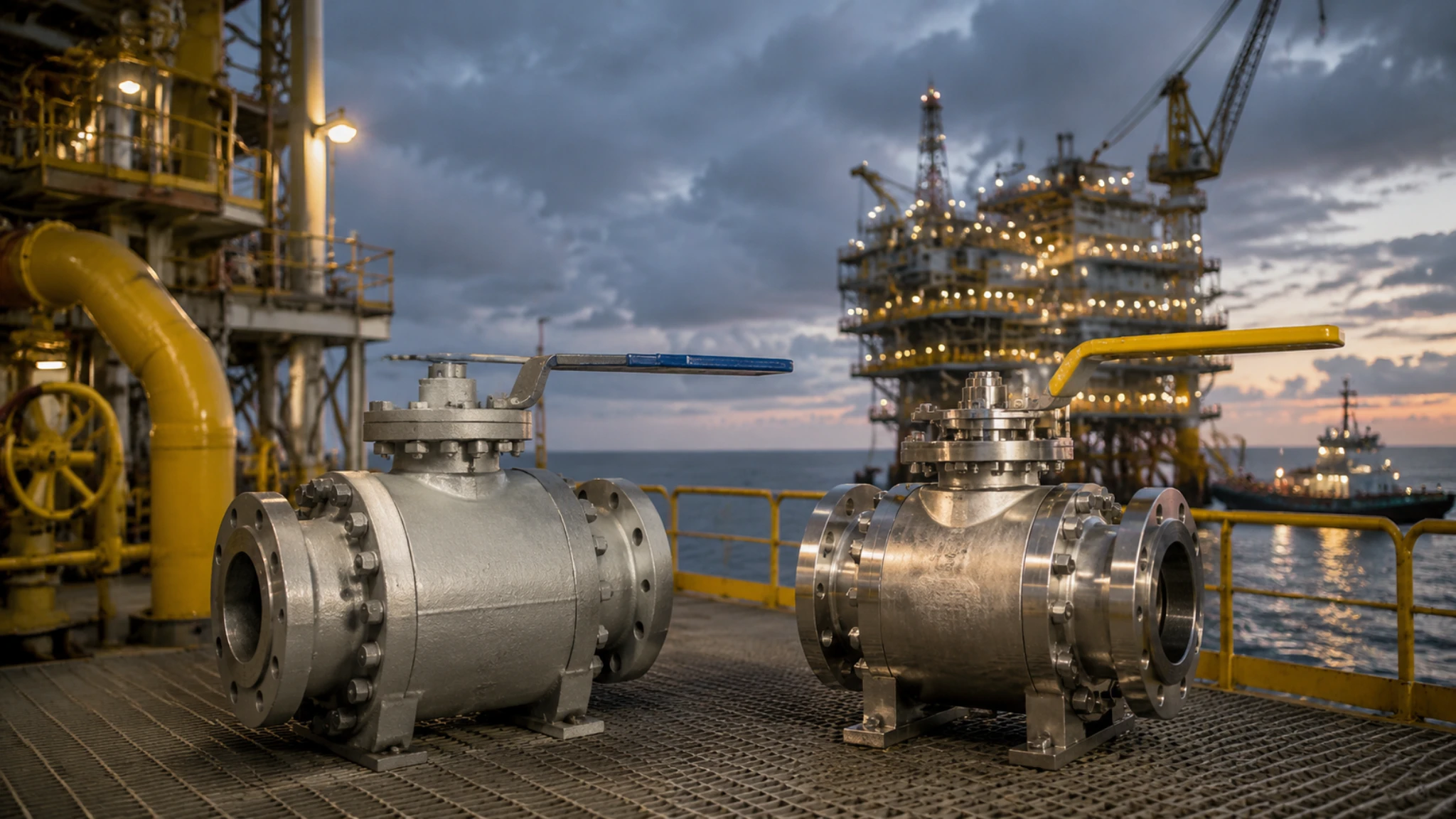
Three DBB valve banks at one petrochemical plant failed to vent completely because the bleed connection was routed to a higher discharge header without proper drain consideration. The problem was not only the valve selection. The bleed line geometry created liquid holdup and made pressure verification unreliable.
A DBB valve assembly must be designed as a connected isolation system. The valve body, seat configuration, bleed port, vent routing, discharge destination, pipe support, operating access, and pressure test procedure all affect whether the assembly can isolate, depressurize, and verify leakage safely.[1]
DBB design is not only a valve selection issue. It is also a piping layout, vent routing, operation access, and maintenance planning issue.
| Design Area | Main Question | Typical Risk If Ignored |
|---|---|---|
| Isolation principle | Does the service require DBB, DIB-1, DIB-2, or two separate block valves? | Wrong isolation logic or false leakage verification |
| Bleed port location | Should the cavity have a high-point vent, low-point drain, or both? | Gas pocket, liquid holdup, blocked bleed path, or trapped pressure |
| Pipe rack layout | Is there enough space for operation, support, lifting, and maintenance? | No wrench clearance, poor access, actuator removal difficulty, or support overload |
| Bleed destination | Where does the vented or drained medium go? | Unsafe atmospheric release, backpressure, environmental noncompliance, or blocked discharge |
| Inspection and testing | How are the seats, cavity, bleed valve, and final assembly tested? | Incomplete pressure verification, unproven bleed function, or poor traceability |

DBB Principle
Single-Body DBB and DIB Implementation
A single-body DBB valve places the required sealing elements and an intermediate bleed path inside one valve body. For API 6D pipeline valve service, the project data sheet should clearly state whether the required function is DBB, DIB-1, or DIB-2, because these terms are not interchangeable.[2]
A compact DBB manifold normally reduces installation length and external leak points compared with two separate inline block valves. However, compact construction does not automatically prove the required isolation class. The seat design, pressure direction, cavity venting path, test method, and manufacturer documentation must match the process safety requirement.
- Close the upstream block element.
- Close the downstream block element.
- Open the intermediate bleed valve to depressurize the cavity and verify whether either sealing face is leaking.
API 6D specifies requirements for manufacturing, assembly, testing, and documentation of pipeline valves. ISO 14313:2025 supplements API 6D, 25th edition, and applies to axial, ball, check, gate, and plug valves for oil and gas pipeline transportation systems within the stated class range.[3]
Trunnion-mounted ball valve designs are common for high-pressure and larger-size pipeline DBB or DIB applications because the ball position is mechanically supported and the seat/cavity arrangement can be engineered for defined pressure directions. Floating ball DBB designs may exist in small-bore or special configurations, but they should not be treated as equivalent without checking the seat arrangement and test certificate.
The important engineering question is not simply whether the valve is floating or trunnion-mounted. The important question is whether the valve provides the required sealing surfaces, the required pressure barrier direction, and a verifiable intermediate bleed path.
- Do not use DBB and DIB as interchangeable labels.
- Confirm whether the seat design seals from one direction or both directions.
- Confirm whether pressure trapped in the cavity can be safely relieved.
- Record the required isolation category directly in the valve data sheet.
- Make the pressure test procedure match the specified isolation category.
Bleed valves are commonly selected from needle, ball, or plug designs.
| Bleed Valve Type | Best Use | Selection Note |
|---|---|---|
| Needle valve | Instrument isolation, sampling, and controlled bleed | Good for small-flow bleeding and gradual depressurization |
| Ball valve | General vent and drain isolation duty | Simple operation and wide availability |
| Plug valve | Dirty, waxy, or solids-bearing service | Often more tolerant of contaminated media than small-bore ball valves |
For abrasive, waxy, or dirty service, the bleed valve should be selected according to solids content, particle size, viscosity, valve bore, expected operation frequency, flushing method, and replacement access. A fixed wear-resistance multiplier should not be used unless it comes from a project-specific test or manufacturer qualification report.
ASME B16.34 is relevant when reviewing valve pressure-temperature ratings, materials, dimensions, tolerances, nondestructive examination requirements, testing, and marking for flanged, threaded, and welding-end valves.[4]
Further reading: CARILO DBB Compact Manifold Product Page.
Two-Valve Tandem DBB Arrangement
A two-valve tandem DBB arrangement uses two independent block valves installed in series, with a bleed or drain connection installed in the intermediate spool piece. This arrangement is common when the operator wants two physically separate block valves or when the project isolation philosophy requires two independent inline valves.
The two-valve tandem arrangement is often selected when the two block valves belong to different process areas, when spare-part independence is important, or when the plant prefers standard inline valves instead of a compact manifold.
- Flexible component procurement
- Independent replacement of either block valve
- Possible use of different valve types where process conditions require it
- Clear physical separation between the two isolation valves
- Easy visual understanding for operations and maintenance teams
The main disadvantages are larger footprint, more flanged or welded joints, more potential leak points, and a trapped intermediate spool volume.
ASME B16.10 covers face-to-face and end-to-end dimensions of straightway valves and is relevant when comparing the installation length of separate inline valves against a compact DBB manifold.[5]
| Configuration | Typical Length Basis | Main Layout Impact |
|---|---|---|
| Two-valve tandem arrangement | Two standard valve face-to-face lengths plus spool, gasket, bolting, branch, and access allowance | Longer pipe rack space and more external joints |
| Single-body DBB manifold | Manufacturer-specific compact body length | Shorter footprint and fewer external joints in many small and medium sizes |
In congested pipe racks, offshore modules, and packaged skids, the extra length of a tandem arrangement can increase pipe support demand, skid frame size, lifting envelope, and maintenance access requirements. The cost impact should be calculated from the actual layout, not from a fixed cost per square meter.
The intermediate spool can also become a dead zone. With both block valves closed, leaked or trapped media remains in the spool until the bleed valve is opened. Depending on bore size and spool length, the trapped volume may range from a small residual volume to several liters.
If the medium contains wax, polymer, heavy hydrocarbons, corrosion products, or sand, the bleed branch may plug or the bleed valve may seize. In such services, the spool should include practical drain geometry, flushing access, and enough space for valve replacement.
Bleed Port Location
Bleed port location directly determines whether the DBB verification step works in the field.
The bleed connection should be placed at the highest or lowest practical point of the intermediate cavity according to fluid phase, condensate behavior, freezing risk, and discharge destination. For two-phase service, one side-mounted bleed connection may not be enough.
| Media Phase | Recommended Bleed Port Position | Reason |
|---|---|---|
| Gas media | High-point vent or cavity top connection | Gas accumulates at the highest point |
| Liquid media | Low-point drain or cavity bottom connection | Liquid drains from the lowest point |
| Two-phase flow | Separate high-point vent and low-point drain where required | Gas and liquid require different release paths |
| Waxy or dirty service | Accessible drain with flushing consideration | Small-bore bleed branches can plug during service |
Compact DBB manifolds often use 1/2″ NPT bleed connections in small and medium sizes, but the final port size should follow the valve data sheet, pressure class, fluid phase, depressurization requirement, and project piping specification. Viscous liquid, waxy service, two-phase flow, or fast depressurization may require a larger bleed path.
Bleed line elevation should be checked carefully. If a bleed line rises from the cavity and then drops to a closed drain or vent header, it may create an unintended liquid trap. In gas service with condensate, this trap can block pressure verification. In liquid service, it can prevent complete draining.
Where drainage is required, the bleed line should avoid unintended high points and should maintain a continuous fall toward the approved collection point where practical. The slope value should follow the project piping design specification, fluid properties, freezing risk, and drain system philosophy. ASME B31.3 should be used as the process piping code basis for materials, components, design, fabrication, assembly, erection, examination, inspection, and testing.[6]
If the vented medium is classified as sour service, the wetted bleed piping, valve body, trim, bolting, and weld procedures should comply with NACE MR0175 / ISO 15156 or the project sour-service specification. Sour-service suitability should be based on H2S partial pressure, pH, chloride content, temperature, material condition, and operating envelope, not only on H2S ppm concentration.[7]
For hazardous, toxic, flammable, sour, or environmentally restricted media, the bleed outlet should normally connect to a closed vent, closed drain, flare, or other approved collection system. Atmospheric venting should only be used where it is explicitly allowed by the project safety philosophy, environmental rules, and operating procedure.
Further reading: CARILO High-Pressure Ball Valve Selection.
Layout Design
Pipe Rack Space Reservation
DBB valves on pipe racks should normally be aligned along the main pipeline axis unless a reviewed maintenance envelope confirms that an offset arrangement is safe, operable, and maintainable.
In one offshore platform model review, a DBB assembly had been rotated to save longitudinal rack space. The arrangement looked compact in plan view, but the bleed valve had almost no wrench swing clearance and the actuator lifting path conflicted with an upper pipe tier. The layout had to be revised before fabrication.
Each DBB assembly should be checked for operation access, bleed valve actuation, actuator or gearbox removal, lifting path, flange bolt removal, sealant injection access where applicable, and visibility of pressure gauges or vent indicators.
- Reserve access along the pipeline axis for flange, bolting, and spool work.
- Keep the bleed valve side clear for hand operation and tool swing.
- Check actuator, gearbox, and handwheel removal before finalizing the 3D model.
- Confirm that lifting points and temporary rigging do not clash with upper pipe tiers.
- Show maintenance envelopes in the 3D model or piping isometric drawing.
Pipe support design should account for concentrated valve weight, actuator weight, thermal displacement, vibration, nozzle loads, and temporary maintenance loads. ASME B31.3 provides the process piping code basis, but support details should also follow the project pipe support standard and structural design criteria.[8]
| Item | Two-Valve Tandem Arrangement | Single-Body DBB Manifold |
|---|---|---|
| Installation length | Usually longer because of two valve bodies, spool, and flange allowance | Usually shorter in small and medium compact manifold sizes |
| External leak points | More flanges, gaskets, bolts, or welds | Fewer external joints in compact construction |
| Support demand | Higher support demand in many layouts | Lower support demand where compact body weight is lower |
| Maintenance flexibility | Individual valve replacement is easier | Fewer joints to inspect, but replacement may involve the full manifold |
The weight and support savings of a compact DBB manifold are project-specific. They should be verified by comparing actual manufacturer drawings, valve weights, actuator weights, support span, and structural design loads. Avoid presenting a fixed percentage saving unless it comes from a documented project calculation.
In multi-tier pipe racks, DBB valves should not be placed on the top level unless operation and maintenance access has been confirmed. A valve that is easy to operate during normal service may still be difficult to maintain during shutdown if actuator removal space, lifting clearance, or platform access is missing.
Further reading: CARILO Valve Product Range.
Operating Platform Requirements
DBB operating platforms must accommodate four operation types:
- Handwheel, lever, gearbox, or actuator operation for isolation.
- Bleed valve actuation for pressure verification.
- Actuator, gearbox, handwheel, or lever removal for maintenance.
- Sealant injection or emergency sealing access where the valve design includes injection fittings.
During one petrochemical EPC drawing review, the platform provided handwheel access on one side but missed the opposite-side sealant injection fittings. The valve could be opened and closed, but emergency sealing access was blocked. The platform required field modification.
Each operation point should have a dedicated clearance zone for hand access, tool swing, safe posture, and escape route. These zones should be reviewed during the 3D model stage rather than discovered during commissioning.
| Platform Requirement | Recommended Basis | Purpose |
|---|---|---|
| Platform load rating | Project structural specification; increase where actuators, gearboxes, or maintenance tools are handled | Supports operators, equipment, and temporary maintenance loads |
| Handwheel or lever height | Project ergonomics requirement and operating frequency | Reduces unsafe overreach and awkward posture |
| Guardrail height | Local safety code and client standard | Personnel fall protection |
| Toe board | Local safety code and falling-object risk assessment | Prevents tools and small parts from falling from the platform |
For projects referencing OSHA general industry requirements, 29 CFR 1910.29 provides criteria for fall protection systems and falling-object protection, including guardrail and toe board requirements.[9]
On multi-tier platforms, the bleed valve operation path should be direct and unobstructed. Operators should be able to open the bleed valve, observe pressure decay, and confirm discharge status without moving through unrelated platform levels whenever the process safety philosophy allows it.
At an ethylene plant, one bleed line was routed through several platform levels before reaching the discharge header. Operators had to move between different access points to actuate the bleed valve and confirm discharge. The vent confirmation cycle became longer and more error-prone than necessary.
The bleed valve operating point and the discharge confirmation point should be kept close enough for reliable field verification. If local confirmation is not practical, the system should provide a clear pressure gauge, pressure transmitter, sight glass, drain indicator, or operating procedure that avoids guesswork.
Further reading: CARILO Technical Support.
Bleed Piping Destination
Bleed piping destination is determined by fluid phase, pressure, temperature, toxicity, flammability, corrosivity, sour-service classification, environmental restrictions, and plant vent or drain philosophy.
On a gas processing project, DBB vent outlets were separated by service type. Dry hydrocarbon gas was routed to a flare or closed vent system, wet gas and hydrocarbon liquid were routed to a closed drain system, and sour gas service required a dedicated route consistent with the plant sour-service and toxic gas handling philosophy.
| Vented Medium | Typical Destination | Design Note |
|---|---|---|
| Dry hydrocarbon gas | Flare or closed vent system | Check backpressure, purge philosophy, and flame arrestor requirements where applicable |
| Wet gas or condensate-bearing service | Closed drain drum or closed collection system | Avoid liquid holdup, freezing, hydrate formation, and plugging risk |
| H2S-bearing gas | Approved sour gas handling route | Apply toxic gas controls and sour-service material requirements |
| Nonhazardous utility service | Approved local vent or drain point where allowed | Confirm personnel exposure, noise, temperature, and environmental limits |
For offshore production platform piping, API RP 14E is commonly used as a design and installation recommended practice. It should be applied together with the current project specification, owner standard, local regulation, and platform flare or drain philosophy.[10]
Piping material should follow the project piping class for pressure, temperature, corrosion allowance, sour-service requirement, and compatibility with the vented medium. General hydrocarbon service may use carbon steel under the approved piping class, while sour, corrosive, or low-temperature service may require additional material controls.
The bleed piping bore should not be smaller than the bleed valve nominal bore unless an approved hydraulic calculation or venting calculation justifies the restriction. Undersized bleed lines increase pressure drop, extend depressurization time, and may make bleed verification unreliable.
An isolation valve on a bleed line can create a pressure trap if it is accidentally closed. If a maintenance shutoff is required, it should be locked open or car-sealed open during normal operation and tagged clearly as “NORMALLY OPEN — CLOSE ONLY FOR MAINTENANCE.” The tag should be bilingual where the plant operates in a multilingual environment.
The bleed line should remain open, traceable, and verifiable. A closed or blocked bleed path can turn a DBB cavity into a pressure trap.
Bleed line terminals must connect to designated collection systems when the medium is hazardous, flammable, toxic, sour, or environmentally restricted. Direct discharge to atmosphere, open trench, or deck drain should not be used unless it is explicitly allowed by the project safety and environmental requirements.
For combustible gas detection around closed vent or drain equipment, alarm settings should be expressed as %LEL rather than a fixed ppm value. OSHA notes that combustible gas meters measure flammable gas concentration as a percentage of the lower explosive limit of the calibrated gas, and calibration gas should match the monitored gas where practical.[11]
Further reading: About CARILO.
Selection Parameters
Single-Body DBB vs. Two-Valve Tandem Assembly
Choosing between a single-body DBB manifold and a two-valve tandem assembly depends on isolation philosophy, valve size, pressure class, material, available space, support loading, maintenance method, spare-part strategy, and the owner’s safety requirement.
| Selection Factor | Single-Body DBB Manifold | Two-Valve Tandem Assembly |
|---|---|---|
| Space | Compact and suitable for tight skids or congested pipe racks | Longer total installation length |
| Weight | Often lower in small and medium compact manifold sizes | Higher in many cases because of two valves, spool, flanges, bolts, and supports |
| External leak points | Fewer external joints | More flange, gasket, bolting, or weld interfaces |
| Maintenance | Fewer joints to inspect, but full manifold replacement may be required in some cases | Individual valve replacement is easier, but spool dead-leg deposits may occur |
| Procurement | Simpler package traceability if factory assembled and tested | Flexible sourcing and useful emergency repair options |
| Isolation philosophy | Must verify DBB, DIB-1, or DIB-2 seat function from the data sheet | Physical two-valve isolation with an intermediate bleed between separate valves |
In small and medium sizes, a compact single-body DBB manifold may reduce total installed cost by shortening the skid, reducing external joints, simplifying assembly, and reducing the number of support points. However, the first purchase price may be higher than a simple tandem assembly made from standard valves.
The total cost comparison should include valve purchase price, spool fabrication, flanges, gaskets, bolts, pipe supports, installation labor, pressure testing, leak management, inspection time, spare-part strategy, and downtime value. A fixed breakeven period should not be presented as universal unless it comes from a documented project calculation.
For one reviewed maintenance case, the compact DBB arrangement required two routine inspections over three years, with about two labor hours per inspection. At 85 USD/hour, that case equals about 340 USD in inspection labor over three years.
In the same review, the tandem arrangement required more frequent intervention because the intermediate spool collected deposits and several external joints required inspection. If a tandem assembly requires four to five maintenance events per year, each averaging 4.5 labor hours, the three-year labor cost at 85 USD/hour becomes about 4,590-5,738 USD.
These figures should be treated as a project case calculation, not an industry-wide constant. The broader conclusion is that compact DBB designs can reduce maintenance exposure where they eliminate external joints and intermediate dead legs.
For lines 6″ and above, compact single-body DBB weight, forging size, machining difficulty, actuator torque, and maintenance handling may increase rapidly. In many large-bore services, a two-valve tandem arrangement or engineered three-valve assembly may be more economical and easier to maintain.
CARILO’s compact DBB supply range is generally focused on small and medium sizes. Larger sizes should be reviewed case by case according to bore, pressure class, material, actuator, vent requirement, and project isolation philosophy.
Further reading: CARILO API 6D High-Pressure Valve Information.
Factory-Assembled vs. Knock-Down Supply
Factory-assembled supply means the DBB valve bank is assembled, inspected, and pressure-tested by the manufacturer before delivery. Knock-down supply ships the main valves, bleed valve, spool, flanges, gaskets, and bolts as separate items for site assembly.
Factory assembly is preferred when the project needs stronger traceability, repeatable pressure testing, controlled bolting, documented cavity verification, and reduced site commissioning risk.
Knock-down supply may be useful for emergency repair, remote inventory flexibility, or field replacement where fast restoration is more important than receiving a fully packaged manifold.
| Supply Method | Advantages | Risks |
|---|---|---|
| Factory-assembled supply | Pre-tested, easier site installation, better traceability, fewer site assembly variables | Longer lead time and less emergency flexibility |
| Knock-down supply | Fast repair flexibility and easier emergency sourcing | Higher site assembly, gasket control, bolt torque, alignment, and pressure test risk |
In one procurement case, knock-down assembly created leakage risk because gaskets and bolting were stored in a humid warehouse before installation. The issue was not simply component quality. The larger problem was loss of controlled storage, controlled assembly, torque documentation, and final assembly pressure test traceability.
Factory assembly has three clear advantages:
- The manufacturer can perform shell and closure testing before delivery.
- The intermediate cavity and bleed path can be verified as part of the assembly test.
- Inspection reports, material certificates, pressure test records, and traceability documents are easier to package together.
API Standard 598 covers valve inspection and pressure testing requirements for common industrial valve types. The current edition should be confirmed in the project specification or purchase order before inspection and test plans are finalized.[12]
Knock-down assembly requires qualified site testing. If the site lacks a suitable test bench, calibrated gauges, safe test area, proper blinds, controlled bolting procedure, approved test medium, and trained personnel, full pressure verification may be incomplete.
For remote project sites without qualified test facilities, factory assembly is usually safer. For scheduled turnaround maintenance, factory assembly also reduces commissioning uncertainty and simplifies documentation review.
Further reading: CARILO FAQ on Supply Options.
Pressure Testing Procedure
DBB compact manifold pressure testing is more complex than single ball valve testing because it involves two sealing elements and one intermediate vent cavity.
For most DBB assemblies, the inspection and test plan should include at least these checks:
- Shell strength test according to the applicable valve standard and pressure class.
- Upstream seat test with the intermediate cavity monitored or vented according to the approved procedure.
- Downstream seat test with the intermediate cavity monitored or vented according to the approved procedure.
- Bleed valve and bleed path function verification.
- Final assembly inspection, marking, and documentation review.
ISO 5208 specifies examinations and tests used by valve manufacturers to establish pressure boundary integrity, verify valve closure tightness, and confirm the structural adequacy of the closure mechanism. It should be applied together with the applicable product standard and project inspection procedure.[13]
Soft-seated DBB valves often target tight shutoff such as ISO 5208 Rate A where specified by the project. Metal-seated DBB valves may use a different leakage rate according to seat design, pressure class, temperature, and project acceptance criteria. The acceptable leakage rate should be stated in the valve data sheet instead of assumed.
Cavity vent function verification is the special DBB pressure testing step. The test should confirm that the intermediate cavity can be depressurized through the bleed valve and that pressure decay can be observed by gauge, transmitter, or approved test equipment.
For double-bleed or dual-cavity configurations, each cavity and each vent path should be tested independently according to the approved valve data sheet and inspection procedure.
Fire-safe performance should be handled as a type-test and certification requirement, not as a routine fire exposure test for every delivered valve. API 607 is the fire test standard for quarter-turn valves and valves equipped with nonmetallic seats; the project should confirm the applicable edition, valve size coverage, pressure class coverage, and seat material coverage in the manufacturer’s certificate.[14]
If site conditions limit hydrostatic testing, pneumatic testing should only be used where permitted by the applicable standard, project procedure, and safety plan. Compressed gas stores much higher energy than water, so pneumatic testing requires strict exclusion zones, calibrated relief protection, controlled pressurization, and controlled depressurization.
During one land terminal acceptance test, an operator started the upstream seat test without confirming the bleed valve position. The intermediate cavity was unintentionally pressurized, creating an avoidable overpressure risk.
The DBB pressure test checklist must include: “CONFIRM BLEED VALVE POSITION BEFORE TEST.”
A DBB pressure test package should include valve position, test pressure, test medium, cavity vent status, gauge location, hold time, acceptance criteria, safety exclusion area, and discharge destination.
| Test Item | Purpose | Key Check |
|---|---|---|
| Shell test | Verify pressure boundary integrity | No unacceptable leakage or deformation under the approved test condition |
| Upstream seat test | Verify upstream sealing face | Cavity pressure or bleed flow confirms leakage status according to the procedure |
| Downstream seat test | Verify downstream sealing face | Cavity pressure or bleed flow confirms leakage status according to the procedure |
| Bleed path test | Verify cavity depressurization function | Bleed valve opens, flow path is not blocked, and pressure decay is observable |
| Documentation review | Confirm traceability and compliance | Material certificates, pressure test reports, marking, and fire-safe documents where required |
When designing a DBB valve piping system, space, vent path, selection configuration, and maintenance accessibility are interdependent decision dimensions.
Early 3D model review, clear DBB versus DIB terminology, correct bleed port elevation, closed discharge routing, verified platform access, and documented pressure testing can eliminate many common field rework problems.
Single-body DBB manifolds offer strong installed-cost and maintenance advantages in many 1/2″ to 4″ applications, while larger sizes and strict two-valve isolation philosophies may favor a tandem assembly. Factory assembly with complete testing documentation substantially reduces site installation risk.
Further reading: CARILO Forged Metal-Seated Valve Specifications.