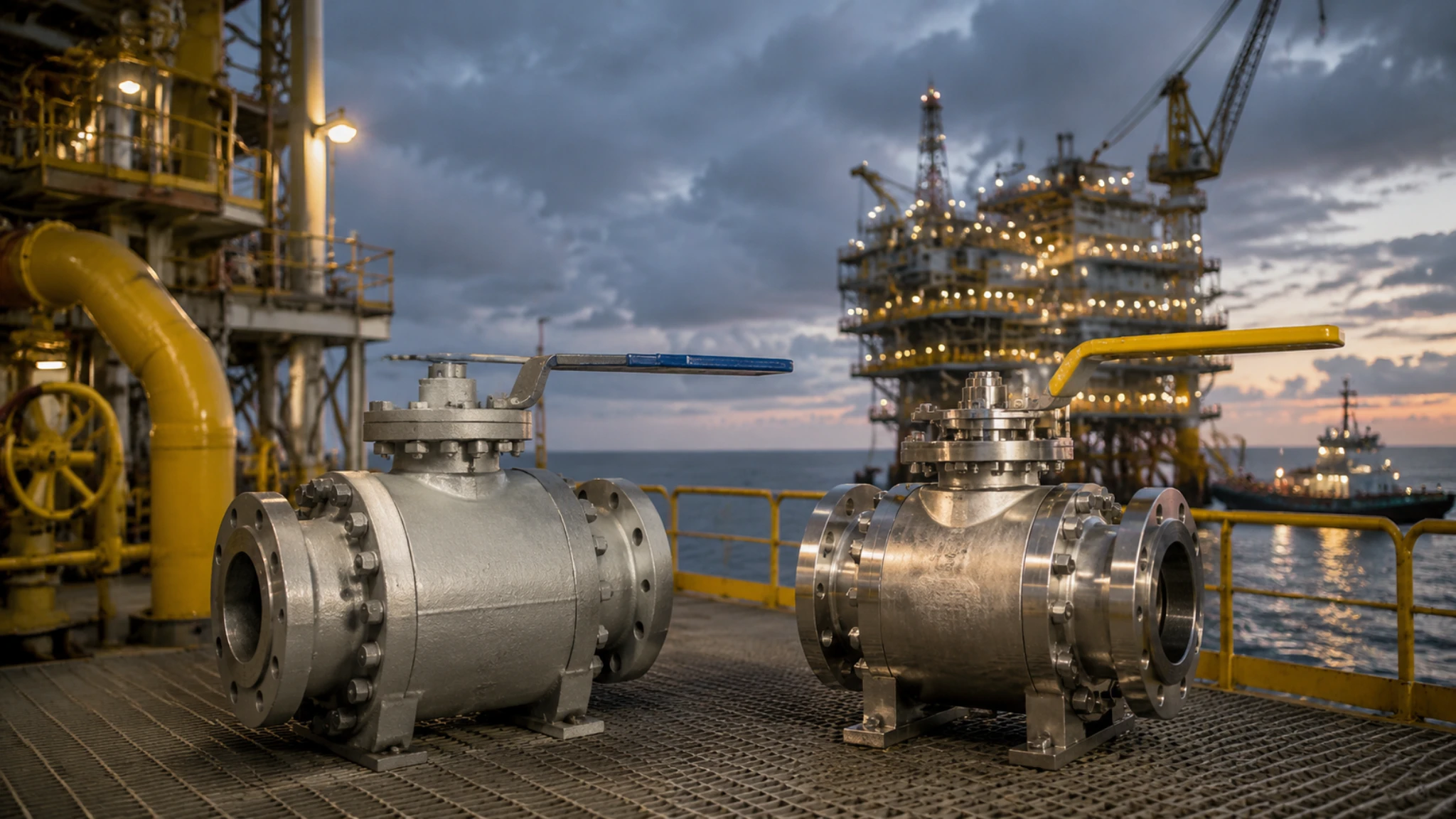
Selecting between cast and forged ball valves for offshore platforms involves trade-offs across weight, strength, cost, delivery time, maintainability, inspection risk, and long-term service reliability.
Based on offshore replacement, procurement, and inspection experience, forged products are generally preferred for small-bore, high-pressure, high-cycle, and vibration-sensitive services. Cast products remain practical for many large-bore and medium-pressure services where geometry, availability, and procurement cost are dominant factors.
Neither manufacturing route is universally better. The correct choice depends on valve size, pressure class, vibration exposure, corrosion environment, inspection requirements, delivery schedule, and maintenance strategy.
For offshore platforms, the decision should not be made only by comparing purchase price. The more useful comparison is whole-life value: pressure-boundary confidence, NDE burden, topside weight, lifting access, coating performance, spare-parts commonality, shutdown risk, and replacement lead time.
| Decision Factor | Cast Ball Valves | Forged Ball Valves |
|---|---|---|
| Typical size advantage | Often more economical for large-bore valves, especially DN 200 and above | Often more practical for small-bore and medium-bore valves, especially DN 80 and below in high-pressure service |
| Strength and fatigue resistance | Suitable for many medium- and low-pressure services when casting quality and inspection are controlled | Better suited to high-pressure, high-cycle, vibration-sensitive, and safety-critical services because of grain-flow control and lower shrinkage-defect risk |
| Weight | Usually heavier when the same bore, end connection, and pressure class are compared | Can be lighter where the design takes advantage of forged material integrity and optimized body sections |
| Cost | Usually lower for large-bore or low-volume production | Competitive for small-bore valves and critical high-pressure services |
| Lead time | Can be longer because of pattern making, mold preparation, pouring, heat treatment, cleaning, repair cycles, and casting inspection | Often shorter for standard small-to-medium sizes machined from forged bar, billet, or qualified forgings |
| Inspection focus | More attention to volumetric defects such as shrinkage, gas porosity, inclusions, and repair welds | More attention to forging laps, folds, seams, heat-treatment control, grain flow, and surface/subsurface indications |
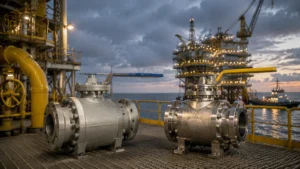
Cast vs Forged Metallurgy
Grain Structure Differences
Forging plastically deforms steel under hammering or pressing. This deformation refines the grain structure and can orient grain flow along the main stress path of the component. This is one of the main metallurgical reasons forged pressure-retaining parts are widely used in high-pressure and fatigue-sensitive applications[1].
For valve bodies, this means the pressure boundary can show more predictable mechanical behavior when the forging process, heat treatment, machining, and nondestructive examination are properly controlled.
- ASTM A105 forged carbon steel is commonly used for forged piping and valve components. Typical published minimum mechanical properties include tensile strength of 485 MPa and yield strength of 250 MPa[2].
- ASTM A216 WCB cast carbon steel is commonly used for pressure-containing cast valve bodies. Typical published minimum mechanical properties include tensile strength of about 483 MPa and yield strength of about 248 MPa[3].
- The practical difference between cast and forged valve bodies is therefore not only nominal tensile strength. It is also defect distribution, grain-flow direction, repeatability, inspection burden, and fatigue confidence.
Cast steel normally solidifies with a more equiaxed grain structure. If melting, pouring, feeding, riser design, heat treatment, and inspection are not well controlled, shrinkage cavities, gas porosity, and inclusions can remain inside the casting. These discontinuities can become leak paths or fatigue crack initiation sites when they are located in critical zones[4].
In offshore valve procurement, coarse grain concerns should be confirmed by metallographic examination rather than by ultrasonic testing alone. Ultrasonic testing can screen internal discontinuities, but grain-size confirmation normally requires metallographic evidence.
- Cast valve bodies may require repair welding when shrinkage, porosity, or inclusions exceed the applicable acceptance criteria.
- Repair welding can add rework time, reinspection cost, and schedule uncertainty.
- For critical service points, replacement with CARILO forged ball valves can reduce casting-related inspection risk when the valve design and service condition support a forged solution.
- Seat hardness and sealing durability should be attributed to the specified ball, seat, hardfacing, coating, or heat-treatment route, not to the forged valve body alone.
Grain-flow direction and material consistency are major advantages of forging, especially for high-pressure services such as Class 600 and above, where pressure-boundary integrity, fatigue behavior, and inspection confidence carry more weight in procurement decisions. ASME B16.34 covers pressure-temperature ratings, dimensions, tolerances, materials, nondestructive examination requirements, testing, and marking for cast, forged, and fabricated valves[5].
For critical offshore valves, the practical advantage of forging is not simply higher nominal strength. It is lower variation, cleaner internal structure, and easier quality verification.
In project inspection records, cast valve bodies often show higher first-pass NDE rejection than comparable forged bodies. This should be treated as project-specific operating experience, not as a universal acceptance-rate statistic published by API 6D or ASME B16.34.
Further reading: Key Criteria for Choosing a Ball Valve Manufacturer.
Internal Defect Probability
The solidification process in casting can produce porosity, shrinkage cavities, gas pockets, and inclusions. These defects are not automatically unacceptable, but they increase inspection complexity and can reduce pressure tightness or fatigue resistance when located in pressure-retaining or sealing-critical areas.
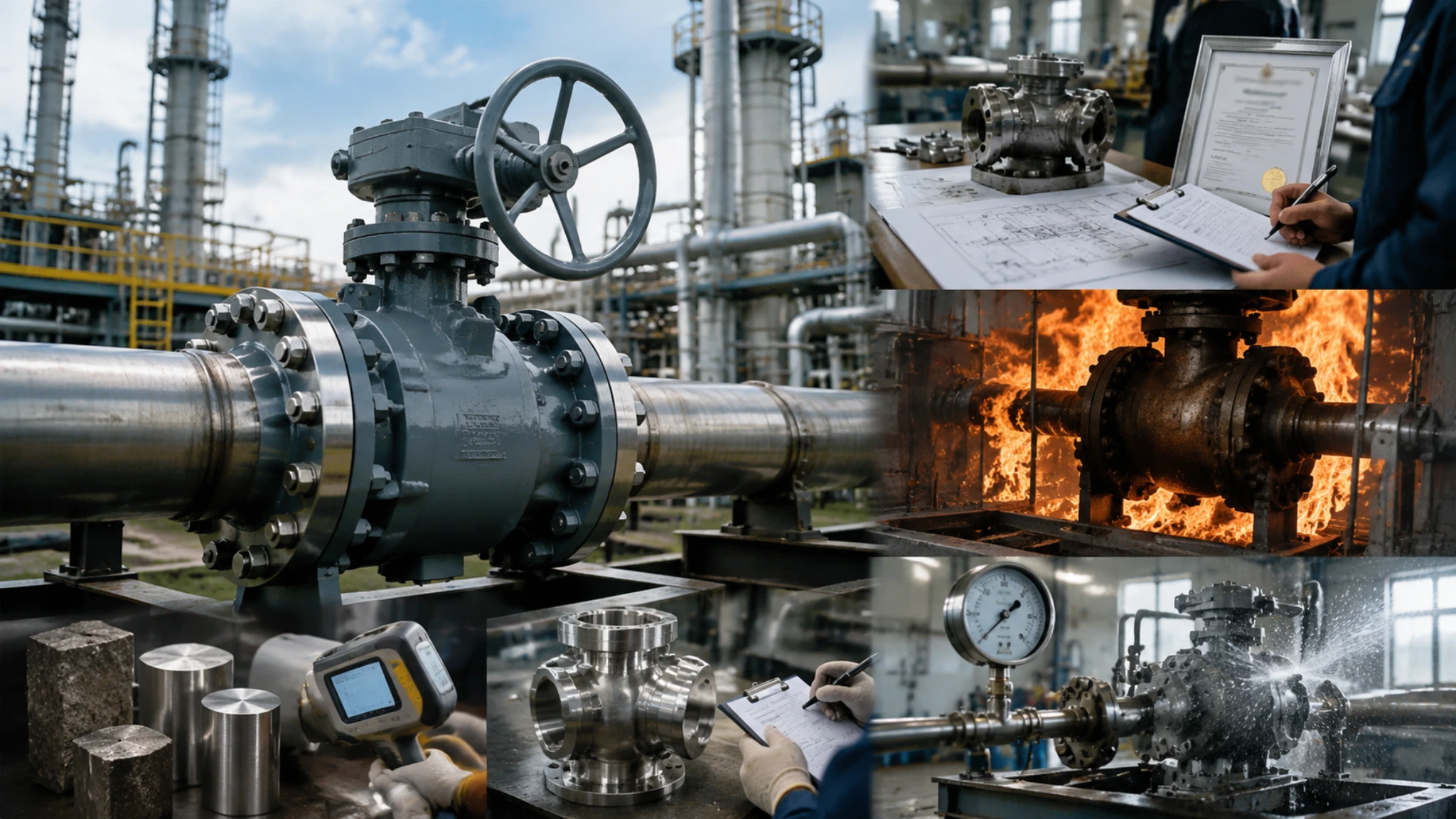
- Radiographic testing is commonly used for castings and welds when project specifications require volumetric examination.
- Ultrasonic testing, magnetic particle testing, and liquid penetrant testing may also be required depending on material form, defect type, wall thickness, and acceptance criteria.
- API 6D defines requirements for design, manufacturing, assembly, testing, and documentation of ball, check, gate, and plug valves used in petroleum and natural gas pipeline and piping systems[6].
- API 6D and ASME B16.34 do not publish universal first-pass acceptance rates for cast or forged valve bodies. Acceptance rates should be presented only as internal project data or supplier quality records.
Forging has lower risk of shrinkage porosity than casting, but forged parts are not risk-free. Inadequate forging ratio, poor temperature control, laps, folds, seams, decarburization, or improper heat treatment can still lead to surface or subsurface defects.
For forged valve procurement, the incoming inspection plan should define material certificate review, heat-treatment verification, dimensional inspection, surface NDE, and any required volumetric NDE. This is especially important for high-pressure, sour, subsea, cryogenic, or high-cycle offshore services.
For high-reliability offshore installations, purchaser specifications often add supplementary NDE coverage for critical zones of forged bodies, cast bodies, weld-end connectors, and pressure-containing welds. The exact requirement should be defined in the material requisition, inspection and test plan, and applicable project specification.
In critical offshore service, the most important procurement question is not “cast or forged” in isolation, but whether the manufacturing route can be verified by traceable material certificates, qualified heat treatment, and suitable NDE.
Further reading: API 6D Ball Valve Factory Acceptance Test Checklist.
Size Limitations
Forging capacity, die dimensions, press capacity, raw-material availability, and machining envelope limit the practical size range of single-piece forged valve bodies. For many standard products, single-piece forged body construction is most common in small and medium sizes.
For larger valves, forged construction may require multi-piece bodies, segmented forged parts, or welded assembly. Whether this requires post-weld heat treatment and full volumetric NDE depends on material grade, wall thickness, weld category, design code, purchaser specification, and service severity.
- Segmented forged construction can increase weld count and inspection scope.
- It can increase cost and lead time compared with a cast body of the same nominal size and pressure class.
- It may still be justified for high-pressure, high-cycle, sour, subsea, or safety-critical services.
Casting offers more geometric flexibility for large and complex pressure-containing bodies. For many DN 200 and larger medium-pressure services, cast construction remains common because it can achieve the required body geometry without very large forging equipment.
On offshore platforms, large-bore production manifolds, water injection systems, cooling water systems, utility lines, and firewater ring mains often use cast steel or cast stainless steel valve bodies when the service is not unusually high-cycle or high-pressure.
When pressure class, fatigue exposure, or inspection traceability dominates the decision, forged or hybrid construction can still be justified at larger sizes. The additional cost should be evaluated against shutdown consequence, replacement difficulty, weight, inspection scope, and service criticality.
For ultra-large valves, a cast-plus-forged hybrid approach can be practical. The main body may be cast for geometry and cost efficiency, while forged parts may be used at highly loaded or wear-sensitive interfaces such as trunnion supports, stems, bushings, seat carriers, or connector zones.
The cast-versus-forged boundary is not fixed by DN size alone. It shifts with pressure class, material grade, service criticality, available manufacturing capacity, and owner risk tolerance.
Further reading: Large Diameter Flanged Ball Valve Installation Guide.
Offshore Platform Specifics
Weight Reduction as a Priority
Every kilogram of valve weight on an offshore platform can affect topside layout, support steel, lifting plans, maintenance access, and module handling. Forged bodies can sometimes be designed with thinner optimized sections while still satisfying the applicable pressure-temperature rating and minimum wall-thickness requirements.
- Weight savings should be evaluated only when bore type, pressure class, end connection, body pattern, stem design, operator, and actuator arrangement are comparable.
- Actual valve weight must be verified from the manufacturer’s certified dimensional drawing.
- A compact threaded or socket-welded valve and a flanged API 6D valve of the same nominal size can have very different weights, even when the pressure class is the same.
For DN 50 / 2 inch Class 1500 flanged ball valves, public dimensional and weight tables show that valve package weight varies significantly by construction, bore arrangement, end connection, and operator configuration[7]. Therefore, any claim such as “a DN 50 Class 1500 valve weighs 12.5 kg” should not be used unless it comes directly from a certified drawing for that exact valve design.
In offshore replacement projects, forged valve packages can reduce cumulative topside weight when many small-bore or high-pressure valves are involved. However, the saving must be calculated valve by valve because actuator weight, stem extension, fire-safe design, drain and vent fittings, and end connection geometry can dominate total package weight.
For offshore projects, forged valves should be compared as complete valve packages, not only as bare bodies.
For small satellite platforms with crane, laydown, or access limitations, a lighter forged valve package may reduce logistics complexity. For large-bore utility systems, cast valves may still remain more economical after structural and lifting costs are included.
Further reading: Forged Floating Ball Valve Applications.
Vibration Resistance Requirements
Offshore platforms operate under continuous mechanical vibration, wave excitation, rotating-equipment pulsation, pressure cycling, and thermal cycling. These conditions make valve-body fatigue and flange-joint reliability important selection factors.
Because forging can align grain flow with major stress paths, forged components often show better fatigue resistance than equivalent cast components when material, heat treatment, surface condition, and design geometry are comparable[8].
- Forged valves are commonly preferred around compressor discharge, high-pressure injection, wellhead, and high-cycle isolation services.
- Cast valves remain acceptable in many offshore services when vibration levels are low, support design is adequate, and inspection acceptance criteria are met.
- The most reliable decision comes from combining material route selection with piping stress analysis, vibration measurement, support design, and fatigue assessment.
For high-frequency areas such as centrifugal compressor discharge piping, forged metal-seated ball valves are often preferred when pressure class, temperature, solids content, or cycling frequency makes soft-seated cast valves less attractive.
Bench fatigue data from individual materials should not be copied directly into valve selection without checking specimen condition, casting quality, forging quality, surface finish, stress concentration, and actual piping vibration. The engineering approach should specify material route, NDE scope, wall thickness, support arrangement, allowable vibration limit, and installation controls together.
Field experience often shows fewer leak-related work orders on small-bore forged valves than on comparable cast valves in high-vibration zones. Such figures should be treated as operating experience, not as an industry-wide failure-rate guarantee.
Vibration performance is not controlled by body material alone. It also depends on piping support, valve mass, actuator overhang, flange alignment, bolting, gasket selection, and operating cycles.
Further reading: API 6D Ball Valve Actuator Selection.
Corrosion Protection Coatings
The marine atmosphere on offshore platforms demands robust surface preparation and coating control for all ball valves. The key difference between cast and forged bodies is not the coating standard itself, but the surface condition that the coating system must cover.
- Cast surfaces can retain mold-sand residues, surface porosity, and micro-shrinkage cavities if cleaning and inspection are inadequate.
- Forged surfaces are usually denser and more uniform after machining and blasting.
- Both cast and forged valve bodies must meet the project coating specification, surface preparation grade, soluble-salt limit, roughness profile, dry film thickness, curing, adhesion, handling, and repair requirements.
NORSOK M-501 specifies requirements for selection of coating materials, surface preparation, application procedures, and inspection for protective coatings applied to offshore and coastal facilities[9].
ISO 12944-9 specifies performance requirements for protective paint systems for offshore and related structures exposed to marine atmosphere, CX offshore corrosivity, and immersion-related conditions[10]. For offshore valve packages, it is more accurate to reference ISO 12944-9 or NORSOK M-501 qualification than to describe coating performance only as a simple salt-spray-hour result.
For tropical offshore environments, ISO 12944 C5 and CX systems may be used depending on exposure, splash-zone risk, maintenance interval, and owner specification. The older shorthand “C5-M” should be used carefully because ISO 12944 was revised and CX was introduced for extreme offshore exposure.
Coating life depends on the full system: surface preparation, substrate condition, primer, intermediate coat, topcoat, edge retention, curing, handling, installation damage, and repair practice.
Thermal spray aluminum, zinc, or zinc-aluminum coatings should be specified against standards such as ISO 2063 for thermal-sprayed metallic corrosion-protection coatings[11]. The joint NACE No. 12 / AWS C2.23M / SSPC-CS 23.00 standard is also used for thermal spray coatings applied to steel for corrosion protection[12].
NACE SP0198 is relevant when valves, piping, or equipment are insulated or fireproofed and corrosion under insulation is a concern. It should not be cited as the primary standard for splash-zone thermal spray coating application because its scope is corrosion under thermal insulation and fireproofing materials[13].
In practice, forged substrates often provide a more uniform coating base after blasting, while cast substrates may require more surface preparation and closer inspection for pores, sand inclusions, and outgassing risk. This does not mean cast valves cannot meet offshore coating specifications; it means the surface preparation and inspection plan must be more carefully controlled.
Further reading: Chemical Plant Valve Material Corrosion Guide.
Economic Comparison
Large-Diameter Casting Cost
Above DN 200, the per-unit cost advantage of casting is often significant. Sand casting can form large and complex valve bodies without requiring very large forging dies or very high press capacity, making it economical for low-volume large-bore production.
- For DN 300 and larger valve bodies, casting may cost substantially less than a fully forged alternative, depending on material grade, pressure class, casting yield, NDE scope, machining complexity, and delivery schedule.
- For small production runs, casting tooling and pattern cost are often easier to justify than large forging tooling.
- For large-bore medium-pressure services, cast construction often provides the best balance of geometry, availability, and initial procurement cost.
Cast bodies are typically heavier than optimized forged equivalents of the same rating. If the platform requires added deck steel, special lifting arrangements, or longer installation windows, some of the purchase-price advantage can be offset.
For a large-bore platform retrofit, a cast-body solution may still remain lower in total installed cost when the valves are medium-pressure, low-cycle, accessible for maintenance, and not located in severe vibration zones. For high-pressure or high-cycle locations, a forged or hybrid solution can be more economical over the service life even if the initial purchase price is higher.
Material cost comparisons such as “cast steel per tonne” versus “forged steel per tonne” should be used only as rough screening numbers. Final valve cost is driven by body route, trim material, pressure class, end connection, actuator, stem design, seat design, fire-safe requirements, testing, coating, documentation, certification, and logistics.
For large offshore valves, the lowest body price is not always the lowest installed cost. Weight, lifting, inspection, coating repair, and shutdown consequence must be included.
Further reading: Cast Soft-Seated Valve Selection Guide.
Small-Diameter Forging Value
At DN 50 and below, the cost gap between cast and forged products can narrow or even reverse. Small forgings can be machined from bar stock or billet, with low tooling cost, good material traceability, stable dimensional control, and shorter repeat-production lead time.
- For DN 15 to DN 50 high-pressure valves, forged construction is often commercially competitive because machining and inspection are more predictable.
- Direct bar-stock machining avoids mold-sand residue and reduces casting-defect risk.
- Forged small-bore valves often simplify spare-parts planning because dimensions are more consistent across production batches.
- For offshore chemical injection, instrument air, sampling, drain, vent, and high-pressure utility services, forged small-bore valves can reduce commissioning rejection risk.
Forged small-bore bodies can also support tighter seat machining and more consistent sealing geometry. In leakage testing after repeated operation cycles, CARILO forged gas pipeline ball valves maintain stable sealing performance when seat material, surface finish, assembly torque, and test procedure are controlled.
For ultra-small instrument and chemical injection valves, direct bar-stock machining offers further advantages.
- Lower risk of casting porosity at the seat pocket.
- Single-pass seat turning for consistent surface finish.
- Full heat-number traceability.
- Better interchangeability for operators managing many small valves across several platforms.
The commercial case for forged small-bore valves becomes stronger when offshore logistics, spares, commissioning rejection risk, and shutdown urgency are included.
Further reading: Forged Soft Seat vs Metal Seat Comparison.
Lead Time and Spare Parts
Casting can require longer upfront preparation because of pattern making, mold preparation, pouring, cleaning, heat treatment, repair cycles, and volumetric inspection. Forged bodies in standard small-to-medium sizes can often be machined directly from available stock or qualified forgings.
For emergency offshore replacements, the shorter route is often the one that uses a standard forged body already supported by qualified drawings, material records, and machining programs.
When an offshore platform needs urgent valve replacement, a standard forged body can reduce schedule risk if the material, pressure class, end connection, and face-to-face dimensions match the existing specification. A cast alternative may still be suitable, but the pattern and casting cycle can make it less attractive for urgent shutdown windows.
Cast valve bodies can show dimensional variation between casting runs, especially at non-machined outer surfaces and complex transition areas. Critical sealing faces are machined, but casting variation can still affect rework, repair, and interchangeability.
- For operators managing multiple platforms, standardizing DN 80 and smaller forged valve sizes can reduce spare-parts variety.
- It can also reduce the risk of stocking incompatible components.
- Spare-parts commonality is especially valuable for remote platforms where emergency logistics are expensive.
API 6D is a valve standard for pipeline and piping valves. It covers ball, check, gate, and plug valves for petroleum and natural gas pipeline and piping systems; it is not an instrumentation standard[14].
Hydrostatic shell testing should be specified according to the applicable valve standard and project requirements. API 6D describes hydrostatic shell test pressure as at least 1.5 times the pressure rating at 38°C for the valve material, with no visible leakage through the pressure boundary during the required test duration[15].
Further reading: Forged Floating Ball Valve Manufacturer Global Shipping.
Final Selection Guidance
Choosing between cast and forged ball valves for offshore platforms is not a binary decision. It requires evaluation of platform conditions, valve size, pressure class, vibration exposure, corrosion environment, inspection requirements, delivery schedule, replacement difficulty, and whole-life cost.
Within the ASME B16.34 and API 6D framework, forged valves are usually preferable for DN 80 and below, high-pressure service, high-cycle duty, vibration-sensitive locations, and applications where traceability and inspection confidence matter more than initial purchase price.
Cast valves remain a practical and economical choice for many DN 200 and larger medium-pressure services, especially where geometry, large-bore availability, and cost control dominate the decision.
Hybrid construction can be the best option when a large valve requires cast-body geometry but also benefits from forged components at highly loaded, wear-sensitive, or inspection-critical interfaces.
As large forging capacity, precision casting, improved NDE, and offshore coating systems continue to develop, the practical boundary between cast and forged valve selection will keep shifting. The final decision should be based on certified drawings, project specifications, material certificates, inspection results, coating requirements, and service-specific risk assessment rather than process preference alone.