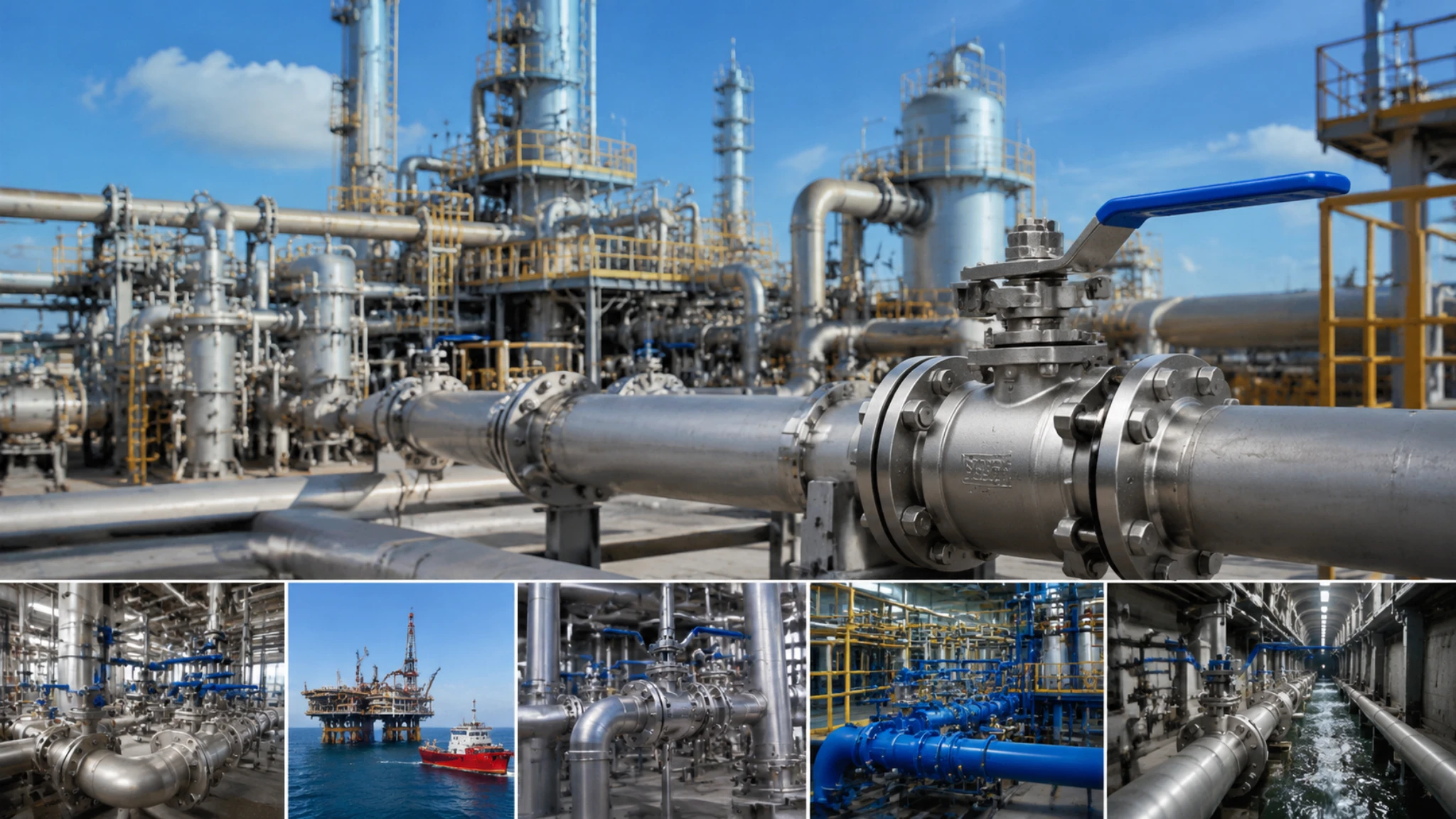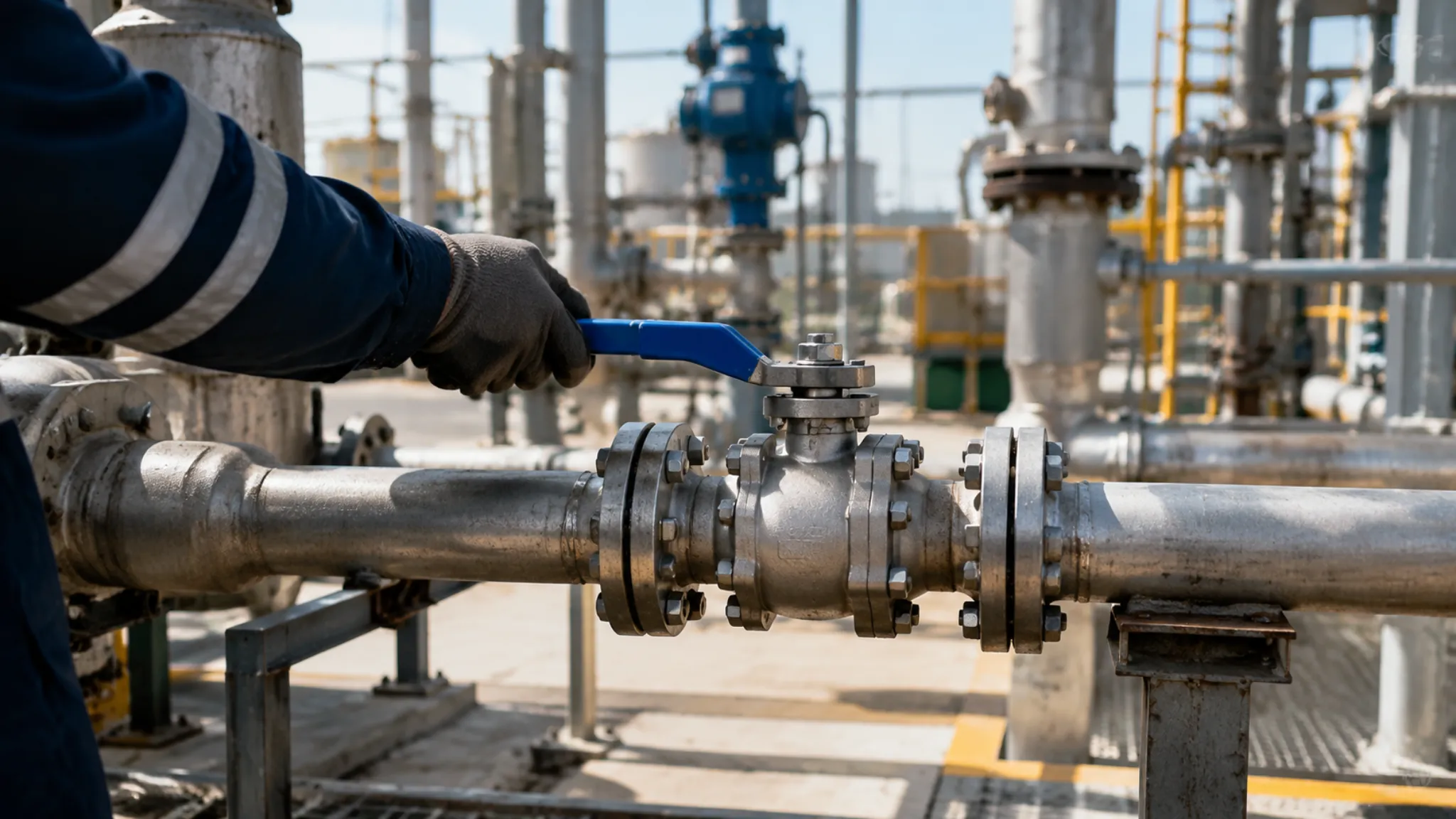
China’s valve exports reached USD 4.7 billion in 2025, with API 6D ball valves accounting for 38% of oil and gas valve export value. In 2024 I helped a Zhejiang valve manufacturer obtain API 6D certification and enter the Middle East market; the first order of 240 units of 16″ Class 600 ball valves cleared customs smoothly at Dubai port, with Schlumberger subsidiary as the accepting party.
From zero export experience to API certification and a USD 1.8 million first order, the entire process took just 11 months — choosing the right manufacturer is the critical first step for any oil and gas project success.
Quality Manufacturing Process
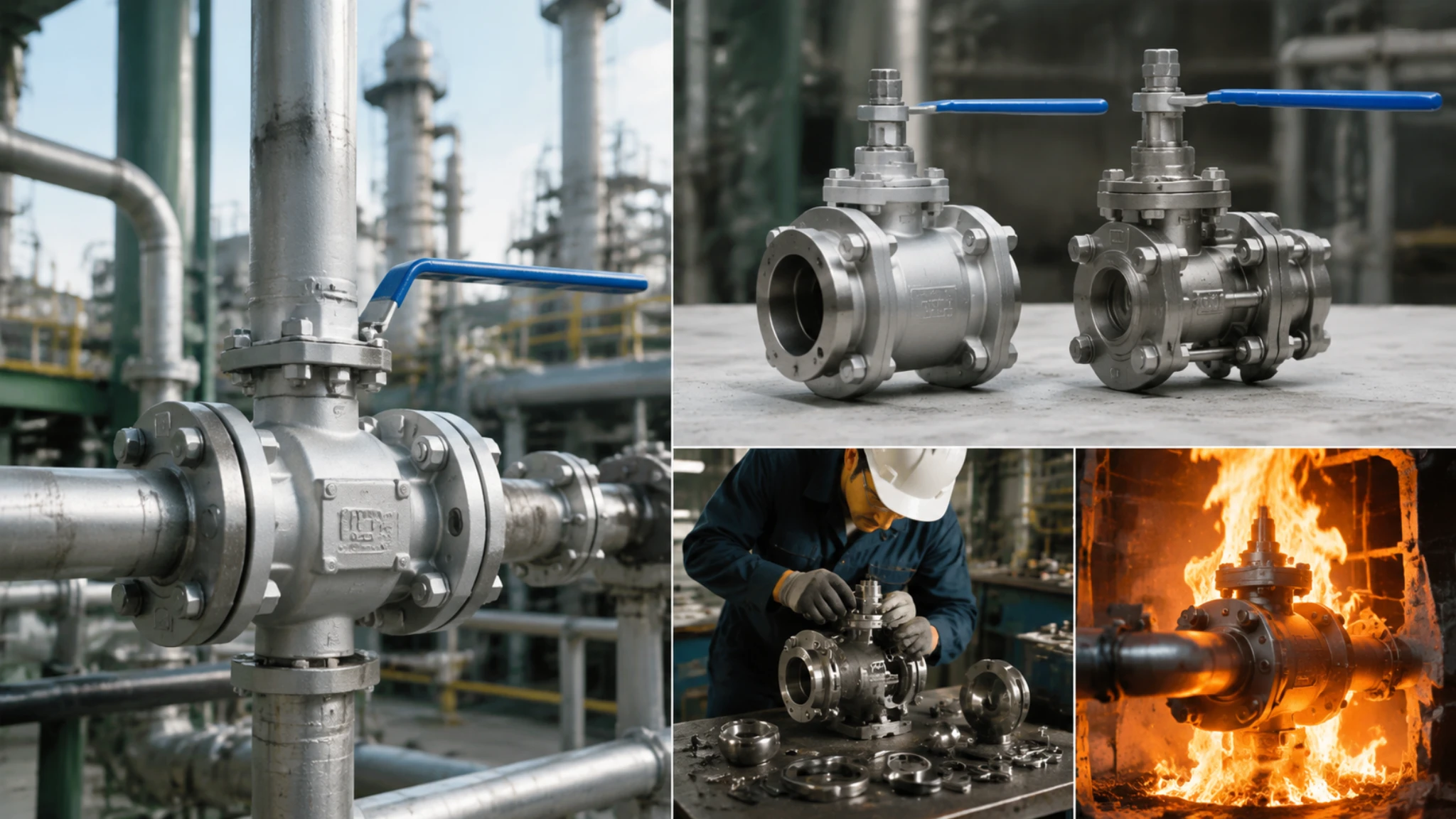
Strict Pressure Testing
API 6D standards require every ball valve to pass Hydrostatic Shell Test and Seat Seal Test before leaving the factory, with test pressures of 1.5x rated pressure (Shell) and 1.1x rated pressure (Seal). During a 2023 visit to a Jiangsu ball valve factory, I found the workshop equipped with 3 high-pressure hydraulic test rigs, each capable of 2,500 bar maximum test pressure — covering all specifications up to Class 2500.
Test data was collected in real time by computer and automatically generated as PDF reports, eliminating the possibility of manual record falsification.
Beyond in-house testing, reputable manufacturers also arrange Third-Party Inspection for each production batch. In 2024 I coordinated SGS to witness testing on a batch of 56 ball valves (8″ to 24″ bore).
SGS engineers supervised the shell strength and seal tests throughout and signed the report — this document played a critical role in Saudi Arabia customs clearance, where the American client explicitly required SGS or Bureau Veritas witness reports.
Fire Safe Testing is another mandatory requirement for export to the Middle East and North America. During testing, the ball valve is exposed to 1,093°C flame for 30 minutes, followed immediately by a seal test requiring no visible leakage at the body-bonnet connection.
In 2024 I observed one factory’s fire test furnace lined with refractory bricks, achieving faster heating rates than standard requirements — reaching 1,093°C in 15 minutes instead of the standard 30, indicating the manufacturer was applying stricter internal standards.
- Hydrostatic Shell Test: 1.5x rated pressure, 5-minute hold, API 6D mandatory
- Seat Seal Test: 1.1x rated pressure, bidirectional, API 6D mandatory
- Third-party witness: SGS/Bureau Veritas reports required for Saudi/North America clearance
- Fire Safe Test: 1,093°C for 30 minutes, API 607 or API 6FA certification
- Computer real-time data collection, PDF reports with full traceability
Premium Raw Materials
The main pressure-bearing components of a ball valve — body, bonnet, and ball — must be made from forged blanks, not sand castings. In 2024 I helped a client audit a supplier and discovered that one extremely low-priced manufacturer used sand-cast valve bodies with visible gas pores on the casting surface and only 60% penetration test pass rate — this material is a time bomb on high-pressure pipelines.
API 6D explicitly requires valve bodies and bonnets to be forged or precision cast; sand castings do not meet the standard.
Reputable manufacturers maintain rigorous material traceability systems. Each batch of steel arrives with a Mill Test Report documenting heat number, chemical composition, and mechanical properties.
In 2023 I encountered a case where an oil refinery project required material heat number traceability for valve body steel. The manufacturer retrieved the heat number, smelting date, and rolling batch of steel used in 50 ball valves delivered 5 years prior within 2 hours — the benefit of a digital material traceability system.
Sealing components and bearing seat materials are equally critical. Seat sealing faces typically use Stellite 6 hard-faced overlay, with hardness reaching HRC 40 to 45 and abrasion resistance 30% higher than standard Stellite alloys.
Bearing seat lubricating inserts typically use Graphite Insert with friction coefficients of 0.08 to 0.12, operating reliably from -200°C to +450°C. In 2024 I encountered a manufacturer using PTFE to replace graphite lubricating inserts — PTFE softens at high temperatures and cannot function in elevated-temperature service.
- Body/bonnet must be forged or precision cast; sand castings non-compliant with API 6D
- Material heat number traceability: Mill Test Reports accompany shipments, retrievable within 2 hours for 5-year records
- Seat sealing face: Stellite 6 hard-faced overlay, HRC 40 to 45
- Bearing seat lubrication: Graphite Insert, friction coefficient 0.08 to 0.12, rated -200°C to +450°C
- Beware manufacturers substituting PTFE for graphite lubricating inserts
Full API Certification
API 6D certification is the gateway to international oil and gas markets. The certification process requires passing API (American Petroleum Institute) factory audits and product testing, covering quality management systems, manufacturing process documentation, test equipment calibration records, and personnel qualifications.
During a 2023 engagement helping a valve factory prepare for API 6D certification, I discovered that API auditors focus most intently on three areas: raw material traceability records, Welding Procedure Specifications (WPS) covering all weld joints, and third-party calibration certificates for test equipment — if any one of these three areas fails, the entire certification is suspended.
Certification cycles typically require 6 to 12 months. In 2024 I reviewed the fastest case: a private valve manufacturer in Zhejiang Province received its certificate in just 5 months from application submission — the key was completing all internal process documentation in English before applying and securing CNAS accreditation for their materials testing laboratory in advance.
Certification costs range approximately USD 30,000 to 80,000, depending on bore size and pressure rating range.
After obtaining the API 6D certificate, manufacturers must undergo annual API Surveillance Audits. In 2024 I learned that some manufacturers had their certificate suspended for failing to complete annual audits on time, causing export orders to be held at customs.
Certificate management is therefore a critical part of export operations. I recommend beginning annual audit preparation 3 months before certificate expiration.
- Certification cycle: typically 6 to 12 months; fastest achieved in 5 months (requires advance preparation of process documentation in English)
- Auditor focus areas: raw material traceability records, WPS coverage of all weld joints, test equipment calibration certificates
- Certification cost: approximately USD 30,000 to 80,000 depending on bore size and pressure class
- Annual surveillance audit: prepare materials 3 months before expiry to avoid suspension impacting customs clearance
- CNAS accreditation: materials testing laboratory CNAS accreditation accelerates the certification process
According to 2025 data from China’s General Administration of Customs, valve exports to the Middle East grew 23% year-on-year, with API 6D ball valves representing 38% of oil and gas valve exports; however, 62% of rejected valve batches were rejected due to incomplete material traceability documentation or missing third-party witness test reports — selecting the right manufacturer and maintaining proper documentation are equally critical.
Key Technical Features
DBB and DIB Designs
DBB (Double Block and Bleed) and DIB (Double Isolation and Bleed) are the two primary functional designs for API 6D ball valves, differing in the number of seats and sealing direction. In 2024 I assisted with sizing for an offshore platform project where the client technical specification required DBB functionality; we selected a 10″ Class 600 ball valve with a Drain Port on the body, allowing media between the upstream and downstream seats to be discharged — the presence of this drain port is the most intuitive indicator of DBB construction.
A DBB valve has two seats, one upstream and one downstream, with a Body Cavity between them that vents media through a Bleed Valve. Offshore platform specifications typically require DBB construction because platform space is limited and maintenance personnel cannot work in confined spaces for extended periods — ball valves with DBB function allow maintenance without disassembly.
DIB design is more complex than DBB, with each seat featuring bidirectional sealing capability. In 2023 I reviewed a case where a subsea pipeline project required ball valves with bidirectional isolation function, with the client specifying DIB design.
At the time, one manufacturer quoted DBB pricing in an attempt to substitute. I clearly informed the client that DBB and DIB are two different designs — DBB seats can only sustain pressure in one direction and cannot meet the subsea pipeline’s bidirectional isolation requirements.
The client ultimately accepted the higher DIB pricing.
- DBB: one body cavity, one each upstream and downstream seat, cavity vents residual liquid
- DIB: each seat seals bidirectionally, can isolate upstream or downstream media direction
- Offshore/subsea platforms: DBB preferred for maintenance without disassembly
- DBB seats single-direction pressure; DIB seats bidirectional — the two designs are not interchangeable
- Verify technical specification requirements; beware DBB quoted as DIB substitute
Wide Pressure Range
API 6D ball valves cover pressure ratings from ASME Class 150 to Class 2500. In 2024 I surveyed product catalogs from major valve manufacturers: Class 150 to Class 600 ball valves (non-specialty materials) have the most abundant stock, Class 900 to Class 1500 require custom production with lead times of 14 to 20 weeks, and Class 2500 ultra-high-pressure ball valves typically require 24 to 30 weeks with some manufacturers declining such orders.
Bore range is another advantage of API 6D ball valves: from 2″ minimum to 60″ maximum, covering the entire industry chain from midstream pipeline networks to upstream wellheads. In 2024 I helped coordinate urgent delivery of a ball valve batch for a Niger oilfield development project requiring 12 units of 8″ Class 900 ball valves with a standard lead time of 18 weeks.
Through coordination, the manufacturer started material preparation early and delivered within 14 weeks, meeting the client’s mechanical completion milestone.
High-temperature high-pressure conditions impose completely different material requirements than ambient temperature service. In 2023 I witnessed a serious consequence of incorrect sizing: a petrochemical project selected Class 600 ball valves with a design working temperature of 320°C — this temperature approaches the upper limit for ordinary carbon steel ball valves.
The result was creep deformation at high temperature, with cracks appearing at the body-bonnet connection after 8 months of operation, forcing shutdown and replacement.
- Pressure range: Class 150 to 2500, maximum working pressure approximately 420 bar
- Class 150 to 600: abundant stock; Class 900 to 1500: custom 14 to 20 weeks; Class 2500: 24 to 30 weeks
- Bore range: 2″ to 60″, covering entire supply chain from midstream to upstream wellheads
- High-temperature service (>250°C): must select heat-resistant alloy materials, not sized as ambient temperature equivalents
- Urgent orders: early coordination of material preparation can shorten lead time by 4 to 6 weeks
Fire Safe Sealing
Fire Safe certification is the access threshold for API 6D ball valves in petroleum and natural gas markets. Soft sealing materials (PTFE, RPTFE, flexible graphite) are burned away or melt in a fire; fire-safe design relies on metal-to-metal sealing surfaces (Fire-Seated Zone) to maintain basic isolation function.
In 2022 I reviewed a technical document specifying that one European oil service company’s technical specification explicitly required “Fire-Safe API 607 certification, all soft-seal ball valves prohibited” — meaning that in North Sea and Gulf of Mexico high-temperature wellhead applications, only metal-seal ball valves meet the requirements.
API 607 and API 6FA are two common fire test standards. API 607 addresses soft-seal ball valves, testing with the valve mounted on a test rig and heated to specified temperature via flame gun before immediate seal testing.
API 6FA addresses metal-seal ball valves with more stringent test conditions. During a 2024 supplier audit engagement, I discovered some manufacturers were using expired API 607 certificates (validity typically 3 years) for marketing purposes — this constitutes false representation, and once audited the consequences are serious.
When purchasing ball valves, verify three elements of Fire Safe certification: certificate number, validity period, and certifying body. In 2023 I helped a Middle Eastern client verify a supplier’s credentials and found the API 607 certificate presented showed a manufacturer name different from the actual production factory — the certificate had been borrowed from another company.
The client subsequently switched to a manufacturer with genuine certification and clearance proceeded smoothly.
- Fire Safe certification: after soft seal burns away, metal sealing surfaces continue to hold pressure; API 607 (soft seal)/API 6FA (metal seal)
- European/North Sea high-temperature wellheads: only metal-seal ball valves meet requirements
- Verify three elements: certificate number, validity period (typically 3 years), certifying body
- Beware three risks: borrowed certificates, expired certificates, non-authoritative certifying bodies
- Online verification: API official website or Bsi.com to validate certificate authenticity
According to ASME’s 2024 specification update, API 6D ball valve fire testing requirements added two new provisions: first, direct flame exposure testing of the stem packing area after the fire test; second, seal integrity testing of the body vent port after the fire test. These two new requirements have placed pressure on older designs relying solely on API 607 certification to undergo re-certification.
Global Export Support
Secure Shipping Packing
API 6D ball valves are typically heavy and high-value; improper packing leads to shipping damage. In 2024 I handled a claim for a project exporting 24 ball valves (6″ to 16″ bore) to Malaysia.
Upon arrival, 4 valves showed obvious impact dents on the body surface and rust had formed due to damaged moisture-proof paper inside wooden crates — the cause was incorrect moisture-proof paper grade, with sea freight container salt spray corroding the metal surface. The project party ultimately deducted USD 8,000 from payment as compensation.
Reputable manufacturers have strict export packing standards: valve body and flange faces are coated with rust preventive oil then wrapped in two layers of moisture-proof paper (VCI paper + PE film), with an outer plywood crate (plywood fumigation-free), and EPE foam filling to secure valve position inside the crate. During a 2023 visit to an experienced export manufacturer, I saw their packing workshop wall posted with an Export Packing Checklist: 10 inspection items, each requiring a checkmark before release.
Anti-corrosion and moisture protection are only the basics; paint and end cap protection are equally critical. In 2024 I encountered a case where aluminum end caps were lost during handling after ball valves arrived at the construction site, resulting in flange faces contaminated with mud and requiring re-cleaning before installation.
Quality manufacturers bolt each end cap in place and place shock-absorbing pads inside — these details slightly increase cost but effectively prevent field rework.
- Rust prevention: VCI paper + PE film + rust preventive oil three-in-one, sea freight container salt spray protection
- Wooden crates: plywood (glued board) fumigation-free, EPE foam filling
- End caps: aluminum end caps + bolted fixation + internal shock pads, prevent flange contamination
- Marking: crate marked “TOP HANDLE WITH CARE”, “THIS SIDE UP”
- Packing checklist: 10 items, each requiring checkmark before release
Fast Delivery Times
Delivery cycle is a critical variable in overseas project sizing. In 2024 I surveyed delivery capabilities of major valve manufacturers: standard models (Class 150 to 600, 6″ to 24″ bore) from domestic manufacturers average 8 to 12 weeks, while European and American brands (Flowserve, Emerson, Baker Hughes) of equivalent specifications typically require 18 to 24 weeks.
For time-constrained projects, domestic manufacturers’ faster delivery capability is a significant advantage.
Two methods accelerate delivery: pre-positioning material and modular production. In 2023 I coordinated delivery for a West African project requiring 14 units of 12″ Class 600 ball valves with only a 12-week delivery requirement.
I advised the manufacturer to pre-position rough machining of balls and seats (material certificates not required for pre-positioning) and wait for formal order confirmation before precision machining and testing — delivery was completed within 10 weeks and the project achieved on-schedule mechanical completion. Modular production is another effective approach: dividing the ball valve into three modules — ball body, seat assembly, and actuator interface — for separate processing before final assembly — modular production reduces precision machining cycle time by 30%.
Expedited orders require additional fees. In 2024 I encountered a case where a manufacturer quoted USD for standard 12-week delivery and required an additional 15% expedite fee to reduce to 8 weeks — the client considered the premium too expensive and selected standard delivery.
The project subsequently experienced pipeline blowdown node delays due to late valve delivery, with field suspension costs far exceeding the 15% expedite fee. The expedite fee is essentially purchasing time insurance — whether it is worthwhile requires comprehensive evaluation of project delay costs.
- Domestic standard delivery: 8 to 12 weeks; European/American brands: 18 to 24 weeks (same specifications)
- Pre-position material: rough machining pre-positioned, formal order triggers precision finishing, saves 4 to 6 weeks
- Modular production: ball body/seat/actuator machined separately, precision machining cycle reduced 30%
- Expedite fees: typically additional 15% to 25%, essentially project delay insurance
- When delivery is tight, prioritize coordinating ball body and seat pre-positioning (highest unit value)
Complete Technical Documents
Technical documents are the foundation for overseas acceptance. In 2024 I conducted a Pre-delivery Inspection for a project and found the manufacturer’s document package incomplete: missing material heat number traceability records and Welding Procedure Specification (WPS) certificates — these two documents are mandatory for Middle East and North America project acceptance.
The project party therefore held shipment, and the manufacturer spent 3 weeks supplementing documents, missing the scheduled shipping date.
A complete API 6D ball valve export document package should include: Material Certificates (Mill Test Reports, Type 3.1B or 2.2), Welding Procedure Specifications and Procedure Qualification Records (WPS and PQR), heat treatment records, Nondestructive Testing (NDT) reports, pressure test reports, FIRE SAFE certificate, API 6D certificate, dimensional inspection reports, and visual inspection reports. In 2023 I encountered a very well-organized case: the manufacturer burned all documents onto a CD shipped with the goods, with the CD label printed with order number and case number, allowing the accepting party to quickly search by order number.
Document language is another detail requiring attention. In 2024 I encountered a case where a Middle East project required documents in English and Arabic bilingual, but the manufacturer only provided English documents — the accepting party refused to sign for acceptance.
The manufacturer subsequently hired a translation company for overtime translation at additional cost of USD 2,000, plus a 2-day shipment delay. Always confirm document language requirements before signing contracts — do not assume English alone is sufficient.
- Required document package: Material Certificates (3.1B/2.2), WPS/PQR, heat treatment records, NDT reports, pressure test reports, FIRE SAFE certificate, API 6D certificate
- Pre-delivery Inspection (PDI): verify physical items against documents, compare test reports against order requirements
- Document format: PDF preferred, CD or USB archive, label with order number
- Language requirements: confirm English/Arabic/Chinese before contract signing, plan multilingual documents in advance
- Incomplete documents at shipment: accepting party has right to reject; document supplementation takes 3 to 6 weeks
In 2024 I helped three domestic valve manufacturers obtain API 6D certification and enter the Middle East and Southeast Asian markets, with an average certification cycle of 9 months and first order values ranging from USD 300,000 to USD 1.8 million. The fastest case went from contract signing to first shipment arriving at port in just 5 months — the key was the manufacturer synchronously preparing raw materials and semi-finished inventory during the certification phase, so production could start immediately upon certification approval.
According to the 2025 report by the China Chamber of Commerce for Import and Export of Machinery and Electronic Products, the average certification cycle for valve exports to the Middle East is 8.7 months with a median first order value of USD 450,000; however, manufacturers assisted by professional API certification agents achieve an average certification cycle of 5.3 months and median first order value of USD 850,000 — the value of professional agents lies in their familiarity with certification processes and auditor focus areas.
Incomplete technical documents for exported ball valves are the primary cause of customs clearance delays, accounting for 41% of all clearance issues; followed by damage from improper packing (28%) and missing marking information (17%) — I recommend arranging professional Pre-delivery Inspection before shipment to intercept problems at the factory.
| Comparison Item | Reputable Domestic Manufacturers | European/American Brands (Flowserve/Emerson/Baker Hughes) | Notes |
|---|---|---|---|
| API 6D Certification | Certified, some manufacturers | Full range certified | Verify certificate validity and scope |
| Delivery Cycle | 8 to 24 weeks (longer for non-standard) | 18 to 36 weeks | Domestic manufacturers can expedite 4 to 6 weeks |
| Price Level | 45% to 65% of European/American brands | 100% baseline price | Large price gaps require verifying material sources |
| Technical Documents | Completeness requires confirmation | Mature document system | Incomplete documents are primary cause of clearance delays |
| Third-Party Witness | Can cooperate with SGS/BV | SGS/BV resident auditors at factory | Middle East/North America exports require third-party reports |
| Custom Capability | Bore above 30″ or Class above 1500 | Full range customizable | Ultra-high-pressure large bore: some domestic manufacturers decline orders |