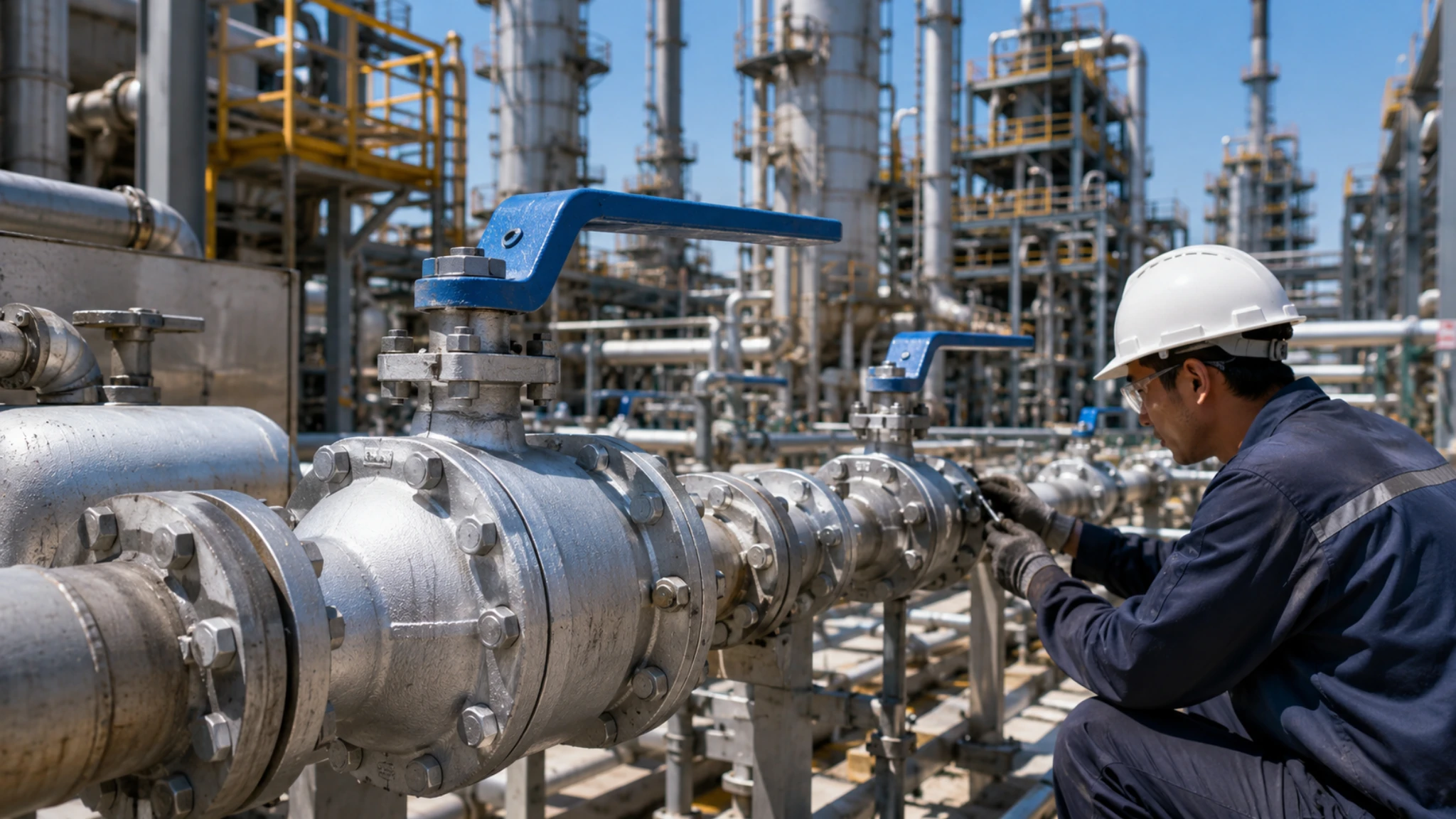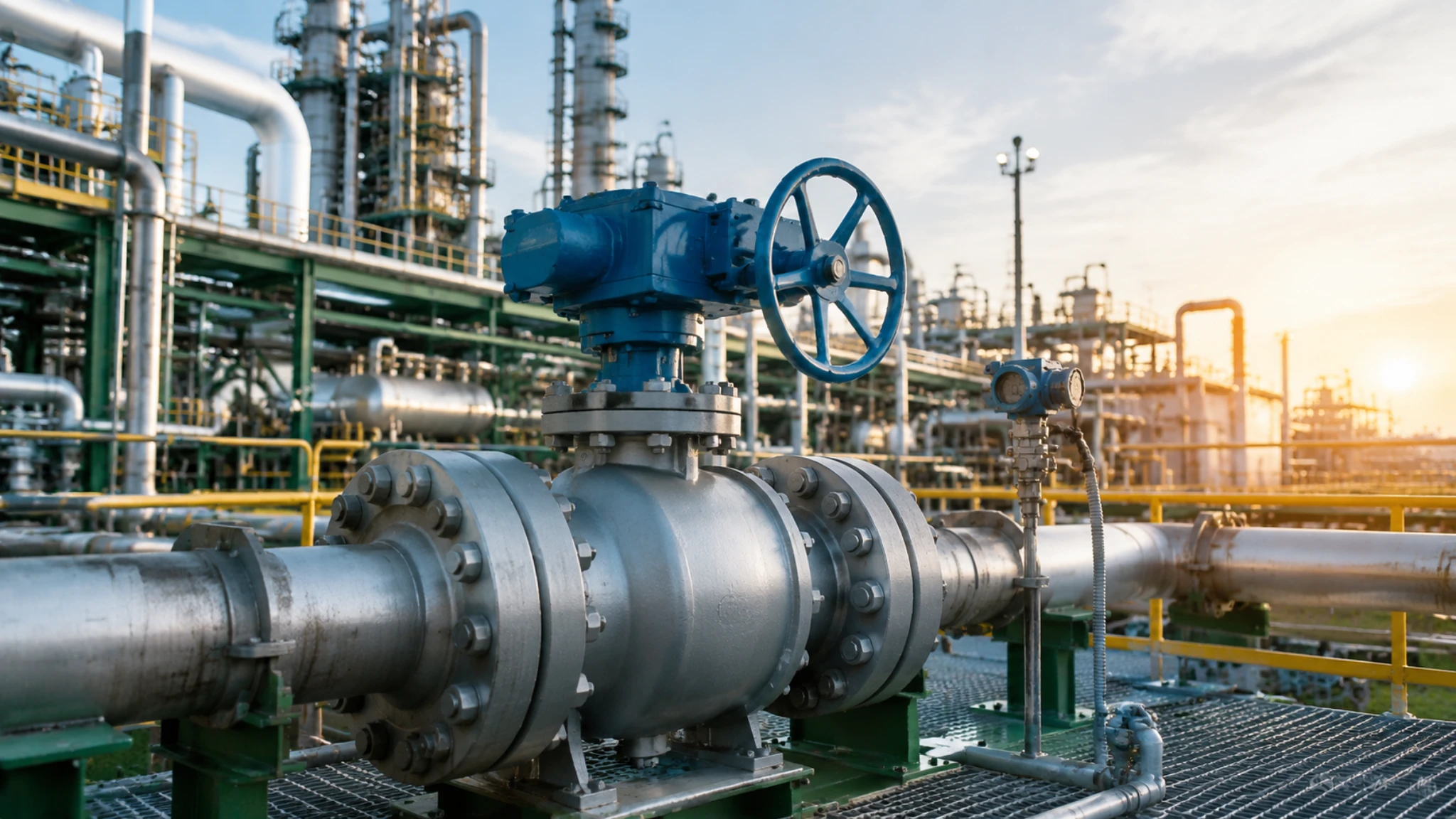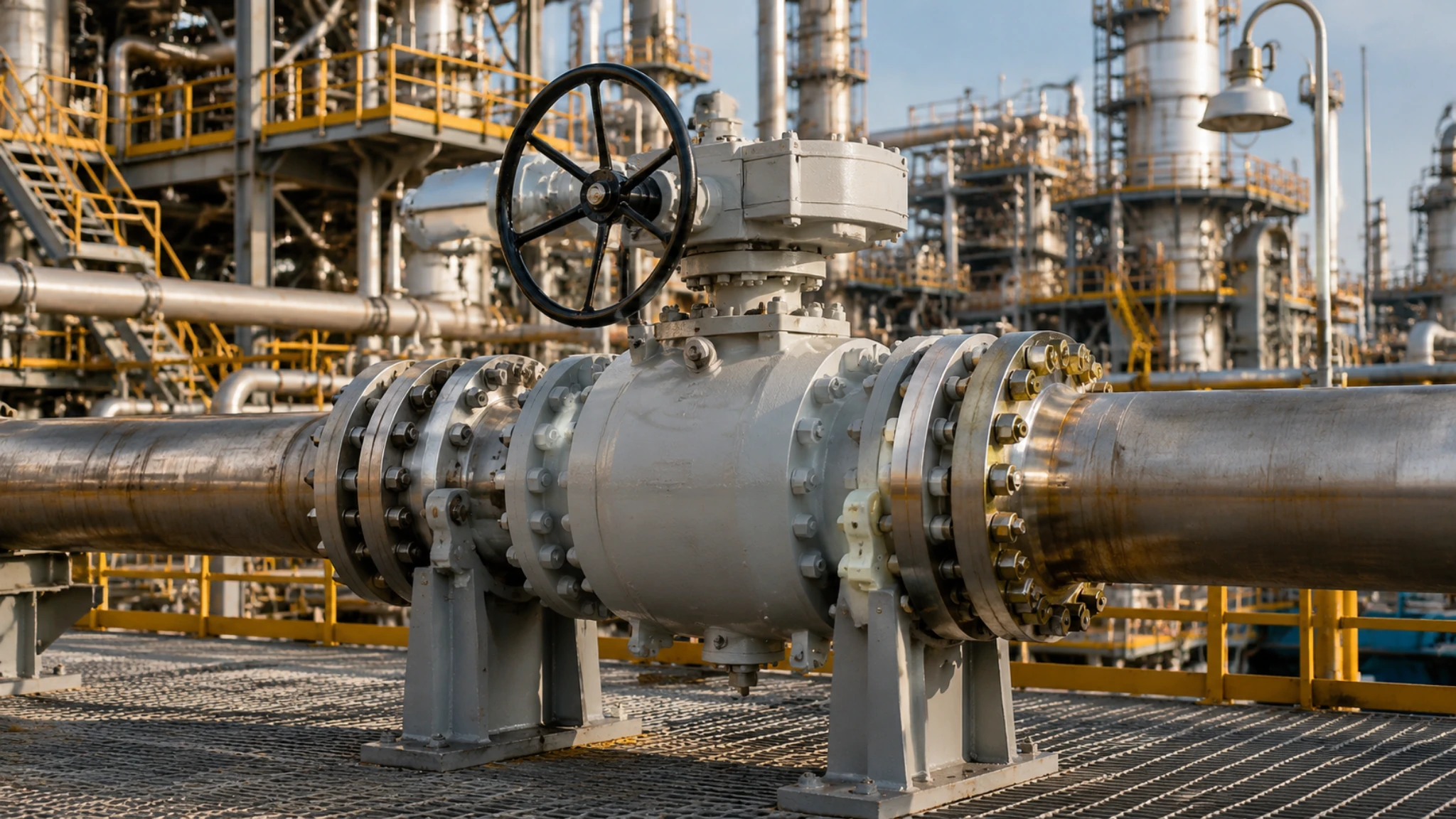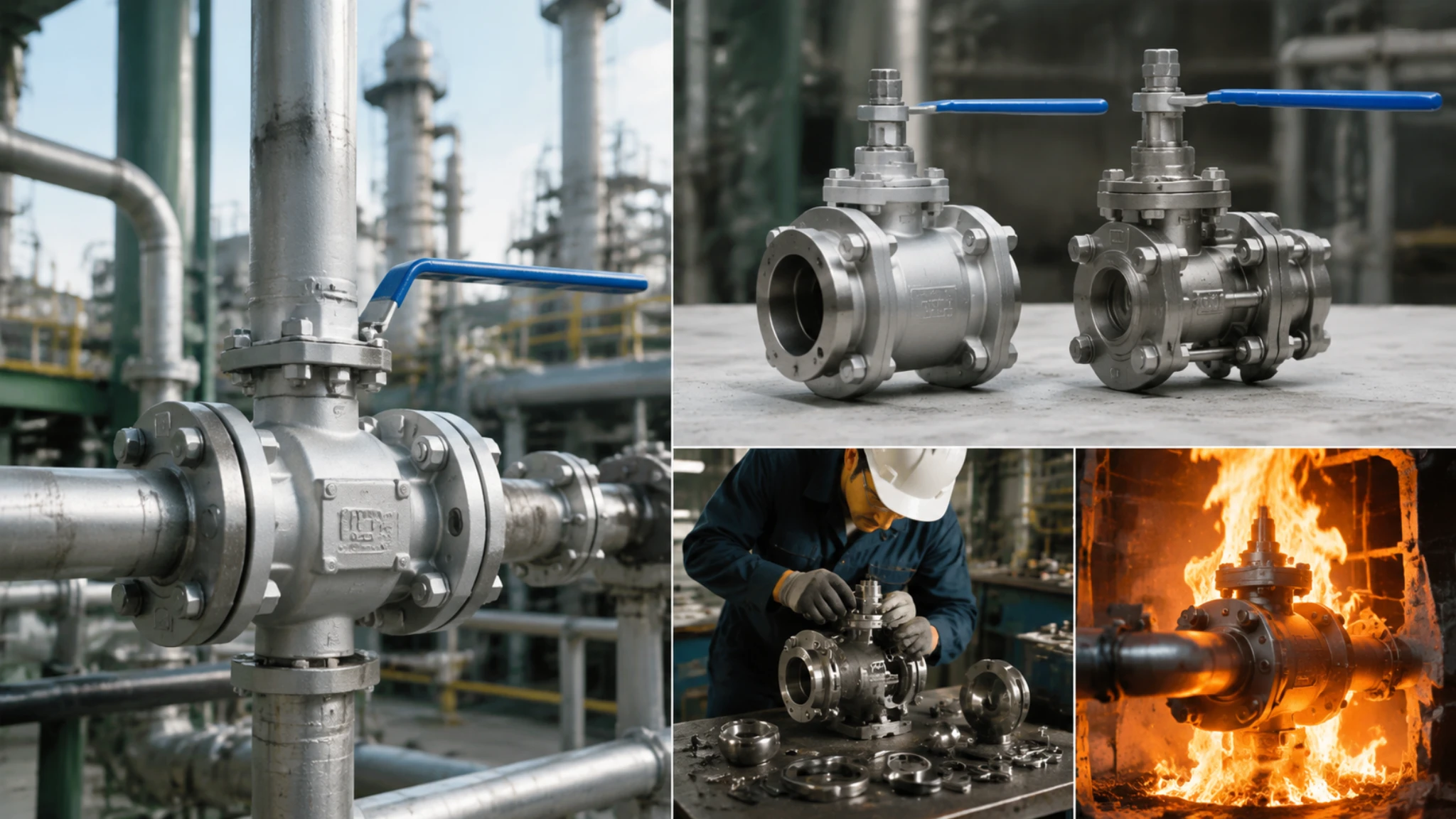
Choosing API certified ball valve manufacturers should verify their ISO 9001 certificate number, CE declaration of conformity and third-party testing reports (such as API 6D testing).
Focus on confirming pressure rating (such as Class 150-2500), leakage rate ≤ 0.01%, opening and closing life ≥ 10,000 times, and require provision of material reports and factory pressure test records, ensuring quality reliability.
ISO 9001
Raw Material Traceability
Every piece of A216 WCB valve body blank entering the factory area, the side must be concave engraved with no less than 8 digits of Heat Number. Material clerk checks MTC quality certificate, ensuring carbon content lower than 0.25%, preventing welding from producing cracks.
Handheld spectrometer aimed at the valve body yields a PMI report showing CF8M stainless steel molybdenum content maintained between 2.0% to 3.0%. Quality control group enters the batch number into the ERP system, verifying whether nickel content reaches the industrial grade standard of 10.5% or above. Materials with data error exceeding 0.05% will be marked with red paint and returned to the melting workshop.
Physical performance testing process retains complete curve charts. Tensile testing machine measured tensile strength must exceed 485 MPa, yield strength 250 MPa is the bottom line requirement. Below this value, the ball valve under high pressure working conditions will appear permanent deformation. Samples are soaked in a -46 degrees Celsius low-temperature impact tank for 10 minutes, impact energy reading needs to stabilize at 27 Joules or above.
Factory only accepts raw materials with EN 10204 3.1 certificates, and even for high-pressure conditions above Class 900, 3.2 grade third-party inspection certificates are required. Every certificate corresponds to a unique tracking code, linked to the procurement contract and entry date.
- Heat No. (Heat No.) corresponds to steel water smelting batch
- Batch No. (Lot No.) corresponds to heat treatment furnace batch
- Serial No. (Serial No.) corresponds to single finished product number
- Inspector code recorded in process handover sheet
Regarding F51 duplex steel material, Pitting Resistance Equivalent PREN value calculation is extremely rigorous. Formula is Cr + 3.3 * (Mo + 0.5 * W) + 16 * N. Value must be greater than or equal to 34, otherwise material in seawater and other high chlorine environments will occur pitting corrosion. Data is directly stored in the cloud database for retrieval within the subsequent 10 years.
Valve stem material selection usually uses 17-4PH, heat treatment state set as H1150. Hardness tester measurement results need to be in the 28-33 HRC range, too high will lead to brittle fracture, too low will cause sealing face wear. After each valve stem processing is finished, diameter tolerance is controlled within plus or minus 0.02 mm, surface roughness reaches Ra 0.4 standard.
Sour service ball valves meet NACE MR0175 regulations. Sulfur content reduced to below 0.005% can effectively avoid hydrogen-induced cracking. Hardness test points are distributed in the valve body middle cavity and flange face, readings need to be pressed below 22 HRC.
Radiographic testing (RT) aims at Class 600 grade and above cast steel valve bodies. Film numbering and valve body numbering correspond one-to-one. On the negative film, if air holes with diameter exceeding 1.5 mm or slag inclusion with length exceeding 4 mm appear, the part is judged as scrap.
- Ultrasonic testing (UT) captures internal shrinkage cavity signals
- Magnetic particle testing (MT) detects cracks within 2 mm of the surface
- Penetrant testing (PT) confirms sealing face overlay welding layer has no point-like pinholes
- Ferrite content measurement controlled between 3% to 8%
Forging A105 undergoes normalization treatment, grain size needs to reach Grade 5 or finer. Coarse grains will lead to valve producing stress concentration during pressure fluctuations. Metallographic analysis report shows pearlite and ferrite distribution is uniform, permitted to enter CNC machine tools for precision machining.
Sealing ring (Seat) adopts RPTFE or PEEK material. PEEK at 260 degrees Celsius high temperature deformation rate is lower than 1%. Polymer material entry inspection needs to check density index, tolerance controlled at plus or minus 0.02 g/cm3.
Worker scans part QR code, screen automatically jumps out material qualified conclusion. If material code does not match drawing BOM table, torque wrench cannot start, eliminating wrong material risk. Assembly torque value set at 1200 Nm, monitored by sensor in real time and recorded into single unit file.
Pressure testing bench produces digital pressure curves, synchronously capturing corresponding Heat Number data. 1.5 times nominal pressure shell test lasts no less than 120 seconds. High pressure water pump pressure gauge every 6 months sent to metrology institute for calibration. Test data error range limited within 0.5% of full scale.
Finished product packaging box outer side is pasted with a nameplate containing all raw material information. QR code covers the whole process from ore ironmaking 3 years ago to assembly testing 3 days ago.
Manufacturing & Processing Accuracy
Ball roundness through high-precision CNC grinding machine controlled between 0.01mm to 0.015mm. Adopt coordinate measuring machine (CMM) to detect ball diameter, ensuring diameter tolerance maintained within plus or minus 0.02mm range. Surface roughness Ra value must reach 0.2μm, preventing opening process scratching soft seal valve seat. Grinding process uses 800 mesh or above diamond grinding paste, continuously running for 45 minutes to eliminate surface microscopic ripples.
Machine tool spindle runout amount before each shift starts needs calibration, dynamic error controlled below 0.005mm. Tool service life through system automatic counting, after processing 50 balls forcibly replace carbide tool head. Spindle speed set at 1200rpm to 1500rpm, matching 7.0 MPa high-pressure coolant to flush chips. CNC program deviation corrected through real-time compensation, ensuring consistency of same batch parts reaches 99.9% or above.
Valve seat sealing face flatness through monochromatic light interference check, light band number less than 2. Metal hard seal ball valve executes “ball-seat matching grinding” process, matched sealing clearance is less than 5 microns. PTFE valve seat insert groove depth deviation limited within 0.05mm range. After sealing pair assembly, self-lubricating coating pressing is performed under 150-ton hydraulic press pressure, ensuring even force.
| Component Name | Inspection Item | Accuracy Requirement/Data Index |
|---|---|---|
| Ball (Ball) | Roundness (Roundness) | 0.01mm – 0.015mm |
| Valve stem (Stem) | Concentricity (Concentricity) | 0.02mm |
| Valve body cavity (Body) | Sealing face roughness (Ra) | 0.4μm |
| Flange face (Flange) | Flatness (Flatness) | Every 100mm deviation < 0.05mm |
| Stuffing Box (Stuffing Box) | Verticality (Verticality) | 0.03mm |
Tungsten carbide coating thickness after High Velocity Oxygen Fuel (HVOF) spraying is stable at 0.15mm to 0.25mm. Coating hardness through Leeb hardness tester actual measurement, reading falls in 68-72 HRC range. Bonding strength test shows coating and substrate bonding force greater than 70 MPa. Spraying room temperature constant at 25 degrees Celsius, humidity lower than 45%, avoiding microscopic pores generated inside the coating.
Valve stem and ball connection keyway matching accuracy level set as H7/g6. Matching clearance if exceeding 0.15mm will lead to actuator appearing 15 degrees idle stroke. Stuffing box hole diameter processed by deep hole drilling machine, verticality deviation within every 100mm length controlled at 0.03mm. Assembly stage uses digital torque wrench, recording initial sealing torque value around 550 Nm.
- Adopt 5-axis linkage machining center one-time clamping to complete milling of 4 planes, eliminating secondary clamping errors.
- Tool holder dynamic balance value set as G2.5 grade, significantly reducing mechanical vibration under high-speed rotation.
- Every 2 hours manually spot check flange sealing groove bottom thickness, tolerance strictly controlled at plus or minus 0.1mm.
- Valve cover connection bolt hole position tolerance controlled at 0.15mm, ensuring stress distribution symmetry during assembly.
- Before coating, surface shot blasting treatment reaches Sa 2.5 grade, anchor pattern depth maintained at 40-70 microns.
Pneumatic ball valve bracket installation face parallelism actual measured value must not exceed 0.1mm. Actuator shaft hole and valve stem axis eccentricity distance controlled in 0.05mm range, preventing valve stem from being squeezed by lateral force leading to packing leakage. Workshop constant temperature system maintained at 22 degrees Celsius, reducing measurement deviation generated by material thermal expansion and contraction. CMM probe every 4 hours automatically calibrates coordinate system on standard ball.
After sealing pair assembly, low pressure gas seal test is performed, valve fully immersed in water tank to observe for 60 seconds. Bubble generation frequency requirement is zero, test data real-time uploaded to ISO 9001 quality database. Ball valve middle flange gasket compression amount strictly controlled between 25% to 30%. Bolt pre-tightening force achieved through sequential diagonal loading method, final torque deviation controlled within plus or minus 5%.
Medium and large diameter ball valve bearing position processing tolerance accuracy improved to IT7 level. Valve body internal flow passage undergoes polishing treatment, flow resistance coefficient reduced by more than 5%. Aiming at Class 600 high pressure working condition, valve body wall thickness margin through ultrasonic thickness gauge point-by-point scanning, recorded points not less than 12. Castings with wall thickness thinning rate exceeding 2% directly enter isolation area, strictly prohibited from entering subsequent precision machining processes.
Metal secondary seal ring in Fire-safe structure, its edge grinding accuracy reaches 0.8μm. In 760 degrees Celsius high temperature simulation experiment, residual leakage after soft seal burning must be lower than the limit regulated by API 607. Anti-static device contact resistance through multimeter actual measurement, reading must be less than 10 ohms.
- Valve seat pre-tightening spring pressure deviation controlled at plus or minus 2N.
- Thrust washer (Thrust Washer) adopts reinforced composite material, friction coefficient lower than 0.05.
- Valve stem anti-blowout (Anti-blowout) step chamfer accuracy controlled at 0.5 * 45 degrees.
- Valve body sealing face spray-welds Stellite 6 hard alloy, thickness not less than 2.0mm.
- Automatic welder current fluctuation range limited within plus or minus 1%, ensuring consistent weld penetration.
CNC lathe X/Z axis repeat positioning accuracy set as 0.003mm. Every batch of parts first piece must be inspected, in continuous production every 10 pieces extract 1 piece for full parameter re-measurement. Machine tool hydraulic fixture pressure maintained at 4.5 MPa, preventing thin-walled parts from elastic deformation under clamping force. All waste chips undergo centrifugal oil removal treatment, workshop floor oil pollution coverage lower than 0.1%, ensuring clean measurement environment.
Finished valve no-load opening torque needs to undergo 10 reciprocating cycle tests. If torque fluctuation amplitude exceeds 10% of initial value, it is judged as uneven internal assembly stress. Packing gland bolt exposed length consistency controlled within 2mm, reflecting standardization of assembly process. Every factory-shipped valve is accompanied by an actual measurement report containing 24 key machining dimensions, serving as paper evidence for the ISO 9001 system.
Pressure Test Specification
API 598 and ISO 5208 standards regulate the hard indicators for ball valve factory pressure testing. Shell test pressure must reach 1.5 times the nominal pressure, test medium is usually clean water containing rust inhibitor. Aiming at stainless steel material valves, chloride ion content in water strictly controlled below 30ppm, preventing induction of pitting corrosion risk during 10-minute pressure holding process.
DN150 specification ball valve under 15.0 MPa pressure needs to maintain 120 seconds without visible leakage. Since castings may have sand holes difficult to distinguish by naked eye, test area light intensity needs to reach 500 Lux or above.
Shell test is not just a leak tightness check, it is a physical verification of valve body structural strength. Under 1.5 times overpressure state, the tonnage pressure borne by the valve body cavity directly acts on the bolts, any material defects will be exposed during the 2-minute pressure holding period.
- DN50 and below valves: pressure holding time 15 seconds
- DN65 to DN150 valves: pressure holding time 60 seconds
- DN200 to DN300 valves: pressure holding time 120 seconds
- DN350 and above valves: pressure holding time 300 seconds
High pressure seal test pressure set as 1.1 times nominal pressure. Water pressure pump raises pressure to rated value, then close upstream valve, observe digital pressure gauge reading change. Grade 0.5 accuracy pressure gauge every 180 days sent to statutory metrology institute for adjustment, ensuring range covers 1.5 to 4 times the test pressure.
Soft seal ball valves are required to reach Rate A leakage standard, which is zero bubbles within specified time. Metal hard seal ball valves according to API 6D allow micro internal leakage, leakage amount through displacement method accurately calculated. Regarding Class 600 grade metal seal valves, allow leakage per mm diameter needs to be converted into drops per minute recorded and archived.
Low pressure gas sensitivity test uses 0.4 to 0.7 MPa dry air or nitrogen. Valve in half-open state filled with gas and fully immersed in water tank, stay for 5 minutes to exclude surface attached bubbles.
Gas molecule diameter is far smaller than water molecule, low pressure gas seal test can capture micron-level gaps that water pressure cannot find. For working conditions transporting natural gas or hydrogen, this step’s qualification certificate is the admission ticket for field entry.
Bidirectional seal ball valves need to be pressurized from left and right ends respectively, to test the reliability of opposite side seats. DBB (Double Block and Bleed) function valves observe at the cavity bleed valve whether cross-pressure exists. Regarding Class 900 and above high pressure ball valves, test process needs to be operated in protection cabin with 20mm thick explosion-proof glass, operation desk data real-time transmitted through 4K camera.
Curve horizontal axis records time, vertical axis records pressure value, fluctuation deviation must be within plus or minus 0.1 MPa. If pressure curve appears obvious step-like decline, system will automatically lock that serial number, prohibit printing qualification certificate and forcibly generate non-conforming item disposal process.
Use digital multimeter to measure resistance value between ball, valve stem and valve body, reading under 12V DC voltage must not exceed 10 ohms.
Pressure test record sheet contains test date, environment temperature, medium type, pressure holding duration and specific pressure drop value. These original data are usually uploaded to cloud server in scanned form, preservation period not less than 10 years.
Aiming at LNG working condition cryogenic ball valves, -196 degrees Celsius liquid nitrogen immersion test needs to be performed. After valve fully cooled in cryogenic box, operation torque value increase must not exceed 3 times the room temperature state. After test finished, need to stand still at room temperature for 24 hours, re-measure sealing face rebound sealing performance at room temperature.
Regarding Emergency Shut-Off valves (ESD), test process needs to contain 5 consecutive no-load switches and 3 pressured actions. Measure time difference from actuator receiving signal to fully closed, usually requirement within 1 second/inch diameter. These time accuracy data precise to 0.01 second, directly determining truncation efficiency of process pipeline in accident state.
Valve seat self-relieving (Self-relieving) function test needs to inject pressure from valve cavity. When internal pressure exceeds rated value 1.1 times to 1.33 times, valve seat should automatically push open to release pressure to downstream. Inspector records relief start pressure and reseating pressure, ensuring deviation within 5% range.
- Water pressure pump output flow: not less than 10 liters per minute
- Filter accuracy: medium filter mesh not less than 100 mesh
- Pressure sensor sampling frequency: 100Hz
- Environment background noise limit: lower than 75 decibels (convenient for manual auscultation leak detection)
Before finished valve packaging, internal cavity water must be blown dry using compressed air. Residual moisture will lead to carbon steel valve seat producing flash rust within 48 hours, affecting sealing accuracy. Humidity inside valve after blowing needs electronic hygrometer detection, reading lower than 30% can plug in plastic dust cover and paste 3M waterproof label.
CE Marking
EN 10204 Certificate
If valve body adopts ASTM A216 WCB carbon steel material, EN 10204 3.1 certificate will clearly list chemical composition percentages. Carbon (C) content usually controlled between 0.21% to 0.25%, manganese (Mn) content then in 0.7% to 1.0% range, while sulfur (S) and phosphorus (P) these impurities must be lower than 0.035%.
Subtle deviation in chemical components will change valve physical performance, if Carbon Equivalent (CE) exceeds 0.43%, valve body when welding with pipeline is extremely easy to produce hot cracks.
Mechanical performance part in certificate records actual measured values of tensile test. For A105 forged steel valve, tensile strength needs to reach above 485 MPa, yield strength must not be lower than 250 MPa. Experimenter will pull standard test bar to break on universal testing machine, recording elongation data not lower than 22%.
- Certificate number and issuance date, need to contain manufacturer’s quality department official seal.
- Material specification grade, for example ASTM A351 CF8M or A105N.
- Chemical analysis actual measured value for each heat number steel, precise to three decimal places.
- Yield strength, tensile strength and elongation actual physical curve data.
- Brinell hardness (HBW) test results, carbon steel usually required between 137 to 187.
- Heat treatment process record, containing normalization temperature 900 degrees Celsius and its constant temperature holding time.
- Nondestructive testing (NDT) report number, such as 100% radiographic testing (RT) qualified record.
In extremely low temperature conditions, such as -46 degrees Celsius liquefied gas environment, certificate must contain Charpy V-Notch impact test data. Three specimens in a group after cooling in low temperature tank are instantly struck to break, average impact energy needs to reach 27 Joules or above, preventing ball valve from occurring brittle fracture like glass during pressure fluctuations.
Heat treatment report is an indispensable attachment in 3.1 certificate. For CF8M austenitic stainless steel ball valve, must undergo solution treatment above 1040 degrees Celsius and rapid water quenching. Certificate will record heating curve, soaking time (usually calculated as 1 hour per 25mm wall thickness) as well as cooling medium initial temperature.
If customer’s project is located on offshore drilling platform or high risk chemical area, usually higher grade EN 10204 3.2 certificate will be required. This not only needs manufacturer’s internal inspection, but also requires third-party inspection agencies like DNV, Lloyd’s or BV to station personnel at factory.
- 3.1 certificate by manufacturer authorized independent quality representative issued, belonging to internal supervision.
- 3.2 certificate by manufacturer representative and third-party inspector jointly signed.
- 3.2 certificate involves whole process visual traceability from original steel ingot to finished product processing.
- 3.2 certification cost usually 15% to 25% higher than 3.1, inspection cycle also will extend.
Pressure test record usually acts as performance supplement to 3.1 certificate. According to API 598 standard, a DN100 PN40 ball valve, its shell water pressure test pressure needs to reach 6.0 MPa, and maintain 120 seconds without visible leakage. Valve seat seal test then performed under 4.4 MPa pressure, recording bubbles leakage count per minute.
Regarding alloy steel valves, PMI (Positive Material Identification) data density is extremely high. Handheld spectrometer will scan valve body surface, actual measuring chromium (Cr) content around 18.2%, nickel (Ni) content around 10.1%.
Valve wall thickness actual measured data will also be reflected in quality proof document. Use ultrasonic thickness gauge to perform 5-point measurement on valve body weak parts, ensuring its actual thickness greater than minimum calculated wall thickness regulated by ASME B16.34 standard, for example minimum wall thickness of 150lb 4 inch valve needs to satisfy 7.6 mm.
Nondestructive testing (NDT) report provides evidence of valve body internal quality. If executing radiographic testing (RT), report will note compliance with ASME BPVC Section V standard, film evaluation grade needs to reach Grade 2 or above, ensuring no internal slag inclusion or shrinkage cavity defects exceeding 2 mm.
Qualified 3.1 certificate also will note anti-static test results. Between ball, valve stem and valve body, resistance value measured using digital ohmmeter needs to stabilize below 10 ohms. This data ensures that during hundreds of opening and closing frictions per hour, static charge can be quickly conducted to earth, avoiding sparks triggering medium explosion.
ATEX 2014/34/EU
A ball valve marked with II 2 G Ex h IIC T4 Gb, its each character corresponds to specific physical environment. II represents non-mining ground factory equipment, 2 G corresponds to Zone 1 high risk gas environment, Ex h refers to structural safety type protection according to ISO 80079-36 standard.
T4 temperature grade regulates that under most extreme working conditions, ball valve outer shell surface temperature must not exceed 135 degrees Celsius. When calculating this data need to consider 40 degrees Celsius or 60 degrees Celsius highest environment temperature, plus temperature rise produced by valve stem and packing friction, ball and valve seat frequent switching, margin usually reserved 20 degrees Celsius.
Aiming at hydrogen (IIC group) etc. extremely flammable medium, ball valve anti-static design must embed a set of spring plus stainless steel ball device between valve stem and ball, valve stem and valve body respectively. This set of mechanical structure maintains continuous electrical contact between metal parts, conduction resistance value needs to stabilize below 10 ohms.
- Select 304 or 316 stainless steel spring, ensuring elastic attenuation lower than 5% after 1 million switching cycles.
- Contact ball diameter usually 3 mm to 5 mm, material hardness needs to be higher than valve stem, preventing long term friction producing pits leading to bad contact.
- Anti-static device test voltage is 12 Volt DC, each batch of products needs 100% resistance detection and record original values.
- Valve drain plug (Drain Plug) needs synchronous equipotential connection, preventing isolated charge produced by medium accumulation.
When environment humidity lower than 30%, non-metallic materials like PTFE valve seat or nylon handle sleeve easy to accumulate static electricity. ATEX certification requires non-metallic exposed surface area under IIC group must not exceed 20 square centimeters, or material surface resistivity must be lower than 10 to the 9th power ohms, preventing brush discharge from occurring.
Regarding cast valve body, ATEX directive strictly limits light metal content ratio. In Zone 1 (Category 2) environment, total content percentage of aluminum, magnesium, titanium and zirconium in valve body material must not exceed 7.5%, to prevent valve from being struck by hard objects producing mechanical impact sparks sufficient to ignite gas.
| Zone Division | Equipment Category | Explosion Protection Level (EPL) | Gas/Dust Environment |
|---|---|---|---|
| Zone 0 / 20 | Category 1 | Ga / Da | Continuously existing explosive atmosphere |
| Zone 1 / 21 | Category 2 | Gb / Db | Likely to occur during normal operation |
| Zone 2 / 22 | Category 3 | Gc / Dc | Unlikely to occur during normal operation |
Technical File (Technical File) needs to be archived in EU Notified Body (such as TUV Rheinland numbered 0035) for at least 10 years. File contains ignition danger review table regulated by ISO 80079-36, detailing analysis of 13 potential ignition sources, including hot surfaces, friction sparks and adiabatic compression.
Ball valve operation speed is limited within 0.2 meters/second, to reduce instantaneous temperature rise of sealing face. Manual ball valve when designing needs to calculate mechanical collision risk of handle or actuator, all exposed fasteners (such as middle flange bolts) need to adopt embedded type or special washers, preventing loose collision producing energy exceeding 0.2 mJ sparks.
Aiming at Zone 21 or Zone 22 dust explosion environment, ball valve nameplate will be marked with Ex h IIIC T135 degrees Celsius Db. This requires stuffing box and bracket parts possess extremely high sealing grade, usually needing to reach IP6X grade, preventing conductive dust from entering valve stem rotation parts causing blockage or local overheating.
- Actuator connection part needs to apply anti-rust grease, preventing thermite reaction sparks produced by friction between iron oxide (rust) and aluminum shell.
- Packing gland nut needs to possess anti-loosing function, ensuring maintenance of pre-tightening force in industrial vibration above 20 Hz.
- Nameplate material should use stainless steel, thickness not less than 0.5 mm, and fixed with rivets, strictly prohibited from using glue paste.
Testing Reports
Pressure Testing
Before factory-shipping ball valves under API 6D specification, shell strength calibration must be completed on hydraulic test bench. Regarding conventional Class 300 grade carbon steel ball valve, shell test pressure needs to be set at 1.5 times the rated working pressure, approximately 7.7 MPa.
NPS 2 and below valves need to maintain for 15 seconds, while for NPS 12 large diameter ball valves, pressure holding time must exceed 300 seconds. During testing, valve body casting surface, packing seal place as well as flange connection parts strictly prohibited from appearing liquid drops or moisture traces.
Aiming at stainless steel material valves, chloride ion content in test water needs control below 30 ppm. This data requirement prevents austenitic material from occurring stress corrosion after contact with moisture. Test environment temperature needs maintenance between 5 degrees Celsius to 50 degrees Celsius, to ensure metal toughness is in standard state.
- Shell test pressure: 1.5 times nominal pressure
- Liquid pressure holding time: 15 seconds to 300 seconds varying
- Medium chloride ion concentration: below 30 ppm (stainless steel specific)
- Instrument accuracy grade: not lower than Grade 1.5
- Test environment temperature: 5 to 50 degrees Celsius
After finishing high pressure shell test, pressure lowered to 1.1 times rated value, entering seal performance detection. Ball valve rotated to full closed position, apply pressure alternately from left and right ends. Regarding soft seal ball valves adopting PTFE or nylon material, standard requires achieving bubble grade zero leakage, no water droplets can seep out from downstream end during pressure holding cycle.
Metal hard seal ball valves allow existence of micro leakage, judgment basis is Rate D standard of ISO 5208. Under 1.1 times water pressure, leakage amount per mm nominal diameter has clear limit. For example a DN250 hard seal valve, if per minute leakage exceeds 10 drops of water, this product will be pasted with unqualified label and returned to assembly workshop.
After high pressure water test, 0.4 to 0.7 MPa low pressure gas seal test needs to be performed. Fill air or nitrogen into valve cavity, and apply neutral leak detection liquid at sealing pair. Observe whether there are bubbles continuously produced and growing, this is an effective means for verifying seat fit tightness under small pressure condition.
- Low pressure gas test pressure: 0.4 MPa to 0.7 MPa
- Soft seal leakage standard: Rate A (zero bubbles)
- Hard seal allowable leakage amount: complies with ISO 5208 Rate D
- Gas seal test medium: industrial nitrogen or dry air
- Leak detection liquid property: neutral, does not corrode sealing face
Trunnion ball valves possessing DBB (Double Block and Bleed) function, their test procedures are more complex. Need to place valve ball in closed position, pressurize from both side seats simultaneously, and open bleed valve at valve body bottom. Observe whether medium overflows from bleed pipe port, to verify whether both end seats each possess independent sealing barrier.
Aiming at DIB-1 or DIB-2 type bidirectional seal valves, need to inject pressure from inside valve cavity, detecting seat performance under reverse load. Since this working condition produces huge reverse thrust, test report will record seat spring compensation displacement amount. Data deviating from design value by more than 0.5 mm is regarded as structural design defect.
During pressure testing process, technical personnel will synchronously measure valve opening and closing torque. In full pressure difference environment, record Newton-meter (N·m) value output by actuator. If actual torque exceeds design theoretical value by 20%, it shows internal parts assembly too tight or friction pair lubrication bad, needs re-disassembly for inspection.
- Breakaway torque: record maximum value at moment of overcoming static friction
- Running torque: record stable value during ball rotation process
- Sealing torque: record squeezing torque when valve ball embeds into seat
- Resistance detection: resistance between valve stem and valve body needs to be less than 10 ohms
Pressure gauge every half year sent to statutory metrology institute for calibration, report sheet will be attached with calibration certificate number. All test curves real-time generated by automatic recorder, strictly prohibited from any manual correction. Top of every report is printed with valve body Heat Number, ensuring this set of pressure data can be traced to steel mill smelting batch.
Third-party inspectors (TPI) usually station on-site to supervise these processes. After confirming pressure gauge reading stable, pressure holding duration reaching standard and no naked eye visible leakage, they will hit steel stamp beside valve body nameplate. These documents containing pressure curves, torque records and material traceability codes, jointly constitute the valve’s quality archive.
Material Traceability
Every qualified API ball valve at the moment casting or forging finished, valve body side will be hit with a set of permanent Heat Number (Heat Number) by steel stamp. This string of 5 to 8 digits of letters and numbers points to the original proportion of that pot of liquid metal in the steel furnace. In production record of ASTM A105 forged steel valve, this Heat Number corresponds to the MTC (Material Test Certificate) provided by raw material plant, recording steel ingot whole process from smelting to forming.
Raw material entry stage, inspector will hold X-ray Fluorescence Spectrometer (XRF) to perform random sampling on each batch of blanks. When sampling ASTM A216 WCB carbon steel valve body, instrument will display within 3 seconds whether manganese (Mn) content is in range of 0.60% to 1.00%. If sulfur (S) or phosphorus (P) content exceeds 0.035%, whole batch of blanks will be marked as unqualified and returned to melting furnace, because impurity exceeding limit will induce welding cracks.
On tensile testing machine in laboratory, specimens cut from same heat number test bar need to undergo tensile strength test exceeding 485 MPa. Actual measured data shows, when yield strength reaches 250 MPa and elongation maintained above 22%, ball valve under high pressure working conditions then possesses sufficient plastic deformation capability, rather than occurring brittle fracture.
- ASTM A216 WCB: Carbon content maximum 0.30%, applicable for non-corrosive media.
- ASTM A350 LF2: -46°C low temperature impact energy needs to satisfy average value 20J or above.
- ASTM A182 F316: Chromium content needs to be in 16.0% to 18.0%, nickel content between 10.0% to 14.0%.
- PMI detection coverage: Under API 6D specification usually required to perform 100% composition verification on pressure bearing parts.
- Specimen size: Standard tensile proportional specimen diameter usually 12.5mm.
In valve industry, EN 10204 3.1 certificate is the minimum bottom line for delivery documentation. This report is independently signed by manufacturer quality department, confirming that batch of ball valves chemical and mechanical energy fully complies with order requirements. When project involves LNG transportation in extremely cold regions, buyers often require provision of more rigorous 3.2 certificate, which requires Lloyd’s (LR) or DNV inspectors to witness whole testing process and stamp.
| Material Grade | Carbon (C) Max | Manganese (Mn) Range | Yield Strength (min) | Tensile Strength (min) |
|---|---|---|---|---|
| A105 | 0.35% | 0.60-1.05% | 250 MPa | 485 MPa |
| WCB | 0.30% | 1.00% max | 250 MPa | 485 MPa |
| F316 | 0.08% | 2.00% max | 205 MPa | 515 MPa |
| LF2 | 0.30% | 0.60-1.35% | 250 MPa | 485 MPa |
Aiming at sour service containing hydrogen sulfide, ball valve material needs to comply with NACE MR0175 standard. At this time, material report will extra add an actual hardness measured data, Rockwell hardness (HRC) must be locked below 22. Technical personnel use table-top Brinell hardness tester, uniformly take 4 measurement points on valve body surface, ensuring hardness average value in range between 137 HBW to 187 HBW, to avoid sulfide stress cracking risk.
Ball valves in low temperature environment are extremely sensitive to Charpy V-Notch impact test. After soaking in -29°C or lower dry ice alcohol bath for 10 minutes, specimen is quickly placed on impact machine. After pendulum falls, instrument will record energy consumed. If average impact energy of three groups of samples lower than standard 30 Joules, then judge that heat number material possesses instability risk under low temperature, cannot enter subsequent processing.
Tightness inside metal is verified through Nondestructive Examination (NDE), which belongs to extension of broad material traceability. Regarding Class 600 or above high pressure ball valves, valve body end flange needs to perform 100% ultrasonic testing (UT). Detector sweeps across metal surface with 2MHz frequency, if reflected pulse exceeding benchmark level appears on screen, it shows internal existence of shrinkage cavity or slag inclusion, this kind of blank with defects will be scrapped immediately.
- RT Radiographic Testing: Used for internal defect characterization of castings, film showing blackness needs to be between 1.5 to 4.0.
- MT Magnetic Particle Testing: Detects surface cracks of forgings, magnetic suspension concentration controlled at 1.2% to 2.4%.
- PT Penetrant Testing: Aiming at stainless steel valve bodies, development time needs maintenance for 10 to 60 minutes.
- Forging ratio requirement: API standard usually requires forging compression ratio not lower than 4:1, to crush coarse grains.
Every process on production line produces a record with time stamp. From saw machine blanking, rough turning forming to precision machining sealing face, operators will sign names into ERP system. When valve passes pressure test in final assembly stage, these fragmented data will automatically converge into a complete material archive.
Closed loop of traceability system also contains control over seats, valve stem, springs and other Trim parts. When valve stem adopts ASTM A182 F6a material, needs to undergo quenching and tempering treatment, metallographic structure after tempering needs grading under 500x microscope. If carbide segregation serious, valve stem in frequent switching process may occur shearing.
Fire-Safe Testing
API 607 fire test is performed in special combustion laboratory, valve is installed in pipeline surrounded by high energy gas nozzles. To simulate real fire condition, 4 thermocouples are arranged at key valve body parts, distance from valve body surface not exceeding 25 mm. Within 2 minutes after ignition, flame temperature must quickly climb and stabilize between 760°C to 980°C.
During testing process, valve interior is filled with fresh water bearing preset pressure. For Class 150 ball valve, during whole 30-minute combustion period, internal pressure needs maintenance around 2.0 MPa. Technical personnel real-time monitor pressure fluctuation through pressure transmitter, if pressure drop exceeds 5% of test benchmark, it is regarded as shell seal failure, test terminates immediately.
- Test duration: Continuous combustion for 30 minutes
- Flame temperature: 760°C (1400°F) to 980°C (1800°F)
- Pressure maintenance: Maintained at 75% of working pressure
- Calorimeter block setting: 2 carbon steel material calorimeter blocks, recording environment absorbed heat
- Medium control: Test medium is clean fresh water, preventing high temperature producing toxic vapor
Under 30 minutes of high temperature roasting, PTFE or nylon and other soft seal seats inside ball valve will quickly carbonize or even fully melt. At this time, API 607 standard examines the effectiveness of Metal-to-Metal auxiliary seal. Valve ball under spring force or medium pressure push, fits with metal sealing face on seat, thereby preventing large scale medium spraying.
Tester outside combustion room through measuring cylinder with scale collects downstream end leakage water. API 607 limit for internal leakage amount is extremely precise, for NPS 6 (DN150) valve, average leakage amount per minute allowed through sealing pair must not exceed 2400 ml.
Aiming at external leakage at valve stem packing and valve body middle flange gasket, standard regulates more rigorous gram indicators. Technical personnel through condenser collect steam and water flowing out from these parts, and perform weight record. During whole combustion process, if total external leakage amount exceeds ratio of 100 ml per inch nominal diameter per minute, that valve will be judged as unable to pass fire certification.
- Internal leakage limit: 400 ml / inch / min (at sealing pair)
- External leakage limit: 100 ml / inch / min (at valve stem and middle flange)
- Low pressure re-test: After cooling verify seal again under 0.2 MPa
- Full differential pressure opening: After cooling need to complete one full switching operation under full differential pressure
Test bench will start forced air cooling system or wait for natural cooling, until valve body surface temperature drops below 100°C. At this time “high pressure re-test” needs to be performed, raising internal pressure again to rated working pressure. Leakage amount data at this time used to evaluate whether valve after fire extinguished can still effectively seal off residual dangerous media.
Laboratory record sheet will detail mark every minute’s temperature curve, ensuring average temperature of calorimeter blocks at 15th minute reached 650°C. This quantification control of thermal load eliminates possibility of cheating by false high flame but insufficient metal heating.
After undergoing nearly thousand degree high temperature quenching, huge static friction often generated between valve stem and seat due to thermal expansion. Tester needs to operate actuator, observe whether ball valve can smoothly switch from full closed to full open. If valve stem occurs twisting break or jamming during operation, even if before not a drop leaked, it also cannot obtain API 607 certificate.
| Specification Item | Technical Parameter Requirement | Actual Measured Data Example |
|---|---|---|
| Test Pressure (Class 150) | 2.1 MPa (300 psi) | 2.08 MPa |
| Average Flame Temperature | 760°C – 980°C | 845°C |
| Total Combustion Internal Leakage | 12000 ml (30min) | 4850 ml |
| Re-test Pressure After Cooling | 2.0 MPa | 2.0 MPa |
| Re-test Internal Leakage | 120 ml / min | 15 ml / min |
Besides API 607, API 6FA standard aiming at upstream oil and gas field emphasizes more on valve performance in full open or full closed state. Technical data package will be attached with detailed Certificate of Compliance, printed with laboratory unique number and inspector signature.
Every group of milliliters, every degree of temperature rise curve, all correspond to precision control of valve body structure on production line. Compliant fire-safe valves on seat design usually reserve 0.5 to 1.2 mm metal compensation margin, to ensure in the vacuum period after soft seal disappears, metal sealing face can instantly take over pressure from pipeline.