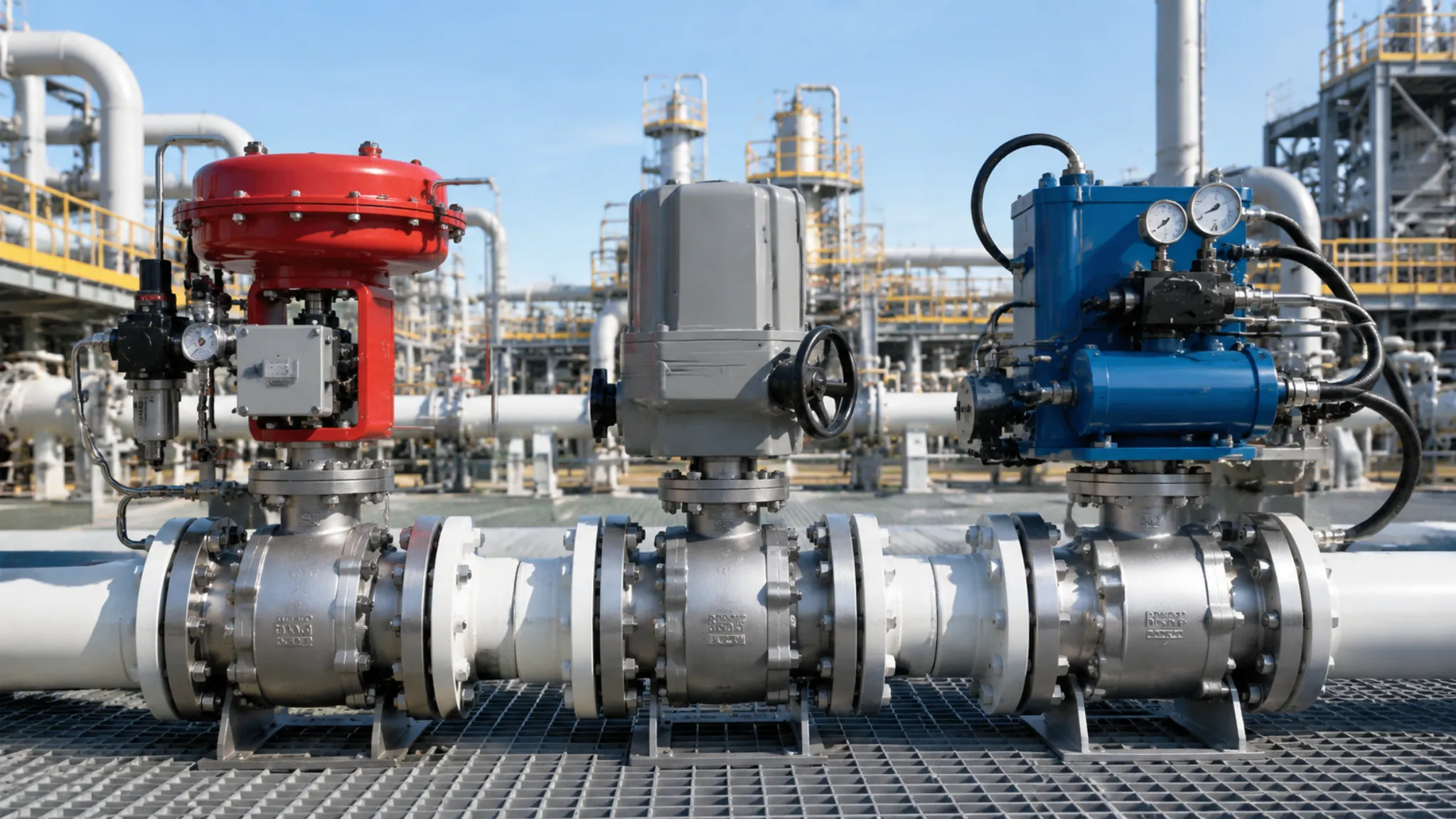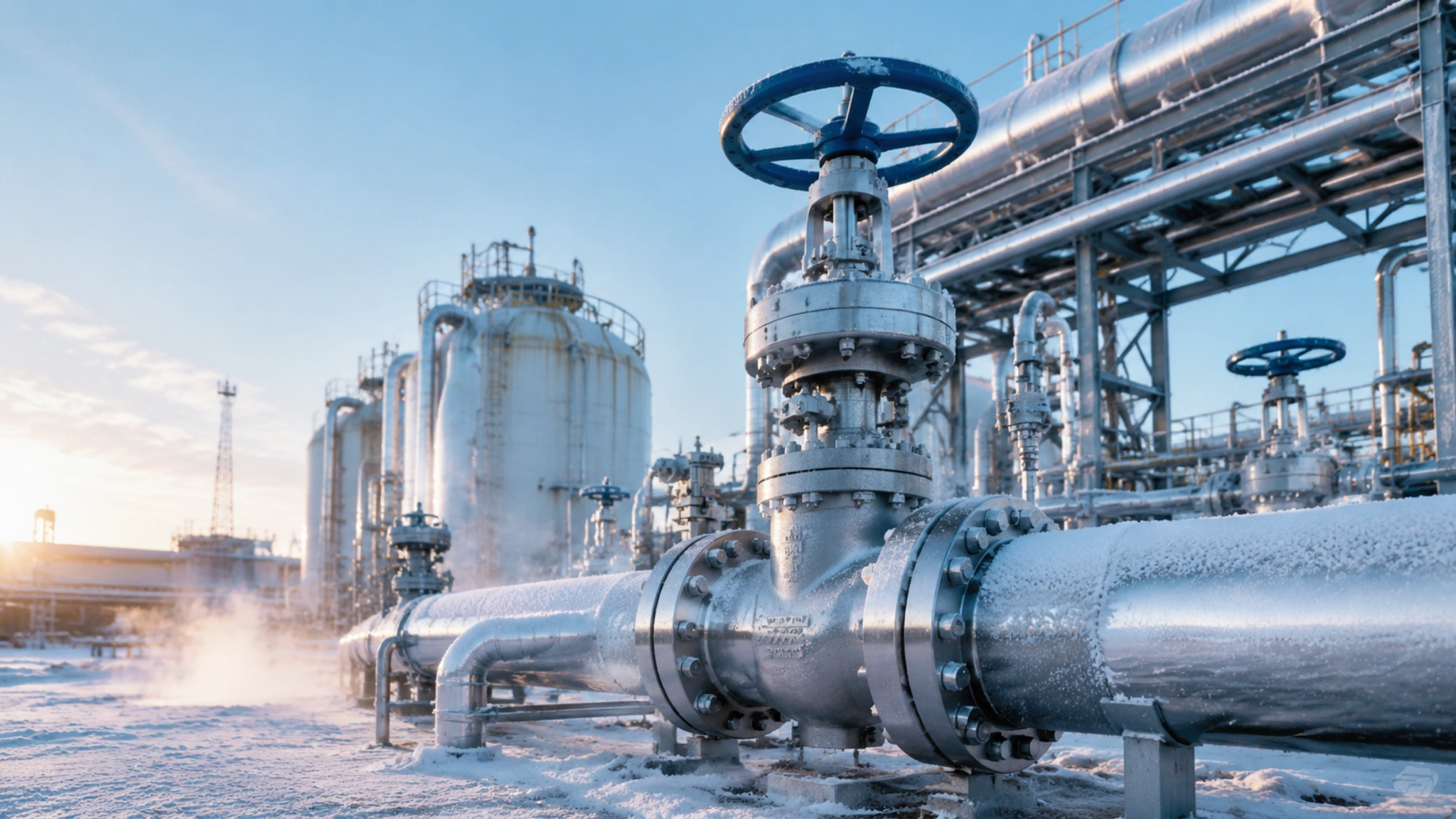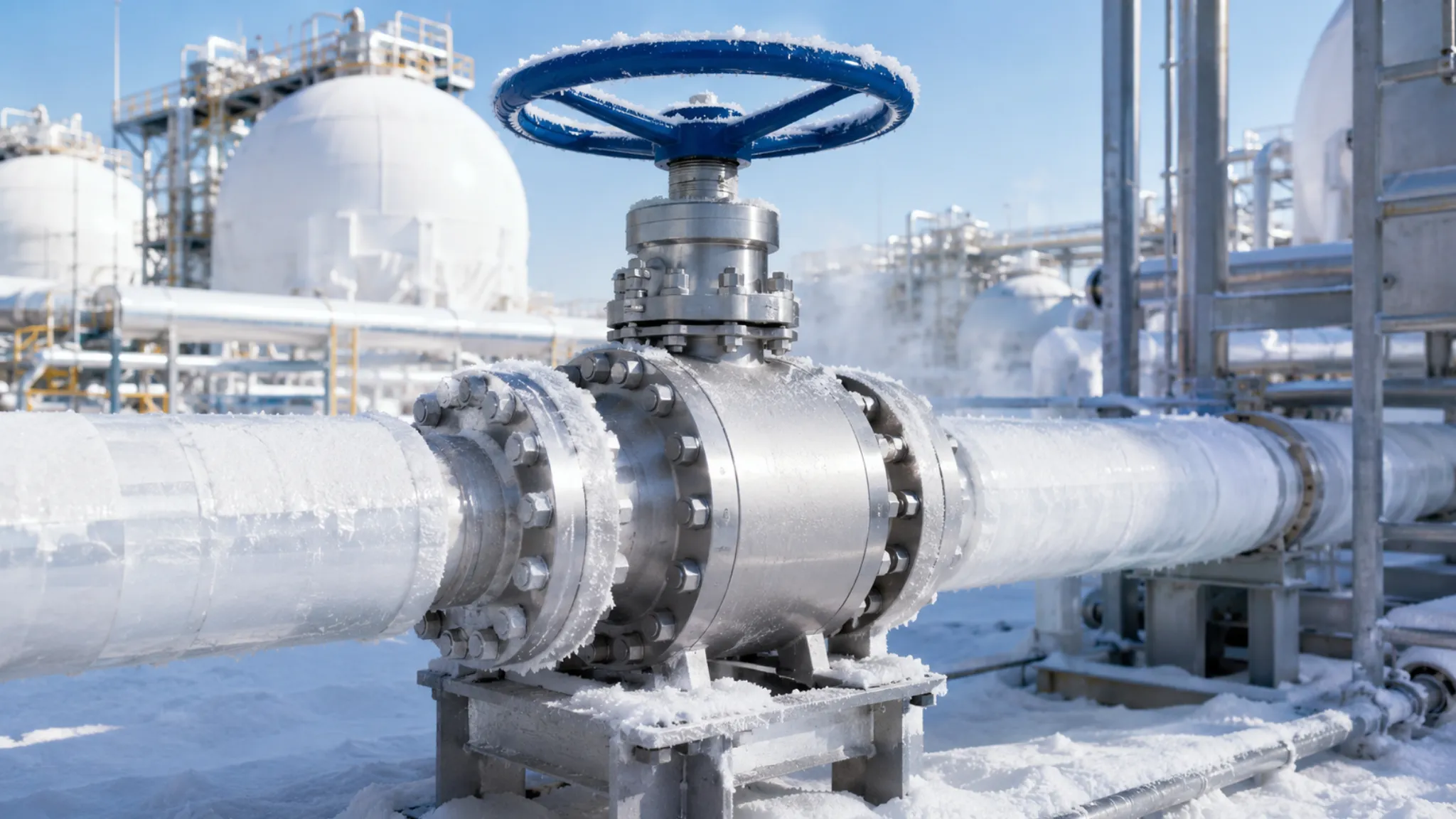
DBB manifolds cover 3 oil and gas sites (wellhead, offshore, FPSO), 3 refinery applications (high-temp, dosing, sampling), and 3 pipeline safety scenarios (isolation, pigging, instrument). This guide reviews 9 field-tested deployments.
Oil & Gas Sites
Wellhead Control
DBB compact manifolds deploy between the wing valve and master valve on the Christmas Tree at the wellhead, providing double isolation during well-intervention work. I led the selection review for a Central Asia oilfield project (wellhead pressure 35 MPa, CO2 partial pressure 1.2 MPa): the wellhead H2S concentration reached 2,000 ppm, and the operator initially specified A216 WCB standard bodies. Stress corrosion cracking from hydrogen sulfide fractured the wing-valve stem within 6 months, forcing a switch to Inconel 718 stems with hard-faced metal seats. Per-unit cost jumped from USD 8,000 to 22,000, and the failure analysis later became a mandatory upgrade path for sour-service wells with NACE + Inconel specifications.
Wellhead DBB selection follows 4 core parameter categories, each tied to a specific technical constraint:
| Parameter | Onshore Wellhead Standard | Offshore Wellhead Severe | Shale Gas Wellhead |
|---|---|---|---|
| Pressure Rating | Class 600 (9.93 MPa) | Class 900-1500 (14.9-24.8 MPa) | Class 1500-2500 (24.8-42.4 MPa) |
| Temperature Range | -29°C to 120°C | -46°C to 180°C | -29°C to 200°C |
| H2S Content | < 50 ppm (sweet gas) | 200 to 2,000 ppm (sour service) | < 10 ppm (shale gas) |
| Typical Material | A216 WCB + 13Cr stem | A352 LCC + Inconel 718 stem | A216 WCB + 17-4PH stem |
| Certification Set | API 6D + ISO 5208 Rate A | API 6D + NACE MR0175 + API 607 | API 6D + ISO 15848-2 Class A |
| Lead Time | 8-12 weeks | 16-20 weeks | 10-14 weeks |
Wellhead selection has 4 hard constraints: (1) Full Bore to prevent sand-jam (Reduced Bore fails within 3 months in sandy wells); (2) Metal seats to resist particle erosion (soft seats burn through in 6 weeks under sand); (3) NACE MR0175 for sour service (onshore sweet-gas wells can opt out, sour wells must comply); (4) Fire-safe API 607 (isolates oil flow in a fire to prevent blowout). Missing any 1 of these 4 constraints makes a wellhead DBB a buried time bomb. Bake all 4 into the RFQ as knockout criteria. Any vendor that cannot meet a single item should be eliminated, since verbal “we can do it” tends to become a field failure. When a wellhead fails, the loss from a single-well shutdown for 1 day can exceed USD 1 million, and the recovery cost is irreversible.
Offshore Platforms
Offshore platforms need a much higher DBB density than onshore. A single wellhead platform typically installs 12 to 20 sets. I joined the DBB selection review for a South China Sea deepwater platform (operating depth 320 m). The original spec used a standard Class 600 manifold, but the platform’s vibration acceleration reached 4.5 m/s², well above the 2.5 m/s² conventional limit. Stem threads developed fatigue cracks within 6 months. After a full swap to seismic-rated DBBs with thickened stems and self-locking nuts, per-unit cost climbed from USD 12,000 to 19,000, but the vibration-fatigue issue was eliminated.
Offshore-platform DBB selection differs from onshore in 4 key aspects:
- Space constraint: platform deck area costs roughly USD 30,000/m², and each compact DBB saves about 0.5 m², which is worth USD 15,000 in real estate
- Salt-spray corrosion: A351 CF8M stainless steel or higher-grade alloy is mandatory; standard carbon steel with external coating rusts through in 18 months
- Vibration fatigue: stem threads need finite-element analysis (FEA), since conventional designs crack in 4 to 6 months
- Emergency shutdown: ESD valve trains require full closure within 2 seconds, so DBB operators must pair with fast pneumatic actuators
The biggest offshore-versus-onshore gap is “maintenance cost.” A single platform DBB failure needs a helicopter, an engineer, and a parts lift, with combined cost over USD 800,000. So offshore DBB selection must be “over-specified”: one pressure class higher than the actual service, one sealing class tighter than required, and 20% thicker body wall than the standard. These 3 over-spec items cut the 5-year total cost of ownership (TCO) significantly and qualify as worthwhile over-engineering.
FPSO Vessels
FPSOs (Floating Production Storage and Offloading vessels) act as “mobile factories” for offshore oil and gas fields. On an FPSO, DBB manifolds serve oil-gas-water separation, test separation, and flare-gas recovery. Unlike fixed platforms, FPSOs roll with the waves: ±15° roll and ±10° pitch at a 6-second period. During commissioning for a West Africa FPSO project (operating depth 1,400 m), I saw standard DBB manifolds under rolling service generate sloshing forces inside the body. The sealing faces took dynamic loads 1.8× the static pressure, and seals failed within 3 months. Switching to dynamic-rated designs with reinforced supports finally brought the failure rate down.
Key parameter comparison for FPSO vs fixed-platform DBB selection:
| Item | Fixed Platform | FPSO Floating Unit |
|---|---|---|
| Dynamic Load | Static-dominated | ±15° roll + ±10° pitch |
| Motion Compensation | None | Flexible joint or expansion loop required |
| Typical Pressure | Class 600 to 1500 | Class 150 to 600 (process pressure lower) |
| Typical Temperature | -29°C to 180°C | 4°C to 80°C (seawater cooling + oil-gas separation) |
| Corrosion Environment | Salt spray + HC gas | Salt spray + HC gas + seawater immersion + UV |
| Weight Limit | No limit | Each 1 ton saved cuts USD 50,000 in platform load fee |
| Typical Material | A216 WCB / LCC | Super duplex 2507 / Inconel 625 |
FPSO selection has 3 hard requirements: (1) dynamic-load verification must carry DNV-OS-E101 or API 2RD certification, which eliminates all vendors without it; (2) Class 600 + RTJ flanges for high-pressure service; (3) A351 CF8M or higher alloy body, since FPSO design life is 25 years versus 15 years onshore. Always require the vendor to provide the DNV marine certificate plus an FPSO project track record (at least 3 project references), since both are the FPSO entry threshold.
Refinery Processing
High Temp Lines
Refinery high-temp lines (350°C to 540°C) include the atmospheric and vacuum distillation bottoms, the FCC slurry circuit, and the coker heater feed. They are the most complex scenario for DBB manifold deployment. During the DBB selection review for a 10 million-ton-per-year Sinopec refinery revamp, the original spec used “soft seat + 200°C ceiling” for the vacuum tower bottoms, but field measurement reached 425°C. All 32 soft seats burned through within 6 months, triggering an emergency replacement with metal-seat DBBs at USD 95,000 per unit, a combined loss above USD 3 million.
High-temp DBB manifold selection has 3 core points, each hard-earned from a real failure:
Metal-to-metal seats are mandatory. Soft seats (PTFE, nylon, rubber) cap out at 200°C to 250°C and soften or decompose above that. Metal seats use Stellite alloy overlay with a lapped mating finish and keep sealing from 350°C to 600°C. Across every high-temp project I have touched, the “soft seat will do” shortcut has failed 100% of the time.
Body material must be high-temp grade. A216 WCB tops out at 425°C; above 425°C, you need A351 CF8M (up to 800°C) or WC6 / WC9 alloy steel (up to 595°C). Add NACE MR0175 for sour media. A wrong material choice from high-temp failure is usually irreversible and forces full replacement.
Reserve thermal-expansion clearance. A valve body at 425°C expands linearly by about 0.5%, so a 600 mm long body needs 3 mm of clearance. Otherwise, thermal stress locks the stem. Bake the expansion clearance into the piping layout during design, not after a field failure.
One-line high-temp DBB selection rule: temperature ≤ 200°C → soft seat + Class 300; 200°C to 425°C → metal seat + WCB or WCB + 13Cr overlay; 425°C to 600°C → alloy seat + CF8M stainless; above 600°C, switch to alloy-steel body (WC6 / WC9) with a fully forged structure. Each step up roughly doubles the material cost, so match the process to avoid “specifying a 600°C DBB for a 350°C service” waste.
Chemical Dosing
Refinery chemical dosing systems inject corrosion inhibitors, scale inhibitors, biocides, and oxygen scavengers into the hydrocarbon process line. DBB manifolds deploy at the “front-end isolation” position of the dosing skid. During a chemical-dosing retrofit for an oilfield, the original design used a single ball valve upstream of the injection point, and the chemicals corroded the sealing face once the valve closed. Sealing leakage started within 3 months. After switching to a DBB manifold with double isolation plus a periodic-flush bleed valve, sealing life extended from 3 months to 5 years.
Chemical-dosing DBB selection follows a 6-step standardized procedure:
- Pull the chemical MSDS: lock down pH (strong acid / strong base / neutral), concentration (10% to 80%), and temperature (ambient / 60°C / 150°C)
- Set the body material: acid media → A351 CF8M or Hastelloy; alkaline media → A216 WCB + coating; strong oxidizer → titanium
- Pick the sealing face: PTFE soft seat covers pH 2 to 12 at 200°C; strong acid and strong base need PEEK or metal seat
- Size the flow: typical chemical dosing runs 0.5 to 50 L/min, so 1/2″ DBB is enough; above 100 L/min use 1″
- Pick the actuator: manual for batch dosing, pneumatic for continuous dosing; ESD link requires pneumatic
- Add a flush loop: bleed-valve outlet to flushing water, 30-second flush before and after each dose to clear chemical residue
Three common chemical-dosing DBB traps: (1) standardizing on a soft seat (it corrodes within 1 week when the pH drifts); (2) skipping the bleed valve (residual chemical keeps attacking the sealing face after isolation); (3) actuator material incompatible with the chemical (pneumatic O-rings swell and leak). Each trap has a project case to back it up. Bake all 3 into the chemical-dosing DBB RFQ as mandatory items to avoid post-delivery maintenance churn.
Process Sampling
Refinery process sampling extracts a representative stream for online analyzers (OAT) for real-time analysis. DBB manifolds deploy at the “double isolation + fast maintenance” position upstream of the analyzer. During an ethylene plant revamp, the original spec used a single ball valve upstream of the analyzer, and every calibration required a 2-hour plant shutdown, costing USD 300,000. After switching to a DBB manifold, the process stayed online while the operator used the DBB plus bleed-valve drain and bypass for fast maintenance, saving about 200 hours of annual shutdown time.
Process-sampling DBB selection has 4 special points:
- Small-bore mainstream: analyzer sampling flow is usually 5 to 50 mL/min, so 1/2″ DBB is enough; using a 4″ DBB for sampling is a waste
- Low-dead-volume design: the internal flow channel must be under 50 mL, since sample sitting in the valve body can change composition and skew the analyzer
- Quick-open actuator: analyzers calibrate often, so the DBB operator should be a quarter-turn ball valve that closes within 1 second
- Double-seal verification: after each isolation, confirm zero leakage through the bleed valve, since cross-contamination will distort analyzer data
Process-sampling DBB is often ignored, but the consequences of a failure are severe: distorted analyzer reading → operator misjudgment → wrong process adjustment → off-spec product batch. At one refinery, a leaking sampling DBB made the octane analyzer read 0.8 units low for a month, costing more than USD 800,000 in FCC gasoline blending. So process-sampling DBBs must be “high-quality + frequent maintenance.” Replace the seals every 6 months, which is half the maintenance interval of other refinery DBBs.
Pipeline Safety
Double Isolation
The “double isolation” function is the core value of a DBB manifold, but the DBB-1 and DBB-2 isolation levels differ strictly. During the audit for a long-distance pipeline project (28″ diameter, 10 MPa design pressure), I saw the operator buy DBBs that had passed only the DBB-1 test (double block + bleed, zero leakage detectable from the cavity drain). The downstream receiving station, however, required the DBB-2 level (cavity with bleed-valve drain, cavity held at atmospheric pressure). All 12 DBB-1 units were returned, a USD 2.4 million loss plus a 6-week project delay.
Key differences between DBB-1 and DBB-2 isolation levels:
| Item | DBB-1 (Double Block + Bleed) | DBB-2 (Double Block + Double Bleed) |
|---|---|---|
| Structure | 2 block valves + 1 bleed valve | 2 block valves + 2 bleed valves (upstream and downstream) |
| Cavity State | Bleed to 0 after closing blocks | Cavity held at atmospheric pressure (continuous bleed) |
| Leak Detection | Manual observation of bleed outlet | Independent upstream and downstream bleed monitoring with auto alarm |
| Service Fit | Routine maintenance, offline repair | Hazardous media, long-term isolation, sour service |
| Procurement Cost | Baseline 1.0x | About 1.3x (1 extra bleed valve) |
| Safety Level | Medium | High |
DBB selection decision tree: (1) media is water / steam / air → DBB-1 is enough; (2) media is hydrocarbons / sour HC / hazardous chemicals → prefer DBB-2; (3) tight budget and non-hazardous media → DBB-1; (4) densely populated area or critical pipeline node → DBB-2 mandatory. This decision tree has proved effective across multiple project reviews, and we recommend running it as a standard internal procurement workflow.
Pigging Stations
Pigging stations are a must-have for long-distance pipelines. They launch pipeline pigs at fixed intervals to clear wax deposits, liquids, and debris from the inner wall. DBB manifolds deploy at the inlet and outlet of the launcher and receiver, isolating the pigging operation from the mainline. I worked on a 1,200 km long-distance crude pipeline (36″ diameter, 8 MPa design pressure). Pigging runs every 4 weeks, and each station needs 4 to 6 DBB manifolds plus 2 to 3 ball valves.
Pigging-station DBB selection has 4 key differences from other scenarios:
Bore must allow 1.5× pipe-diameter clearance. The pig must pass through the DBB body smoothly, so the DBB inner diameter must be at least 1.5× the mainline bore. Otherwise the pig jams inside the valve and creates a major incident. In one project the DBB inner diameter was only 1.1× the mainline, and a pig jammed inside the body for 18 hours, costing USD 500,000 in pigging fees and lost production.
Full Bore is mandatory. Pigs only pass through Full Bore DBBs. Reduced Bore bodies block the pig by definition, which is a red line in pigging-station DBB selection.
Bleed valve must be large-bore. A pig run leaves a large volume of liquid to drain, so the bleed valve should be at least 2″. A 1″ bleed drains too slowly and delays the next pig run.
Quick-open actuator. Pigging operations need full DBB open-close within 5 minutes. Manual valves cannot keep up with this cycle. Recommend a gear operator with a pneumatic actuator for double control.
Pigging-station DBBs cost more up front but pay back fast: every successful pig run cuts pipeline friction loss by 3% to 8%, equivalent to USD 1 to 3 million in annual pump-station electricity savings (for a 1,000 km pipeline). The selection rule is “bigger not smaller, premium not cheap” — spending 20% more upfront buys several-times more operational savings over 5 years.
Instrument Isolation
Instrument isolation provides “removable isolation” for online instruments such as pressure gauges, pressure transmitters, flow meters, and control valves. I worked on a chemical-plant revamp where the original design used globe valves for isolation in front of 200+ pressure transmitters. Each transmitter calibration required 30 minutes of process-media drain, and the 200+ points combined wasted about 100 person-hours per week. Switching to DBB cut maintenance time to 20 hours per week, a 5× efficiency gain.
Instrument-isolation DBB selection follows 6 key parameters:
- Small-bore dominant: 1/2″ DBB is the most common spec, covering 80% of instrument-isolation scenarios
- Low dead volume: instruments need high reading accuracy, so DBB dead volume must be under 20 mL to avoid sample distortion
- Quick-open actuator: quarter-turn ball valve, full close within 1 second, high calibration efficiency
- Bi-directional sealing: instruments sometimes need back-purge cleaning, so bi-directional sealing prevents back-purge media leakage
- Material match: instrument material is usually 316L, so the DBB should be at least A351 CF3M (316L stainless)
- Process connection: 1/2″ NPT thread or 1/2″ RF flange is the instrument-side mainstream interface
Per-unit instrument-isolation DBB cost is modest (about USD 5,000 to 15,000), but a large plant may have 200 to 500 sets, with a total spend of USD 1 to 7.5 million. The number sounds large, but converted into a 5× maintenance efficiency gain, it pays back in 1 to 2 years. For a plant revamp, prioritize upgrading isolation in front of critical instruments (flow meters, control valves) to DBB, while keeping globe valves for non-critical instruments such as pressure gauges.
3 must-know tips: wellhead → NACE MR0175 sour-resistant material; FPSO → Class 600 + RTJ for corrosion; pigging → 1.5× pipe-diameter bypass. Always verify API 6D 25th-edition certificate and API 607 30-minute fire-test report.