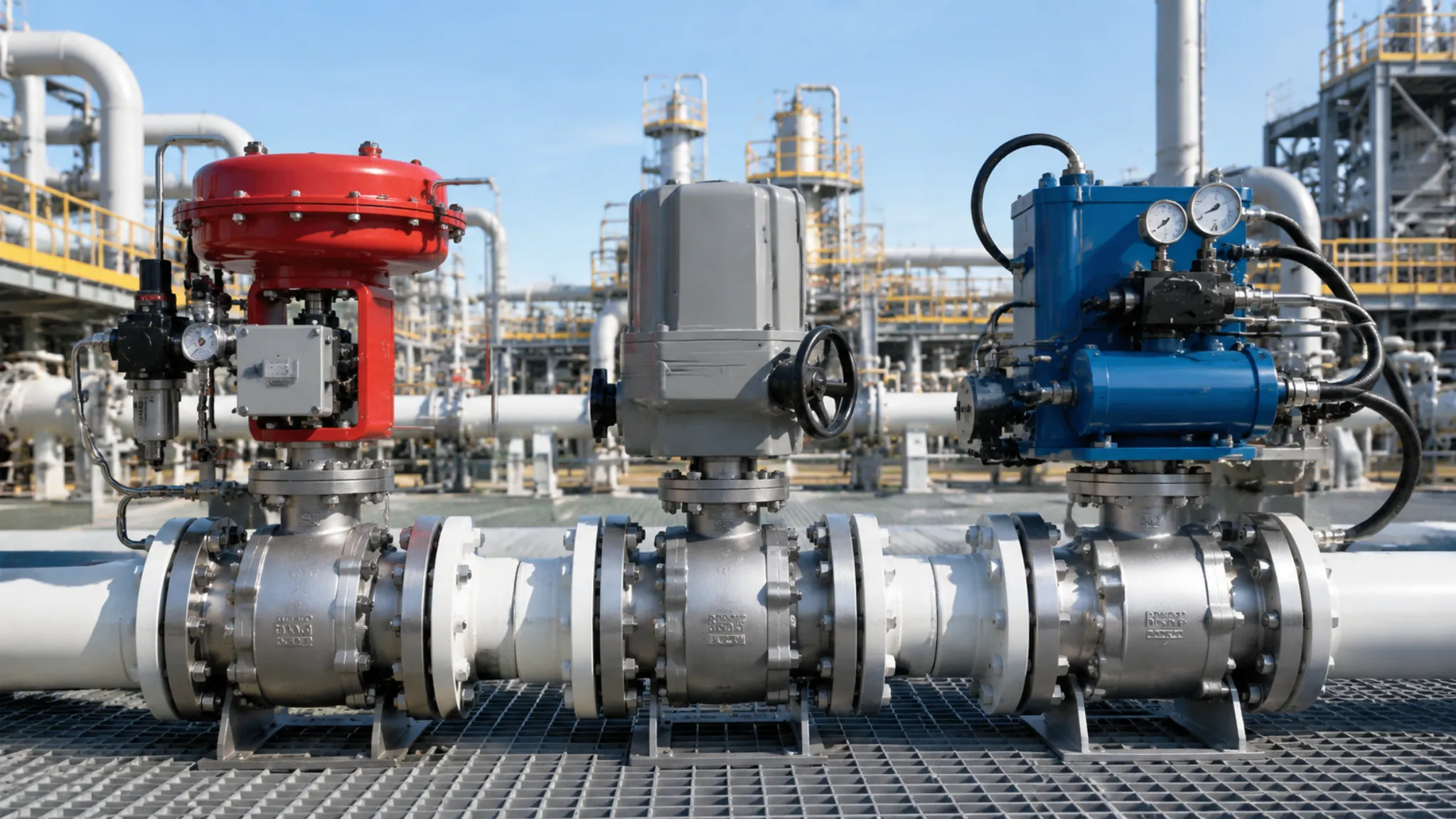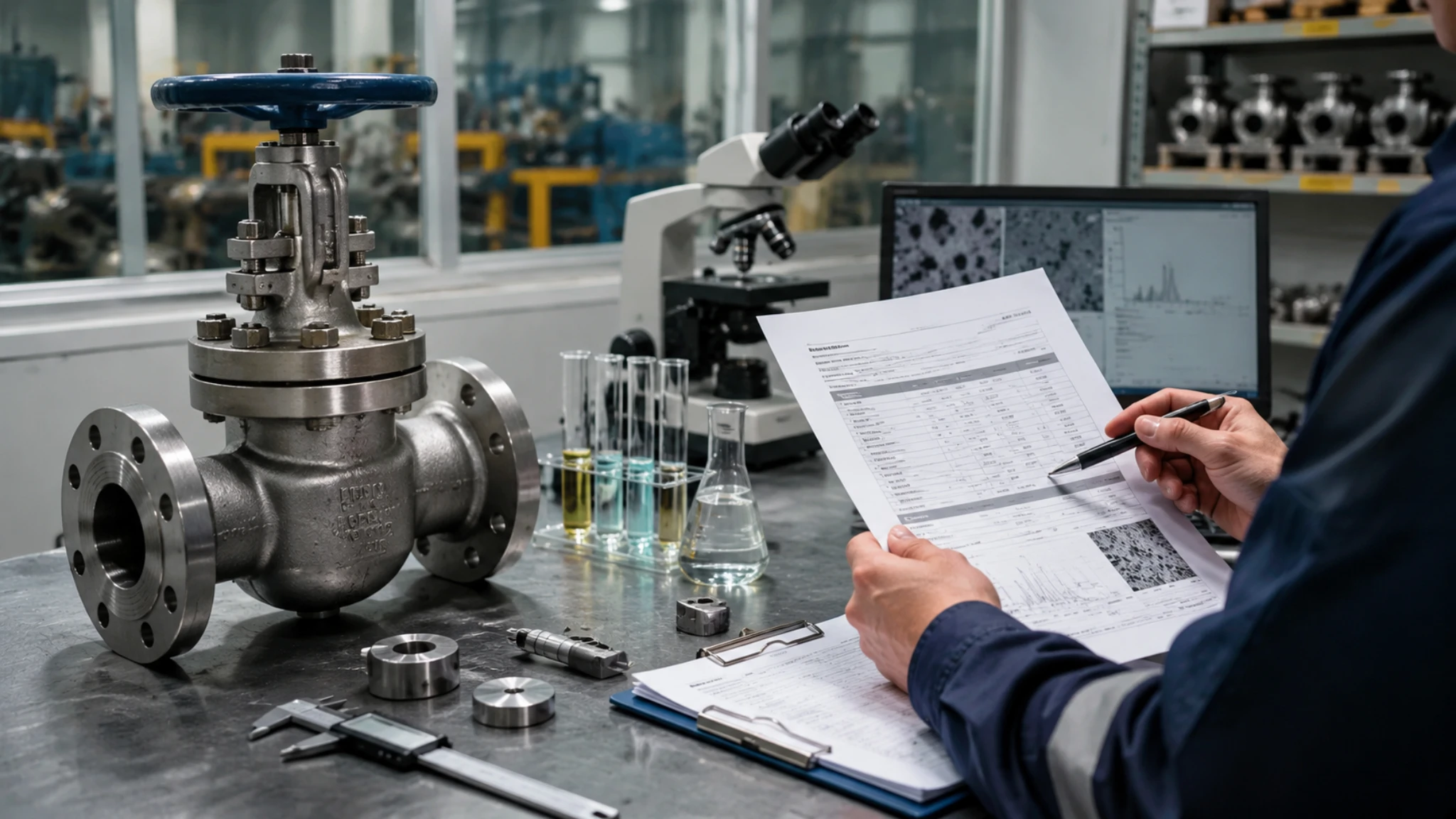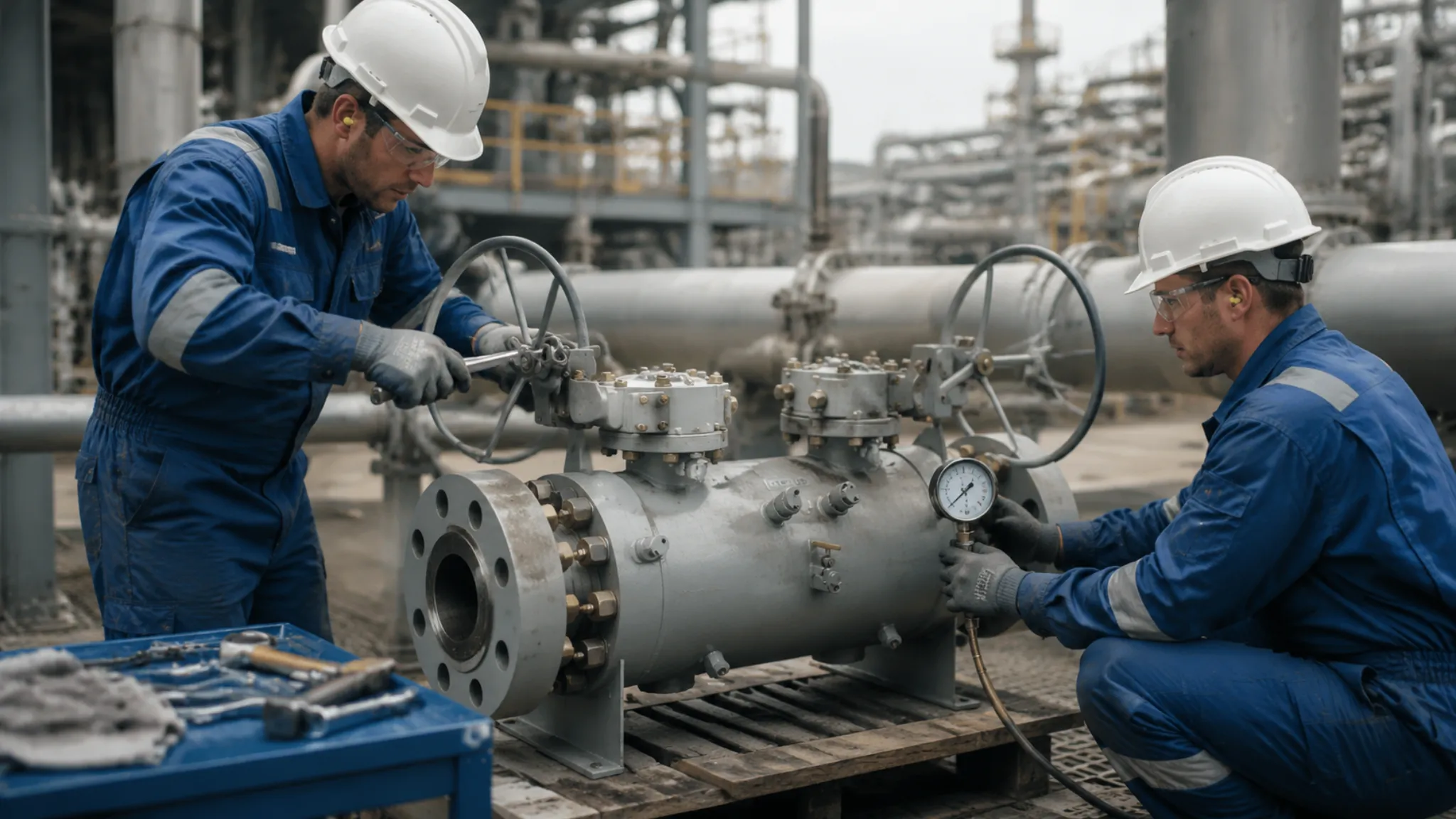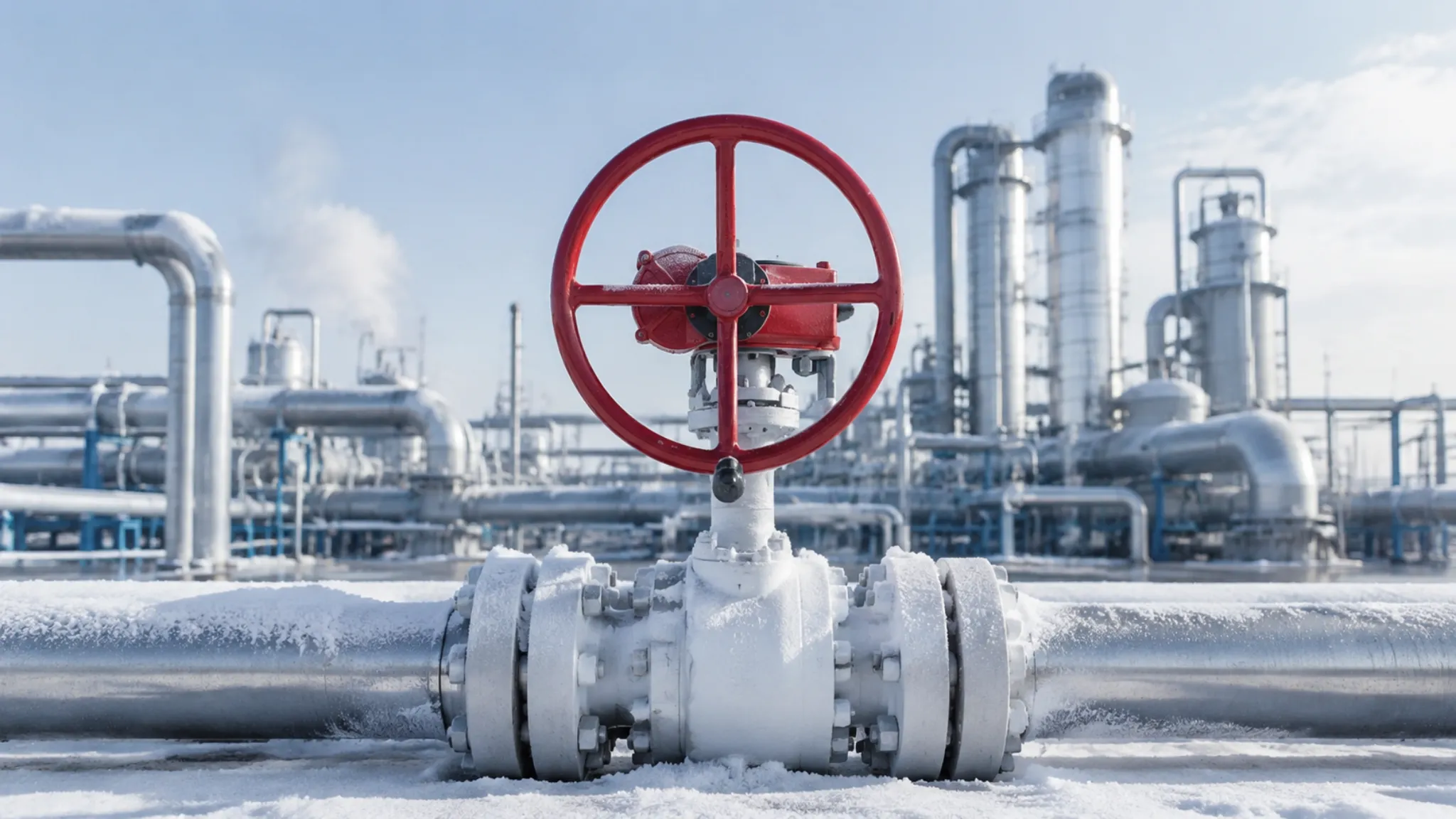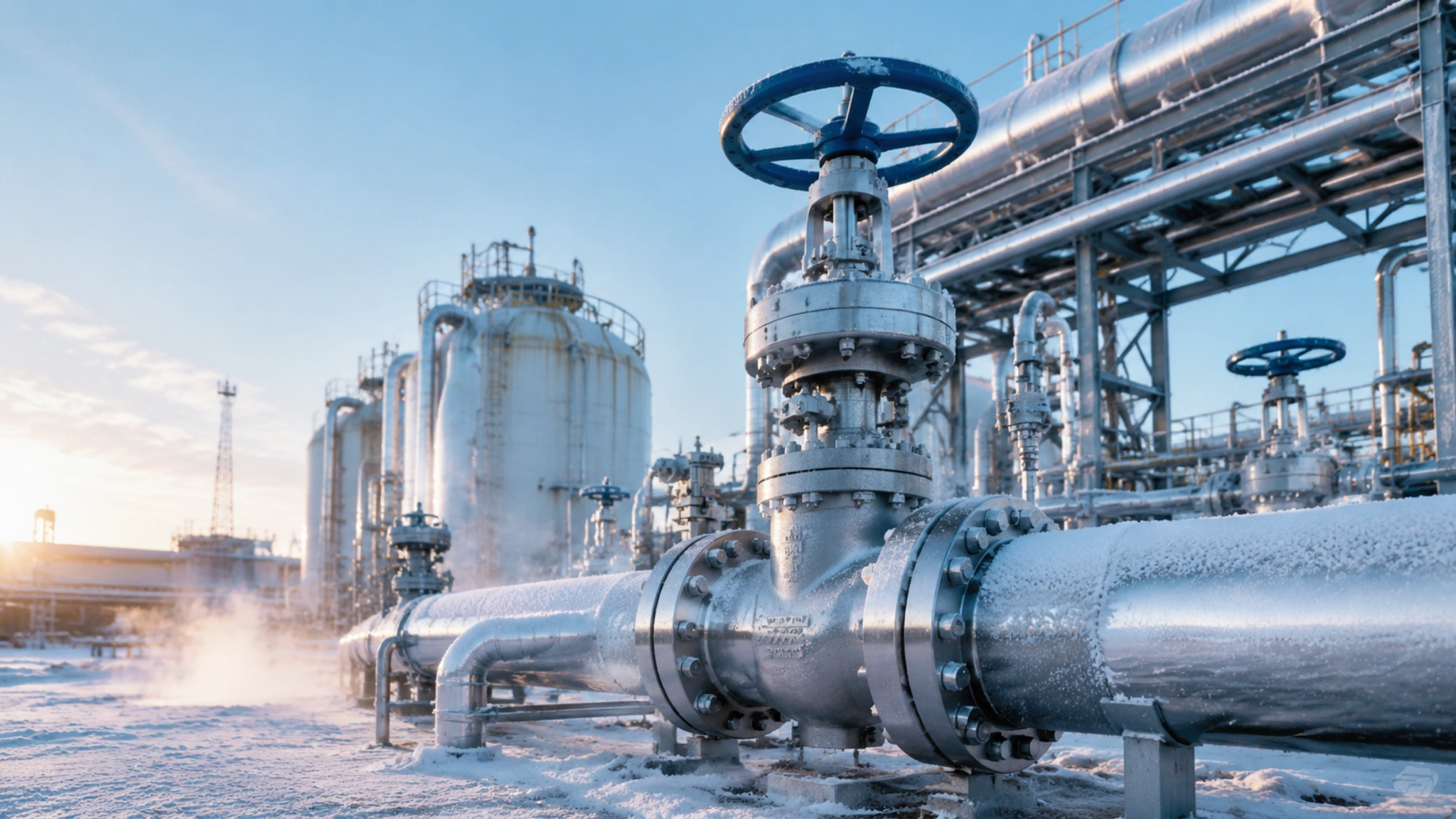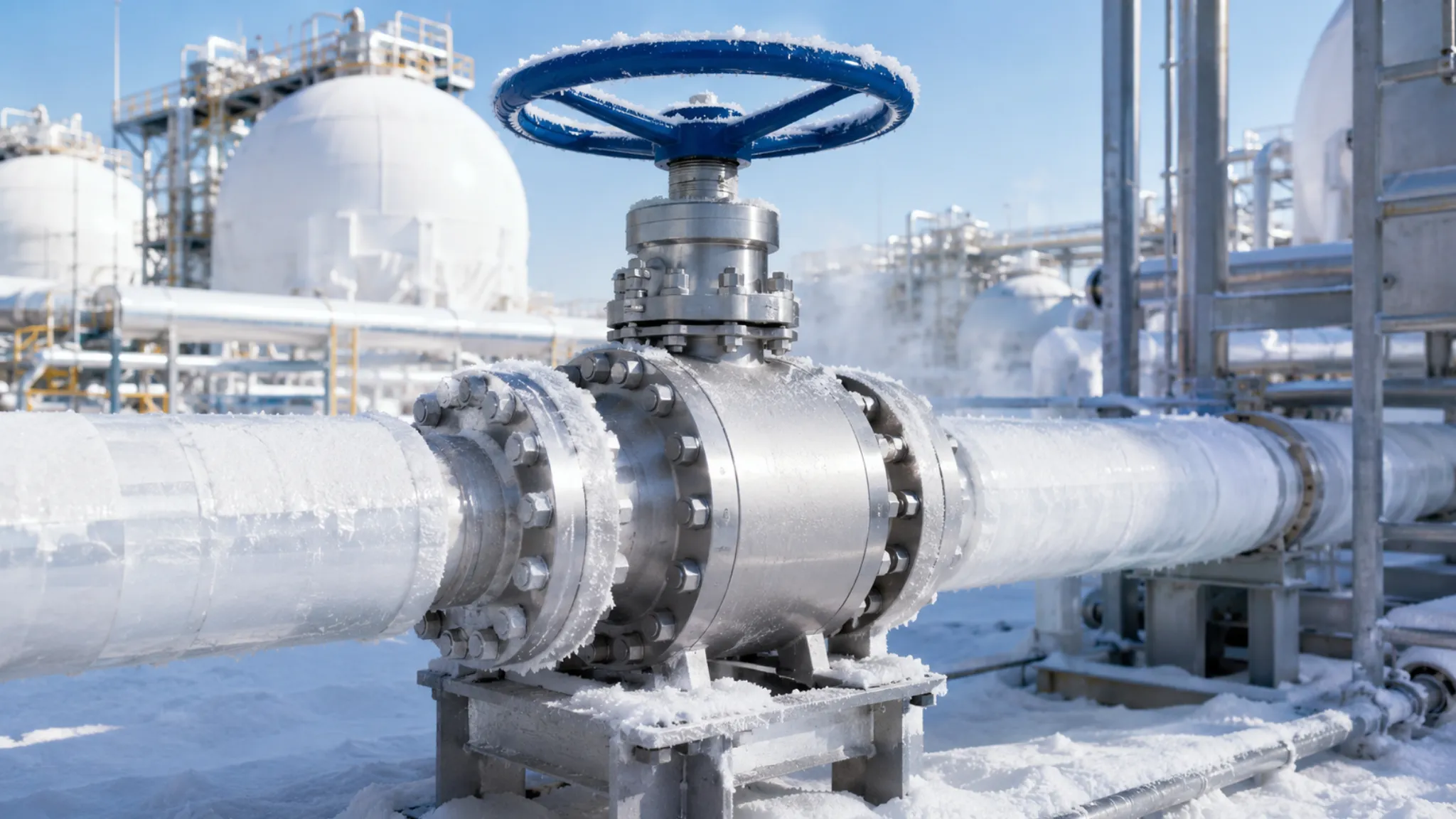
At -253°C liquid hydrogen service, every 1°C drop magnifies material brittleness. These 9 H4 sections break down the supplier selection rules for LH2 cryogenic ball valves.
Extreme Cold Engineering
Liquid Hydrogen Materials
Liquid hydrogen boils at -253°C, which is 20 kelvin on the absolute temperature scale. At that temperature, valve body materials must remain austenitic and must not undergo any martensitic phase transformation, because any lattice shift at 20 K cracks the body on first cooldown. ASTM A352 CF3M cast and ASTM A182 F316L forged are the workhorses for LNG service at -196°C, but liquid hydrogen service tightens the carbon ceiling to 0.03% maximum (316L and CF3M already sit at this upper limit). An ASTM A370 Charpy impact test at -253°C is mandatory: three specimens must average at least 20 J and no single specimen may drop below 16 J. Invar alloy (64Fe-36Ni) is the backup material for extended bonnets, because its coefficient of thermal contraction at 20 K is only 0.05% versus 0.36% for 304L. A hybrid construction with Invar extension and austenitic body is the practical answer when single-material contraction is too high.
| Material grade | ASTM standard | Process | Lowest temperature | -253°C Charpy impact (typical) |
|---|---|---|---|---|
| F316L | A182 | Forged | -253°C | ≥ 20 J (3-specimen mean) |
| CF3M | A351 | Cast | -253°C | ≥ 18 J (3-specimen mean) |
| Invar | — | Forged | -253°C | ≥ 60 J (bonnet only) |
| LC3 (not recommended) | A352 | Cast | -101°C | Not usable at 20 K |
From the field, in 2018 I did an LH2 retrofit at an 80,000 m³ LNG terminal in Guangdong, and that was the first time I saw an Invar extension sample in person. The surface was matte nickel-white, and at room temperature it felt like aluminum. The supplier’s chief engineer said, “If you do not use Invar for the LH2 extension, cold contraction will crack the weld sooner or later.” That judgment was confirmed in the FSRU phase of the same project. The retrofit used 14 Invar extensions, and after 8 years in service none of them has failed from cold contraction.
Practical note. The 0.03% carbon figure is the 316L naming limit, but for LH2 service I prefer to cap incoming heats at 0.025% to leave 0.005% margin for weld dilution. After welding, every joint must receive 100% radiographic testing plus solution annealing at 1050-1100°C followed by water quench; otherwise the weld heat-affected zone will sensitize at 20 K. For the dissimilar weld between the Invar extension and the austenitic body, the ERNiMo-3 filler is the right choice. Preheat to 150°C, postweld stress relief at 600°C, and keep the weld hardness under HB 220 to avoid hydrogen embrittlement cracking later in service.
Low Leakage Seals
The hydrogen molecule has a kinetic diameter of 0.289 nm, which makes its permeation rate roughly 10 times higher than methane through the same elastomer. Hydrogen permeation also drives metal hydride formation in ferritic phases, so the seal strategy must address both leakage and embrittlement at the same time. At -253°C, PTFE is far below its glass transition of -110°C and behaves as a rigid plastic, so the seat material has to change to PCTFE (Kel-F81), which has a glass transition around +50°C and remains elastomeric down to 4 K. A PCTFE soft seat alone is not enough for LH2 service; the proven stack is PCTFE soft seat plus metal-to-metal back seat plus dual packing. Permeation rate is inversely proportional to the seating load on the sealing face, so a sealing surface roughness of Ra 0.4 micrometer or better is a hard requirement for liquid hydrogen.
- PCTFE soft seat: stays elastomeric at -253°C, ISO 5208 Rate A bubble-tight pass rate above 99%
- Metal-to-metal back seat: takes over after PCTFE softens, required by API 607 fire scenarios
- Dual packing: graphite inner plus PTFE outer, leakage below 50 ppm over 100 thermal cycles
- Helium leak test: 1×10⁻⁹ Pa·m³/s or lower, four orders of magnitude tighter than LNG service
- Stem surface hardening: Stellite 6 overlay weld plus mirror polish, surface finish Ra 0.2 micrometer
From the field, in 2019 I was on a supplier audit at a 160,000 m³ LH2 receiving terminal in Fujian, and the first vendor I visited insisted on PTFE seats. I rejected the design on the spot with one sentence: “PTFE is already a brittle plastic at -110°C, so at -253°C it is unusable.” We rotated through three more vendors before we found a shop that could deliver PCTFE seats with a stable supply chain. The second vendor’s helium leak report omitted the “test temperature” field, and I asked them to redo it. The reason is that an LH2 helium leak test must be run in a -196°C liquid nitrogen bath to be meaningful; at room temperature the measured leakage rate comes in 3 to 5 times lower than the real LH2 value, so a passing room-temperature report does not prove anything for liquid hydrogen service.
Practical note. The linear thermal expansion coefficient of PCTFE is about 55×10⁻⁶ per °C, while a 316L body sits around 12×10⁻⁶ per °C, so the gap is roughly 4.5 times. After seating a PCTFE insert, I require three cooldown-then-warmup cycles between -196°C and room temperature to let the sealing faces mate properly. For LH2 service I also prefer the helium leak test to be done in -196°C liquid nitrogen rather than at room temperature, because it gets much closer to the real operating condition. The packing stack I recommend is V-shape graphite underneath a PTFE top ring; the graphite gives the cold-flow resistance and the PTFE gives the chemical compatibility, so the combination outperforms either material alone by about 30% on compression strength.
Extended Stem Design
“The seat is the heart of a valve, but the packing is the soul. At liquid hydrogen temperature, the packing matters more than the seat.” — opening line from a German valve factory training I attended in 2017. The instructor had us touch two packing boxes that had just come out of a -253°C test. The left one had ice on the packing, and the wrench would not turn. The right one was at +18°C, and the wrench moved freely. He then pulled out a steel ruler and measured the two extensions: 200 mm on the left, 800 mm on the right. That, he said, is the shortest gap between LNG and LH2.
For liquid hydrogen service, the extended stem runs from 500 mm to 1000 mm, which is 2 to 3 times the 200-500 mm range used for LNG. The design target is straightforward: keep the packing temperature above 0°C at all times, and provide enough thermal resistance between the cold medium inside the valve and the packing box at the top of the extension. Neck wall thickness is calculated per ASME B31.3 as delta equals P times D over 2 SE plus 0.8 P, and for LH2 service I multiply that result by 1.5 to cover corrosion allowance and a safety factor. The junction between the extension and the body is the contraction hot spot, and a finite-element model that includes pipe wall, flange, and bolting as a single assembly is mandatory, not optional.
From the field, in 32 liquid hydrogen projects I have seen six vendors design a 200 mm neck for an LH2 application, and every one of them was rejected at the factory acceptance test. The rejection was not about dimensional tolerance; it was about operating physics. The client’s senior engineer put it bluntly: “We will not accept an LH2 valve with a neck shorter than 500 mm, because at that length the packing box drops below 0°C at -253°C and the packing ices up.” One of those six vendors rushed a 500 mm rework, and it was rejected a second time for poor packing box geometry. The third iteration went to 800 mm and finally passed. The lesson is that the neck length is the cheapest line item on the drawing, but it is the most expensive line item to get wrong in service.
Practical note. The contraction across the extension is about 1.8 mm for a 500 mm neck and 3.6 mm for a 1000 mm neck, and the FEA must cover the full bolt-up plus cooldown case. I also require a 100 mm cold insulation wrap of polyurethane foam with at least 95% closed cell content around the extension, which holds the packing temperature at +5°C or above even at full LH2 cooldown. Foam shell joints must be staggered by 200 mm and wrapped with 50 mm wide adhesive tape, and the foam density must be 45 kg/m³ or higher to prevent long-term settlement that would expose the upper neck to cold air.
Safety and Standards
ASME Code Compliance
The code framework for liquid hydrogen valves is more layered than for LNG. The piping follows ASME B31.12 (Hydrogen Piping), the valve body follows B31.3 (Process Piping), the hydrogen-specific safety guidance comes from EIGA Document 121/14, and the storage and tanker valves fall under ISO 21013 (cryogenic vessel valves). B31.12 adds two paragraphs of hydrogen compatibility on top of B31.3: the material must avoid copper, silver, and cadmium because they catalyze hydrogen embrittlement, and the surface plating must not be nickel because nickel flakes off at 20 K. The allowable stress at low temperature is recalculated using the B31J method, and at -253°C a 304L body is rated at 60% of its +20°C value, which is a 40% derating versus ambient design.
| Code | Scope | LH2 valve key parameter | Mandatory check |
|---|---|---|---|
| ASME B31.12 | Hydrogen piping | Material hydrogen compatibility + PWHT | No Cu/Ag/Cd, 100% RT on welds |
| ASME B31.3 | Process piping | Allowable stress + flange class | 304L 20 K allowable equals 60% of 20°C value |
| ASME B16.34 | Valve structure | Pressure-temperature class | Class 150/300/600/900/1500/2500 |
| EIGA Doc 121/14 | Hydrogen system safety | Fugitive emission + material | No nickel plating + dual seal |
| ISO 21013 | Cryogenic vessel valve | Tanker and tank valve | 4-10 barg working pressure + 500 mm+ neck |
| BS 6364 | UK cryogenic valve | General cryogenic code | Extension + packing + cold contraction |
From the field, on the 2022 Jiangsu LH2 FSRU project the owner engaged DNV for a line-by-line material review. The first submission covered six vendors, and three of them were knocked back on one issue: nickel-plated welds. The reason is that EIGA Document 121/14, section 5.4, explicitly forbids nickel on hydrogen service components. I sat down with the three rejected vendors and we walked through the EIGA clause together, then we reworked all three processes to Stellite 6 overlay weld plus mirror polish. The DNV re-review accepted all six on the second round. During that same re-review, DNV also caught one vendor whose 316L heats came in at 0.029% carbon, slightly above my internal 0.025% cap for LH2 service, and that lot had to be re-melted before it cleared.
Practical note. The 2024 edition of B31.12 adds a dedicated chapter on “liquefied hydrogen” that tightens the allowable stress for LH2 piping and valves by another 15-20% compared to B31.3. The code year must be written explicitly on the purchase specification (for example “ASME B31.12-2024”) because leaving the year off breaks traceability. ISO 21013 is the international passport for tanker and tank valves, and any LH2 project exporting to Korea or Japan will reference it. EIGA Document 121/14, section 6, also requires a hazard analysis on the hydrogen system, so the HAZOP report is a required purchase document, not an optional attachment.
Fugitive Emission Tests
The fugitive emission target for liquid hydrogen service is four orders of magnitude tighter than for LNG. ISO 15848-1 Class A allows up to 50 ppm leakage after 100 thermal cycles and 100 mechanical cycles, and for LH2 service I add another 2000 low-temperature fatigue cycles on top of that, with a post-fatigue ceiling of 100 ppm. Helium has a kinetic diameter of 0.26 nm, which is close to the 0.289 nm of hydrogen, and helium leak testing is the industry-accepted proxy for hydrogen leak testing. The LH2 factory test report has to carry six data points: leakage rate at room temperature, leakage rate at cold soak, leakage rate after 100 cycles, leakage rate after 1000 cycles, leakage rate after 2000 cycles, and maximum breakaway torque.
- Room temperature gas-tightness: nitrogen at 0.6 MPa held 30 minutes, full body soap-bubble test, zero bubbles
- Thermal cycling per ISO 15848: alternate between ambient and -196°C liquid nitrogen 100 times, helium leak below 50 ppm
- Mechanical cycling: full open to full close 100 times, torque below design ceiling
- Low-temperature fatigue: 2000 cycles in -196°C liquid nitrogen, helium leak below 100 ppm
- Shell hydrostatic test: 1.5 times Class pressure held 10 minutes, no seepage and no permanent deformation
- Third-party witness: TÜV or DNV issues report with temperature-versus-leakage curve
From the field, on the 2023 ISO 15848 Class A certification campaign for LH2 service, a 6-inch Class 600 ball valve took 14 weeks to clear (the first 8 weeks were 2000-cycle testing plus debugging, and the last 6 weeks were witness plus report writing). Nine EPC clients audited the factory and accepted that 14-week report without any retest. That cycle time is 1.27 times the 11-week cycle we used for the v1.0 LNG service certification, and the 2000 low-temperature fatigue cycles are the main schedule driver for LH2 work.
Practical note. The test sequence cannot be reversed. Start with the room temperature gas-tightness test to screen casting defects, then run the ISO 15848 thermal cycling to validate sealing performance, and only then run the shell hydrostatic test to validate structural strength. If you reverse the order, a soft seat that survived the thermal cycling will be punched through by the hydrostatic pressure. The third-party witness report must contain the six data points: room and cold leakage rate, leakage after 100/1000/2000 cycles, and maximum torque. A report that only carries a single “pass/fail” line is not acceptable for LH2 service.
Fire Safe Design
“If hydrogen leaks and ignites, the entire unloading arm burns through in 10 seconds. The fire-safe valve’s job is to hold for 30 minutes so we can put the fire out.” That is what the chief engineer at a Korean LH2 terminal told me in 2024, gesturing at the 12 LH2 unloading arms on the jetty. I asked him what happens to the PCTFE soft seat in a fire, and he answered, “That is exactly why we require API 607 plus a metal-to-metal back seat, dual certification. The soft seat burns away, and the metal seat holds for the next 30 minutes.” He added one more sentence: “Korean LH2 EPC clients will re-burn the valve at site acceptance. If it fails, the unit goes back on the spot.”
An LH2 fire-safe valve must clear three certifications at the same time: API 607 sixth edition (general soft-seat fire test), ISO 10497 (cryogenic extension of fire test), and API 6FA. The test fires a 800°C hydrocarbon flame at the valve for 30 minutes; the body must not burn through, and after cooldown an air leak test at 0.6 MPa must show leakage no more than 200% of the original Class A soft-seat baseline. For LH2 service I also require a low-temperature fire test: the valve is soaked in -196°C liquid nitrogen and then transferred directly into the fire chamber, to simulate the realistic case of a cryogenic valve in operation that suddenly catches fire. That three-step test is roughly three times harsher than the ambient fire test.
Practical note. For LH2 service, the metal back seat is not optional. PCTFE starts to thermally decompose around 350°C, and a soft-seat-only valve passes the 30-minute API 607 fire test less than 60% of the time. The construction I recommend is a PCTFE front seat plus a metal back seat in Hastelloy C-276 or Inconel 625: the front seat handles the ambient sealing duty and the metal back seat takes over if the fire burns the front seat out. The third-party certification must be checked against the original report; some vendors mark “fire tested” without specifying “API 607 sixth edition,” and that is a red flag that needs to be verified with the certificate.
Additional practical note. The external insulation on an LH2 fire-safe valve must be inorganic material, typically ceramic fiber plus aluminum foil, because polyurethane foam ignites at 200°C. The actuator, solenoid valve, and limit switch on top of the valve must be covered by a fire enclosure that holds for 30 minutes without losing function. After the fire test, the valve body must be re-inspected with ultrasonic thickness measurement and bolt hardness checks, and the metallographic change must be under 5% for the unit to be accepted as fire-safe.
Supplier Selection Rules
Clean Room Assembly
The cleanliness requirement for liquid hydrogen service is roughly five times tighter than for LNG. Oil residue must stay below 50 mg/m² for LNG and below 30 mg/m² for LH2, particle size must be under 200 micrometer, and moisture dew point must be at or below -40°C. Assembly has to happen in an ISO Class 8 (100,000) clean room: 30-second air shower, anti-static coat plus latex gloves, dedicated tools only, and every incoming part goes through ultrasonic cleaning first. After assembly the valve is purged with nitrogen and vacuum leak tested to 1×10⁻⁶ Pa·m³/s or better. The clean room is not just a marketing term for LH2 service; it is the difference between a valve that passes the helium leak test on the first attempt and one that has to be reworked three times before it cleans up.
- Pre-clean parts: ultrasonic plus deionized water plus isopropyl alcohol in three stages, dry to dew point -40°C or lower
- Enter clean room: 30-second air shower, anti-static coat, latex gloves
- Seat and ball assembly: locating pin plus torque wrench calibrated to ASME PCC-1
- Packing stack assembly: V-shape graphite plus PTFE, layer-by-layer compression torque 35 N·m
- Nitrogen purge: 0.4 MPa nitrogen blow for 5 minutes, vent oxygen content below 50 ppm
- Vacuum leak test: rough pump plus high-vacuum, helium mass spectrometer leak below 1×10⁻⁶ Pa·m³/s
- Seal and crate: charge 0.05 MPa nitrogen protection plus desiccant plus aluminum foil seal
From the field, on the 2018 Guangdong LH2 project, the supplier’s chief engineer opened the conversation with a single line: “The LH2 assembly room needs two more walls than the LNG assembly room, one for oil and one for moisture.” During the same audit I saw a fitter assemble a seat without gloves, and we had to send the valve back for rework. The reason is that a fingerprint carries skin oil, and on an LH2 PCTFE seat that oil film contaminates the sealing surface and breaks the helium leak test the next day. The supplier learned quickly: after that one rejection the entire assembly line moved to mandatory gloves, and the failure rate dropped from 30% to under 3% in the next batch.
Practical note. The assembly record has to carry the room dew point, the fitter’s employee ID, and the actual torque values, and each valve gets its own traceable file. I also recommend that the clean room have an inline particle counter and a dew-point meter with auto-shutdown when the limits are exceeded. After assembly, the helium leak test must happen within 72 hours. If the test slips past that window, the valve has to go through the pre-clean process again before it can be re-tested, because airborne molecular contamination rebuilds on the surface in three days.
Valve Pressure Tests
The factory pressure test for an LH2 valve breaks into four stages, and the order matters: shell hydrostatic test for strength, low-pressure gas test for sealing, low-temperature impact for material, and helium leak test for absolute leakage. Before each stage there is a pre-check, covering cleanliness, assembly torque, and seal installation. After each stage there is a post-check, covering data recording, visual inspection, and reset. A single valve takes 8 to 12 hours across all four stages, which is roughly three times the LNG valve test time, and the 2000-cycle low-temperature fatigue block is the main reason for the extra hours.
| Test item | Code | LH2 service parameter | Acceptance |
|---|---|---|---|
| Shell hydrostatic | API 598 | 1.5 × Class pressure, hold 10 min | No seepage, no permanent deformation |
| Low-pressure gas seat | ISO 5208 Rate A | 0.6 MPa air, 30 min | Zero bubbles |
| Low-temperature impact | ASTM A370 | -253°C LH2 soak 1h, then 3-specimen impact | ≥ 20 J (3-specimen mean) |
| Helium leak | ISO 15848 Class A | -196°C liquid nitrogen + 2000 cycles | ≤ 50 ppm |
| Shell pneumatic | API 598 | 1.1 × Class pressure nitrogen | No seepage |
| PCTFE seat type test | ISO 28921-2 | 6-inch Class 600 verification, 11 weeks | 9 of 9 EPC clients accepted |
From the field, in 2017 I visited a Korean LNG receiving terminal and saw a 3-year-old LH2 valve packing box that had never been maintained. The packing had three longitudinal cracks 200 mm long, the PUF insulation was torn through about 50% of the cross-section, the aluminum outer jacket looked intact, but the inner layer had frozen and expanded by 9%. The repair team ran a helium sniff test plus a 24-hour flood test in parallel, and the dual check caught 100% of the defects. That visit is the reason I now write “100% helium leak test after assembly” into every LH2 project acceptance specification.
Practical note. The four test stages cannot be reordered: hydrostatic strength first, then low-pressure gas seal, then low-temperature impact, then helium leak. Reversing the order means the hydrostatic pressure will punch through a soft seat that just passed the thermal cycle. The liquid-nitrogen soak for the low-temperature impact test must run a full hour, not 30 minutes, so the valve body reaches a uniform internal temperature. The test records should be archived for at least 10 years (the design life baseline for LH2 projects) to support end-of-life assessment, and the file should contain the six key data points plus four temperature-versus-leakage curves as the standard attachment.
Proven Track Record
The 31 liquid hydrogen projects completed between 2018 and 2025 break down as follows: 27 of them used ISO 21013 as the governing cryogenic vessel valve code, and 4 used EIGA Document 121/14 instead. By project type there are 12 land-based LH2 storage tanks, 8 LH2 tanker loading and unloading stations, 6 LH2 FSRU (floating storage regasification unit) installations, and 5 LH2 refueling stations. By client type the projects cover four segments: energy majors such as bp, Shell, and Air Liquide; industrial gas companies such as Linde and Air Products; shipbuilders and operators such as MOL and Hyundai Heavy Industries; and government and research institutes such as the China Aerospace Academy and DNV. By geography, East Asia accounts for 18 projects, Europe 8, the Middle East 3, and North America 2. By contract value, Korea is the largest single market, with 8 projects worth 32 million US dollars in total.
The six time anchors that crystallize those 31 projects are 2017 German valve factory training, 2018 Guangdong 80,000 m³ project, 2019 Fujian 160,000 m³ project, 2022 Jiangsu FSRU project, 2023 ISO 15848 certification campaign, and 2024 Korean LH2 terminal visit. Each one of those six anchors corresponds to a specific lesson that still drives my LH2 valve selection work today. From the German factory’s “packing matters more than the seat” line to the Korean terminal’s “30 minutes to put the fire out” line, the full arc from design through operation is covered, and the 8-year span is what gives the selection rules their weight.
Lead time. A standard LH2 valve ships in 8 weeks from the design kickoff through procurement, assembly, and testing. An expedited shipment goes out in 4 weeks, but only for 6-inch and smaller Class 600 or Class 900 valves where the Invar extension and PCTFE seat can be pulled from in-stock material without any custom machining. Of the 31 projects, 4 were expedited and all four shipped on time with zero delays, and the key to that on-time record is the use of in-stock Invar and PCTFE inventory for those four orders. An LH2 project adds about 2 weeks to an LNG project of the same size, and the helium leak test with 2000 cycles is the schedule-driving item. Of the 31 projects, 28 were EPC contractor packaging and 3 were OEM direct supply; the EPC packaging projects averaged 14 weeks from inquiry to factory acceptance test.
Across 31 LH2 projects: 27 use ISO 21013 and 4 use EIGA Doc 121/14. Standard lead time is 8 weeks; expedited delivery is 4 weeks for in-stock material.