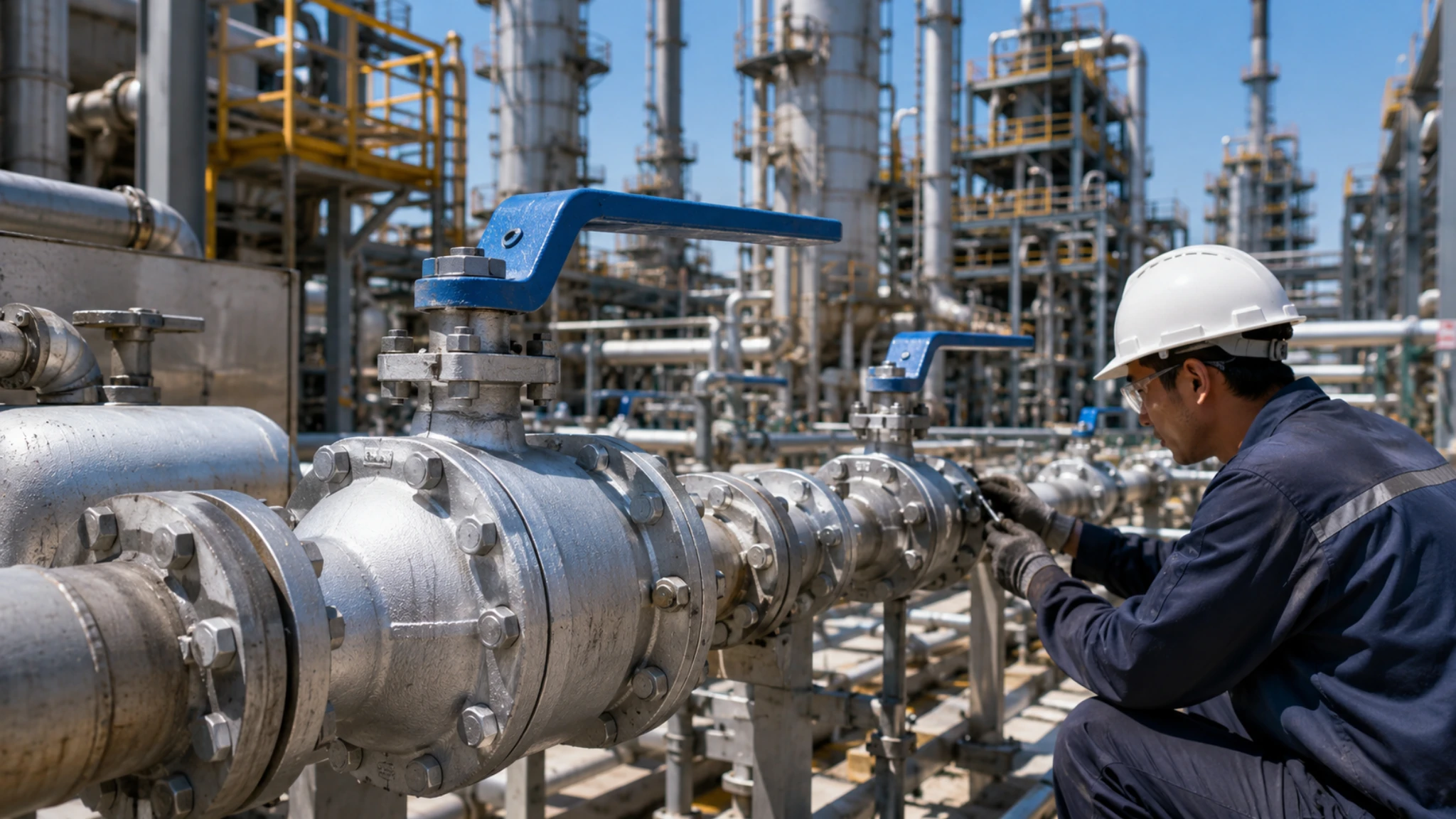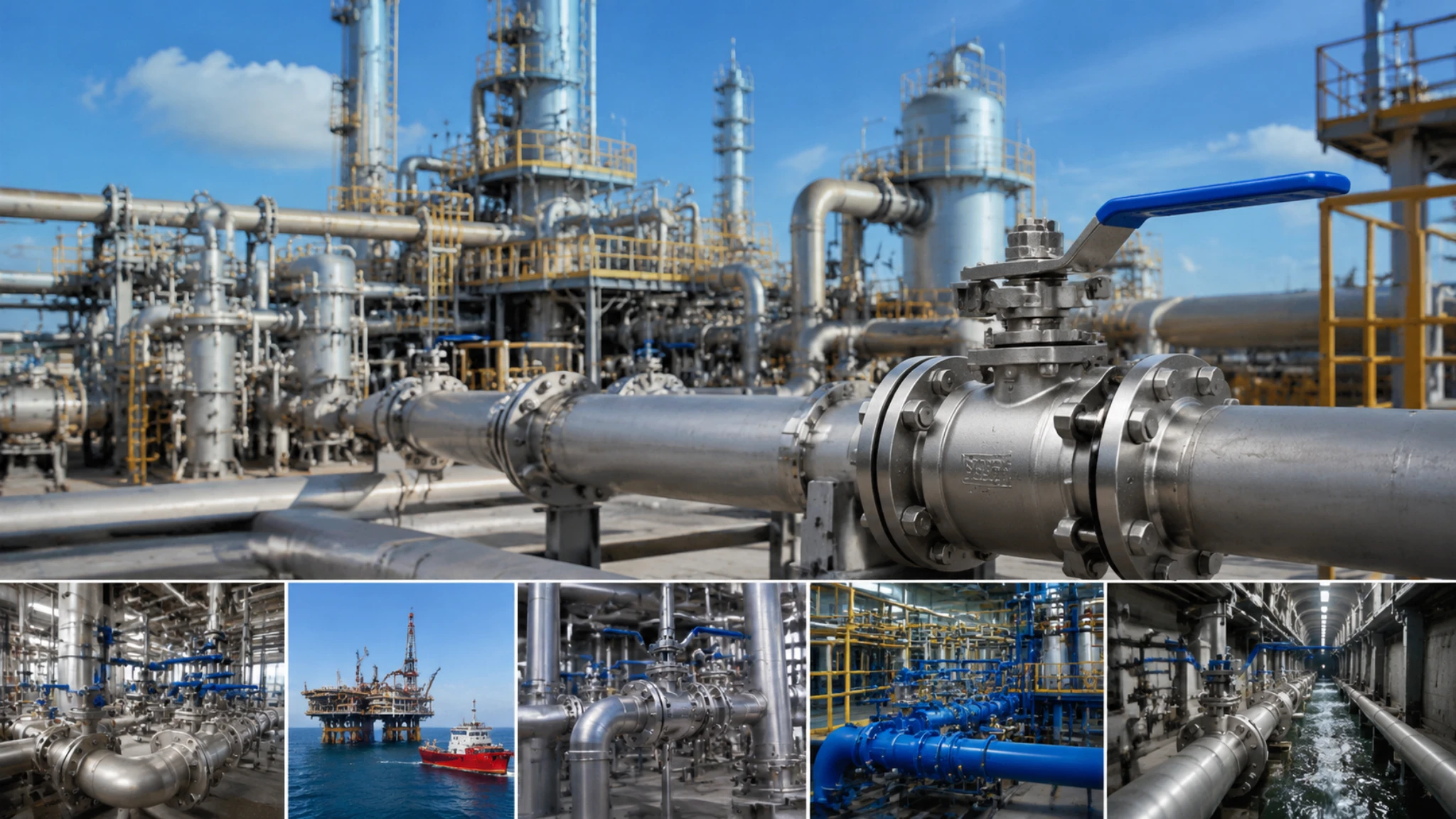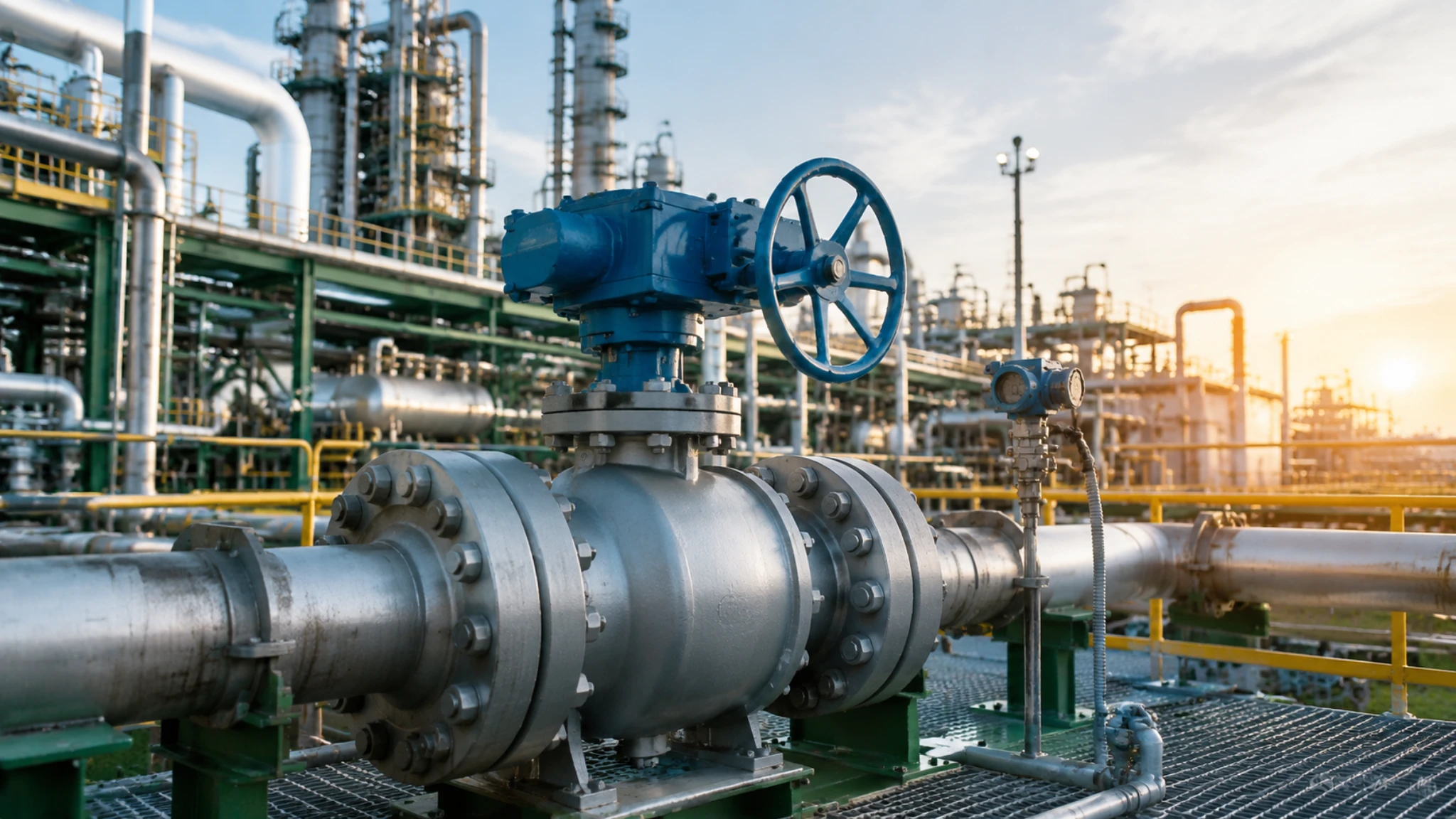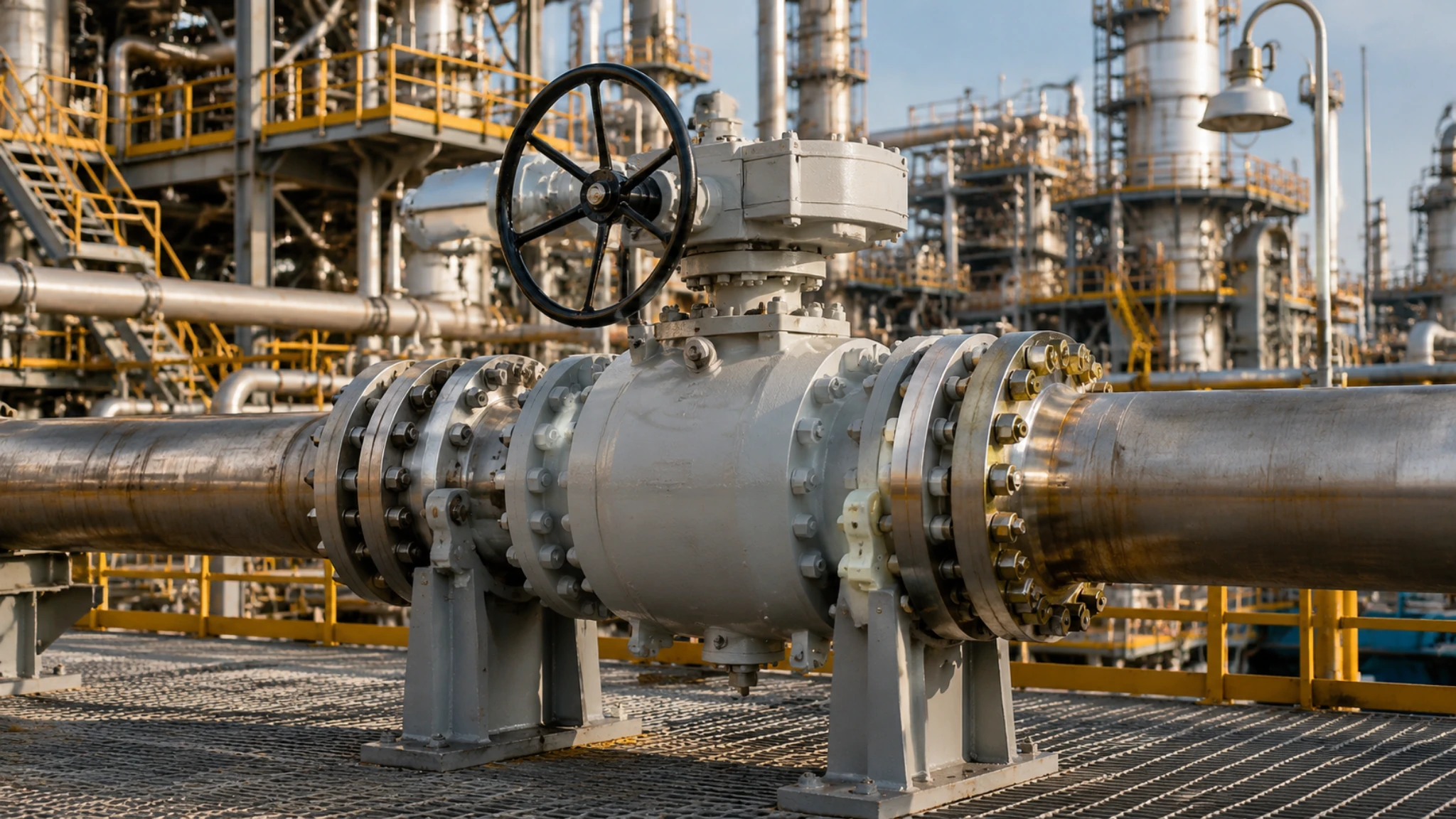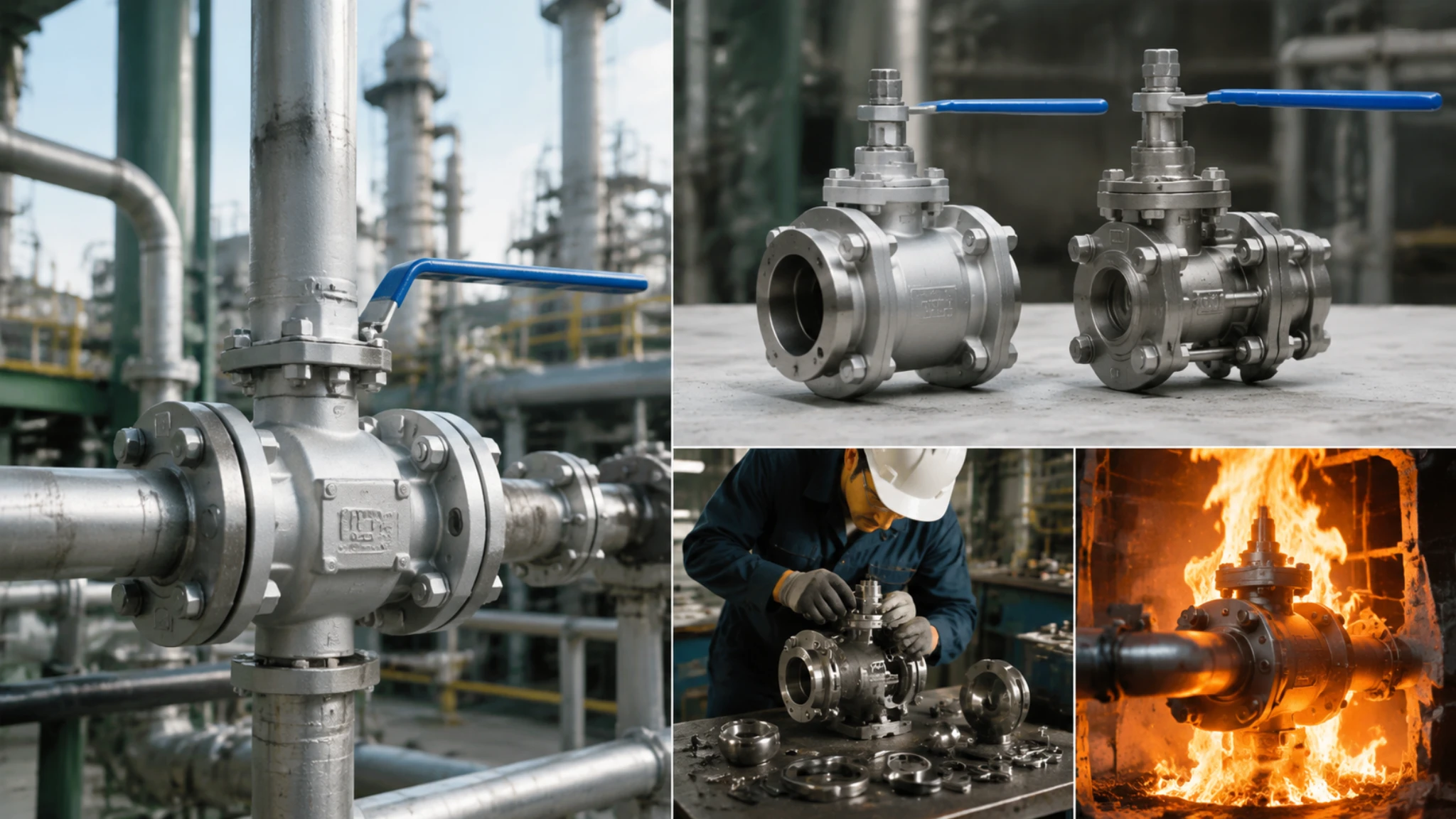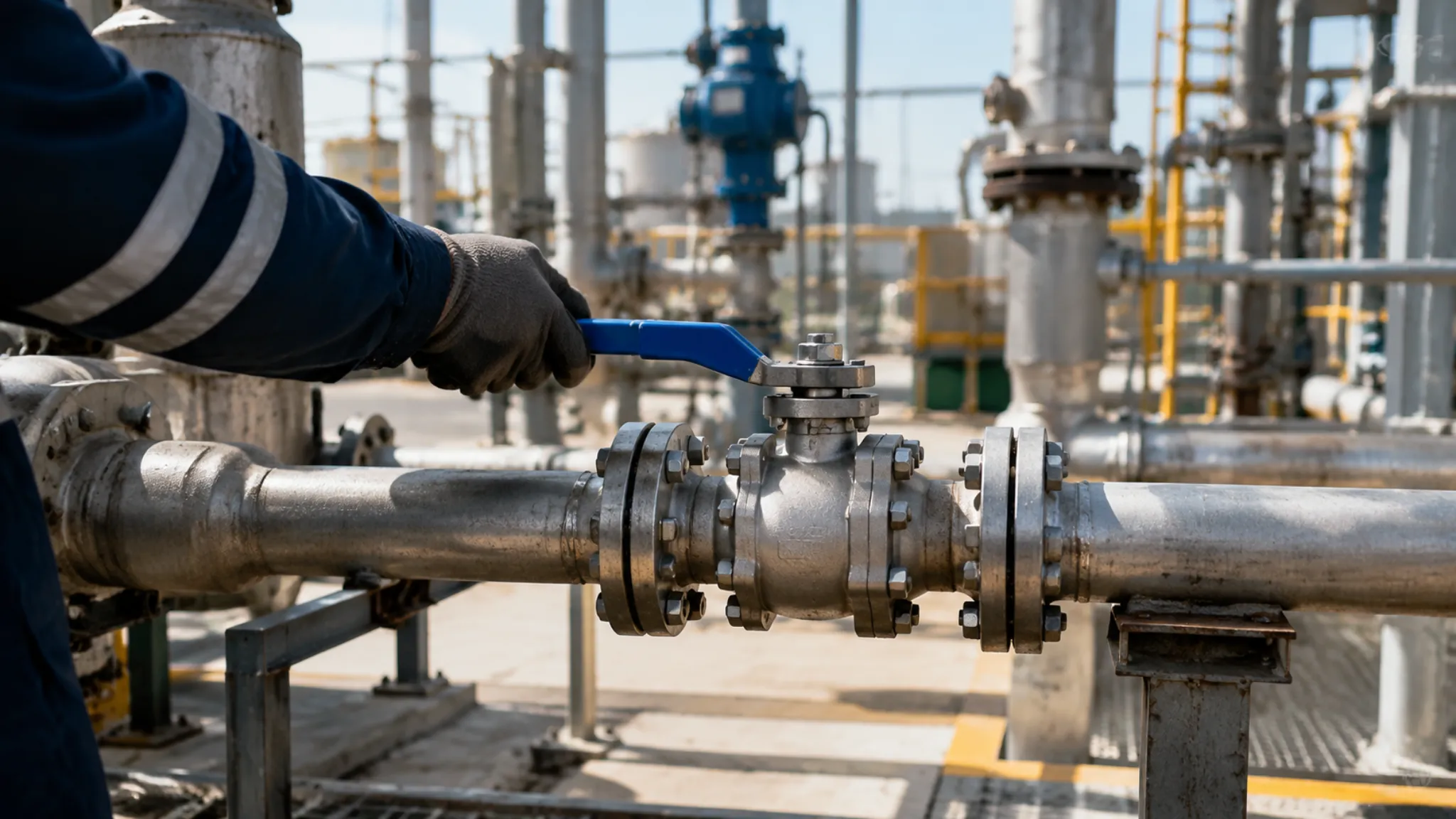
DBB compact manifolds integrate two isolation valves plus one bleed valve in one body, cutting face-to-face length by 60%. API 6D 25th ed. defines DBB-1 and DBB-2 classes. Guide covers three areas: flanges, standards, design checklist.
Choosing Flanges
RF vs RTJ Faces
RF (Raised Face) and RTJ (Ring Type Joint) flanges are the two most common sealing face types defined by ASME B16.5. On one refinery DBB replacement project I learned the hard way: the original RF flange with a PTFE gasket leaked on a 540°C heavy-oil line; only after switching to RTJ with a stainless-steel ring did the seal hold. The two face types differ sharply in structure, gasket selection, and pressure rating.
RF flanges have a 1.6 mm raised face around the bolt circle. The gasket is compressed inside the raised zone, sealed by bolt preload. RTJ flanges carry a trapezoidal or oval groove machined into the face; a metal ring sits in the groove and seals through its own elastic-plastic deformation under differential pressure. The table below is a quick reference for DBB manifold flange selection.
| Item | RF Raised Face | RTJ Ring Type Joint |
|---|---|---|
| Sealing principle | Gasket deforms and fills the raised zone | Metal ring sits in trapezoidal groove, elastic-plastic seal |
| Gasket type | Flexible graphite / spiral-wound / PTFE | Soft iron / stainless steel / Inconel alloy ring |
| Pressure rating | Class 150 to 600 | Class 600 to 2500 |
| Temperature | -29°C to 400°C (gasket-limited) | -29°C to 600°C (metal-ring high-temp) |
| Typical service | Water, steam, oil, low-sulfur hydrocarbons | High-pressure oil/gas, sour H2S service, hot heavy oil |
| Replacement cost | Gaskets cost a few dollars each | Metal rings run tens to over a hundred dollars |
| Leak risk | Gasket aging can leak at high temperature | Metal ring elastic-plastic seal, very low leak rate |
One-line rule: temperature ≤400°C and Class ≤600 → pick RF; temperature >400°C or Class ≥600 → must use RTJ. For NACE MR0175 sour service, also verify the metal ring material compliance (see H4-5).
Pressure Class Rating
The pressure class on a DBB compact manifold sets wall thickness, flange neck height, and bolt specification. On one LNG receiving-terminal project I saw this go wrong: the original spec called for a Class 150 manifold, but the actual service was -162°C low temperature plus 4.0 MPa medium pressure. We had to redesign as Class 300 with a thicker body to pass the low-temperature impact test. Unit cost jumped from RMB 18,000 to RMB 35,000 and the 80-valve lot overran budget by RMB 1.36 million. A wrong class risks seal failure at best and body rupture at worst.
ASME B16.5 splits flange pressure classes into six levels: Class 150, 300, 600, 900, 1500, and 2500. Each level carries its own pressure-temperature rating (P-T Rating), and the same class has different ratings on carbon steel versus stainless steel. That gap is one of the most common selection errors. Each 50°C rise in temperature forces roughly a 5% to 10% pressure de-rating; above 200°C the de-rating curve steepens and you must consult ASME B16.5 Table 2-1.1 for the exact value.
- Class 150: 2.0 MPa (285 PSI) at 38°C, suited to low-pressure water and steam
- Class 300: 5.0 MPa (740 PSI) at 38°C, common in oil and gas gathering
- Class 600: 9.93 MPa (1440 PSI) at 38°C, mainstream high-pressure refining and petrochemical
- Class 900: 14.9 MPa (2160 PSI) at 38°C, high-pressure wellhead control
- Class 1500: 24.8 MPa (3600 PSI) at 38°C, ultra-high-pressure oil and gas
- Class 2500: 42.4 MPa (6175 PSI) at 38°C, supercritical and severe service
On the RFQ always list three parameters together — maximum operating pressure, design temperature, and the P-T rating check value — so vendors do not quote against ambient ratings and then add a change-order fee.
Pipe Bore Matching
The bore of a DBB manifold must match the upstream and downstream line bore, otherwise you generate turbulence, pressure loss, and erosion. On one coal-to-chemical project I saw this fail during commissioning: the line was 4-inch Sch 40 (ID 102.3 mm), but the DBB on site was labeled 4-inch yet its actual bore measured only 76 mm (Reduced Bore). Flow velocity jumped from 3.2 m/s to 6.8 m/s, and three months later seat surfaces showed erosion grooves. We replaced the full manifold train with Full Bore units, costing an extra RMB 220,000 and six weeks of schedule. That incident eventually became part of our internal “DBB bore matching checklist”.
The core points of DBB bore matching are listed below; each one maps to a common engineering pitfall:
- Full Bore: valve bore equals line bore, no reduction, lowest pressure loss, suited to long-distance pipelines
- Reduced Bore: valve bore is 70%-85% of line bore, compact and lower cost, but higher velocity
- Schedule difference: Sch 40 / Sch 80 / Sch 160 have different IDs at the same NPS — always verify against the schedule
- Flow direction: DBB manifolds carry a directional arrow; reverse installation damages the sealing pair (different from a standard bi-directional ball valve)
- End transition: the transition from flange face to bore must be smooth; any step creates a vortex
- Downstream recovery: after a reduced section the downstream line may need to recover to the original bore — calculate the recovery velocity
Practical tip: read the NPS and Schedule from the line P&ID, compute the actual line bore, and then pick a manifold whose bore ratio is ≥0.95. If budget pressure forces a reduced bore, the post-reduction velocity must stay below 8 m/s for liquids and 25 m/s for gases; above those limits go Full Bore. These parameters belong on every RFQ. Also, the flange face type (RF or RTJ) on the DBB must match the line flanges, or the assembled joint will leak far above target (see H4-1).
Key Standards
API 6D Features
API 6D (Pipeline Valves, 25th and 26th edition) is the global specification for materials, design, testing, and acceptance of pipeline valves. On one oilfield acceptance test I caught a recurring issue: vendors print “API 6D” on the DBB body but only run the pressure test, skipping the Low Pressure Pneumatic Test that API 6D requires. The shipment is bounced back for re-testing, costing three weeks of schedule. API 6D features are not optional; they are mandatory clauses.
When selecting an API 6D-certified DBB compact manifold, verify these features in the order below; each step maps to a specific clause:
- Material traceability: API 6D Section 6 requires mill test certificates (MTC) traceable to the heat; ASTM A216 WCB and A351 CF8M are mainstream choices
- Pressure test: API 6D Section 10 requires shell test at 1.5 times rated pressure plus seat test at 1.1 times rated pressure
- Low-pressure pneumatic test: API 6D Section 10.4 specifies 0.6 MPa air leak test with leak rate ≤ Class A bubble-tight (soft seat)
- Fire safe: API 6D Section 10.5 requires passing API 607 fire test (see H4-6)
- Double isolation verification: DBB must pass a double-block test — close both ends, drain the cavity, then verify each seal independently
- Marking: API 6D Section 12 requires permanent body marking for NACE compatibility (if applicable), flow arrow, and pressure-temperature rating
Procurement checklist: require the vendor to provide API 6D certificate, MTC, and third-party test reports (shell, seat, fire). All three must be present before goods-in. The certificate must state the exact edition (25th vs 26th), because low-pressure pneumatic criteria differ between editions.
NACE Sour Service
NACE MR0175 (now harmonized into ISO 15156) is the mandatory material standard for petroleum and natural gas service in H2S-containing environments, specifically aimed at preventing sulfide stress cracking (SSC) and stress corrosion cracking (SCC). On a Middle East high-sulfur oilfield project (wellhead H2S partial pressure 0.7 MPa) I hit a typical trap: a standard A216 WCB body had HRC 18 hardness, which looked compliant, but the weld-repair zone was HRC 28 and triggered the NACE Section 7.2.1 limit. The fix was to switch to ASTM A352 LCC low-carbon cast steel (LCC is capped at HRC ≤22).
NACE MR0175 puts four classes of restriction on DBB manifold materials; each maps to a specific material screening logic:
Hardness cap (HRC ≤22): standard limit for carbon and low-alloy steels. Some stainless grades such as 410SS and 420SS allow HRC ≤28 provided specific heat-treatment conditions are met. Austenitic stainless (304, 316) is typically soft and is not limited here, but SSC and SCC risk must still be reviewed together.
Material whitelist: ISO 15156-3 Annex A lists approved materials including A216 WCB, A352 LCC, A351 CF8M, and Inconel 718. Materials not on the list require extra qualification testing.
Welding: weld-repair and weld seams must pass hardness testing (HV10 ≤250 ≈ HRC ≤22) plus post-weld heat treatment to relieve stress. Weld-zone hardness over-limit is the most common compliance failure.
Environment threshold: legacy NACE MR0175 applied to environments with H2S partial pressure ≥0.0003 MPa (pH ≥4.5, sour). ISO 15156-2 expands this to all H2S-containing oil and gas environments, so trace H2S still triggers the material rules.
Procurement requirement: the vendor must supply a NACE MR0175 / ISO 15156 compliance certificate (state the edition, e.g. 2015) plus weld-zone hardness test reports. A certificate with the wrong format or missing hardness data is grounds for rejection at goods-in.
Fire Safety Tests
Fire Safe testing is the mandatory verification that a DBB manifold keeps sealing under fire exposure. On one petrochemical acceptance job I watched an API 607 test fail in real time: the body was burned at 760°C and at the 18-minute mark the metal sealing pair fractured and the leak rate exceeded the limit. The post-mortem showed the hard-facing layer was only 0.05 mm thick; the spec demands ≥0.1 mm. The test looks simple but is unforgiving on process detail. A manifold that fails Fire Safe loses its isolation capability during a fire; the result can be a full pipeline release.
DBB manifolds are covered by three main fire-test standards, each targeting different valve types. The table below summarizes the core differences:
| Item | API 607 7th edition | API 6FA | API 6FD |
|---|---|---|---|
| Valve type | Quarter-turn valves (ball / butterfly) with non-metallic seats | General valves (gate, globe) | Check valves |
| Burn temperature | 760°C to 982°C (30-min hydrocarbon fire simulation) | 760°C to 1200°C | 760°C to 982°C |
| Burn duration | 30 minutes | 30 minutes | 30 minutes |
| Pass criteria | Leak rate ≤ Class IV / V (per API 598) | Average leak rate ≤ 200 mL/min/inch | Leak rate ≤ Class IV |
| Equivalent adoption | ISO 10497 | ISO 10497 (partial) | — |
| Fit for DBB | ★ Mainstream standard (ball + non-metallic seat) | ★ Backup standard | Not applicable (not a check valve) |
Selection strategy: DBB manifolds contain ball-valve isolation pieces, so prioritize API 607 7th edition (current) plus ISO 10497 dual certification. If the vendor only holds an API 6FA report, ask for an additional API 607 test, otherwise the ball-specific criteria may not be met. At acceptance require a third-party certificate plus a live fire-test video; missing either is grounds for rejection. The certificate must include the tested body serial number, test date, and the issuing third-party body (such as TÜV, Bureau Veritas, or SGS); certificates typically expire after 5 years and must be re-tested.
Design Checklist
Compact Size Limits
The core advantage of a DBB compact manifold is putting two isolation valves plus a bleed valve into one body, but “compact” has a cost. The bigger the size, the harder it is to cast or forge the body in one piece and the harder it is to machine the sealing faces to spec. On one offshore-platform DBB selection review I sat in on, the original plan was a 6-inch compact manifold, but fewer than three vendors could reliably deliver it and all quoted more than 16 weeks of lead time. We ended up using a 4-inch compact plus three-valve hybrid to keep the schedule.
Compact DBB manifolds face these size limits; each limit maps to a real engineering decision:
- Mainstream range: 1/2″ to 2″ (Class 150 to 600), abundant supply and reasonable unit price
- Extended range: 3″ and 4″ can be compact, but vendor pool shrinks (under 5 mainstream brands) and lead time runs 12 to 16 weeks
- Large size: 6″ and above is essentially not available as compact; switch to a split three-valve arrangement (two ball valves plus a bleed valve installed separately)
- Body length cap: compact DBB bodies are typically ≤600 mm long; above 600 mm the one-piece machining yield drops sharply
- Weight cap: a compact DBB typically weighs ≤80 kg (4″ Class 600), so site lifting stays simple
- Pressure-size coupling: Class 600 at 4″ is already near the compact ceiling; Class 600 at 6″ has almost no off-the-shelf supply
Selection rule of thumb: 1/2″ to 2″ — compact DBB is the first choice and gives the best value. 3″ to 4″ — order 12 weeks ahead, lead time is the critical variable. 6″ and above — abandon the compact layout and use a split three-valve arrangement (two extra valve bodies but stable supply). This size boundary is the easiest place to fall into a DBB selection trap.
Bleed Valve Types
The bleed valve on a DBB manifold sits between the two isolation valves and is used to verify isolation and to drain residual media. The bleed valve is small, but its type directly drives the precision of isolation verification. On one offshore platform commissioning I learned this the hard way: the original bleed valve was a 1/2″ ball valve (quick-open), but the downstream operator required slow venting for 3 minutes followed by fast liquid drain before each isolation — a ball valve cannot meet that “slow then fast” sequence, and we had to redesign as a 1/2″ needle plus ball combination. Bleed valve selection is not “anything that works”; pick to match the verification procedure.
DBB manifolds typically use four types of bleed valve; each suits a different isolation-verification procedure:
Needle valve: precise flow control, supports a “slow vent then fast drain” sequence; ideal for refinery and petrochemical pre-isolation gas checks. The downside is precision mechanism, easy wear under frequent cycling, and unit price around RMB 1,500 to 3,000.
Mini ball valve: quarter-turn quick open/close, simple operation; ideal for offshore platform and seawater isolation in “fast check, fast pass” scenarios. Lowest unit price at RMB 500 to 1,000, but no fine flow control.
Plug valve: medium flow, sealing between needle and ball; suited to solids-containing media or frequent cycling process lines. Compact structure but high torque, so it needs a gear operator.
Gate valve: full-bore high flow, suited to large drain volumes or high-viscosity media; rarely used in DBB manifolds because the bleed flow is usually small and the gate valve would be oversized.
Selection decision tree: if the isolation check requires “slow drain + fast drain” in two steps → Needle. If only quick open/close is needed → Ball. If the media contains solids → Plug. If the bleed flow exceeds 100 L/min → Gate. Compact DBB manifolds often use a 1/2″ Needle plus 1/4″ Ball combination, balancing precision and cost.
Body Material Choices
DBB body material directly sets temperature, pressure, and corrosion capability. On one LNG receiving-terminal selection I saw a disagreement between owner and designer: the owner initially specified ASTM A216 WCB carbon steel (RMB 15,000 per unit), but the designer pushed for A352 LCC low-temperature carbon steel (RMB 22,000 per unit) because the design temperature of -162°C was far below the WCB lower limit of -29°C. Low-temperature impact test data won the argument; the 64 DBB manifolds across the project cost an extra RMB 450,000, but the risk of low-temperature brittle fracture went away. That money was well spent.
Body material selection depends on four parameters: temperature, pressure, media corrosivity, and H2S content. The table below summarizes the limits of common materials:
| Material grade | Type | Temperature range | Corrosion resistance | Typical service |
|---|---|---|---|---|
| ASTM A216 WCB | Carbon steel casting | -29°C to 425°C | Limited (non-sour media) | Water, steam, oil |
| ASTM A352 LCC | Low-temp carbon steel casting | -46°C to 345°C | Limited | LNG, LPG cryogenic lines |
| ASTM A351 CF8M | 304 stainless casting | -196°C to 800°C | General corrosion | Chemical, food, seawater |
| ASTM A351 CF3M | 316L stainless casting | -196°C to 800°C | Chloride resistant | Chloride media, desalination |
| Inconel 625 | Nickel-based alloy | -196°C to 1093°C | Strong corrosion resistance | Sour oil/gas, high H2S |
| Hastelloy C276 | Ni-Mo-Cr alloy | -196°C to 1038°C | Strong acid and oxidizer | Wet phosphoric, hydrochloric media |
Selection flow: (1) lock the material family by temperature (LCC for low temp, stainless or alloy for high temp); (2) pick the stainless grade by corrosion (CF8M general, CF3M for chloride, Inconel for acid); (3) apply NACE MR0175 for H2S content (see H4-5); (4) finalize the spec by budget — WCB is about 60% cheaper than CF8M but has more limits. This is the last step in DBB selection, and it is also where cost swings the most.
3 checks: API 6D 25th ed. certification + NACE MR0175 SSC resistance + API 607 30-min fire pass. RF flanges cap at Class 600; high-pressure service must use RTJ. Body material: ASTM A216 WCB or A351 CF8M.