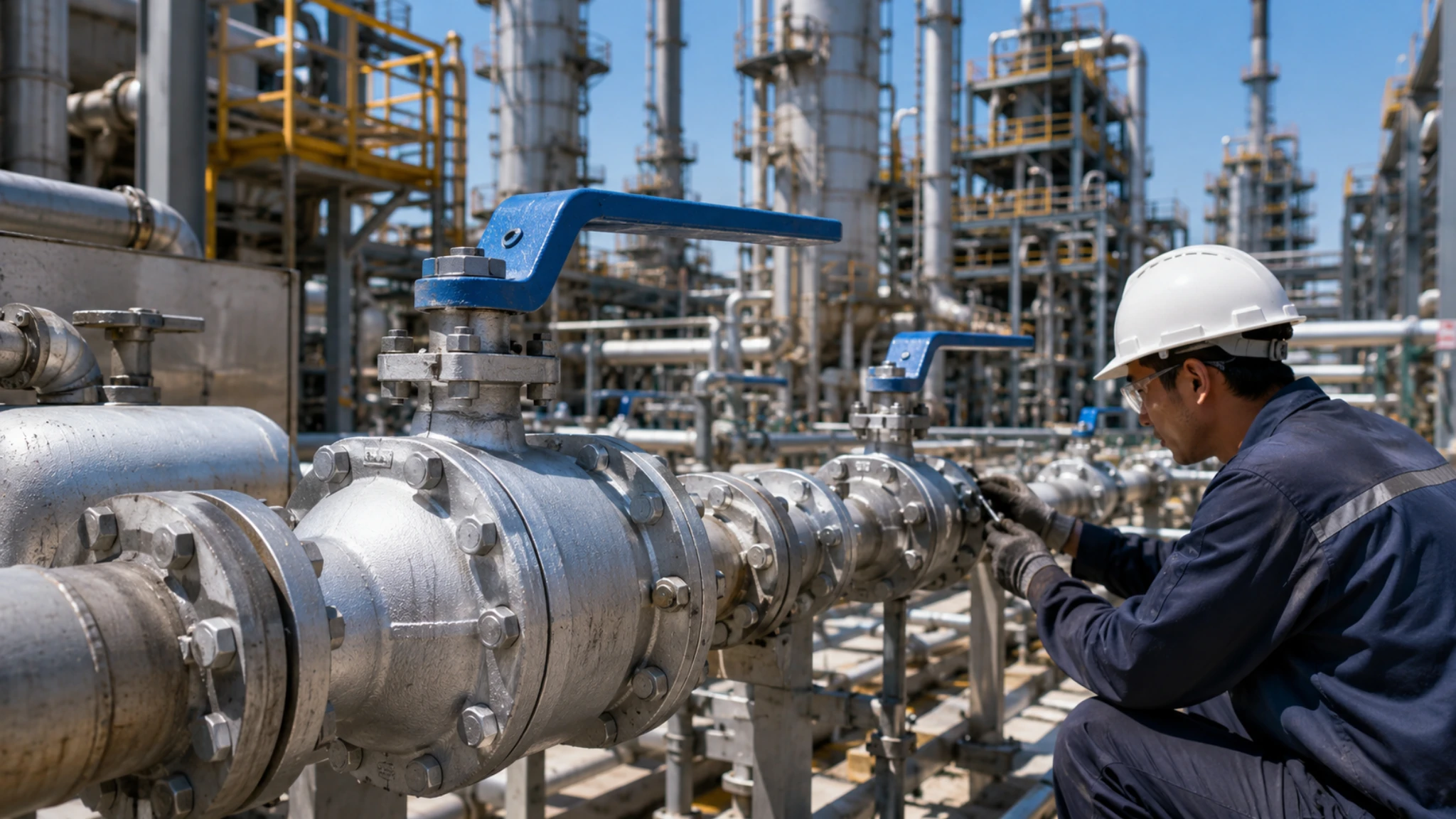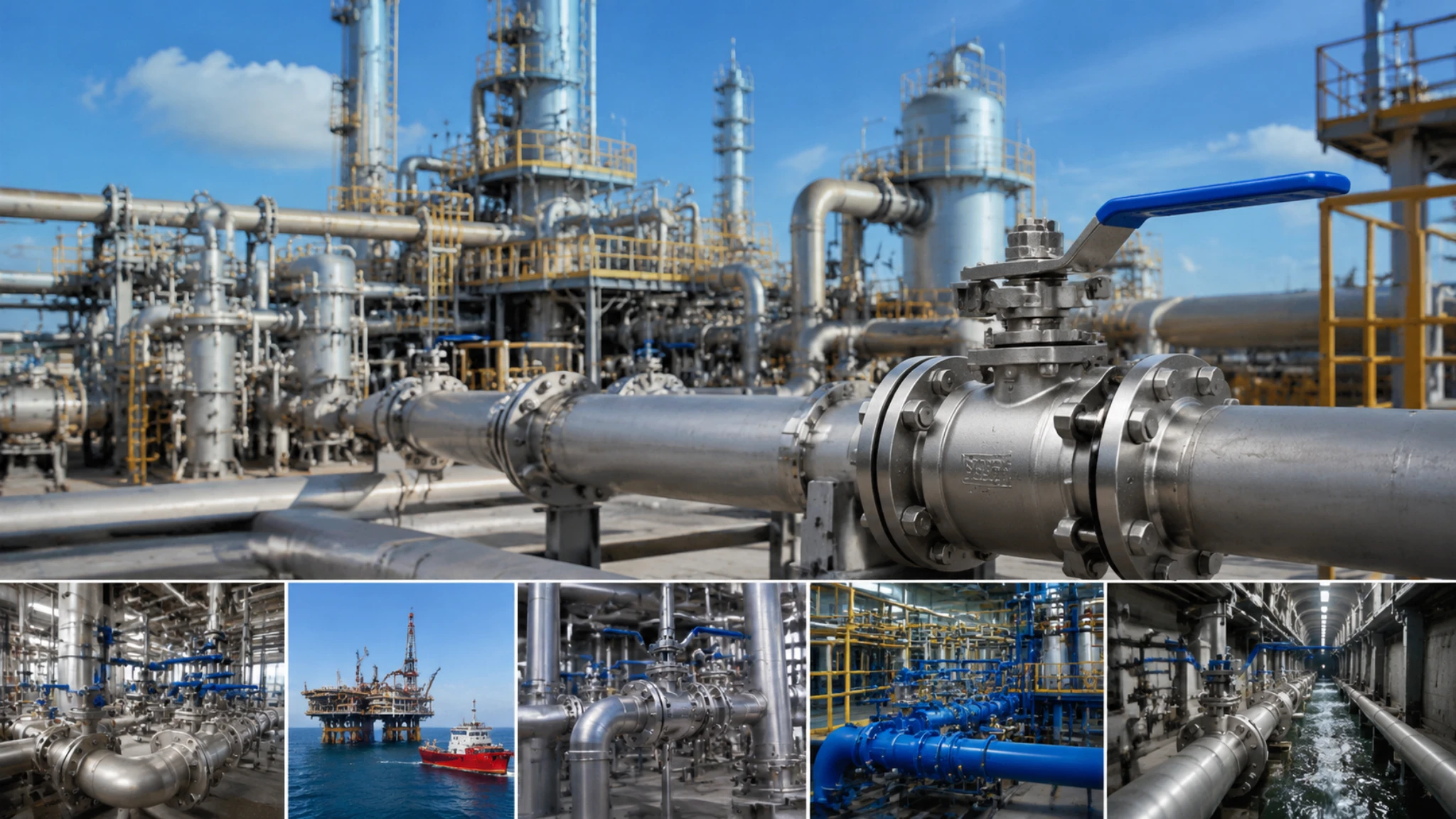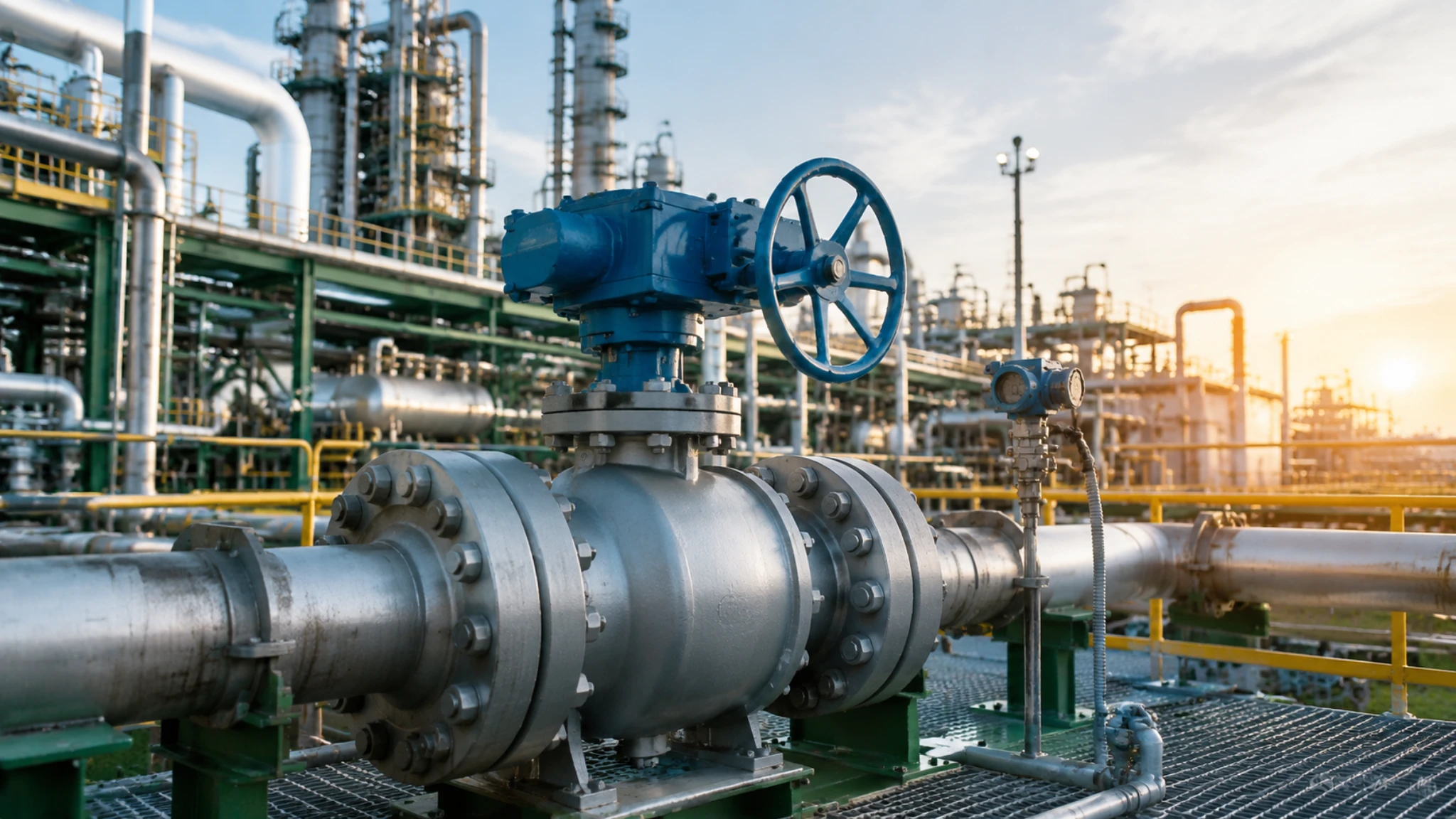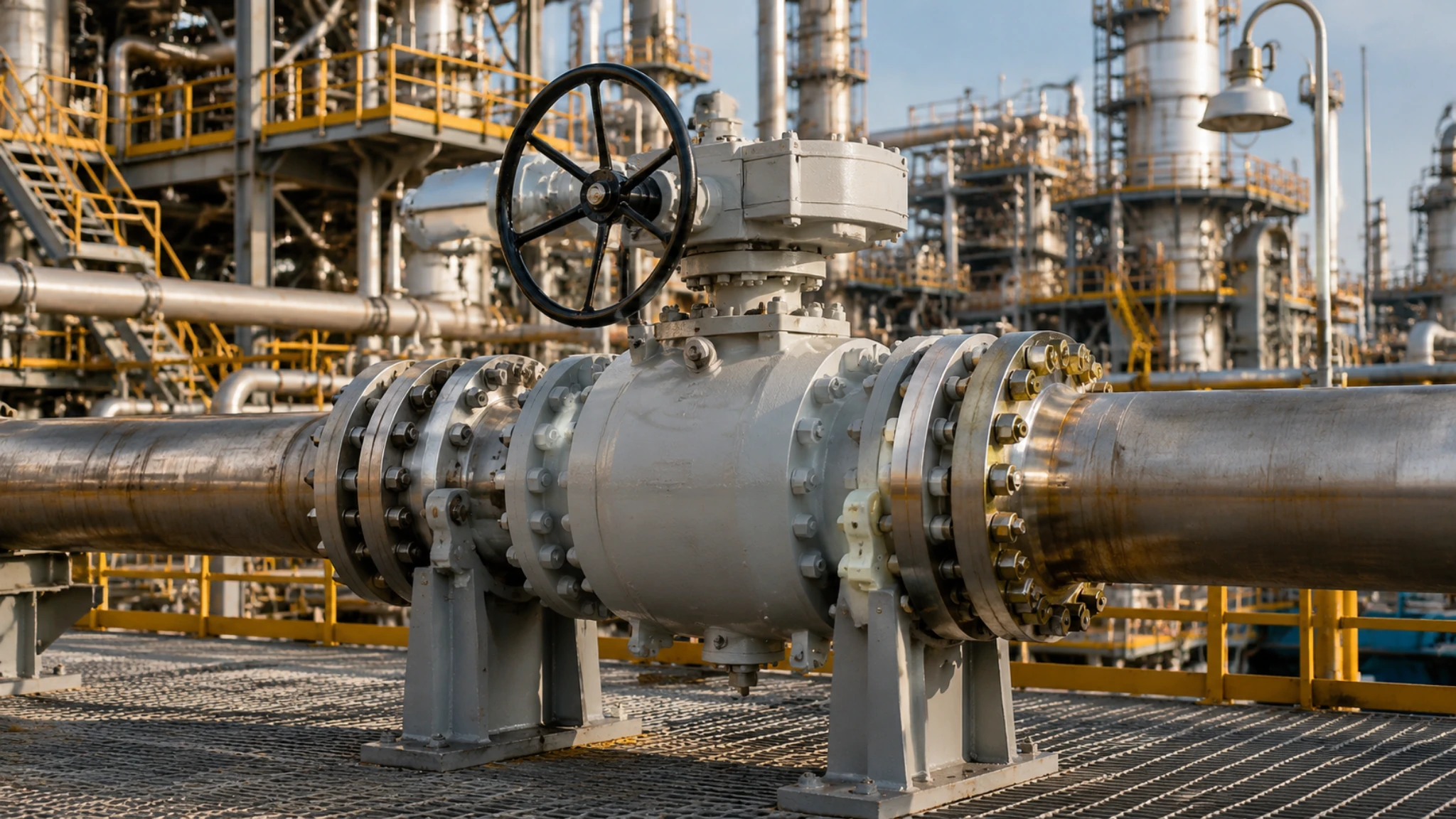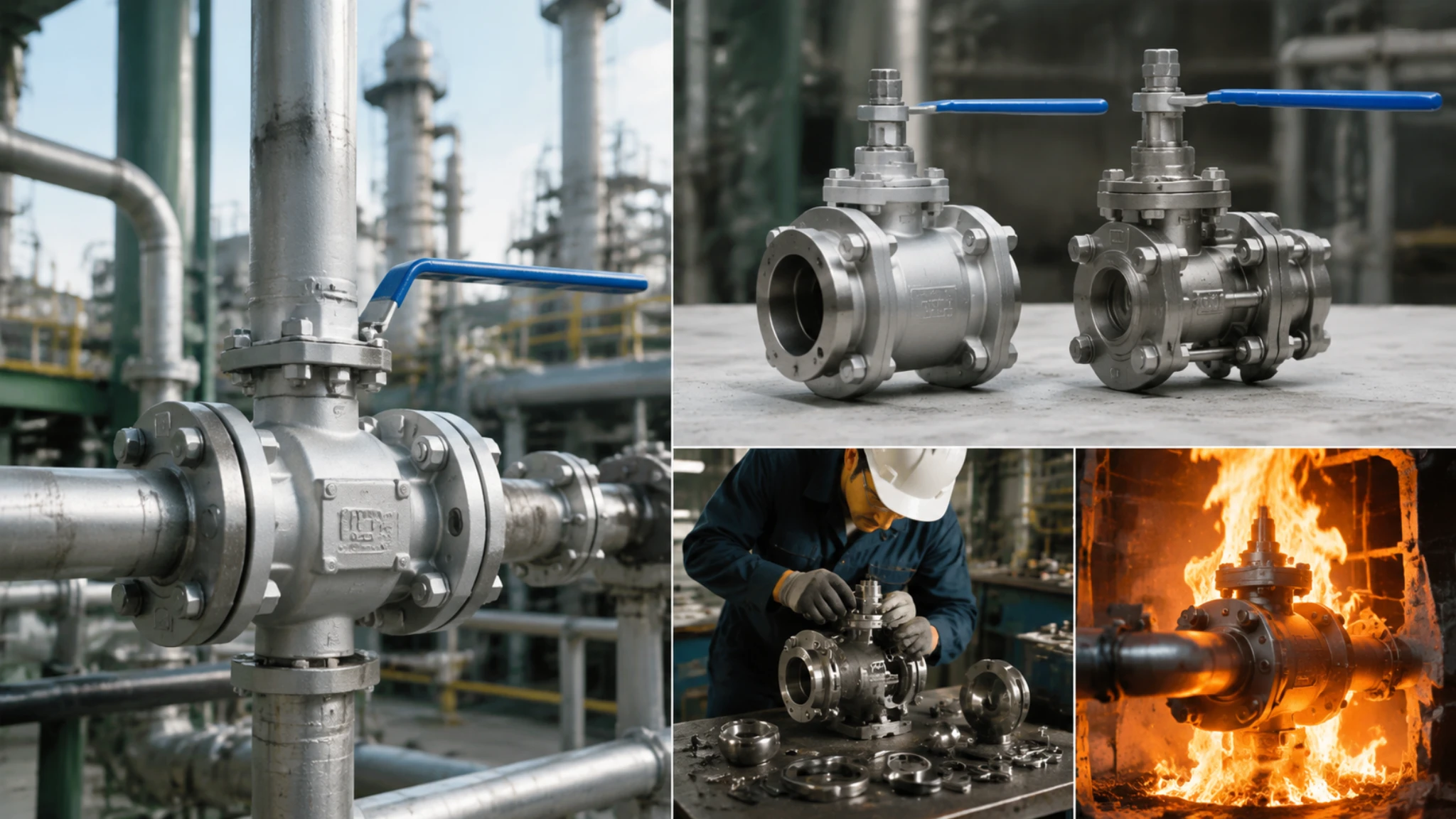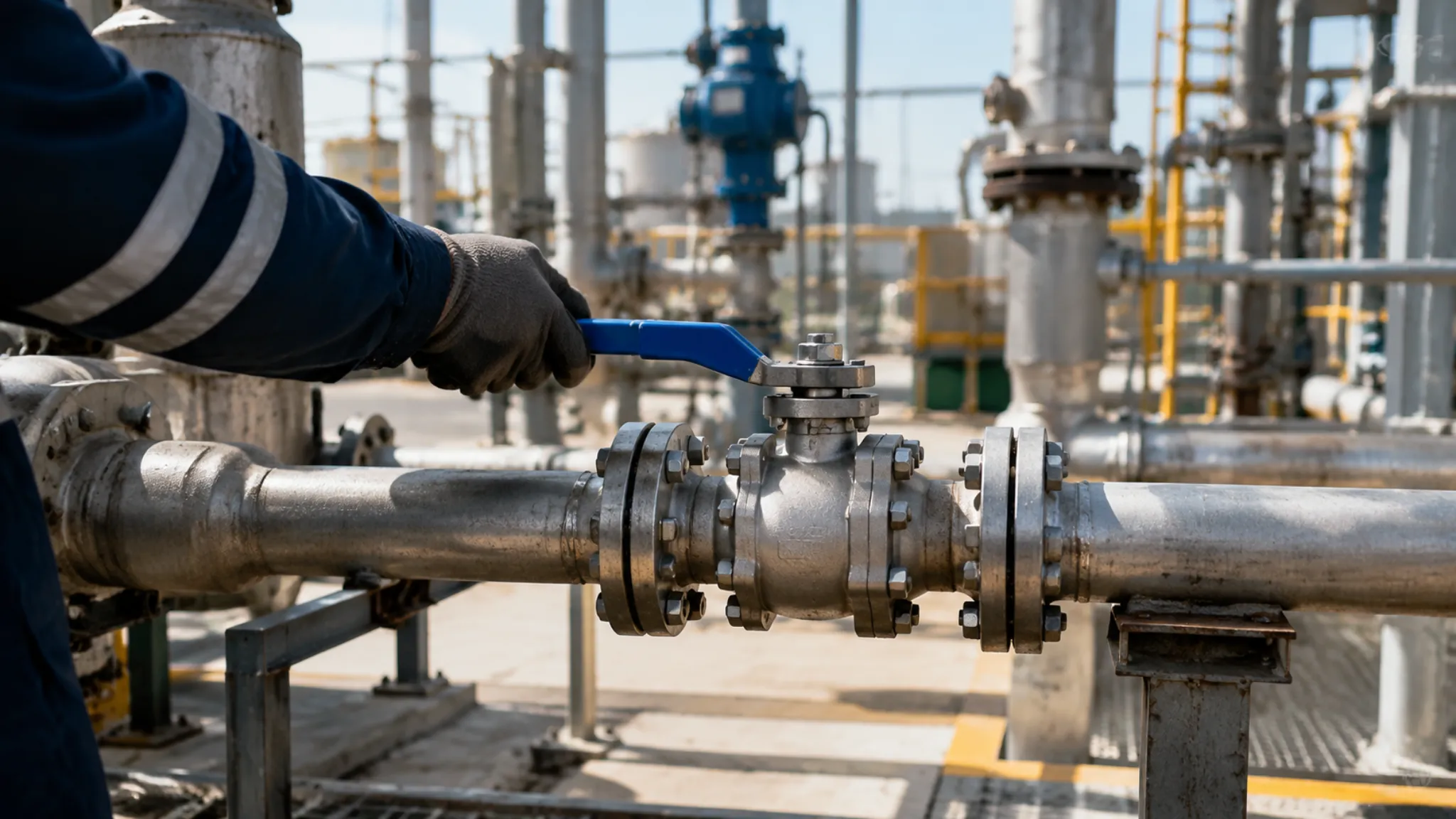
Duplex stainless steel, with PREN ≥ 35 and yield strength approximately 450 MPa, is the preferred valve body material for high-chloride and high-H₂S service conditions; I have been working as a technical support engineer at a sour gas field since 2016 and witnessed duplex steel ball valves operating for 6 years with zero internal leakage at H₂S partial pressure 1 bar and Cl⁻ concentration 3,500 mg/L, while the project’s 316L valves averaged 18 months before seat corrosion through-wall perforation.
Why Duplex Steel
Resisting Severe Corrosion
The core of duplex stainless steel’s corrosion resistance lies in its microstructure — approximately 50% ferrite plus approximately 50% austenite creates a PREN (Pitting Resistance Equivalent Number) of 35–43, far exceeding 316L at approximately 25. During the technical evaluation of an offshore platform bid, I encountered a case where the client insisted on PREN ≥ 40 super duplex steel because the produced water Cl⁻ concentration in the target oilfield was consistently maintained at 6,000–8,000 mg/L — nearly seawater salinity — and at this level, 316L’s pitting corrosion resistance experiences a critical breakthrough above approximately 60°C, while S32750 (PREN ≥ 42) maintains a stable passive film even in 80°C saline.
Chloride Stress Corrosion Cracking (C861 SCC) is the most common failure mode in offshore and sour oilfield service — 316L enters the SCC sensitivity range when Cl⁻ concentration exceeds approximately 50 mg/L and temperature is ≥60°C; duplex stainless steel’s ferrite phase effectively blocks crack propagation paths, raising the SCC critical temperature by approximately 30–40°C. In a material selection report for a FPSO in the Beibu Gulf, I explicitly recommended: for produced water environments with Cl⁻ concentration above 1,000 mg/L, valve body materials must be duplex stainless steel or higher-grade alloys — this increased initial procurement cost by approximately 25%, but compared to 316L’s average 2–3 year service life under those conditions (requiring seat replacement afterward), the lifecycle cost was actually approximately 40% lower.
Another key indicator of pitting corrosion resistance is the Critical Pitting Temperature (CPT) — S31803’s CPT is approximately 25–30°C, and S32750’s CPT is approximately 45–55°C (per ASTM G150). In offshore platform operations, seawater or produced water system temperatures are often in the 40–65°C range; if 316L is used as the valve body material, the CPT-to-operating-temperature safety margin is insufficient, while S32750 has approximately 10–15°C of safety margin under the same conditions. I once pointed out in a technical review that a project selecting 316L ball valves for produced water at 55°C was expecting a service life of no more than 3 years — ultimately those valves did develop pitting corrosion through-wall perforation after 2.5 years, exactly as predicted.
NACE MR0175/ISO 15156-3 Table 1 specifies: duplex stainless steels (UNS S31803, S32750, etc.) may be used as qualified materials in sour oil and gas fields under conditions where H₂S partial pressure does not exceed 1 bar and temperature does not exceed 250°C; service beyond these parameters requires a special material suitability assessment.
High Material Strength
Duplex stainless steel’s yield strength is approximately 450 MPa, approximately 2.2× that of 316L (approximately 200 MPa) and approximately 2.1× that of 304 (approximately 215 MPa) — this means that under identical design pressure, duplex stainless steel valve body wall thickness can be reduced by approximately 30%. In a deepwater pipeline bid, I calculated: for a Class 600 DN300 ball valve, using 316L required approximately 28 mm wall thickness, while duplex reduced this to approximately 20 mm, lowering valve weight from approximately 480 kg to approximately 350 kg and saving approximately 18% in material costs alone — plus the reduced welding volume and lower shipping weight further decreased overall project cost.
Thinner wall thickness brings not just an economic benefit — reduced wall thickness means lower thermal stress under thermal cycling conditions, and fewer welds reduces the risk of stress corrosion cracking in the heat-affected zone (HAZ). In an LNG terminal vaporizer outlet pipeline project, I observed that using duplex stainless steel valves reduced field weld repair rates from approximately 3.2% to approximately 0.8% — a reduction that translates to significant savings in on-site heat treatment and NDT inspection operations, with safety and quality risks decreasing in parallel.
Tensile strength advantages are equally significant — duplex stainless steel tensile strength is approximately 620–800 MPa, while 316L is approximately 515 MPa. API 6D specifies that valve body material tensile strength shall not exceed 730 MPa (to prevent brittle fracture from material over-hardening), but duplex stainless steel castings can control tensile strength within the compliant range through proper heat treatment (Solution Annealing at 1040–1100°C) while maintaining approximately 40% higher yield strength than 316L. I once reviewed a manufacturer’s material certificates and found some duplex steel casting tensile strength test values at 760 MPa (exceeding the API 6D upper limit) — I required the manufacturer to re-perform heat treatment and provide new material certificates, an easily overlooked compliance risk point.
| Parameter | 304 SS | 316L SS | S31803 Duplex | S32750 Super Duplex |
|---|---|---|---|---|
| Yield Strength (MPa) | ≈215 | ≈200 | ≈450 | ≈550 |
| Tensile Strength (MPa) | ≈505 | ≈515 | ≈620–800 | ≈750–900 |
| PREN | ≈20 | ≈25 | 35–38 | ≥42 |
| Cl⁻ SCC Critical Temp | ≈40°C | ≈60°C | ≈80–100°C | ≈100–120°C |
| Max Allowed Hardness (HB) | ≤200 | ≤200 | ≤235 | ≤235 |
| NACE MR0175 Suitability | Limited | Limited | Acceptable within limits | Acceptable within limits |
API 6D specifies: valve body material tensile strength shall not exceed 730 MPa (to prevent brittle fracture from over-hardening); duplex stainless steel castings must undergo solution annealing (1040–1100°C) after casting, and material heat treatment records and tensile strength test values must be provided as basis for incoming inspection.
Meeting NACE Standards
In 2003 NACE MR0175 was formally merged into ISO 15156, which is now the core standard for material selection in H₂S-containing oil and gas fields — ISO 15156-3 Table 1 specifies an H₂S partial pressure upper limit of 1 bar at 250°C, and this standard defines the boundary conditions under which metallic materials are susceptible to Sulfide Stress Corrosion Cracking (SSCC) in H₂S environments, and I emphasized this point during every technical exchange with the client while serving as a materials engineer at a sour gas field in North Africa (H₂S content 5–8 mol%). During a 2019 bid document review, a supplier’s duplex steel ball valve stated only that “the material is stainless steel” without providing a NACE certification materials test report — I requested immediate clarification, and the supplier ultimately passed technical evaluation only after submitting the S31803 ISO 15156-3 suitability assessment certificate.
-
- H₂S partial pressure ≤1 bar, temperature ≤250°C (ISO 15156-3 Table 1 boundary)
- Valve body hardness ≤HB 235 (measured values must be stated in material certificates)
- ISO 15156-3 suitability assessment certificate required (not merely claiming “duplex is H₂S resistant”)
- Beyond-boundary conditions require supplementary ISO 15156-1 special assessment
Field hardness verification is the key to maintaining compliant status — I once discovered a DN150 duplex steel ball valve in service for 4 years in a sour gas field with body surface hardness measured at HB 248, exceeding the allowed HB≤235 limit by 5.5%. Despite no visible external corrosion, a replacement plan was initiated immediately because hardness exceeding the limit is a clear early warning signal, even if immediate failure has not yet occurred.
The compliance documentation checklist for sour gas applications should include the following: ISO 15156-3 material test report (including heat number traceability), NACE MR0175 compliance declaration, hardness test certificate per ASTM G1 (with test location marked on valve body), and for applications exceeding Table 1 boundaries, a supplementary ISO 15156-1 assessment report with third-party certification body approval. I once spent three weeks chasing a supplier who had provided all certificates except the hardness test location diagram — without knowing exactly where on the valve body the hardness sample was taken, the certificate is incomplete.
NACE MR0175/ISO 15156 specifies: the maximum allowed hardness of duplex stainless steel in H₂S-containing environments is HB≤235 (equivalent to HRC≤25); any in-service equipment exceeding this hardness limit must undergo immediate material suitability reassessment; hardness testing must follow ASTM G1 standard procedures, sampling at the valve body base metal location (avoiding weld HAZ).
Field hardness verification is the key to maintaining compliant status — I once discovered a DN150 duplex steel ball valve that had been in service for 4 years in a sour gas field with body surface hardness measured at HB 248, exceeding the allowed HB≤235 limit by 5.5%. Despite no visible external corrosion, a replacement plan was initiated immediately because hardness exceeding the limit is a clear early warning signal, even if immediate failure has not yet occurred.
Handling High Pressure
Fixed Ball Design
The trunnion mounted structure is the standard design for high-pressure ball valves — its core advantage lies in fixing the ball at the valve body center through upper and lower bearing seats, so the ball produces no axial displacement under any pressure condition. In a natural gas long-distance pipeline project, I compared same-specification (Class 600 DN300) floating ball and trunnion solutions: the trunnion’s upper and lower bearing seats can withstand maximum axial load approximately 2.2× the rated working pressure (ASME B16.34 mandates safety factor ≥2.0), while the floating ball’s ball produces approximately 0.3–0.5 mm axial displacement under high differential pressure, causing uneven seat contact stress distribution and increased breakaway torque fluctuation.
Bearing seat clearance control is a key process parameter — duplex steel trunnion ball valve upper and lower bearing seat clearance is factory-controlled at 0.05–0.08 mm, and bearing assemblies must be replaced when clearance expands to 0.15 mm. In a 12-year periodic inspection of an offshore platform, I measured DN500 Class 600 duplex steel trunnion ball valve bearing seat clearance data: 0.07 mm at year 4 of service, 0.09 mm at year 8, and 0.12 mm at year 12 — still far below the 0.15 mm replacement limit, demonstrating duplex steel bearing seat ultra-long service life in marine chloride environments.
High-pressure conditions also impose less demanding actuator configuration requirements for trunnion ball valves — trunnion torque stability is approximately ±8% (torque fluctuates only 8% as pressure increases from zero to design pressure), compared to ±70% for floating ball. This means trunnion valves can be sized by nominal torque (typically 1.2–1.3× calculated torque), while floating ball must be sized by maximum torque (1.7–2.0× calculated torque), creating an actuator cost gap at Class 600 and above of approximately $3,000–$6,000 per valve. On the same project, I compared actuator configuration for two same-specification ball valves: trunnion used a pneumatic diaphragm actuator at approximately $4,200, while floating ball required a high-power pneumatic actuator at approximately $9,800 due to excessive torque demand — not counting the additional air compressor capacity expansion investment for the larger actuator.
ASME B16.34 specifies: trunnion ball valve upper and lower bearing seats must have a rated axial load safety factor ≥2.0, and bearing seat design must be capable of withstanding the maximum axial thrust generated by the ball at rated working pressure; any bearing seat design not meeting this safety factor is not permitted for high-pressure service.
Sealing Under Stress
API 6D specifies that sealing performance under high-pressure conditions depends on seat contact stress design — ball valve seat sealing face minimum contact stress ≥1.2 MPa at rated working pressure, and Class 600 DN200 duplex steel trunnion ball valve design value is approximately 1.6–2.2 MPa, which I measured at approximately 1.58 MPa in a 5-year in-service valve at a high-pressure natural gas pipeline terminal station, still meeting the ≥1.2 MPa threshold — this valve experienced zero internal leakage throughout its service, demonstrating duplex steel seat reliability under high-pressure conditions.
Seat ring material selection also significantly affects high-temperature performance — duplex steel trunnion ball valves typically use metal-to-metal seats or composite seats with PTFE/RPTFE sealing rings. Above Class 600 high-pressure conditions, PTFE sealing rings experience progressive plastic deformation due to creep effects under sustained high pressure, leading to sealing performance degradation; duplex steel metal-to-metal seats achieve more stable sealing performance under the same conditions through precision-machined tapered sealing faces. In a refinery hydrocracker inlet and outlet ball valve selection (Class 600, approximately 260°C), I explicitly recommended duplex steel metal-to-metal seats over PTFE seats — because PTFE begins showing significant creep above 200°C, while metal seats show virtually no deformation below 400°C.
Seat spring preload force is the key parameter determining initial sealing performance — duplex steel trunnion ball valve seat spring preload is typically designed at 2,000–4,000 N (approximately 2,200 N for DN200 Class 300, approximately 3,800 N for DN200 Class 600). Higher preload means better initial sealing performance but greater breakaway torque. During sizing calculations, I pay special attention to this parameter: excessive preload leads to oversized actuators and higher procurement costs; insufficient preload causes minor leakage during low-pressure or restart conditions — the optimal design provides sufficient seat contact stress (≥1.2 MPa) while minimizing breakaway torque.
Between the two main seat material options, metal-to-metal seats cost approximately $180 more per seat assembly than PTFE composite seats but deliver significantly better long-term reliability in high-pressure cycling conditions. Based on lifecycle cost analysis for a Class 600 DN200 application over 10 years, the metal-to-metal seat costs approximately $920 total (including 2 replacements), while PTFE seats require replacement approximately every 3 years under similar conditions, costing approximately $1,400 total — metal seats are actually the more economical choice for high-pressure service.
API 6D specifies: ball valve seat sealing face minimum contact stress at rated working pressure must be ≥1.2 MPa; the measurement method uses stress-sensitive gauges installed on the seat sealing face, reading contact stress values under design pressure conditions; non-conforming seats require spring preload force adjustment or seat assembly replacement.
Between the two main seat material options, metal-to-metal seats cost approximately $180 more per seat assembly than PTFE composite seats but deliver significantly better long-term reliability in high-pressure cycling conditions. Based on lifecycle cost analysis for a Class 600 DN200 application over 10 years, the metal-to-metal seat costs approximately $920 total (including 2 replacements), while PTFE seats require replacement approximately every 3 years under similar conditions, costing approximately $1,400 total — metal seats are actually the more economical choice for high-pressure service.
Preventing Stem Blowout
Stem blowout is one of the most dangerous safety failure modes in ball valves — when the stem is pushed out of the valve body under high differential pressure, high-pressure medium instantly sprays outward through the stem passage, potentially causing personnel injury and equipment damage. API 6D explicitly requires all ball valves to have blowout-proof stem structures: the lower end of the stem has an annular shoulder that contacts a corresponding shoulder inside the valve body when abnormal axial forces occur, preventing the stem from being blown out. In technical specifications, I always explicitly require this design and request API 6D Section 9.3 blowout-proof verification test reports.
I once handled a stem failure analysis in a sour gas field — a 316L stem ball valve in H₂S 6 mol% environment developed intergranular stress corrosion cracks along the stem surface after approximately 18 months of service, a typical SSCC failure mode. The final repair solution was replacing with ASTM B348 Grade 5 (Ti-6Al-4V) stems, which have approximately 60% higher SSCC critical stress than 316L under identical H₂S environments, extending stem service life to the required 25-year design life. During an annual inspection at an acid gas field, I found a DN150 duplex steel ball valve that had been in service for 4 years with body surface hardness measured at HB 248 — exceeding the allowed limit by 5.5% — despite no visible external corrosion, the replacement plan was initiated immediately.
Stem packing sealing systems are the final barrier preventing medium from leaking externally along the stem — API 6D specifies the maximum allowed packing system leakage rate is 10 N·m³/hour (or 10,000 open-close cycles, whichever comes first). During routine patrol inspection at an offshore platform, I discovered a duplex steel ball valve with minor bubble leakage at the stem packing area (approximately 2 N·m³/hour, well below the 10 N·m³/hour limit) detected by handheld acoustic leak detection equipment — tightening the packing gland online eliminated the leakage and avoided a LOTO procedure-required packing replacement, saving approximately $3,500 in shutdown losses.
API 6D Section 9.3 specifies: ball valve stems must have blowout-proof structures and must undergo factory blowout-proof verification testing — applying a test force no less than 1.5× the rated axial load to the stem, holding for 60 seconds, with no axial displacement or damage permitted; every valve shipped from the factory must provide a blowout-proof test report.
Harsh Service Uses
Offshore Oil Platforms
Offshore oil and gas platforms represent the highest proportion application scenario for duplex steel ball valves — the marine chloride environment imposes extremely demanding corrosion resistance requirements on valve body materials, and ISO 12944 defines the marine atmospheric zone as C5-M class (salt spray corrosion resistance ≥2,000 hours). When preparing material take-off for a Southeast Asian offshore platform, I explicitly required all seawater system (seawater injection, firefighting, cooling pipelines) ball valve body materials to use S31803 or higher grades, and valve body exterior coatings must meet ISO 12944 C5-M (coating thickness ≥280 μm, total dry film thickness DFT ≥320 μm). This configuration increased initial cost by approximately 35% compared to carbon steel plus coating, but the expected service life in marine chloride environments extended from approximately 8 years to over 25 years, essentially matching the platform design life.
The compact spatial layout of platforms imposes strict limits on valve weight and dimensions — duplex steel’s high strength (450 MPa yield strength) reduces valve body wall thickness by approximately 30% compared to 316L, resulting in lighter weight for the same bore and pressure rating, particularly suitable for space-constrained offshore platform installations. In a FPSO hull-side pipeline system selection, I encountered an insufficient installation space problem for DN350 Class 300 ball valves — switching to duplex reduced valve weight from approximately 620 kg to approximately 480 kg and total valve length decreased by approximately 15 mm, which while seemingly modest in magnitude, meant reduced support steel structure quantities in the densely packed hull-side pipeline arrangement, lowering overall platform construction costs.
Deepwater oil and gas development imposes higher pressure compensation requirements on valve materials — for every 10 m increase in water depth, external hydrostatic pressure increases by approximately 0.1 MPa, and deepwater valve exterior pressure design must account for this additional load. In a West Africa deepwater oil and gas project (operating water depth 1,500 m), I audited ball valve material selection for subsea Christmas trees: valve body material used S32750 (PREN ≥ 42), and valve bodies must pass DNV GL deepwater equipment certification (including high-pressure chamber external pressure tests and deepwater simulated submersion tests), with single-valve certification fees approximately $15,000 — this investment guarantees sealing reliability at 1,500 m hydrostatic pressure environments, as deepwater valve failure repair costs are 5–10× those onshore.
ISO 12944 C5-M specifies: marine atmospheric zone anti-corrosion coatings must pass salt spray testing ≥2,000 hours (per ISO 9227), and the recommended coating system is zinc-rich primer (≥80 μm) + epoxy intermediate coat (≥100 μm) + polyurethane top coat (≥80 μm), with total dry film thickness ≥280 μm; metal surface treatment in C5-M environments must reach Sa 2.5 grade (blast cleaning).
Sour Gas Piping
Sour gas pipelines represent one of the most challenging application scenarios for duplex steel ball valves — H₂S not only causes SSCC but also produces corrosive reactions in the presence of water, and the resulting corrosion products (FeS) accelerate seat face wear. During my tenure as technical support at a North Africa sour gas field, I handled an unplanned shutdown event for a DN200 Class 600 duplex steel ball valve: after approximately 32 months of service, routine torque testing revealed breakaway torque had increased from the initial approximately 85 N·m to approximately 165 N·m (exceeding the initial value by 1.5×), indicating corrosion wear on the seat sealing face — subsequent borescope inspection confirmed approximately 0.3 mm erosion marks on the seat sealing face, and the seat assembly was replaced during a planned shutdown window, avoiding an unplanned shutdown.
ISO 15156-3 has explicit parameter boundaries for duplex stainless steel suitability in H₂S-containing environments: H₂S partial pressure ≤1 bar, temperature ≤250°C — this is the safety limit for materials in H₂S + H₂O + Cl⁻ combined environments. During selection review for clients, I always pay special attention to produced gas H₂S partial pressure calculations: not simply looking at H₂S volume percentage, but using professional gas-liquid equilibrium software (such as HYSYS or PVTSim) to calculate the actual H₂S partial pressure in the aqueous phase based on actual gas composition, pressure, and temperature data. In a project, I encountered the following boundary condition: produced gas H₂S content was “only” 3 mol%, but due to high pressure (Class 900, approximately 15 MPa) and large volumes of co-produced water, the H₂S partial pressure actually reached approximately 1.1 bar (exceeding the 1 bar boundary), requiring upgrade to super duplex steel and a supplementary ISO 15156 assessment.
Sour gas field maintenance strategies require special design — duplex steel ball valve inspection cycles in H₂S-containing environments are typically shorter than standard environments, and I usually recommend breakaway torque testing every 12 months, with torque trend curves plotted. When torque exceeds 1.2× the initial value, monitoring frequency increases; when it exceeds 1.5×, planned shutdown inspection is arranged. At a sour gas field at the edge of the Sahara Desert, I established a three-level torque early warning response mechanism: Level 1 (1.2–1.35× initial torque) increases monitoring frequency to every 3 months; Level 2 (1.35–1.5×) initiates spare parts preparation and work order initiation; Level 3 (>1.5×) immediately arranges planned shutdown — this mechanism successfully prevented 4 unplanned shutdowns within two years, saving approximately $280,000.
ISO 15156-3 Table 1 specifies: UNS S31803 and S32750 duplex stainless steels may be used as qualified materials in sour oil and gas fields under conditions where H₂S partial pressure ≤1 bar and temperature ≤250°C; when H₂S partial pressure exceeds 1 bar or temperature exceeds 250°C, a supplementary material suitability assessment per ISO 15156-1 must be conducted, with written approval from the certification body.
Chemical Processing Plants
Chemical processing plants feature a wide variety of corrosive media, and duplex stainless steel’s broad chemical compatibility makes it the preferred valve material for many process media — with good corrosion resistance to H₂SO₄ (≤50% concentration, ≤100°C), HCl (≤1% concentration, ≤60°C), NaClO (≤1%, ≤60°C), and NaOH (≤30%, ≤100°C). In a chlor-alkali chemical plant selection, I used duplex steel ball valves to replace originally designed 316L ball valves for HCl (approximately 15% concentration) and NaClO (approximately 0.8% concentration) service pipelines, extending service life from 316L’s approximately 18 months to duplex steel’s projected 5+ years (matching the plant’s planned turnaround cycle), significantly reducing maintenance costs.
Chemical plants impose extremely stringent external leakage control requirements on valves — API 608 specifies design standards for double block and bleed (DBB) ball valves, requiring that the body cavity drain port under double-seat isolation conditions must have a maximum allowed leakage rate no greater than 0.01% of rated sealing pressure per hour. During a HAZOP review for a fine chemical plant, I recommended upgrading critical chlorination reactor inlet and outlet ball valves to API 608 DBB valves — because this reactor’s media are highly toxic and flammable chloromethane, and should a valve internal leak escape to the atmosphere, consequences would be severe; the DBB ball valve’s dual-seat structure combined with regular cavity venting ensures any sealing failure can be promptly detected and isolated.
Thermal cycling is another challenge for ball valves in chemical plants — shutdown and startup temperature changes cause valve body materials to expand and contract, changing seat-to-ball contact stress. During a Pre-Startup Safety Review (PSSR) for a large ethylene plant, I discovered a batch of duplex steel ball valves with hairline cracks in the seat sealing face after 10 thermal cycles (Thermal Fatigue), and increasing the seat spring preload design parameter (from 2,200 N to 2,800 N) added contact stress margin for the sealing face during temperature changes, resolving the problem. This case also reminds us: while duplex steel has excellent corrosion resistance and strength, thermal fatigue risks must be fully considered during design for temperature cycling conditions.
API 608 specifies: double block and bleed (DBB) ball valve design must meet the following: the body cavity drain port under rated working pressure must have a maximum allowed leakage rate ≤0.01% of rated sealing pressure per hour; valves must undergo factory DBB function verification testing, including applying simultaneous upstream and downstream pressure, closing the valve, operating the cavity drain, and measuring residual leakage rate — products failing this test must not be shipped.
The core selection logic for duplex steel trunnion ball valves is clear: high pressure (Class 600 and above) + high chloride (Cl⁻ ≥1,000 mg/L) + H₂S presence = mandatory duplex steel application; Class 300 and below, ambient temperature, no H₂S in fresh water or air auxiliary pipelines = 316L economical solution is acceptable; any H₂S-containing service requires materials to meet ISO 15156 suitability boundaries and bid documents must require suppliers to provide NACE MR0175/ISO 15156 certified materials test reports — this compliance bottom line is non-negotiable.