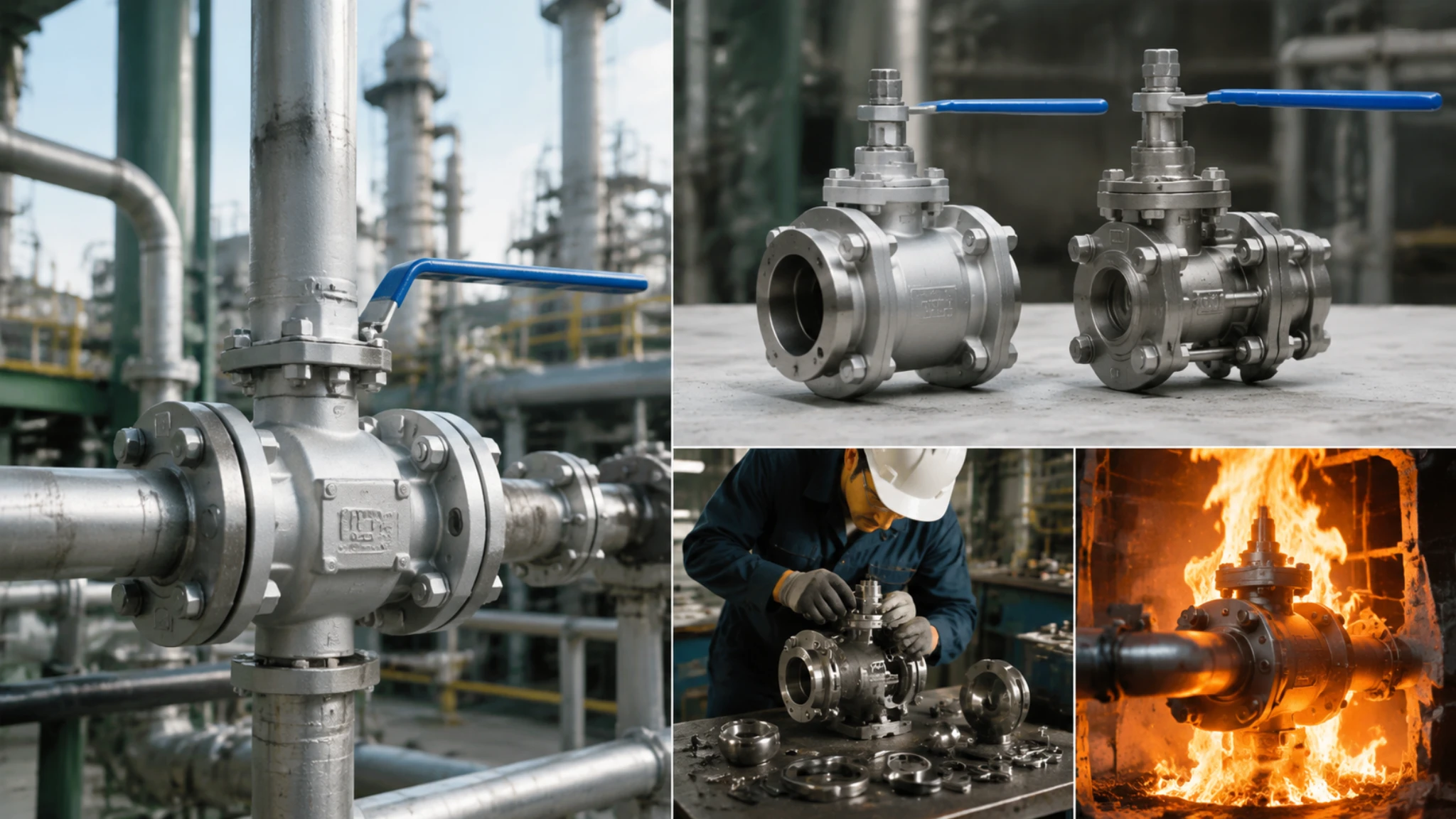
As a Chief Technical Compliance Officer with over two decades of field experience in severe service flow control and pressure vessel integrity, I have reviewed thousands of premature valve failures. More than 40% of these failures stem from a fundamental specification error: misjudging the trade-off between standard port geometries and heavy-duty small port designs.
This guide strips away marketing narratives to provide an objective, data-driven engineering analysis of these two valve architectures based on ASME, API, and ISO technical standards.
Comparing Wall Thickness
Wall thickness is the primary defense mechanism against hoop stress, mechanical piping loads, and internal erosion. While standard valves optimize material volume for baseline pressure ratings, heavy-duty small port configurations deliberately alter the ratio of internal diameter to wall mass.
Heavy Duty Wall Size
Heavy-duty small port valves (often categorized under API 602 for forged steel variations or ASME B16.34 Special Class) utilize a restricted internal bore diameter paired with an oversized forge blank body. For an NPS 1 (DN 25) Class 1500 heavy-duty small port valve, the minimum wall thickness (\(t_m\)) does not merely meet the standard baseline; it often defaults to the thickness profile of an NPS 1.5 or Class 2500 forging.
According to ASME B16.34 Table 3, the minimum wall thickness for a standard Class 800 NPS 1 valve is 6.4 mm. In contrast, a heavy-duty small port alternative engineered for severe thermal cycling or high-pressure transients increases this wall thickness to \(\geq 9.5 \text{ mm}\) while restricting the seat port diameter to approximately 18 mm. This configuration yields an exceptionally high mass-to-volume ratio, dampening mechanical vibrations and providing a massive sacrificial envelope for corrosive or erosive wear.
Standard Valve Thickness
Standard valves (whether full port or standard reduced port under API 603 or ASME B16.34 Standard Class) are engineered to minimize flow restriction while maintaining compliance with minimum code boundaries. For a standard NPS 1 Class 150 or Class 300 valve, the wall thickness is kept tight to the minimum allowable limits (e.g., ~3.6 mm for Class 300 NPS 1).
The manufacturing tolerance here is lean. While this design minimizes weight and raw material costs—ideal for structural loading limits on generic utility piping—it leaves virtually zero margin for localized wall thinning caused by velocity-induced erosion or chemical pitting.
Why Thickness Matters
From a structural mechanics perspective, thickness dictates the allowable working pressure and the valve’s resistance to piping stress (such as thermal expansion loads or water hammer). The correlation between internal pressure, port diameter, and wall thickness is governed by the modified Barlow’s formula or the Lamé equation for thick-walled cylinders.
To determine the minimum required shell thickness (\(t_{min}\)) under ASME Section VIII, Div 1 and ASME B16.34, the underlying engineering logic relies on the following model:
Where:
- P = Maximum Design Pressure (MPa)
- Di = Inside Diameter of the valve body cavity (mm)
- \(\sigma\) = Allowable Stress of the material (MPa) at design temperature (e.g., ASTM A105 or ASTM A182 F316)
- E = Joint Efficiency (typically 1.0 for forged bodies)
- CA = Corrosion/Erosion Allowance (mm)
By executing a “Small Port” design, engineers minimize \(D_i\). When this reduced \(D_i\) is combined with an increased physical wall thickness (\(t_{min}\)), the safety factor against pressure-induced tensile stress spikes exponentially. This structural configuration prevents body deformation, which is the root cause of internal seat misalignment and subsequent packing leaks under high pipe bending moments.
| Parameter | Standard Valve (NPS 1, Class 600) | Heavy Duty Small Port (NPS 1, Class 1500 Body Blank) |
|---|---|---|
| Primary Standard | ASME B16.34 Standard Class | API 602 / ASME B16.34 Special Class |
| Typical Wall Thickness (\(t_m\)) | ~4.8 mm | \(\geq 8.5 \text{ mm}\) |
| Port Bore Diameter (\(D_i\)) | 25.4 mm (Full Port) | 17.5 mm (Reduced/Small Port) |
| Sacrificial Corrosion Allowance (\(C_A\)) | 1.0 mm | \(\geq 3.0 \text{ mm}\) |
| Resistance to Piping Bending Moments | Low to Moderate | High |
Lifespan and Wear
Valve longevity is not a linear function of time; it is an exponential function of fluid velocity, pressure drop (\(\Delta P\)), and material hardness.
Heavy Duty Lifespan
Heavy-duty small port valves are built to endure high-kinetic-energy environments. Because their internal velocity profiles are high due to the restricted bore, their internal trims are armored. The typical configuration includes solid Stellite 6 (Cobalt-Chromium-Tungsten alloy) or heavy Stellite weld overlays on both the seat ring and wedge/disc, yielding a surface hardness of \(\geq 45 \text{ HRC}\) (Rockwell C).
The stem material is frequently upgraded to ASTM A564 Gr. 630 (17-4PH) in condition H1150D to prevent galling and fatigue. In high-pressure drop applications (\(\Delta P > 5 \text{ MPa}\)), a heavy-duty small port valve achieves a Mean Time Between Failures (MTBF) that is 4 to 5 times longer than a standard valve, primarily because its thick body housing absorbs cavitation energy without transmitting stress to the bonnet threading.
Standard Valve Wear
Standard valves typically deploy standard trim materials, such as API Trim 8 (13Cr stem and hardfaced seats) or Trim 5 (Full hardfacing), but with thinner deposition layers. Under benign conditions (low velocity, clean fluids), these valves operate reliably for years. However, when subjected to throttling or severe cyclic service, they degrade rapidly via cavitation, flashing, or droplet impingement.
Field Audit Case Study: Boiler Blowdown Failure
In 2018, during a compliance audit at a 2x660MW supercritical power plant, we investigated the chronic failure of an NPS 1.5 boiler continuous blowdown valve. The EPC contractor had installed a standard API 602 Class 800 full-port globe valve with standard 13Cr trim (HRC 25).Due to the continuous pressure drop from 18.5 MPa to atmosphere, localized flashing occurred. The fluid velocity exceeded 55 m/s. Within 420 operating hours, the standard valve suffered severe “wire-drawing” (micro-jet erosion across the seating surface), leading to a total loss of isolation compliance and triggering an unscheduled unit shutdown costing $120,000 per day. The valve wall itself showed 1.8 mm of localized cavitation pitting, nearing the code-minimum retirement thickness.
How to Last Longer
To maximize the lifespan of any small port or standard valve installation, asset operators must employ specific tacit knowledge metrics that go beyond standard catalogs:
- Trim Velocity Management: For liquid service, ensure the trim outlet kinetic energy (\(V^2 \cdot \rho\)) does not exceed \(200,000 \text{ kg/(m}\cdot\text{s}^2\text{)}\). For gas service, limit the outlet Mach number to \(\leq 0.3\).
- Stuffing Box Integrity: Migrate from standard die-formed graphite rings to live-loaded packing systems utilizing Inconel wire-reinforced flexible graphite rings complying with API 622 low-emission standards. This maintains a constant sealing force even during rapid thermal transients (\(\Delta T > 100^\circ\text{C/min}\)).
- Weld Overlay Preheating: When field-repairing or hardfacing heavy forged bodies (e.g., ASTM A217 WC9 or A105), mandate a minimum preheat temperature of \(200^\circ\text{C}\) and post-weld heat treatment (PWHT) per ASME Section IX to prevent hydrogen-induced cracking in the transition zone behind the Stellite layer.
Where to Use Each
Selecting between these two designs requires evaluating the boundaries between processing economics and absolute safety risks.
Heavy Duty Uses
Heavy-duty small port valves are mandatory in critical-loop and severe-service environments where a valve failure threatens plant containment or human safety.
- High-Pressure Vent and Drain Systems: Operating under ASME TDP-1 (Prevention of Water Damage to Steam Turbines).
- Chemical Injection Blocks: Handling highly corrosive catalysts where NACE MR0175/ISO 15156 compliance for sour gas (\(H_2S\)) is required.
- Hydrocracker and Catalyst Slurry Lines: Where entrained solids act as a continuous abrasive blasting medium against the valve inner walls.
Standard Valve Uses
Standard valves are the correct financial and engineering choice for high-volume, low-risk utility frameworks.
- Utility Distribution: Closed-loop cooling water lines, plant air, and low-pressure nitrogen blanketing systems (Class 150/300 service).
- Hydrocarbon Transfer Lines (Low \(\Delta P\)): Long-distance transport of clean, single-phase refined products where flow maximization (low pressure drop via full-bore geometry) is critical for pumping efficiency.
Making Your Choice
The final engineering selection must be governed by an objective Life Cycle Cost (LCC) model rather than the initial Capital Expenditure (\(C_{cap}\)).
The economic justification model is structured as follows:
Where:
- Ccap = Purchase cost of the asset
- Cinst = Installation and welding/NDE costs
- Cops = Operational energy costs (pressure drop penalty)
- Cmaint = Scheduled and unscheduled maintenance/trim replacement
- Cdown = Production loss during valve-induced downtime
- Cenv = Environmental non-compliance fines (e.g., fugitive emissions leaks)
The table below provides a quantified framework for a high-pressure bypass line application (\(\Delta P = 8.2 \text{ MPa}\), continuous cycling, 5-year operating horizon):
| Cost Factor | Standard Valve (Full Port, Class 900) | Heavy Duty Small Port (Class 1500 Blank) | Engineering Rationale |
|---|---|---|---|
| Initial Ccap | $1,200 | $3,100 | Heavy duty requires premium alloy forgings and specialized machining. |
| Frequency of Repair | Every 6 Months (Failed Trim/Seats) | None (Inspected at Year 5) | Standard trim cannot withstand the localized flashing velocity. |
| 5-Year Cmaint | $8,500 (10 interventions) | $400 (Single seal swap) | Labor, machining, and replacement parts over the lifecycle. |
| Risk of Cdown | High ($150,000/instance risk) | Negligible | Standard valve failure risks systemic steam/fluid bypass, forcing unit derates. |
| Fugitive Emissions (Cenv) | Non-compliant after 12 months | Compliant via ISO 15848-1 Class AH | Heavy-duty stem packing guides prevent lateral stem deflection. |
| Total 5-Year LCC | $9,700 + High Downtime Risk | $3,500 Total | Heavy Duty delivers a 63.9% direct savings, ignoring downtime mitigation. |
Summary Recommendation
Do not permit purchasing departments to substitute a heavy-duty small port specification with a standard reduced-port valve solely based on nominal pipe size (NPS) and pressure class parity. If the application involves a pressure drop exceeding 20% of the upstream absolute pressure, or if thermal cycling exceeds \(80^\circ\text{C}\) variance per cycle, the heavy-duty small port configuration is the only technically defensible choice to maintain plant containment and regulatory compliance.