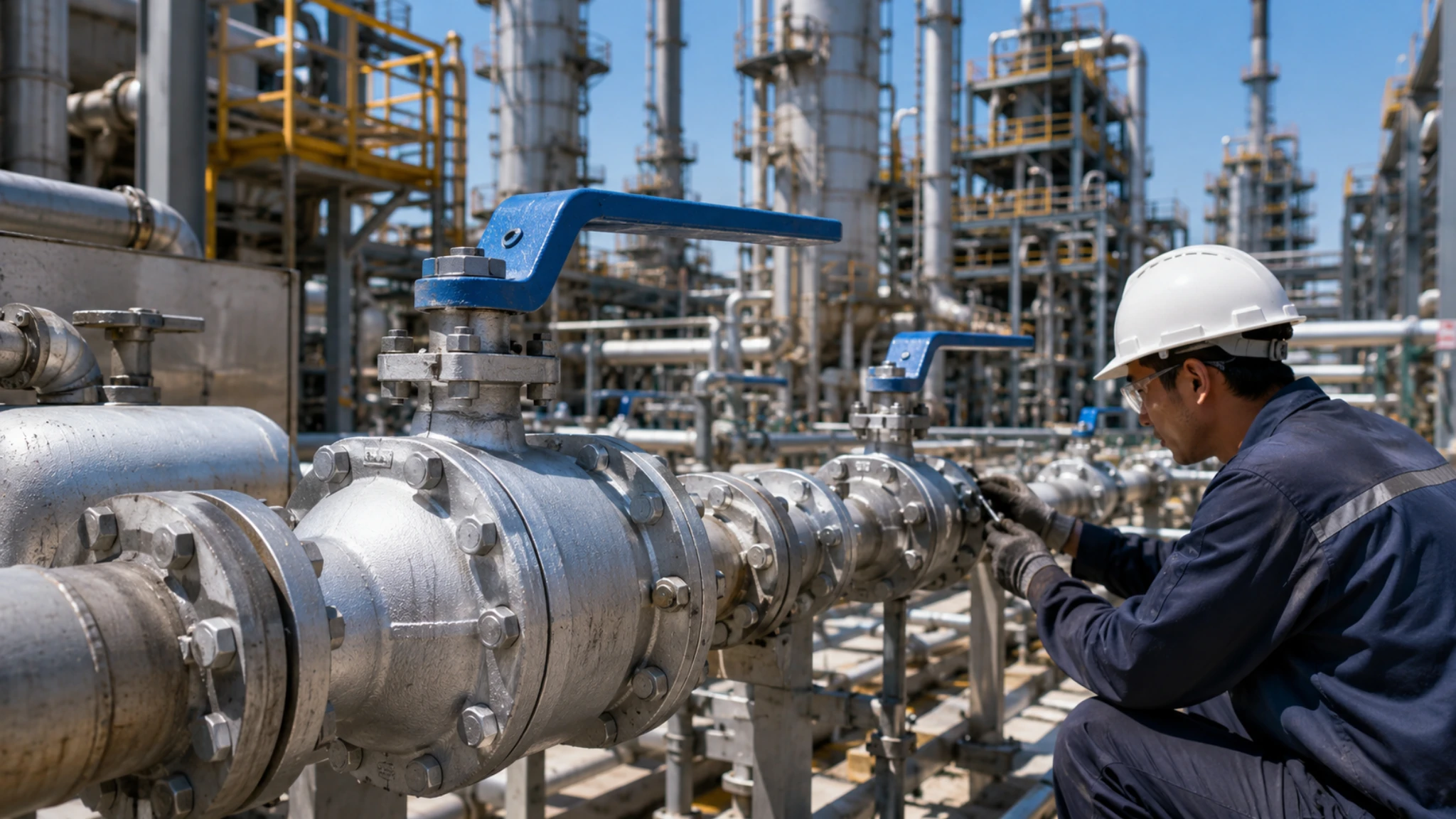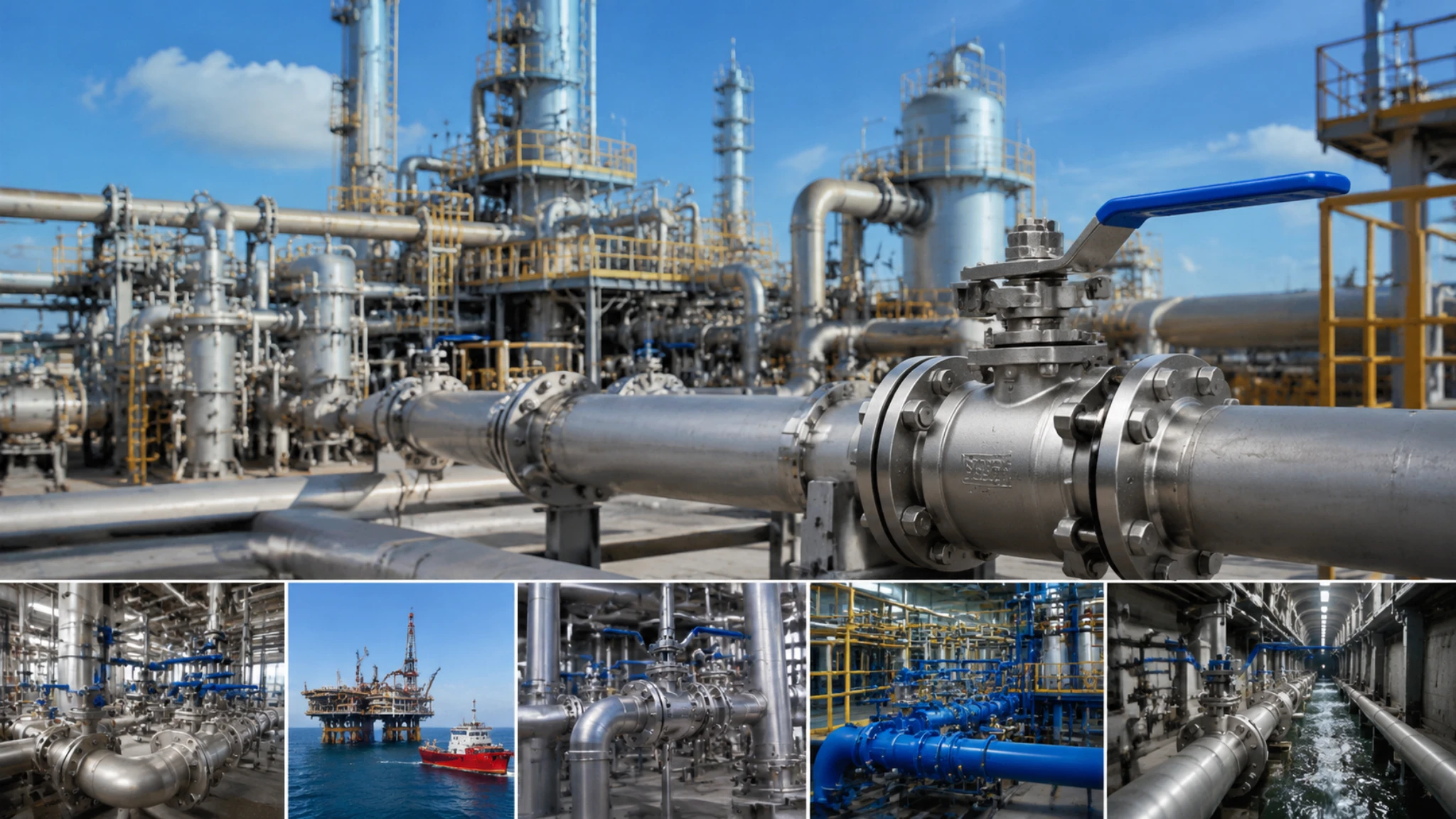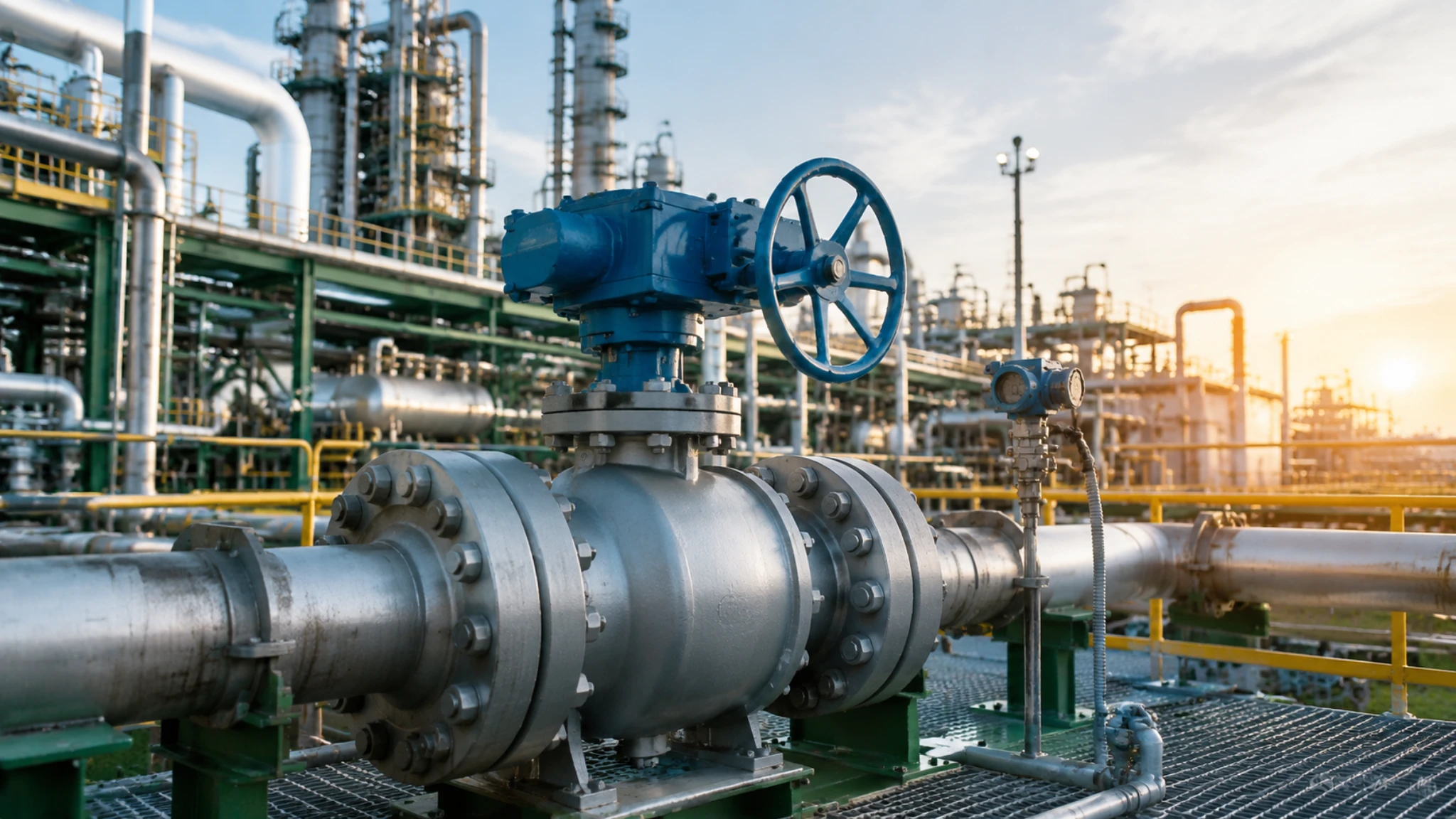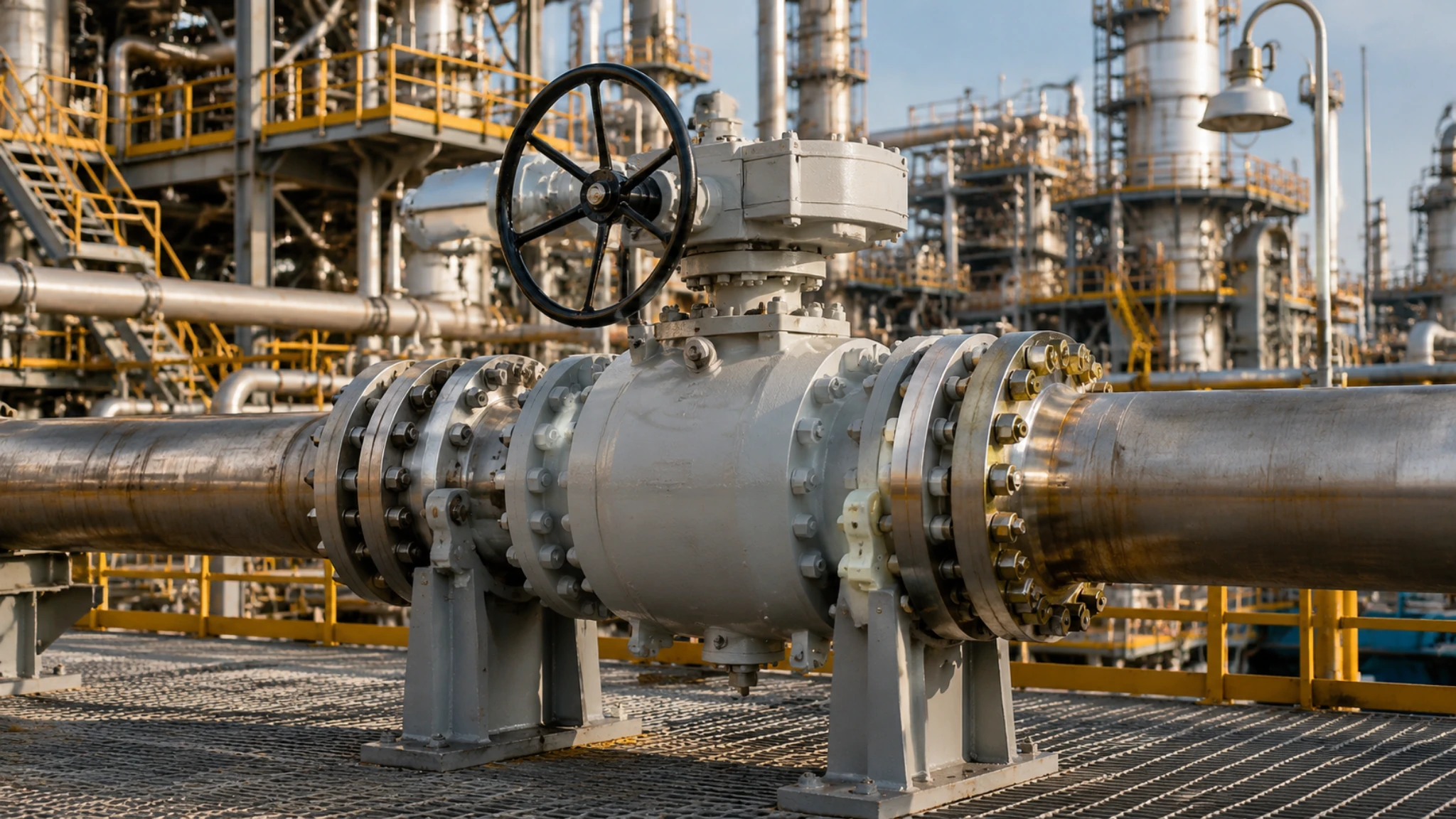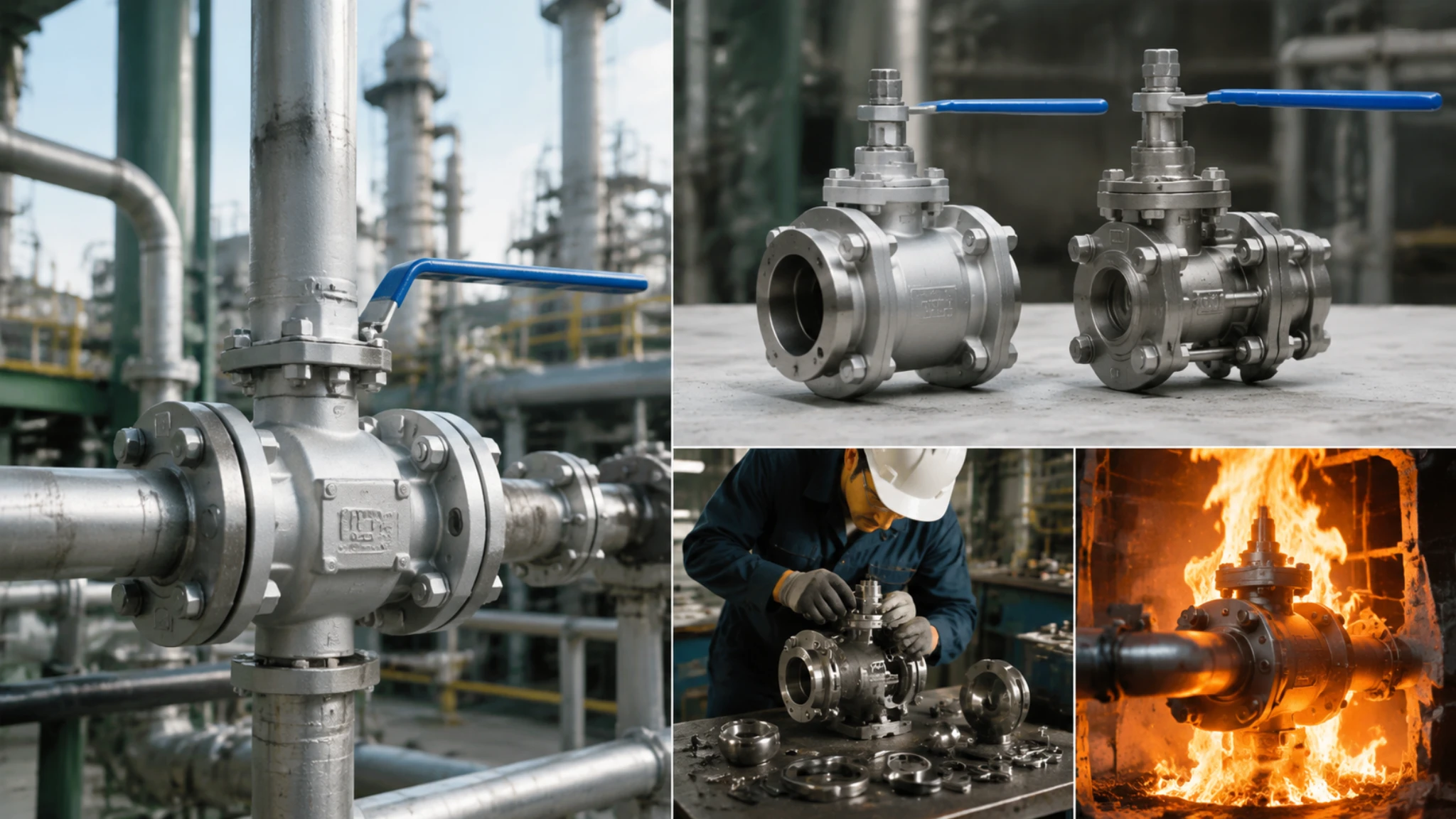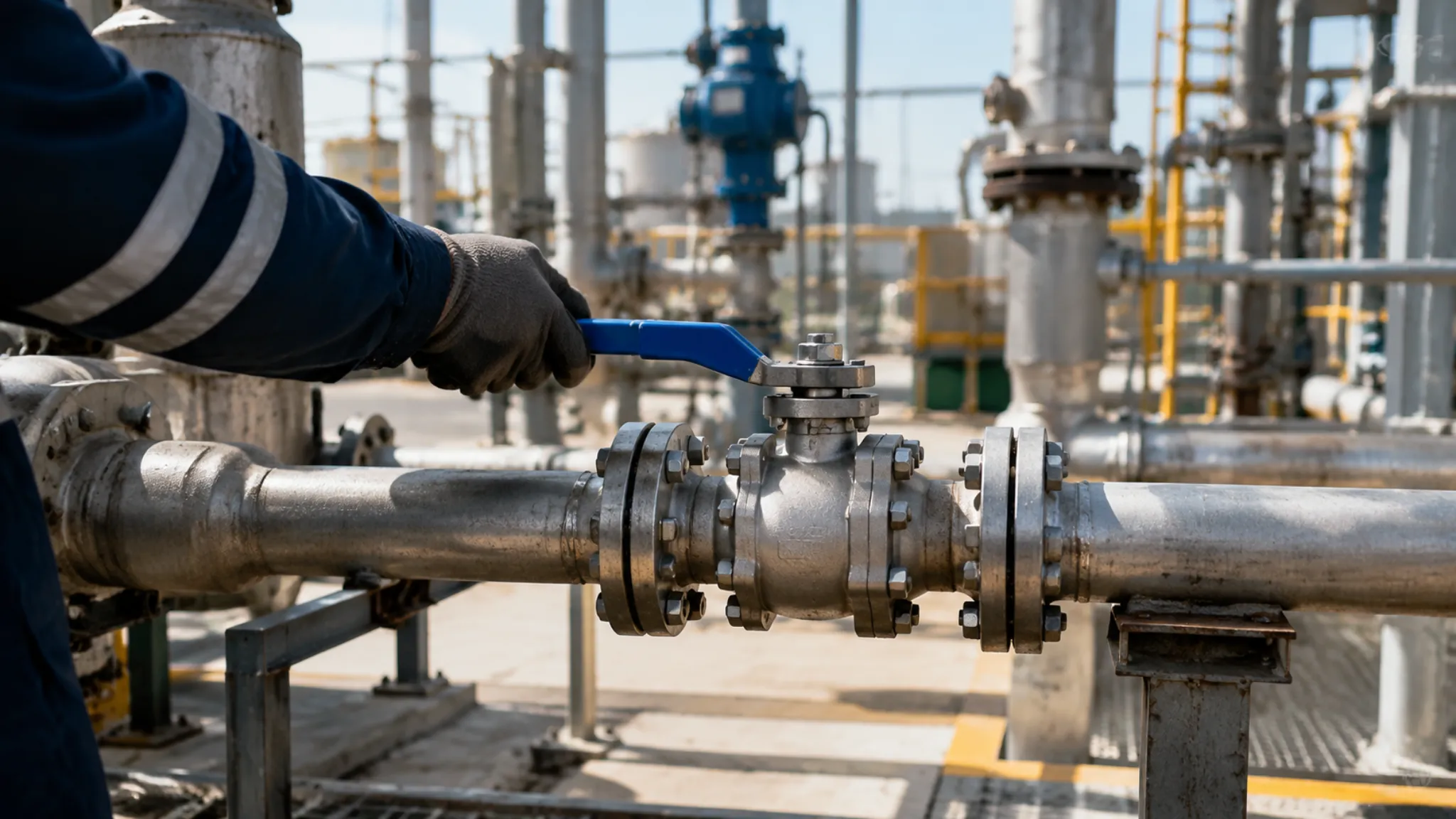
The global industrial valve market is approximately USD 38 billion, with ball valves accounting for 35% to 40% of that total. My first overseas project involved delivering a batch of Class 600 NPS 8 forged ball valves to a refinery in Indonesia — the client’s technical specification ran to 187 pages covering every requirement from materials to testing to marking to documentation. Ball valves are the “gatekeepers” of industrial fluid control: select the correct specification and your pipeline operates safely for 20 years; select incorrectly and you face anything from minor leakage to catastrophic failure.
Top Industry Applications
Oil and Gas
The oil and gas industry consumes approximately 42% of global industrial ball valve output — the largest single application sector. Offshore platform ball valves typically require dual API 6D plus API 17D certification. API 17D is the specialized specification for subsea wellhead equipment, with more stringent requirements for hydrostatic testing, sealing performance, and corrosion coatings than API 6D alone. On a deepwater project in the South China Sea, subsea ball valves operated at water depths of 1,200 meters, where the valve body had to withstand external hydrostatic pressure of 1.2 MPa plus internal medium pressure — requiring a wall thickness approximately 25% greater than standard API 6D designs.
Onshore oil and gas gathering pipeline ball valves have a core requirement for Emergency Shutdown (ESD) function: when a pipeline leak occurs, ESD ball valves must complete shutdown within 1 second. When reviewing the design documents for a western China gas field, I discovered the ESD valve and control system response time calculation had omitted the solenoid valve energizing time (typically 200 to 300 ms), meaning actual shutdown time could reach 1.5 seconds — exceeding the specification limit of 1 second. This design-stage finding saved approximately CNY 600,000 in what would have been field rework costs.
LNG terminal ball valves operate at cryogenic temperatures as low as -162°C, using A352 LCC or A351 CF8M materials with specialized cryogenic sealing components. On an LNG project, a quality issue was discovered upon valve delivery: the measured low-temperature Charpy impact energy was only 15 J (specification requires 20 J), caused by a heat treatment process that had not been customized for -196°C service. After the factory re-ran the heat treatment, retesting passed — delivery was delayed 3 weeks but the project startup was not affected.
- Offshore oil and gas: API 6D plus API 17D dual certification; subsea ball valve wall thickness approximately 25% greater at 1,200 m water depth
- ESD function: shutdown response time ≤1 second; solenoid valve energizing time of 200 to 300 ms must be included in total response calculation
- LNG terminal: operating temperature -162°C; A352 LCC or A351 CF8M material; cryogenic Charpy impact ≥20 J at -196°C
- Gathering pipelines: piggable ball valves require full-bore design; top-entry construction at launcher/receiver locations for on-line maintenance
- Subsea pipelines: BVID (Ball Valve Interface Document) verification required; cathodic protection coating must pass ISO 15711 salt spray test
- Natural gas dehydration: molecular sieve dehydrator dry gas outlet ball valve stems require stainless steel braided graphite packing to prevent silica gel dust embedment
Another detail: in water injection development, ball valves are commonly used on high-pressure water injection pipelines (operating pressures up to 35 MPa). Using standard Class 600 valves (rated approximately 10 MPa) on 35 MPa lines causes premature fatigue failure. I recommend selecting Class 900 or Class 1500 valves — the additional cost buys 20+ years of safe operation rather than premature failure.
Petrochemical Processing
900°C maximum, 180°C to 250°C typical — ball valves in petrochemical service face these temperature ranges, and I once saw a design specify ball valves for a cracking furnace main feed line where seat materials would carbonize above 500°C.
Hydrocracker ball valves represent a typical high-temperature high-pressure condition: operating temperature 350°C to 450°C, operating pressure 15 to 20 MPa, media containing hydrogen, hydrogen sulfide, and hydrocarbons. Stem sealing is the critical risk point for this service — when reviewing a hydrocracking upgrade project’s technical documents, I found the original design specified PTFE stem packing, when graphite packing is the correct choice, because PTFE begins degrading above 200°C and operating temperatures of 350°C+ far exceed PTFE’s temperature limit.
Coker (delayed coking unit) ball valves represent one of the most severe ball valve applications: media includes high-temperature coke particles (approximately 500°C) in a water-gas mixture, operating at 450°C and 0.5 to 1.0 MPa. This service typically requires metal-seated ball valves (metal seat plus Stellite overlay), with seat sealing faces using plasma-sprayed tungsten carbide (coating thickness ≥0.5 mm, hardness HRC 65 to 70). A delayed coking unit originally using standard metal-seated ball valves experienced seat lives of only 3 months; after switching to tungsten carbide overlaid seats, service life extended beyond 18 months.
- Ethylene cracking: ball valves for quench oil/water systems (≤250°C); cracking furnace feed lines require high-temperature gate valves
- Hydrocracker: 350°C to 450°C, 15 to 20 MPa; stem packing must be graphite, not PTFE
- Coker unit: media includes 500°C coke particles; seats require plasma-sprayed tungsten carbide (≥0.5 mm, HRC 65 to 70)
- Aromatics complex: media includes benzene, toluene, xylene; flange gaskets must be spiral wound with graphite filler
- Polypropylene unit: media includes catalyst slurry; ball chrome-plated 316L, prevents catalyst abrasion
- Ethylene oxide unit: media highly flammable; ball valves require anti-static construction (API 6D Section 8.5), body-stem resistance ≤10 Ω
A commonly overlooked issue in petrochemical applications: solid particles in the media (such as catalyst fines) embed in the seat sealing face when the ball valve closes, gradually forming scratches that cause leakage. I recommend installing Y-strainers upstream of ball valves and cleaning them periodically. After one polyethylene plant added strainers, ball valve internal leakage rate dropped from 12% to below 2%. This modification cost only a few thousand dollars but eliminated a dozen annual leakage emergency repairs.
Water Treatment Systems
Water treatment accounts for approximately 12% of total ball valve market volume, with relatively mild service conditions — municipal water supply systems typically operate at ≤1.6 MPa and ≤60°C. Ball valves in this sector predominantly use brass or soft seats (PTFE), with body materials commonly ductile iron (ASTM A395) or stainless steel (A351 CF8M). However, the challenge in water treatment is not the valve itself but the water quality — chloride ion (Cl⁻) concentration in seawater desalination systems or coastal power plant cooling systems creates stress corrosion cracking (SCC) risk for austenitic stainless steel ball valves.
Seawater desalination (Desalination) plant Reverse Osmosis (RO) systems have significantly different ball valve conditions before and after the RO unit: the pre-RO raw water side operates at approximately 2 to 3 MPa and approximately 30°C with Cl⁻ concentration potentially exceeding 15,000 ppm; the post-RO product water side operates at approximately 1 MPa with Cl⁻ concentration dropping to approximately 150 ppm. When reviewing a Saudi Arabia desalination project, the pre-RO raw water side ball valves were originally specified as A351 CF8M (standard stainless), but were changed to A182 F51 duplex stainless per NACE MR0103 requirements, with the stem also upgraded to duplex stainless to prevent stress corrosion risk.
Another special application in water treatment: sludge handling systems. Media contains high-concentration solid particles (suspended solids SS up to 5,000 mg/L or more), causing valve seizure. I recommend full-bore ball valves (reduces particle deposition from flow restriction) plus extended stem construction (buried stem with stem extended above the bonnet for ground-level operation). Body material should be ASTM A395 ductile iron with EPOXY coating (coating thickness ≥250 μm). A municipal wastewater treatment plant originally used butterfly valves for returned sludge handling with extremely high failure rates; after switching to extended-stem full-bore ball valves, failure rates dropped 85% within two years.
- Municipal water supply: ≤1.6 MPa, ≤60°C; ductile iron (ASTM A395) or stainless steel (A351 CF8M)
- Seawater desalination pre-RO: Cl⁻ >15,000 ppm; use A182 F51 duplex stainless or 254 SMO super-austenitic
- Seawater desalination post-RO: Cl⁻ approximately 150 ppm; A351 CF8M acceptable but flange sealing faces require corrosion-resistant treatment
- Sludge handling: full-bore ball valve plus extended stem; ASTM A395 ductile iron plus EPOXY coating ≥250 μm
- Circulating water system: bypass filter inlet/outlet uses ball valves; stem seals use EPDM rubber (resists corrosion inhibitor in cooling water)
- Filtration system: multi-media filter backwash lines use NBR-sealed ball valves; low cost, good wear resistance
A characteristic of the water treatment industry: large quantities of relatively low-cost valves. This leads many projects to sacrifice quality for cost — using ductile iron instead of stainless, and standard seals instead of corrosion-resistant options. The most instructive lesson I have seen: a coastal wastewater treatment plant used ductile iron ball valves for wastewater with high chloride ion concentration, and valve bodies developed through-wall corrosion in under 2 years. After switching to stainless valves, they operated for 5 years without issues. Buying cheap cost more in the end through repairs and replacements.
Why Forged Performance
Handles Extreme Pressure
Forged ball valve pressure ratings span from Class 150 to Class 2500, covering the vast majority of industrial applications. I worked on a high-pressure water injection project with an operating pressure of 32 MPa. At that time, standard Class 600 valve rated pressure was approximately 10 MPa, Class 1500 was approximately 25 MPa, and Class 2500 reached approximately 38 MPa. We ultimately selected Class 1500 forged ball valves, providing 6 MPa margin for pressure fluctuations — a well-reasoned design with appropriate safety margin.
Forged ball valve body wall thickness design complies with the ASME B16.34 formula: t = PD/(2SE-1.2P), where P is design pressure, S is material allowable stress, and E is weld efficiency factor. For a Class 1500 NPS 8 A105 forged ball valve, calculated wall thickness is approximately 21 mm, with actual manufacturing thickness taking 22 to 24 mm (accounting for corrosion allowance and machining allowance). Cast ball valves of the same specification typically have 10% to 15% greater wall thickness due to casting process limitations, yet offer inferior density and material properties.
Another critical design point for high-pressure ball valves: flange connections. Ball valves Class 900 and above typically use BWE (Butt Weld End) connections rather than RF flanges, because RF flange sealing faces get crushed under high pressure. When reviewing a customer’s purchase specification, I discovered they had specified RF flanges for NPS 6 Class 900 ball valves — this is a design error; BWE is the correct connection form. Identifying this error before installation prevented a serious leakage incident in the field.
- Pressure rating range: Class 150 to Class 2500; Class 1500 rated pressure approximately 25 MPa; Class 2500 approximately 38 MPa
- Wall thickness calculation: ASME B16.34 formula t = PD/(2SE-1.2P); Class 1500 NPS 8 A105 calculated wall thickness approximately 21 mm
- Corrosion allowance: carbon steel corrosion allowance typically 3 mm; high-pressure ball valve wall thickness takes calculated value plus 3 to 5 mm
- Flange connections: Class 900 and above use BWE butt weld, not RF flange; high-pressure RF flange sealing faces will crush
- High-pressure applications: body end transition zone is the stress concentration point; FEA analysis required to verify stress distribution
- Hydrostatic test: factory hydrostatic test pressure is 1.5x rated pressure; pneumatic testing not permitted as substitute (safety hazard)
Another easily overlooked issue with high-pressure ball valves: pressure surges (Water Hammer). When ball valves open or close rapidly in a pipeline, rapid fluid velocity changes downstream generate water hammer pressure — peak pressure can reach 2 to 3 times normal operating pressure. I recommend installing accumulators on the discharge side of fast-closing ball valves, or using staged closing (two-stage: first stage closes 70% of flow, second stage closes remaining 30%), reducing water hammer peak by more than 50%.
Resists Harsh Chemicals
Corrosion rates range from 2 to 3 mm/year (316L in 32% HCl) down to 0.01 mm/year (Hastelloy C-276) — ball valve material selection directly determines failure timeline in chemical service, not forging versus casting. When specifying valves for a chlor-alkali project with media containing approximately 32% hydrochloric acid (HCl), standard 316 stainless steel had a corrosion rate of approximately 2 to 3 mm/year in this service — completely unacceptable. The final selection was Hastelloy C-276 (UNS N10276), with corrosion rate dropping below 0.01 mm/year. Corrosion resistance is about selecting the correct material, not the correct process.
Refinery acid water (Acid Water) systems commonly have media containing NH₃, H₂S, and CO₂ at pH approximately 4 to 5.
High-Temperature Sulfidic Corrosion occurs when temperature exceeds 260°C and media contains hydrogen sulfide — corrosion rates for plain carbon and low-alloy steels increase dramatically. When specifying valves for a residual oil hydrotreater at 370°C with H₂S concentration approximately 1%, the body material was selected as A182 F91 (9Cr-1Mo-V alloy steel), providing more than 5x the corrosion resistance of plain carbon steel in high-temperature sulfidic environments.
- 32% HCl: requires Hastelloy C-276 (UNS N10276); 316 stainless steel corrosion rate 2 to 3 mm/year, unacceptable
- Acid water (pH 4-5, H₂S, NH₃, CO₂): A216 WCC body plus 316L internals plus Stellite 6 seats
- High-temperature sulfidic (>260°C plus H₂S): A182 F91 (9Cr-1Mo-V); plain carbon steel corrosion rate escalates sharply
- Seawater Cl⁻: A182 F51 duplex stainless (Cl⁻ <20,000 ppm); A182 F55 super-duplex (Cl⁻ >20,000 ppm)
- Acetic acid media: A182 F316L; standard 304 is unsuitable (acetic acid is reducing, 304 will corrode)
- Flue Gas Desulfurization (FGD): A216 WCC body plus Hastelloy C-276 internals; wet scrubber slurry contains Cl⁻ and solid particles
A common misconception in material selection: believing that higher stainless steel grade numbers mean better corrosion resistance. The corrosion resistance mechanism of 304, 316, and 316L depends on chromium oxide film — the numerical differences mainly reflect molybdenum content (304 has none, 316 has 2% to 3% molybdenum). However, in strong reducing acids (such as hydrochloric acid, hydrofluoric acid), the chromium oxide film is destroyed — nickel-base alloys or titanium alloys are required, and standard 300-series stainless is completely unsuitable.
Zero Leak Safety
Ball valve sealing performance is the baseline of industrial safety. API 6D requires ball valve seat sealing to meet ISO 5208 Rate A or API 598 zero visible leakage standards — Rate A is the highest grade, with allowable leakage no more than 0.01 mL of bubbles per minute. On an ethylene plant ball valve contract, the owner required every valve to undergo Helium Mass Spectrometer Leak Testing before shipment, with a leak rate standard of ≤1×10⁻⁸ Pa·m³/s (equivalent to approximately 0.3 mL of helium per year) — 100,000 times more stringent than the API 598 soap bubble test.
Fire Safe design is mandatory for offshore platforms and refineries. API 607/API 6FA fire testing specifies: after 15 minutes of flame exposure at 800°C to 1,100°C, the valve body must retain strength (no cracks or penetration), and seat sealing may fail but must be resettable at ambient temperature. When specifying valves for an offshore platform, I discovered one supplier’s Fire Safe certificate covered only the 7-minute API 607 version, while the platform specification required 15 minutes — that certificate was non-compliant, and the supplier was required to redo the testing at the 15-minute duration.
Anti-static design (Anti-static) is also an API 6D safety requirement: the body must be electrically continuous with the stem, with resistance value ≤10 Ω. During inspection, I encountered a ball valve measuring 38 Ω — non-compliant. The cause was a broken graphite sealing ring in the stuffbox disrupting the electrical conduction path. This valve was installed on a high-pressure flammable medium pipeline; if the stem accumulated static charge, sparks could ignite an explosion. API 6D Section 8.5 explicitly requires this, and every valve should have resistance measured before shipment.
- ISO 5208 Rate A: ≤0.01 mL bubbles per minute; API 598 zero visible leakage
- Helium mass spectrometer leak testing: ≤1×10⁻⁸ Pa·m³/s; approximately 100,000 times more stringent than API 598 (specify in contract purchase spec)
- API 607 Fire Safe: 800°C to 1,100°C for 15 minutes; body maintains strength, seats resettable; verify test duration (7 min vs 15 min)
- Anti-static: body-stem resistance ≤10 Ω (API 6D Section 8.5); every valve tested before shipment
- Seat leak disposition: first determine upstream or downstream seat (DBB bleed port); confirm then disassemble for repair
- ESD function: emergency shutdown ball valves require functional testing every 6 months; response time ≤1 second (solenoid energizing time 200 to 300 ms)
One detail overlooked by many users: after a ball valve closes, the valve body cavity retains pressure (Body Cavity Pressure). If this retained pressure is not vented, rising temperatures cause the seats to bear additional differential pressure, potentially deforming seats or causing leakage. API 6D requires body or bonnet vents (Body Bleeders) to release cavity pressure periodically. This function may seem minor, but if the user welds it shut or blocks it, the protective mechanism is lost.
How to Choose
Check Material Compatibility
pH 0 to 14 with Inconel 625, pH 4 to 10 with 316L — material compatibility follows predictable windows, and I once saw a project select 316L for 32% HCl service based on “stainless steel should work” — the valves failed within 18 months. I encountered a project where the owner’s design document described the medium simply as “brine” — we selected 316L stainless per standard brine guidelines. The actual medium contained 3% sodium hypochlorite (NaOCl), and the hypochlorite ion ClO⁻ is actually more corrosive to austenitic stainless than chloride ion. 316L developed pitting perforation in only 18 months under these conditions.
pH compatibility by material: nickel-base alloys (such as Inconel 625) are stable across the full pH range 0 to 14; 316L stainless is stable at pH 4 to 10, with accelerated corrosion in strong acids below pH 4 and strong alkalis above pH 10; titanium alloys perform excellently in oxidizing acids (such as nitric acid, chromic acid) but are inferior to nickel-base alloys in reducing acids (such as hydrochloric acid, sulfuric acid).
Another frequently overlooked detail: the effect of temperature on material corrosion resistance is not linear. 316L stainless performs well below 60°C, but above 60°C, Cl⁻ pitting aggressiveness increases sharply. A coastal power plant’s circulating water ball valves showed significantly increased pitting in summer when water temperature reached 35°C, while operating normally at 10°C in winter. I recommend selecting duplex stainless or super-austenitic stainless for hot water systems with high Cl⁻ concentration (>200 ppm), rather than standard 316L.
- Media analysis: confirm each chemical component’s concentration, temperature, and partial pressure; brine plus disinfectant (sodium hypochlorite) requires special selection
- pH compatibility: Inconel 625 stable full pH range; 316L only pH 4 to 10; titanium suitable for oxidizing acids
- Temperature effect: 316L pitting accelerates above 60°C with Cl⁻ present; duplex stainless for Cl⁻ >200 ppm hot water systems
- Dissimilar metal connections: when stainless ball valve flanges connect to carbon steel pipe, use non-conductive gaskets to prevent galvanic corrosion
- Solid particle media: ball chrome-plated or Stellite overlaid; hard-faced seats; install strainer upstream
- Purchase technical specification: attach complete media chemical composition (MSDS); factory selects per actual media not standard catalog
One material selection tip: consult the material’s iso-corrosion chart. Major materials including Hastelloy, 316L, and duplex stainless all have standard iso-corrosion chart references, with temperature on the horizontal axis and concentration on the vertical axis, each curve representing a fixed corrosion rate (such as 0.1 mm/year). Plot your actual operating conditions on the chart and read the material recommendation — this method is far more reliable than experiential selection.
Confirm Pressure Ratings
PN20 ≈ 2 MPa, PN63 ≈ 6.3 MPa, Class 600 ≈ 10 MPa — confusion between PN and Class pressure systems causes serious selection errors, and I once discovered an 11 MPa design pressure project using PN20-rated valves.
PN versus Class conversion: PN20 ≈ 2 MPa ≈ 300 psi; PN63 ≈ 6.3 MPa ≈ 900 psi; PN100 ≈ 10 MPa ≈ 1500 psi; Class 600 ≈ 10 MPa; Class 900 ≈ 15 MPa; Class 1500 ≈ 25 MPa; Class 2500 ≈ 38 MPa. Note: PN100 is not exactly equal to Class 600 (PN100 is approximately 10 MPa, Class 600 is approximately 10 MPa — close but not identical). The correct approach is to select per the rated pressure at the specific temperature, not by simply comparing PN and Class numbers.
Pressure selection also involves temperature correction: the same ball valve’s rated pressure at 200°C is approximately 15% to 20% lower than at 20°C. API 6D provides pressure ratings at different temperatures (Appendix B), and selection must use the rated pressure corresponding to the maximum operating temperature — room temperature rated pressure cannot substitute. On a steam pipeline project, the factory quoted based on the 20°C rated pressure, but the actual operating temperature was 350°C, where the actual rated pressure was only approximately 75% of room temperature — nearly selecting an undersized valve class.
- Design pressure 11 MPa: requires at minimum PN100/Class 600 (rated approximately 10 MPa — close but requires temperature correction) or higher
- PN vs Class conversion: PN100 ≈ 10 MPa ≈ Class 600; Class 900 ≈ 15 MPa; Class 1500 ≈ 25 MPa; Class 2500 ≈ 38 MPa
- Temperature correction: same ball valve at 200°C rated approximately 15% to 20% lower than at 20°C; consult API 6D Appendix B temperature correction table
- Pressure testing: factory hydrostatic test at 1.5x rated pressure; no additional field hydrostatic test after installation (pipeline test performed with valve fully open)
- Overpressure protection: pipeline design pressure higher than operating pressure by 1.1 to 1.25 times; ball valve rated pressure ≥ design pressure
- Pressure fluctuations: fast-closing ball valves generate water hammer; install accumulator or staged closing on valve discharge side
A common issue: ball valves operating continuously near rated pressure cause seat sealing face stress relaxation (Creep), gradually degrading sealing performance. I recommend keeping operating pressure at 70% to 80% or less of rated pressure, maintaining lower seat stress levels and longer life. When reviewing a high-pressure water injection project specification, I insisted on selecting Class 1500 valves (rated pressure 25 MPa) for 32 MPa operating pressure, with design pressure at 43 MPa — operating/rated pressure ratio approximately 0.74, within the safe operating range.
Select Proper Ends
5 connection forms — BWE, SW, TH, RF, RTJ — each with specific pressure and size limits, and I once reviewed a Class 900 NPS 12 ball valve specified with RF flanges that should have been BWE.
BWE butt weld ends are the standard choice for high-temperature high-pressure piping. Weld-through-butt-weld connections achieve strength equal to or greater than the base pipe — the most reliable connection form. When specifying ball valves for a refinery atmospheric-vacuum distillation unit, the process engineering team selected BWE for all Class 600 NPS 8 and above ball valves — this was correct design. Flange connections at high temperature and pressure have sealing failure risk; butt welding is the right choice.
RF raised face flanges are suitable for Class 300 and below under relatively mild conditions — flange sealing faces use spiral wound gaskets, offering convenient installation and maintenance. However, when reviewing design documents, I found Class 900 NPS 12 ball valves specified with RF flanges — this is incorrect design. RF flange sealing faces are crushed under high pressure; RTJ ring joint flanges or BWE butt weld ends are the correct choice.
- BWE butt weld end: standard choice for high-temperature high-pressure; weld strength ≥ base pipe; recommended for Class 300 or above, NPS 8 and above
- SW socket weld: suitable for Class 3000 and below small bore; socket weld throat area is small, unsuitable for high-pressure large bore
- RF raised face flange: Class 300 and below, moderate temperature/pressure; convenient installation and maintenance; use with caution above Class 600 NPS 8
- RTJ ring joint flange: Class 600 to Class 1500 high-pressure applications; metal ring gasket with R-groove provides reliable sealing
- TH threaded connection: only for Class 2000 and below, 2-inch and below small bore; low pressure, low temperature, non-strongly-corrosive media
- BWE bevel: must be machined per ASME B16.25; bevel angle, root gap, and land dimensions must match pipeline pup piece
One easily overlooked detail: matching connection end material with pipeline base material. I encountered a project where a ball valve used A351 CF8M (stainless), the pipeline used A106 Gr.B (carbon steel), connected by flanges in between — the thermal expansion coefficients of the two materials differ, and under temperature cycling conditions, flange sealing faces experience fretting wear leading to leakage. The correct approach is to match ball valve and pipeline materials as closely as possible, or insert non-conductive gaskets between flanges to block the galvanic corrosion pathway.
Selecting ball valves is not about selecting a product — it is about selecting a sealing solution that will operate reliably throughout the entire project lifecycle. Get every step right from material to pressure rating to connection form, and the pipeline runs smoothly for 20 years. Get any step wrong, and it becomes a field maintenance headache. There are no shortcuts to ball valve selection — what works is accurate understanding of the service conditions and thorough technical communication with the manufacturer.
| Industry | Typical Conditions | Recommended Material | Key Considerations |
|---|---|---|---|
| Onshore oil and gas gathering | ≤25 MPa, ≤120°C | A216 WCB/A105, seals NBR/PTFE | Pigable valves must be full bore; ESD response ≤1 sec |
| Offshore oil and gas | Water depth ≤1,200 m, ≤25 MPa | A182 F51/F55 duplex stainless | API 6D+API 17D dual cert; subsea wall thickness +25% |
| LNG terminal | -162°C, ≤10 MPa | A352 LCC/A351 CF8M | Charpy impact ≥20 J at -196°C; Fire Safe required |
| Petrochemical/hydrocracker | 350°C to 450°C, 15 to 20 MPa | A182 F91 body, graphite packing | Stem packing: NO PTFE; Fire Safe required |
| Seawater desalination pre-RO | Cl⁻ >15,000 ppm, ≤40°C | A182 F51 duplex/254 SMO | NACE MR0103; RTJ flanges prevent crevice corrosion |
| Municipal water supply | ≤1.6 MPa, ≤60°C | Ductile iron A395/stainless CF8M | Avoid standard stainless if Cl⁻ >200 ppm |
In chloride-rich (>200 ppm) hot water systems, 316L stainless steel pitting accelerates sharply above 60°C — selecting duplex stainless or super-austenitic stainless costs far less than repairing or replacing valves that fail prematurely.
API 6D Section 8.5 requires body-stem electrical resistance ≤10 Ω — anti-static protection is a fundamental safety requirement on high-pressure flammable medium pipelines. Every valve must be tested with a multimeter before shipment; non-compliant valves must not ship.
BWE butt weld ends are the correct connection form for Class 600 and above ball valves. RF raised face flanges in high-pressure service have their sealing faces crushed — one project using RF flanges on Class 900 applications required complete field rework to butt weld, a costly lesson.
32% HCl service requires Hastelloy C-276 (corrosion rate <0.01 mm/year); 316 stainless steel corrosion rate is 2 to 3 mm/year. In strong reducing acids, 300-series stainless is completely unsuitable.