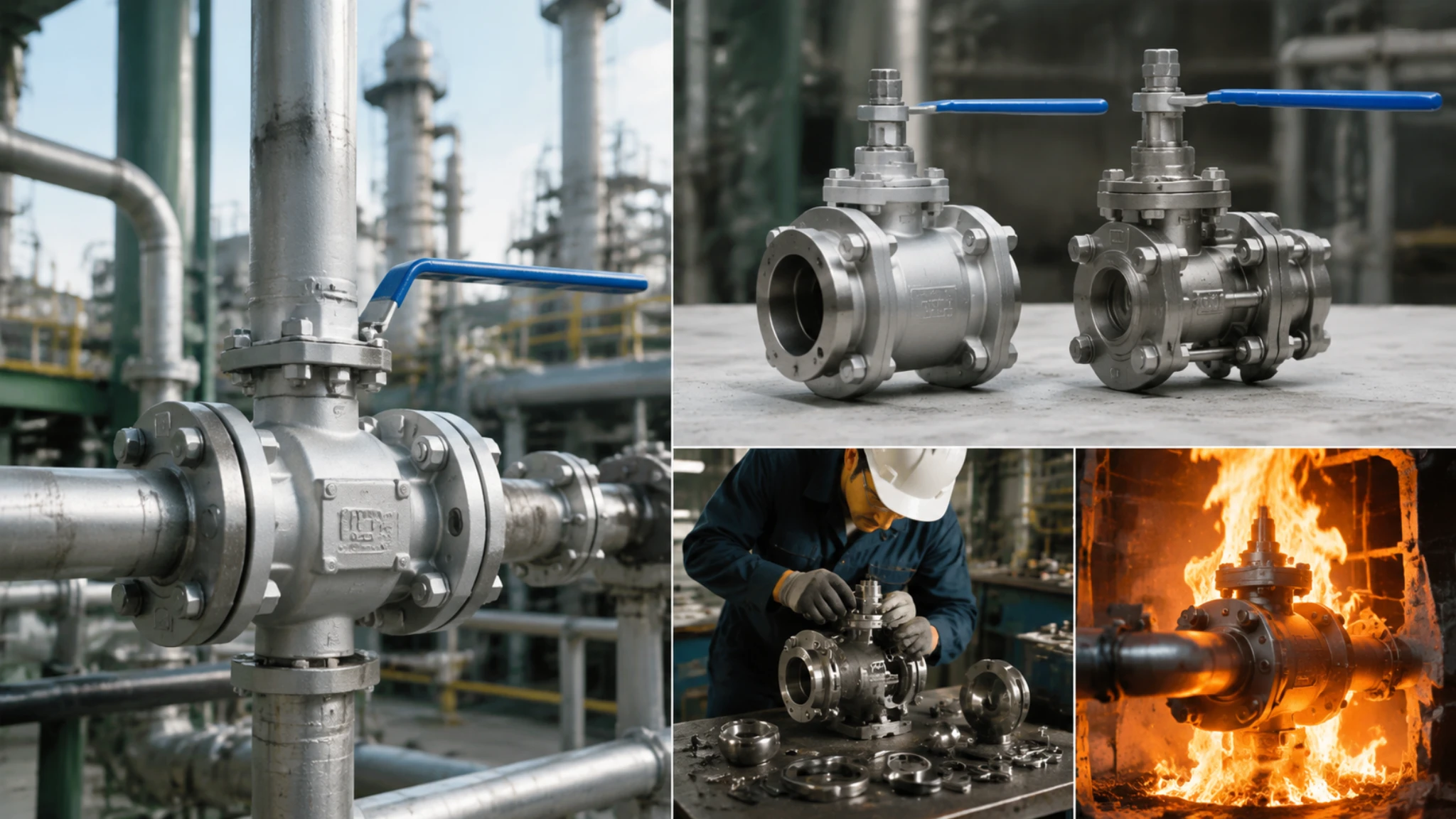
As a reliable industrial valve supplier, we provide API 6D and CE certified valve products, ensuring compliance with international standards.
All valves before shipment undergo strict pre-assembly inspection and testing, to ensure their performance and safety.
We also provide as long as over one year warranty period, ensuring customers’ use has no worries.
Our supply chain management is efficient, ensuring on-time delivery, and providing after-sales technical support services.
API 6D/CE Approval
API 6D
When processing media containing H2S or CO2, the carbon equivalent (CE) of forgings such as ASTM A350 LF2 must be limited to below 0.43. Purchasing technical agreements need to mark NACE MR0175/ISO 15156 specifications, by this avoiding sulfide stress cracking risk under sour service conditions.
Material qualification is only the basis, the workshop pressure test bench’s real-time data directly decides whether the valve can be delivered. Shell hydrostatic test pressure is set at 1.5 times the cold working pressure (CWP) level. For ball valves of NPS 24 and above caliber, the pressure holding time is not less than 15 minutes, while for the NPS 6 to NPS 18 range, it needs to be maintained for 5 minutes.
If the pressure gauge recorded drop exceeds 5% of the range, the whole batch of castings needs to be returned for inspection. At this time, should refer to ASME B16.34 Appendix-I to execute Radiographic Testing (RT), strictly checking internal pores and sand inclusion defect levels. The certificate must be attached with an RT report, proving defects do not exceed Level 2 rating.
After the shell passes, the reliability of the sealing pair is verified by double testing. High pressure water seal test pressure is 1.1 times CWP, and low pressure air tightness test injects 80 psig (0.55 MPa) compressed air. Long-distance pipelines often require DIB-1 (Double Isolation and Bleed) structure, ensuring the valve seat reaches ISO 5208 Class A zero leakage index when both ends are simultaneously pressurized.
- Pressure relief mechanism: When valve cavity pressure reaches 1.33 times pipeline pressure, the valve seat needs to achieve automatic pop-up pressure relief.
- Anti-blowout design: Stem adds T-type step, to cope with stem blowout risk under Class 1500 rating.
- Sealing ring selection: Dynamic sealing parts adopt high fluorine rubber passed NORSOK M-710 testing, to prevent explosive decompression from happening.
- Resistance control: Between stem and ball embed spring steel ball, maintaining resistance value below 10 ohms, leading away static electricity.
- Overlay thickness: At valve seat and seal contact surface, the Inconel 625 alloy overlay layer’s net thickness after processing must reach 3.0mm.
When purchasing NPS 12 Class 600 trunnion ball valves, need to actually measure the Breakaway Torque under pressurized state. If the torque value exceeds 1500 N·m, it will directly pull up the electric actuator selection cost.
CNC machines need to compress ball roundness error to within 0.015mm. Sealing surface roughness needs to reach Ra 0.4 standard, cooperating with PEEK valve seat, to maintain sealing integrity after tens of millions of switching times under Class 2500 high pressure.
If the refining and chemical site encounters a fire, the metal-to-metal secondary seal is the last line of defense to block medium flow. API 607 fire test requires after the valve is burned, the external leakage upper limit must not exceed 25 ml/min/NPS.
Marine platform projects need to adopt a three-layer epoxy zinc-rich paint system, total Dry Film Thickness (DFT) needs to be in the 250 to 300 microns range. Coating adhesion needs to pass the cross-cut test, ensuring it will not fall off in a large area in salt spray environment.
- Heat number verification: Valve body steel stamp must completely correspond with the heat batch number of EN10204 3.1 Material Test Report (MTR).
- Instrument calibration: Pressure gauges used for testing need to have range in 1.5 times to 4 times the test pressure, and be attached with a calibration sticker within 6 months.
- Size re-measurement: Use inside micrometer to measure valve bore, tolerance needs to comply with zero negative deviation specified in API 6D appendix.
- Weld seam inspection: All repair welding areas of the pressure boundary need 100% execution of Magnetic Particle (MT) or Penetrant (PT) testing.
During Factory Acceptance Test (FAT), the resident supervisor needs to check every H point (Hold point) in the Inspection and Test Plan (ITP). From raw material PMI spectral analysis to final bore testing, every step’s data needs to be entered into the quality file.
API 6D nameplate is not just an aluminum piece, it represents the valve passed the full temperature range pressure assessment from -29 degrees to 121 degrees. Purchasing managers need to check if the factory’s API 6D certificate covers the full size range from NPS 2 to NPS 48.
CE / PED Certification
Valve body material elongation must be above 14%, in the lowest design temperature environment, Charpy V-notch impact energy test data needs to reach 27J. These mechanical indicators are directly recorded into EN 10204 3.1 or 3.2 material certificates, and one-to-one correspond with the Heat Number on the valve body.
Pipeline transport fluids are divided into Group 1 (dangerous class) and Group 2 (non-dangerous class). When the product of pressure and caliber (PS times DN) reaches specific values, the valve needs according to Category I, II, III or IV to perform conformity assessment. Notified Body will check every four-digit code, such as CE 0035 or CE 0036, representing the audit originates from international agencies like TÜV.
| Verification Link | PED 2014/68/EU Execution Details | Actual Measured Data Standard |
|---|---|---|
| Hydrostatic Strength | Test Pressure = 1.43 x Maximum Allowable Pressure | Pressure fluctuation range controlled within 1% |
| Impact Test | Charpy V-notch Impact Energy Test | Sub-zero temperature environment index > 27 Joules |
| Weld Inspection | ISO 17636 Radiographic Testing (RT) | Defect level executes ISO 5817 Class B |
| Wall Thickness Check | EN 12516 Calculation Model Verification | Ultrasonic thickness measurement error < 0.1 mm |
| Material Traceability | EN 10204 3.1/3.2 Certificate Comparison | Chemical composition Nickel, Chromium error < 0.5% |
Pressure-bearing weld construction personnel must hold ISO 9606-1 welding qualification certificates. Welding Procedure Qualification Record (WPQR) recorded 5 dimensions of parameter changes such as current, voltage, preheat temperature. Every Radiographic Testing (RT) film must be issued by a non-destructive testing operator with ISO 9712 Level II or above qualification, original data retention period is set for 10 years.
Shell pressure test water quality chloride ion content is strictly controlled within 50ppm. This is especially important for stainless steel valves like 316L, preventing induction of microscopic intergranular corrosion during the testing stage. Pressure gauge range selects 1.5 times to 4 times the test pressure, accuracy level not lower than 1.0 grade, and calibration certificates must be within 6 months validity period.
- Heat number steel stamp: Valve body, valve cover and bolts need to have permanent heat batch number identification fully applied.
- Anti-static test: Between ball and stem, actual measured resistance value needs to be stable below 10 ohms.
- Anti-blowout stem: Design passes PED Annex I Article 3.1.3 regarding prevention of blowout detachment review.
- Operating torque: Under 1.1 times rated pressure difference, actual measured torque needs to be within 85% of actuator output range.
- Surface roughness: Metal sealing pair actual measured roughness value after grinding needs to reach Ra 0.4 standard.
For Category III level and above valves, the Notified Body will intervene in design review (Module B). Review documents will list in detail the valve seat wear margin and material fatigue cycle after 2500 cycles of operation.
Sealing test executes EN 12266-1 standard. Air sealing test pressure constant at 6 bar, soft sealing structure must reach Rate A zero leakage index. Hard sealing structure according to nominal diameter DN calculates allowable leakage rate, drop count or bubble count needs to be via high precision flow meter or water tank for real-time monitoring and recording.
Raw material entry must implement handheld Positive Material Identification (PMI). Re-verify mass percentage of main elements like chromium, nickel, molybdenum. If actual measured data deviates from ASTM or EN standard by more than 0.5%, this batch of castings will be unable to pass PED compliance review, must be handled as scrap.
- Coating thickness measurement: Adopt Dry Film Thickness (DFT) gauge measurement, under ISO 12944 C5 environment thickness needs to reach 280 microns.
- Valve seat pop-up: Cavity pressure relief pressure set between 1.1 times to 1.33 times rated pressure.
- Nameplate information: Must state manufacturing year, serial number, PS pressure value and TS temperature range.
- Bore tolerance: Use inside caliper to re-verify, actual measured value and drawing nominal size error needs to be within 0.5mm.
- Packaging protection: Flange faces adopt over 3mm thickness rubber gaskets and plastic covers for full coverage protection.
EN 10204 3.1 certificate is issued by factory quality department, 3.2 certificate then needs third-party inspector to conduct witness test at the production site. Purchasing managers when checking documents, need to confirm the authenticity of the third-party stamp, and check the Notified Body (NoBo) announcement list.
Pre-shipment Inspection
Material & NDT
Casting valve bodies before entering warehouse execute ASTM A216 or ASTM A351 chemical composition verification. WCB carbon steel parts carbon content controlled below 0.30%, manganese content situated at around 1.00%. Low temperature service LCC material manganese content increased to 1.20% to improve impact toughness, sulfur, phosphorus impurity content double lower than 0.035%.
Raw materials via X-ray fluorescence spectrometer (XRF) undergo 100% on-site handheld PMI testing. 316L stainless steel molybdenum content needs to reach 2.0% to 3.0% range, nickel content not lower than 10%.
Spectral analysis data and steel mill issued EN 10204 3.1 certificates are cross-compared. When chromium, nickel element deviation discovered exceeding 0.5%, this batch of castings undergoes return-to-warehouse handling. Mechanical property testing belongs to hard indicators, every heat number’s follow-up test bar via universal material testing machine undergoes tensile and bending tests.
WCB material tensile strength needs to reach above 485 MPa, yield strength not lower than 250 MPa. Aiming at NACE MR0175 environment valves, hardness value (HB) is locked below 225, eliminating stress cracking under high pressure hydrogen sulfide environment.
Non-Destructive Testing (NDT) link follows quantitative execution standards:
- RT Radiographic Testing: Aiming at over 2 inch high pressure forgings, film sensitive density maintained at 2.0 to 4.0, sensitivity reaches 2-2T grade.
- UT Ultrasonic Testing: Aiming at wall thickness exceeding 50mm valve bodies, use 2-5 MHz frequency probe, detecting internal shrinkage cavities, looseness defects.
- MT Magnetic Particle Testing: Aiming at ferromagnetic material surfaces, detection current intensity according to 3A/mm to 5A/mm set, screening for cracks within 3mm depth.
- PT Liquid Penetrant: Aiming at austenitic stainless steel surfaces, developing time not less than 10 minutes, ensuring processing stress cracks have nowhere to hide.
Radiographic films according to ASTM E446 or ASTM E186 standard rating. Grade 1 or Grade 2 judged qualified, when Grade 3 and above pores or sand inclusion appear, whole machine scrapped, not permitted to adopt repair welding means to cover structural defects.
RT detected defects will interfere with high pressure service sealing stability. Low temperature (Cryogenic) valve materials additionally via -196 degrees Celsius Charpy V-notch impact test. Three groups of specimen average impact energy need to be greater than 27J, single group minimum value not lower than 21J.
Extreme cold testing verifies valves in liquid nitrogen or liquefied natural gas service do not undergo brittle fracture. Stem and other moving parts undergo 100% ultrasonic testing, preventing internal fracture under axial load. NACE service valves via metallographic analysis observe austenitic stainless steel grain size.
Grain size standard needs to reach ASTM E112 Grade 5 or above. Grain boundary carbide precipitation amount controlled at extremely low level, preventing intergranular corrosion triggering valve failure. High parameter control valves or special ball valve material selection and non-destructive testing cover following details:
- Valve seat overlay STL alloy: After welding conduct PT testing, hardness reaches 40 HRC to 45 HRC, wear-resistant layer thickness not less than 1.5mm.
- Forging compression ratio: All valve body forgings compression ratio not lower than 3:1, via pressure forging eliminating internal metal streamline fracture risk.
- Wall thickness measurement: Utilizing digital thickness gauge on valve body weak parts multi-point sampling, actual measured value needs to be greater than ASME B16.34 standard calculated value 1.1 times.
Original heat number, heat treatment curve to every NDT detection film, via serial number in cloud system traceable. 5 years after project operation, can still check the original NDT data of the valve pressure points of that year.
NDT engineers hold ASNT Level II or III grade certificates. On-site acceptance supports designated third-party inspection agencies to conduct on-site re-check of already detected parts, deviation rate tolerance is 0.
Quality control sets no gray zone. Material purity and inspection integrity belong to valve pressure boundary bottom line. Material entering factory undergoes 48 hours warehouse-entry pending inspection period, completing chemical, mechanical, metallographic, non-destructive quadruple verification before entering processing workshop.
Data monitoring not only for passing API 6D or CE certification, but even more for providing physical safety protection under 2500lb and other high pressure conditions. Data points accurately collected, excluding latent downtime risks for long-term equipment operation.
Aiming at duplex steel materials (such as 2205 or 2507), Pitting Resistance Equivalent Number (PREN) must be greater than 35 or 40. Via ASTM G48 experiment at 22 or 50 degrees Celsius conduct 24 hours corrosion test, weight loss rate needs to be lower than 0.8g per square meter.
High temperature service valves need to conduct short-time tensile test above 538 degrees Celsius. Ensuring high temperature state yield strength attenuation rate complies with design requirements, preventing hot state deformation leading to opening jamming. All fasteners according to ASTM A193 B7 or B8M standard, hardness sampling rate 100%.
For sour oil and gas field service, HIC (Hydrogen Induced Cracking) and SSC (Sulfide Stress Cracking) testing cycle as long as 720 hours. Observe specimen Crack Sensitivity Ratio (CLR) and Crack Length Ratio (CTR), indicators respectively controlled within 3% and 1%.
Pressure & Leakage Test
Shell strength test refers to API 598 standard. Pressure set at 1.5 times rated value under 20 degrees Celsius environment. Class 150 pound grade carbon steel parts bear 3.1 MPa pressure. Sensor monitors readings, numerical change controlled in 0.01 MPa range.
Valves below 2 inches pressure hold 15 seconds. Large caliber parts above 20 inches pressure hold 300 seconds.
Medium selects clean water containing rust inhibitor. Pressurize to 1.1 times rated value. Class 300 pound grade valve pressure 5.6 MPa. Bidirectional sealing ball valves for flow path both ends respectively execute.
Table below records actual measured values under different pressure grades:
| Pressure Grade (Class) | Shell Test Pressure (MPa) | Seal Test Pressure (MPa) | Minimum Holding Duration (s) | Leakage Standard (Rate) |
|---|---|---|---|---|
| 150lb | 3.1 | 2.2 | 15 – 300 | API 598 Rate A |
| 300lb | 7.8 | 5.6 | 15 – 300 | API 598 Rate A |
| 600lb | 15.4 | 11.2 | 15 – 300 | API 598 Rate A |
| 900lb | 23.2 | 17.0 | 15 – 300 | API 598 Rate A |
| 1500lb | 38.8 | 28.5 | 15 – 300 | API 598 Rate A |
| 2500lb | 64.2 | 47.1 | 15 – 300 | API 598 Rate A |
Soft sealing valve seats such as PTFE or Devlon material need to reach zero leakage standard. Hard sealing valve seats refer to API 598 Table 6. Allowable drop count increases with caliber, 10 inch hard sealing gate valve allows 20 drops of water per minute.
Inner cavity water trace drained and dried. Transfer to 0.4 to 0.7 MPa low pressure air sealing test. Use dry nitrogen. Immersion method observes sealing pair. Soft sealing valves require 60 seconds within no bubbles produced.
Low pressure air test verifies stem packing and gasket micro leakage. Metal sealing gate valves leakage per inch caliber lower than 10 milliliters per minute. Check valve leakage is 2 times the liquid test value. Safety valve pop-up pressure deviation controlled in plus or minus 3% range.
Increase ISO 15848-1 external leakage test aiming at toxic media service. Helium mass spectrometer leak detector detects stem packing. Helium molecules identify 10 to the power of negative 7 mbar.l/s level micro leakage. Class BH grade certification requires per millimeter stem diameter leakage rate lower than 10 to the power of negative 4 milligrams per second.
Test includes over 500 mechanical cycles. Temperature control switches between 425 degrees Celsius high temperature and room temperature. Dynamic monitoring verifies automatic compensation capability after packing set wear. DBB ball valve pressurize to cavity 1.1 times rated value, record flow rate at two end release ports.
Table below for different sealing material temperature and pressure adaptation data:
- PTFE valve seat: Room temperature 0.6 MPa air test, zero bubbles, temperature resistance 180 degrees Celsius.
- PEEK valve seat: High pressure 11.2 MPa water test, zero leakage, temperature resistance 250 degrees Celsius.
- STL hard alloy: High pressure 1.1 times rated pressure, temperature resistance 540 degrees Celsius, drop count up to standard.
- Flexible graphite packing: 400 degrees Celsius helium detection, leakage rate lower than $10^{-4}$ level.
Digital system every second collects 10 groups of pressure values. Generate unchangeable pressure test curves. Test instrument accuracy not lower than 0.5 grade. Range covers 1.5 to 4 times the test pressure.
Breakaway Torque (BTO), Running Torque (RUN) and End to Close Torque (ETC) synchronously recorded. Actual measured value and calculated value deviation within 20%. Torque sensor accuracy 1 Newton meter. Data decides electric or pneumatic actuator safety factor, protection factor needs to be greater than 1.25.
Chloride ion content lower than 25ppm. After testing hot air system degreasing. Ultraviolet lamp scans inner cavity. Class 1500 grade 4 inch ball valve shell hydrostatic 38.8 MPa. Pressure holding duration not less than 120 seconds.
API 6D long-distance pipeline valves execute high pressure air sealing test. Pressure loaded to 1.1 times rated value. Use high pressure nitrogen. Test completed in fully enclosed explosion-proof room. Remote high-definition camera monitors readings.
High pressure air test discovers micro metal defects unable to be found by water pressure test. Class 600 grade valve pressure 11.2 MPa. Any micro damage under pressure leads to reading drop. Multi-dimension actual measurement intercepts service leakage risk.
Class 2500 grade 2 inch gate valve sealing water test value 64.2 MPa. Low temperature valves at -196 degrees Celsius execute helium sealing detection. Leakage rate lower than 100 cubic millimeters per second. Data aggregated into FAT report.
Vacuum diaphragm valves via vacuum test. Inner cavity pumped to below 1 Pascal. Observe 1 hour vacuum degree decay. Eliminate micro-pore leakage influence on process system. Valve seat self-relief function automatically opens when cavity pressure exceeds 1.33 times rated value.
Test medium temperature deviation controlled within 5 degrees Celsius. Rust inhibitor concentration 3% to 5%. Avoid water quality producing corrosion on valve sealing surface. Every batch test records heat number and valve serial number.
During high pressure air test pressure holding period personnel strictly prohibited to enter. Relief valve set at 1.05 times the test pressure. Protect equipment operation safety. Every half year conduct third-party mandatory verification for digital pressure sensors.
Dimensional & Torque Check
Face-to-Face length must comply with ASME B16.10 specification. Class 150 pound grade 8 inch ball valve, length standard value is 457mm, actual measured tolerance compressed to within plus or minus 2.0mm, eliminating on-site pipeline forced stretching.
ASME B16.5 specifies Class 300 pound grade 4 inch flange outer diameter as 255mm, bolt hole circle diameter 200mm. 8 bolt holes symmetry deviation must not exceed 0.5mm, preventing bolts unable to pass through flange hole positions during on-site installation.
Digital thickness gauge executes 12-point sampling on valve body weak points. According to ASME B16.34 calculation, Class 600 pound grade WCB material 6 inch gate valve wall thickness lower limit is 19.1mm. Quality inspection actual measured average needs to be maintained above 21.0mm, pre-reserving 10% redundancy to cope with long-term medium erosion thinning.
- Stem Diameter: Use micrometer to measure, tolerance controlled at h9 level, surface finish reaches Ra 0.8.
- Valve cover flange flatness: Adopt feeler gauge detection, gap lower than 0.05mm, protecting metal wound gasket specific pressure distribution uniformity.
- Actuator connection platform: According to ISO 5211 standard re-verify, F07 or F10 plate surface bolt hole center distance deviation within 0.2mm.
- Middle flange bolt length: 2 to 3 threads exposed after tightening, all washers flatness execute 100% visual inspection.
Geometric tolerance deviation will lead to forced butt welding at installation site, generated mechanical stress after running 3000 hours induces flange leakage. Actual measured data accurate to 0.1 millimeter is the physical premise to exclude on-site secondary hot work costs, avoiding flange surface uneven force leading to sealing failure.
Utilizing torque multiplier and dynamic torque sensor conduct three complete cycle tests. Record maximum Breakaway Torque (BTO) at the moment of valve opening. Class 900 pound grade 10 inch trunnion ball valve, design BTO value is 1850 Newton meters.
If actual measured torque reaches 2200 Newton meters, need to re-check valve seat pre-tightening force or bearing coaxiality. Running Torque (RUN) fluctuation rate needs to be lower than 15%, preventing actuator oscillation. End to Close Torque (ETC) needs to reach design sealing specific pressure requirement, ensuring hard sealing pair completely closes under maximum pressure difference.
Actual measured torque data written into FAT report sheet, actuator selection needs to be based on actual measured peak value multiplied by safety factor of 1.25 to 1.5. Protecting in state of pipeline scaling or long-term non-operation, valve still possesses enough torque to forcibly cut off fluid, avoiding motor burnout or cylinder thrust insufficiency.
Class 150 grade DN500 butterfly valve, rated closing torque set at 3500 Newton meters. Error controlled within plus or minus 5%, protecting metal sealing ring physical pressing force. Every valve needs to test opening torque deviation under 0.7 MPa air pressure.
Stem anti-torsion strength via Maximum Allowable Stem Torque (MAST) verification. Calculate 17-4PH material stem limit load shear stress. Actual measured torque strictly forbidden to exceed 80% of MAST value, avoiding sudden overload leading to stem twisting off. Bearing parts filled with molybdenum disulfide grease, no-load torque needs to drop 20%.
- Valve seat sealing pre-tightening force: Pressure direction sensor reading shows, bidirectional force difference lower than 3%, protecting bidirectional sealing consistency.
- Handwheel operation force: Large caliber valves equipped with worm gear reducer, handwheel opening force controlled below 360 Newton, complies with manual operation specification.
- Stroke limit deviation: Full open and full close position mechanical limit accuracy reaches 0.5 degrees, preventing over-travel damaging sealing surface.
- Packing gland torque: According to calculated value lock bolts, ensuring balance between packing sealing performance and low friction torque.
Database stores 3D scanning point cloud data and original design drawing comparison results. When replacing parts in project later stage, system automatically retrieves actual measured shaft diameter data from 5 years ago. This granularity ensures 100% interchangeability of spare parts.
Marked lifting center of gravity coordinate error within 10mm. Ensuring on-site lifting balance, protecting stem from being squeezed by radial side force. Bracket height deviation controlled in 1mm range, preventing eccentric wear with actuator coupling.
Valve inner cavity dead zone volume via displacement method actual measured. For service requiring self-cleaning, residual amount needs to be lower than 0.1%. Full bore valve flow path bore deviation controlled at plus or minus 1.5mm, eliminating vortex noise when medium passes through.
Hard sealing valves execute 200 no-load cycle life pre-test. Record torque change curve of 1st and 200th times. If torque increase exceeds 10%, explaining sealing pair running-in abnormal. Data monitoring not only for delivery, but even more for predicting torque trend of the valve in future 100,000 operations.
Aiming at API 6D standard long-distance pipeline valves, execute End-to-End length accurate measurement. For welding end valves, bevel form according to ASME B16.25 verify, root face thickness accuracy 0.2mm.
Warranty
Clear & Reliable Warranty Terms
API 6D trunnion ball valves’ warranty period after pipeline putting into operation is set as 12 months, or calculated as full 18 months from shipment date. This timetable covers all stages from factory departure, inland logistics to project site installation. Aiming at deep sea service or extreme corrosion environments, warranty period can according to specific engineering contract extend to 24 to 36 months.
Valve body materials such as ASTM A105 or F316 chemical compositions all comply with EN 10204 3.1 certificate specifications. Every batch of 17-4PH steel selected for stems all undergoes 100% Ultrasonic Testing (UT). After sealing surface overlay Stellite 6 hard alloy, surface hardness maintains above HRC 40, ensuring anti-erosion performance supports over 50,000 switching cycles.
Specific protection scope and performance indicators are as follows:
- High pressure hydrostatic sealing test specified in API 598 achieves zero leakage.
- Under ASTM B117 salt spray test environment, valve body coating anti-corrosion aging reaches 1500 hours.
- Complying with ISO 15848-1 standard packing box low leakage protection reaches above B level.
- Within -29℃ to 200℃ operation range, operating torque deviation value lower than 15% of initial design value.
- Shell fireproof integrity within API 607 or API 6FA fire protection certification validity period.
- Actuator selection pre-reserves 30% safety margin, preventing on-site pressure difference fluctuation leading to valve failure to move.
Raw material heat treatment process heat number records achieve 100% traceability. Every bolt and nut of API 6D valves is all marked with clear heat treatment heat number. Once on-site feedback valve seat sealing ring (such as Devlon V or Viton AED) appears abnormal wear, database can within 10 minutes retrieve this batch sealing parts’ entry date, hardness actual measured value and vulcanization curve chart.
After technical service team receives feedback, establish technical communication channel within 24 hours. Aiming at service conditions where leakage rate exceeds API 598 allowable standard, issue complete 8D investigation scheme within 48 hours. Failure analysis report contains Scanning Electron Microscope (SEM) original data for valve seat PEEK insert, as well as secondary calculation for hydrogen sulfide (H2S) concentration in the medium.
On-site downtime caused production value loss usually calculated by hour. Therefore warehouse constantly stocks universal spare parts valued at 5 million US dollars.
- Soft sealing seat components (Viton GLT, HNBR) spot stock covers DN15 to DN600 specifications.
- Stainless steel 304 or 316 material disc springs and gland bolts maintain 6 months normal turnover amount.
- Urgent spare parts via DHL or FedEx international air transport, arrive at global main industrial ports within 3 to 5 working days.
- Provide original repair kit, containing full set of gaskets, O-rings and dedicated synthetic grease.
Connection dimensions between actuator and valve strictly follow ISO 5211 standard. This guarantees achieving seamless physical matching during spare part replacement. Warranty files contain every valve’s ex-factory no-load torque test chart. For PN160 and above high pressure valves, hydrostatic strength test pressure needs to reach 1.5 times nominal pressure, and pressure holding time is extended 25% compared to API standard.
Quality management system recorded all readings from casting X-ray testing (RT) to final coating thickness test. Coating thickness uniformity controlled within ±10% error range, detection basis is SSPC-PA2 standard.
- MTBF (Mean Time Between Failures) design indicator not lower than 45,000 hours.
- API 6D check valve opening pressure error controlled within ±5%.
- Control valve stroke linearity deviation lower than 1.5%.
- Under Double Block and Bleed (DBB) function test, time for cavity pressure release to zero less than 30 seconds.
- Every batch of castings conduct 10% random sampling spectral analysis, ensuring Cr, Ni, Mo and other alloy element contents reach standard.
Aiming at large caliber ball valves above DN300, provide detailed on-site grease injection operation specifications, avoiding due to grease injection valve pressure too high damaging soft sealing seat. This preventive support reduced over 60% of equipment damage risk triggered by human misoperation.
All export valves all insured with product liability insurance, single insurance amount reaches up to 2 million US dollars. This provides financial protection for large energy facilities, refining and chemical plants and multinational pipeline projects. For breach of contract liability in purchase contracts, clearly mark on-site repair fee sharing ratio caused by material defects.
delivered data package contains API certificate copy, Declaration of Conformity (DOC) as well as all non-destructive testing reports. No matter whether warranty period has expired, with product serial number can self-service query all performance indicators on official website.
For metal hard sealing ball valves under high temperature service, we promise hardened layer after 8000 hours continuous operation at 450℃ does not appear peeling phenomenon. Ball and seat grinding matching accuracy controlled at light band level, ensuring under high temperature expansion state still satisfies ANSI FCI 70-2 Class VI sealing requirement.
Aiming at Volatile Organic Compounds (VOG) media, we provide API 622 certified packing sets. After 100 mechanical cycles and 3 thermal cycles, methane leakage detection value needs to be lower than 100ppm. These test data are directly attached in ex-factory detection records, as part of warranty system submitted for owner audit.
Valve surface treatment adopts three-layer paint system (Zinc Rich Primer + Epoxy Intermediate + Polyurethane Finish). Total Dry Film Thickness (DFT) not lower than 280 microns. Within warranty period, if non-mechanical damage nature paint large area peeling appears, we will provide original repair paint and on-site spraying process guidance.
Logistics link packaging standard follows ISPM 15 specification. Export wooden box inner walls equipped with vacuum packaging bags and desiccant, preventing salt spray erosion during ocean transport. Warranty liability starting point based on Bill of Lading date, ensuring 45-60 days time during sea transport does not consume project site’s effective warranty period.
After-sales spare parts pricing strategy transparent, spare parts supply price fluctuation outside warranty period every year controlled within 5%. We establish linkage with 12 global authorized service centers. These sites stock API 6D common sealing components and actuator seal kits, can leave warehouse within 12 hours after receiving instruction.
Expert-Level After-Sales Response
After-sales service team composed of senior engineers with average industry experience exceeding 10 years, ensuring every technical feedback can all obtain professional reply possessing engineering background. Within 2 hours after receiving on-site quality feedback, back-end system completes process file registration and preliminary classification. Within 24 hours, technical department will issue first fault diagnosis scheme.
Aiming at API 598 sealing leakage service condition reported from site, technical personnel via video connection check packing gland torque, if actual measured torque value lower than O&M manual set value by 10%, will guide on-site personnel according to 5% increment to conduct stepwise compensation attempt.
Within 48 hours start 8D investigation procedure to screen for manufacturing defects. Analysis process extracts micro-morphology data of damaged valve seat, utilizing Scanning Electron Microscope (SEM) observe sealing surface scratch depth. Laboratory compares solid particle size whether exceeding 150 microns, judging fault belongs to medium erosion damage or mechanical pulling caused by switching pressure difference too large. Engineer synchronously retrieves this batch 17-4PH stem Ultrasonic Testing (UT) original report, verifying whether invisible tissue defects exist.
| Service Stage | Response Timeliness | Technical Output Document |
|---|---|---|
| Preliminary Information Assessment | 2 hours | Fault phenomenon registration form and service condition check sheet |
| Remote Fault Guidance | 24 hours | Troubleshooting Checklist |
| Deep Failure Diagnosis | 48 hours | 8D Corrective Action Report first draft |
| On-site Disposal Execution | 72 hours | Expert site visit scheme or urgent spare part air waybill |
When operating temperature situated at 450 degrees Celsius, ball and seat matching gap needs to be accurately maintained at 0.05 millimeter level. Technical team utilizing CFD fluid dynamics simulation software, input on-site actual pressure difference data, re-calculate actuator output torque safety factor under extreme pressure difference, ensuring its output capability exceeds 1.3 times the torque required for valve opening.
On-site detection link equipped with portable Positive Material Identification (PMI) and Leeb hardness tester, conduct composition re-check for valve body where Stress Corrosion Cracking (SCC) happened. If nickel, chromium element content deviates from ASTM A182 standard by more than 0.5%, will judge as raw material consistency issue and start whole machine replacement procedure. Hardness test points cover valve body, valve cover and bolt connections, ensuring single point hardness not higher than HRC 22, satisfying NACE MR0175 anti-hydrogen sulfide environment requirement.
Aiming at Volatile Organic Compounds service, provide on-site detection support complying with ISO 15848-1 Class B standard. Use helium leak detector on flange connections conduct vacuum assisted test, detection sensitivity reaches 10 to the power of negative 7 mbar.l/s. Test data real-time uploaded to digital quality system, as warranty proof.
- MTBF (Mean Time Between Failures) design indicator stable at above 45,000 hours.
- API 6D check valve opening pressure error strictly controlled within plus or minus 5%.
- Control valve stroke linearity deviation lower than 1.5%.
- Under Double Block and Bleed (DBB) function test, cavity pressure release to zero time less than 30 seconds.
- Every batch of castings conduct 10% random sampling spectral analysis, ensuring Cr, Ni, Mo alloy elements reach standard.
Failure database accumulated over 800 typical cases in petrochemical and long-distance pipelines. Engineers according to pipeline pressure fluctuation curve chart troubleshoot API 6D check valve water hammer induction factors. Aiming at large caliber valves above DN300, provide detailed on-site grease injection volume calculation formula. Grease injection pressure must be controlled within 1.1 times system operation pressure, preventing overpressure leading to soft sealing seat permanent plastic deformation.
On-site operator annual technical training indicator set as 120 class hours. Content covers actuator limit adjustment accuracy control within plus or minus 1 degree. Demonstrate how to use dedicated grease to improve Viton GLT sealing ring friction coefficient. Through this preventive guidance, on-site human misoperation caused valve damage rate in past three years decreased by over 45%.
| Fault Category | Detection Analysis Method | Data Judgment Indicator |
|---|---|---|
| Packing Leakage | API 622 Simulation Test | Leakage lower than 100ppm |
| Sealing Surface Scratch | Microhardness Test | Hardened layer depth reaches 3 millimeters |
| Operating Torque Too Large | Dynamic Torque Test | Deviate from initial no-load torque 15% |
| Coating Large Area Peeling | Adhesion Pull-off Test | Pressure value satisfies 5MPa standard |
Urgent spare parts via international express arrive at global main industrial ports within 3 to 5 working days. Warehouse constantly stocks sealing components valued at 5 million US dollars, including HNBR, PEEK and 316L valve seat rings through cryogenic treatment. Every repair kit (Repair Kit) internally attached with ISO 5211 standard connection part calibration shims, processing accuracy controlled at 0.1 millimeter.
All export valves insured with product liability insurance, single quality claim insurance amount maximum 2 million US dollars, used to pay for lifting equipment leasing, third-party detection and downtime loss compensation. Claim process within 15 working days after 8D report confirms responsibility completes financial accounting. delivered 8D report contains targeted preventive suggestions.
Every suggestion is all attached with ASTM or API specific standard clause references, providing real data for purchasing manager’s supply chain quality assessment. With product unique serial number QR code, owner can at any time access all maintenance records and original manufacturing parameters of that valve.
In actuator matching aspect, technical support covers on-site debugging of pneumatic, electric and hydraulic drive schemes. Aiming at long-distance pipeline gas-over-oil actuators, technical personnel will check effective volume of energy storage tank under lowest environment temperature, ensuring in state of gas source cut-off still can complete 3 complete switching operations.
Full Lifecycle Traceability
API 6D valves in casting or forging stage namely implanted with unique digital identity code. Every furnace steel water chemical composition analysis (CMTR) all accurately corresponds to valve body heat number. ASTM A105 carbon steel or A182 F316 stainless steel carbon equivalent (CE) controlled below 0.43%. Data granularity ensured material anti-cracking property during welding process, all original heat treatment curves recorded in digital archive database, preservation years reach 20 years.
100% of pressure-bearing parts conduct physical property tests, tensile strength deviation controlled within 5%. RT Radiographic Testing film pixel resolution satisfies ASME specification, discovered over 0.5mm pores immediately scrapped. Valve seat sealing surface Stellite 6 hard alloy overlay thickness maintained between 1.5mm to 3.0mm. CNC machining center (CNC) control accuracy for ball roundness reaches 0.01mm. Assembly gap records contain tolerance matching data for stem and packing box.
QR code etched on every valve nameplate is the entry to retrieve manufacturing history. Purchasing party scanning code can namely obtain 12 items of original detection data including chemical composition, mechanical properties, pressure test curves. This transparency excluded risk of paper records loss.
Radiographic Testing (RT) report recorded in detail looseness and sand inclusion situation inside castings, original film images were converted to high-definition digital format. Shell hydrostatic test pressure holding time specified by API 598, on basis of standard extended 50%, to verify micro leakage risk under high pressure. Pressure fluctuation data during holding period collected by digital pressure transmitter at frequency of 10 times per second, preventing error caused by manual meter reading.
Helium leak test complying with ISO 15848-1 standard, background leakage rate lower than 1.0E-07 mbar.l/s. Cold state torque and room temperature torque contrast values for cryogenic ball valves in -196 degrees Celsius environment recorded in file. Coating Dry Film Thickness (DFT) takes average value at 15 points in different orientations of the valve, error not exceeding 5%. Fastener connection torque calibrated via digital torque wrench, error controlled within 3%.
Sealing parts such as Viton AED or PEEK valve seats all attached with original material certificates provided by suppliers. Database recorded these non-metal parts’ vulcanization batch and Shore A hardness values. If project site after 5 years needs to replace seal kits, only need to provide serial number, system will automatically match the corresponding part mold dimensions of that year.
Material Test Certificate (MTC) not only contains text results, but even more contains test real-time curve charts from digital collection. This recording method prevented data secondary processing, ensuring every pressure reading seen on site all originates from test bench sensors.
Digital Quality Management System (QMS) achieved full link coverage from order placement to product leaving factory. Purchasing manager can retrieve paint batch and anti-corrosion coating components in specific orders. For large valves over 10 tons, lifting schemes and center of gravity calibration records similarly provided as traceability attachments, ensuring logistics and on-site lifting safety and controllability.
Cylinder opening and closing time accuracy controlled at 0.1 second level. Instrument pipeline joint tightening state via anti-loosening marks conduct visual confirmation. Aiming at control grade valves, output signal feedback curve and valve opening achieve linear fitting, deviation value lower than 1.0%.
Raw material purchase contracts and original invoice copies as archive attachments, proving steel originates from audited qualified supplier list. Aiming at NACE MR0175 service conditions, material nickel content actual measured value needs to be stable between 10.0% to 14.0%. Hardness detection adopts full number inspection mode, ensuring every pressure-bearing flange surface hardness value uniformly distributed in HB 160 to HB 185 range.
Traceability system not only used for post-event quality investigation, but even more can through big data analysis discover production fluctuations. For example when some batch castings scrap rate fluctuation exceeds 2%, system will automatically trigger process verification procedure, intercepting potential defects in advance.
All non-destructive testing personnel (NDT) all hold Level II or Level III certificates, their qualification numbers and detection reports one-to-one bound. Radiographic film evaluation opinions signed and confirmed by two independent technicians. For high frequency switching service conditions, valve shaft fatigue test data and actual service cycle estimation reports delivered together.
Warehouse management system via RFID technology monitors Work in Progress (WIP) flow path. Every workstation processing personnel ID, used tool models, cutting fluid ratio all have records to check. This refined management makes when facing complex multinational projects, able to provide complete technical dossiers complying with EU PED directive or Russian EAC certification requirements.
Valve packaging wooden box outer side posted with three-axis shock recorders, real-time monitoring vibration intensity during ocean transport. If shock load exceeds 2G, unloading inspection records will automatically be marked as priority check objects.
For special alloys such as Monel or Inconel valves, additionally provide on-site video clips of Positive Material Identification (PMI). Alloy elements such as molybdenum, niobium content readings directly displayed in video. Supporting every set of gaskets and bolts all have independent qualification labels, ensuring on-site repair will not happen mixing materials risk.
In late operation and maintenance stage, via serial number can see the leakage actual measured value of that valve before leaving factory. If on-site operation 3 years later inner leakage appears, technician through comparing ex-factory data and current detection data, can quantify sealing seat wear rate.