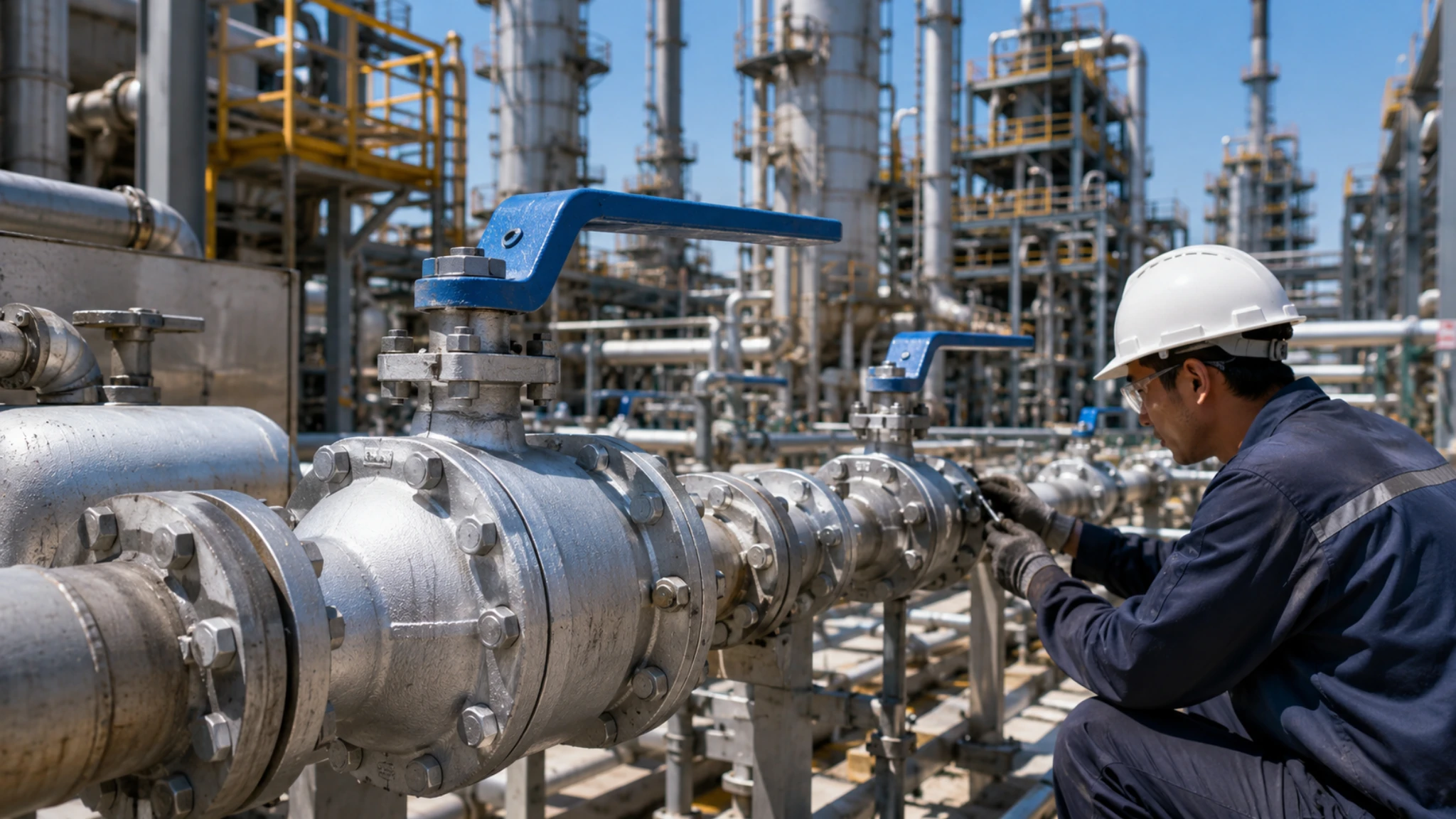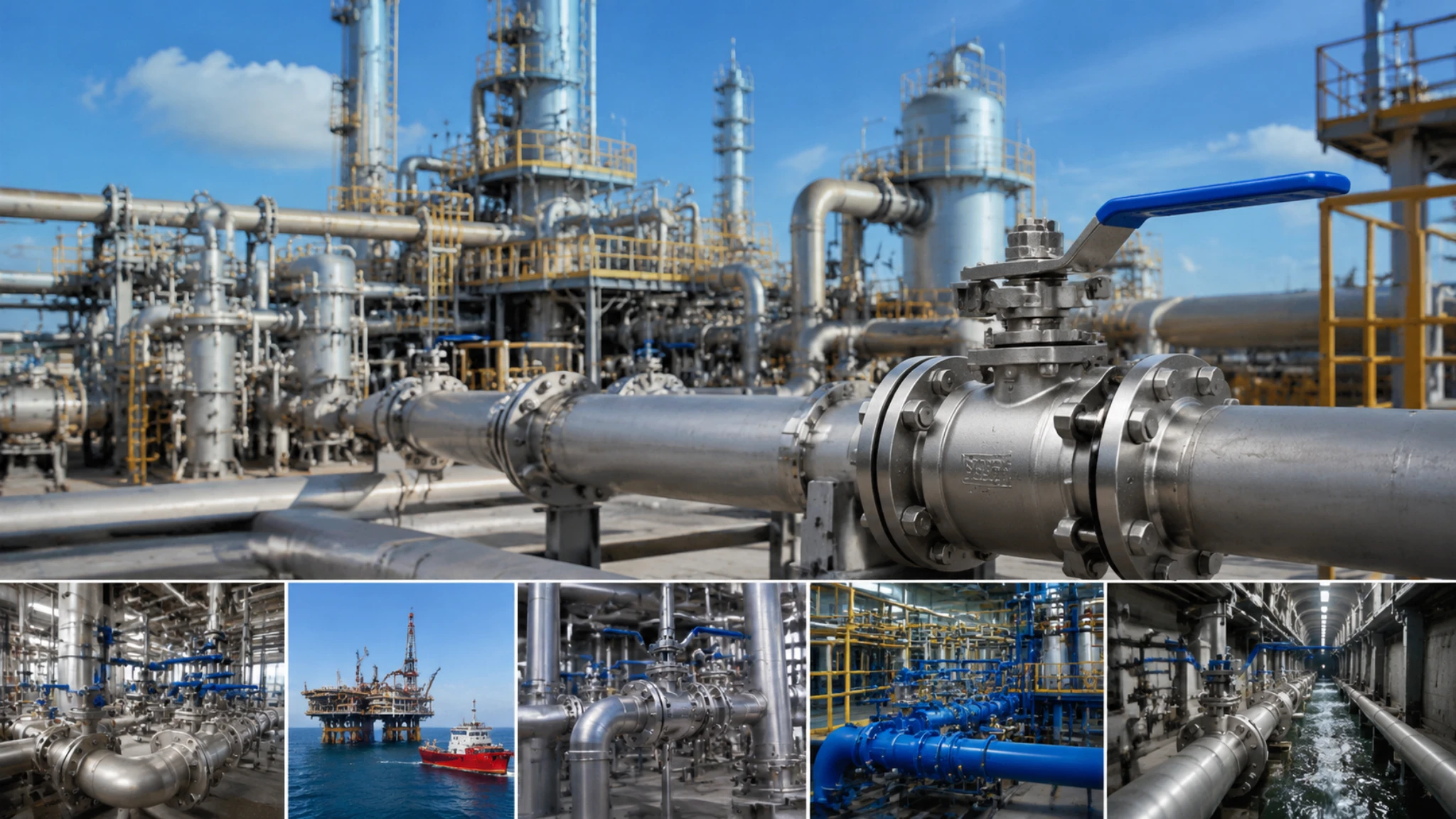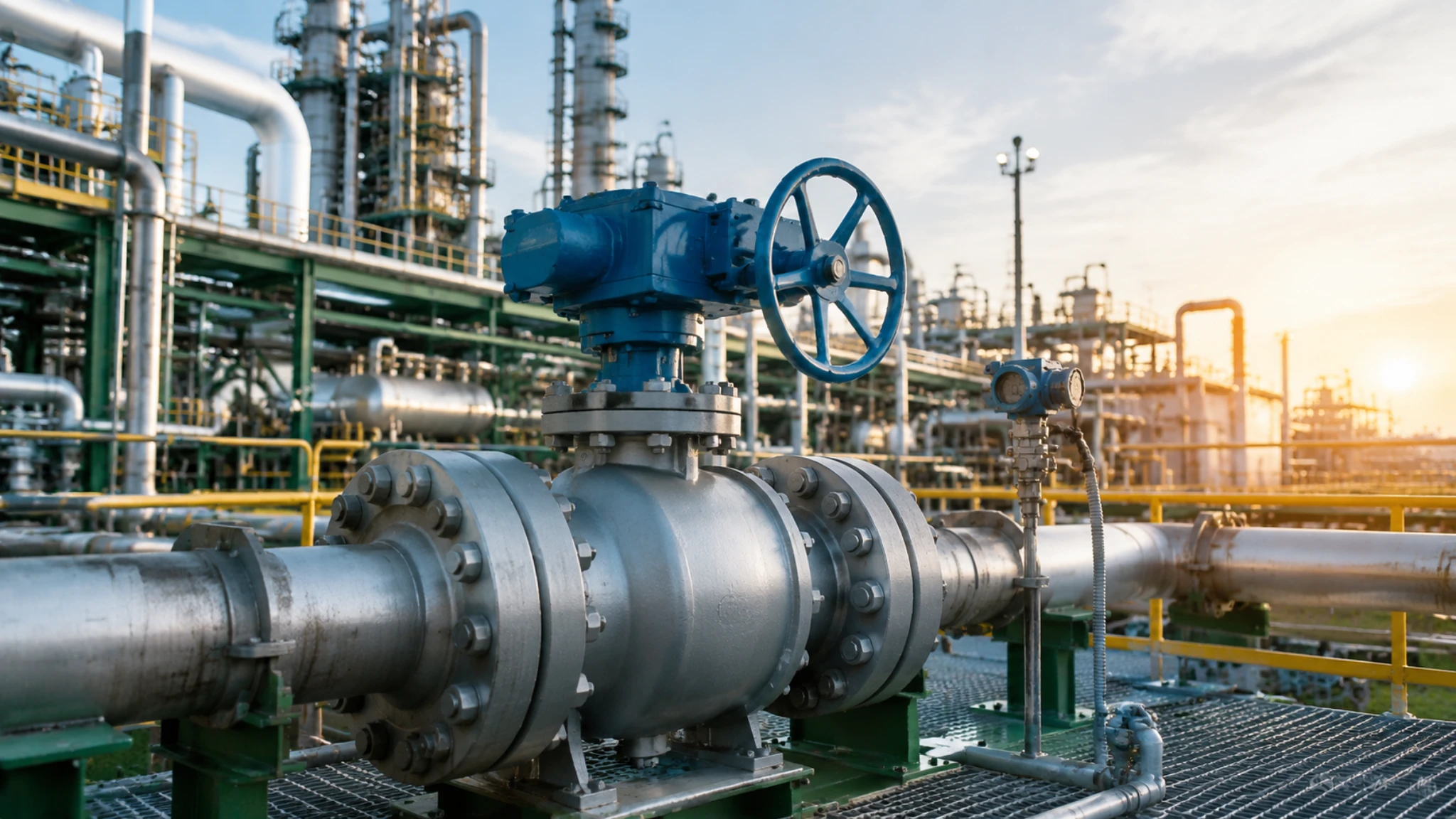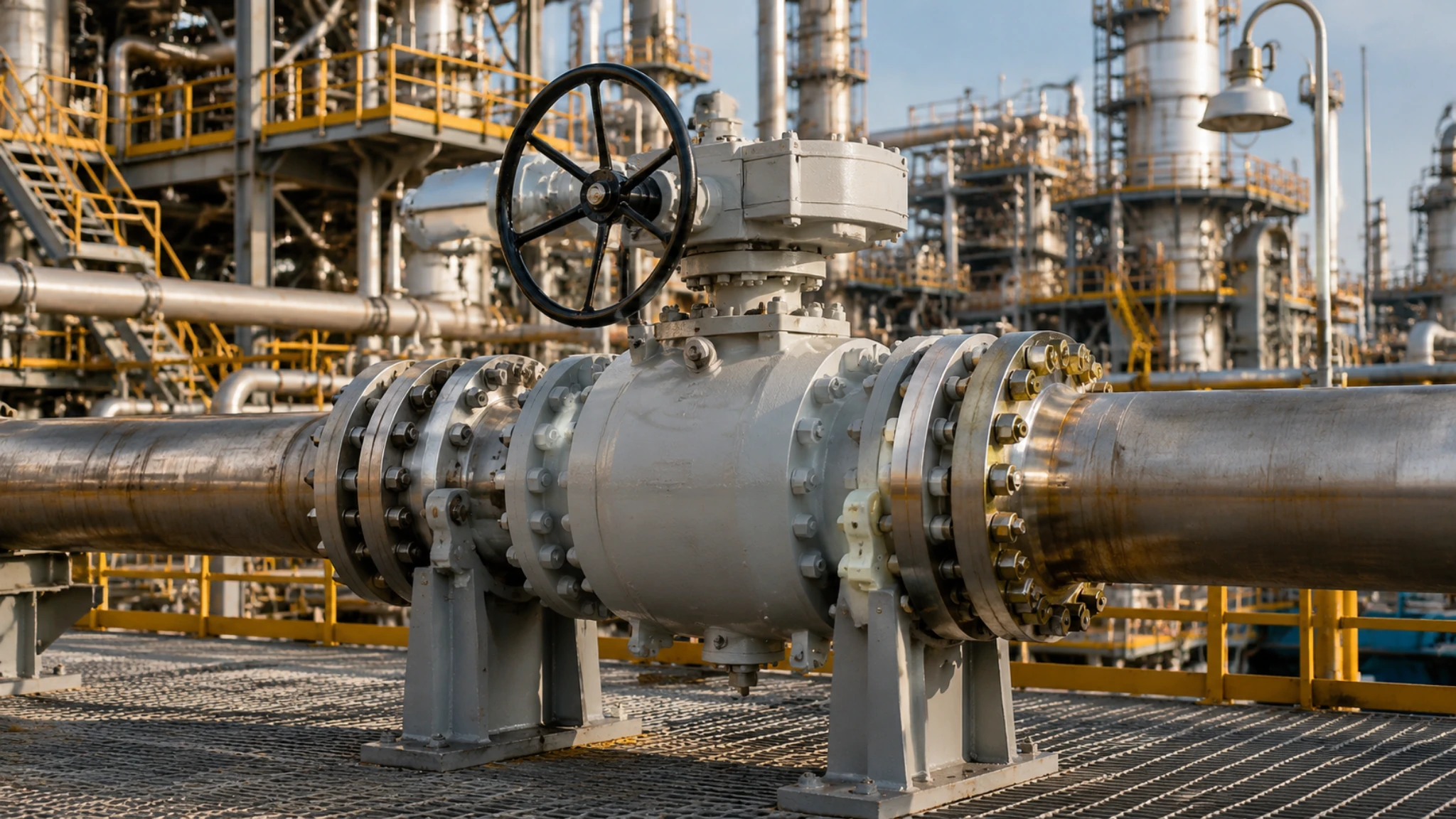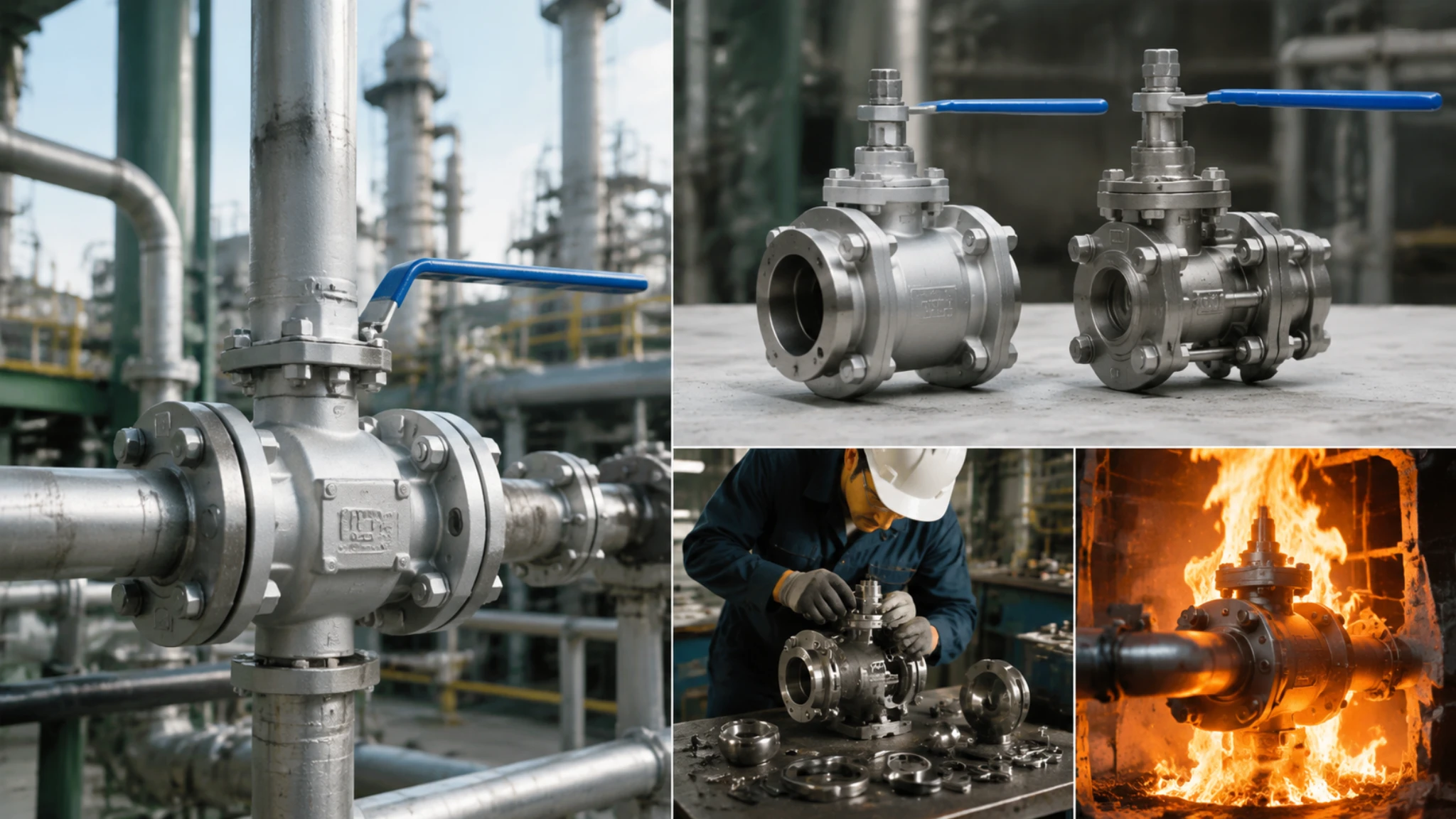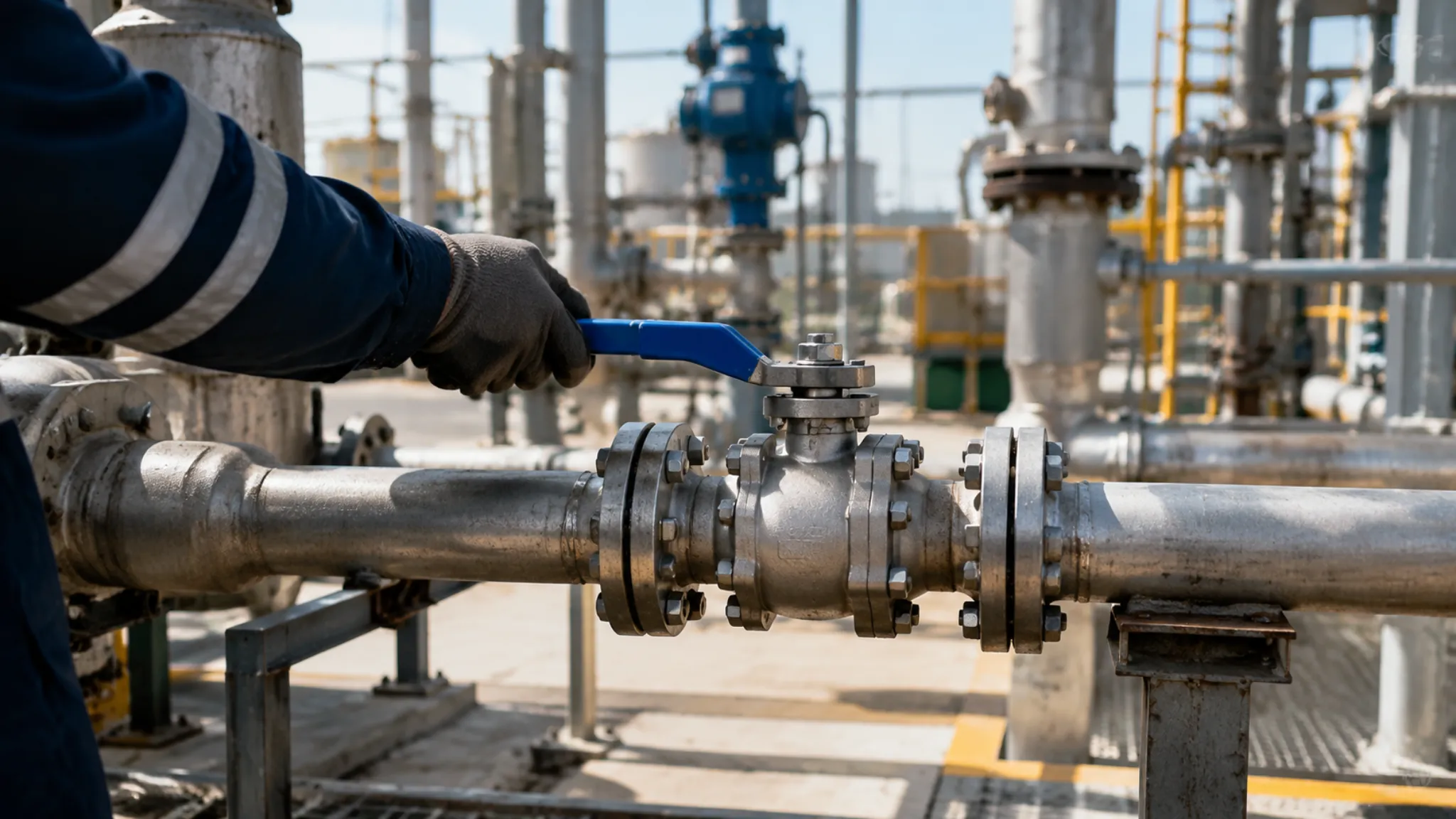
Ball valves rank among the most common isolation devices in piping systems worldwide, and the design differences between floating-ball and trunnion-mounted types directly determine pressure capacity, seal reliability, and life-cycle cost — wrong selection leads either to chronic leakage or, in the worst cases, pipeline overpressure incidents. According to Baker Hughes 2024 field data, 38% of industrial ball valve failures trace back to improper sizing, with floating-ball valves selected beyond their pressure class leading all failure categories.
How They Work
Floating Ball Design
ASME B16.34 requires a minimum seat contact stress of 1.2 MPa across the soft seat sealing face to establish an effective seal. I once reviewed a design file for a DN200 Class 300 floating-ball valve where the calculated design seating stress was only 0.8 MPa — below the standard requirement — and the ball shifted upstream by 0.3 mm at design pressure, driving seating stress to zero. This is not theoretical: factory test reports document identical valve specs showing measurable downstream leakage that required redesign to trunnion mounting. The practical ceiling for floating-ball valves is Class 300 at NPS 12 (DN300); beyond this, trunnion mounting becomes structurally mandatory, not a matter of preference.
The floating ball’s freedom of axial movement defines both its elegance and its operational limitation. The ball is held between upstream and downstream seats within the valve chamber, with the stem passing through the body top cover to connect with the ball top. When the valve closes, fluid pressure acts on the downstream side of the ball, pushing it against the upstream seat to form a pressure-assisted seal. At Class 150, DN50 floating-ball valves require only 8–12 N·m torque for manual operation — completely practical without any actuator. But as bore size increases and pressure rises, lateral force on the ball grows proportionally, and seat friction wear and indentation accelerate accordingly. PTFE soft seats in Class 150 service last approximately 2,000 open-close cycles; in the Class 300 high-pressure regime, 0.8 mm cracks appear within 300 cycles (0.4 mm deep, representing 26% of the 1.5 mm total PTFE thickness), degrading seal performance from API 598 Class B to Class C.
Floating-ball valves are not synonymous with inferior — they deliver the best cost-to-performance ratio in Class 150–300, small-bore service. I specified Class 150 DN200 floating-ball valves for raw water lines at a Southeast Asian water treatment plant; over five years of operation the maintenance team reported zero leakage and torque consistently between 25–30 N·m. The critical discipline is knowing the structural ceiling — understanding exactly where floating-ball capability ends matters more than defaulting to trunnion mounting on every application.
API 598 shell test pressure is 1.5× rated pressure; seat test is 1.1× rated pressure. Class B requires zero visible bubbles under test conditions.
Trunnion Mounted Design
Upper and lower bearings fixing the ball in the valve chamber center distinguish trunnion-mounted valves from floating-ball designs — the ball no longer floats.Upper and lower bearings each carry approximately 50% of the pipeline fluid hydrostatic load, making seat wear predictable and controllable.The key physical change is this: with the ball centered and restrained, the sealing task is distributed between spring preload (for static conditions) and fluid pressure (for dynamic compensation), eliminating the need for ball displacement to generate sealing force. I reviewed DN800 Class 600 offshore platform valve documentation where the manufacturer specified single-side seat spring preload torque at 4.2 kN·m — requiring only 25% of actuator rated output to overcome seating resistance, versus 340% for an equivalent floating-ball design at the same spec.
The upper and lower bearing design simultaneously solves another core problem of large-bore ball valves — stem side load.At Class 600 DN800, fluid lateral force on the ball reaches approximately 34 kN — floating-ball stem bearings cannot sustain this continuously, resulting in inevitable stem deflection under load; the trunnion’s upper bearing takes this lateral load directly, leaving the stem to transmit rotational torque only. I witnessed a 12-year-old Class 300 DN500 trunnion valve teardown during a planned turnaround: bearing clearance had grown from an original 0.05 mm to 0.09 mm — still within the 0.1 mm maintenance threshold, cleared to continue until the next turnaround. This quantifiable bearing clearance maintenance window is something floating-ball valves structurally cannot provide.
NACE MR0175 mandates maximum Brinell hardness HB 235 for H₂S environments to prevent stress corrosion cracking in valve body materials.
Sealing Mechanism Differences
API 607 fire-safe testing reveals a critical divergence between the two designs after 593°C high-temperature exposure: floating-ball soft seats permanently deform, with reseating performance dropping approximately 35%; trunnion metal seats under identical conditions show no seal face damage and 100% reseating capability. PTFE soft seat temperature limit is 200°C — above this, molecular chain slip becomes irreversible and seating stress collapses. I assisted a refinery analyzing chronic leakage on catalytic cracker outlet piping operating at 210–230°C: the facility had replaced seats three times in five years, each cycle lasting no more than 18 months, because the supplier’s typical 18-month life data was based on 150°C testing — never covering the actual operating envelope above 200°C. This was a temperature basis error in the selection documentation, not supplier misrepresentation.
Seat injection capability is a trunnion-exclusive feature that fundamentally changes the maintenance model. When minor seat wear causes leakage, injecting sealing grease at 8 MPa restores API 598 Class B leakage rates without shutting down the pipeline. I observed this procedure on an offshore platform: 15 minutes from setup to completion, pipeline continued operating throughout. One DN300 Class 600 water injection trunnion valve continued in service for 14 months after injection, leakage within API 598 Class B throughout, until the planned turnaround window — operational flexibility that floating-ball designs structurally cannot provide, since downstream seat leakage in floating-ball valves requires full shutdown, disassembly, and seat replacement.
Pressure and Size
Pressure Rating Limits
ASME B16.34 establishes pressure-temperature relationships: the same Class yields different pressures at different temperatures — this is the most commonly misapplied principle in valve sizing. Class 300 at 260°C rates 2.0 MPa; at 454°C it rises to 5.0 MPa. Both carry the Class 300 designation, yet the pressure differs by 2.5×. I have sat through procurement meetings where engineers quoted Class 300 without specifying design temperature, causing supplier quotes at 38°C and at 260°C to differ by nearly 7× and delaying orders by weeks. The correct practice is to annotate the data sheet with both design temperature and the corresponding pressure from the ASME B16.34 P-T curve.
The floating-ball pressure ceiling of Class 300 is a physical constraint from API 6D seal stress requirements, not a design convention. Class 600 DN200 floating-ball valves typically show design seating stress around 0.6 MPa — insufficient for ASME B16.34 minimum requirements — causing measurable downstream leakage at factory pressure tests that mandates redesign to trunnion structure. Trunnion-mounted valves reach Class 2500 (42.0 MPa), a rigid requirement for water injection wellheads at 26.0 MPa and ultra-high-pressure chemical processes. Class 2500 and above batch availability covers NPS 2–NPS 12 only; custom fabrication for larger sizes carries 12–18 month lead times.
ASME B16.34 Section 6.2 mandates that valve pressure-temperature ratings be determined at design temperature — 38°C ambient values are not valid for elevated-temperature design conditions.
Available Valve Sizes
The practical size ceiling for floating-ball valves is NPS 12 (DN300) — beyond this, ball self-weight and seat stress problems compound simultaneously. From project experience: NPS 12 Class 300 floating-ball breakaway torque reaches 60–85 N·m, making worm-gear manual operators mandatory rather than optional; NPS 14 and above requires electric actuators with pipeline alignment tolerances tightened from plus or minus 1 mm to plus or minus 0.3 mm, dramatically increasing field installation complexity. Trunnion valves cover NPS 1/2 through NPS 48 (DN1200). The NPS 12–NPS 24 range is the overlap zone where selection depends on pressure class rather than size alone: below Class 300 floating-ball is economical; above Class 600 trunnion is mandatory; NPS 24 and above trunnion is the only structurally viable option.
| Design Type | Pressure Limit | Size Limit | Soft Seat Temp Limit | Injection Seal |
|---|---|---|---|---|
| Floating Ball | Class 300 | NPS 12 / DN300 | ≤200°C (PTFE) | Not supported |
| Trunnion Mounted | Class 2500 | NPS 48 / DN1200 | ≤230°C (RTFE) or >400°C (metal) | Supported |
DN400 Class 600 trunnion valve body wall thickness is approximately 36 mm with a main body weight around 2.4 tonnes, requiring dedicated lifting plans and foundation design budgeted during project execution — not discovered during construction. I once overlooked DN700 Class 150 trunnion valve transport dimensions at a Southeast Asian desalination project: body diameter 2.1 m exceeded standard container limits, resulting in on-site rehandling costs that exceeded the valve body price itself.
Operating Torque Requirements
Torque is the most underestimated parameter in ball valve selection — it directly determines actuator sizing, and actuator cost often represents 30–50% of total valve system cost. Class 300 DN200 breakaway torque: floating-ball approximately 60 N·m, trunnion approximately 85 N·m — trunnion runs approximately 40% higher due to bearing friction. However, above Class 600 this relationship inverts: floating-ball DN200 Class 600 breakaway reaches approximately 130 N·m (bearing plus seat combined high pressure), while trunnion equivalent is approximately 95 N·m. The bearing constraint in trunnion designs fixes the ball center, seat wear becomes uniform, and no additional compression force is needed to compensate for displacement — reducing net torque demand at high pressure.
Torque variation with pressure is the key discriminator between the two designs. I conducted in-service torque measurements on Class 150 DN100 floating-ball valves from 0 MPa to design pressure 1.0 MPa: torque rose from 32 N·m to 54 N·m, a +69% increase. Actuator selection must reserve 1.7× design pressure torque margin, otherwise high-pressure peaks can trigger combined valve seizure and actuator overload failure. Trunnion equivalent testing showed 78 N·m at 0 MPa versus 84 N·m at design pressure — only +8% fluctuation. Actuator selection for trunnion valves requires only 1.1× design torque margin.
API 6D mandates that valve rated torque be measured at design pressure and documented in the data sheet with pressure-torque correspondence for actuator selection.
How to Choose
Best Industry Applications
Selection is fundamentally about finding the optimal balance between pressure, size, temperature, and media constraints. I faced a specific sizing decision at a natural gas city gate station with a Class 600 DN500 trunk pipeline handling treated natural gas — both structural types could technically cover the duty. I recommended trunnion valves because the gate station is critical infrastructure where unplanned shutdown cost far exceeds the trunnion procurement premium, and injection seal capability provides essential operational flexibility. A seat degradation incident post-commissioning validated the judgment: pressure-assisted injection allowed the pipeline to continue operating for six months until the planned turnaround, avoiding an emergency shutdown that would have disrupted supply to approximately 40,000 residential customers.
Wellhead service is the absolute domain of trunnion valves — pressures exceeding Class 900, temperatures above 200°C, and sand-laden media simultaneously expose every floating-ball weakness. Class 1500 DN65 wellhead ball valves universally specify trunnion mounting plus metal seats plus MCAW surface treatment — this is a technical mandate under API 6D for high-pressure, high-volume wellhead applications, not a matter of engineering preference. LNG receiving terminals operating at -162°C require stainless bellows seals plus extended stems — no floating-ball product exists for LNG duty. I measured DN300 cryogenic ball valve breakaway torque on an LNG tanker discharge line and found it ran approximately 22% higher at -162°C versus 20°C ambient. Actuators specified without this cold-embrittlement margin risked drive failure during winter discharge operations.
Price and Value
Class 300 DN200 10-year life-cycle cost comparison: floating-ball procurement $800–$1,200 plus annual maintenance approximately $180 and seat replacement approximately $350 per cycle times 3 cycles totals approximately $3,800; trunnion procurement $2,200–$3,500 plus annual maintenance approximately $60 and injection seal approximately $150 per cycle times 2 cycles totals approximately $4,100 — only approximately 8% gap at this pressure class. However, the economics reverse above Class 600 where floating-ball torque surge demands oversized actuators. I conducted an LCC analysis for a chemical plant acetic acid pipeline at Class 600 DN150: floating-ball valve $950 plus actuator $1,400 equals $2,350 total; trunnion valve $2,100 plus actuator $650 equals $2,750 total, approximately $400 initial gap. But the floating-ball option required early gearbox replacement at 18 months ($680) plus two unplanned shutdowns at approximately $1,200 each in production loss, expanding the 10-year LCC gap to approximately $2,100.
Emerson 2023 LCC analysis: steam service PTFE seat life approximately 18 months versus metal seats exceeding 5 years; over 10 years, metal seat LCC often falls below the cumulative cost of repeated PTFE replacements in high-temperature steam applications.
Maintenance and Wear
DN100 Class 300 ball valve wear concentrates in two locations: the seat sealing faces and the stem bearings — the former governs leakage performance, the latter governs operating precision and actuator life. I audited a cement plant pneumatic conveying pipeline where DN100 Class 300 ball valve seats averaged only four months of service life versus the supplier’s 18-month claim. Root cause analysis identified solid-particle-laden media (silica dust at approximately 80 mg/L) embedding in PTFE seats and micro-cutting the sealing faces on every open-close cycle. This was not a PTFE quality defect — it was a selection failure to recognize that PTFE soft seats in solids-laden media constitute an application mismatch regardless of pressure rating. Solids-laden service requires metal seats or Stellite overlay surface treatment without exception.
Stem bearing wear in trunnion valves is quantifiable through clearance measurement — upper and lower bearing clearance follows defined thresholds: 0.1 mm triggers preventive maintenance planning, 0.15 mm mandates replacement. I watched an offshore platform rotating equipment engineer measure bearing clearance during a quarterly inspection using a 0.1 mm feeler gauge inserted between the upper bearing and ball journal: the 0.1 mm gauge entered but the 0.15 mm gauge did not, confirming the bearing was in marginal condition requiring replacement at the next planned turnaround. This inspection requires no valve disassembly — an extension tool reaches the upper bearing through the actuator mounting flange during normal operation.
- Torque exceeding 1.5× initial value triggers seat replacement
- Bearing clearance at 0.1 mm triggers preventive maintenance
- Bearing clearance at 0.15 mm mandates replacement
- PTFE soft seat Class 150 service — approximately 2,000 open-close cycle practical ceiling
I helped a terminal operator establish a ball valve torque log for 47 valves: baseline torque recorded at commissioning, quarterly comparison analysis against baseline. After 18 months of operation, three valves showed breakaway torque exceeding 1.6× initial values — early scheduling of replacement avoided in-service seat failure and the resulting unplanned shutdown. This approach is particularly effective for trunnion valves where torque fluctuation bandwidth is narrow, making deviation from baseline statistically significant at lower multiples of initial torque.
Ball valve selection ultimately balances pressure, size, temperature, media compatibility, and life-cycle cost — floating-ball valves deliver the best cost-to-performance ratio in Class 150–300, small-bore (≤DN300), clean-media service; trunnion-mounted valves establish irreplaceable technical advantages in high-pressure, large-bore, high-temperature, solids-laden, and critical-service applications. Understanding the physical boundaries of each design does more for making the right choice than any price comparison alone.