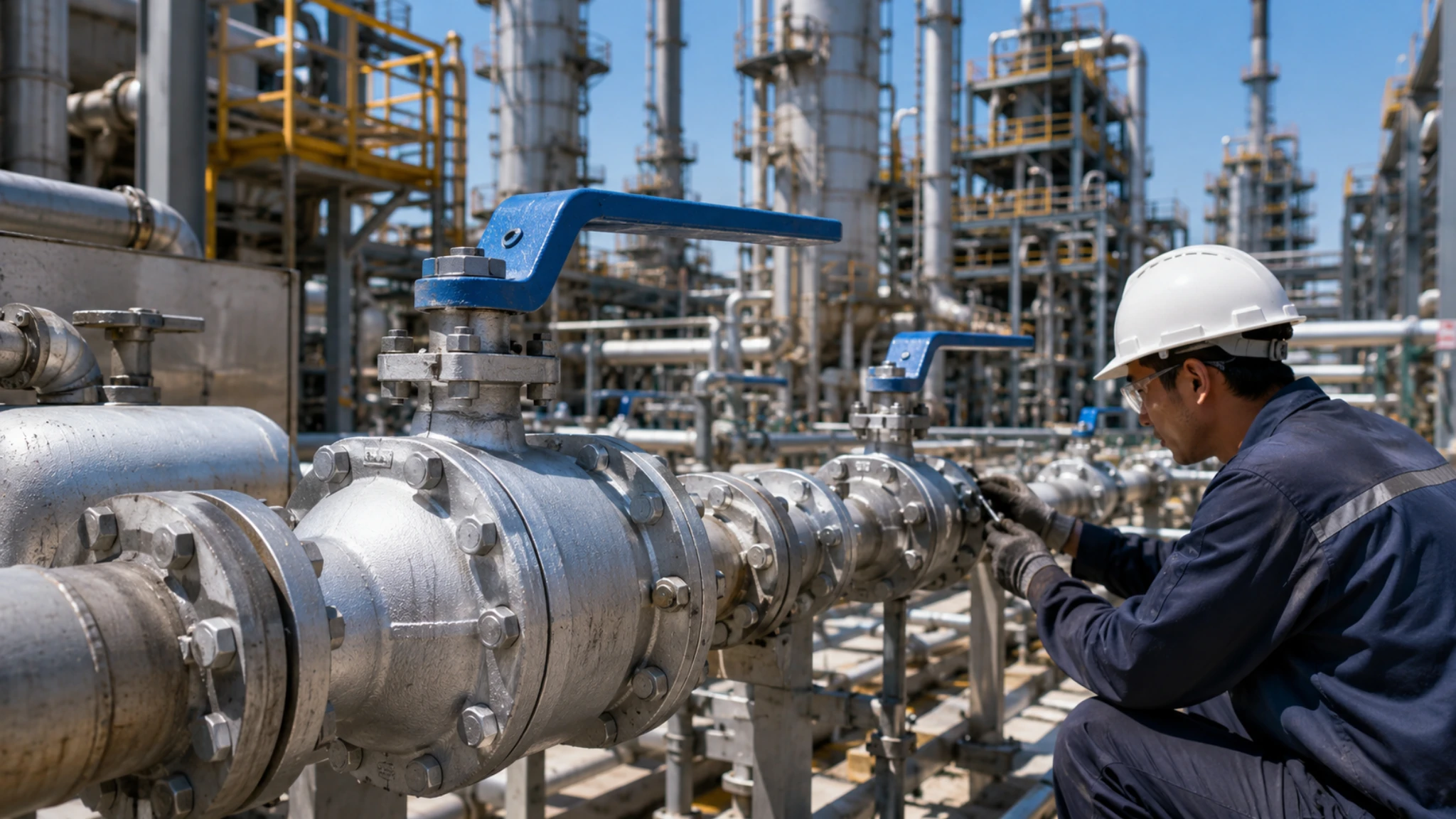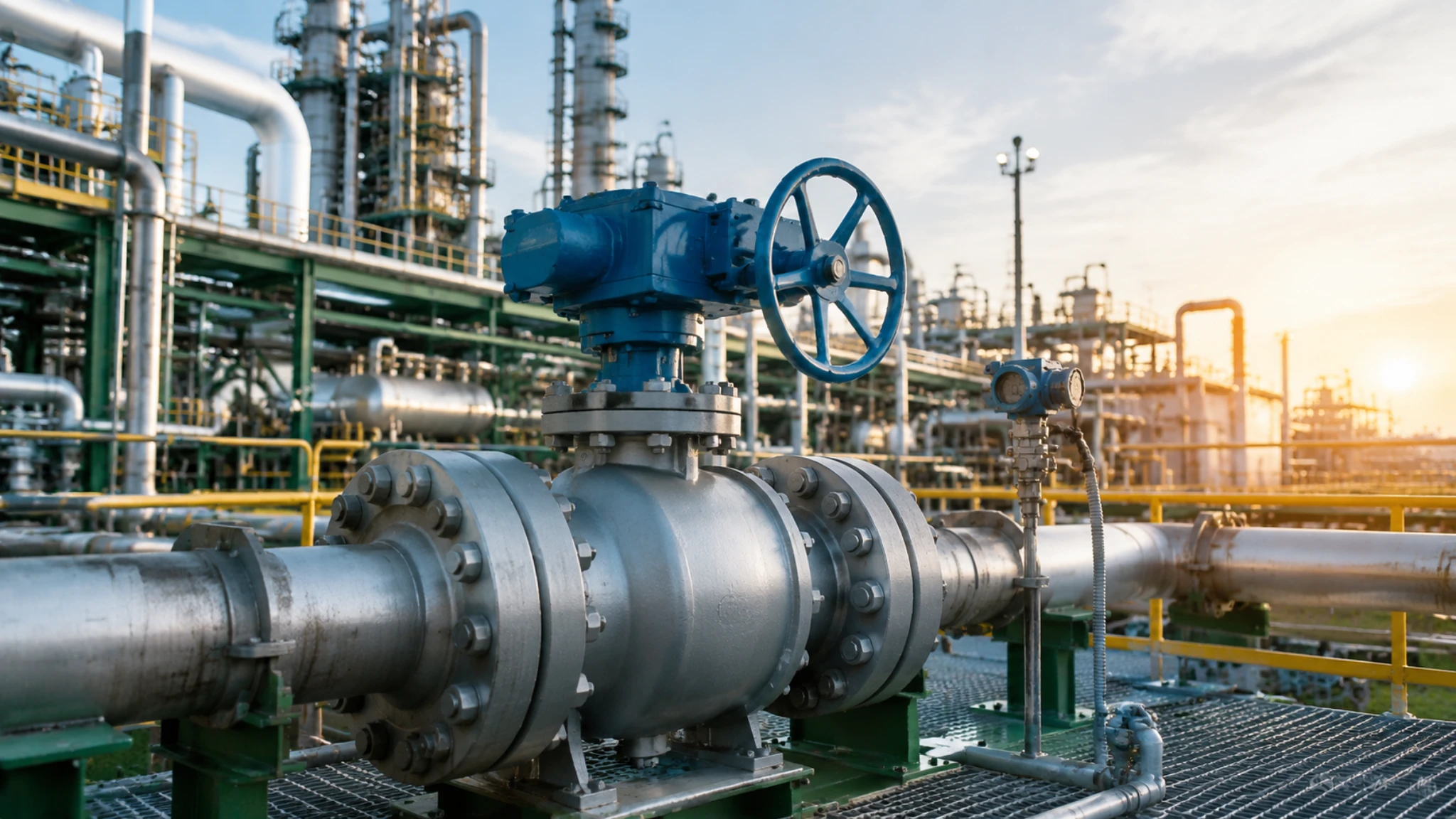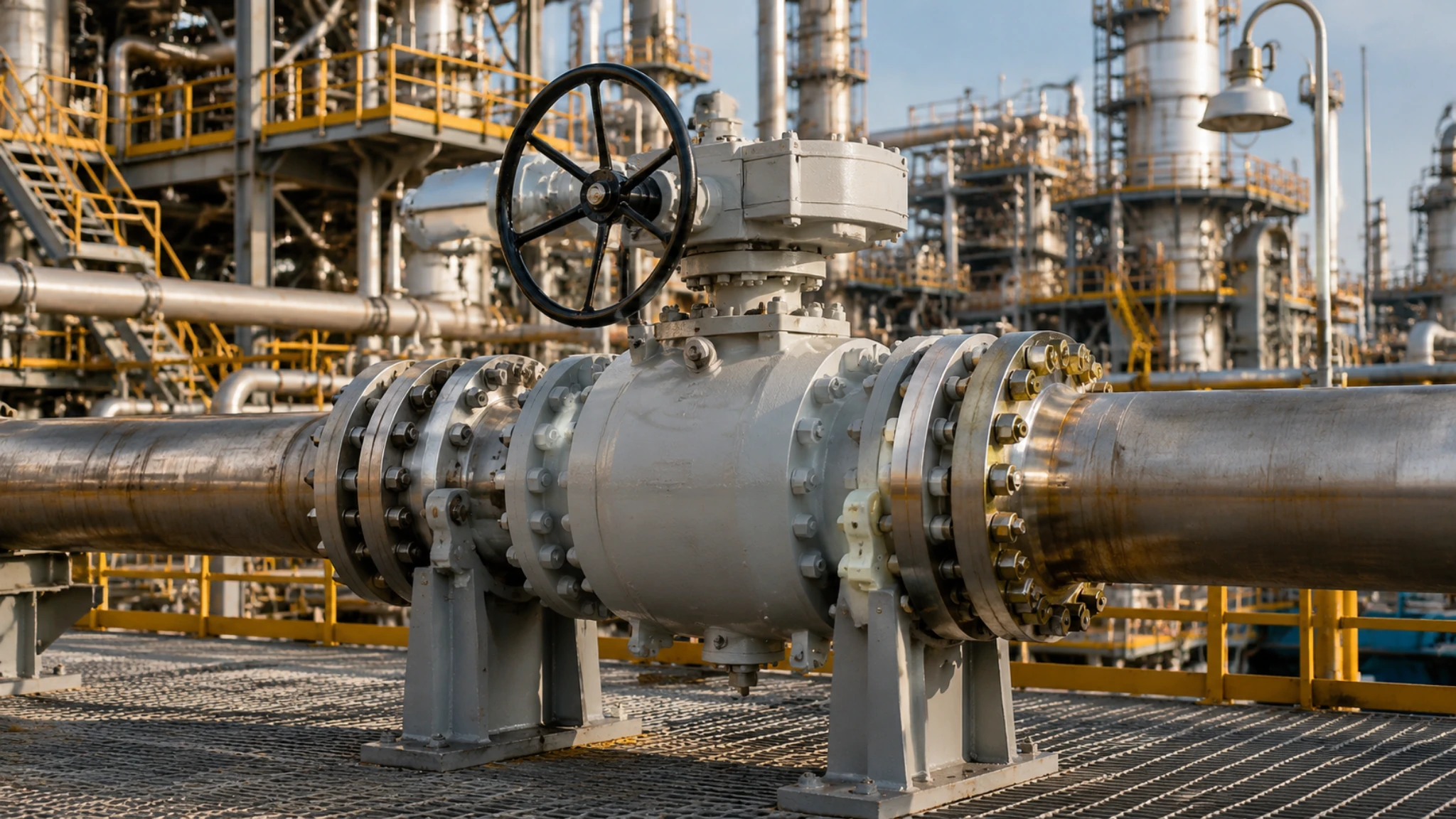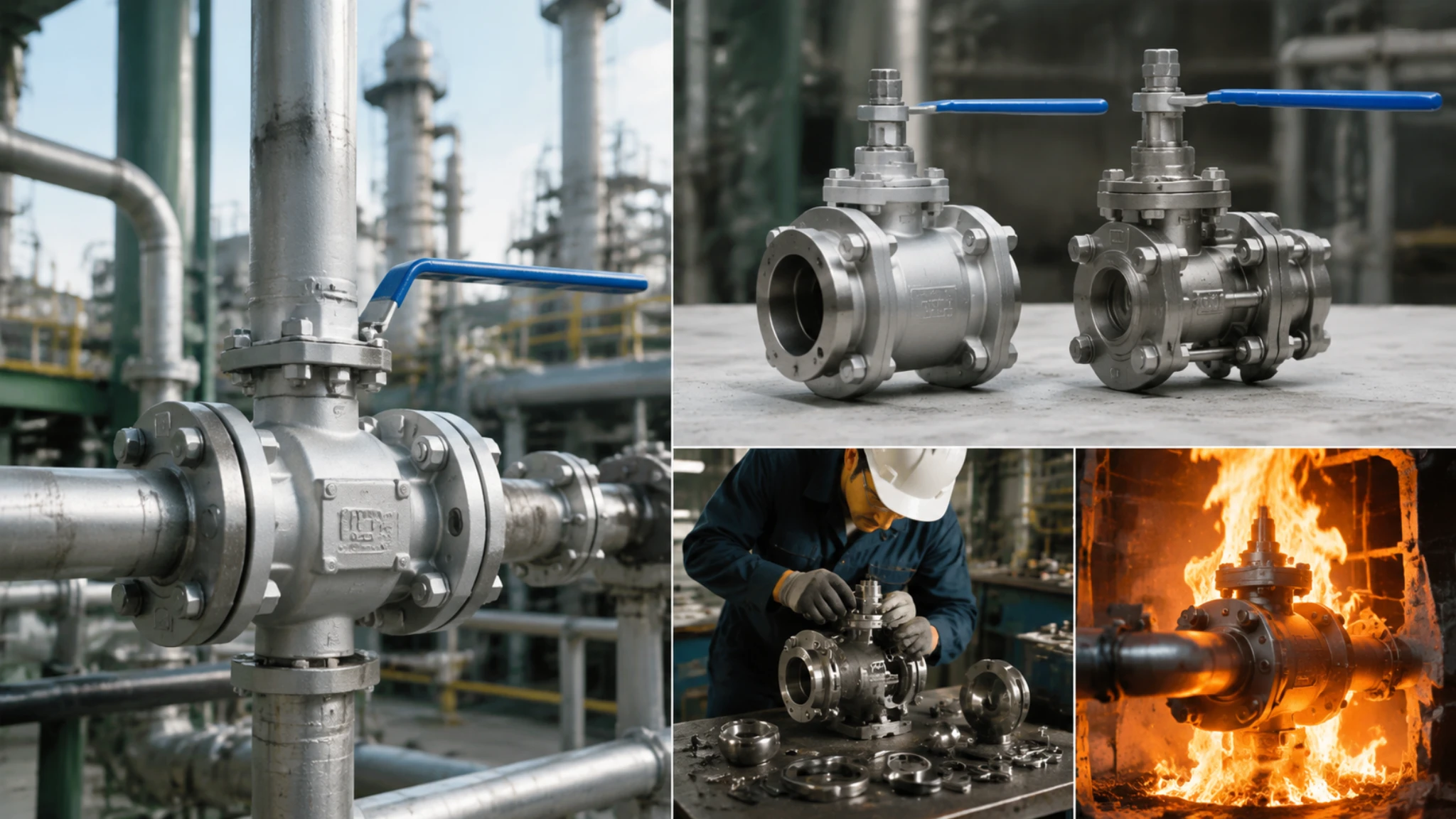
A few years ago I was called in to investigate a Class 900 10-inch ball valve that had cracked at the body during a hydro test. The valve was supposed to be forged A105 steel. The test pressure was 3,330 psi – standard 1.5 times the Class 900 rated pressure of 2,220 psi. The crack originated at an internal corner radius in the body cavity and propagated through the wall in about two seconds. Fortunately, nobody was standing close.
When we sectioned the body, the fracture surface told the story immediately. The grain structure was coarse, random, and contained internal porosity. This was a casting. Someone had machined a cast body, stamped it with an A105 forging heat number, and shipped it. The casting had passed the visual inspection because the outside looked fine. Under load, the internal porosity created stress concentrations that the forged grain structure would have avoided. The foundry that made the casting had no record of the heat, and the PMI reading on the body confirmed the chemistry was close to A105 but the silicon content was off – typical for a WCB casting, but wrong for A105 forging. The entire batch of sixteen valves from that supplier was rejected.
Forged ball valves exist for a reason: when the pressure gets high enough, the grain structure of the steel matters.
A forged body has a continuous grain flow that follows the contour of the part, giving it 15–20% higher fatigue strength than an equivalent cast body and eliminating the internal voids that can exist in a casting. For Class 600 and above, forged bodies are the standard for good reason. Here’s what forged actually means, when it matters, and when you can save money by using cast instead.
What forging does to steel that casting can’t
Steel starts as an ingot. In a casting, the ingot is melted, poured into a mold, and cooled. The grain structure is random. The cooling rate varies depending on the thickness of the mold wall and the section thickness of the part. Thick sections cool slowly and develop large grains. Thin sections cool quickly and develop fine grains. At section transitions – where a thick flange meets a thinner body wall – the grain structure changes abruptly, and that’s where stress concentrates under load.
In a forging, the ingot is heated to about 1,150°C and mechanically worked under pressure in a forge press. The working process – hammering or pressing the steel into shape – breaks up the as-cast grain structure and aligns the grains along the flow lines of the part. The mechanical working also closes internal voids and porosity that existed in the original ingot. The result is a body with a uniform grain structure, oriented along the stress paths that the valve will see in service, with an internal porosity level below 0.001%.
API 6D forged ball valves in full bore configuration achieve the highest pressure integrity because the grain flow in a forging matches the hoop stress pattern around the bore.
The ASTM standards spell out the difference. A105 is the standard forged carbon steel for valve bodies. Minimum tensile strength 485 MPa, yield strength 250 MPa, elongation 22% minimum. The forging ratio – the ratio of the original ingot cross-section to the final part cross-section – must be at least 3:1 to achieve these properties. Below 3:1, the mechanical working is insufficient to break up the as-cast structure, and the forging has properties closer to a casting than a true forging. This is why you can’t forge a 24-inch body from a 26-inch ingot and call it a forging. The geometry doesn’t provide enough reduction to refine the grain structure.
WCB cast carbon steel has similar tensile strength – 485–655 MPa – but the yield strength is slightly higher at 250 MPa minimum, and the elongation is the same at 22%. The difference isn’t in the static properties. It’s in the fatigue properties and the consistency. A forging will have uniform properties throughout the part because the grain structure is uniform. A casting will have property variations depending on section thickness and cooling rate. The fatigue limit of A105 forged steel is typically 10–15% higher than WCB cast steel of the same nominal composition, and the scatter in fatigue test results is much lower for forgings because there are no random casting defects to act as crack initiation sites.
| Property | A105 (Forged) | WCB (Cast) |
|---|---|---|
| Tensile strength (MPa) | 485 min | 485–655 |
| Yield strength (MPa) | 250 min | 250 min |
| Elongation | 22% min | 22% min |
| Fatigue limit | Baseline (10–15% higher than cast) | Lower (more scatter) |
| Internal porosity | < 0.001% | Can exist (shrinkage, hot tears) |
| Grain structure | Uniform, aligned with stress paths | Random, varies with section thickness |
| Silicon content (typical) | 0.15–0.35% | 0.60% max (often higher) |
| Forging ratio required | ≥ 3:1 | N/A |
When forged makes a real difference
The practical rule:
- Forged bodies for Class 600 and above.
- Cast bodies for Class 300 and below.
- Class 600 is the gray zone where both are used depending on the application.
At Class 150 and 300, the working pressures are low enough that a properly inspected cast body has plenty of margin. A Class 300 WCB valve at 38°C sees 740 psi. The wall thickness per ASME B16.34 is conservative for cast material. There’s no reason to pay the forging premium unless the service conditions are aggressive in some way other than pressure – extreme thermal cycling, for instance, where the superior fatigue properties of a forging might matter.
At Class 600, the working pressure at 38°C is 1,480 psi. The wall thickness goes up about 50% from Class 300. The forces on the body are higher, the bolting loads are higher, and the consequences of a body failure are more severe. This is where the industry splits. Some buyers specify forged at Class 600 as a blanket requirement. Others accept cast with 100% radiographic inspection. Both approaches can work. The deciding factor is usually the procurement philosophy and the risk tolerance of the end user. Oil majors with strict material specifications tend to require forged at Class 600. Independent operators and EPC contractors focused on cost often accept cast with additional NDE.
At Class 900 and above, forged is standard. A Class 900 valve at 38°C sees 2,220 psi. A Class 1500 valve at 38°C sees 3,705 psi. A Class 2500 valve at 38°C sees 6,170 psi. At these pressures, the wall thickness of a cast body would be too thick to cool uniformly, and the risk of internal casting defects – shrinkage porosity, hot tears, inclusions – becomes unacceptable for most applications. Forged bodies are denser, more uniform, and more predictable under load.
API 6D forged ball valve manufacturers who produce Class 1500 and Class 2500 valves are almost exclusively using forged bodies because the casting rejection rate at those wall thicknesses would be too high to maintain production schedules.
Forged bodies also make sense at lower pressure classes when the valve is in a safety-critical or high-cycle application. An emergency shutdown valve that might sit in one position for a year and then have to close in three seconds against full line pressure benefits from the fatigue resistance of a forging even if the working pressure is only Class 300. A valve on a compressor discharge line that sees pressure pulsations 24 hours a day benefits from the uniform grain structure that won’t develop fatigue cracks at stress concentrations. The forging premium on a Class 300 ESDV is maybe 30–40% on the valve cost. The cost of an unplanned shutdown because the body cracked is several orders of magnitude higher.
Forged valve sizes and what’s actually forgeable
Forging presses have physical limits. The largest open-die forging presses in the world can produce forgings up to about 80 inches in diameter and 200,000 pounds. But those are for nuclear reactor vessels and turbine rotors. Commercial valve body forgings are limited by the presses typically available at valve foundries, which max out around 8,000 to 12,000 tons of press force. This limits forged valve bodies to about NPS 24 for most manufacturers. Some specialized forges can produce NPS 30 or 36 bodies, but at those sizes the tooling cost becomes prohibitive and lead times stretch to 12–18 months.
For sizes above NPS 24 in Class 600 and above, manufacturers typically use cast bodies with extensive NDE requirements – 100% radiographic inspection per ASME B16.34 Appendix B, ultrasonic testing per ASME Section VIII, and magnetic particle or liquid penetrant on all accessible surfaces. The quality assurance cost on a large casting can exceed the manufacturing cost. But the alternative – a custom forging with a 14-month lead time and a six-figure tooling charge – is worse.
Forged floating ball valves top out around NPS 6 to 8. Above that, the floating ball design runs into the stem torque limits that make it impractical regardless of body construction. Forged trunnion ball valves cover NPS 2 to NPS 24 in Class 600 through 2500. Trunnion designs in forged bodies are the standard for high-pressure pipeline isolation valves below NPS 24.
Trunnion mounted valves with forged bodies combine the pressure integrity of the forging with the low operating torque of the trunnion design.
Material grades for forged valve bodies
| Grade | Type | Key properties | Typical service |
|---|---|---|---|
| A105 | Carbon steel forging | Tensile 485 MPa min, yield 250 MPa, CE < 0.43% for field weldability | -29°C to 425°C, general oil/gas pipelines |
| A350 LF2 | Low-temp carbon steel forging | Impact tested at -46°C (20 J min Charpy V-notch) | Cold climates (northern Canada, Siberia, Alaska) |
| A182 F316 | Austenitic stainless forging | 2–3% Mo for chloride pitting resistance, NACE MR0175 compliant | Offshore, marine, sour service with H₂S |
| A182 F51 (duplex) | Duplex stainless forging | Yield ~450 MPa (double F316), better Cl⁻ SCC resistance | Corrosive environments where 316 isn’t enough |
| Inconel 625 | Nickel-chromium-molybdenum alloy | Tensile 800+ MPa at RT, 600+ MPa at 600°C | Deepwater wellheads, geothermal, flue gas desulfurization |
Forged materials for corrosive environments include F51 duplex and F53 super duplex when 316 isn’t enough.
You don’t specify Inconel unless the alternative is a valve failure that costs more than the valve.
Cast vs forged: the cost and lead time tradeoff
A forged valve body costs 25–40% more than an equivalent cast body. The raw forging itself is more expensive than a casting because the forging process requires a press, dies, and multiple heats, while casting requires a mold and a single pour. The machining time on a forging is also higher because the forged blank has more stock to remove – typically 5–8 mm of machining allowance vs 3–5 mm on a casting. The total cost premium for a forged valve over a cast valve of the same size and class is typically 30–50%.
Lead time favors casting. A cast valve body can go from order to finished casting in 8–12 weeks for standard sizes. A forged valve body takes 12–20 weeks because the forging dies have to be made or pulled from storage, the forging press schedule has to align with the material availability, and the heat treatment after forging adds several days. For large or exotic forgings, lead times of 6–12 months are not unusual.
Cast vs forged body selection often comes down to lead time as much as technical requirements. A project that needed valves six months ago might have to accept cast bodies with enhanced NDE because the forged alternatives can’t be delivered in time.
But the lead time penalty of forging can be offset by reduced inspection requirements. A forged body doesn’t need radiographic inspection because there’s no internal porosity to find. The inspection cost savings on a forged body can be 5–10% of the valve cost, which partially offsets the forging premium. A cast body at Class 600 and above typically requires 100% radiography on all pressure-containing sections, plus ultrasonic testing on critical areas, plus magnetic particle or liquid penetrant on all accessible surfaces. That inspection cost adds up, especially on large valves where the radiography requires multiple film shots and the film interpretation requires a certified Level II or Level III inspector.
Forged full bore and the pigging requirement
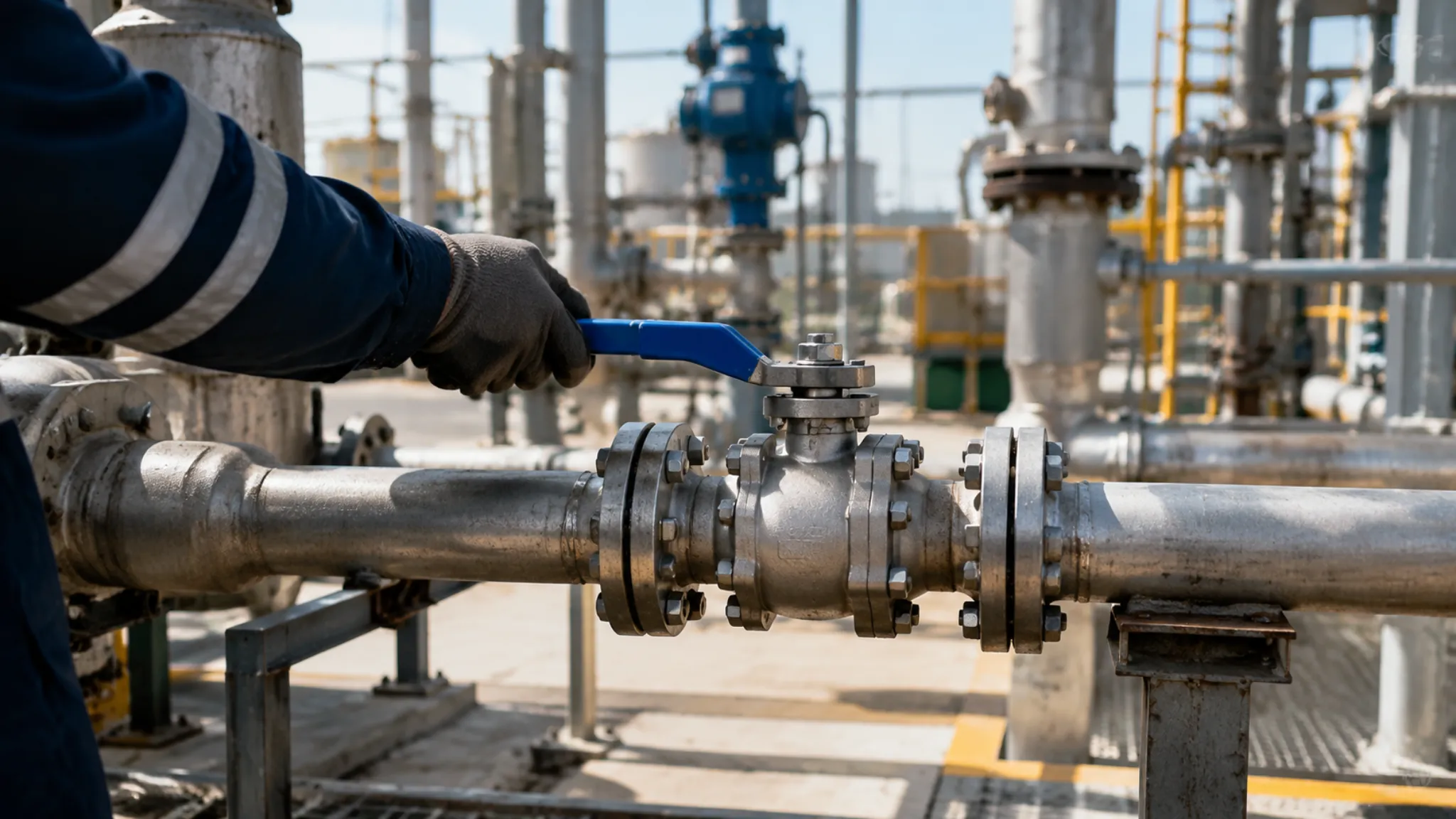
Forged ball valves in full bore configuration have the ball opening machined to match the pipe ID exactly. This means there’s no step change in diameter at the valve, so a pipeline inspection gauge – a pig – can pass through without hanging up. Full bore is mandatory on any line that needs to be pigged, which includes most gas transmission pipelines and many crude oil lines.
The forged full bore body is heavier than a reduced bore forging because the ball is larger and the body has to accommodate the larger ball diameter. A full bore 8-inch Class 600 forged valve weighs about 15–20% more than the reduced bore version. The ball itself is heavier because it’s a larger diameter sphere, and the larger ball requires a larger stem to transmit the operating torque. The cost premium for full bore over reduced bore in a forging is typically 15–25%.
For pipeline valves, the full bore requirement is non-negotiable if the line operates with pigs. The cost of converting a full-bore pigging operation to a reduced-bore system would be astronomical because the entire pipeline would need to be checked for reduced-bore bottlenecks. The valve cost premium is trivial compared to the operational impact of not being able to pig the line.
API 6D specifications for forged full bore valves require the bore diameter to match the pipe ID within a specified tolerance, and the pig passage test is part of the API 6D qualification.
How to verify a forging is actually a forging
The valve I mentioned at the start – the one that cracked during hydro – was a casting passed off as a forging. This happens more often than the industry likes to admit. Spotting a fake forging requires specific checks.
- Weight. A forged body of a given size and class weighs about 5–10% more than a cast body of the same dimensions because the forging has higher density – no porosity – and the machining allowance on the forging blank means the finished part retains slightly more metal. If a “forged” valve is lighter than the catalog weight for a cast valve of the same size and class, something is wrong.
- Ultrasonic thickness mapping. A casting will show thickness variations of 5–10% around the body because the mold shifts slightly during pouring and the cooling shrinkage isn’t perfectly uniform. A forging will show thickness variations of 1–3% because the forged blank is machined to the final dimensions, and the machining process is much more precise than the casting process. Map the wall thickness at 20–30 points around the body. If the variation is more than 3%, it’s probably a casting.
- Positive material identification (PMI) with an XRF gun. A105 forging chemistry has tighter tolerances on residual elements than WCB casting chemistry, particularly on silicon (0.15–0.35% for A105 vs 0.60% maximum for WCB) and carbon (0.35% maximum for A105 vs 0.30% maximum for WCB for standard grades). If the chemistry matches a casting grade more closely than a forging grade, the PMI result plus the weight and thickness data together tell the story.
- The heat number. A forging heat number traces to a specific ingot from a specific steel mill, with a specific forging press, on a specific date. The heat number should be stamped on the body and traceable to a mill certificate with the chemical composition and mechanical properties for that specific heat. If the manufacturer gives you a generic material certificate without a heat number, or the heat number doesn’t trace to a mill certificate, the documentation chain is broken and the forging claim is unverifiable.
The investigation at the hydro test facility took about four hours from the body cracking to the preliminary conclusion that the forging was a casting. The micrometer measurements on the fracture face, the XRF chemistry, and the archived certificates from the real A105 heats all pointed the same direction. The supplier was removed from the approved vendor list within a week.
The lesson isn’t that forgings are inherently better than castings. It’s that when you pay for a forging, you need to verify you got one.
The cost of verification is a few hundred dollars in inspection time. The cost of not verifying is a failed hydro test, a delayed project, and a valve body that could have killed someone if it had failed in service instead of on the test stand.