A valve torque curve is the main reference for actuator sizing.
If the curve is read from only one value, the selected actuator may fail to open the valve, stop before full travel, or close without enough torque to achieve the required seat tightness. The opposite problem is also common: if a catalog value is multiplied by an extra safety factor without understanding whether the catalog value already includes a service margin, the actuator can become unnecessarily oversized.
For quarter-turn ball valves, the torque curve should normally be read by stroke phase: break torque at initial opening, run torque during travel, and reseating torque near final closing. The exact relationship between these values is not universal. It depends on valve design, seat material, differential pressure, packing load, media, temperature, storage condition, and the actuator output curve.
Balon, for example, states that its listed floating ball valve breakaway torque values do not contain service or safety factors and apply to standard seats controlling clean liquid or gas at ambient temperature. It also states that run torque is approximately 50% of breakaway torque and re-seat torque is approximately 75% of breakaway torque for that listed data set.[1] These ratios are useful as a manufacturer example, but they should not be treated as a universal rule for all ball valves.
| Torque item | Valve phase | Practical reference | Main sizing role |
|---|---|---|---|
| Break torque | Opening from fully closed | Usually the highest opening demand; must be taken from the exact valve and service condition | Main opening benchmark for actuator sizing |
| Run torque | Continuous rotation after initial movement | Often lower than break torque; manufacturer data can show values around 25%-50% or more depending on valve design | Checks whether the actuator can continue moving the valve through the stroke |
| Reseating torque | Closing back into the seat | Often lower than break torque, but can rise near the closing end; manufacturer examples may be around 75%, while some project data can be higher | Confirms closing and sealing reliability |
Read the curve by stroke phase: opening peak, running load, and closing peak.
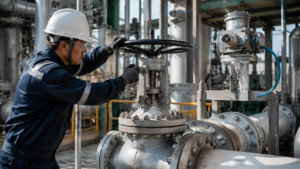
Torque Components
Break Torque Is Usually the Main Opening Peak
Break torque is the torque needed at the moment the valve starts rotating from the fully closed position.
In a floating ball valve, differential pressure pushes the ball against the downstream seat when the valve is closed. The actuator must overcome seat friction, stem packing friction, and any static adhesion before the ball starts moving. This is why break torque is normally higher than run torque.
A high measured value on one valve size should not be generalized to the entire industry. For example, a DN80 floating ball valve under high differential pressure, high seat preload, special seat material, long idle time, or contaminated service can produce a much higher break torque than a clean-service catalog value. Published manufacturer data for a 3-inch floating ball valve can be far lower under standard clean liquid or gas service at ambient temperature.[1]
| Condition | Possible torque effect | Selection note |
|---|---|---|
| Higher differential pressure | Increases seat normal load and usually increases break torque | Use the pressure point from the valve torque chart or test report |
| Higher seat preload | Can increase break torque and reseating torque | Confirm preload assumptions with the valve manufacturer |
| Low-emission packing | Can increase stem friction if packing compression is high | Use measured torque or packing torque limits, not a generic added value |
| Long idle time | Can increase first-cycle torque because of static adhesion | Use a higher service factor or retest before installation |
For pipeline valves specified under API 6D, the actuator selection should be based on the valve design, pressure class, service condition, test documentation, and project torque data rather than an unsupported nominal value. API 6D defines requirements for pipeline valves, but the actual actuator sizing basis still needs the specific valve torque data and the applicable project conditions.[2]
A practical sizing basis is:
- Use measured or manufacturer-confirmed break torque at the specified differential pressure.
- Confirm whether the torque value is raw torque or already includes service factors.
- Apply the selected application factor or safety factor only after the torque basis is clear.
- Check that the selected actuator does not exceed the valve stem maximum allowable torque.
For product-specific data, use the valve manufacturer’s own torque table. For example, API 6D forged ball valve pages such as API 6D forged ball valves should be supported by torque data by bore size, pressure class, seat material, and service condition.
Run Torque Is Lower but Still Must Be Checked
Run torque is the torque required to keep the valve moving after the first movement has started. It is normally measured after the initial breakaway point, often after the first few degrees of travel.
Run torque is usually lower than break torque because static friction has already been overcome. However, it is still important for actuator sizing. An actuator can have enough starting torque but still fail during travel if its continuous torque rating is too low.
Balon’s floating ball valve torque data gives one manufacturer example: run torque is approximately one-half of breakaway torque for the listed standard-seat, clean-service conditions.[1] Other valve designs, seat materials, packing arrangements, and service conditions can produce different ratios.
| Run torque driver | Effect on torque | Recommended check |
|---|---|---|
| Packing gland preload | Excessive preload increases stem friction | Verify packing compression procedure and measured torque during FAT |
| Seat machining tolerance | Uneven contact can create torque scatter across a batch | Compare each unit against batch trend data |
| Contamination or slurry | Particles can increase friction and wear | Use a severe-service factor and confirm seat material suitability |
| Frequent operation | Wear or packing degradation can change running torque over time | Trend run torque during maintenance or partial-stroke testing |
ISO 15848-1 is often mentioned in low-emission valve projects, but it should be used correctly. ISO 15848-1 specifies testing procedures and a classification system for evaluating external leakage of valve stem seals, shaft seals, and body joints. It is not a universal source for added actuator torque. If low-emission packing is specified, the torque increase should be verified by the valve manufacturer, packing supplier, or project test data.[3]
Run torque is also a useful assembly-quality indicator. If one valve in a batch shows a run torque far above the batch trend, possible causes include excessive packing compression, seat misalignment, ball surface damage, contamination, or machining tolerance issues.
For electric actuators, run torque is especially important. Electric actuators may have a short-time starting torque that is higher than their continuous rating. The actuator must therefore be checked for both starting torque and continuous torque through the full stroke.
Stable run torque means the valve is not only moving; it is moving predictably.
For application pages such as forged floating ball valve applications, torque guidance should distinguish clearly between break torque, run torque, and reseating torque instead of using one value for the whole stroke.
Reseating Torque Controls Closing Reliability
Reseating torque is the torque required near the final closing position as the ball re-enters the seat and the valve attempts to achieve the required sealing performance.
Reseating torque is commonly lower than break torque, but the ratio is not fixed. Balon’s listed floating ball valve data gives re-seat torque as approximately three-quarters of breakaway torque for its stated clean-service conditions.[1] In other applications, reseating torque can be higher because of seat design, pressure, temperature, contamination, or long idle time.
| Seat type | Practical behavior | Selection note |
|---|---|---|
| Soft seat | Often lower friction than metal seat, but preload and media compatibility still matter | Use the manufacturer’s torque table for the selected seat material |
| PEEK or reinforced polymer seat | Can require higher torque than PTFE depending on preload and pressure | Do not transfer PTFE torque data directly to PEEK service |
| Metal seat | More sensitive to contact stress, coating condition, lapping quality, and temperature | Check hot and cold torque values when temperature range is wide |
| Low-temperature seat package | Contraction and clearance changes can increase torque | Use measured cryogenic torque data where available |
For a spring-return actuator, reseating torque must be checked at the correct stroke position and fail action. Emerson’s EL-O-Matic sizing guidance shows that fail-to-close spring-return actuators must satisfy four separate checks: air-start torque greater than valve break torque, air-end torque greater than run open torque, spring-start torque greater than run close torque, and spring-end torque greater than re-seat torque.[4]
This is a common source of sizing mistakes. A spring-return actuator can pass the opening torque check but fail the closing-end torque check if the spring-end output is below the valve reseating torque. For this reason, the valve torque curve and the actuator output curve should be checked together across the full 0-90° stroke.
Seat leakage should also be described using the correct test standard and unit. ISO 5208 specifies examinations and pressure tests used to establish pressure-boundary integrity and closure tightness for metallic industrial valves.[5] Instead of reporting an undefined leakage percentage, a project should specify the applicable leakage rate or acceptance class, such as ISO 5208 Rate A, Rate B, Rate C, or another project-required criterion.
For API 6D ball valve specifications, closing torque and leakage class should be treated as linked requirements: the actuator must provide enough closing torque at the required supply condition to achieve the specified seat tightness.
Influencing Factors
Media Pressure Effect
Media pressure is one of the most important external variables in the valve torque curve.
In a floating ball valve, higher differential pressure generally increases the force pushing the ball against the downstream seat. This increases the normal load on the seat and usually increases the friction torque required to move the valve.
Pressure does not increase torque by one universal percentage per MPa. A statement such as “each 1.0 MPa increase raises torque by 8%-12%” is too broad unless it is limited to a specific valve design, bore size, seat material, differential pressure range, and test method.
If a project test shows a DN150 floating ball valve increasing from 350 N·m at 1.0 MPa to 1,620 N·m at 6.4 MPa, the two-point slope is:
(1,620 – 350) / (6.4 – 1.0) = 235 N·m/MPa
If the full six-point regression slope is different, the article should state that it is a regression result and provide enough context to avoid a simple endpoint-calculation conflict.
| Pressure point | Measured break torque | Engineering interpretation |
|---|---|---|
| 1.0 MPa | 350 N·m | Lower pressure load on the seat |
| 6.4 MPa | 1,620 N·m | Higher pressure load and higher friction torque |
| Endpoint slope | About 235 N·m/MPa | Calculated only from the two stated endpoints |
API 6D should be used together with the applicable pressure class, valve design data, and manufacturer documentation. It defines requirements for pipeline valves, but it does not replace the need for project-specific actuator sizing based on the actual valve torque curve.[2]
Media type also affects torque. Bray’s ball valve actuator selection guide uses application factors for different media and service conditions, including clean service, dry gas, slurry, steam, low temperature service, and cryogenic service. This supports the practical approach of adjusting torque requirements by application rather than using one fixed pressure multiplier for every valve.[6]
Body material weight should not be treated as a direct actuator torque driver. A difference between WCB carbon steel and duplex stainless steel body weight mainly affects handling, support, installation, and piping loads. Actuator sizing should still be based on pressure, seat load, bearing friction, packing friction, temperature, media, and measured torque.
Valve design also matters. Floating ball valves and trunnion-mounted ball valves carry pressure loads differently. In floating ball valves, the ball movement under differential pressure is a major contributor to seat load. In trunnion-mounted valves, the ball is supported by trunnions, and the seat design changes how pressure load is transferred. The actual torque difference should come from manufacturer torque data, not from a fixed generic percentage.
For comparison pages such as trunnion-mounted vs floating ball valve selection, the torque comparison should identify the bore size, pressure class, seat type, test pressure, and whether the quoted torque is raw or service-factored.
Temperature Effect on Torque
Temperature affects valve torque through several mechanisms.
- Seat material friction and stiffness can change with temperature.
- Thermal expansion can change the clearance between body, ball, stem, seats, and bearings.
- Packing friction can increase or decrease depending on material and compression.
- Low-temperature contraction can increase sealing stress in some designs.
Because these mechanisms can work in opposite directions, temperature compensation should not be reduced to one simple multiplier.
PTFE torque data should not be applied to high-temperature service above its suitable operating range. Teflon PTFE is commonly described with temperature resistance up to about 260°C. A valve operating around 400°C should use a suitable high-temperature seat package, such as metal, graphite-based, or another material selected for the actual service condition.[7]
For low-temperature and cryogenic service, torque can increase as temperature drops because material stiffness, seal contraction, and fit clearances change. ISO 28921-1:2022 applies to isolation valves for low and cryogenic temperature service where the design low-temperature service is from -50°C down to -196°C.[8]
BS 6364 is still seen in some legacy cryogenic valve specifications, but it should not be cited as the only current reference without checking the project specification and applicable standard edition. For new low-temperature valve work, ISO 28921-1 and ISO 28921-2 should be considered where applicable, together with project and purchaser requirements.[8]
Cryogenic actuator sizing should use torque data measured or validated at the relevant low temperature. Ambient-temperature torque should not be extrapolated to LNG or other cryogenic service without manufacturer confirmation.
For cryogenic valve selection, torque tables should identify the test temperature, pressure condition, seat material, stem packing, and leakage requirement.
Use the highest torque point in the real temperature envelope, not just the room-temperature value.
Long Idle Time Can Increase First-Cycle Torque
Valves left stationary for a long time can show higher first-cycle torque. This is often called static stick.
Static stick can be caused by micro-adhesion between the seat and ball surface, lubricant aging, packing compression, corrosion, contamination, or elastomer and polymer relaxation. The effect depends strongly on valve design, storage condition, media exposure, and maintenance practice.
API 6D should not be presented as a source for one universal static torque increase formula. In practice, long-idle valves should be handled by retesting, partial-stroke testing, preservation procedures, and higher service factors for critical duty.
Bray’s actuator selection guide includes a frequency-of-operation factor. The guide uses different factors for frequently operated valves and valves cycled less often, including valves operated less than once per six months. This supports the practical approach of increasing the torque requirement for long-idle valves instead of using the same factor as frequently cycled valves.[6]
| Condition | Torque risk | Recommended action |
|---|---|---|
| Emergency shutdown valve | May remain in one position for months or years | Use a higher service factor and verify actuator output at minimum supply pressure |
| Stored spare valve | Seat adhesion, lubricant aging, or corrosion can raise first-cycle torque | Retest torque before installation if storage time is long |
| Valve in coastal or humid storage | Moisture can increase corrosion and packing friction risk | Use preservation, humidity control, and inspection before shipment or installation |
| Critical isolation valve | Failure to open or close can create a safety or production issue | Use partial-stroke testing and trend torque over time |
For existing installations, partial-stroke testing every 3-6 months can help keep seat surfaces active and provide early warning of increasing torque. The exact interval should be set by the plant’s maintenance philosophy, valve criticality, safety integrity requirement, and manufacturer guidance.
For API 6D ball valve maintenance, storage, preservation, partial-stroke testing, and torque trending should be part of the actuator reliability plan.
Safety Factor Selection
Normal-Service Factors
A common practical approach is to apply a margin to the maximum required valve torque. For clean, normal, well-controlled service, a factor around 1.2-1.3 is often used, but it should not be described as a universal requirement from ISO 5211.
ISO 5211 specifies requirements for the attachment of part-turn actuators, with or without gearboxes, to industrial valves. It covers flange dimensions, driving component dimensions, and reference torque values for interfaces and couplings. It is an actuator-to-valve attachment standard, not a universal actuator safety-factor standard.[9]
Actual actuator sizing factors should come from the valve manufacturer’s torque data, the actuator manufacturer’s sizing procedure, and the service condition. Emerson’s EL-O-Matic sizing example uses a recommended safety factor of 1.2 for one double-acting actuator example and 1.5 for one spring-return actuator example. It also sizes at minimum supply pressure, not nominal maximum pressure.[4]
Bray’s actuator selection guide uses torque factors based on application, valve design, and frequency of operation. It then selects an actuator whose output torque exceeds the total valve torque requirement at the available air supply pressure.[6]
The selected factor should cover realistic uncertainty sources:
- manufacturing tolerance and seat machining variation;
- seat wear, contamination, or aging during service;
- packing friction changes;
- pneumatic supply pressure drop or electric voltage variation;
- long idle time or low-temperature operation.
For pneumatic actuators, the sizing pressure should be the minimum guaranteed pressure at the actuator inlet. A drop from 6.0 bar to 5.0 bar represents a pressure reduction of about 16.7%. Because pneumatic actuator torque is strongly related to available supply pressure, using nominal plant air pressure instead of minimum available pressure can lead to undersizing.
Use measured or manufacturer-confirmed torque, not unexplained catalog torque, as the sizing basis.
Higher Factors for Severe Service
High pressure, abrasive media, sour service, cryogenic service, long idle time, emergency shutdown duty, and high-temperature metal-seat service usually require a higher margin than normal clean service.
For Class 900 and above service, the torque basis should be reviewed carefully because high differential pressure can increase seat load, packing friction can become significant, and contamination or seat wear can raise break torque above the clean-service value.
Do not compare normal force directly with torque. Normal force is measured in N, while torque is measured in N·m. A technically correct statement is that pressure-induced seat normal load can become a dominant contributor to torque after it is multiplied by the applicable friction coefficient and effective torque arm.
A practical severe-service factor often falls around 1.5-2.0, but the final factor should be selected from project requirements, valve manufacturer data, actuator manufacturer guidance, and service criticality. The higher end is more appropriate for abrasive media, sour service, long idle emergency isolation, or low-temperature service.
API 6DX is relevant where actuator and mounting-kit requirements for API 6D valve assemblies apply. API 6DX is described as defining requirements for mechanical integrity and sizing of actuators used on valves manufactured under API Specification 6D.[10]
For forged metal-seated ball valves, actuator sizing should use a torque envelope that includes pressure, temperature, seat coating, packing design, and expected media condition.
Actuator Torque Matching
Actuator-to-valve torque matching is the final application of the valve torque curve.
| Actuator type | Output characteristic | Matching concern |
|---|---|---|
| Scotch-yoke pneumatic actuator | High torque at stroke ends and lower torque near mid-stroke | Often matches ball valve break and reseating peaks well, but mid-stroke torque must still be checked |
| Rack-and-pinion pneumatic actuator | More even double-acting torque curve; spring-return versions vary by stroke position | Check air-start, air-end, spring-start, and spring-end torque where applicable |
| Electric actuator | Starting torque and continuous torque limits can differ | Check starting torque, continuous torque, duty cycle, thermal protection, and stem maximum torque |
| Hydraulic actuator | High force density when hydraulic pressure is maintained | Confirm hydraulic pressure, fail action, full-stroke torque coverage, and system pressure loss |
Scotch-yoke actuators deliver higher torque near stroke ends. This can match ball valve demand well because break torque is highest near the opening end, run torque is lower in mid-stroke, and reseating torque rises again near the closing end.
Rack-and-pinion double-acting actuators usually provide a flatter torque curve. Spring-return rack-and-pinion actuators require more careful checking. Emerson’s EL-O-Matic sizing guidance checks the actuator torque at the required positions against break torque, run torque, and re-seat torque.[4]
Electric actuators require both starting and running checks. A motor may have enough short-time starting torque to break the valve open, while the continuous rated output may still be too low for full-stroke operation. If the actuator overheats or trips during travel, the problem may be a run torque or duty-cycle mismatch rather than a break torque problem.
For all actuator types, the valve torque curve should be superimposed on the actuator output curve. The selected actuator should cover the required torque at every relevant stroke position and under the minimum available power or supply condition.
| Torque item | Selection purpose | Required check |
|---|---|---|
| Break torque | Main opening benchmark | Actuator must overcome the opening peak at the worst credible service condition |
| Run torque | Continuous movement verification | Actuator must cover the running portion without thermal overload or pressure limitation |
| Reseating torque | Closing and sealing reliability | Actuator must provide enough end-of-stroke closing torque at minimum supply pressure or available power |
| Maximum stem torque | Valve mechanical protection | Actuator output must not exceed the valve stem or drive-train limit |
Correct interpretation of a valve torque curve reduces actuator failure risk and avoids unnecessary oversizing. The safest method is to use manufacturer-confirmed torque data, apply the correct service factor, and check the full 0-90° torque match instead of relying on one peak value.
- Base actuator sizing on measured or manufacturer-confirmed torque values.
- Confirm whether the torque value is raw, service-factored, or catalog-factored.
- Use normal-service factors only for clean, frequent, well-controlled service.
- Use higher factors for high pressure, abrasive media, cryogenic service, long idle time, and emergency shutdown duty.
- Check break torque, run torque, reseating torque, minimum supply pressure, and maximum stem torque together.
References
- Balon Floating Ball Valve Torque Data
- API Specification 6D: 25th Edition
- ISO 15848-1:2015 Industrial valves — Measurement, test and qualification procedures for fugitive emissions
- Emerson EL-O-Matic: Sizing of Rack & Pinion Actuators
- ISO 5208:2015 Industrial valves — Pressure testing of metallic valves
- Bray Technical Bulletin No. 1005: Actuator Selection Guide — Ball Valves
- Teflon Fluoropolymers: Chemical and Thermal Resistance
- ISO 28921-1:2022 Industrial valves — Isolating valves for low-temperature applications
- ISO 5211:2026 Industrial valves — Part-turn actuator attachments
- API Standard 6DX: Standard for Actuators and Mounting Kits for Valves