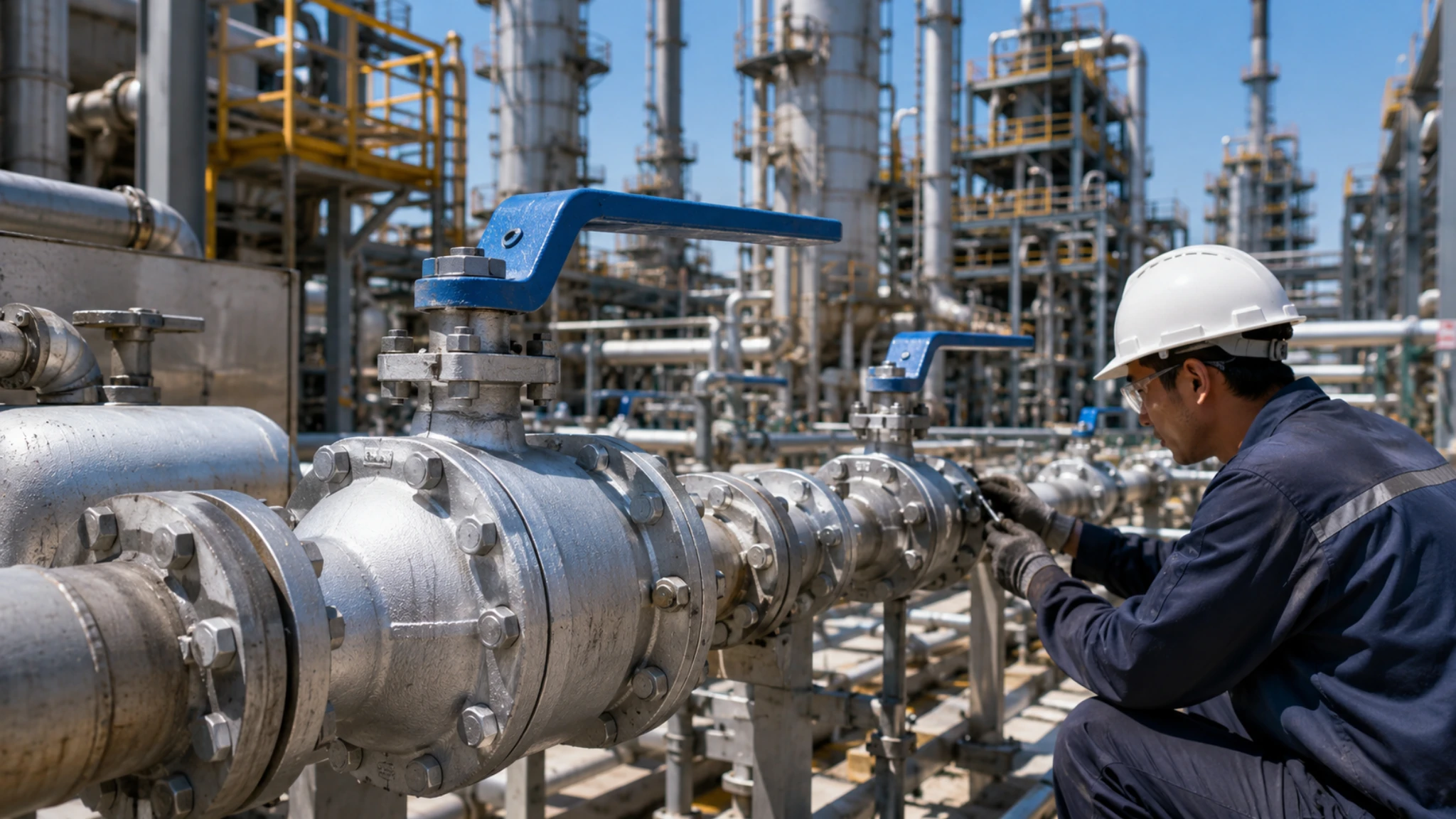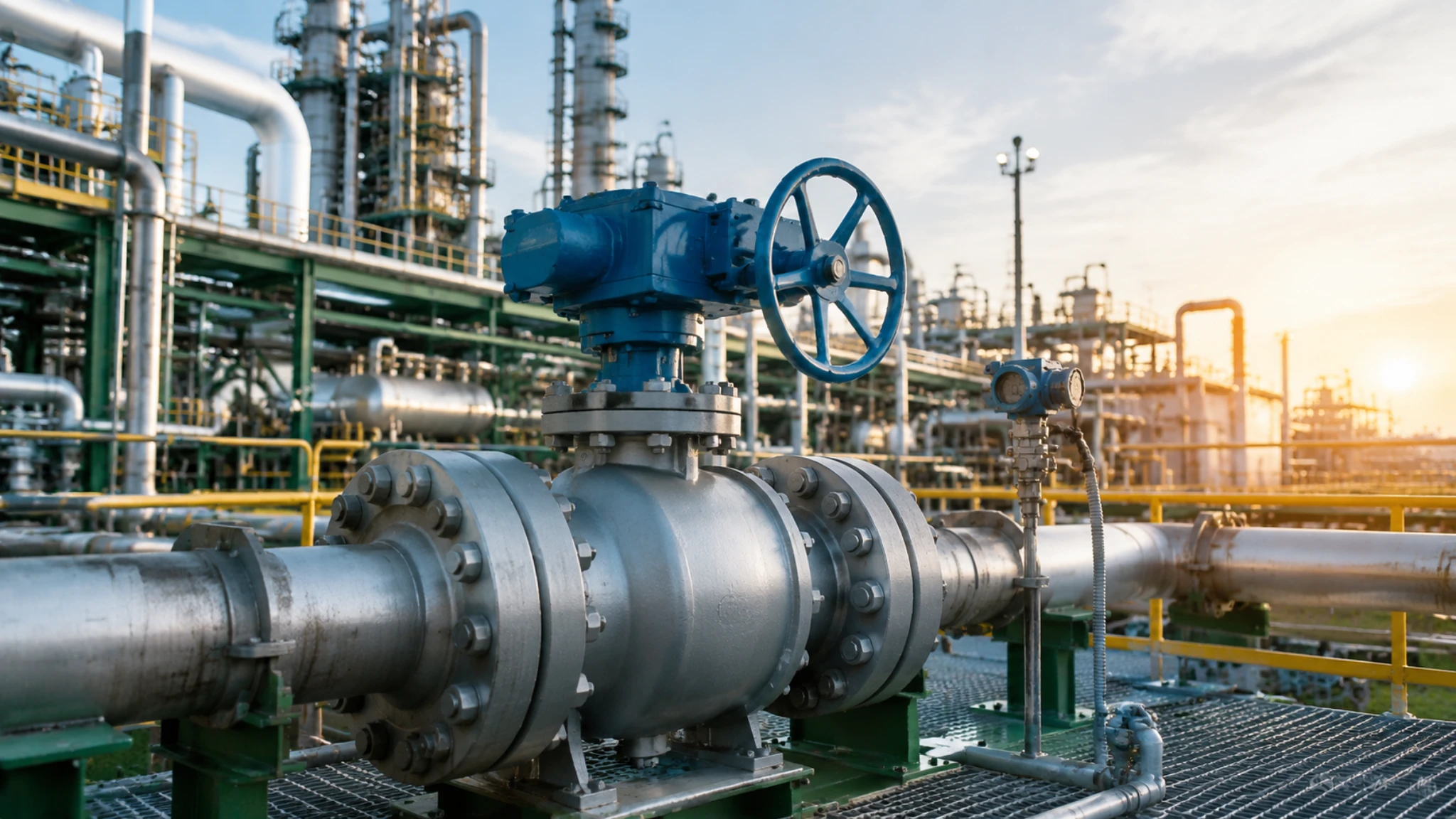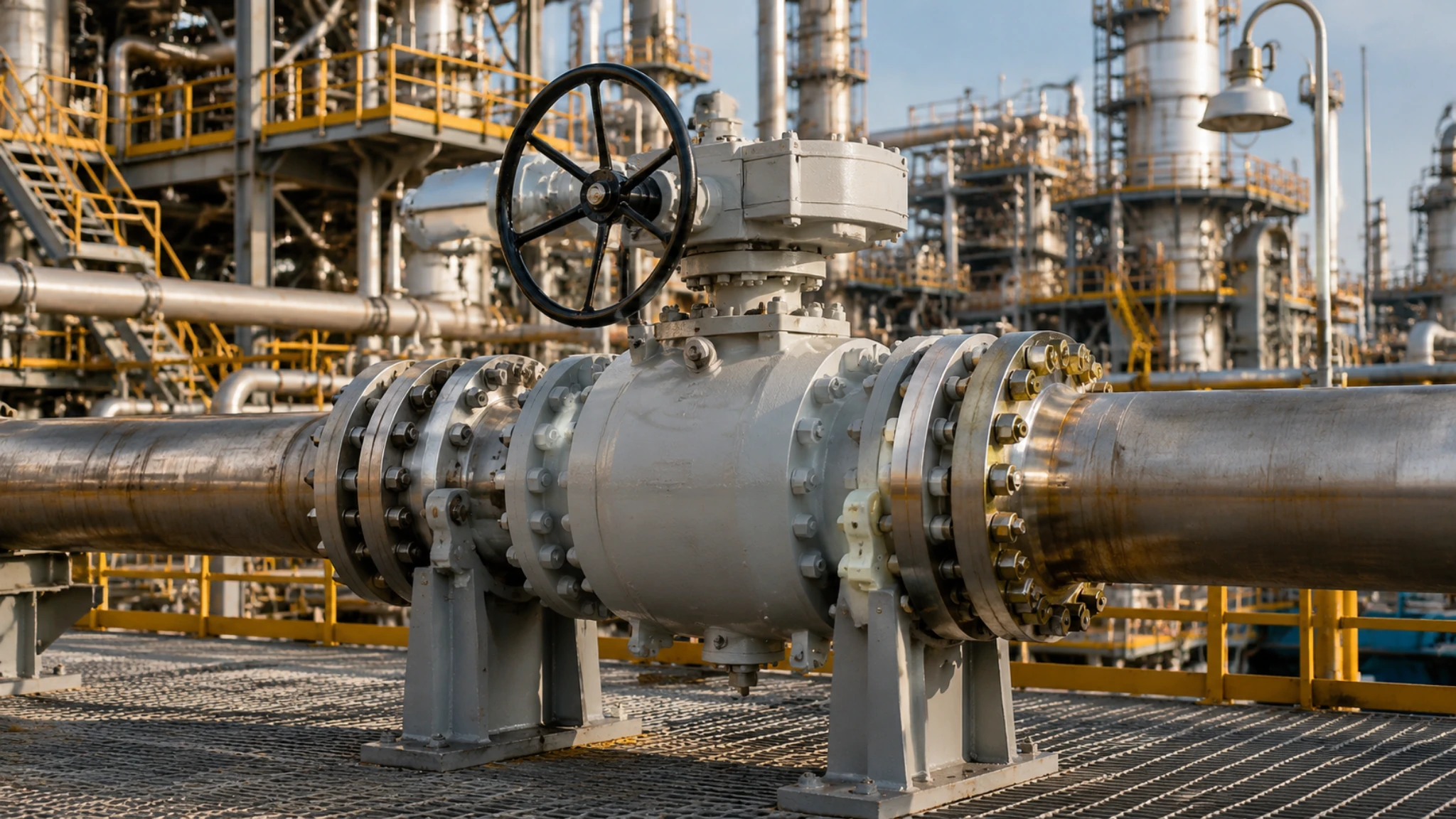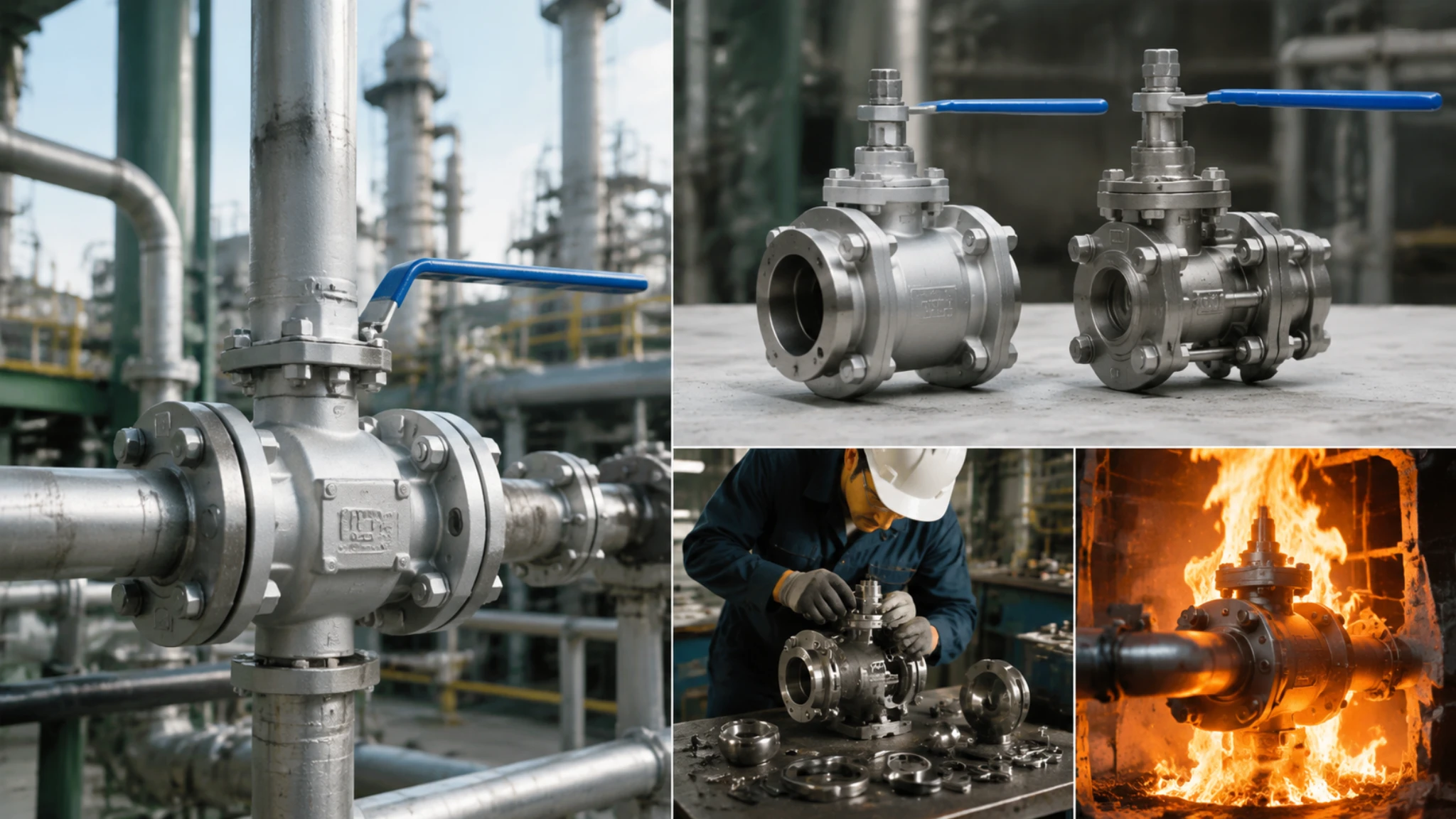
In API 6D ball valves: WC coating hardness reaches HRC65–75, suitable for containing 30–40% solid particles medium, wear resistance lifespan improves 3–5 times; but temperature resistance ≤500–600°C.
Stellite surfacing welding hardness about HRC38–48, temperature resistance can reach 800°C, anti-erosion and cavitation better.
High temperature/cavitation choose Stellite, strong abrasive medium choose WC.
operating temperature
-46°C – 400°C
Minus 46 degrees to 400 degrees pipeline interval is tungsten carbide coating playing role’s regular territory. Factory workshop starts supersonic flame spraying equipment, accelerates extremely fine tungsten carbide powder to speed of sound’s two times above. Powder in midair experiences 2800 degrees high temperature baking instantly melts, high speed impacts on ball valve metal surface.
Worker holds micrometer measuring, makes this layer hard shell’s thickness deadly stuck between 0.15 to 0.25 millimeters. Vickers hardness tester’s probe presses down, dial reading easily breaks through HV 1100. Pipeline enters minus 46 degrees extreme cold working condition, commonly used A350 LF2 forged steel valve body approaches metal’s cold brittle critical point.
Laboratory’s Charpy V-notch impact testing machine smashes breaking test block, base material absorbed energy dropped to 20 joules’ low valley. This layer merely 0.2 millimeters thick coating endures metal extreme cold shrinking brought pulling. Quality inspection department required bonding strength test data must exceed 70 megapascals, slightly having error pipeline valve surface occurs large area falling off.
Pipeline inside flowing high pressure crude oil often mixes rice grain size quartz sand. These diameter at 0.5 millimeters around solid impurities bring Mohs hardness 7 sharp edges, at per second 5 meters speed endlessly scrape valve body inside.
High hardness tungsten carbide powder acts as anti-wear physical armor. Polishing machine tool changes onto special sand belt, polishes coating surface’s roughness Ra to 0.1 micrometers below. Quality inspector puts workpiece under 500 times microscope observing, pore quantity is rigidly regulated inside 1%’s passing line.
Workshop document’s several process parameters stuck very strictly, to thereby block fluid inward leaking tiny channels:
- Spray gun moving speed keeps 400 to 600 millimeters per second
- Spray head to workpiece surface distance maintains at 150 to 200 millimeters
- Every layer spraying superimposed thickness absolutely not exceeds 15 micrometers
- Coating each area microhardness negative deviation extreme value limited inside 5%
Crude oil is heated by heating furnace to 200 degrees flowing through valve, several tons heavy metal sphere occurs micrometer level expansion. Drawing on for seal ring left matching gap merely calibrated as 0.05 to 0.1 millimeters. Tungsten carbide material meets high temperature, every rising one degree only expands millionths 4.5.
This value even conventional 316 stainless steel’s half all not reaches. Bottom metal base material after receiving heat desperately outward expands, abruptly in coating inner wall pulls out per square millimeter nearly 30 kilograms residual tensile stress. Pipeline worker turns several meters long handwheel, metal friction surface endures reaching 500 kilograms force shearing torque.
Formula engineer in tungsten carbide powder mixes in 10% proportion metal cobalt. Texture extremely soft cobalt plays buffer pad’s role, makes hard tungsten carbide micro particles tightly glued together. Thermometer’s probe monitors pipeline inside temperature approaches 300 degrees high position.
High temperature environment lets surrounding oxidation reaction speed double several times. Crude oil inside extremely trace oxygen molecules follow polished surface’s tiny gaps inward drill. Encountering 300 degrees continuous baking, acting as binder metal cobalt with oxygen produces chemical reaction.
Bonding layer surface slowly floats out one layer dim blue-gray oxide film. Some natural gas pipelines’ design pressure reached Class 1500 level, pipeline inside actual working pressure soars to 25 megapascals up and down. Huge pressure difference generates exceeding 10 tons thrust force.
Heavy sphere is deadly pressed by thrust force on downstream valve seat metal ring. Two metal surfaces’ actual contact specific pressure exceeded 150 megapascals. Two surfaces under naked eye fitting degree reaches ninety-nine percent, remaining that little tiny gap under high pressure squeezing generates micro jet flow.
High pressure water flow cutting coating’s destructive power extremely big. Fitter master in constant temperature workshop, uses diamond lapping paste facing sprayed well surface doing multi-pass manual pairing lapping. Lapping paste’s granularity from W20 all the way downward drops, using to extremely fine W1.5 model.
Masters on polishing table consume ten several hours, abruptly press entire sphericity’s error inside 0.005 millimeters tolerance zone. Assembled well ball valve is hoisted to pressure test table pumped into 27.5 megapascals high pressure nitrogen gas. Entire valve body submerges in water tank long as 5 minutes, inspector deadly stares at water surface not letting go any one bubble.
Solid surface layer under continuous high temperature erosion very easily occurs problems. Oilfield maintenance team’s repair record book perennially registers these extreme damage data:
- 350 degrees environment under continuously with pressure runs exceeding 90 days
- Big pressure difference under valve with load forcibly opens closes breaks through 2000 times
- Sealing surface scratch depth flaw detector sweeps out 0.08 millimeters groove
- Nitrogen gas test inner leaking amount soars to per minute 50 milliliters
Temperature pointer crosses 400 degrees red line, material’s physical structure occurs unable to reverse collapse. Chemical factory’s high temperature thermal conductive oil pipe inside brings large amount free carbon. Thermocouple once measures out 405 degrees data, that 10% content cobalt binder becomes soft degrades.
Test room inside microhardness tester data from HV 1100 cliff style drops to HV 600 up and down. Losing constraint tungsten carbide powder in pieces falls off dropping into pipeline, following per hour 300 cubic meters fluid forward washes. Sphere surface completely bares out original metal base color.
400°C – 600°C
Thermometer’s reading steps over 400 degrees threshold, refinery catalytic cracking device’s pipeline skin hot frighteningly. Operation console screen on jumps 530 degrees working temperature.
Supersonic spraying equipment is pushed back warehouse corner. Welder master puts on thick heavy protective suit, starts plasma transferred arc (PTA) surfacing machine tool. Tungsten pole front end sprays out reaching 10000 degrees high temperature plasma arc.
Silver white Stellite alloy powder instantly turns into one puddle boiling hot steel water. Liquid metal on ball valve base material surface spreads open, with A105 carbon steel or stainless steel surface layer occurs extremely trace melting together.
Laboratory calls that little mixed in base material iron element as dilution rate. Drawing on uses thick pen marks dilution rate absolutely not allowed to exceed 5%. Iron element once exceeds standard, entire surfacing layer in high temperature environment inside anti-rust anti-corrosion ability greatly discounted.
Cooled after metal shell thickness reaches 2.0 to 3.0 millimeters. Thickness fully is room temperature spraying layer’s ten times upwards. Slice put under microscope, two kinds metals’ boundary place grows out dog teeth intersecting crystal grains, formed unbreakable metallurgical bonding.
Material testing machine uses 450 megapascals pulling force toward two heads pulls test block. Surfacing layer absolutely still, instead is underneath base material first gets pulled broken. Purchase order on most often appearing name is Stellite No. 6 alloy.
Ingredients list writes 28% chromium, 4.5% tungsten, remaining vast majority is metal cobalt. In 20 degrees air conditioned workshop, Rockwell hardness tester smashes out pit very shallow, dial pointer stays between HRC 40 to 45.
Throws it into 500 degrees heating furnace inside bakes for few days, wonderful physical phenomenon occurred. Ordinary metal early soft like mud, it however displays industry extremely valuing red hardness. Even if burns to turning red 600 degrees, hardness still deadly defends at HRC 35 above.
Alloy internal carbon atoms and tungsten atoms under high temperature hug together, precipitate extremely hard carbide particles. Coal chemical’s grey water pipeline every day pumps sends 550 degrees boiling black water, inside mixes 20% hard cinder.
Per second 15 meters cinder flow crazily impacts sphere surface. 2.5 millimeters thick Stellite defense line takes impact force entirely, surface even one little pit all cannot find out. Technician’s notebook inside densely records long cycle tracking data.
High temperature working condition under wear test sheet on lists several hard indicators:
- 550 degrees grey water pipeline continuously failure-free runs 8000 hours
- Valve ball surface wear maximum depth stays at 0.15 millimeters
- 15 megapascals pressure difference under valve open close torque increase rate only is 4%
- Sealing surface gas pressure test maintains ANSI Class V extremely low leakage amount
Ordinary hard alloy lathe tool puts on, less than five minutes tool tip burns turning red cracks. CNC machine tool all changes onto extremely expensive cubic boron nitride (CBN) blades.
Feed amount is deadly pressed at per revolution 0.1 millimeters. Processing one 24 inches valve ball, merely rough turning just consumes away 30 hours. Turning finished still needs to send onto special CNC grinding machine, uses diamond grinding wheel to stick roundness error into 0.01 millimeters range.
Thermal expansion cold shrinking trouble here easily solved. Stellite alloy’s linear expansion coefficient is per degree 14.5 multiplies 10’s negative 6 power. It with underneath 304 stainless steel base material expansion pace almost exactly same.
From 20 degrees soars to 500 degrees, two metals hand holding hand together outward stretch. Stress tester sticks on interface, measured out shearing residual stress less than per square millimeter 10 kilograms. High temperature under frequently opens closes several thousand times, surface even one hair thread thickness crack all not has.
Workshop’s blackboard on uses chalk draws two sets process’s parameters comparison table.
| Comparison item | Tungsten carbide surface spraying | Stellite alloy surfacing welding |
|---|---|---|
| Processing thickness | 0.15 to 0.25 millimeters | 2.0 to 3.0 millimeters |
| Base material bonding method | Physical mechanical anchoring adhesion | Metallurgical fusion penetration bonding |
| 500 degrees wear rate | Per hundred hours 0.8 millimeters | Per ten thousand hours 0.1 millimeters |
| High temperature microstructure | Binder oxidation peeling | Carbide crystal grains stable |
Encountering high hydrogen sulfide high temperature gas field, process technician will change material into Stellite No. 21. Carbon content is chopped to 0.25% extremely low level, extra added 2.5% molybdenum element. 600 degrees high temperature poisonous gas mixes 500 ppm hydrogen sulfide day and night washes.
Maintenance worker two years later takes apart valve for inspection and repair. 3.0 millimeters thick surfacing layer did not occur one thread one hair intergranular corrosion. Ultrasonic thickness gauge sticks on friction surface, screen still jumps out 2.92 millimeters thickness data. Hard metal barrier deadly blockades high temperature fluid inside pipeline internal.
media corrosiveness
Cermet composite materials
Aviation kerosene mixing pure oxygen in spray gun inside ignites, sprayed out flame speed fast to per second 800 meters. Diameter 15 to 45 micrometers tungsten carbide powder is rolled by high pressure airflow into 3000 degrees sea of fire. Powder half melted not melted abruptly smashes on steel body sphere. Micro particles smashed flat stick together, forcefully overlap out 0.15 to 0.4 millimeters thick cermet layer.
Conventional 86WC-10Co4Cr powder inside, 86% is hardness reaching HV 1350 tungsten carbide skeleton. Remaining is playing bonding role metal cobalt and chromium. Pure ceramic material meeting pipeline inside 10000 psi pressure liquid one wash immediately shatters into slag.
Powder’s making fire control decides coating in the end solid or not solid.
- Spray drying made out powder looks like hornet’s nest round balls.
- Enters furnace burned finished then smashed broken particles all bring sharp corners.
- Wrapped one layer material powder presses most solid, porosity perennially less than 0.5%.
- 50 grams powder poured into standard funnel measuring fluidity, must in 15 seconds inside all leak finished.
Texas shale oil mine’s pipe flow speed per second 8 meters, oil inside wraps a pile 200 mesh fine sand. Ordinary 316 stainless steel material ball valve goes up resisting 72 hours, surface abruptly is washed out 2 millimeters deep groove. Sprayed front that layer metal powder ball valve, at same territory continuously opening closing 4000 times not even one drop water leaked.
Take under microscope magnifying 2000 times looking. Tungsten carbide particles with river beach inside pebbles same tightly embed in metal mud. Bringing little hydrofluoric acid chemical factory liquid overflows valve inner seat, acid water follows gap just inward drills. Metal gap local being corroded speed one year can rot away 0.05 millimeters.
Pure cobalt meeting acidity alkalinity lower than 5.5 acid water extremely easily occurs reaction. Liquid every melts away 1 microgram cobalt, surrounding 3 to 5 micrograms tungsten carbide particles just have no foundation. Worker dismantling repairing pipeline elbow place broken valve, often can from inside pick out a handful black grey powder.
Change different metal material mixed in will have completely two kinds testing results.
- Mixing 17% cobalt 83WC-17Co powder not afraid minus 46 degrees suffering freezing.
- Adding 4% chromium element material, in salt spray box inside can resist 1000 hours not peeling skin.
- Changing pure nickel powder bottoming coating can in 500 degrees oven inside long term stay.
- Take X-ray machine illuminating, W2C this kind brittle-making component absolutely cannot exceed total’s 15%.
Valve inside used to seal plastic ring basically is using PEEK or Devlon material lathed out. Surface roughness Ra 0.4 micrometers coating spherical surface will like grinding wheel same rub plastic ring rotting. Workshop worker takes paste diamond toward death polishes, abruptly makes spherical surface polished to Ra 0.1 micrometers mirror state.
12 inches thick 600 pounds class long distance pipeline valve, spherical surface polishing qualified after wrench testing torque is 2400 N·m. Polishing not done well drops to Ra 0.2 micrometers, spherical surface friction force greatly increases. Mechanical torque testing meter’s pointer instantly soars over 3100 N·m.
Leaving factory before inspection department sticks dead rules checking quality.
- Polishing used diamond sand belt from 400 mesh little by little changes to 3000 mesh.
- Ultrasonic thickness gauge’s probe sound wave frequency welded dead at 5 MHz.
- Checking cracks used fluorescent water must on spherical surface stay full 15 minutes.
- Hardness tester downward pressing mechanical weight locks dead at 300 grams.
Cobalt base solid solution alloy
Plasma arc welding gun sprays out 1500 degrees extremely high temperature arc. 3.2 millimeters thick Stellite alloy welding wire slowly melts into one puddle iron water. Fully automatic machine head on one 48 inches ball valve base turns circle upward paving material. Surfacing layer’s thickness is deadly controlled between 3 to 5 millimeters.
Takes oxygen acetylene fire gun facing 24 inches stainless steel valve seat ring fiercely bakes. Infrared temperature measuring gun hitting on steel surface displays breaking through 200 degrees then allowed to stop fire. Not heated through going up just welding cold hot rapidly alternating extremely easily pulls base material out ten several centimeters hidden cracks. Surfacing equipment bringing cold water circulation casing feeding speed stuck precisely at per minute 120 millimeters.
Welded finished heavy piece overnight takes overhead crane hoists into 300 kilowatts trolley oven inside. Temperature strictly according to per hour raising 80 degrees rule going upward, burns to 620 degrees forcibly keeps temperature three and half hours. Iron block internal accumulated pulling force relying on hot energy slowly disperses away.
Steel water thoroughly cools completely solidifies into one layer silver grey hard shell. Ingredients proportion list on has strict data red line. 27% to 32% pure chromium element mixes 4% to 6% tungsten. Remaining 50% more all relies on pure cobalt metal holding up entire material’s bottom frame.
Cuts open one scrapped sample placing under electron microscope reading. Black grey dendrite skeleton mutually deadly bite together connecting into one piece. Large amount rich in metal chromium hard carbide like crushed stones same all poke in base bottom inside. Take to laboratory pressure testing, room temperature under Rockwell hardness stable at HRC 42 up and down.
Encountering different pipeline environment ingredients list inside things must follow changing. Grade grasping not accurately ten several tons valve installed few days just leaks gas. Underneath workshop warehouse perennially stocks three big categories metal powder.
| Alloy grade | Chromium content(%) | Tungsten content(%) | Rockwell hardness(HRC) | Applicable pipeline working condition |
|---|---|---|---|---|
| Stellite No. 6 | 28.0 | 4.5 | 40-43 | General purpose wear resistant anti corrosion |
| Stellite No. 12 | 29.5 | 8.5 | 46-49 | Pipe inside brings high flow speed fine sand |
| Stellite No. 21 | 27.0 | 0.0 (add 5.5% molybdenum) | 28-32 | Strong acidic brings high concentration hydrogen sulfide |
No. 21 material relies on formula inside 5.5% metal molybdenum hard resisting corrosion. Metal chromium meets acid liquid surface immediately generates one layer few nanometers thick passivation defense line. Hydrogen sulfide stinky gas continuously soaking one year also cannot bite off 0.01 millimeters base material.
Desert inside high temperature pipeline fluid temperature sometimes can soar over 600 degrees. Ordinary carbon steel inside early soft became noodles no way to receive force. This layer thick cobalt base alloy material still can bite hardness at HRC 30 not dropping down. Sphere with underneath gasket deadly pushing dry rubbing 10000 times cannot scratch out deep tracks.
Ordinary white steel blade scraping on it straightly emits half meter high sparks. Machine tool tool post only can all change onto polycrystalline cubic boron nitride making head’s special tool. Main spindle rotating speed from usual 800 revolutions ruthlessly drops to per minute 150 revolutions then dare to downward slow cut.
Heavy machine tool first cut rough cutting eats down 1.5 millimeters allowance. Rolled down iron chips all break into fingernail big blue purple broken slag. Semi-finishing machining must open big water pump taking cutting fluid toward tool tip fiercely pouring. Tool head metal surface temperature soars breaking 800 degrees on the spot chipping dropping slag scrapping.
Fusion welding most afraid underneath base material steel water large amount rolls upward mixing muddying. Testing department calls it dilution rate, dead rule must press inside 10%. Bottom layer ordinary iron element upward running occupies surface 15% share. Anti-corrosion anti-acid foundation wholly invalidated, thrown into seawater soaking two weeks all is one layer red rust.
Quality inspection workshop holding instruments one by one on smooth surface finding thorns.
- Uses X-ray machine facing joint place taking photos, finding naked eye cannot touch sesame pores.
- On polished well smooth surface sprays red potion, pinching watch waiting 20 minutes checking fine cracks.
- Takes portable direct reading spectrometer continuously shoots three guns checking chemical components proportion exceeds or not exceeds standard.
- Takes hacksaw cutting one piece corner material soaking into 65% boiling nitric acid inside boiling 48 hours.
5 millimeters thick rough welding surface lathe walking finished leaves two millimeters net smooth surface. Middle East desert oilfield’s water injection pipe pressure perennially stands at 35 megapascals up and down. Heavy ball valve back and forth opening closing resisted full 6 years. Maintenance worker dismantles taking caliper clamping dimensions only lost 0.08 millimeters.
coating adhesion stability
Supersonic flame spraying
Aviation kerosene following pipe at per hour 22 to 26 liters speed flows into spray gun rear chamber, beside liquid oxygen pipeline pressure stands at 0.8 to 1.0 megapascals. Two streams material bumping together, flame instantly burns to 3000 degrees, gun chamber inside pressure soars to 0.7 megapascals. Gun barrel front section that two ends big middle small special nozzle, abruptly makes this ball fire forced to per second 2000 meters ultra hypersonic state, gun muzzle outside straightly emits dazzling rhombus Mach rings.
Fine like flour same tungsten carbide powder is blown by high pressure gas into high temperature flame tongue, powder output stuck at per minute 70 grams. Powder particles size between 15 to 45 micrometers, in fire only stayed less than 3 milliseconds, just right being baked soft but yet not completely melted. Bringing huge inertia, this ball half soft powder speed rushes to per second 1000 meters, deadly smashes on in advance using 40 mesh brown corundum roughened valve sphere surface.
Impact force extremely big, micrometer level particles all being slapped into flat pancake shape, one layer overlapping one layer, abruptly digging into base material surface’s rough pits inside. Mechanical arm holding spray gun on spherical surface back and forth sweeps, single time swept thickness extremely thin, must rely on countless times walking overlapping then can gather enough thickness:
- Single layer thickness stuck at 5 to 8 micrometers
- Total thickness brushed to 0.15 to 0.25 millimeters
- Internal porosity less than one percent
- Surface microhardness high reaching Vickers 1200
Beside surrounding 4 thick big liquid carbon dioxide spray heads, facing continuously rotating metal sphere fiercely blowing cold air dropping temperature. Operator hand pinching infrared temperature measuring gun, surface back temperature is deadly pressed inside 150 degrees. Once temperature loses control, underneath carbon steel sphere will receive heat deforming or internal structure mutating. Just sprayed finished spherical surface grey dusty lacking luster, taking surface roughness meter measuring, data basically stops between 4.0 to 6.0 micrometers.
Taking advantage of hotness passing, large size sphere is hoisted onto precision cylindrical grinder. 200 mesh diamond grinding wheel rotating speed soars to per minute 6000 revolutions, biting spherical surface starts rough grinding. Cutting fluid following pipe at per minute 30 liters flow rate downward rushing, taking friction generated high heat all away. Waiting surface slightly flat, immediately changes onto 400 mesh resin diamond grinding wheel continuing fine grinding, making thickness uneven places finding flat, thickness error pressed to 50 micrometers inside.
Fine work handed to machine table lapping. Worker onto cast iron lapping tool evenly smears one layer greasy lapping paste, inside all is 3 to 5 micrometers single crystal diamond powder. Sphere with paired non-metal valve seat mutually biting dry rubbing, fully rubbed 4 hours. Washed clean looking, surface shines reflecting people, total reflection same as mirror. Coordinate measuring machine probe walked one circle, roundness error even 0.008 millimeters all not reaches, surface roughness done to 0.1.
Quality inspector holding eddy current thickness gauge, on spherical surface drew 24 coordinate points one by one pressing. Sphere top dead center’s reading stable at 220 micrometers around, more toward valve stem that hole’s edge walking, thickness slowly drops to 180 micrometers. Following together sprayed test iron block is sent into destructive laboratory, must resist crossing several hard passes:
- Pulling machine abruptly tearing, holding to 80 megapascals then breaks open
- Diamond needle scratch test, resisting 80 Newtons pressing
- Scoring knife cutting grid pasting tape fiercely tearing, edge not dropping powder
- Soaking into five percent salt water tank one day, not seeing half rust point
Placing under electron microscope magnifying 5000 times looking, extremely hard tungsten carbide particles just like crushed stones, by cobalt chromium alloy solidly wrapped into concrete. Ten percent cobalt responsible absorbing impact vibration, four percent chromium responsible at outermost layer holding out one layer anti-rust film. Natural gas pipe inside mixing fracturing sand, at per second 20 meters speed toward valve inside fiercely pouring. Quartz sand’s hardness at most 800, bumping on hardness 1200 surface, even one white mark all cannot scratch out.
Factory test table on, pipeline pumped into 1500 pounds full load pressure. Actuator abruptly pulling valve completing one whole set opening closing actions, sphere and valve seat ring are deadly squeezed together. High pressure nitrogen gas following air pump desperately toward closed valve cavity inside pressing, steadily held 15 minutes.
Plasma powder surfacing welding
Worker at operation console presses start button, one reaching 300 kilograms A105 carbon steel sphere is slowly sent into preheating furnace. Furnace cavity inside resistance wire powering reddening, pulling environment temperature rising to 250℃, sphere inside fully baked 4 hours.
Plasma welding gun’s gun head slowly approaches metal sphere surface, purity 99.99% argon gas at per minute 15 liters flow rate blowing out. Tungsten pole and nozzle between instantly pulls out one dazzling arc, making blown out argon gas forcibly torn into plasma state. This beam plasma arc’s center temperature all the way crazily soars to 15000℃, temperature high frighteningly.
Sphere surface’s carbon steel base material under high temperature fire pillar’s baking, less than two seconds just melts into one puddle reflecting white light steel water melt pool. Loaded in powder feeder inside Stellite No. 6 alloy powder, following airflow at per minute 15 grams speed steadily smashes into this puddle steel water inside. Powder particles size between 50 to 150 micrometers, dropping water instant just is thoroughly melted.
Base material’s iron water and Stellite’s cobalt water under liquid state thoroughly stir mixing together, cooling solidifying after just deadly grows into one piece flesh. Operator two eyes tightly staring screen, sticks current at 150 amperes, voltage stable at 30 volts. Fire control grasped strictly fitting, base material melting into coating’s dilution rate is abruptly pressed in 5% to 10% narrow interval, protected surface alloy’s purity.
Welding gun on spherical surface walking spiral line, one circle next to one circle upward piling flesh, every pass weld seam mutually overlapping thirty percent. Single layer piled out thickness can have 3 millimeters, welding finished entire big sphere needs to consume inside nearly 20 kilograms expensive cobalt base powder. Just welded finished sphere red hot shining, is by asbestos insulation blanket wrapped tightly solidly, thrown in sand pit slowly cooling 48 hours then dare taking out doing subsequent processing.
Cooled after sphere surface all is uneven fish scale lines, crane hoists it onto heavy CNC lathe. Tool post on clamped with polycrystalline cubic boron nitride (PCBN) special blade, main spindle rotating speed set at per minute 80 revolutions. Lathe tool cutting into hardness reaching Rockwell HRC 42 surfacing layer, emitting ear-piercing metal friction sound, one breath cutting off 1 millimeter thick machining allowance.
Surface slightly flat after, must enter non-destructive testing workshop crossing pass. Inspector toward spherical surface sprays full red penetrant testing agent, waited 20 minutes after wiping dry, again covering one layer white developer agent. Fully observed half hour, white bottom on not floating out even one tiny bit red spot, confirming surface even one 0.01 millimeters tiny crack all not has.
Ultrasonic flaw detector’s probe smeared with slippery coupling agent, sticking spherical surface little by little back and forth slow sweeping. Screen on green waveform walks four flat eight steady, bottom if having not welded through empty holes, reflected wave immediately just will soar alarming. Ultrasonic testing confirmed this layer final 2 millimeters thick Stellite alloy and carbon steel base material achieved one hundred percent metal blending.
Aiming at containing high concentration hydrogen sulfide acidic gas field harsh working condition, Stellite surfacing layer displays extremely strong resistance:
- Cobalt base component proportion exceeding 50%, born immune acidic gas corrosion
- 28% chromium element under high temperature tying into dense oxidation defense line
- 4.5% tungsten element in microstructure inside holding up anti-wear skeleton
- Carbon content stuck at 1.2%, precipitating carbide enhancing biting strength
Refinery inside catalytic cracking pipeline temperature perennially stands at 538℃. Stellite surfacing layer’s thermal expansion coefficient is 13.5 micrometers/meter·degree, and underneath 11.5 carbon steel base material very close. Pipe inside cold hot alternating time, two layers metal almost is one pace expanding shrinking, eliminated mutually pulling causing coating in blocks dropping off accidents.
Site engineers usually rely on below this data table judging physical boundaries, no longer blindly guessing:
| Physical parameter testing | Carbon steel base material (A105) | Stellite surfacing layer (Stellite 6) |
|---|---|---|
| Melting point critical value | 1430℃ to 1520℃ | 1285℃ to 1395℃ |
| Room temperature yield strength | 250 megapascals | 540 megapascals |
| Elongation stretching rate | About 22% | Less than 2% |
| Ultimate hardness interval | HB 137 to 187 | HRC 38 to 45 |
High concentration carbon dioxide mixing formation water, with 5 megapascals high pressure in pipeline inside horizontally rushing vertically colliding. Dense surfacing layer even one naked eye cannot see pinhole all not has, corrosiveness extremely strong acid water fundamentally permeates not through this 2 millimeters solid barrier. Underneath carbon steel extremely afraid acid, but under seamlessly connecting alloy armor protection below, still can resist ten years long cycle full load running.
Temperature & medium
Northwest oilfield’s winter wild outside air temperature drops to minus 30℃, pipeline inside pumped up crude oil yet brings 40℃ residual heat. Every day has several hundred tons mixing fracturing sand viscous liquid, by pump applying 15 megapascals thrust force, abruptly smashed into API 6D pipeline ball valve inner cavity.
Fine broken quartz sand particle size approximately at 0.5 millimeters up and down, following fluid at per second 15 meters speed wildly running. Sharp sand grains hardness high reaching Vickers 800, hitting on ordinary carbon steel spherical surface, not exceeding one week just can cut off 2 millimeters thick metal skin.
Supersonic flame sprayed upward tungsten carbide dispatched big usage. Surface hardness reaches Vickers 1200, quartz sand bumping on it even one scratch all cannot leave down. Room temperature under fluid washing force no matter how big, also is by this layer 0.2 millimeters thick hard armor totally blocked.
“As long as pipeline temperature steady inside 100℃ slowly running, sprayed layer just like one bulletproof glass, every day taking sand fiercely shooting also cannot smash out one white spot.”
Changing working condition to heavy oil thermal recovery well, pipeline inside walking is 350℃ superheated steam. Operator unscrews valve, blazing hot steam in 5 seconds inside completely fills 20℃ valve cavity. Carbon steel sphere receiving heat abruptly expands, thermal expansion coefficient is 11.5 micrometers/meter·degree.
Attached on surface tungsten carbide expansion coefficient only has 5.0 micrometers/meter·degree, fundamentally follows not up base material’s expansion amplitude.
Facing violently fluctuating temperature situation, engineer hand inside testing report usually will sound below data alarms:
- Heating up rate once exceeds per minute 80℃, sprayed layer internal pulling force sharply increases.
- Surface very quickly will crack open long reaching 3 millimeters, deep reaching base material micro cracks.
- 10 megapascals high pressure water steam following cracks drills inside, instantly making coating from root lifted up.
Underground pumped up natural gas inside mixes 15% hydrogen sulfide and 5% carbon dioxide, also clamping bringing formation inside salty water. Temperature 120℃, pipeline pressure high reaching 10 megapascals.
Hydrogen sulfide dissolving into water becomes highly poisonous acid liquid. Sprayed tungsten carbide internal self-brings less than 1% tiny pores, acid water just following these naked eye cannot see capillary pores, quietly inward permeated fully 0.2 millimeters, touched carbon steel’s house door.
Acid water crazily gnaws underneath iron atoms, generating a pile black dark ferrous sulfide powder. Iron rust volume compared to original expanded three times, in bottom layer desperately upward pushing, abruptly making surface hard layer pushed out one by one blisters.
“Outside coating touching slippery not half point trouble, taking screwdriver tip following blister one poke, whole piece hard layer like eggshell same peels off, exposing underneath rotted thoroughly rotted iron.”
2 millimeters thick alloy layer is pure solid metal, porosity is an absolute zero. 50% cobalt and 28% chromium melting together, even extremely tiny hydrogen atoms also drill not through.
High reaching 10000 ppm concentration chloride ions salty water soaking on spherical surface, 28% chromium atoms rapidly on surface tying into one layer 0.05 micrometers thick oxidation passivation film. Even if in 10% boiling sulfuric acid inside boiling 72 hours, alloy surface also just being gnawed off less than 0.01 millimeters.
High pressure gas field often encounters emergency venting operation, pipeline pressure in 3 seconds inside from 20 megapascals plummets to atmospheric pressure. Gas if in coating pores inside rapidly expands, will trigger explosive gathering peeling off.
Pipeline containing large amount free water and strong corrosive gas processing plant, selection must deadly fight several hardware indicators:
- Every day free water production exceeding 5 cubic meters, decisively go up PTA surfacing welding.
- Mixed gas inside H2S partial pressure breaking through 0.05 megapascals, abandon bringing pores spraying process.
- Operating temperature if needing in -46℃ to 200℃ between frequently going back and forth, handed to expansion rate similar cobalt chromium alloy carrying pressure.
450℃ heavy oil inside mixing extremely hard aluminum oxide catalyst powder. Sprayed layer endures not 450℃ high temperature will crack, Stellite alloy hardness only has HRC 42, resists not powder’s rough friction.
Welder in Stellite welding powder inside additionally mixing in 35% tungsten carbide particles. Plasma arc makes cobalt alloy turn into steel water, tungsten carbide particles intact without damage floating in inside. Welded out coating not only hardness soars to HRC 55, also perfectly preserved carrying thermal expansion cold shrinking toughness, on pipeline resisted fully three years.