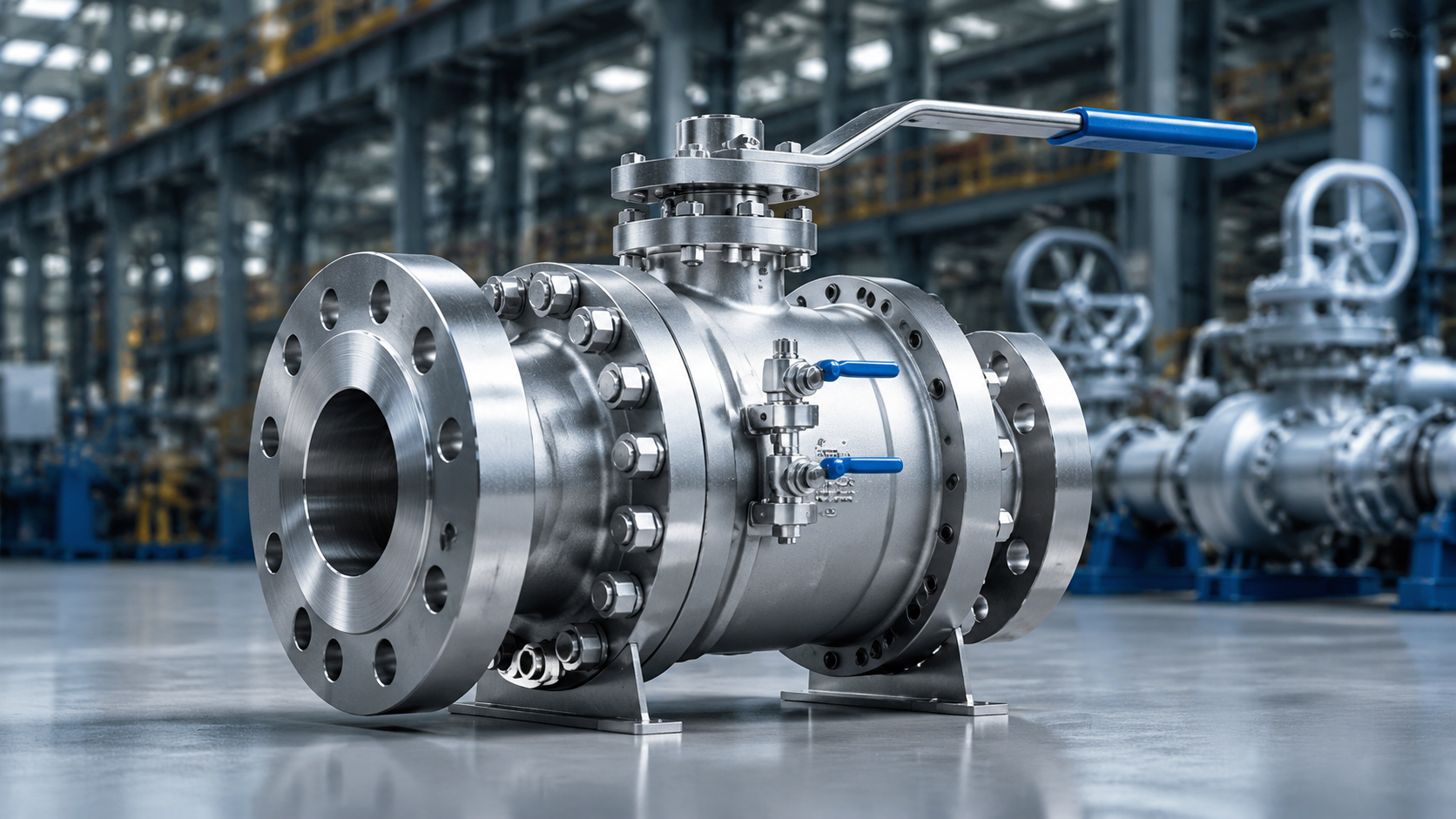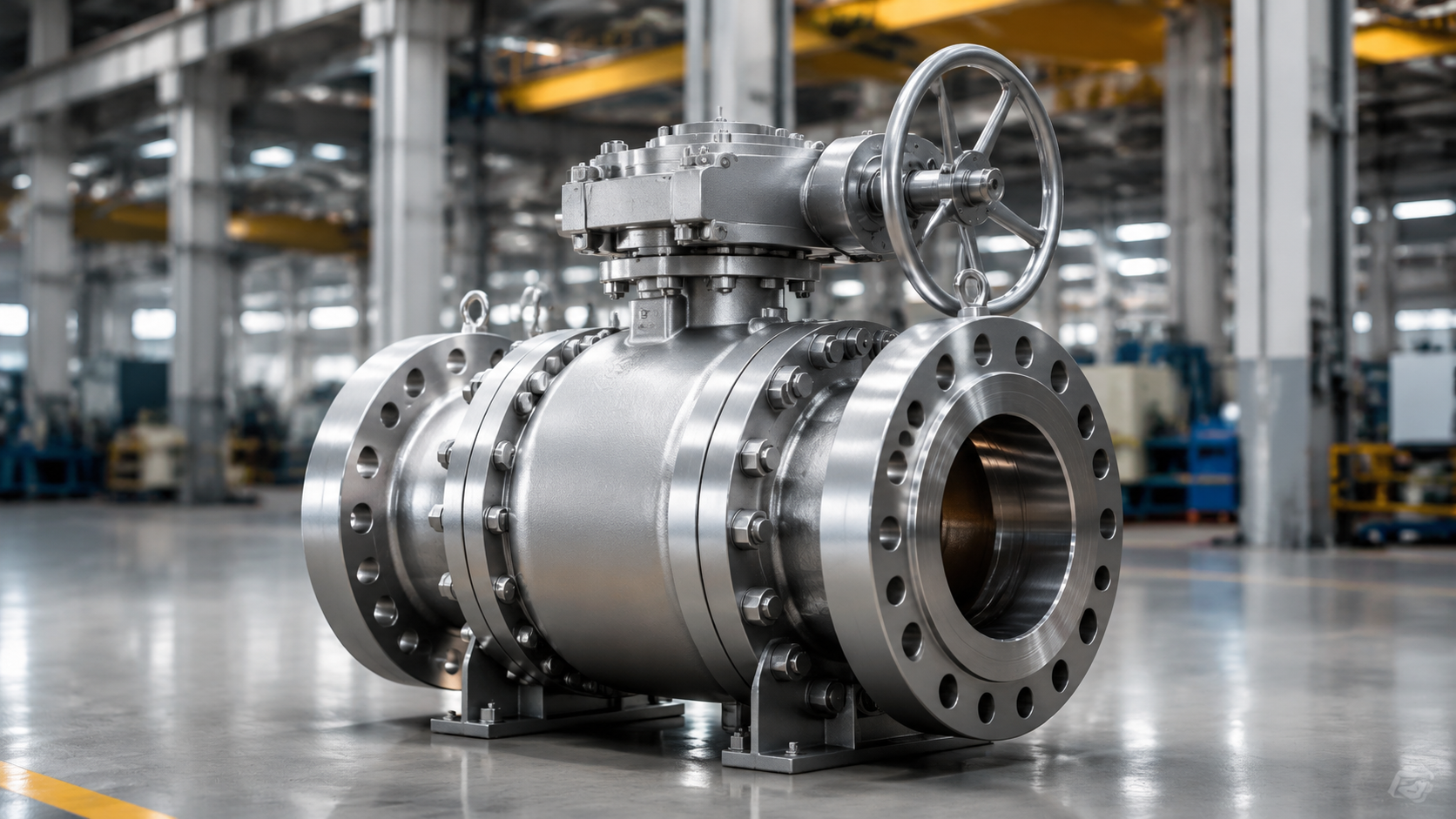
Carbon steel (WCB) floating ball valve high strength, suitable for ≤425℃, non-strong corrosive media (such as water, steam, oil), cost about 20–40% lower than stainless steel.
Stainless steel (CF8M, ≈316) contains 2–3% molybdenum, resistant to Cl⁻ corrosion, suitable for seawater, acid and alkali, temperature generally ≤200℃.
When selecting: look at media corrosivity (pH, Cl⁻ppm), temperature and pressure rating (Class 150–600), then combine with budget; corrosive environments prioritize CF8M, common working conditions select WCB is more economical.
WCB vs CF8M
Material Composition & Identity Identification
WCB steel castings under ASTM A216 standard mainly consist of iron element. The mass fraction of carbon element is strictly controlled below 0.30%. Manganese element proportion upper limit is set at 1.00%. Silicon content needs to be controlled within 0.60%. Phosphorus and sulfur, these two harmful impurities, are limited below 0.04% and 0.045% respectively.
WCB internal residual elements such as chromium, nickel, copper, molybdenum, vanadium etc. sum total strictly prohibited from exceeding 1.00%. Metallographic structure under microscope appears as uniform mixed state of pearlite and ferrite. Grain size grade usually required to reach grade 5 or higher standard. This microscopic arrangement ensures material structural stability within temperature zone of -29 degrees Celsius to 425 degrees Celsius.
CF8M castings in ASTM A351 standard introduce large amounts of alloying elements. Chromium content stable in 18.0% to 21.0% range. Nickel content distributed between 9.0% to 12.0%. 2.0% to 3.0% molybdenum element is the physical mark distinguishing it from ordinary stainless steel. Its pitting resistance equivalent PREN value calculated through formula Cr + 3.3Mo + 16N, results usually fall in 23.1 to 28.5 interval.
CF8M carbon content upper limit set at 0.08%. In actual smelting, it is often pressed down to about 0.04% through AOD refining furnace to improve plasticity. Silicon and manganese upper limits are 1.50% respectively. Its organizational matrix is austenite, and retains 5% to 20% ferrite phase.
| Chemical elements and composition indicators | WCB cast steel (UNS J03002) | CF8M stainless steel (UNS J92900) |
|---|---|---|
| Carbon (C) max proportion | 0.30% | 0.08% |
| Chromium (Cr) proportion | Below 0.50% (residual) | 18.0% – 21.0% |
| Nickel (Ni) proportion | Below 0.50% (residual) | 9.0% – 12.0% |
| Molybdenum (Mo) proportion | Below 0.20% (residual) | 2.0% – 3.0% |
| Manganese (Mn) max proportion | 1.00% | 1.50% |
| Silicon (Si) max proportion | 0.60% | 1.50% |
| Phosphorus (P) max proportion | 0.04% | 0.04% |
| Sulfur (S) max proportion | 0.045% | 0.04% |
Measured data usually above 250 MPa. CF8M yield strength then floats near 205 MPa. But in elongation after fracture, CF8M can reach above 30%. WCB elongation standard is only 22%.
WCB has extremely high magnetic permeability, powerful magnets will firmly adsorb. CF8M due to austenite structure dominating, magnetism is extremely weak or even non-magnetic. But after casting cooling, due to existence of ferrite, when detecting with high sensitivity magnetometer there will still be slight reaction.
WCB coefficient is about 11.7 x 10^-6/C. CF8M then as high as 16.0 x 10^-6/C. In 400 degrees Celsius high temperature steam condition, every meter of CF8M valve set thermal elongation amount is about 1.72 mm more than WCB.
| Physical and mechanical parameter comparison | WCB (carbon steel) | CF8M (316 stainless steel) |
|---|---|---|
| Density (kg/m3) | 7850 | 7980 |
| Tensile strength (MPa) | Above 485 | Above 485 |
| Brinell hardness (HB) | Below 209 | Below 185 |
| Thermal conductivity (W/m·K) | 48 | 15 |
| Specific heat capacity (kJ/kg·K) | 0.473 | 0.502 |
| Low temperature toughness test (J) | -29 degrees Celsius qualified | -196 degrees Celsius qualified |
WCB thermal conductivity performance is almost 3 times CF8M. When fluid temperature fluctuates violently, WCB valve body internal heat conduction is more rapid, internal and external temperature difference is smaller. CF8M heat conduction slower, temperature rise process easy to produce thermal fatigue at thicker wall thickness. For this reason, CF8M wall thickness tolerance design usually stricter than WCB, needs to be controlled between +10% to -0%.
WCB surface roughness usually around Ra 25. CF8M after acid pickling and passivation can reach Ra 12.5. CF8M surface generated chromium-rich passivation film thickness usually in 1 to 5 nanometers.
WCB valve body usually cast with WCB words, side will stamp 4-digit heat number steel stamp. CF8M valve body then cast with CF8M or 316 identification. MTR material certificate must include accurate percentages of chromium, nickel, molybdenum and nitrogen elements. For valves used in petroleum field, if environment contains hydrogen sulfide, WCB hardness needs to be reduced to below 22 HRC according to NACE MR0175 standard.
One ton CF8M melting cost is usually 4 to 5 times WCB. Nickel and molybdenum prices on London Metal Exchange (LME) directly affect valve price. Reflected to DN50 caliber floating ball valve, CF8M version selling price is usually 250% to 350% higher than WCB.
Temperature & Pressure
ASME B16.34 standard classifies WCB into 1.1 group material, its room temperature pressure rating datum point set at 38 degrees Celsius. At this temperature, Class 150 level WCB valve body allows maximum working pressure of 1.96 MPa. When pipeline internal medium temperature rises to 200 degrees Celsius, rated pressure will decay to 1.38 MPa.
CF8M is classified as 2.2 group material, at the same 38 degrees Celsius, its highest pressure bearing capacity is 1.90 MPa. As temperature increases to 200 degrees Celsius, affected by metal softening effect, pressure limit drops to 1.14 MPa. Comparing data shows, stainless steel tensile strength performance in room temperature zone is slightly inferior to carbon steel.
In industrial steam systems, WCB application upper limit is dead-ended at 425 degrees Celsius. Long term in this temperature zone above, carbon element inside steel will undergo graphitization deposition phenomenon. This microstructural evolution leads to loose metal crystal structure, weakening of valve body wall thickness stress section, extremely easy to induce sudden shell burst risk.
CF8M thermal stability performance is excellent, material itself can withstand 815 degrees Celsius high temperature without organizational degradation. But in actual assembly of floating ball valves, temperature-pressure curve often restricted by high polymer sealing valve seat. PTFE valve seat when exceeding 180 degrees Celsius will produce plastic flow, leading to valve closure not tight, internal leakage rate skyrocketing instantly.
- Class 150 WCB at 300 degrees Celsius pressure bearing 1.02 MPa
- Class 150 CF8M at 300 degrees Celsius pressure bearing 1.02 MPa
- Class 300 WCB at 38 degrees Celsius pressure bearing 5.11 MPa
- Class 300 CF8M at 38 degrees Celsius pressure bearing 4.96 MPa
- Above 425 degrees Celsius WCB strength decline curve tends to be steep
- At 538 degrees Celsius CF8M still retains 0.28 MPa rated pressure
Pressure cycle fluctuation produces small fatigue damage to WCB. Carbon steel elastic modulus is about 200 GPa, under frequent pressure pulsation impact, valve body elastic deformation amount maintains at extremely low level.
CF8M elastic modulus is about 193 GPa. In 6.4 MPa high pressure strength test, same caliber stainless steel valve body expansion amount is about 3% more than carbon steel. When designing ultra-high pressure floating ball valves, CF8M middle cavity wall thickness usually needs to extra increase 1.5 mm to 2.2 mm, to offset sealing failure hidden danger brought by material flexibility.
WCB below -29 degrees Celsius will undergo cliff-like drop in impact work. In -46 degrees Celsius low temperature impact test, WCB sample rod absorbed work usually lower than 20 Joules.
CF8M belongs to face-centered cubic lattice structure, does not have obvious low temperature brittleness transition point. In -196 degrees Celsius liquid nitrogen environment, its impact work can still maintain above 60 Joules. For LNG receiving station pipelines, CF8M is the only standardized choice, and needs to be equipped with extended valve cover to ensure packing box stays in room temperature zone.
- Valve internal cavity wall thickness tolerance strictly follows ASME B16.34 Table 3 requirements
- DN100 valve Class 150 minimum wall thickness mandatory requirement is 6.4 mm
- WCB casting before finished product needs to undergo 900 degrees Celsius normalizing heat treatment
- CF8M needs to undergo 1050 degrees Celsius solution treatment and rapid water quenching
- After solution, CF8M yield strength usually maintains near 205 MPa
- Opening torque in 200 degrees Celsius condition compared to room temperature usually increases more than 15%
RPTFE (Reinforced Polytetrafluoroethylene) temperature limit under 2.0 MPa pressure is 200 degrees Celsius. If replaced with PPL (Polyphenylene) valve seat, temperature upper limit can be pulled up to 250 degrees Celsius, but at this time valve opening and closing torque will increase by 30% to 50% accordingly.
Metal sealing structure CF8M floating ball valve can adapt to extreme conditions above 450 degrees Celsius. Ball surface usually processed with Stellite alloy using supersonic spraying technology, hardness stable at 50 HRC. This hard-to-hard configuration under 3.5 MPa high temperature and high pressure, can still maintain Class V level airtight sealing performance.
Serious misalignment of thermal expansion coefficients often leads to valve jamming. 316 stainless steel ball’s thermal expansion rate is about 30% higher than WCB valve body. In 300 degrees Celsius fluid, if ball and valve seat pre-tightening force too large, ball diameter micro-increment will lead to opening and closing difficulty. At this time motor driving current will spike instantaneously due to friction resistance increase.
Shell test pressure is usually 1.5 times room temperature rated pressure. Class 150 WCB valve water pressure strength test value is 3.0 MPa. CF8M test value then set at 2.9 MPa. Pressure holding time executed according to API 598 standard, DN50 caliber needs to continue 15 seconds and appearance inspection without any visible leakage or sweating.
Airtight test pressure fixed at 0.6 MPa. For CF8M material, test medium must use deionized water or tap water with low chlorine ion content, concentration needs to be controlled below 25 ppm. Excessive chlorine ions will induce stress corrosion cracking of stainless steel during test residue drying process.
Under vacuum negative pressure condition, bearing performance of both is basically consistent, both can withstand 10 to the minus 3rd power torr vacuum. But in -50 degrees Celsius vacuum environment, WCB sealing ring groove easy to produce micro deformation due to material contraction. This will lead to vacuum degree dropping at rate of 5% per hour.
For media containing solid particles, pressure erosion speed is inversely proportional to metal hardness. WCB Brinell hardness is around 180 HB, under 4.0 MPa high speed fluid impact, its surface erosion rate is about 0.12 mm/year. CF8M although hardness slightly lower, actual loss rate under combined effect of corrosion and erosion is lower.
High temperature creep strength is data index for evaluating long-cycle running performance. After continuous running for 100,000 hours at 400 degrees Celsius, WCB enduring strength will show obvious decline. CF8M in same time can maintain above 90% of initial strength.
Corrosion Resistance
WCB carbon steel when lacking external coating protection, exposed to atmospheric environment within 24 hours will produce red rust visible to naked eye. This is because iron element undergoes electrochemical reaction with oxygen and water molecules in air, forming loose iron oxide layer. This oxide layer thickness usually penetrates towards metal matrix interior at speed of 0.1 mm to 0.5 mm per year, and does not possess any self-healing ability.
In standard ASTM B117 salt spray test, unpainted WCB valve body after 12 hours surface coverage reaches above 90%. By contrast, CF8M castings rely on 18% to 21% chromium element, naturally generating a chromium oxide passivation film with thickness only 2 to 5 nanometers on surface.
- Industrial atmospheric environment: WCB corrosion rate 0.05 mm/y; CF8M corrosion rate < 0.001 mm/y
- Urban freshwater system: WCB corrosion rate 0.12 mm/y; CF8M performs as completely inert
- 3% sodium chloride solution: WCB will produce large area uniform corrosion, wall thickness loss obvious
- 10% dilute sulfuric acid environment: WCB will dissolve within several hours, producing large amount of hydrogen bubbles
- Acetic acid (Glacial acetic acid): CF8M maintains extremely low loss in full concentration range
Experimental data shows, CF8M in simulated seawater containing 19,000 ppm chlorine ions, even after experiencing 2000 hours continuous immersion, its surface pitting pit depth usually maintains within 0.02 mm. This pitting resistance capability originates from its internal added 2% to 3% molybdenum element, which significantly improves passivation film rupture potential in acidic chloride environment.
WCB when facing 98% concentrated sulfuric acid, surface will generate a layer of insoluble ferrous sulfate passivation film, thus slowing down corrosion, at this time corrosion rate can drop below 0.1 mm/year. But if acid solution concentration diluted to below 70%, this layer of protective film will quickly dissolve, carbon steel valve body will be penetrated within a few days.
CF8M when handling organic acids such as oxalic acid, formic acid shows excellent stability. In 50% concentration boiling acetic acid test, CF8M corrosion rate is lower than 0.05 mm/year. When medium mixed with small amount of reducing impurities, CF8M internal nickel content (9% to 12%) can effectively inhibit metal ion dissolution, ensuring fluid purity matches pharmaceutical or food grade hygiene standards.
- Nitric acid (65% concentration): CF8M belongs to preferred material, WCB strictly prohibited from use
- Sodium hydroxide (20% concentration): CF8M under 80 degrees Celsius still stable
- Phosphoric acid (85% concentration): CF8M annual loss rate less than 0.1 mm
- Wet chlorine environment: WCB will undergo violent exothermic reaction, leading to metal catching fire and burning
- Hydrogen sulfide (dry gas): WCB needs to limit hardness to prevent hydrogen embrittlement, CF8M naturally immune
In acidic oil and gas well (containing H2S) conditions of oil extraction, according to NACE MR0175 standard, WCB must pass as long as 20 hours tempering treatment to press down hardness to below 22 HRC. While CF8M with austenite structure, shows critical fracture toughness KISSC in stress corrosion cracking test about 40% higher than WCB.
When fluid contains solid particles and accompanied by high speed scouring, corrosion resistance will evolve into erosion resistance. WCB Brinell hardness is about 180 HB, its scouring resistance capability mainly relies on mechanical strength of metal matrix.
CF8M although Brinell hardness slightly lower (usually around 170 HB), but its surface passivation film has extremely strong dynamic regeneration capability. In acidic slurry transportation, even if solid particles constantly scratch metal surface, CF8M can still repair defense layer through trace dissolved oxygen in medium. Data comparison shows, in erosion environment of same particle concentration, CF8M comprehensive service life is usually 3 to 4 times WCB.
WCB standard electrode potential is about -0.44V, while CF8M is at about +0.05V. If WCB valve is directly connected on stainless steel pipeline, WCB valve body as anode corrosion speed will be 5 to 10 times faster than normal state. This requires insulation flange gaskets must be configured during installation.
- Intergranular corrosion: CF8M needs to strictly control carbon content below 0.08% to prevent grain boundary chromium depletion
- Crevice corrosion: At flange connection, CF8M crevice corrosion resistance better than CF8 (304)
- Stress corrosion: In chloride environment above 60 degrees Celsius, CF8M has risk of cracking
- Surface roughness: CF8M surface of Ra 1.6 harder to produce corrosion core than Ra 6.3
- Passivation treatment: Finished CF8M needs to undergo 20% nitric acid solution immersion to strengthen film layer
Targeting salt spray environment of offshore platforms, WCB valves painted with three layers of epoxy zinc-rich paint, their maintenance period is usually 2 years. While original color acid pickled CF8M valves, in case of not performing any painting, wall thickness thinning amount after 10 years service usually smaller than measurement instrument error range (0.01 mm), long-term running cost advantage in the 4th year can offset initial procurement premium.
In biopharmaceutical field, medium has strict limits on metal ion dissolution amount. WCB will release iron ions in purified water, leading to fluid conductivity quickly exceeding standard. CF8M in 80 degrees Celsius deionized water, metal ion migration amount lower than 10 ppb (parts per billion).
For chlorination reactors in fine chemicals, even trace amounts of water entering will generate hydrochloric acid. WCB corrosion in such condition appears as ulcerous, deep hole corrosion speed can reach 2 mm per month. CF8M although cannot be completely immune to hydrochloric acid, but in environment of parts per million (ppm) level hydrochloric acid residue, its safety margin provided by PREN value can support equipment for emergency shutdown handling, avoiding catastrophic leakage.
Media Suitability
ASTM A216 WCB
ASTM A216 WCB this material is called carbon steel at engineering sites, its internal carbon content strictly restricted below 0.30%, purpose is for not easily producing cracks during welding. Manganese element content usually maintained around 1.00%, this ensures valve body will not undergo permanent deformation when bearing yield pressure above 250 MPa. When pipeline pressure rating reaches Class 300 (about 5.0 MPa), WCB shell wall thickness usually will be about 2 mm thicker than stainless steel valve of same specification, to hedge medium erosion loss.
Every set of WCB floating ball valve before leaving factory, must undergo 890 degrees Celsius to 910 degrees Celsius normalizing treatment, refining internal metal grain size to above grade 5, enhancing anti-impact capability under low temperature. If environment temperature goes down to minus 29 degrees Celsius, internal molecules of carbon steel will transition from plastic state to brittle state, extremely easy to crack when receiving stress impact. After exceeding 425 degrees Celsius, internal carbon element will undergo graphitization reaction, leading to metal matrix becoming fragile like honeycomb.
This material during casting process has clear digital boundaries for impurity control:
- Phosphorus P content must be less than 0.04%
- Sulfur S content must not be higher than 0.045%
- Elongation after metal stretching to exceed 22%
- Reduction of area stable above 35%
- Tensile strength after stress reaching 485 MPa
- Copper, chromium, nickel etc. impurity total sum added together cannot exceed 1.0%
In saturated steam pipeline of 1.0 MPa pressure, WCB valve internal oxidation rate every year maintains around 0.05 mm, as long as not contacting strong acid, service period very stable. Methane concentration in dry natural gas as long as higher than 95%, and no liquid water precipitated, carbon steel valve sealing life can break through 10 years. When hydrogen sulfide partial pressure maintained below 0.05 psia, this material does not need extra anti-sulfur hardening treatment.
Pressure rating is the ruler for measuring WCB valve pressure bearing upper limit, different pound classes correspond to precise pressure data:
- Class 150 level in room temperature can bear 1.96 MPa
- Class 300 level upper limit raised to 5.11 MPa
- Class 600 level can support 10.21 MPa fluid pressure
- Class 900 level then needs to cope with 15.32 MPa impact
- Class 1500 level even can carry 25.53 MPa load
- A DN50 specification WCB floating ball valve dead weight usually around 12 kg
Crude oil transportation field has 80% of ball valves selecting WCB, because it can bear 3000 PSI instantaneous back pressure generated at the moment oil pump starts and stops. If transporting thermal oil below 350 degrees Celsius, metal fatigue limit enough to support valve for 500,000 times opening and closing operations. Procurement price per ton WCB is usually about 15,000 yuan cheaper than stainless steel, this can significantly reduce initial construction investment cost in large scale pipeline network construction.
If boiler feed water pH value adjusted between 8.5 to 9.5 , WCB surface will generate a layer of pitch-black magnetic iron oxide protective film, isolating water erosion. Once dissolved oxygen content in water exceeds 7 ppb, this layer of protective film will quickly collapse, leading to rust pits as deep as several millimeters appearing on metal surface. In order to prevent moisture in outdoor air from corroding valve body, surface usually needs to spray 75 micron thick epoxy zinc-rich paint.
Maintenance personnel at site can use dilute nitric acid to drop on valve body surface, WCB will produce violent chemical reaction and release brown gas, this is in sharp contrast with stainless steel’s no reaction state. Factory will perform 100% magnetic particle testing on every batch of castings, looking for whether internal exists sand holes exceeding 2 mm. Brinell hardness measured value of this material usually falls between 137 to 187 HBW, which is the basis for valve seat sealing surface wear calculation.
When flow velocity reaches 5 m/s, fluid containing fine silt will produce physical scouring on valve interior. Experimental data shows, WCB durability in this wear environment is about 12% higher than pure austenitic stainless steel. This hardness advantage makes it perform steadily in wellhead collection valve groups of oil and gas fields, even facing high dust environment of Gobi desert can maintain normal service cycle of more than 5 years.
WCB valve can be directly welded on steel pipe of API 5L Gr.B grade, before welding interface needs to be heated to about 150 degrees Celsius. This welding connection method compared to traditional flange connection reduces 15% potential leakage points, also saves work of later maintaining bolts. In middle and low pressure valve market, WCB occupies 65% share by virtue of this excellent construction convenience.
Encountering concentrated sulfuric acid of above 90% concentration, WCB will produce a layer of ferrous sulfate passivation layer, stopping acid solution from penetrating into metal interior. But if flow velocity exceeds 1 m/s, this thin film will be washed away, corrosion speed will skyrocket to above 10 mm per year. Density of this material is about 7.85 g/cm3, when performing gravity load calculation, this is a physical constant structural engineers must cite.
In order to prevent valve stem from jamming due to rust, inject grease into packing box once every 180 days, this can let valve opening force reduce about 20%. Under Class 300 pressure, WCB valve ball and valve seat will produce great extrusion force, usually matching RPTFE this reinforced sealing gasket. This material combination when coping with non-corrosive fluid below 200 degrees Celsius, can realize zero leakage sealing effect.
ASTM A351 CF8M
ASTM A351 CF8M belongs to austenitic stainless steel castings, its metal proportion contains 18% to 21% chromium and 9% to 12% nickel. This proportion ensures material possesses stable austenite organization under room temperature, will not produce phase change leading to dimensional failure due to pressure fluctuation. Key 2.0% to 3.0% molybdenum element addition amount, specifically used for dealing with chloride ion infringement common in industrial wastewater and chemical media, this chemical design can effectively prevent metal surface from appearing pitting holes hard to distinguish by naked eye.
In actual offshore engineering, CF8M pitting resistance equivalent (PREN) calculation value usually maintains between 23 to 28. Compared to CF8 material without molybdenum, this data performance lets its corrosion rate reduce by an order of magnitude when handling standard seawater of 3.5% salinity. Nickel element inside valve body not only provided excellent plasticity, but also lets material elongation stable above 30%, even when receiving violent pipeline vibration or fluid hammering, valve body also will only produce micro deformation and not brittle fracture like ordinary iron parts.
Physical characteristics of this material determine its ability to adapt from extreme cold to extreme heat span:
- Yield strength minimum standard is 205 MPa
- Tensile strength requirement exceeds 485 MPa
- Impact work under minus 196 degrees Celsius still can maintain above 60 Joules
- Material density measured value is 7.98 g/cm³
- Thermal conductivity at 100 degrees Celsius is about 16.3 W/(m·K)
- Magnetic permeability controlled below 1.05 mu, suitable for precision environment sensitive to magnetic interference
When handling hot phosphoric acid with concentration of 50%, measured annual corrosion depth is less than 0.1 mm, this is critical for ensuring drug solution purity. Its surface formed chromium-rich oxide film has millisecond level self-repair capability, as long as millionths of dissolved oxygen exists in fluid, damaged passivation layer can regrow at original site, stopping iron ions from migrating towards medium.
Targeting different industrial corrosive media, CF8M tolerance limit data as follows:
| Medium name | Concentration percentage | Temperature condition | Corrosion rate(mm/a) | Suggestion |
|---|---|---|---|---|
| Acetic acid | 99% | Boiling state | < 0.05 | Excellent choice |
| Phosphoric acid | 80% | 60 degrees Celsius | 0.08 – 0.12 | Safe service |
| Sulfuric acid | 10% | 25 degrees Celsius | 0.5 – 1.2 | Needs periodic detection |
| Sodium hydroxide | 50% | 100 degrees Celsius | < 0.1 | Stable performance |
| Bleaching powder solution | Saturated | Room temperature | Local pitting risk | Needs to shorten overhaul period |
In mechanical performance level, CF8M Brinell hardness upper limit is set at 187 HBW. Although this hardness is lower than carbon steel, its work hardening characteristic is obvious, during valve opening and closing process, friction contact surface of ball and valve seat will form a layer of dense hardened layer. Corresponding elastic modulus is 193 GPa, when bearing Class 150 level (about 2.0 MPa) internal pressure, elastic expansion amount of valve middle cavity is minimal, thus ensured alignment precision of sealing pair.
In order to solve intergranular corrosion phenomenon easy to occur in stainless steel, this material after casting completion must undergo solution treatment. Casting is heated above 1040 degrees Celsius and held for sufficient time, letting carbides all dissolve into austenite matrix, subsequently performing rapid water cooling. This process can control internal ferrite content between 5% to 20%, this part of ferrite distributed in matrix like islands, can effectively block crack spreading between grain boundaries.
In acetic acid workshop of fine chemical plant, environment temperature often fluctuates above 100 degrees Celsius, WCB material usually serves less than a quarter and large area ulcer corrosion will appear. After changing to CF8M, average overhaul period of valve can be extended to about 60 months. Although its procurement price is 3.2 times carbon steel, but through calculating equipment depreciation and shutdown loss, comprehensive holding cost of single valve within five years can save about 45%.
Pipeline designers when handling high purity water systems, will prioritize specifying CF8M and performing electropolishing treatment. Inner cavity surface roughness (Ra) after polishing can reach 0.4 micron, this mirror effect lets microorganisms and impurities lose attachment points. Under 3 meters per hour flow velocity pure water scouring, metal surface ion precipitation amount far lower than 10 ppb, matching strict regulation of semiconductor cleaning water on fluid purity.
Facing nitric acid with strong oxidizing property, CF8M shows a unique passivation characteristic. In boiling nitric acid experiment of 65% concentration, corrosion rate of the material is lower than 0.6 mm/a. This capability originates from synergistic effect of nickel and chromium, making oxide film generated on metal surface possess extremely high resistance value, blocking charge exchange of electrochemical reaction. In spent fuel processing equipment of nuclear industry, this nitric acid resistance characteristic is the main basis for selecting CF8M.
Valve maintenance worker when judging material authenticity at site, besides using spectrometer (PMI), also will observe acid pickling passivation layer on valve body surface. Qualified CF8M surface appears silver gray and with uniform micro-matte, this is standard state after cleaning with 20% nitric acid plus 5% hydrofluoric acid. If valve serves in environment containing chlorine gas, suggested to perform surface cleaning once every 360 days, preventing salt accumulation from inducing stress corrosion cracking.
Under high pressure oxygen condition, safety of CF8M is far higher than carbon steel, its ignition point higher and thermal conductivity lower. Under 15 MPa oxygen pressure, this material valve matching Monel alloy internals, can effectively prevent static sparks generated due to high speed fluid friction. This configuration is very common in air separation devices, even at gas flow velocity of 20 meters per second, metal loss of valve inner wall also can be almost ignored.
In cost structure, CF8M valve weight usually about 10% lighter than WCB, because its excellent low temperature toughness allows for decreasing thickness in some non-pressure parts. Taking a DN100 specification floating ball valve as example, finished weight of CF8M version is about 34 kg. Although nickel and molybdenum in raw materials pushed up manufacturing cost, but its scrap metal recovery value after scrapping can reach 15% to 20% of original procurement cost, while recovery value of carbon steel is only about 3%.
Industrial Site Selection
When pipeline fluid flow velocity exceeds 7 meters per second, fluid kinetic energy will produce physical cutting on internal cavity of floating ball valve. WCB material when handling crude oil with sand content reaching 0.2%, wall thickness thinning speed of its sealing surface is about 0.12 mm per year. CF8M contains about 10% nickel inside, this increases ductility of metal surface, making its loss amount under high speed particle impact only 65% of carbon steel.
Medium hydrogen sulfide partial pressure reaching 0.05 psia belongs to watershed of material selection. WCB must pass NACE MR0175 test and hardness pressed down below 22 HRC to prevent hydrogen embrittlement. CF8M austenite structure can naturally inhibit hydrogen induced cracking, no need to add extra heat treatment process to maintain physical strength.
Industrial wastewater with chlorine ion content exceeding 500 ppm will produce electrochemical corrosion on valve body, carbon steel surface will form red rust layer visible to naked eye. CF8M added 2.5% molybdenum element, this component constructed a dense protective film with thickness of about 3 nanometers on metal surface. This micro-level blocking, lets valve in 35 degrees Celsius circulating seawater, expected service cycle can be extended from 12 months of carbon steel to 96 months.
Under condition where pressure reaches Class 600 (about 10.2 MPa), ball of floating ball valve will move about 0.05 mm towards outlet side under pressure difference effect. Opening torque of WCB material valve usually grows violently with pressure rise, measured torque of DN100 specification often above 450 N·m. CF8M matching reinforced PTFE valve seat, its friction coefficient can stabilize around 0.12, saving 15% operation thrust compared to ordinary carbon steel sealing pair.
Low temperature condition has hard requirement on material toughness. WCB at minus 29 degrees Celsius impact work will fall below 20 Joules, existence of brittle cracking risk. CF8M in extremely low temperature of minus 196 degrees Celsius, elongation still can maintain above 30%, is the only optional low cost casting for cryogenic air separation devices.
CF8M material when flowing through fatty acid with concentration of 98%, iron ion migration amount lower than 5 ppb. WCB due to lack of chromium element protection, its surface oxide layer easy to fall off and enter fluid, leading to catalyst poisoning and deactivation in downstream reactors, this potential loss is often hundreds of times valve procurement unit price.
- WCB density 7.85 g/cm³, suitable for large flow low corrosion condition
- CF8M density 7.98 g/cm³, specially for acid-alkali and marine environment
- Carbon steel valve suggested to perform external anti-corrosion paint re-spraying once every 180 days
- Stainless steel valve creep strength under 500 degrees Celsius still has 60 MPa
- Valve stem material usually matches 17-4PH to improve anti-torque performance
- If graphite material used at packing box, CF8M can resist 600 degrees Celsius high temperature
Because CF8M thermal conductivity is only 16.3 W/(m·K), when transporting high temperature hot oil, its valve cover part heat dissipation speed is 30% slower than carbon steel. This can effectively slow down drying speed of grease inside packing box, extending maintenance period of packing leakage from 1 year to 3 years. WCB material due to fast heat dissipation, when handling medium above 250 degrees Celsius, must be equipped with heat sink long neck structure to protect actuator.
Economical calculation not only looks at buying price. CF8M average procurement unit price is usually about 3 times WCB. But on fertilizer production line with annual corrosion rate of 0.5 mm, replacement and shutdown cost of WCB valve is about 5000 yuan every year, while average maintenance expenditure of CF8M after amortization is only 800 yuan.
For dilute acid condition containing 10% sulfuric acid, WCB valve will completely perforate and fail within 48 hours. CF8M corrosion rate in this environment is about 0.8 mm per year, although cannot be used permanently, but can provide enough safety margin for system parking. If acid solution flow velocity controlled below 0.5 m/s, this stainless steel material even can run steadily for 24 months without needing to replace main pressure-bearing parts.
- DN50 Class 150 carbon steel valve dead weight 12 kg
- DN50 Class 150 stainless steel valve dead weight 11 kg
- Solution treatment temperature needs to reach 1040 degrees Celsius and rapid water quenching
- Black skin thickness on carbon steel surface usually controlled within 0.5 mm
- Stainless steel valve body magnetic permeability should be less than 1.05 mu
- Valve opening and closing life test standard usually set at 20000 times
When working pressure fluctuation range is between 2.0 MPa to 5.0 MPa, WCB elastic modulus is about 210 GPa, showing higher structural rigidity. This makes in large caliber pipeline connection, carbon steel valve body can better bear thermal stress extrusion from pipeline without deformation. CF8M when handling such loads, needs to offset displacement hidden danger brought by lower elastic modulus (193 GPa) through adding stiffeners or increasing wall thickness grade.
Cost
Raw Materials & Procurement
On foundry’s quotation sheet, ASTM A216 WCB casting blanks usually priced at 12 to 18 yuan per kilogram. By contrast, unit price of ASTM A351 CF8M often skyrockets to between 75 to 95 yuan. This price difference originates from 2.0% to 3.0% of molybdenum element.
Taking a 4-inch Class 150 floating ball valve as example, WCB valve body blank weight about 28 kg. Changing to CF8M material, because its 8.0g/cm³ density higher than carbon steel’s 7.85g/cm³, blank weight will increase to about 28.6 kg. Variation of this raw material expenditure alone, lets procurement cost jump from 500 yuan level to above 2500 yuan.
Stainless steel internal contains 10% to 14% nickel element. Nickel price every ton rises 1000 US dollars, additional fee amortized to single valve will increase dozens of yuan. Because CF8M belongs to high alloy steel, shrinkage rate during casting as high as 2.1%, far exceeding carbon steel’s 1.5%. Foundry must design thicker risers, leading to casting yield rate dropping from 75% for carbon steel to about 50%.
- Micro-data difference at production end:
- WCB carbon content strictly controlled below 0.30%, ensuring no cracks during welding.
- CF8M must undergo solution treatment at 1050℃, and cool to below 427℃ within 3 minutes.
- Electrical energy consumed by stainless steel heat treatment per ton is about 450 degrees higher than carbon steel.
- WCB blank surface allowed to have 0.8mm slight oxide scale, not affecting subsequent processing.
- CF8M must be matched with spectrometer (PMI) for composition detection, single detection cost about 60 yuan.
When turning WCB material, linear speed of carbide tool can be pulled to 190m/min, processing a 2-inch valve body takes about 12 minutes. CF8M material has extremely strong work hardening tendency, linear speed forced to be pressed below 65m/min. This let unit hour output rate of machine tool drop by more than half.
When processing same number of valve seat sealing surfaces, number of blades consumed by processing stainless steel is usually 3.5 times carbon steel. Single unit price of every imported coated blade about 45 yuan, this consumable expenditure will be amplified into a heavy financial expenditure in mass production. In order to cool tools, cutting fluid concentration also needs to be increased from 5% to above 10%.
- Detail expenditures in procurement process:
- WCB valve before leaving factory must be sprayed with 80μm thickness anti-rust paint, cost about 40 yuan.
- CF8M although no need to paint, but needs to undergo acid pickling passivation, price per liter of reagent about 18 yuan.
- Stainless steel valve often matched with 316 material bolts, single set unit price is 5 times carbon steel galvanized bolts.
- In valve stem selection, CF8M valve usually standardized with 17-4PH precipitation hardening steel.
- Carbon steel valve then mostly adopts 2Cr13 or 410 stainless steel as valve stem.
WCB valve extremely sensitive to environment humidity, once air humidity exceeds 65%, within three months flange face will produce 0.03mm deep rust red spots. If not doing secondary rust removal and grinding, this kind of valve after installation will face risk of sealing surface leakage. Labor fee of this kind of rework, usually occupies about 8% of valve procurement price.
Stainless steel valve stacked in open-air warehouse for two years, its surface chromium-rich oxide film still can maintain thickness of 0.01μm. Purchaser can conduct large scale hoarding, without worrying about inventory price drop loss. Chemical performance of this material extremely stable, in media with pH value of 4 to 10, annual corrosion rate almost can be ignored.
- Residual value data in recovery stage:
- Scrapped WCB valve body only can be handled as scrap iron, unit price about 2.4 yuan/kg.
- Scrapped CF8M belongs to high value 316 scrap, unit price year-round maintained above 13 yuan/kg.
- WCB below -29℃ will undergo brittle transition, losing pressure bearing capacity.
- CF8M under -196℃ ultra-low temperature still can maintain good toughness.
- 3.1 material certificate is mandatory requirement in stainless steel procurement, single filing fee about 20 yuan.
If project service period set for 10 years, WCB valve due to internal medium scouring corrosion, usually needs to replace internals in the 4th year. Labor fee expenditure for each disassembly and reinstallation is about 300 yuan, plus output loss caused by shutdown, single maintenance cost equivalent to half a valve. CF8M maintenance-free cycle usually can cover entire project life.
Manufacturing Process
WCB castings usually adopt resin sand molding process, finished product surface roughness maintains around Ra 12.5 micron. CF8M in order to ensure density of austenite organization, mostly selects silica sol investment casting, surface finish can reach Ra 3.2 to Ra 6.3 micron. Mold cost of investment casting although 5 to 8 times higher than sand casting, but can compress machining allowance from 5mm to about 1.5mm.
Casting shrinkage rate of WCB is 1.5% to 2.0%, mold lofting relatively simple. This high alloy material CF8M shrinkage rate as high as 2.1% to 2.5%, and extremely easy to produce shrinkage holes during solidification process. In order to compensate shrinkage, foundry will increase CF8M riser volume to above 40% of part weight. This low process yield rate let actual yield of every ton stainless steel liquid nearly 20 percentage points lower than carbon steel.
In heat treatment workshop, WCB only needs to perform 900℃ normalizing treatment, subsequently natural cooling in air. CF8M then must undergo high temperature solution above 1050℃, and requirement to rapidly put into 15℃ circulating cold water within 3 minutes.
“Staying in this dangerous temperature interval from 427℃ to 816℃ too long, chromium element inside CF8M will produce depletion, leading to valve occurring fracture from grain boundary within half a year of service.”
When cutting WCB, linear speed of carbide tool usually set at 180m/min. After changing to CF8M, due to material toughness extremely high and easy to produce work hardening, linear speed must be pressed down to about 70m/min. Difference of this processing efficiency, makes machine processing hour fee of same specification stainless steel valve usually 2.5 times carbon steel.
- Process monitoring data on production line:
- WCB pouring temperature controlled at 1530℃ to 1560℃, fluctuation range allowed 30℃.
- CF8M pouring temperature needs to be precisely locked at 1450℃ to 1480℃, deviation exceeding 10℃ easy to produce cracks.
- Carbon steel valve body flaw detection (RT) qualification rate year-round maintained above 95%.
- Wall thickness thinning rate of stainless steel investment castings needs to be controlled within 5% at elbows.
- Machining CF8M produced cutting heat 80% concentrated at tool tip, need to check tool head wear once every hour.
During machining process, chips of CF8M appear as long filaments and extremely easy to entwine main spindle, special blades with smaller chip breaker radius must be used. Chips of WCB mostly as crumbles, cleaning frequency lower. Cutting force during stainless steel processing is 30% larger than carbon steel, this requires machine tool spindle possess higher rigidity, otherwise 0.02mm above chatter marks will be produced when turning valve seat sealing surface.
WCB valve before assembly needs to experience Sa 2.5 grade sandblasting rust removal, subsequently spraying 120μm thickness epoxy primer and topcoat. CF8M then enters acid pickling tank, immersed in solution containing 15% nitric acid and 3% hydrofluoric acid for 40 minutes. This process can remove oxide scale produced by casting, and generate a layer of chromium-rich passivation film with thickness about 2 to 4 nanometers on surface.
“Quality of passivation film determines anti-corrosion upper limit of valve. If chlorine ion content in acid pickling solution exceeds 25ppm, stainless steel surface instead will produce pitting pits, ruining sealing of entire batch of goods.”
In pressure testing stage, WCB valve because material hardness lower (usually around HB 150), extrusion embedding sense of valve seat sealing ring is stronger, air pressure test (80 psi) easy to pass. CF8M casting hardness often above HB 170, grinding matching precision of ball and valve seat must reach 0.01mm grade. Stainless steel ball valve when testing high pressure water pressure (2.25Mpa), pressure stabilizing time needs to be extended 15 seconds compared to carbon steel standard to observe micro seepage.
- Microscopic indicators of quality control nodes:
- Carbon steel valve coating adhesion needs to reach grade 1 standard (cross-cut test).
- Stainless steel valve needs to perform iron ion contamination test, strictly prohibited from using grinding discs that processed carbon steel.
- WCB valve stem usually adopts 410 stainless steel, hardness reaches HRC 28 after quenching and tempering treatment.
- CF8M valve stem mostly selects XM-19 or 17-4PH, tensile strength needs to be maintained above 1000Mpa.
- Cleanliness of valve inner cavity has higher requirement on CF8M, residual particle diameter needs to be smaller than 0.5mm.
WCB commonly uses magnetic particle testing (MT) to find surface cracks, cost low and speed fast. CF8M is non-magnetic material, MT detection completely invalid, only can rely on penetrant testing (PT). PT detection single reagent cost about 40 yuan, and every development needs 20 minutes of waiting period, this added quite some implicit time cost in assembly line operations.
Because carbon steel powder will induce electrochemical corrosion of stainless steel, CF8M must be assembled on dedicated workbench covered with rubber pads or wooden boards. Wrenches and fixtures used need to be coated with Teflon or select stainless steel material. This physical isolation established to prevent “iron contamination”, let production site occupancy cost of stainless steel valve rise about 15%.
Full Life Cycle
In industrial atmosphere moist and containing sulfur dioxide, annual external wall corrosion rate of WCB carbon steel valve body is usually between 0.1mm to 0.3mm. When running to the 5th year, a Class 150 grade valve body might already lost 1.5mm wall thickness, this often close to limit of design allowance. CF8M because containing 2% molybdenum element, in same condition, annual corrosion rate usually lower than 0.005mm, almost can be ignored.
Replacing a 3-inch floating ball valve, needs two technicians matching work for 4 hours, calculated according to labor fee of 80 yuan per hour, labor cost of single disassembly and assembly reaches 640 yuan. If the valve located at high-altitude pipe gallery 5 meters off ground, also needs to extra build scaffolding or call hydraulic lifting vehicle, lease fee about 300 to 500 yuan per day.
WCB valve due to sealing surface easy to scale, usually serves 3 to 4 years then needs to perform overall replacement. Maintenance-free cycle of CF8M usually can be stretched to above 12 years, during this period saved not only valve unit price, but also at least 3 times construction fees.
“On a fertilizer production line running 24 hours, output loss of unplanned shutdown per hour might as high as 20,000 yuan. To save several thousand yuan price difference of stainless steel valve, to risk shutdown risk caused by carbon steel valve rust jamming, is extremely unwise in financial logic.”
| Fee composition (12-year statistics cycle) | WCB carbon steel solution | CF8M stainless steel solution |
|---|---|---|
| Initial procurement (single unit) | 850 yuan | 2900 yuan |
| Replacement frequency (within 12 years) | 3 times (once every 4 years) | 0 times (full cycle service) |
| Spare parts total investment | 2550 yuan | 2900 yuan |
| Accumulated installation labor fee | 1920 yuan | 0 yuan |
| Gasket and bolt consumables | 450 yuan | 0 yuan |
| Scrap recovery after scrapping | Minus 45 yuan | Minus 720 yuan |
| Full life cycle total expenditure | 4875 yuan | 2180 yuan |
Scrapped WCB valve body only can be handled as heavy scrap, market price year-round hovering at 2.4 to 2.8 yuan per kilogram. While CF8M belongs to high value 316 scrap steel, recovery unit price usually above 13 yuan/kg. A 25 kg valve, price difference when scrapping then opened more than 260 yuan.
Implicit cost of daily inspection reflected more obviously on WCB. Carbon steel valve in order to prevent atmospheric oxidation, needs to re-spray epoxy anti-corrosion paint once every 24 months. This kind of outsourced painting operation associated with polishing rust removal labor expenditure, single cost about 150 yuan. CF8M life-long no need for painting, its surface chromium-rich oxide film possesses self-repair function, in 10-year cycle, expenditure of this part of maintenance fee is zero.
- Technical detail data during valve holding period:
- WCB sealing surface during shutdown period if no oil seal, will produce 0.05mm thick floating rust within 2 months.
- Valve seat wear coefficient of CF8M is 20% lower than WCB, sealing ring life therefore extended 1.5 times.
- Carbon steel valve long term use above 300℃, oxide scale shedding amount about 50 grams per square meter.
- Stainless steel valve in same temperature oxide scale weight gain almost zero.
- Annual valve actuator overload damage rate caused by WCB rust jamming about 3%.
WCB valve in order to prevent rust, must be stored in constant temperature warehouse with humidity lower than 60%, and periodically check oil seal state. CF8M can be directly stacked in simple open-air shed or even outdoors, zero requirement on storage environment let annual amortized management fee of single valve reduce about 40 yuan.
“When valve serves exceeding 8 years, internal cavity thinning of WCB will lead to flow channel resistance increase, increased pumping electricity consumption per valve per year about 15 degrees. Although number small, but after accumulating in entire factory scope, this is another extra energy expenditure.”
WCB material because matrix hardness slightly lower, under scouring of fluid containing trace solid particles, support surface at valve seat bottom easy to produce plastic deformation. Once 0.02mm gap produced, fluid will quickly form “grooving effect”. Solution treatment state of CF8M provided more stable matrix support, making mechanical life of sealing surface improved about 60% above compared to carbon steel.