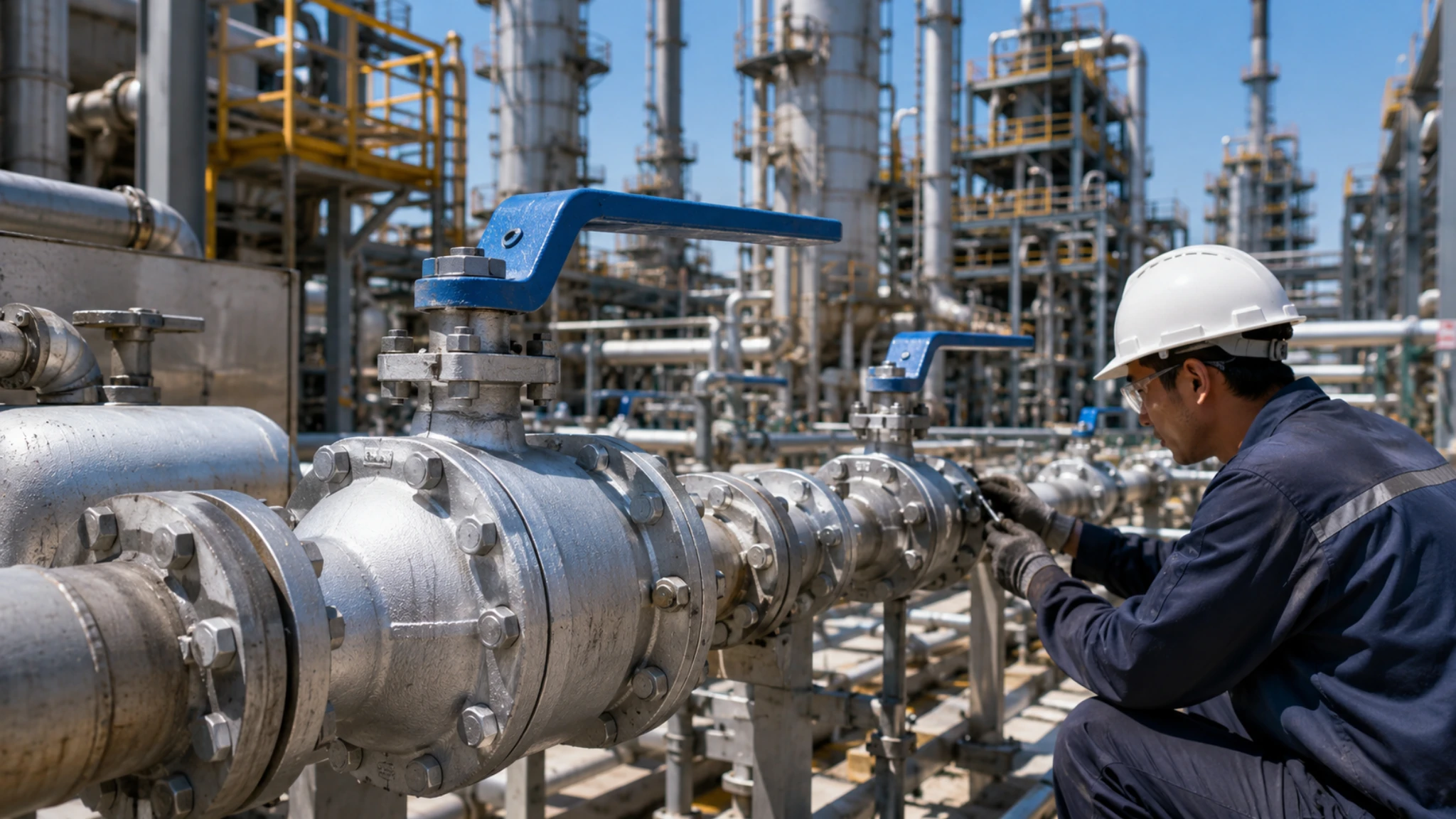
An engineer at a gas processing facility in Qatar once showed me the mill certificate for a batch of A105 forged valve bodies. The certificate listed the correct chemistry, the correct tensile strength, the correct heat number. Everything matched the purchase order.
But when I picked up one of the valve bodies and looked at the surface finish, something felt wrong. The forging had the uniform, slightly rough surface texture of a properly forged part, but the radius at the flange-to-body transition was too sharp – maybe 3 mm where the drawing called for 8 mm.
A sharp radius in a forging is a stress concentration. At 2,200 psi operating pressure with thermal cycles from ambient to 200 °C, a sharp radius can initiate a fatigue crack within a few thousand cycles. We ultrasonic tested the radius and found no cracks yet. But we rejected the entire batch of sixteen valves because the forging geometry didn’t match the drawing, and a forging with the wrong geometry is no better than a casting with the wrong wall thickness.
The supplier had used a worn die that no longer produced the specified radius, and their quality control didn’t catch it because nobody was checking the forging dimensions against the drawing before machining. The dies had made about 800 forgings since the radius last met specification. Every one of those valves is a potential fatigue failure waiting to happen.
A forging is only as good as the die that shapes it, the heat treatment that follows, and the inspection that verifies the result.
A forged ball valve gets its strength from the forging process itself. The steel is heated to about 1,150 °C and mechanically worked under thousands of tons of pressure, aligning the grain structure along the stress paths the valve will see in service. Here’s what goes into a properly forged valve body, the standards that govern the process, and how to tell a good forging from a bad one.
The forging process: heat, pressure, and grain flow
Steel for a forged valve body starts as an ingot or a continuously cast billet from the steel mill. The mill certificate documents the heat chemistry – carbon, manganese, silicon, phosphorus, sulfur, chromium, nickel, molybdenum, and any other specified elements.
For A105 carbon steel, the key limits are:
- Carbon: 0.35 % maximum
- Manganese: 0.60–1.05 %
- Silicon: 0.15–0.35 %
- Phosphorus: 0.035 % maximum
- Sulfur: 0.040 % maximum
These limits are tighter than the equivalent casting grade WCB, which is one reason forgings have more consistent mechanical properties than castings.
The billet is heated in a furnace to the forging temperature, typically 1,100 °C to 1,250 °C for carbon steel. The temperature has to be uniform throughout the billet. If the center is cooler than the surface, the forging won’t flow uniformly, and the grain structure will vary through the section. The billet is transferred to the forging press, where it’s positioned in a die that has the negative shape of the valve body machined into it. The press applies force – for a 12‑inch Class 600 valve body, roughly 5,000 to 8,000 tons of press force – and the steel flows into the die cavity.
The forging ratio is the critical parameter that determines whether the part has true forging properties or behaves more like a casting. The ratio is the cross‑sectional area of the original billet divided by the cross‑sectional area of the thickest section of the finished forging. API and ASTM standards require a minimum forging ratio of 3:1 for pressure‑containing components. This means the original billet had at least three times the cross‑section of the finished part, and the forging process reduced it to one‑third of that area through mechanical working. Below 3:1, the grain structure isn’t sufficiently refined, and the mechanical properties approach those of a casting rather than a forging.
A 12‑inch Class 600 valve body with a main body diameter of about 18 inches has a cross‑sectional area of roughly 250 square inches. To achieve a 3:1 forging ratio, the starting billet needs a cross‑section of about 750 square inches – roughly a 31‑inch diameter cylinder. The forging press has to reduce that 31‑inch billet to the 18‑inch body shape, which requires enough press force to flow the steel into the die cavity at the forging temperature. This is why larger valves need larger forging presses, and why the maximum size of a forged valve body is limited by the available press capacity. Industrial forged ball valve manufacturers with access to large forging presses can produce bodies up to NPS 24, and in some cases NPS 30 for specialized applications.
Heat treatment: what happens after the forging press
The forging process leaves the steel in a stressed condition. The mechanical working has deformed the grain structure, but the rapid cooling after forging – even in still air – creates internal stresses and a mixed microstructure that’s not optimal for service. Heat treatment relieves the stresses and produces the desired microstructure and mechanical properties.
Normalizing is the standard heat treatment for A105 forged carbon steel valve bodies. The forging is heated to about 900 °C, held at temperature long enough for the microstructure to fully transform to austenite – typically one hour per inch of section thickness – and then cooled in still air. Normalizing refines the grain size, improves the uniformity of the microstructure, and produces the tensile and yield strength specified in the material standard. The cooling rate determines the final grain size. Faster cooling produces finer grains and higher strength. Slower cooling produces coarser grains and higher ductility.
Quenching and tempering provides higher strength than normalizing. The forging is heated to the austenitizing temperature, then quenched in water, oil, or polymer solution to produce a hard martensitic structure. The quenched forging is brittle and highly stressed, so it’s immediately tempered – reheated to 550 °C to 700 °C – to reduce the hardness and improve the toughness while retaining most of the strength increase from quenching. Quenched and tempered A105 can achieve yield strengths above 300 MPa compared to 250 MPa for normalized material, which allows thinner walls for the same pressure rating. The tradeoff is that quenching can introduce distortion and residual stresses if the part geometry has sharp section transitions, which is why quenched and tempered forgings require careful design of the forging geometry to avoid quench cracks.
For low‑temperature service, A350 LF2 forgings are normalized and then tempered at a temperature that produces the required impact toughness at −46 °C. The Charpy V‑notch impact test at −46 °C must show a minimum absorbed energy of 20 joules for standard LF2 and 27 joules for LF2 Class 1. Achieving this requires tight control of the phosphorus and sulfur content – both below 0.025 % – and grain refinement through controlled rolling or normalizing. A forging that meets the chemistry and tensile requirements for LF2 can still fail the impact test if the grain size is too coarse or if there are non‑metallic inclusions that act as crack initiation sites. Forged trunnion ball valves in low‑temperature service require A350 LF2 material with certified impact testing from every heat.
Material grades for forged valve bodies
| Grade | Key Properties & Limits | Typical Applications |
|---|---|---|
| A105 | Carbon steel forging grade. 485 MPa min. tensile, 250 MPa min. yield, 22 % min. elongation. Carbon equivalent below 0.43 % for weldability without preheat. Above 0.45 % requires preheat ≥150 °C and PWHT. Rated −29 °C to 425 °C. | Majority of forged valve bodies in Class 600–1500 pipeline service. |
| A350 LF2 | Low‑temperature grade. Same tensile and yield as A105, but impact tested at −46 °C. Tighter P & S limits (both ≤0.025 %). Fine‑grain practice required. Cost premium 15–25 % over A105. | Pipeline valves in arctic / sub‑arctic climates, LNG facilities, any application below −29 °C. |
| A182 F316 | Standard austenitic stainless forging grade. 515 MPa min. tensile, 205 MPa min. yield, 30 % min. elongation. 2–3 % molybdenum for pitting resistance. Cannot be hardened by heat treatment. Solution‑annealed condition, HRB 80–90 (below NACE MR0175 limit of HRC 22). | Chemical plant valves, offshore platform valves, environments where carbon steel would corrode. |
| A182 F51 (Duplex) | Roughly double the yield strength of F316 – 450 MPa min. Excellent chloride SCC resistance. Hot‑working temperature narrow: 1,020 °C–1,100 °C. Controlled cooling to avoid sigma phase embrittlement. Properly heat‑treated: impact toughness >100 J at −50 °C, HRC 22–25. | Offshore platform valves, seawater injection valves, high‑strength + corrosion‑resistance applications. |
| A182 F53 (Super Duplex) | Yield strength 550 MPa min., PREN >40. Pitting resistance in seawater up to 70 °C. Cost 3–4× F316, 1.5–2× F51. Higher hot strength requires more press force; heat‑treatment window even narrower. | Subsea valves, deepwater wellhead equipment, most demanding offshore applications. |
Forged duplex and super duplex ball valves require specialized forging and heat treatment expertise that fewer manufacturers possess.
Inspection and verification of forgings
A forging’s quality is verified through mechanical testing, non‑destructive examination, and dimensional inspection.
- Mechanical tests – Typically done on a test bar forged from the same heat and heat‑treated with the same cycle as production forgings. Tensile testing measures yield strength, tensile strength, and elongation. Impact testing measures the energy absorbed by a notched specimen at the specified test temperature. Hardness testing verifies the specified hardness range.
- Ultrasonic testing (UT) – The primary NDE method for forgings. A UT probe scans the surface and detects internal discontinuities by reflection of sound waves. Can detect inclusions, cracks, and porosity down to about 2 mm equivalent size. Acceptance criteria per ASME Section VIII or customer specification. A clean forging shows no indications above reference level. Scattered small indications are normal and represent natural variation in grain structure.
- Magnetic particle inspection (MT) – Detects surface and near‑surface discontinuities in ferromagnetic materials. After machining, forging surfaces are inspected with MT to verify that no cracks, laps, or seams were exposed. Any linear indication longer than 1.5 mm is cause for evaluation. Rounded indications below 3 mm are typically acceptable unless in a critical area (seal surface, section transition).
- Dimensional inspection – Verifies forging matches the drawing. Wall thickness measured by ultrasonic thickness gauge at multiple points. Critical radii checked with radius gages. Bore diameters, flange dimensions, seal surface profiles measured with calibrated instruments. A forging that’s within dimensional tolerance but machined from a forging with insufficient stock removal might have surfaces that don’t match the forging grain flow pattern, reducing fatigue strength. Machining allowance is typically 3–5 mm per surface and should be uniform. If the forging was distorted during heat treatment and machined to correct it, some surfaces will have thinner stock and fatigue properties will vary around the part.
The cost of getting a forging right
A properly manufactured forged valve body costs 25–40 % more than an equivalent cast body. The raw material is more expensive because the forging process starts with higher‑quality steel – typically vacuum‑degassed to reduce hydrogen and oxygen content. The forging press and die represent capital investment in the millions of dollars. The heat treatment is more precisely controlled than for castings. The machining time is longer because the forging blank has more stock to remove.
But the total cost of ownership over the valve’s service life typically favors forgings for Class 600 and above. A forged body with uniform grain structure and no internal defects has a lower probability of in‑service failure. The inspection requirements are simpler – no radiographic testing needed because there’s no casting porosity to find. The fatigue life is 15–20 % higher for the same size and pressure class. And when the valve is in a location where a failure would be catastrophic – under a busy highway, next to an occupied building, inside a processing unit where a gas leak could find an ignition source – the forged premium is the cheapest insurance you can buy.
Check the forging against the drawing. It’s the cheapest part of the entire procurement process.
The die wear problem I saw in Qatar – the sharp radius that would have initiated fatigue cracks – was caught because someone looked at the forging and compared it to the drawing. The inspection took about two minutes per valve body. The cost of rejecting the batch was about 45,000 dollars. The cost of installing those valves and having one fail in service – gas leak, emergency shutdown, fatality risk, reputational damage – was beyond calculation. The forging process is only as good as the inspection that verifies it. A forged valve body with a die defect is just an expensive casting. Check the forging against the drawing. It’s the cheapest part of the entire procurement process.