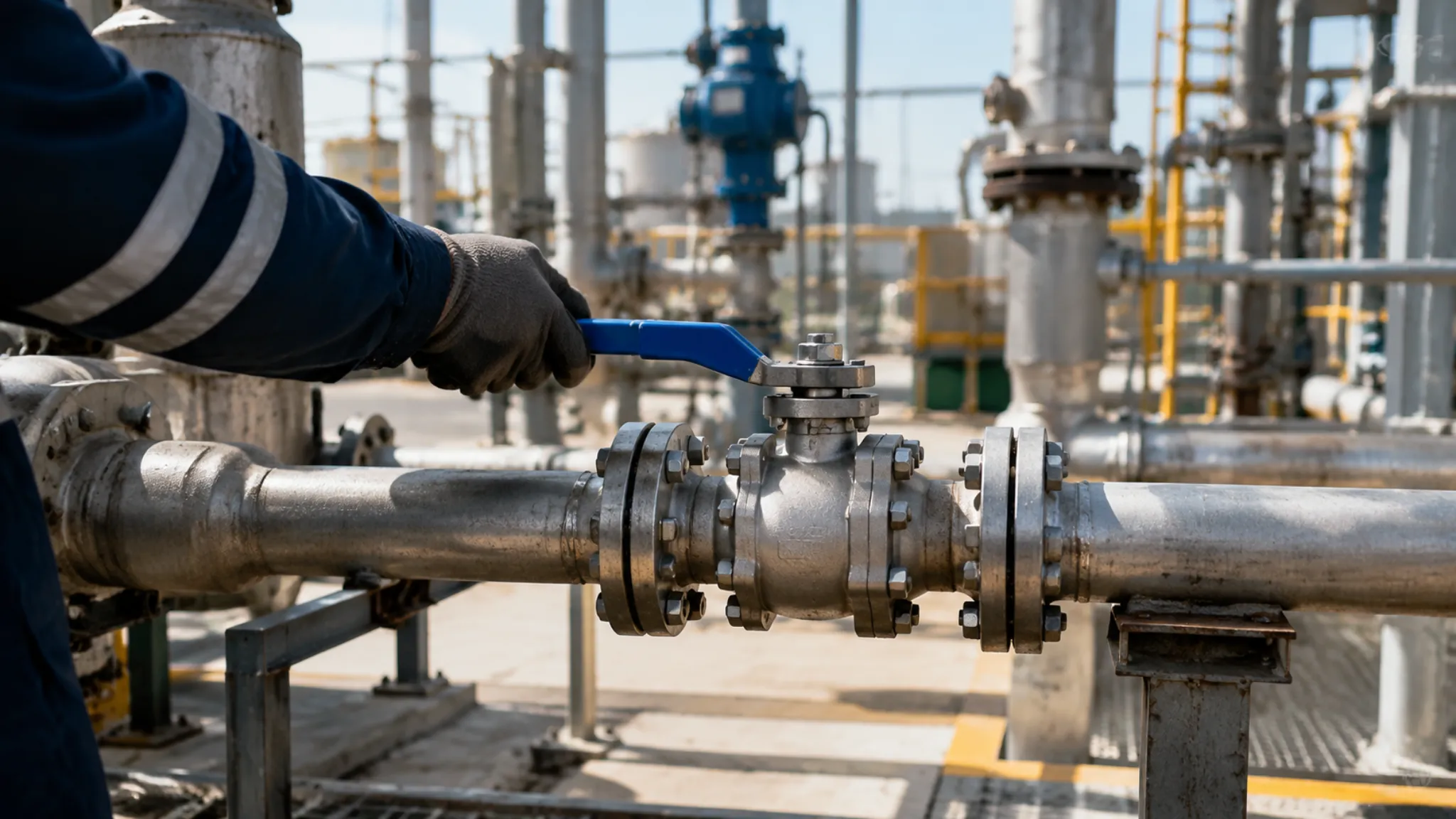
A quality manager at a valve distribution company once told me something that stuck: “We don’t sell valves. We sell the confidence that when you close the valve, the flow stops.” An industrial ball valve that doesn’t seal is not a valve. It’s a very expensive pipe fitting.
The confidence that a ball valve will seal when you need it to comes from three things: the design standard it was built to, the testing it passed, and the certifications that verify both. Here’s what those standards and tests actually mean, and how to read a valve’s documentation to know whether you’re buying confidence or just buying metal.
The standards that govern industrial ball valves
API 6D – Specification for Pipeline Valves. It covers design, manufacturing, materials, testing, and inspection for ball, gate, plug, and check valves in pipeline systems from NPS 2 to NPS 60, Class 150 to 2500. The 2015 edition (the 24th) made Double Block and Bleed mandatory and completely revised the pressure‑temperature rating tables. The 2022 edition added quarterly partial stroke testing recommendations for emergency shutdown valves.
- If a valve is stamped API 6D, it was designed, manufactured, and tested to this standard. If the documentation can’t prove that, it wasn’t.
- API 6D certified industrial ball valves cover the full range of pipeline applications from Class 150 to Class 2500.
API 608 – Metal ball valves for process piping. It applies to valves up to NPS 24 and Class 600. API 608 valves are typically used in process plants – refineries, chemical plants, power stations – rather than long‑distance pipelines. The testing requirements are similar to API 6D but the design requirements are less stringent. (Process plant valves are usually in more accessible locations and operate at lower pressures.) Chevron’s 2019 onshore pipeline specification replaced API 608 with API 6D for all ball valves NPS 4 and above – part of a broader industry trend toward requiring API 6D for larger pipeline isolation valves.
ASME B16.34 – Valve body wall thickness and pressure‑temperature ratings. Every industrial ball valve body is designed to this standard or an equivalent. The standard provides the formulas and tables that determine the minimum wall thickness for each material group, pressure class, and temperature. A valve that meets API 6D or API 608 automatically meets B16.34 for the body design, because both API standards reference B16.34 for pressure‑containing envelope requirements. Industrial ball valve specifications per API 6D include the B16.34 wall thickness calculation as a mandatory design verification.
API 598 – Valve inspection and testing. This standard defines the hydrostatic shell test, the seat closure test, and the acceptance criteria for both. Every industrial ball valve sold with an API certification has been tested per API 598.
- Shell test: 1.5 times the rated pressure at 38°C, held for a duration based on valve size – 15 seconds for valves up to DN50, 60 seconds for DN300 and above, and proportionally for sizes in between.
- Seat test: 1.1 times the rated pressure. For soft‑seated valves in gas service, the seat test uses gas at 0.4 to 0.7 MPa, and the acceptance criterion is zero visible bubbles.
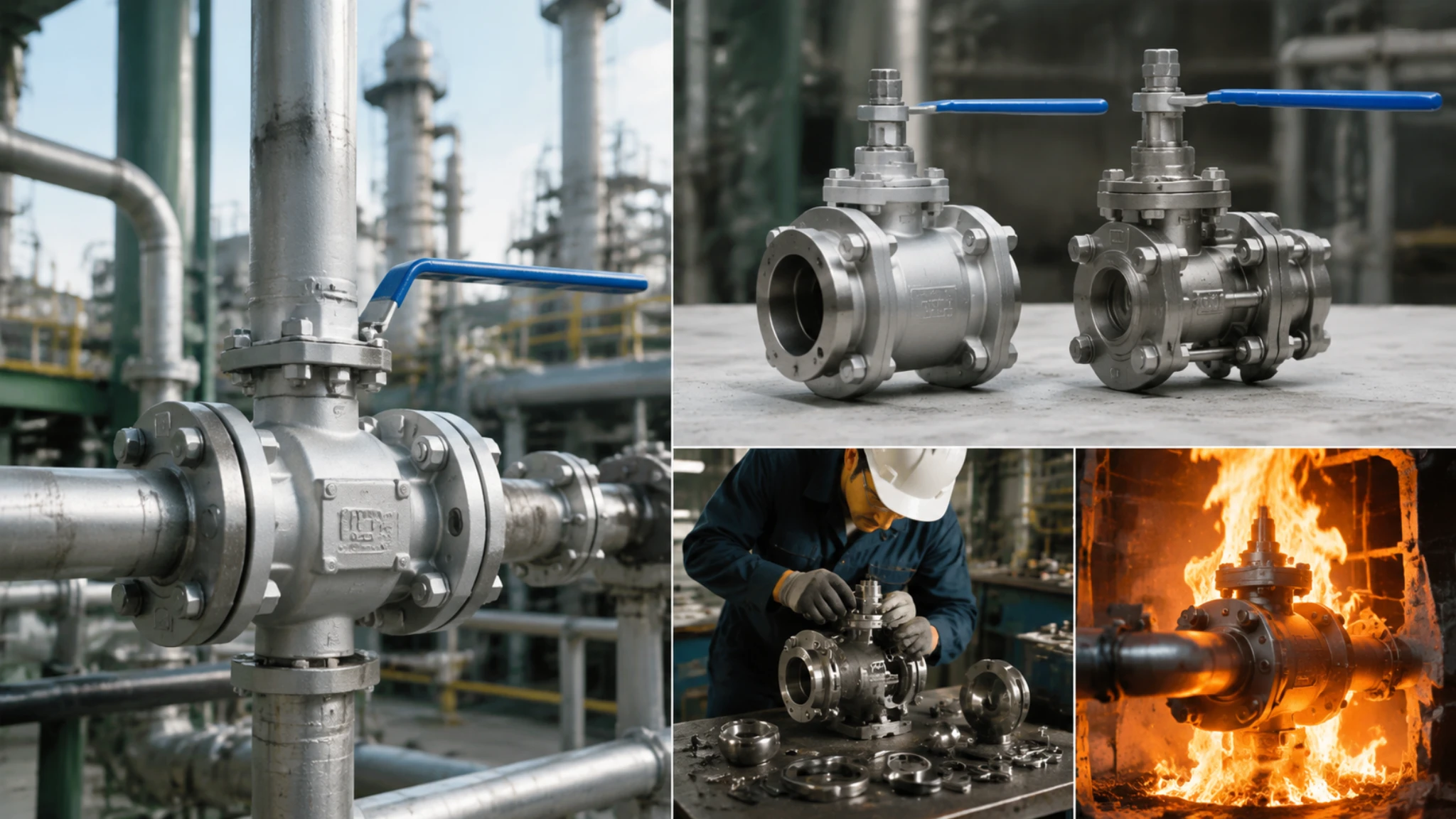
API 607 and API 6FA – Fire‑safe testing. A fire‑safe valve is placed in a furnace at a minimum of 760°C for 30 minutes while pressurized, then quenched with water, then tested for external and seat leakage. After all that, the stem must be operable with a standard wrench. A valve that passes this test won’t add fuel to a fire. The fire‑safe certification is not automatically included with API 6D or API 608 – it’s a separate test, typically done once per valve design family. The test report should match your valve’s size, class, and seat material. Fire‑safe industrial ball valves certified to API 607 are standard for hydrocarbon service where fire exposure is a credible risk.
NACE MR0175 and ISO 15156 – Materials for sour service (environments containing hydrogen sulfide). For carbon and low‑alloy steels, the maximum hardness is HRC 22. This limit is not negotiable. Steel harder than HRC 22 exposed to wet H2S will crack through sulfide stress corrosion. Cracking can happen in hours to weeks depending on H2S concentration and stress level. Every metallic component that contacts the process fluid in a sour service valve must meet the hardness limit, and the material certificate must state actual measured values, not just “NACE compliant.”
| Standard | Scope |
|---|---|
| API 6D | Pipeline valves (NPS 2–60, Class 150–2500) |
| API 608 | Process piping metal ball valves (≤ NPS 24, Class 600) |
| ASME B16.34 | Body wall thickness and pressure‑temperature ratings |
| API 598 | Inspection and testing (shell and seat) |
| API 607 / 6FA | Fire‑safe testing |
| NACE MR0175 / ISO 15156 | Sour service materials (hardness limits) |
What the testing actually verifies
Hydrostatic shell test – verifies that the pressure‑containing envelope (body, body‑to‑bonnet or body‑to‑body joint, stem seal) can contain 1.5 times the rated pressure without leaking or deforming. The test uses water because water is nearly incompressible, so a failure releases a small amount of energy. Testing with gas is dangerous at high pressure – the stored energy can turn a body failure into an explosion. API 598 allows gas testing only when water cannot be used, and requires extensive safety precautions.
The shell test finds gross defects. A body with a casting defect that penetrates the wall will leak. A body joint with a damaged gasket will leak. A stem seal that’s missing packing will leak. The test won’t find small defects below the surface, and it won’t find defects oriented such that they don’t create a leak path at the test pressure. The shell test is necessary but not sufficient for verifying casting integrity. Radiographic or ultrasonic inspection is required for that.
Seat test – verifies that the valve seals when closed. The test applies pressure to one side of the closed ball and measures leakage past the seat.
- For soft‑seated valves in liquid service: typically no visible leakage for the duration of the test.
- For metal‑seated valves: a specified leakage rate per API 598 – rate B for general service, rate A for critical service. Rate limits vary by valve size.
The seat test is done at the factory on every valve. It’s also the test most commonly repeated during site acceptance testing and after maintenance.
A valve that passes the factory seat test can fail a site seat test if it was damaged during shipping, if debris entered during installation, or if the seat material degraded during storage. This is why site acceptance testing – at least a seat test at operating pressure – is standard practice for critical service valves. Ball valve seat leak testing at the factory is the first verification of seal integrity. On‑site retesting verifies that nothing changed between the factory and the installation.
High‑pressure pneumatic seat test – an optional test that’s more revealing than the standard water seat test. Gas molecules are smaller than water molecules and will find leak paths that water won’t. A valve that passes a water seat test at 1.1 times rated pressure might fail a nitrogen seat test at 0.6 MPa if there’s a microscopic leak path through the seat. For gas service above Class 600, a pneumatic seat test should be specified in the purchase order. The test uses nitrogen or air at 0.4 to 0.7 MPa, and the acceptance criterion is zero visible bubbles over a minimum of 15 seconds for soft seats and a specified rate for metal seats.
Helium leak detection – the most sensitive test available. A mass spectrometer probe scans the seat and stem areas while the valve is pressurized with helium. The detection threshold is typically 50 parts per million – orders of magnitude more sensitive than a bubble test. Helium leak testing is specified for valves in hydrogen service, toxic gas service, and any application where even a microscopic leak is unacceptable. The test equipment is expensive, the helium is expensive, and the testing takes longer than standard methods. The cost is justified when the consequence of a leak is large.
Material certification and traceability
Every pressure‑containing component in an industrial ball valve should be traceable to its original material certificate. The certificate documents the heat number, chemical composition, mechanical test results, and heat treatment. For critical components (body, ball, stem, bolting), the certificate should be EN 10204 Type 3.1 – meaning the test results were witnessed by an independent inspector.
Positive material identification (PMI) – using a handheld XRF spectrometer – verifies that the material in the finished component matches the material on the certificate. PMI takes about 30 seconds per component and detects material substitutions that would otherwise go unnoticed. For sour service valves, PMI should be done on every pressure‑containing component because a single non‑compliant part (a bolt, a seat ring, a stem) can fail in sour service and cause a leak. API certified manufacturers with PMI verification on every production batch provide the material traceability that industrial end users require.
Heat number traceability is the foundation of the quality system. The heat number stamped on the valve body should match the number on the material certificate. The certificate should trace to a specific heat of steel from a specific mill, with a specific chemical composition and mechanical properties. If the heat number on the body doesn’t match the certificate, the traceability chain is broken. The material could be anything. A broken traceability chain invalidates the material certification regardless of what the certificate says.
The documentation package: what to ask for and what to check
For every industrial ball valve in critical service, the documentation package should include at minimum:
- Certificate of compliance stating the valve meets API 6D or API 608 (signed by a responsible officer, referencing the valve’s unique serial number)
- Hydrostatic shell test report with actual test pressure and hold time
- Seat test report with actual test pressure and leakage rate
- Material test reports for all pressure‑containing components
- NDE reports for any radiographic or ultrasonic inspections performed on castings
A certificate without a serial number is a generic document that proves nothing about your specific valve. Test reports should show actual measured values, not just “pass” or “conforms.” A hydro test report that says “pass” without the test pressure, hold time, and gauge readings doesn’t prove the test was done correctly. A seat test report that shows zero leakage at 1.1 times rated pressure for the specified hold time is evidence that the valve sealed at the factory. A report that just says “seat test passed” could mean anything.
Material test reports should show the chemical composition with actual percentages for each specified element, tensile test results with actual yield and tensile strength values, and impact test results with actual absorbed energy values (if impact testing was required). A report that says “conforms to ASTM A105” without actual numbers is a declaration, not a test report. The actual numbers tell you whether the material barely met the specification or comfortably exceeded it.
The quality manager who said his company sells confidence, not valves, had a simple test for documentation packages: if the package is thinner than the valve is heavy, ask for more. A properly documented industrial ball valve comes with a documentation package that weighs about half a pound for a 50‑pound valve. If the documentation is a single page, it’s not documentation – it’s a sales brochure.
Industrial ball valves are safety equipment as much as they are process equipment. The documentation is the evidence that the valve will do its job when the system needs it to. Without it, you’re not buying confidence. You’re buying hope.