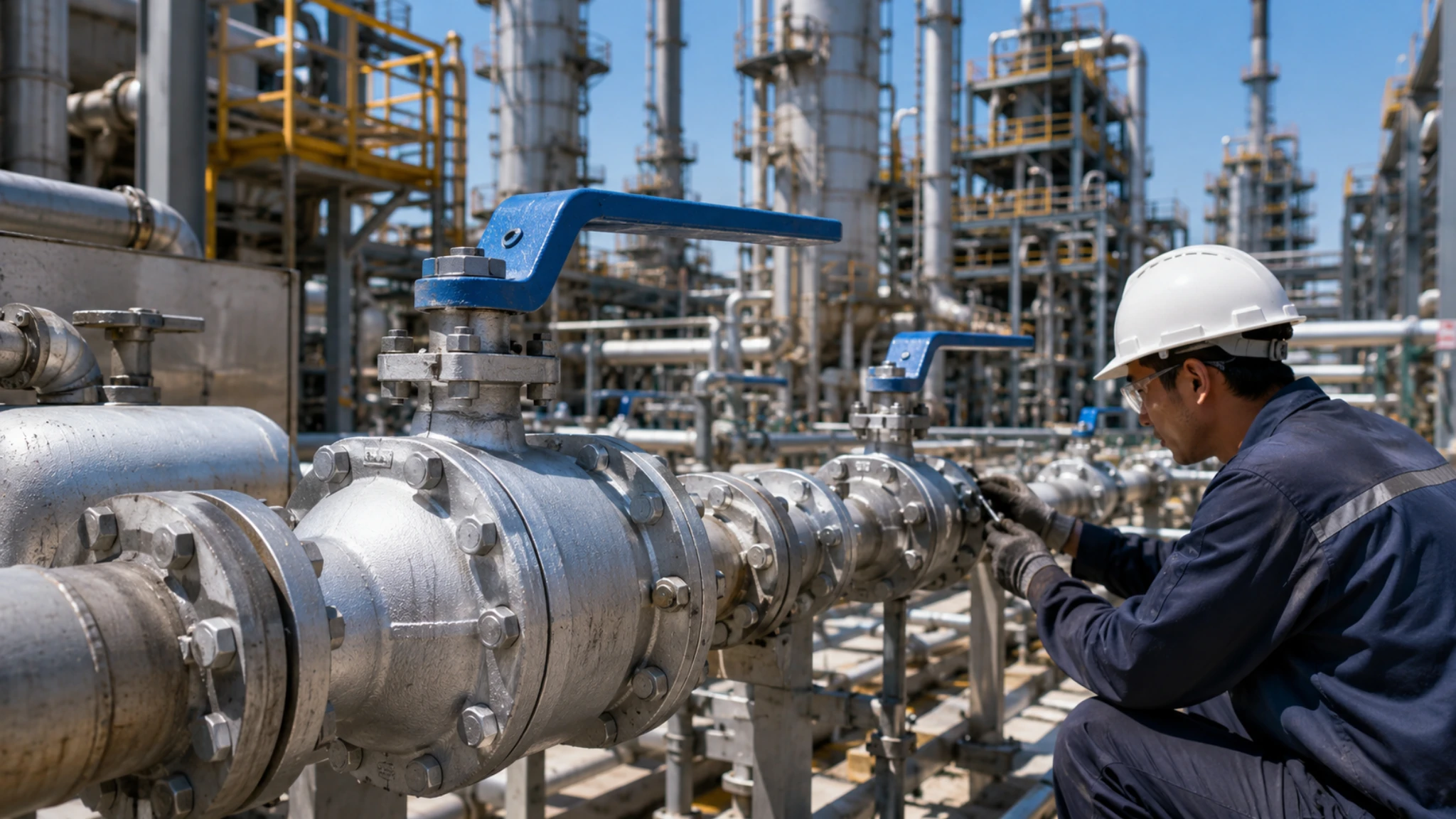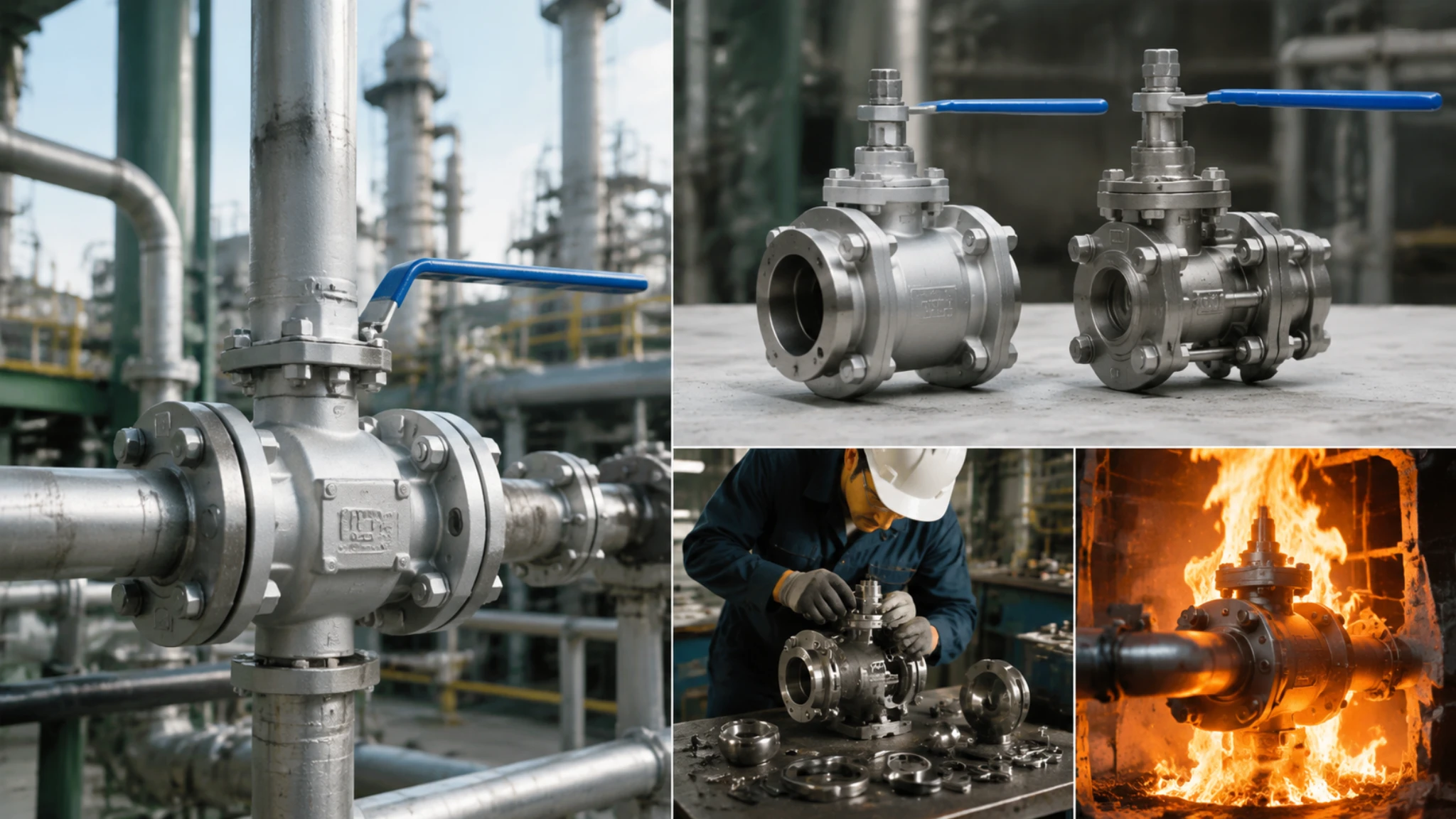
About ten years ago, I watched a crew try to close a 16-inch floating ball valve on a crude oil transfer line at 900 psi.
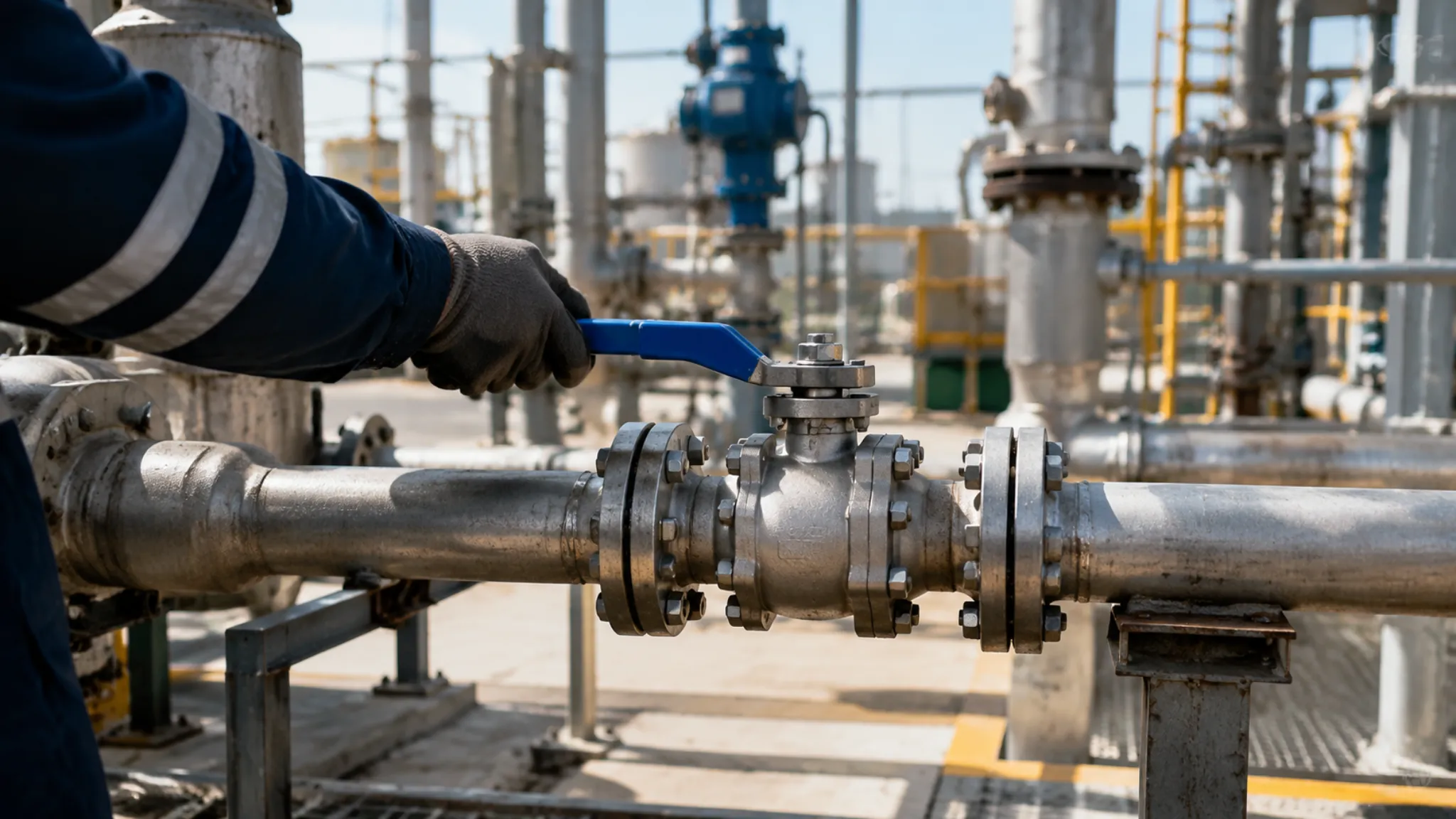
The operator was a big guy, maybe 250 pounds, and he was hanging off the end of a four-foot cheater bar that was never supposed to be on that valve. The valve hadn’t been cycled in months.
The ball was stuck against the downstream seat with about 180,000 pounds of force from the line pressure. He got it to move about ten degrees before the stem twisted. Not bent. Twisted.
The square drive end of the stem sheared right at the keyway, and the valve was permanently jammed in a partially open position. They had to shut down the entire transfer line, drain 300 meters of 16-inch pipe, and cut the valve out.
The replacement was a trunnion mounted ball valve of the same size and class. The operating torque dropped from “requires a cheater bar and a large human” to about 350 Nm, easily handled by a standard gear operator. Nobody ever installed a floating ball valve above 8 inches on that site again.
Trunnion mounted ball valves solve a specific physics problem: when a ball valve gets big and the pressure gets high, the force on the ball becomes too large for a floating design to handle.
The trunnion design fixes the ball in place with upper and lower bearings, so the line pressure pushes against the seats instead of pushing the ball into the downstream seat. This one design decision changes everything about how the valve performs at scale.
- It’s why virtually every pipeline ball valve above 8 inches and Class 600 is trunnion mounted.
- It’s why the torque stays manageable when the line pressure goes up.
- And it’s why the seats last five times longer in high-pressure service than they would in a floating design of the same size.
Here’s how it works, when you actually need one, and how to not screw up the specification.
How the trunnion design solves the force problem
In a floating ball valve, the ball isn’t supported from below. It’s held between two seats, and when you pressurize the line, the ball floats downstream and presses against the downstream seat to create the seal. This works fine at small sizes and low pressures. At 4 inches and Class 300, the force on the ball is maybe a few thousand pounds, and the stem torque is under 100 Nm. You can operate it by hand.
Scale that to 12 inches at Class 600 with 1,200 psi on the line. The ball has a projected area of about 113 square inches. At 1,200 psi differential, the force pushing the ball into the downstream seat is roughly 135,000 pounds.
The friction between the ball and the seat at that force translates to a stem torque somewhere north of 2,000 Nm. That’s not hand-operable. That’s not even gear-operable without a massive gearbox. And if the valve has been sitting in one position for months, the seats can stick to the ball, and the breakaway torque can be double the running torque.
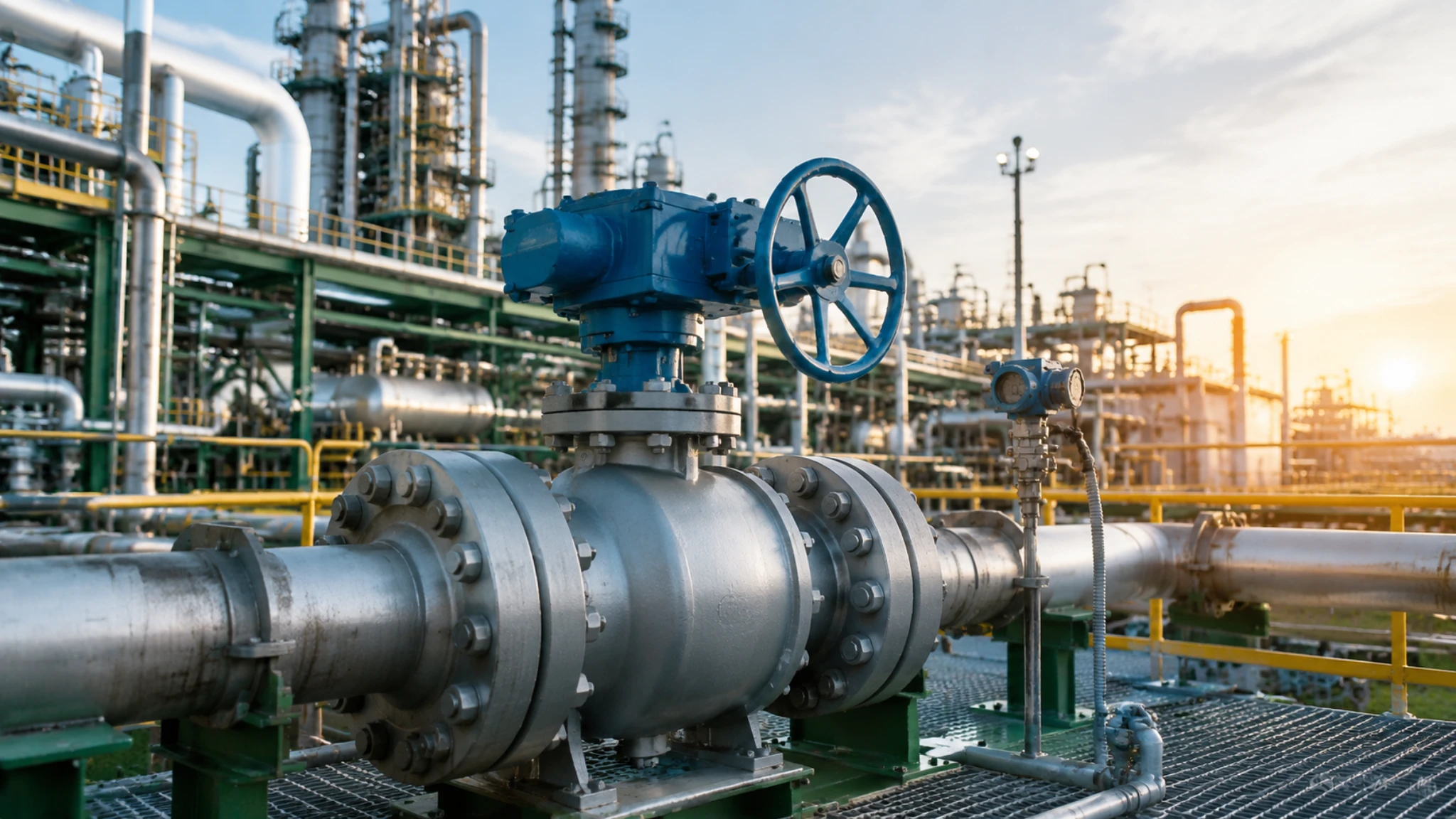
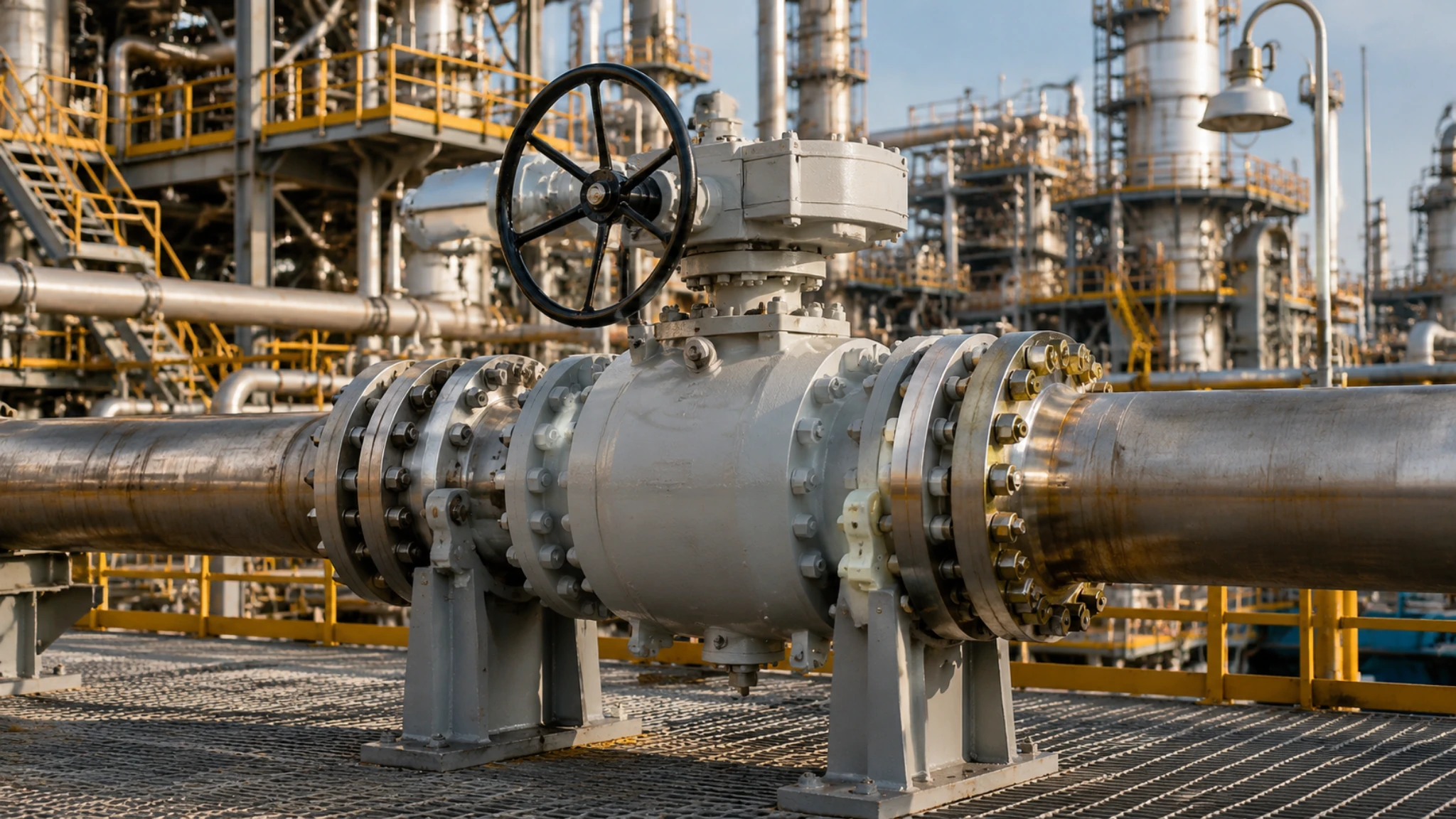
A trunnion mounted ball valve fixes the ball with an upper stem bearing and a lower trunnion bearing. The ball can rotate, but it can’t translate downstream. The seats are spring-loaded, so they press against the ball rather than the ball pressing against them.
The friction that creates operating torque comes from the spring force on the seat, not from the line pressure on the ball. At 12 inches and Class 600, the operating torque drops from over 2,000 Nm to around 350-450 Nm. That’s gear-operable with a standard worm gear drive.
API 6D trunnion mounted ball valves in sizes up to NPS 48 and Class 2500 use this design because it’s the only way to make a valve that size both sealable and operable.
The spring-loaded seats have another advantage: they maintain contact with the ball even as the seats wear. In a floating design, as the downstream seat wears, the ball moves further downstream to maintain contact, and the stem packing sees increasing side load. Eventually the packing deforms, the stem starts leaking, and you’re replacing the packing and possibly the stem. In a trunnion design, the spring-loaded seats take up the wear without affecting stem alignment. Seat replacement intervals on a trunnion valve are typically five to seven times longer than on a floating valve of the same size in the same service.
When you need a trunnion mounted valve and when you don’t
The industry rule of thumb is simple: above 6 inches or above Class 600, go trunnion. Below that, floating is fine. But like most rules of thumb, there are exceptions.
- Below 6 inches but high class: If your application is below 6 inches but you’re at Class 900 or 1500, the forces are high enough that a trunnion design makes sense even at small sizes. A 4-inch Class 1500 floating valve at 3,700 psi line pressure has about 46,000 pounds of force on the ball. The stem sees enough torque that you need a gear operator anyway. At that point, the trunnion design gives you lower torque and longer seat life for a marginal cost increase.
- Class 300 to 600, below 8 inches, clean service: If you’re at Class 300 to 600 and below 8 inches in clean service with infrequent cycling, a floating valve is usually the right choice. It’s cheaper, simpler, and perfectly adequate. Don’t over-specify a trunnion valve for a 4-inch Class 150 cooling water line. The valve will work fine, but you’ll pay 40-60% more than you need to.
- Full bore for pigging: If you need full bore for pigging, trunnion mounted is the standard above 4 inches. Full bore floating ball valves exist, but they get heavy fast because the ball diameter scales with the bore, and a larger ball means more surface area for the line pressure to push against. A full bore 8-inch floating valve weighs about 40% more than a reduced bore version, and the operating torque at Class 300 is already marginal for manual operation. A full bore trunnion valve of the same size weighs more than the floating version but operates with lower and more predictable torque.
Sizes, pressures, and what’s actually available
Trunnion mounted ball valves cover a huge range. Standard production covers NPS 1/2 to NPS 48, Class 150 to Class 2500. But availability isn’t uniform across that range.
| Size range | Class range | Lead time | Notes |
|---|---|---|---|
| NPS 1/2 to NPS 12 | Class 150-600 | Stock / catalog items | Standard from major manufacturers |
| NPS 14 to NPS 24 | Class 600 and above | 12-16 weeks | Semi-custom territory |
| Above NPS 24 | All classes | 10-14 months | Custom-engineered; few foundries can cast |
| Class 2500, NPS 2-12 | Class 2500 | Standard production | Weighs ~3 tons for 12-inch; costs 4-5x Class 600 |
| Class 2500, above NPS 12 | Class 2500 | Up to 18 months | Fully custom; body forgings made to order |
API 6D ball valve manufacturers with in-house foundry capability can hold lead times a few months shorter than those who outsource their castings, but at these sizes there’s no such thing as a quick delivery.
The weight difference between pressure classes is nonlinear. A DN400 (16-inch) Class 300 trunnion valve body has a wall thickness of about 24mm and weighs roughly 1.5 tons. The same size in Class 600 has a wall thickness of about 36mm and weighs about 2.4 tons. In Class 900, the wall goes to about 48mm and the weight approaches 3.5 tons. Every jump in pressure class adds roughly 50% more metal to the body alone.
The foundations, the lifting equipment, the actuator sizing, and the piping supports all have to account for this. I’ve seen projects where the piping stress analysis was done assuming a Class 300 valve weight and someone upgraded the spec to Class 600 without re-running the pipe support calculations. The support sagged about 4mm over the first year of operation. That put a bending moment on the flange joint that eventually caused a gasket leak.
Seat selection: the decision that determines service life
The valve body will almost certainly outlast the seats. The seat material choice determines how often you’re shutting down to replace them, and how much those replacements cost.
| Material | Max continuous temperature | Relative compressive strength vs PTFE | Typical service life (clean gas) | Best for |
|---|---|---|---|---|
| PTFE | 200°C | 1x (baseline) | 5-10 years | Moderate temperature, clean service |
| Devlon V-API (nylon) | 150°C | ~5x | 3-4 years in crude with sand | Crude oil, abrasive service |
| PEEK | 260°C | ~8x | Longer (except steam above 260°C) | High temperature, chemical resistance |
| Metal (tungsten carbide / Stellite 6) | Above 400°C | N/A (metal-to-metal) | Very long; annual wear <0.01mm in sand-laden crude at 25 m/s | Extreme temperature, severe erosion |
PTFE is the standard soft seat. It seals bubble-tight, it’s chemically inert to almost everything, and it’s cheap. But PTFE has a service temperature limit of about 200°C for continuous use. Above that, it cold-flows under load and eventually extrudes out of the seat pocket.
Devlon V-API is a step up. It’s a high-performance nylon with about five times the compressive strength of PTFE and much better abrasion resistance. It’s rated to about 150°C and works well in crude oil with entrained sand. Many North Slope and North Sea operators standardized on Devlon seats for production manifolds in the 1990s and still use them because the field data shows 3-4 year replacement intervals compared to 8-12 months for PTFE in the same service.
PEEK is the premium polymer option. Continuous service to 260°C, compressive strength around eight times that of PTFE, and excellent chemical resistance. The catch is that PEEK doesn’t like superheated steam. At 300°C, the surface can crystallize and crack. For steam service above 260°C, you need metal seats.
The soft seated vs metal seated choice comes down to whether you can tolerate the slight leakage that metal seats allow in exchange for years of uninterrupted service at temperatures that would destroy any polymer.
Metal seated trunnion valves use tungsten carbide or Stellite 6 coatings on the ball and seat. Tungsten carbide applied by HVOF spraying at 800 m/s produces a coating 0.15-0.25mm thick with hardness around HRC 70 and porosity below 1%. In sand-laden crude at 25 m/s, annual wear is under 0.01mm. The tradeoff: metal seats typically don’t achieve API 598 Class A zero-leakage. You’re looking at Class B (60 bubbles per minute) or Class IV per FCI 70-2. For most pipeline applications, that’s fine. For toxic or high-consequence services, you might need the zero-leakage of soft seats, and that means accepting more frequent replacement intervals.
Materials: when the standard stuff isn’t enough
Most trunnion mounted ball valves in pipeline service use ASTM A216 WCB carbon steel bodies with A182 F316 or A351 CF8M stainless internals. WCB is rated from -29°C to 425°C and handles the vast majority of oil and gas pipeline conditions without issues. The stainless trim provides adequate corrosion resistance for mildly sour service.
When the service gets aggressive, the materials get expensive fast.
- Sour gas with H2S: When the H2S partial pressure is above 0.34 kPa, NACE MR0175 compliance is required with a maximum hardness of HRC 22 for carbon steel. Every metallic component in contact with the process fluid has to meet this limit, including bolting, gaskets, and trim. The material certificates must state actual measured hardness values, not just declare “NACE compliant.”
- Offshore / subsea: The standard upgrade is duplex or super duplex stainless. F51 duplex (UNS S31803) doubles the yield strength of 316L while providing much better chloride stress corrosion cracking resistance. F53 super duplex (UNS S32750) pushes yield strength above 550 MPa with a PREN value exceeding 40, which means it can handle seawater injection at 70°C without pitting. The cost: F53 is about four to five times the price of WCB for the body material, and the machining is harder because the material work-hardens.
- LNG service at -162°C: The body material has to be A352 LC3 or austenitic stainless steel. WCB is not rated below -29°C. At LNG temperatures, WCB has essentially zero impact toughness. A water hammer event that a WCB valve at ambient temperature would shrug off could shatter a WCB valve at -162°C like glass. The bonnet on an LNG trunnion valve is typically extended 24 inches or more to keep the packing above freezing, because standard graphite packing loses flexibility below about -20°C.
- Extreme conditions (Inconel / Hastelloy): Inconel 625 retains tensile strength above 800 MPa at 600°C and resists chloride stress corrosion cracking at concentrations that would pit 316L within hours. It’s used for deepwater wellhead valves, geothermal steam service, and flue gas desulfurization systems. A 6-inch Class 1500 Inconel 625 trunnion valve costs roughly 15-20 times what a WCB valve of the same size and class costs. You don’t specify Inconel unless the alternative is a valve failure that costs more than the valve.
Materials for corrosive environments like duplex stainless, Inconel 625, and Hastelloy C276 are specified when the process fluid will destroy a standard carbon steel valve within months.
The DBB requirement and why it matters
API 6D 2015 made Double Block and Bleed mandatory for all trunnion mounted ball valves. DBB means the valve has two seating surfaces that independently seal against pressure from both directions, with a bleed port between them.
When the valve is closed and you open the bleed, you can verify that both seats are holding independently. If either seat leaks, fluid comes out the bleed port, and you know the isolation isn’t complete before anyone enters a confined space or breaks a flange downstream.
The DBB test isn’t just a single-seat test done twice. Each seat has to be tested with the cavity at zero pressure and the opposite side at full rated pressure. Then the test is reversed. The interaction between the two seats under simultaneous pressure can mask leakage that a single-seat test would catch, because the pressure in the cavity affects how the opposite seat seals against the ball. I’ve seen valves pass single-seat tests on both sides and then fail the full DBB test because the cavity pressure from the first seat test temporarily pushed the opposite seat into better contact with the ball. When the cavity was vented, the opposite seat relaxed and started leaking.
API 6D testing standards for trunnion valves require the full DBB sequence, not a shortcut version.
For applications that need bidirectional isolation, API 6D Appendix D defines DIB-1 and DIB-2 configurations.
- DIB-1: Both seats seal in the same direction, with the downstream seat providing primary isolation.
- DIB-2: Seats seal in opposite directions, so each seat independently seals against pressure from its own side. DIB-2 is typically used in subsea manifolds and offshore platforms where you need to verify isolation from both directions without relying on a single seat to seal bidirectionally.
If your specification says “DBB” but your application needs bidirectional isolation, you need DIB, and you need to specify which configuration.
Installation and maintenance that prevents the common failures
Trunnion mounted valves are more forgiving than floating valves in operation, but they have their own failure modes that are expensive when ignored.
The number one cause of premature trunnion valve failure is using the valve as a throttle. The same high-velocity jetting that destroys floating valve seats destroys trunnion valve seats, just more slowly. At 15 degrees open on a 12-inch Class 600 trunnion valve with 900 psi differential, the flow velocity through the crescent opening can exceed 150 ft/s. The spring-loaded seats that make trunnion valves so good at sealing also make them vulnerable to wire-drawing erosion at partial opening because the seat is constantly pressed against the ball by spring force, and the high-velocity fluid cuts a channel right through the seat-to-ball contact point. The seat that would have lasted 60 months in on-off service can be destroyed in three months of throttling at 15-20% open.
Stem packing is the most common maintenance item. Live-loaded packing with Belleville springs maintains consistent compression as the packing settles during the first few hundred cycles. Without live loading, packing compression drops about 25% in the first 100 cycles, and fugitive emissions start. The packing should be graphite for temperatures above 200°C and PTFE for lower temperatures. Graphite packing in oxidizing service above 400°C loses about 22% of its cross-section to oxidation within 6,000 hours. If your valve cycles more than once a week and the packing isn’t live-loaded, it’s going to leak.
Trunnion ball valve maintenance should include stem leakage inspection at least quarterly, packing bolt torque verification, and cycle testing to confirm the valve still moves through its full 90-degree range.
Seat leakage testing should be done through the cavity bleed port. Close the valve, vent the cavity, and monitor for pressure buildup or fluid flow from the bleed. Any sustained flow means at least one seat is leaking past the ball. The standard acceptance criterion is API 598 rate B leakage for metal seats and zero visible leakage for soft seats. If you don’t have a documented seat leakage test frequency, you don’t have a maintenance program. You’re waiting for a failure to tell you something’s wrong.
For emergency shutdown valves, API 6D now recommends quarterly partial stroke testing. A partial stroke moves the valve about 15 degrees off the seat and back, verifying that the actuator can move the valve and the seats aren’t stuck to the ball. The test takes about 30 seconds and can be automated. The alternative is discovering during an annual shutdown test that your ESDV hasn’t moved in 12 months and the seats are permanently bonded to the ball by scale and corrosion products.
The specification checklist
If you’re writing a trunnion mounted ball valve specification or reviewing a quotation, here are the things that get missed most often and cost the most when they’re wrong.
- Specify the API 6D edition. The 2015 edition (24th) made DBB mandatory and revised the P-T tables. The 2022 edition added quarterly ESDV testing recommendations. If you just say “API 6D” without the edition, the manufacturer can ship to whichever edition they can most easily comply with, which might be two editions behind what your project requires.
- Specify the DBB or DIB configuration explicitly. “DBB per API 6D” is not enough if you need DIB-2 for bidirectional isolation. The valve design is different, the testing is different, and the cost is different. If the specification is ambiguous, the manufacturer will quote DBB because it’s cheaper.
- Require witnessed testing for critical service valves. A test report signed by the manufacturer is not the same as a test report signed by your inspector who was standing at the test bay. The travel cost to witness testing on a $200,000 valve order is maybe $3,000. The cost of installing a valve that fails its first hydro test on site because the manufacturer’s test report was optimistic is orders of magnitude higher.
- Check the weight. A 12-inch Class 600 trunnion valve should weigh roughly 2.2 to 2.6 tons. If the quoted weight is 1.7 tons at a 30% price discount, the body wall thickness is below the ASME B16.34 minimum. Put it on a scale at receiving inspection. Weight doesn’t lie.
API 6D specifications for pressure rating and end connections define the dimensions and weights that a properly built valve must meet. If the valve is light, the wall is thin, and thin walls fail.
The operator on that crude oil transfer line I mentioned at the start? After they replaced the floating valve with a trunnion valve, the valve cycled every week for the next eight years without a single maintenance intervention beyond packing adjustment.
The gear operator turned smoothly with about 40 pounds of rim force on a 24-inch handwheel. Nobody ever needed a cheater bar again. That’s what the trunnion design buys you: predictable, low operating torque across the entire pressure range of the valve, for the full service life of the seats. It costs more up front. It costs dramatically less over the life of the installation.