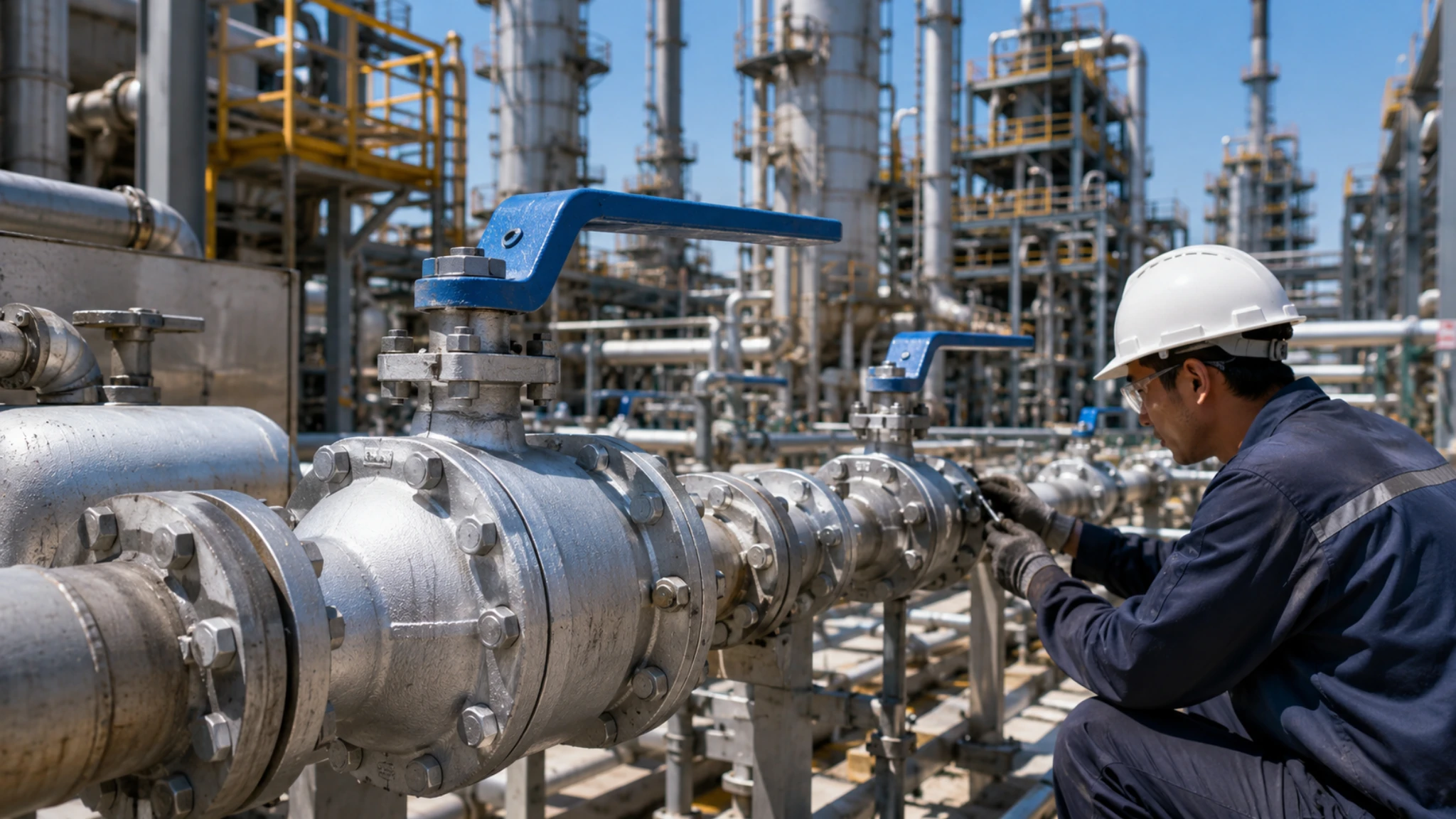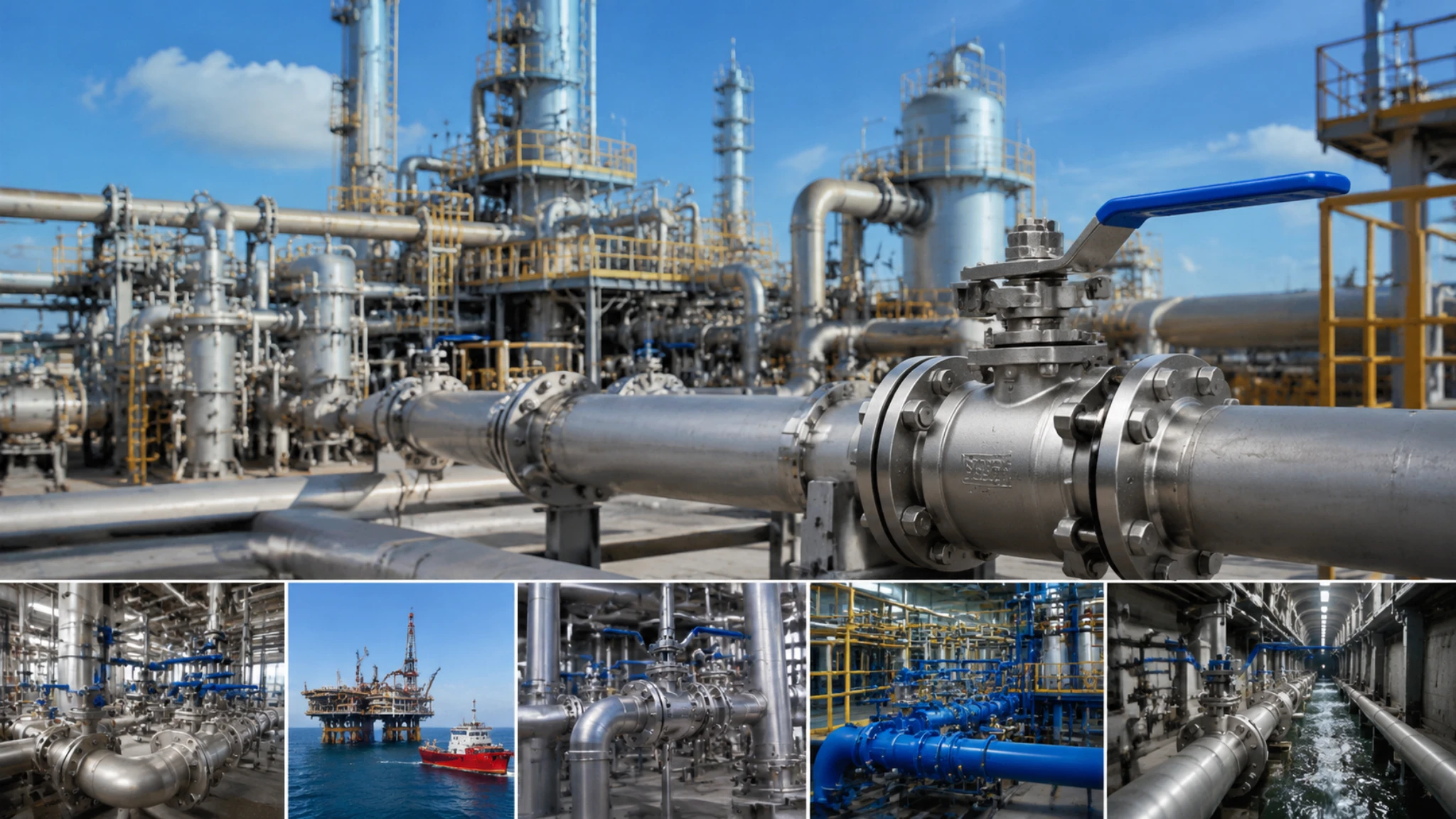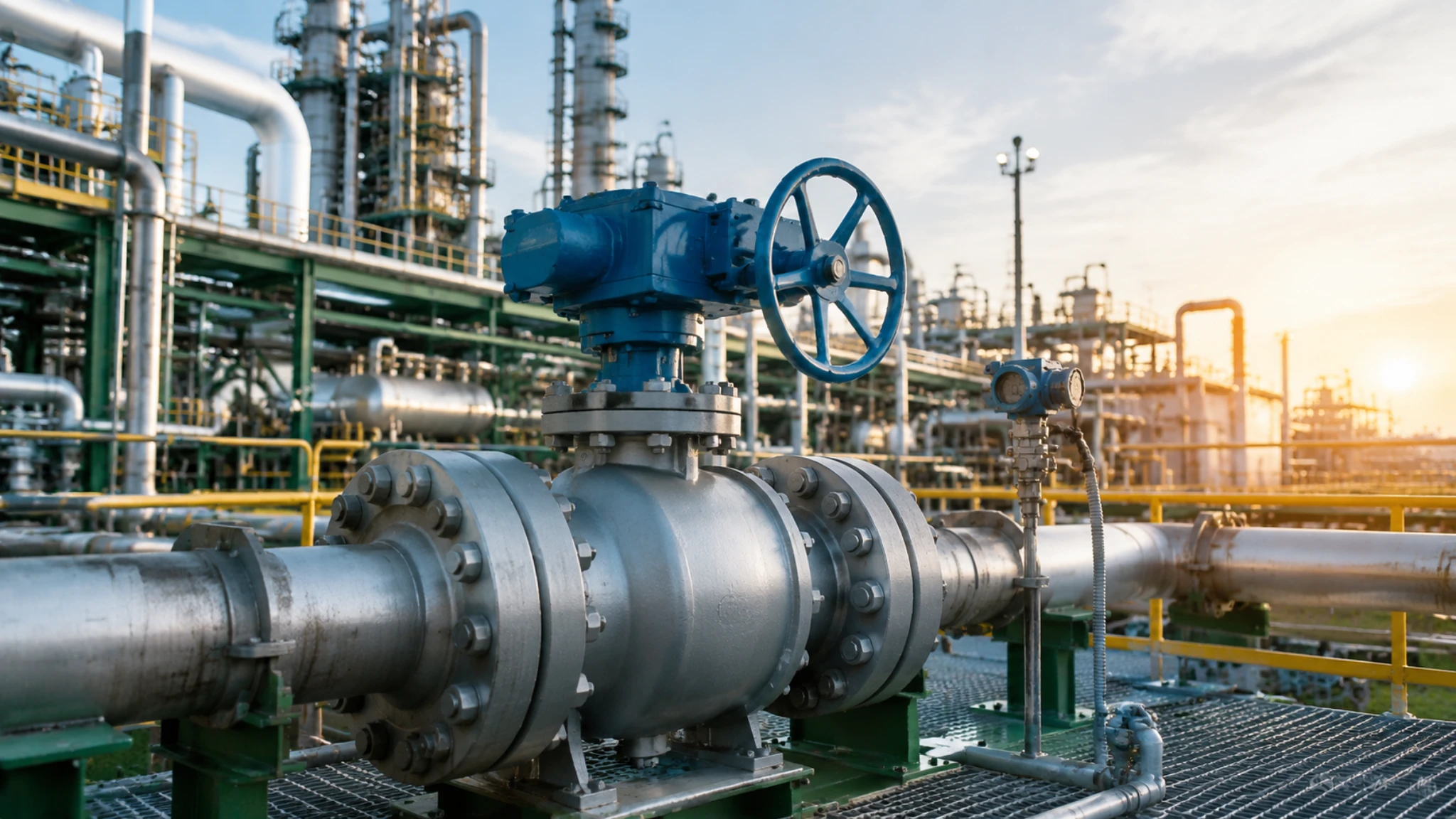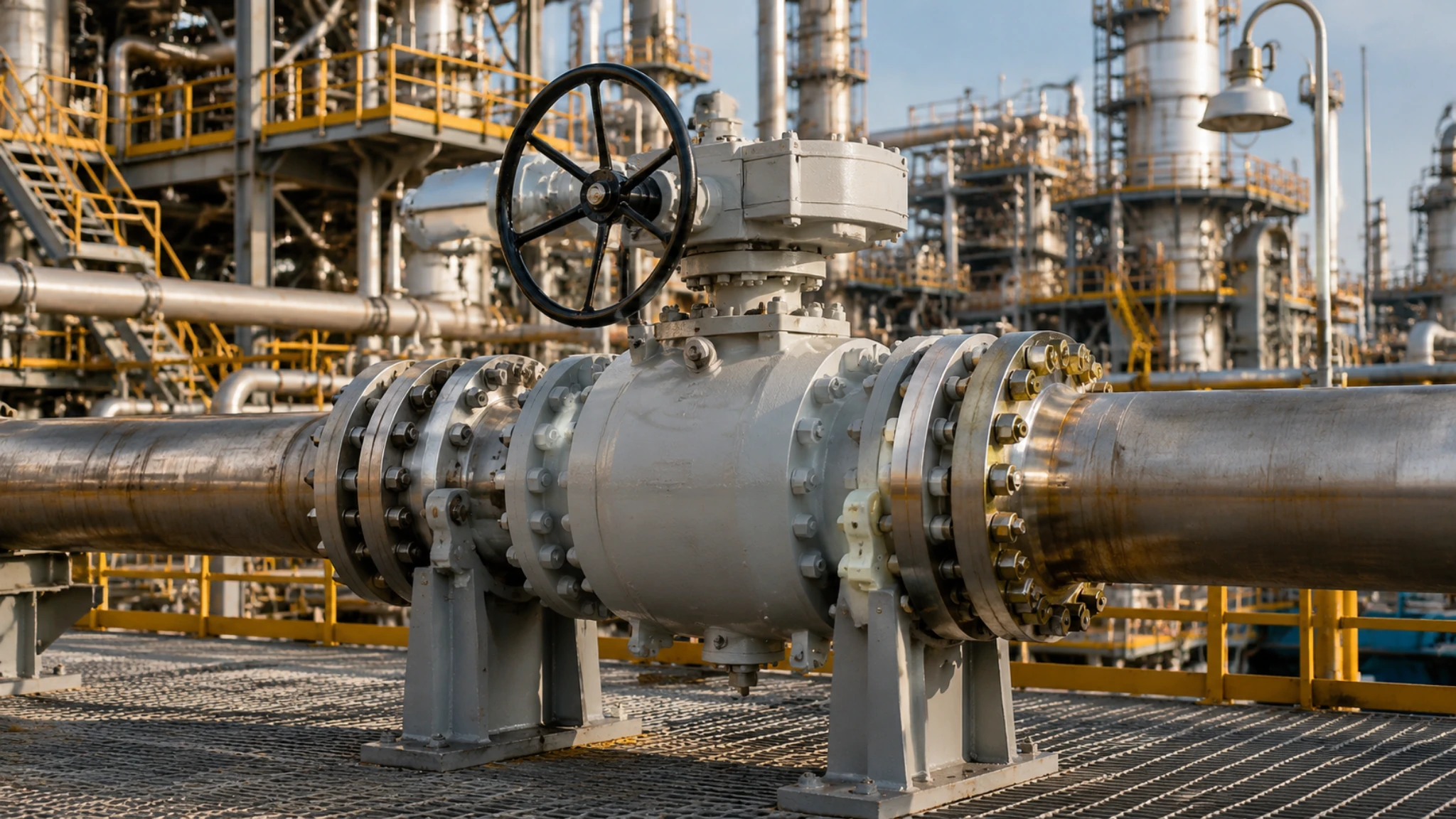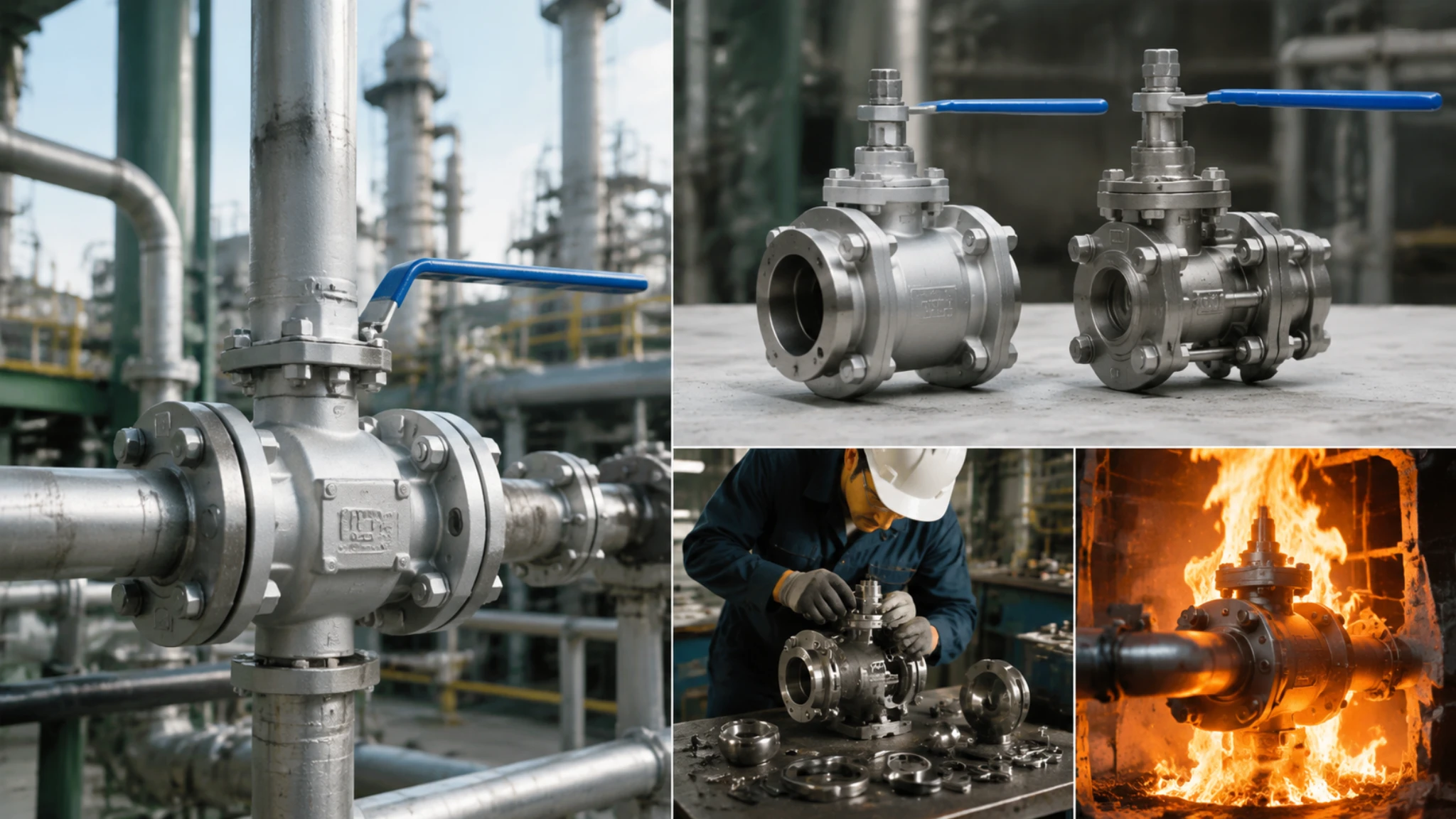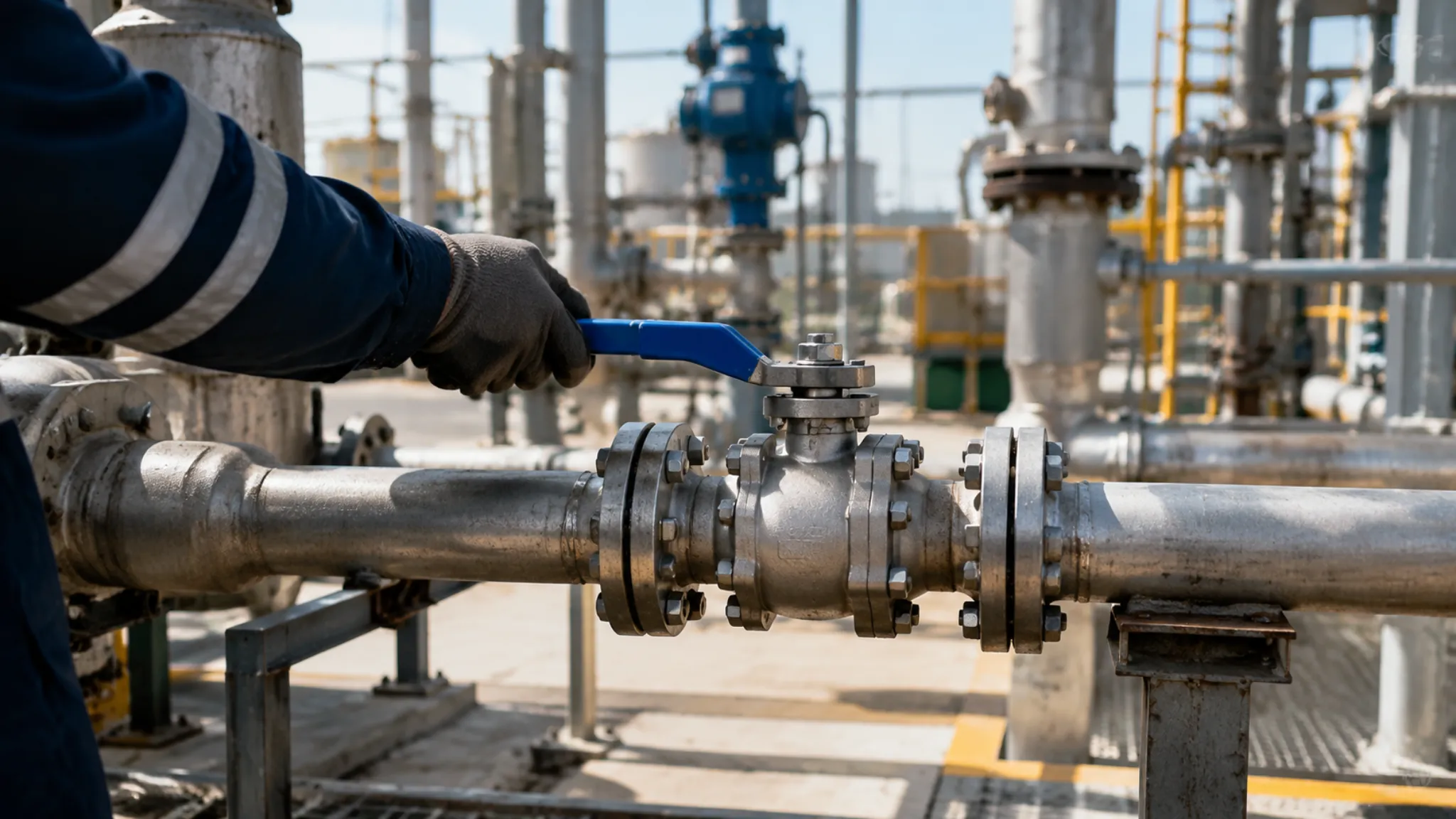
Walk into any refinery, chemical plant, or power station and count the valves. A medium-sized refinery has about 30,000 valves.
Roughly 40% of them are ball valves. They are on cooling water lines, steam headers, product transfer lines, instrument air headers, and emergency shutdown systems.
They range in size from half-inch instrument isolation valves to 42-inch pipeline isolation valves weighing over ten tons. They operate at pressures from near-atmospheric to 6,000 psi and temperatures from minus 196C to over 500C.
The common thread: a ball with a hole through it, rotated 90 degrees, that stops or starts flow with a quarter turn.
The industrial ball valve is the most widely specified quarter-turn valve in the world for a reason. It is simple and reliable.
It seals tighter as the pressure increases, which is the opposite of most other valve types. It opens and closes in less than a second with a lever, or in a few seconds with an actuator.
It is available from stock in virtually any size, material, and pressure class you could need. When properly specified and maintained, it can operate for decades without attention.
Here is what an industrial ball valve actually is, how the different types work, and how to know which one you need.
How a ball valve works in 30 seconds
A ball valve has a spherical closure element—the ball—with a cylindrical hole bored through it. The ball sits between two seats inside a pressure-containing body.
A stem passes through the top of the body and engages the ball. When the stem rotates 90 degrees, the ball rotates with it.
When the bore aligns with the pipe, the valve is open. When the bore is perpendicular to the pipe, the valve is closed. That is it.
- There are no wedges to seat like a gate valve.
- There is no disc to lift like a globe valve.
- There is no clapper to swing like a check valve.
- It is just a ball that rotates.
The simplicity has practical advantages. The 90-degree rotation means the valve opens and closes fast.
A lever-operated 2-inch ball valve goes from fully closed to fully open in about a quarter of a second with a flick of the wrist. An actuated 12-inch ball valve takes 2 to 5 seconds depending on the actuator.
Compare that to a gate valve of the same size, which might take 30 to 50 turns of a handwheel and 30 seconds to a minute to cycle. For emergency shutdown applications where speed matters, the ball valve’s quarter-turn operation is a critical advantage.
Industrial ball valves are the standard isolation valve for process plants because their speed and reliability make them ideal for safety-critical applications.
The self-energizing seal is the ball valve’s other key advantage. In a floating ball design, upstream pressure pushes the ball against the downstream seat.
Higher pressure means tighter sealing. This is the opposite of a gate valve, where the sealing force comes from the wedge action and doesn’t increase with pressure.
A ball valve that might weep slightly at 5 psi can seal bubble-tight at 500 psi. This makes ball valves the preferred choice for high-pressure gas service where positive shutoff is critical.
Floating vs trunnion: the two ball valve architectures
Every industrial ball valve falls into one of two categories based on how the ball is supported. The choice between them is determined primarily by valve size and pressure class.
- Floating Ball: The ball is not supported from below. It is held between two seats, and the stem engages it from above. Upstream pressure pushes the ball downstream against the seat to create the seal. This works well up to about 6 to 8 inches and Class 600.
- Trunnion Mounted: The ball is supported by upper and lower bearings (trunnions) that fix it in position. The seats are spring-loaded and press against the ball. This design scales to 60 inches and Class 2500 without excessive torque.
In a floating ball valve, the stem has to transmit enough torque to rotate the ball against the friction of the loaded seat. Beyond 8 inches, this force becomes too large for the stem to overcome easily.
Floating ball valves in carbon steel and stainless cover the size range from NPS 1/4 to NPS 8 for the vast majority of process plant applications.
In a trunnion mounted ball valve, the trunnion bearings carry the pressure load. The stem only has to overcome the spring force on the seats and the friction in the bearings.
Operating torque at 10 MPa on a 12-inch valve drops from over 1,800 Nm for a floating design to under 650 Nm for a trunnion design. Trunnion mounted industrial ball valves are the standard for pipeline service above 8 inches and Class 600.
Here is the practical decision rule for choosing between them:
| Size and Pressure Class | Recommended Design | Reason |
|---|---|---|
| Below 6 inches and Class 600 | Floating is usually fine | Torque requirements are manageable |
| Above 8 inches or Class 600 | Go with trunnion | Torque is too high for floating design to handle efficiently |
| Between 6 and 8 inches at Class 600 | Depends on operating frequency | Yearly cycling can be floating; daily cycling should be trunnion to reduce wear |
Full bore vs reduced port: the flow path decision
Industrial ball valves come in full bore and reduced port configurations.
- Full bore: The ball opening matches the pipe ID. There is no restriction, no pressure drop, and you can pass pipeline inspection tools (pigs) through the valve.
- Reduced port: The ball opening is one pipe size smaller than the connection. This saves material cost and reduces operating torque, but creates a permanent restriction in the flow path.
Full bore ball valves are mandatory on piggable pipelines, high-velocity gas lines, and slurry services. Reduced port is the standard for utility services where the pressure drop is negligible.
The cost difference is about 15-25% in favor of reduced port.
On a project with hundreds of valves, the savings from specifying reduced port on utility services can free up budget. You can then use that budget to upgrade critical service valves where full bore actually matters.
Body construction: cast, forged, and side entry
Cast bodies are the standard for Class 300 and below. WCB carbon steel castings account for about 65% of all industrial ball valve bodies.
The casting process is economical, the quality is adequate for the service conditions, and the lead times are short. Cast bodies at Class 600 are common with 100% radiographic inspection to verify internal soundness.
Cast valve bodies require more extensive inspection than forgings. This is because the casting process can introduce internal defects that machining doesn’t expose.
Forged bodies are standard for Class 900 and above. The forging process mechanically works the steel under pressure, eliminating internal voids and aligning the grain structure.
The fatigue life is 15-20% higher than an equivalent cast body. Forged bodies also don’t require radiographic inspection because the forging process eliminates internal defects.
Forged industrial ball valves in Class 900 and above are the default specification for pipeline and process plant isolation valves.
Side entry is the dominant body style for industrial ball valves above about 4 inches. The body splits into two or three pieces along a plane perpendicular to the pipe axis.
This allows the ball, seats, and stem to be removed for maintenance without cutting the valve out of the line.
- Two-piece side entry: Standard for most pipeline valves.
- Three-piece side entry: Provides easier in-line maintenance at a moderate cost premium.
- Top entry: Internals are accessed through a bonnet on top of the body, used where there is no axial clearance to spread a side entry body.
Side entry ball valves are the industry standard because they combine structural integrity with maintainability.
Seat materials: the decision that determines service life
The valve body will almost certainly outlast the seats. The seat material determines how long the valve seals and how often you replace the seats.
- PTFE (Teflon): The standard soft seat material. It is chemically inert, has a very low friction coefficient, and seals bubble-tight. The limitations are temperature (cold-flows above 200C) and pressure (compressive strength is about 900 psi at 100C).
- PEEK: The upgrade for higher temperatures. Continuous service to 260C, with high compressive strength (about 8,500 psi at 100C). It handles Class 1500 differential pressure where PTFE would fail. The cost is about three times that of PTFE.
- Metal seats: Used for temperatures above 260C or abrasive service. Coated with tungsten carbide or Stellite. The tradeoff is slight leakage (typically ISO 5208 Rate B or FCI 70-2 Class V), not the zero-leakage of soft seats.
Soft seated vs metal seated ball valves in PEEK provide bubble-tight shutoff at temperatures and pressures that would destroy PTFE.
For pipeline isolation where a small seat leak is acceptable, metal seats provide decades of service without the replacement intervals that soft seats require.
Industrial ball valve applications by industry
- Oil and gas production: Used on wellhead isolation, production manifolds, separator inlet and outlet, and pipeline isolation. Materials range from carbon steel to duplex stainless and Inconel 625 for sour gas. Sizes from 2 to 48 inches, pressure classes from 150 to 2500. Fire-safe certification to API 607 is standard. Oil and gas ball valves operate in highly demanding conditions.
- Refining and petrochemical: Used on product transfer, tank farm isolation, and utility systems. Temperatures reach up to 400C on heavy oil services. Metal-seated valves are common in fluid catalytic cracking where abrasive catalyst particles are present. Fire-safe design is mandatory throughout the refinery.
- Chemical plants: Used on process isolation, reactor feed, and utility systems. 316 stainless is the default material. Hastelloy is used for aggressive acids. PTFE or PEEK seats are standard unless temperature or abrasion dictates metal seats.
- Power generation: Used on cooling water, feedwater, steam, and fuel systems. Sizes are large (24 to 48 inches on main cooling water lines). Valves need to cycle reliably after long periods in one position. Metal-seated valves are common on high-temperature steam services.
- LNG facilities: Used on liquefaction, storage, and loading systems. Temperatures are cryogenic (minus 162C). This requires low-temperature carbon steel (A352 LC3) or austenitic stainless bodies with extended bonnets to keep stem packing above freezing.
The industrial ball valve is a solved engineering problem in the sense that the basic design hasn’t changed significantly in decades. The ball rotates, the seats seal, and the quarter-turn mechanism works.
What separates a valve that runs for 20 years from one that fails at its first hydro test is not the concept. It is the execution.
It is the material that is actually in the body, not what is on the certificate. It is the seat that is actually rated for the service temperature, not what the datasheet says. It is the testing that was actually done, not what was promised.
A properly specified, properly manufactured, and properly installed industrial ball valve is one of the most reliable pieces of equipment in any process plant. The challenge is making sure that is what you actually get.