A few years ago, a project engineer at a gas pipeline company in Texas called me about a batch of 16-inch Class 600 ball valves that had just failed their site acceptance test.
The valves were supposed to be API 6D compliant. They had the documentation. The nameplate said “API 6D.” But when the site inspector ran the hydro test at 1.5 times rated pressure, three out of twelve valves leaked at the stem.
When he asked the manufacturer for the anti-blowout stem design verification records, they couldn’t produce them. The stems had been machined without the internal shoulder that API 6D requires. The valves were re-stamped with someone else’s certification number and shipped.
The project was delayed four months while replacements were sourced from a different manufacturer. Total cost: roughly 2.1 million dollars in delays, rework, and expedited freight.
API 6D is the most referenced standard for pipeline ball valves in the world, but I’ve learned over years of working with valve specifications that most people quoting the standard don’t actually know what it requires.
They know it’s the pipeline valve standard. They know it’s what the datasheet asks for. But when you ask them what specific tests API 6D mandates, or what changed in the 2015 edition, or how it differs from API 608, you get blank stares.
This is a problem because API 6D compliance isn’t a checkbox. It’s a detailed set of design, material, testing, and documentation requirements that directly affect whether your valve survives the first hydro test and the next twenty years of service.
Here’s what API 6D actually means, in plain terms, without the standards-committee language that puts people to sleep.
What API 6D actually covers (and what it doesn’t)
API 6D is the Specification for Pipeline Valves. It covers gate, plug, ball, and check valves used in pipeline systems. It was first published in 1971 and has been revised multiple times, with the most significant update being the 24th edition in 2015, which was also adopted as ISO 14313.
The 2015 edition made DBB and DIB configurations mandatory and completely revised the pressure-temperature rating tables for elevated temperatures up to 454°C.
The standard covers valves from NPS 2 to NPS 60, Class 150 to Class 2500. It specifies design requirements, material requirements, testing and inspection procedures, marking, and documentation.
It does not cover subsea valves (that’s API 17D), wellhead equipment (API 6A), or small-bore process valves (that’s API 608). If you’re specifying a ball valve for an onshore or offshore pipeline, compressor station, or refinery transfer line above NPS 4, API 6D is almost certainly what you need.
API 6D ball valve manufacturers who are serious about the standard can produce full certification documentation for every pressure class from 150 to 2500.
| Standard | Covers | Size range | Pressure class |
|---|---|---|---|
| API 6D | Pipeline gate, plug, ball, check valves | NPS 2 – NPS 60 | Class 150 – 2500 |
| API 608 | Metal ball valves for process piping | NPS 24 max | Class 600 max |
| API 17D | Subsea valves | Various | Various |
| API 6A | Wellhead equipment | Various | Various |
One thing people get wrong constantly: API 6D and API 608 are not interchangeable. API 608 covers metal ball valves for process piping in sizes up to NPS 24 and only up to Class 600. API 6D covers pipeline valves up to NPS 60 and Class 2500, with more stringent testing and documentation requirements.
Chevron’s 2019 onshore pipeline specification actually mandates API 6D for all ball valves NPS 4 and above, replacing API 608 entirely at those sizes. If your project spec says “API 608” for a 12-inch Class 900 valve, it’s wrong. Someone copied the wrong standard number from an old datasheet.
Pressure classes and the P-T curve nobody checks
API 6D valves come in Class 150, 300, 600, 900, 1500, and 2500. But the Class number doesn’t tell you the working pressure. You need the pressure-temperature table for the specific material group per ASME B16.34.
| Temperature | Working pressure (MPa) | Working pressure (psi) |
|---|---|---|
| 38°C (100°F) | 5.1 | 740 |
| 260°C (500°F) | 4.2 | 610 |
| 400°C (752°F) | 2.8 | 400 |
That’s a 45% reduction in working pressure from ambient to 400°C. If you’re specifying a Class 300 valve for a 4 MPa steam line at 350°C, you’re right at the edge of the envelope with zero margin.
I’ve seen plants operate valves at the P-T curve limit for years with no problem, and I’ve seen them crack at the body-to-bonnet joint because someone forgot that the process temperature spikes 30°C above normal during startup.
The Class 2500 valves are in a different league entirely. Class 2500 WCB at ambient is rated for about 42 MPa. Beyond NPS 12, Class 2500 valves are typically custom-engineered with lead times that can stretch to 18 months. The valve body on a 12-inch Class 2500 trunnion ball valve can weigh over three tons. You don’t buy these off the shelf.
API 6D pressure rating specifications need to be checked at the actual operating temperature, not the design temperature on the P&ID, because the P&ID doesn’t always account for process upsets.
Every API 6D valve should come with a manufacturer’s P-T curve showing the maximum allowable working pressure at each temperature for that specific material group. If a manufacturer can’t produce this curve for your exact material and class, they don’t have a valid API 6D product. The curve is required by Section 7 of the standard. No curve, no compliance.
The 2015 revisions that changed everything
The 24th edition of API 6D in 2015 made two changes that affect every pipeline valve buyer.
- DBB and DIB mandatory: DBB (Double Block and Bleed) means the valve has two seating surfaces that, in the closed position, provide a seal against pressure from both ends of the valve, with a bleed between the seating surfaces. DIB (Double Isolation and Bleed) means each seat seals against pressure from one direction only, with a bleed between them. The difference matters when you’re isolating a section of pipeline for maintenance and you need to verify zero leakage before anyone enters a confined space.
- Revised P-T rating tables: The 2015 edition completely revised the P-T rating tables to account for material behavior at elevated temperatures. The previous tables were based on simplified calculations that didn’t fully account for creep and stress relaxation above 260°C. The new tables are more conservative at high temperatures, which means a valve that met API 6D 2008 edition at 400°C might not meet the 2015 edition at the same temperature. If you’re buying replacement valves for an older facility, check which edition of API 6D the originals were built to. A “like-for-like” replacement might not exist if the original valve was built to the older, less conservative P-T tables.
Testing that matters: hydro, pneumatic, and the tests that get skipped
API 6D references API 598 for testing requirements. Every valve gets a hydrostatic shell test at 1.5 times the rated pressure, held for a duration based on valve size. Every valve gets a seat test at 1.1 times rated pressure. For soft-seated valves in gas service, the seat test is done with gas at 0.4 to 0.7 MPa, and the acceptance criterion is zero visible bubbles for the duration of the test. One single bubble larger than 1mm diameter counts as a failure.
But here’s what often gets skipped:
- The anti-static test: Verifies that the electrical resistance between the ball, stem, and body is below 10 ohms. This isn’t optional. In hydrocarbon service, static electricity buildup can discharge into the process fluid and ignite it. The anti-static spring costs about three dollars. Bypassing the test saves maybe thirty seconds per valve on the production line. The margin on skipping it is essentially zero, but some manufacturers do it anyway because the test equipment requires calibration and maintenance.
- The cavity relief test: Verifies that if liquid gets trapped in the valve cavity when the valve is closed and the liquid thermally expands, the cavity pressure will self-relieve at about 1.33 times the line pressure before the body cracks. This is a critical safety feature and API 6D requires it. If the valve doesn’t have a self-relieving seat or an external cavity relief valve, it doesn’t meet the standard.
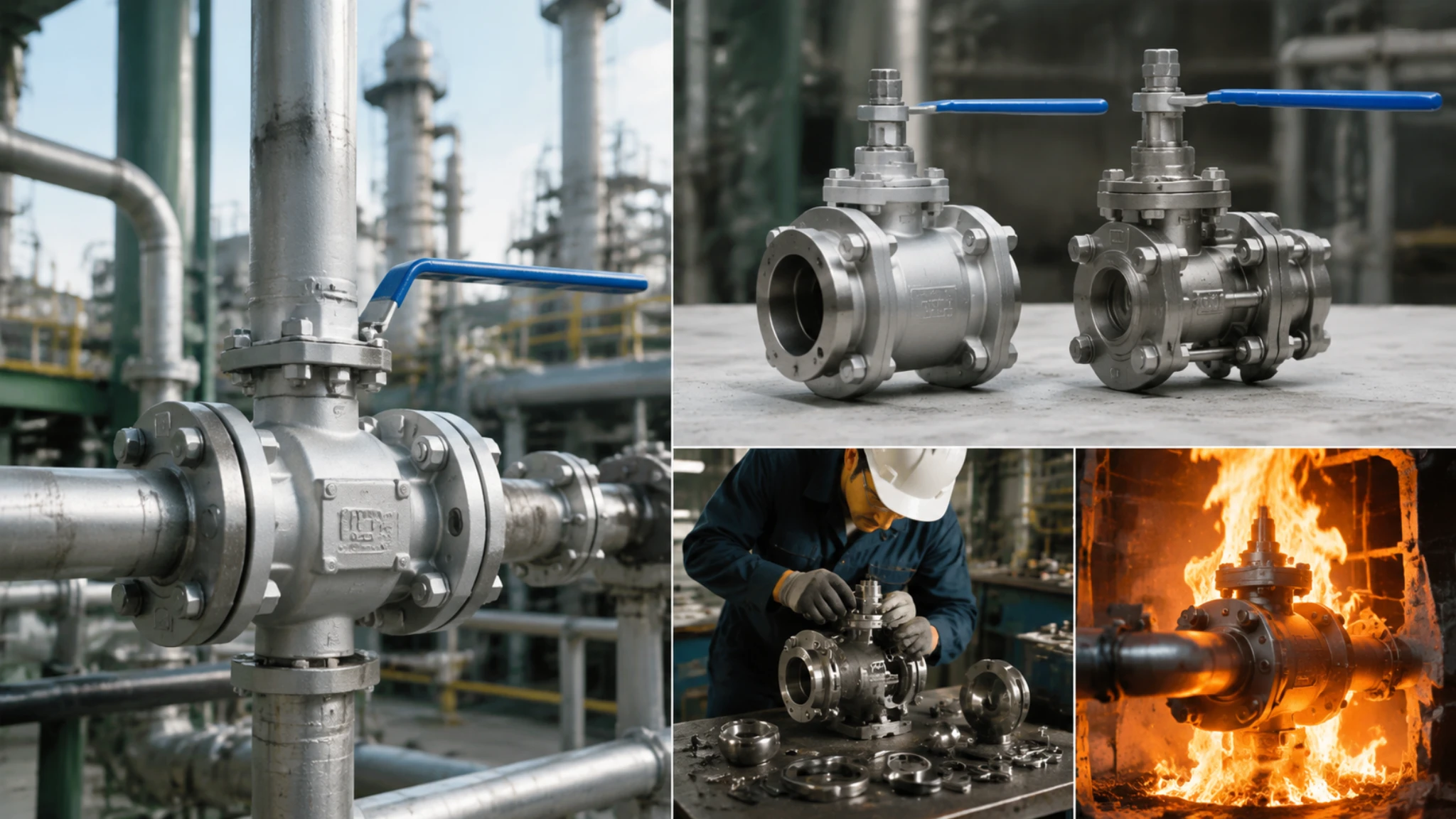
- The fire-safe test: Fire-safe testing to API 607 or API 6FA is technically a separate standard, but it’s so commonly required alongside API 6D that it’s effectively a companion requirement. The valve gets put in a furnace at a minimum of 760°C for 30 minutes while pressurized, then quenched with cold water, then tested for external and seat leakage. After all that, the stem has to be operable with a wrench. Not a cheater bar. A standard wrench. If the stem snaps or the seats leak above the specified rate, the valve fails.
API 6D valves for oil and gas pipelines routinely require fire-safe certification as part of the specification package.
Materials: what the standard requires vs what you actually get
API 6D doesn’t dictate specific material grades. It references ASME B16.34 for material requirements and allows any material that meets the mechanical properties and corrosion resistance requirements for the service conditions.
| Material | Standard grade | Service temperature range | Typical use |
|---|---|---|---|
| Carbon steel | A216 WCB | -29°C to 425°C | General pipeline service (about 65% of API 6D bodies) |
| Low temperature carbon steel | A352 LC3 or LCC | -46°C to 425°C | Cold climate, LNG service |
| Stainless steel | A351 CF8M (316) | Corrosive service, higher temperatures | Corrosive environments, offshore |
| Forged carbon steel | A105 or A182 | -29°C to 425°C | Forged ball valves, higher pressure integrity |
API 6D forged ball valves use A105 or A182 forged bodies rather than cast bodies, providing better grain structure and pressure integrity.
The material traceability requirements in API 6D are where things get real. Every pressure-containing component must be traceable to its heat number and mill certificate. EN 10204 Type 3.1 certification is the baseline – an independent inspector verified the chemical composition and mechanical properties. For sour service under NACE MR0175, the hardness limit is HRC 22 for carbon steel, and every component in contact with the process fluid must meet this limit.
If the manufacturer can’t produce traceability documentation for every pressure-containing part in your valve, the valve is not API 6D compliant regardless of what’s stamped on the nameplate.
WCB carbon steel accounts for about 65% of API 6D valve bodies globally. It works for -29°C to about 425°C in non-corrosive service. But I’ve seen WCB valves specified for LNG service where the operating temperature is -162°C. WCB is not rated for temperatures that low. At -162°C, WCB loses impact toughness and becomes brittle. The correct material is A352 LC3 or austenitic stainless steel. The mistake happens because someone copies the material spec from a standard pipeline datasheet without checking the temperature requirements for the specific application.
API 6D trunnion mounted ball valves in LNG service require specific low-temperature materials and extended bonnets to keep the packing above freezing.
End connections and why they matter more than you’d think
API 6D valves come with flanged, butt-weld, or hub ends. Flanged connections with RF (raised face) facing account for about 70% of installations. RF flanges work fine up to Class 600. Above Class 600, RTJ (ring type joint) flanges with metal ring gaskets are standard because they seal more reliably at high pressure. The RTJ ring is a consumable – every time you break the flange, you replace the ring. Maintenance cost roughly doubles compared to RF flanges, but the alternative is a gasket blowout at 15 MPa that nobody wants to be standing next to.
Butt-weld ends are specified for NPS 4 and above in Class 600 and higher, especially on gas transmission pipelines where flange leaks are unacceptable and the line will be in service for decades without breaking the connection. The weld-end preparation is per ASME B16.25: a 37.5-degree bevel with a 1.6mm root face and a 1.6-3.2mm root opening. Sounds trivial, but a poorly machined weld prep causes weld defects that show up on radiographic inspection and require cut-out and re-weld. I’ve seen an entire batch of valves rejected at site because the weld bevel angle was off by 5 degrees and the contractor refused to accept the welding risk.
DBB and DIB: the difference that kills people
DBB and DIB are not the same thing, and confusing them in a specification can create a safety hazard.
- DBB (Double Block and Bleed): Both seats are bi-directional. Pressure from either end is sealed by both seats. When you open the bleed between the seats, you can verify that both seats are holding. This is the standard configuration for most pipeline isolation valves.
- DIB (Double Isolation and Bleed): The seats are uni-directional but oriented in opposite directions. Each seat seals against pressure from one side only.
- DIB-1: Both seats seal in the same direction, with the downstream seat providing the primary isolation.
- DIB-2: The seats seal in opposite directions. DIB configurations are typically used in offshore platforms and subsea applications where you need to verify isolation from both directions independently.
The 2015 edition of API 6D made DBB mandatory, and DIB is defined in Appendix D for applications that need bidirectional isolation. If your specification says “API 6D ball valve” without specifying DBB or DIB, you should assume DBB. If you need bidirectional isolation, you have to specify DIB-1 or DIB-2 explicitly.
Maintenance and the API 6D valve lifecycle
API 6D valves are designed for decades of service, but their actual service life depends entirely on maintenance. A valve that’s operated once a year for a pipeline shutdown might develop problems that aren’t caught until the shutdown, when there’s no time to fix them. A valve that’s operated every day on a batch transfer line can wear out its seats in 18 months if the process conditions are aggressive.
The stem packing is the most common maintenance item. Graphite packing in cyclic service settles with each operation. Without live-loaded packing that maintains consistent compression force, the packing relaxes and starts leaking. API 6D doesn’t mandate live-loaded packing, but any valve that cycles more than once a week without it is a fugitive emission waiting to happen.
API 6D ball valve maintenance covers the specific inspection points: stem seal leakage, seat leakage past the closed ball, flange joint integrity, and cavity vent function.
Seat replacement intervals depend on the seat material, process fluid, and operating cycle. PTFE seats in clean gas service might last 10 years or 10,000 cycles. The same PTFE seat in a slurry line at 15 m/s with 100-micron silica particles might last six months. PEEK seats roughly double the service temperature range and triple the pressure capability of PTFE. Metal seats with tungsten carbide coating can last 20 years in abrasive service but won’t provide bubble-tight shutoff – you trade absolute sealing for durability.
How to check if your API 6D valve is actually API 6D
This is the part that makes people uncomfortable because it requires admitting that nameplates and certificates can be forged. They can. I’ve seen it. Here’s how to verify.
- Check the nameplate. An API 6D nameplate must include the manufacturer’s name, the valve size and pressure class, the body and trim material designations, the API 6D monogram if licensed, the serial number, and the date of manufacture. If any of these are missing, the valve doesn’t meet the marking requirements and isn’t compliant, regardless of what the certificate says.
- Review the documentation package. For every valve, the manufacturer must provide a certificate of compliance stating that the valve was designed, manufactured, and tested in accordance with API 6D. This must be signed by a responsible officer of the company. Supporting documents should include the material test reports for all pressure-containing parts, the hydro and pneumatic test reports with actual test pressures and durations, and the NDE reports for any radiographic or ultrasonic inspections performed on castings.
- Verify the serial number traceability. Every API 6D valve has a unique serial number. That number should appear on the valve body (stamped, not stickered), on the nameplate, and in the documentation package. If the serial number on the body doesn’t match the number on the certificate, the valve cannot be considered API 6D compliant because the traceability chain is broken.
- Weigh the valve. A Class 600, 12-inch, WCB trunnion ball valve should weigh roughly 1,200 to 1,500 kilograms. If someone offers you one that weighs 900 kilograms at a 30% discount, the body wall thickness is probably below the ASME B16.34 minimum. Put it on a scale. Weight doesn’t lie.
API certified valve manufacturers who consistently meet the wall thickness requirements have heavier valves because they pour more metal, and that’s exactly what you’re paying for.
The Texas pipeline engineer I mentioned at the beginning? After the stem blowout fiasco, his company implemented a three-point verification for every API 6D valve on site: witnessed hydro testing, weight verification against the B16.34 wall thickness calculation, and XRF PMI on the body and trim materials.
They caught three more non-compliant valves in the first year. The program cost about 40,000 dollars annually. They estimated it saved them roughly 800,000 dollars in avoided failures and downtime. The math on API 6D verification isn’t hard. You just have to do it.